“I was the only human in the Iron Court when the empire’s most feared eleven-year-old princess stood before her mother, looked straight at me
For several seconds, nobody in the Iron Court moved.
Then Lord Carrick stepped forward.
“Your Majesty, the princess has answered. The human remains a security risk, and the missing regulator must be found before this matter proceeds.”
Empress Usold kept her eyes on her daughter.
“Veila. Come here.”
The girl obeyed, though her shoulders had gone rigid.
I watched her cross the polished floor. She looked impossibly small beneath the banners of the Keithan Ascendancy, surrounded by guards who could have snapped her arms without effort.
Yet every one of them moved aside for her.
That was what frightened me most.
They had taught an eleven-year-old to command a room, but nobody had taught her what to do when she was afraid.
“Did you see Daniel take the regulator?” Usold asked.
“No.”
“Did you speak with him about the replacement part?”
Veila glanced at me.
Just once.
It was enough.
Carrick noticed.
“Your Majesty, I believe the princess is withholding information.”
“Then ask her a question she can answer without being surrounded by armed men,” I said.
A dozen guards turned toward me.
Carrick’s expression hardened.
“You are in no position to instruct the Empress.”
“Probably not. But I’m in a position to recognize a frightened child.”
Veila’s chin lifted.
“I’m not frightened.”
“I know,” I said quietly. “You’re trying very hard not to be.”
Her mouth tightened.
Usold raised one hand, silencing the room.
“Daniel Akafer, you will be confined to the eastern guest quarters until the investigation is complete.”
“Am I under arrest?”
“You are being held for the security of the Ascendancy.”
“That’s a long way of saying yes.”
Carrick smiled faintly.
“Take him.”
Two guards approached.
As they led me away, I looked back at Veila.
She stood beside her mother, hands clenched at her sides.
I wanted to tell her it would be all right.
But I had learned a long time ago that promises were dangerous things when you didn’t control what happened next.
So I gave her the only thing I could.
A small nod.
She didn’t return it.
The doors closed between us.
The eastern guest quarters had a beautiful view of the palace gardens.
They also had a lock on the outside.
For the first day, I assumed the misunderstanding would be cleared up quickly.
My ship needed a coolant regulator to fly. The palace engineers knew that. The missing part was worth more to me installed in the Patient Ren than hidden under a statue.
I told the guards the same thing.
They listened with the blank patience of people who had already decided I was guilty.
On the second day, I asked to speak with the Empress.
The answer was no.
On the third, I asked to speak with the princess.
The answer was also no.
By the fourth, I stopped asking.
I spent my mornings watching maintenance crews cross the gardens and my afternoons repairing a damaged navigation tablet with the few tools they had allowed me to keep.
At night, I thought about Ada.
Not because I wanted to.
Because an empty room has a way of making old memories louder.
My daughter had been eight when she died.
She had a narrow face, a stubborn chin, and a laugh that always arrived a second before the joke.
She used to sit beside me while I worked on the freighter, passing me screws and pretending she knew what every one of them did.
When she was sick, she would ask whether the next shipment of medicine was going to help another child.
I always told her yes.
I never told her how many children were still waiting.
After she died, I kept flying.
At first, I told myself it was because I needed the money.
Then I realized I couldn’t stand the thought of another parent hearing a doctor say the medicine hadn’t arrived in time.
So I carried it.
Across storms, broken routes, and places where nobody remembered the names of the people who lived there.
I carried it because someone had to.
On the fifth day, a guard brought my dinner.
It was a bowl of pale grains and roasted roots.
“Is the princess well?” I asked.
The guard looked at me.
“Princess Veila is training.”
“Every day?”
“She is the Apex.”
That wasn’t an answer.
I pushed the food away.
On the sixth day, the palace engineers stopped sending updates about my ship.
On the seventh, I heard a crash from the courtyard below my window.
I looked out and saw Veila standing in the sparring yard.
She had knocked a training post clean off its base.
Her instructor was saying something to her, but she wasn’t listening.
She struck the next post.
Then the next.
Her movements were powerful, precise, and furious.
When she finally stopped, she stood in the middle of the yard with her fists hanging at her sides.
No one approached her.
Not even the instructor.
I pressed my hand against the glass.
“That’s enough, kid,” I whispered.
She couldn’t hear me.
On the ninth day, the door opened.
Lord Carrick entered with two investigators and a metal case.
“Mr. Akafer,” he said. “The missing coolant regulator has been recovered.”
I stood.
“Where?”
“In the Hall of Victories. Inside the base of the late Empress Marad’s statue.”
For a moment, I couldn’t make sense of the words.
Then I remembered the hollow base.
The statue stood in the main hall, beneath the names of Keithan warriors who had died defending the empire.
“Who found it?”
“An investigator conducting a search.”
“And you think I put it there?”
“We have reason to believe you arranged for it to be hidden.”
I stared at him.
“Why would I hide the part I need to leave?”
“To prolong your stay. To maintain influence over the princess.”
I let out a short, disbelieving breath.
“You’re accusing me of stealing a regulator so I could remain imprisoned?”
Carrick’s eyes narrowed.
“You have become unusually important to the princess.”
“She’s a child.”
“She is the Apex.”
“She’s eleven.”
“Those are not mutually exclusive.”
He opened the case.
The regulator lay inside, its silver casing scratched but intact.
I recognized the small blue mark I’d made on it when the delivery arrived.
“Where is Veila?” I asked.
“That is not your concern.”
“It became my concern when you started using her name to accuse me.”
Carrick closed the case.
“Tomorrow, you will answer before the Imperial Court.”
“And if I don’t?”
“Under the Iron Law, a foreigner accused of theft from the imperial household may be required to prove his innocence by combat.”
I looked at the regulator.
Then at him.
“You people really need to find a better way to settle arguments.”
His smile returned.
“Tomorrow, we shall see how amusing you find our traditions.”
The court chamber was colder than the guest quarters.
Black stone pillars rose toward a ceiling painted with the victories of ancient Keithan armies.
The throne stood above a wide circular floor.
Empress Usold sat beneath a silver crest, her face unreadable.
Veila stood at her right hand.
She looked tired.
Not physically. Her posture was still perfect, her uniform immaculate.
But the skin beneath her amber eyes had darkened.
I had seen that look before.
Ada used to wear it after a night when the pain had kept her awake.
Lord Carrick presented the evidence.
He described the missing regulator, the delay to my departure, my frequent meetings with the princess, and the recovered object inside the statue.
He made it sound like a carefully planned operation.
I listened until he finished.
Then I said, “I didn’t steal it.”
Carrick turned toward the throne.
“The accused denies the charge, as expected.”
“I didn’t arrange for anyone to hide it, either.”
“Then perhaps you can explain how the regulator came to rest inside a monument in the most heavily guarded hall of the palace.”
“No. But I can tell you who didn’t put it there.”
Carrick raised an eyebrow.
“Who?”
“Me.”
A low murmur passed through the chamber.
He looked almost pleased.
“Then the court has no choice but to proceed under the Iron Law.”
Usold shifted in her seat.
“Before that happens, I want to hear from my daughter.”
Veila’s hands tightened.
“Mother—”
“Did you know the regulator was missing?”
The princess looked at Carrick.
Then at me.
I wanted to shake my head.
Don’t.
Whatever happens, don’t let them make you carry this alone.
But I stayed silent.
Veila swallowed.
“Yes.”
The entire chamber seemed to draw in a breath.
Carrick stepped forward.
“Your Highness, are you saying you witnessed the theft?”
“No.”
“Then what do you know?”
Veila’s voice became very small.
“I took it.”
Usold rose.
“What?”
“I took the regulator. I hid it inside Grandmother’s statue.”
The Empress stared at her.
“Why?”
Veila’s eyes filled.
She blinked hard, trying to force the tears back.
“I didn’t want him to leave.”
No one spoke.
“I knew he was going to go back to his ship. He said he had medicine to deliver. He said children were waiting. But I thought if the regulator disappeared, he would have to stay.”
Her voice broke.
“I thought I could make him stay.”
The first tear rolled down her cheek.
She wiped it away angrily.
Then another came.
She had faced soldiers, beasts, and the empire’s strongest warriors without crying.
But she couldn’t stop now.
“I lied to you,” she whispered to her mother. “When you asked me, I said no. I knew it was wrong. I just didn’t want him to go.”
Usold descended one step from the throne.
“Veila…”
“I know I’m supposed to be the Apex. I know I shouldn’t need anyone. But when Daniel was here, he didn’t look at me like I was a weapon.”
She looked at me.
“He just talked to me.”
I felt something tighten behind my ribs.
I stepped forward, ignoring the guards.
“Veila, look at me.”
She did.
“You made a bad choice.”
Her face crumpled.
“I know.”
“But you told the truth when it mattered, even though you knew it would cost you.”
I crouched until we were eye to eye.
“That’s not weakness.”
She pressed her lips together.
“Are you angry?”
“I’m disappointed you stole a part from my ship.”
A tiny, miserable sound escaped her.
“But I’m not angry that you wanted a friend.”
I held her gaze.
“Next time, just ask me to stay for dinner.”
Her tears kept falling.
“I thought you would say no.”
“Then you should have given me the chance to answer.”
She nodded.
Behind us, Carrick cleared his throat.
“Your Majesty, the confession establishes that the human’s presence was the cause of this breach. His influence—”
“Enough.”
Usold’s voice cut across the chamber.
Carrick stopped.
The Empress looked at the regulator in its case, then at her daughter.
“Dismiss the charge against Daniel Akafer.”
“Your Majesty—”
“Now.”
Carrick bowed, but his jaw tightened.
Usold stepped down from the throne.
She crossed the floor and stopped in front of Veila.
For a moment, she seemed uncertain what to do.
Then she knelt.
The movement startled the entire court.
“My daughter,” she said, “why didn’t you tell me you were lonely?”
Veila looked at her.
“You never asked.”
Usold closed her eyes.
The words had landed harder than any accusation.
When she opened them again, the Empress looked less like the ruler of a thousand worlds and more like a woman who had just discovered how much of her child she had never known.
She reached for Veila’s hands.
“I thought I was preparing you to survive.”
“You were.”
“I did not understand what it was costing you.”
Veila didn’t answer.
Usold drew her daughter into an embrace.
It was awkward at first.
The princess stood stiffly, as if she had forgotten how to be held.
Then her arms rose and wrapped around her mother’s shoulders.
The court watched in silence.
I looked away.
Some things deserved privacy, even when they happened in front of an empire.
The Empress summoned me to her private study that evening.
It was a smaller room than I expected, filled with old books, maps, and a collection of carved wooden animals.
A little blue bird sat beside a stack of imperial reports.
I pointed at it.
“That one yours?”
Usold followed my gaze.
“It belonged to my mother.”
“She carved it?”
“No. She gave it to me when I was six.”
She picked it up and turned it over in her hands.
“She was not an affectionate woman.”
I waited.
“She believed children became strong by learning not to need comfort. When I cried, she sent me to the training hall. When I was frightened, she told me fear was an insult to my blood.”
The Empress set the bird down.
“I became exactly what she wanted.”
“And then you raised Veila the same way.”
Her expression tightened.
“Yes.”
She didn’t defend herself.
That surprised me more than anything else.
“Why did you bring me here?” I asked.
“Because I owe you an apology.”
“You don’t owe me anything. The charge has been dismissed.”
“I owe you more than that. My daughter trusted you with something she could not tell me. I punished you for the very thing I should have been grateful to see.”
I sat across from her.
“She needed someone who would talk to her like a kid.”
“She is the future of my empire.”
“She’s also a kid.”
Usold looked toward the window.
“How did you learn to see her that way?”
I considered the question.
“Because I had a daughter.”
The Empress turned back.
“You mentioned her once. Ada.”
I nodded.
“She died when she was eight.”
“I’m sorry.”
“She had a rare blood illness. There was medicine that might have helped, but the mining colony where we lived didn’t have enough. The next shipment was delayed.”
I rubbed my thumb against a worn spot on the table.
“By the time it arrived, it was too late.”
Usold said nothing.
I was grateful.
“I kept flying after that. I started taking medical cargo because I couldn’t change what happened to Ada. But I could make sure someone else’s kid got their medicine on time.”
“That is why you were so determined to reach the colony.”
“Yes.”
“And you would have left Veila.”
“I had to. Those children were waiting.”
The Empress lowered her eyes.
“She would have understood if I had allowed her to.”
“Maybe. But she shouldn’t have had to understand everything.”
Usold looked up.
“What do you mean?”
“She’s eleven. She can be disappointed. She can miss someone. She can want a friend without having to justify it as an imperial duty.”
The Empress leaned back.
For a long time, she studied the little wooden bird.
Then she said, “I would like to learn the game you played with her.”
“Rummy?”
“Yes.”
I smiled.
“Fair warning. She’s better than I am.”
“That is not a high standard.”
I laughed.
It was the first time I’d heard the Empress make a joke.
She looked almost startled by the sound.
Then she laughed, too.
It was brief and uncertain, but it was real.
The next morning, the palace engineers came to my quarters with a work schedule.
My ship would be repaired.
The coolant regulator would be reinstalled.
The damaged navigation board would be replaced, and the hull plating would be inspected before departure.
The Empress also ordered the Patient Ren’s cargo replenished.
“Your original medical supplies will be restored,” the chief engineer told me. “The palace has added additional antibiotics, blood stabilizers, and emergency treatments for the mining colony.”
I stared at the inventory.
It was more than I had carried when I arrived.
“Who authorized this?”
“Her Majesty.”
I looked across the hangar.
Usold stood beside Veila, speaking with the chief engineer.
When she saw me, she inclined her head.
I returned the gesture.
Veila ran over.
“Are you leaving?”
“Not today.”
“Tomorrow?”
“Not tomorrow.”
“How many days?”
“Three, maybe four.”
She frowned.
“That’s not long.”
“No. It isn’t.”
She glanced at the ship.
“Can we play cards?”
I looked at her.
“Your mother wants to learn.”
Veila’s eyes widened.
“Mother?”
Usold approached, hands folded behind her back.
“I was told there are rules.”
“There are,” I said.
“Are they difficult?”
“Not particularly.”
“Good. I have little patience for games that require unnecessary complexity.”
Veila grinned.
“You’re going to lose.”
The Empress gave her a stern look.
“I have not yet played.”
“That’s why I know.”
We played in the eastern courtyard.
The same courtyard where Veila had first appeared and declared my stew terrible.
The same stone table still held a faint scorch mark from the cooking burner I’d borrowed.
I brought out the old deck of cards.
Usold studied them as if they were an unfamiliar weapon.
“These symbols are arbitrary.”
“That’s part of the fun.”
“Why are there four suits?”
“Because someone thought two weren’t enough.”
Veila laughed.
The Empress gave me a suspicious look.
“Are you certain you understand this game?”
“Not as well as your daughter.”
We started.
Veila won the first hand.
Usold lost the second.
I won the third by accident.
By the fourth, the Empress was asking whether a certain move was legal.
By the sixth, she had accused me of making up rules.
“That’s not how you played last round.”
“It absolutely is.”
“Then your memory is unreliable.”
“That’s possible.”
Veila laughed so hard she nearly knocked over the cards.
I hadn’t heard that sound from her before.
It wasn’t the controlled smile she used in the training hall.
It wasn’t the polite expression she wore before ministers.
It was loud, messy, and completely unguarded.
The Empress watched her.
Something softened around her eyes.
She lost eleven hands that afternoon.
On the twelfth, she finally won.
She looked at her cards, then at us.
“I believe I am beginning to understand the game.”
Veila leaned across the table.
“You’re beginning to understand how to lose.”
Usold laughed.
Not the brief laugh from her study.
A full laugh that made her shoulders shake.
I sat back and watched them.
For the first time since landing on Keithra Prime, the palace sounded less like a fortress.
It sounded like a family.
But the change did not please everyone.
Lord Carrick did not attend the card games.
Neither did the old ministers who had spent their lives believing the empire’s strength depended on never showing weakness.
They met behind closed doors.
I learned about it from a young palace mechanic who came to inspect the Patient Ren’s engines.
“Some of the councilors think Her Majesty is changing too quickly,” he told me.
“Changing how?”
“She has delayed the new military levy. She approved a trade agreement with the human colonies. She also ordered the training masters to reduce the princess’s combat hours.”
I tightened a coupling.
“Sounds reasonable.”
“To you, perhaps.”
He hesitated.
“They say the princess is becoming soft.”
I looked at him.
“Has anyone asked her?”
He didn’t answer.
That afternoon, Grath came to see me.
He was Veila’s old arms master, a broad-shouldered veteran with a scar running from his temple to his jaw.
He had watched me play cards with the princess several times.
“You have made her less obedient,” he said.
“I’ve made her better at Rummy.”
“She used to spend every free hour training.”
“Now she spends some of them playing cards.”
“An Apex must be prepared.”
“For what?”
“For everything.”
I put down my wrench.
“Nobody can be prepared for everything.”
Grath studied me.
“You humans have strange ideas about strength.”
“Maybe.”
He looked toward the courtyard.
“Her grandmother climbed the Storm Spire at twelve. Her mother did it at eleven. The tradition has stood for generations.”
I knew the name.
The Storm Spire was a narrow basalt pinnacle rising from the sea beyond the palace cliffs.
The Keithan trial required a candidate to remain on its summit for two days and two nights without food, tools, or assistance.
It was supposed to prove endurance and independence.
“Veila is eleven,” I said.
“She is the Apex.”
“She’s eleven.”
Grath’s scarred face remained still.
“The council will demand the trial. If she refuses, they will say the Empress has weakened her.”
“And if she goes?”
“She will prove them wrong.”
I looked at him.
“Or she could get killed.”
“The trial has never claimed a life.”
“There’s a first time for everything.”
Grath said nothing.
Then he turned and left.
I found Veila later in the courtyard.
She was sitting on the stone bench, studying a card in her hand.
“What’s that?”
She showed me.
The queen of hearts.
“Your favorite?”
“No.”
“Then why are you looking at it?”
She shrugged.
“Mother says I should learn to recognize the faces.”
“That’s a good idea.”
She slipped the card back into the deck.
“Daniel, if I have to do something difficult, will you think I’m strong?”
I studied her.
“Depends.”
“On what?”
“Whether you’re doing it because it’s right or because someone scared you into it.”
She looked down.
“I don’t want them to think Mother is weak.”
“Your mother can handle people thinking whatever they want.”
“Not if they stop listening to her.”
I sat beside her.
“What’s happening?”
She took a long time to answer.
“The council wants me to climb the Storm Spire.”
I felt the muscles in my back tighten.
“When?”
“Tomorrow morning.”
“Did your mother agree?”
“She hasn’t decided.”
“Then don’t decide for her.”
Veila’s fingers moved over the edge of the card.
“If I refuse, they’ll say I can’t become Empress.”
“Do you want to become Empress?”
She looked at me as if I’d asked whether she wanted to stop breathing.
“That’s what I was born for.”
“That’s not what I asked.”
She was quiet.
Then she said, “I don’t know.”
I nodded.
“That’s an honest answer.”
She looked up at me.
“Will you come watch?”
“I don’t like the idea of you going.”
“That isn’t what I asked.”
I wanted to tell her no.
Instead, I said, “I’ll be there.”
The council announced the trial that evening.
It would begin at dawn.
Veila would climb the Storm Spire alone and remain there for two days and two nights.
The official announcement described it as a celebration of her readiness.
It did not mention the political argument behind it.
It did not mention the fact that the child had not been asked whether she wanted to go.
Usold came to my quarters after midnight.
She looked exhausted.
“I cannot stop the council without appearing to surrender the authority of the throne,” she said.
“Then change the rules.”
“They will accuse me of changing tradition for my daughter.”
“She’s your daughter.”
“That is precisely why they will use it against me.”
I stood by the window.
Beyond the palace walls, lightning flickered over the dark sea.
“Is there another way to prove she’s ready?”
Usold shook her head.
“Not under the old law.”
“Then the old law is wrong.”
She gave a weary smile.
“You make that sound very simple.”
“It isn’t simple. But it doesn’t make it right.”
She looked toward the corridor.
“Veila has already agreed.”
I turned.
“She agreed?”
“She said she would do it to protect me.”
I closed my eyes.
That was exactly what I had feared.
The child who had stolen a machine because she couldn’t bear to lose a friend was now preparing to risk her life because she couldn’t bear to lose her mother’s approval.
“She shouldn’t have to protect you from your own council.”
“I know.”
For a moment, the Empress looked as if she might say something else.
Instead, she left.
I didn’t sleep.
At dawn, I went to the edge of the sea.
The Storm Spire rose from the water like a black spear.
Veila stood at its base in a dark climbing suit.
No food.
No tools.
No shelter.
Only the clothes on her back and the endurance the empire expected her to prove.
I approached her before the guards could stop me.
“Hey.”
She turned.
“You’re here.”
“I said I would be.”
She glanced toward the summit.
“It doesn’t look so high from here.”
“It looks high enough.”
She smiled faintly.
Then I took a small device from my pocket.
It was an emergency beacon from my survival kit, no larger than a coin, with a red activation stud.
“What’s that?”
“A distress beacon. If you press this, it sends a signal on a frequency my ship can detect.”
“Your ship?”
“Yes.”
“Can it reach the palace?”
“It can reach farther than the palace.”
I placed it in her palm.
“Keep it hidden. If the weather turns bad, you use it.”
She stared at the device.
“But the trial says no tools.”
“Then don’t tell them.”
Her fingers closed around it.
“Would you come?”
I looked at the dark water.
“I’d come.”
“Even if it was dangerous?”
“Especially then.”
She tucked the beacon into the inner pocket of her suit.
For the first time that morning, she looked like an eleven-year-old.
“Thank you.”
I touched her shoulder.
“Climb carefully.”
She nodded and began her ascent.
I watched until the dark shape of her suit disappeared against the basalt.
The first day passed without incident.
Veila reached the summit before sunset.
The palace broadcast showed her standing upright on the narrow platform, the wind tugging at her clothes.
The councilors applauded.
Usold did not.
She stood beside me in the observation room, her hands clasped so tightly that her knuckles had gone pale.
“She has done well,” Grath said.
The Empress didn’t look at him.
“She has reached the top.”
“That is the purpose of the trial.”
“No,” Usold said. “The purpose was supposed to be to see whether she could endure.”
Grath lowered his head.
“That is what she is doing.”
The first night was cold.
The second morning brought rain.
By noon, the weather station reported that a storm system had changed direction.
The wind speed was rising.
At first, the officials said the summit remained within acceptable limits.
Then the sea turned black.
The waves struck the rocks hard enough to send white spray over the lower cliffs.
By evening, the wind was moving faster than two hundred kilometers per hour.
The observation room filled with officers.
“Can a shuttle reach her?” Usold demanded.
The flight commander shook his head.
“Not safely, Majesty. The crosswinds would throw it against the spire.”
“Send a rescue team.”
“The sea is too violent.”
“Then send another ship.”
“No vessel can hold position near the summit.”
Usold turned toward the screen.
Veila was barely visible.
She had wedged herself into a narrow gap in the rock, her body pressed against the basalt.
The broadcast flickered.
Then it went black.
“Restore the signal!” the Empress ordered.
The technicians worked frantically.
Nothing.
I was already moving.
“Daniel?” Usold called.
I didn’t stop.
“Where are you going?”
“To my ship.”
“Your ship isn’t ready.”
“I know.”
“The navigation board has not been fully tested.”
“I know.”
“The storm will tear an unfinished freighter apart.”
I turned at the door.
“Then I hope it holds together long enough.”
The Patient Ren was still inside the palace hangar.
Its new navigation board had been installed, but the engineers had not completed the final calibration.
The hull plating was incomplete.
One engine had passed its test.
The other had not.
I climbed aboard.
The mechanic who had been helping me ran after me.
“Captain, you can’t launch!”
“Open the hangar doors.”
“The storm is above the flight limit.”
“Open them.”
He looked at my face and stopped arguing.
The hangar doors began to separate.
Rain blew through the widening gap.
I strapped into the pilot’s seat and powered the engines.
Warning lights filled the panel.
The navigation board blinked, then displayed a string of errors.
I switched it off.
The beacon was all I had.
I keyed the emergency frequency.
“Veila, this is Daniel. If you can hear me, activate the beacon.”
Nothing.
I tried again.
“Veila, press the red button.”
The storm swallowed my voice.
Then a signal appeared.
Weak.
Intermittent.
But there.
I locked onto it.
The ship lifted.
A gust slammed the Patient Ren sideways.
The left engine screamed.
I fought the controls, trying to keep the nose pointed toward the sea.
The palace disappeared behind sheets of rain.
Lightning split the clouds ahead.
The beacon signal grew stronger.
I flew by its pulse, correcting whenever the storm pushed me off course.
There was no safe route.
No reliable navigation.
Only a child on a rock and a signal telling me where she was.
The sea rose beneath the ship.
Waves struck the lower cliffs, exploding into white water.
I dropped altitude and skimmed over the surface.
The Patient Ren shuddered.
A warning flashed across the panel.
HULL BREACH.
“Not now,” I muttered.
A piece of plating tore loose from the starboard side and vanished into the rain.
The beacon pulsed again.
I saw the spire.
It was barely visible through the storm, a black column surrounded by white water.
I circled once.
The summit was too narrow for a landing.
I couldn’t set the ship down.
I couldn’t send a shuttle.
I had one chance.
I brought the freighter alongside the pinnacle and fought to hold it steady.
The wind battered the hull.
The engines strained.
I lowered the cargo ramp.
“Veila!”
For a second, I saw nothing.
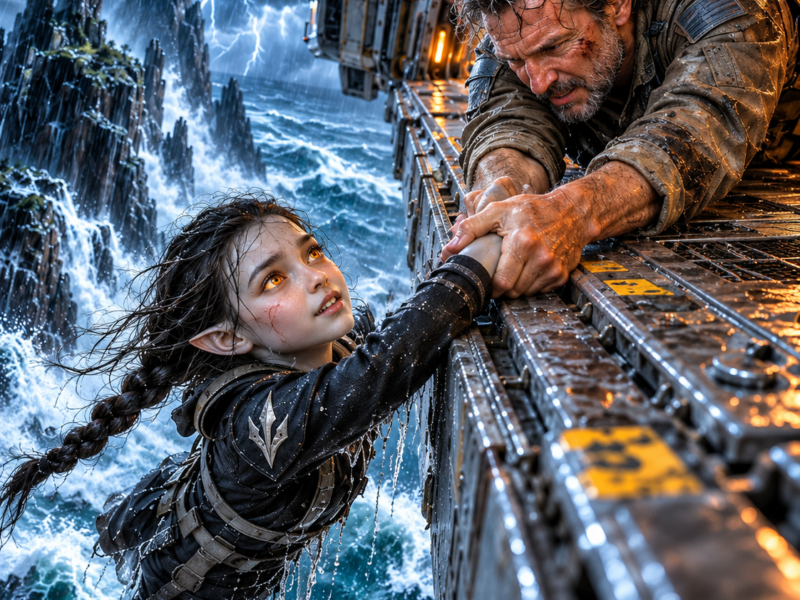
Then a small figure appeared at the edge of the summit.
She was crouched against the rock, one hand gripping a crack in the stone.
The other held the beacon.
“Daniel!”
Her voice disappeared in the wind.
I pushed the ship closer.
The ramp swung over empty air.
“Jump!”
She looked down.
The gap was nearly four meters.
“Veila, jump now!”
She hesitated.
The ship lurched.
The ramp struck the rock and bounced away.
I pushed the controls forward, bringing it back.
“Trust me!”
She jumped.
For one terrible instant, she was suspended between the spire and the ship.
Then her hands caught the edge of the ramp.
Her body swung beneath it.
I threw myself out of the pilot’s seat and reached for her.
I caught her wrist.
The impact dragged me across the deck.
Her fingers slipped.
“Don’t let go!” she shouted.
“I’m not planning to!”
I braced one boot against the ramp frame and pulled.
Her other hand found the metal edge.
Together, we dragged her inside.
I slammed the emergency close control.
The ramp began to rise.
A wave of rain swept through the opening before the seal locked.
Veila collapsed onto the deck.
She was soaked, shaking, and covered in small cuts.
But she was breathing.
I dropped beside her.
“Are you hurt?”
She shook her head.
Then she started crying.
Not quietly.
Not with the controlled tears she’d tried to hide in court.
She cried like a child who had been holding herself together for two days and had finally run out of strength.
I pulled her into my arms.
“You’re safe.”
“I thought you wouldn’t get here.”
“I told you I would.”
The ship lurched again.
A warning alarm sounded.
I looked toward the cockpit.
“We need to get out of here.”
Veila wiped her face with the sleeve of her suit.
“Can you fly?”
“That is a very good question.”
She gave a shaky laugh.
I helped her into the passenger harness and returned to the controls.
The Patient Ren climbed away from the spire.
Behind us, lightning struck the sea.
For several seconds, the entire horizon turned white.
Then the ship’s right engine began to fail.
I adjusted the thrust manually.
The freighter dipped.
Veila gripped the harness.
“Daniel?”
“I’ve got it.”
The engine coughed.
The warning lights flashed.
I kept the nose level.
We were losing altitude, but the palace lights were visible through the rain.
“Hold on.”
I pushed the remaining engine harder.
The ship shuddered toward the coastline.
The landing field appeared beneath us.
I brought the freighter down hard.
The landing gear struck the ground.
One wheel collapsed.
The hull scraped across the wet surface, throwing sparks behind us.
We slid to a stop less than twenty meters from the hangar wall.
For a moment, the only sound was the ticking of hot metal.
Then the passenger harness clicked open.
Veila stood.
“Daniel?”
I turned.
She looked at me with wide amber eyes.
“Are you okay?”
I glanced at the smoking control panel.
“Ask me again after I’ve had a sandwich.”
She laughed.
Then she threw her arms around me.
The hangar doors opened.
Empress Usold came running through the rain.
She had abandoned her ceremonial robes for a plain dark coat.
Her hair was loose.
Two guards tried to keep pace with her, but she reached the ship first.
“Veila!”
The princess climbed down the ramp.
Her mother caught her and held her so tightly that Veila’s boots left the ground.
Usold buried her face in her daughter’s wet hair.
“I thought I had lost you.”
Veila clung to her.
“I’m sorry.”
“No.”
The Empress pulled back and held her daughter’s face between her hands.
“No, you do not apologize for surviving.”
Around us, the court had gathered.
Carrick stood near the front, his expression carefully composed.
Grath stood behind him.
The Empress looked at them.
“Look at her.”
No one moved.
“Look at my daughter.”
Her voice carried through the hangar.
“You demanded that she prove she could endure the Storm Spire. She did. Then the storm came, and you stood here discussing whether a rescue was possible while she fought to stay alive.”
Carrick stepped forward.
“Your Majesty, the trial was conducted according to tradition.”
“Tradition does not absolve us of responsibility.”
“She accepted the trial.”
“She accepted it because she believed she had to protect me.”
Usold looked down at Veila.
“That is not what a child should have to do.”
The Empress turned toward the gathered councilors.
“We mistook loneliness for strength. We mistook obedience for loyalty. We taught our children to hide their fear, then praised them when they suffered in silence.”
Her voice shook.
“That ends today.”
Carrick’s jaw tightened.
“Your Majesty, the Ascendancy cannot abandon the principles that made it strong.”
“Nor can it survive by sacrificing its children to preserve the appearance of strength.”
She looked toward me.
“Daniel Akafer risked his life to rescue my daughter.”
I opened my mouth.
“Your Majesty, I—”
“Let me finish.”
She faced the court again.
“He did not ask whether she was the Apex. He did not ask whether the council approved. He heard a child calling for help, and he came.”
Veila stepped closer to her mother.
The Empress took her hand.
“That is the kind of strength I want my daughter to remember.”
I glanced at the battered freighter.
One engine was smoking.
The starboard hull was missing a section of plating.
My navigation board was probably ruined.
I was going to have a very unpleasant conversation with the repair crew.
But Veila was standing beside her mother.
That was enough.
“She called,” I said. “So I came.”
The next several days were a blur of repairs, medical examinations, and meetings.
Veila had suffered exhaustion, dehydration, and a handful of cuts.
None were serious.
The physicians ordered her to rest.
She argued.
Her mother told her she was not allowed to argue.
For once, Veila obeyed.
Carrick was removed from his position pending an investigation into the council’s handling of the trial.
Grath resigned as her principal arms master, though he continued teaching her.
The Empress issued a new decree suspending the Storm Spire trial for all children under sixteen.
She also ordered a review of the training system.
The announcement caused anger among some of the old houses.
But Usold did not withdraw it.
The trade agreement with the human colonies was signed three days later.
The Patient Ren was repaired with new hull plating, a rebuilt engine assembly, and a navigation board that actually worked.
The Empress added medical supplies to my cargo.
More than the colony had requested.
When I asked why, she said, “Because I would rather have you arrive with too much than one vial too little.”
I didn’t know what to say.
So I thanked her.
On the morning of my departure, I found Veila waiting beside the cargo ramp.
She wore my old flight jacket.
It was far too large for her.
The sleeves covered her hands, and the collar nearly reached her ears.
“That’s mine,” I said.
“I know.”
“You’re keeping it?”
She looked down at the jacket.
“Only until you come back.”
I smiled.
“That’s a dangerous way to borrow something.”
“I’ll return it when you visit.”
“Then I guess I’ll have to visit.”
She nodded as if she had just secured a formal agreement.
The Empress approached, carrying a small metal case.
“Your departure papers.”
I opened it.
Inside was a royal document naming the Patient Ren the first courier vessel of the Imperial Household.
It granted permanent landing rights at Keithan ports and established a regular medical trade route between the Ascendancy and the human mining colonies.
There was also a credit authorization for future emergency supplies.
I looked up.
“This is a lot.”
“It is a beginning,” Usold said.
“Your Majesty, I can’t promise to be here every month.”
“You do not have to promise what your work cannot guarantee.”
Veila looked at her.
“He’s coming back.”
Usold smiled.
“If he can.”
I crouched in front of the princess.
“I’ll try to make it monthly.”
“Try harder.”
“That’s fair.”
She held out a deck of cards.
I took it.
“What’s this?”
“So you remember the rules.”
“I thought you knew them better than I did.”
“I do.”
“Then why give me the deck?”
“So you have no excuse when I beat you next time.”
I laughed.
“You’re getting very confident.”
“I am the Apex.”
Then she paused.
“Also, I’m your friend.”
I looked at her for a moment.
“Yes, you are.”
She stepped forward and hugged me.
This time, she didn’t wait for me to move first.
I hugged her back.
When she let go, she looked toward her mother.
“Mother?”
“Yes?”
“What is your favorite color?”
Usold blinked.
It was such a simple question.
But I watched her search her memory as if nobody had ever asked her anything like it.
“I don’t know,” she said.
Veila frowned.
“How can you not know?”
“I have spent most of my life choosing colors for uniforms, ceremonies, and banners. I have rarely chosen one simply because I liked it.”
“Then think about it.”
The Empress smiled.
“I will.”
“Tell me at dinner.”
“I will tell you at dinner.”
Veila nodded, satisfied.
I climbed aboard the Patient Ren.
The engines started with a low, steady hum.
Through the cockpit window, I could see the two of them standing together on the landing field.
The Empress held her daughter’s hand.
Veila wore my jacket.
Neither of them looked like the figures carved into the Hall of Victories.
They looked like a mother and daughter waiting for a ship to leave.
I lifted the freighter into the morning sky.
Keithra Prime grew smaller beneath me.
My cargo hold was full of medicine.
My navigation board was working.
And for the first time in years, I had a destination waiting for me beyond the next delivery.
A month later, when I returned, Veila was waiting at the same landing field.
She had grown no taller, but she had learned a new card trick.
The Empress was beside her.
“Daniel!” Veila shouted as the ramp lowered.
She ran toward me, holding up a card.
“Pick one.”
I stopped at the bottom of the ramp.
“Is this a trick?”
“Obviously.”
I picked a card.
She grinned.
“Now put it back.”
I did.
She shuffled with the confidence of someone who had practiced for weeks.
Then she revealed the card.
It was wrong.
I stared at it.
Veila stared at it.
The Empress covered her mouth.
“That was supposed to be the queen of hearts,” Veila said.
“I thought you were the Apex.”
“I am.”
“Then what happened?”
She narrowed her eyes at the deck.
“I need to practice.”
The Empress laughed.
“She has been practicing every evening.”
“Mother!”
“What? It is true.”
I looked at Usold.
“And your favorite color?”
She glanced at the deep green thornflower growing along the courtyard wall.
“Green,” she said. “Not because it belongs to the imperial house. Because it reminds me that something can grow even after a difficult season.”
Veila considered that.
Then she took her mother’s hand.
“That’s a good color.”
I watched them walk toward the palace.
My ship needed unloading.
The colony needed its medicine.
There were still routes to fly and children waiting somewhere beyond the stars.
But as I turned toward the cargo hold, I heard Veila call after me.
“Daniel! Dinner is at seven!”
I raised a hand.
“I’ll be there.”
And this time, nobody had to hide a machine to make sure I stayed.
The end.









