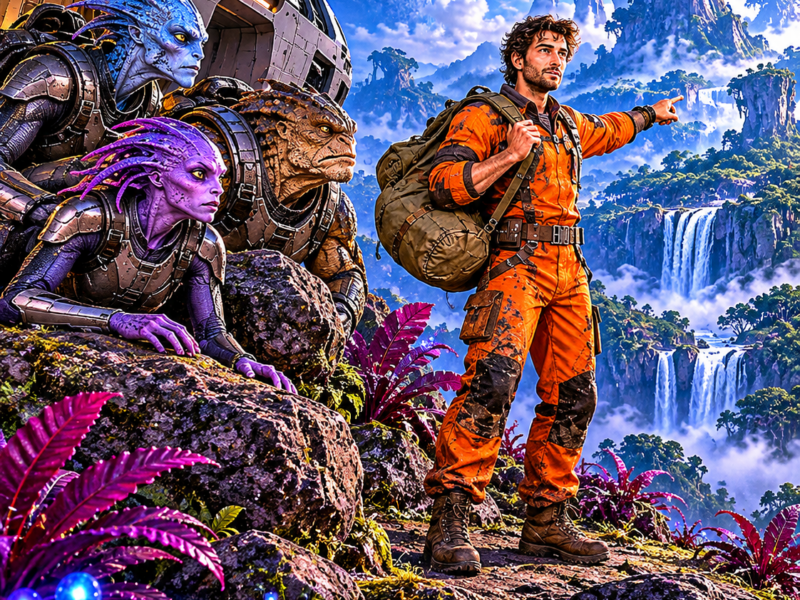
“I was the only human aboard the survey ship when our computer announced we’d crashed on a planet where entire expedition teams had vanished
The first thing I heard was Dobick screaming my name.
Not calling.
Not asking for help.
Screaming.
I grabbed the emergency pack and ran toward the edge of the ridge. Rain struck my face so hard it felt like handfuls of gravel. Behind me, Captain Tetravon was already moving, his heavy boots sliding across the wet stone.
“Where is he?” he shouted.
I pointed toward the narrow gully below us.
A flash of lightning illuminated the slope.
For one second, I saw the problem.
The little stream that had been trickling through the gully that afternoon had become a raging river. Brown water surged between the rocks, carrying branches, mud, and pieces of vegetation. And somewhere down there, Dobick was trapped.
“Stay on the ridge!” I yelled to Ammaen. “Keep the fire alive. If the rescue beacon activates, make sure it has a clear signal.”
She nodded, her face pale in the firelight.
“Bring them back,” she said.
I wanted to promise her I would.
Instead, I followed Tetravon into the rain.
We moved along the upper slope, avoiding the gully. The ground was slippery, and every step had to be tested before I trusted it. Tetravon struggled with the uneven terrain. His species had been built for strength, not for climbing wet, unfamiliar hillsides.
“Slow down,” I called.
“He is my crew member.”
“And he will still be your crew member if you stop breaking your neck.”
The captain gave me a look that suggested he disliked being corrected by a human half his size.
But he slowed.
We reached a rocky outcrop overlooking the gully. I crouched and searched through the rain.
“Dobick!”
A faint answer came from below.
“Here!”
I leaned forward.
There.
A small figure was wedged between two enormous stones. One leg was pinned beneath a slab of dark rock. Water rushed around his waist, climbing higher with every passing second.
“I’m here!” he shouted. “I can’t move!”
“Don’t fight the water!” I yelled back. “Keep your head above it. We’re coming!”
Tetravon stepped toward the slope.
I caught his arm.
“Not that way.”
“He is directly below us.”
“And the ground between us is collapsing.”
I pointed to a narrow shelf of rock that curved around the side of the gully. It was longer, but it gave us a chance to reach Dobick from above.
The captain looked at the route.
Then he looked at me.
“You are certain?”
“No,” I said. “But it’s better than drowning halfway down.”
We started across.
The rain made everything difficult. Twice, I slipped and caught myself against the rock. Once, Tetravon grabbed the back of my jacket before I slid over the edge.
Neither of us said anything about it.
We were too busy trying to stay alive.
When we reached a lower ledge, I saw that the water had already risen to Dobick’s chest.
His eyes were wide.
“Ren!”
“Look at me,” I called. “Not the water. Look at me.”
He did.
“Good. Keep breathing. We’re going to get that rock off your leg.”
Tetravon climbed down beside me. He examined the slab, then pressed both hands against it.
It barely moved.
“Too heavy,” he said.
“Not if we use leverage.”
I searched the ground and found a thick branch wedged between two smaller stones. It was almost as long as my body, but it was strong enough to serve as a lever.
I pushed one end beneath the slab.
Tetravon understood immediately.
He positioned a smaller rock beneath the branch, creating a pivot.
“On three,” I said.
We pushed.
The branch bent.
The slab shifted a fraction.
Dobick screamed.
“Stop!” I shouted.
We froze.
“Is your leg broken?”
“I don’t know!”
“Can you feel your foot?”
A pause.
“Yes.”
“Then we’re going to keep going. But when the rock moves, pull your leg toward you. Don’t wait for us to tell you.”
I repositioned the lever.
Tetravon planted his feet.
“One.”
The rain hammered the stones.
“Two.”
The water climbed over Dobick’s shoulders.
“Three!”
We pushed with everything we had.
The slab lifted.
Dobick pulled his leg free.
For one glorious second, I thought we had done it.
Then the branch snapped.
The rock crashed down behind him, sending a wave of water over the ledge. Dobick lost his grip and disappeared beneath the surface.
I plunged forward.
My hand caught his jacket.
Tetravon seized my belt.
Together, we dragged him against the rocks.
Dobick coughed violently, spitting water and mud.
“Can you stand?” I asked.
He tried.
His injured leg buckled.
“No,” he gasped.
“That’s fine. We don’t need you walking.”
Tetravon lifted him over one shoulder.
I looked toward the slope we had used to reach the ledge.
It was gone.
The water had torn through it, leaving a gap filled with rushing brown foam.
Our route back to camp had disappeared.
“We need another way up,” Tetravon said.
I looked around.
The only nearby high ground was a massive boulder rising from the center of the flooded gully. It was perhaps twenty feet across, with a rounded top and a narrow shelf on one side.
It wasn’t a way home.
It was a place to avoid being swept away.
“Get him onto that boulder,” I said.
Tetravon stared at me.
“That is not the ridge.”
“No. But it’s higher than the water.”
We moved as quickly as we could.
The current was already pulling at our legs. Tetravon carried Dobick while I held onto his arm, using the rocks for balance.
A wave struck us from the side.
My feet left the ground.
For one terrifying moment, I was underwater.
I reached blindly and caught a root.
The current pulled at my jacket. Something sharp tore across my forearm.
Then Tetravon grabbed my wrist and hauled me upright.
“Move!” he shouted.
We reached the boulder just as another surge swept through the gully.
Tetravon pushed Dobick onto the lower shelf.
I climbed after him, scraping my knees against the stone. The captain followed, barely making it before the water covered the place where he had been standing.
We were safe.
For the moment.
The water rose around the boulder, swirling violently. Branches struck its sides. A fallen tree spun past us and vanished into the darkness.
Dobick lay against the rock, shivering.
Tetravon crouched beside him.
“Report your condition.”
“My leg hurts.”
“Anything else?”
“My pride.”
The captain gave a short, unexpected laugh.
I checked Dobick’s leg as best I could. There was swelling around the ankle, but no obvious deformity. His shin was bruised and bleeding, though the worst injury seemed to be a deep cut.
I wrapped it with a pressure bandage from the emergency pack.
“We need to keep him warm,” I said.
Tetravon removed a thermal layer from his own suit and covered Dobick with it.
Then the captain looked toward the ridge.
Our campfire was a tiny orange point in the distance.
“Can they see us?” he asked.
“Maybe.”
“Can we reach them?”
I watched the water.
“No.”
He was silent for a long moment.
I could hear the storm moving through the mountains like a living thing. Wind tore at the trees. Thunder rolled across the valley.
The water kept rising.
I checked the emergency communicator.
Nothing.
The storm had swallowed the signal.
“How long can this boulder hold?” Tetravon asked.
I looked at the stone beneath us.
“Longer than we can hold our breath.”
“That is not reassuring.”
“It’s not supposed to be.”
Dobick tried to sit up.
“Captain, I’m sorry.”
Tetravon turned toward him.
“For what?”
“I went down there because I thought I saw a piece of the ship’s equipment. I thought I could recover it before the rain got worse.”
I closed my eyes briefly.
Of course.
The young engineer had spent the afternoon worrying about the equipment. He had been convinced that every broken component mattered, that every lost tool made our survival less likely.
He had forgotten that the planet did not care how useful he wanted to be.
“You should have told someone,” Tetravon said.
“I know.”
“You should have stayed with the group.”
“I know.”
The captain looked out at the flood.
“Then remember it.”
Dobick lowered his head.
I checked the water again.
It was higher.
Much higher.
The current had begun to cover the lower shelf where we were sitting. We climbed onto the rounded top of the boulder, pulling Dobick between us.
My hands were numb.
The rain had soaked through every layer of my clothing. My injured arm throbbed.
I tried to calculate how long we could remain there.
The answer was not encouraging.
Then I heard something.
A deep, low vibration beneath the thunder.
At first, I thought it was another rockslide.
The sound came again.
A slow, heavy rumble.
Tetravon raised his head.
“What is that?”
I looked toward the upper end of the gully.
Two enormous shapes moved through the rain.
The giants.
Grandmother came first.
Her broad body emerged from the darkness, her massive feet pressing into the flooded ground. Behind her was Little Hill, the younger animal I had seen grazing near our camp.
They moved slowly, almost calmly, despite the violence of the storm.
I stood up.
“Grandmother!”
Tetravon grabbed my sleeve.
“Do not approach them.”
“I wasn’t planning to.”
The giant female stopped near the edge of the flood.
Her head lifted.
For a moment, she seemed to study the boulder.
Then she looked toward the upper slope.
I remembered the way she had moved through the forest earlier that day. The way smaller predators had vanished when her shadow crossed the grass. The way the herd had followed her without hesitation.
She was not frightened by the flood.
She was reading it.
Grandmother stepped into the rushing water.
The current struck her legs and divided around her enormous body. She moved sideways, pushing against the flow with her shoulder.
The water changed direction.
Not completely.
But enough.
A section of the flood began spilling toward a lower channel, away from our boulder.
Tetravon stared.
“She is changing the current.”
“Yes,” I whispered.
Grandmother moved again.
A large fallen tree had become trapped between two rocks, creating a barrier that forced water directly toward us. She pressed her shoulder against it.
The tree shifted.
Then it broke free and swept downstream.
The force of the water lessened.
Little Hill approached the boulder.
The young giant lowered her enormous head.
Her dark eyes settled on us.
Dobick made a frightened sound.
“Are they going to attack?”
“No,” I said.
I hoped I was right.
Little Hill stepped closer.
Then she lowered her neck until it rested against the side of the boulder.
A living bridge.
I stared at her.
I understood what she was offering.
But understanding did not make it easy.
The distance from the boulder to her back was still several feet. The water between them was deep, and the current had not completely stopped.
Tetravon looked at me.
“You cannot be serious.”
“I think she’s giving us a way out.”
“She is an animal.”
“So are we, technically.”
“That is not the point.”
I looked at Little Hill.
She remained still.
No sudden movement.
No threat.
Just patience.
I had spent years learning how to survive in places where human beings were not welcome. The first rule was simple: observe before you decide what something means.
Little Hill was not chasing us.
She was not trying to reach Dobick.
She was waiting.
“Captain,” I said, “we have two choices. Stay here until the water takes this rock, or trust the animal that just redirected the flood.”
Tetravon looked toward Grandmother.
The giant female had moved farther downstream. She stood against the current, keeping the water away from the narrow channel beside us.
The captain’s jaw tightened.
“I do not like this.”
“Neither do I.”
“Then why are you smiling?”
I hadn’t realized I was.
“Because I think we’re going home.”
I climbed down first.
The water still moved around the boulder, but it was no longer strong enough to pull me away immediately. I reached for Little Hill’s neck.
Her skin was warm and rough beneath my fingers.
She did not flinch.
I pulled myself onto the broad ridge of her shoulder and settled low, gripping the thick folds of skin.
“Ren!” Tetravon shouted.
“I’ve got her!”
I looked toward him.
“Pass Dobick to me. Carefully.”
The captain hesitated.
Then he lifted the injured engineer and moved him toward the edge.
Little Hill remained completely still.
Tetravon passed Dobick into my arms.
I nearly lost my balance.
Dobick grabbed my jacket.
“Don’t let me fall.”
“I wasn’t planning on it.”
Little Hill raised her neck slowly.
The movement was gentle, but it lifted us several feet above the water.
Tetravon watched.
Then, with the expression of someone making a decision he would spend the rest of his life trying to understand, he climbed onto the giant’s back behind us.
His armor made the climb difficult.
Once he was settled, Little Hill began moving.
She stepped into the water.
I held Dobick tightly against my chest. Tetravon gripped the thick ridge behind her shoulder.
The giant walked through the flood as if she had done it a hundred times.
Maybe she had.
The water reached her belly, then her chest. She adjusted her footing with each step, choosing the strongest patches of ground beneath the surface.
Grandmother moved ahead of us.
She guided Little Hill toward the higher bank, occasionally pushing aside fallen branches and debris.
I watched her enormous back disappear and reappear through the rain.
I had never seen anything like it.
Two animals navigating a disaster with a level of coordination that no one in our expedition report had ever mentioned.
The water began to fall as we reached the far side.
Little Hill climbed onto the bank and lowered her neck.
I slid off first, carrying Dobick.
Tetravon climbed down after us.
For several seconds, none of us moved.
We were alive.
That was all I could think.
We were alive.
Grandmother approached the bank.
She stopped a short distance away and looked at us.
I placed one hand against my chest.
“Thank you,” I whispered.
She blinked slowly.
Then she turned and walked into the rain.
Little Hill followed.
They disappeared into the forest, leaving us standing in the mud.
Tetravon watched them go.
“I will never understand this planet,” he said.
I looked at him.
“You don’t have to understand everything to respect it.”
He didn’t answer.
But he did not look away from the forest.
The journey back to camp took almost an hour.
We stayed on the upper ridge, moving slowly because Dobick could not put weight on his injured leg. Tetravon supported him on one side while I carried the emergency pack and kept watch.
The storm gradually weakened.
When we finally reached the camp, the first thing I saw was the fire.
It was still burning.
Small, but alive.
Ammaen stood beside it, holding a metal panel above the flames to protect them from the rain.
When she saw us, she dropped the panel.
“Dobick!”
She ran toward us.
Then she stopped, as if afraid that we might disappear if she moved too quickly.
Tetravon helped Dobick onto a dry patch of ground.
Ammaen knelt beside him.
“What happened?”
“He tried to collect equipment,” I said.
Dobick looked miserable.
“I made a mistake.”
“You made a very stupid mistake,” Ammaen replied.
Then she hugged him.
The captain turned away.
I pretended not to notice that his shoulders had relaxed.
We spent the rest of the night treating Dobick’s injury and securing the camp.
The storm had damaged our shelter, but the ridge remained stable. The fire survived. Our water containers were intact.
The communicator still wasn’t working.
But we had shelter, warmth, and enough supplies to last until the rescue team arrived.
For the first time since the crash, I allowed myself to sleep.
I dreamed of enormous shadows moving through green grass.
When I woke, the rain had stopped.
The valley below us was transformed.
Water filled the low ground, forming temporary lakes between the trees. Mud covered the old streambed. Several trees had fallen, and a wide channel had been carved through the soil.
The air smelled of wet leaves and fresh earth.
I stepped outside the shelter.
Grandmother stood at the far end of the ridge.
She was grazing.
Little Hill was beside her.
The sight was so ordinary that I almost laughed.
After everything that had happened, they were simply eating.
Tetravon joined me a few minutes later.
He had removed the damaged outer plates from his armor. Without them, he looked less like a military commander and more like a tired traveler.
“They returned,” he said.
“Yes.”
“Do they always come here?”
“Not always. But they know this area.”
He watched Little Hill tear a mouthful of grass.
“Yesterday, I thought you were leading us toward a threat.”
“I know.”
“You said the animals would protect us.”
“I said their presence would make the area safer. I didn’t say they were our guards.”
He considered that distinction.
“Yet they saved us.”
“They helped us. There’s a difference.”
He looked at me.
“You are very careful with your words.”
“I’ve learned that careless words can get people killed.”
For a moment, neither of us spoke.
Then he said, “I owe you an apology.”
I turned toward him.
“For what?”
“For dismissing your judgment. For treating your knowledge as a lesser form of expertise because it did not come from a command academy.”
I hadn’t expected that.
Tetravon continued.
“I believed survival was a matter of equipment, discipline, and control. I thought a safe place was one that could be defended.”
He looked toward the giants.
“You saw something I did not.”
“I saw something I had been taught to look for.”
“That may be the same thing.”
I smiled faintly.
“Maybe.”
He glanced toward the shelter.
“Dobick will recover?”
“He should. His ankle needs rest, but I don’t think it’s broken.”
“Good.”
Then he returned to watching the herd.
We spent the next several days rebuilding.
The crew worked together in a way we hadn’t managed before the storm. Ammaen improved the shelter’s roof. Tetravon organized our supplies and repaired the damaged communication unit. Dobick, unable to walk for long, checked the ship’s remaining power systems from the shelter.
I gathered edible plants, monitored the water supply, and watched the animals.
I also began keeping a more detailed record of their movements.
Grandmother and Little Hill returned each morning.
Sometimes they grazed near the ridge.
Sometimes they crossed the valley.
Once, a group of smaller animals followed them through the grass, keeping a careful distance.
The predators stayed away.
Not because the giants hunted them.
Because the giants changed the balance of the entire area.
Their size, their movement, and their presence created a space where smaller creatures behaved differently.
The more I watched, the more I understood that the planet was not simply hostile.
It was organized in ways we had never bothered to study.
We had arrived expecting danger.
We had interpreted every unfamiliar sound as a warning and every movement as a possible attack.
But the forest had patterns.
The animals had habits.
The land had rules.
We were the ones who had failed to learn them.
On the eighth day after the crash, our communicator picked up a faint signal.
Dobick heard it first.
He was sitting beside the equipment when the speaker crackled.
“Repeat transmission,” he called.
I hurried inside.
A voice emerged through the static.
“Patient Lantern survivors, this is rescue vessel Meridian. Please respond.”
Tetravon nearly knocked over a supply crate getting to the communicator.
“This is Captain Tetravon of the Patient Lantern. We have four survivors. All alive. One injured. We are established on elevated ground north of the crash site.”
The signal faded.
Then returned.
“Captain Tetravon, your transmission is received. Rescue approach delayed by atmospheric conditions. Estimated arrival: four days.”
Four days.
We looked at one another.
Four more days.
But this time, no one panicked.
We had survived the crash.
We had survived the storm.
We had learned where to find water and how to avoid the dangerous lowlands.
We knew where the giants grazed.
We had a functioning shelter and a working fire.
Four days no longer seemed impossible.
On the twelfth morning, the rescue ship appeared above the mountains.
Its engines sent a low vibration through the ridge.
I stood outside the shelter, watching it descend through the clouds.
Dobick leaned against Tetravon’s shoulder, his injured leg supported by a brace.
Ammaen stood beside me.
The captain looked toward the valley.
“Do you think they will believe our report?”
“They’ll believe the recordings.”
“And if they don’t?”
I watched Grandmother emerge from the tree line.
Little Hill followed.
They stopped near the edge of the grassland, watching the rescue ship settle.
“Then they’ll have to come here and see for themselves,” I said.
The rescue team arrived with medical equipment, replacement power cells, and enough supplies to make the journey back possible.
They examined our injuries.
They inspected the shelter.
They asked about the storm.
Then they asked how we had survived.
Tetravon answered first.
He described the ridge, the water sources, the animal trails, and the dangers of the lower valley. He explained how my observations had helped us choose a safer camp.
When he reached the story of the flood, he paused.
“The large herbivores intervened,” he said.
One of the rescue officers frowned.
“Intervened?”
“They redirected the water and provided a route across the flooded channel.”
The officer looked at me.
“You’re saying the animals rescued you?”
“I’m saying they behaved in a way we didn’t understand until we needed their help.”
She glanced toward the grassland.
“Are they dangerous?”
I looked at Grandmother.
She was grazing beside Little Hill, her enormous head moving slowly through the grass.
“Yes,” I said. “If you threaten them, corner them, or interfere with their young, they could be. But they aren’t monsters. They’re animals living in a world we barely understand.”
The officer made a note.
Then she asked the question I had been expecting.
“Should this planet remain classified as Category Nine?”
I looked across the valley.
The storm had changed it, but the land was already healing. Small creatures moved through the grass. Birds circled above the trees. The giants continued their slow journey toward the river.
I thought about the expedition team that had died before us.
I thought about the ruined camp in the low valley.
I thought about the people who had classified Galvara from a distance, based on limited scans and incomplete observations.
Then I thought about our first night on the ridge.
How frightened we had been.
How close we had come to making the same mistake.
“No,” I said.
The officer raised an eyebrow.
“What classification would you recommend?”
“Reassessment. A full ecological survey. Not a military assessment. Not a weapons survey. A study of how the species interact and how the environment changes across seasons.”
“And human settlement?”
I looked at the shelter we had built.
At the fire that had kept us warm.
At the small collection of tools we had arranged beneath the roof.
“We shouldn’t build here until we understand the land better,” I said. “But we shouldn’t abandon it because we’re afraid of it, either.”
The officer closed her notebook.
“That’s a complicated recommendation.”
“It’s an honest one.”
The rescue team prepared to leave that afternoon.
Before boarding, I walked back toward the grassland.
Grandmother stood near the edge of the trees.
Little Hill was beside her, her ears moving as she listened to the unfamiliar sounds of the rescue ship.
I stopped several yards away.
I didn’t want to crowd them.
For a long moment, we simply watched each other.
Then Little Hill lowered her head.
I smiled.
“Take care of the ridge,” I whispered.
Grandmother turned first.
The younger animal followed her into the trees.
I watched until the last part of her enormous body disappeared.
Then I returned to the ship.
As we lifted away from Galvara, I looked through the window.
The valley grew smaller.
The ridge became a thin line of stone.
The forest spread beneath us like an endless green sea.
I had arrived believing that survival meant finding a place where nothing could hurt us.
I left understanding that safety was more complicated.
Sometimes safety came from a shelter.
Sometimes it came from knowing when to move.
Sometimes it came from understanding the creatures around you instead of trying to control them.
And sometimes, when you were very lucky, it came from a giant animal that had no reason to trust you but chose to help anyway.
The official report took months to complete.
The rescue team’s recordings confirmed our account. The survey data revealed that Galvara’s large herbivores played a central role in maintaining the ecosystem. Their migration paths shaped the grasslands, their feeding patterns influenced plant growth, and their presence affected the behavior of smaller predators.
The planet was not harmless.
It was not gentle.
But it was not the mindless death trap our original classification had suggested.
The category was revised.
New expeditions were approved.
And the old rules for approaching the planet were rewritten.
Two years later, I returned to Galvara.
This time, I arrived with a research team.
There was no crash.
No desperate search for shelter.
No damaged ship waiting to run out of power.
We came prepared to listen.
The research station stood on the ridge where we had built our first camp. It was modest, designed to leave as little impact on the land as possible. We called it Callaway Base.
The name embarrassed me.
I had argued against it, but the team insisted.
They said the first expedition had changed the way humans understood Galvara.
I told them it wasn’t my achievement.
It belonged to all four survivors.
And to two enormous animals who had never asked for recognition.
The first morning after our arrival, I walked outside before sunrise.
The air was cool.
The grass shimmered with dew.
I heard a familiar rumble from the far side of the valley.
Then I saw them.
Grandmother.
And Little Hill.
The younger animal was larger now, almost as tall as the older female. She moved with the same steady confidence, her head swinging gently as she walked.
They approached the ridge.
I stood still.
Grandmother stopped at the edge of the grassland.
For a moment, she seemed to study the station.
Then she looked at me.
I placed my hand against my chest, just as I had done during the storm.
Little Hill stepped closer.
She lowered her head.
I laughed softly.
“You remember me.”
Of course, I couldn’t know what she remembered.
Perhaps she recognized my scent.
Perhaps she simply liked the grass near the ridge.
Perhaps the moment meant nothing to her at all.
But I chose to believe there was something familiar in the way she waited.
Behind me, the station doors opened.
Captain Tetravon stepped outside.
He had returned with the research team as their senior field liaison. His uniform was different now, without the heavy armor he had worn during the crash.
He stopped beside me.
“Are those the same two?”
“Yes.”
He watched them for a long time.
Then he said, “I thought I would feel afraid when I saw them again.”
“And do you?”
He considered the question.
“No. I feel fortunate.”
I looked at him.
That was a long way from the commander who had once insisted that the giants were a threat simply because they were unfamiliar.
Little Hill turned toward the valley.
Grandmother followed.
They moved away together, leaving deep impressions in the wet grass.
Tetravon watched until they vanished.
Then he asked, “What do we do now?”
I looked at the station.
At the research equipment.
At the notebooks waiting on my desk.
At the wide, living world beyond the ridge.
“We learn,” I said.
And that was exactly what we did.
We learned which plants could be harvested without damaging the ecosystem. We learned how the giant herds moved during the changing seasons. We learned that the smaller predators avoided certain trails, not because they feared the giants themselves, but because those trails were used by their young.
We learned that the storm had not been an unusual accident.
It was part of Galvara’s natural cycle.
We learned that the safest places were not always the highest places, and that the best shelter was not always the strongest structure.
Most importantly, we learned to stop treating every unfamiliar thing as an enemy.
Years later, when new researchers arrived at Callaway Base, I told them the story of our first twelve days.
I told them about the crash.
The failing power cell.
The destroyed camp in the valley.
The storm.
The flood.
The boulder.
And the two giant herbivores who carried three stranded survivors through the water.
Some of the new researchers smiled politely.
Others asked whether the story had been exaggerated.
I never blamed them.
It sounded impossible.
But the recordings were there.
The tracks were there.
And every year, when the great herd crossed the grassland, we saw the same enormous female moving at its front.
Grandmother.
Still steady.
Still watchful.
Still leading the way.
I kept one photograph beside my desk.
It showed the ridge on the morning after the storm. The shelter stood in the background, patched together from branches and emergency fabric. The sky was clear. The grass was bright with rain.
In the foreground, Grandmother and Little Hill stood side by side.
The photograph reminded me of something I had nearly forgotten.
When we first arrived, I had thought the greatest danger on Galvara was the wildlife.
I had been wrong.
The greatest danger was our certainty that we already knew what we were looking at.
We had landed on an unfamiliar world and judged it before we understood it. We had mistaken its balance for chaos and its strength for cruelty.
The planet had never promised to be safe.
It had only offered us a chance to learn how to live within it.
And when we finally stopped trying to make Galvara behave like the worlds we already knew, it gave us something we had never expected.
Not control.
Not ownership.
A place in its story.
I still visit the ridge whenever I can.
Sometimes the giants pass close enough that I can hear the soft rumble of their breathing. Sometimes they remain far away, moving through the grass like distant hills.
I never approach too closely.
I never forget that they are wild.
But when Little Hill looks toward the station, I always pause and raise my hand.
And sometimes, just sometimes, she lowers her head in return.
That is enough.
Because the lesson Galvara taught me was never that every creature is friendly, or that every danger can be overcome.
It was that fear is not the same as understanding.
And survival is not always about building higher walls.
Sometimes it begins when you learn to look beyond them.
The End









