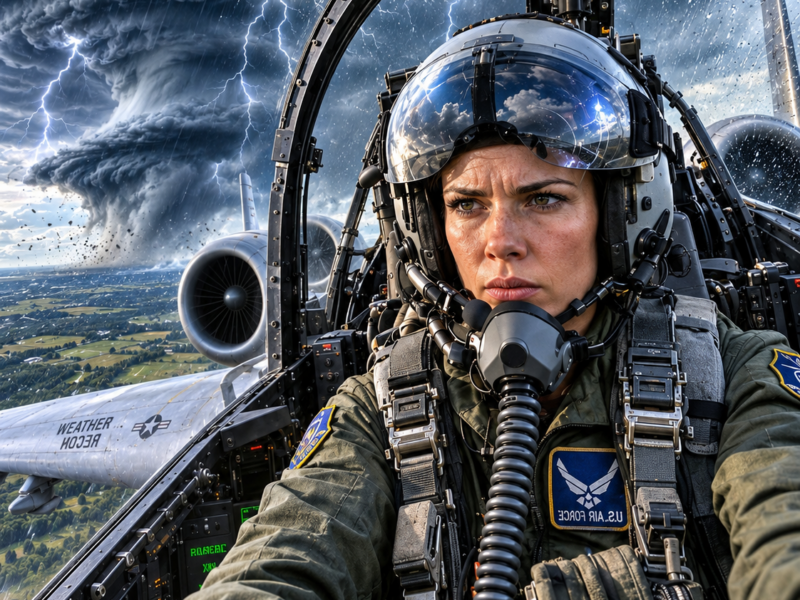
“I was still being laughed at in the McConnell briefing room when Major Jenkins called my aircraft a flying thermometer, but forty minutes later
The wind direction changed.
I saw it on the Doppler display first, a sudden shift in the horizontal flow that sent a warning flashing across my instrument panel.
“Brooks, hold your dive! Don’t pull up yet!”
“Captain, we’re below five thousand feet!”
“I know. Keep the nose down!”
The C-17 was dropping faster than I had ever seen a transport aircraft descend.
Its damaged right wing trembled violently, and the remaining engines were screaming as Brooks struggled to keep the aircraft from rolling.
I glanced at my own altimeter.
4,800 feet.
The ground was still hidden beneath the clouds, but I knew we were running out of room.
Behind me, the radio erupted with another transmission.
“Captain Hayes, this is Lieutenant Reed. We have men injured in the cargo bay. The restraint systems are failing!”
“Tell everyone to keep their harnesses fastened. Nobody moves until we’re clear.”
“Understood!”
I studied the atmospheric readings.
The storm’s downdraft was carrying an enormous column of cold air toward the ground. When it reached the surface, that air would spread outward in a powerful horizontal surge.
That was our chance.
But the timing had to be perfect.
If we pulled up too early, the downdraft would crush us.
If we waited too long, the ground would do the rest.
“Brooks, what is your airspeed?”
“Three hundred knots and climbing!”
“Your control surfaces?”
“Starting to respond. Some ice is breaking away.”
“Good. Keep the wings level.”
I could barely feel my fingers through my gloves.
The Bruiser shook so violently that several warning lights flickered across the instrument panel.
Then the radio crackled.
It was Colonel Mitchell.
“Captain Hayes, we are tracking your descent. You need to pull up immediately.”
I almost smiled.
The colonel had spent the morning telling me that my aircraft was unnecessary.
Now he was asking me to do exactly what the storm wouldn’t allow.
“Negative, sir. We’re waiting for the outflow.”
“You’re below five thousand feet!”
“Then you should probably keep watching.”
I switched back to Brooks.
“Look for the pressure spike. When I call it, you pull up with everything you’ve got.”
“Copy.”
3,500 feet.
3,200.
The clouds began changing color.
The darkness outside the cockpit turned a deep purple, and occasional flashes of lightning revealed the patchwork farmland below.
I could see tree lines, narrow roads, and fields rushing beneath us.
The ground was much closer than it looked.
My pressure gauge began moving.
Slowly at first.
Then suddenly, the needle jumped.
There it was.
The outflow boundary.
“NOW! PULL UP!”
I hauled back on the control stick.
The Bruiser groaned as the wings fought against the horizontal wind.
Beside me, the enormous C-17 lifted its nose.
For a terrifying second, nothing happened.
Then the air caught its wings.
The aircraft leveled out.
“WE HAVE CONTROL!” Reed shouted over the radio.
Brooks was breathing so hard I could hear it through the transmission.
“Altitude holding! We’re holding!”
I checked the radar.
The storm was behind us.
We had made it.
The two aircraft burst through the lower cloud layer into the afternoon sunlight.
For a moment, neither of us said anything.
The sky ahead was almost painfully blue.
After several minutes of fighting darkness, hail, and violent winds, that ordinary blue sky looked like the most beautiful thing I had ever seen.
Then Brooks spoke.
“Captain Hayes?”
“Go ahead.”
“I don’t know how to thank you.”
“Get those people on the ground first. You can thank me later.”
I tried to sound calm, but my hands were shaking.
My aircraft had survived the storm, although barely.
The canopy was cracked, the outer armor was badly damaged, and several instruments were displaying temperatures outside their normal operating ranges.
But the C-17 had bigger problems.
“Captain, we’ve got a serious fuel leak,” Brooks reported. “Number three engine is gone. Hydraulic system B is failing, and we’re having trouble controlling the landing gear.”
I checked our position.
We were far from McConnell.
“Command, Titan One. Requesting emergency diversion for Iron House 40.”
Mitchell answered immediately.
“Stand by. We’re calculating the nearest suitable airfield.”
A few seconds passed.
Then he returned.
“Captain, there’s an old auxiliary runway at Harrison Field, approximately thirty miles east of your position. It was decommissioned years ago.”
“Can it handle a C-17?”
“Technically, yes. But the runway is only six thousand feet. It’s cracked and hasn’t been maintained.”
I looked at the C-17’s damaged wing.
Six thousand feet.
One dead engine.
A failing hydraulic system.
And forty passengers.
“Send me the coordinates.”
“Hayes, I need you to understand something. That runway is not safe.”
I looked at Brooks.
He was trying to keep his aircraft level, fighting the controls with everything he had.
“Colonel, neither is the sky we’re flying in.”
I pushed the throttle forward and headed for Harrison Field.
The abandoned runway appeared beneath us several minutes later.
It looked more like a forgotten road than a military airstrip.
Weeds had grown through the cracks in the concrete. The surrounding grass was nearly waist-high, and old warning signs leaned at strange angles along the perimeter.
I descended to inspect the runway.
At first, it appeared usable.
Then I noticed the damage near the threshold.
A huge section of concrete had collapsed along the left side, exposing broken reinforcement bars and a deep depression in the ground.
I circled once.
The usable portion was barely wide enough for a careful landing.
I keyed the radio.
“Brooks, there’s a major obstruction on the left side of the runway. Stay to the right. You’ve got approximately forty feet of usable width.”
“Understood.”
Then another transmission came through.
“Captain Hayes, this is Lieutenant Reed. We’ve attempted to lower the landing gear.”
I waited.
“The nose gear is down. Left main gear is locked. Right main gear is showing unsafe.”
I looked at the C-17.
“Can you get it locked?”
“First Sergeant Cole is attempting a manual release. We’re working on it.”
“How long?”
“I don’t know.”
I looked at the fuel pressure indicator on my display.
Brooks had perhaps ten minutes before the leak became critical.
“Keep working on it. We need that gear.”
I flew ahead and circled the runway again.
The wind was coming from the southwest, creating a difficult crosswind across the damaged concrete.
Even with all three engines working, the C-17 would have needed a careful approach.
With one engine gone and hydraulic assistance failing, the landing was going to be extremely dangerous.
I could hear the strain in Brooks’s voice.
“Captain, I’ve got a question.”
“Go ahead.”
“If the right gear doesn’t lock, what happens when we touch down?”
I watched the damaged aircraft approaching in the distance.
“It may collapse.”
“That’s what I was afraid you’d say.”
“Listen to me, Daniel. Don’t think about the runway. Don’t think about the damage. Just fly the aircraft.”
There was a pause.
Then he answered quietly.
“Forty people are sitting behind me. I’m not giving up on them.”
I understood that feeling better than he knew.
Two years earlier, I had watched a targeting system identify a building as an enemy position.
I had seen children stepping off a school bus beside it.
I had made a decision that cost me the career I thought I wanted.
I had never regretted saving those children.
And now, forty more lives were depending on someone making the right decision.
“Then let’s bring them home,” I said.
The C-17 began its final approach.
I positioned the Bruiser alongside its left wing, matching its speed as closely as possible.
“You’re slightly left of centerline,” I called.
“Correcting.”
“Hold your heading. Don’t overcorrect.”
The damaged transport rocked in the crosswind.
Its landing gear was visible beneath the fuselage.
I stared at the right main assembly.
It looked dangerously unstable.
“Any update on the lock?”
Reed answered.
“First Sergeant Cole is still working on it. He’s got the mechanism partially engaged.”
“Partially?”
“That’s all we’ve got.”
I swallowed.
“Tell him to get clear before touchdown.”
The runway was getting closer.
“One hundred feet,” I called.
“Copy.”
“Seventy-five.”
The C-17 drifted left.
“Correct right, Brooks. Right rudder. Hold it.”
The aircraft moved back toward the usable section.
“Fifty feet.”
The concrete rushed beneath us.
“Flare!”
Brooks pulled back gently.
The massive transport floated for a brief moment, its nose rising against the crosswind.
Then the left main wheels touched the runway.
The right wheels followed.
For two seconds, everything held.
Then the right landing gear collapsed.
A tremendous metallic bang echoed across the runway.
The C-17 dropped onto its starboard side, its damaged engine nacelle scraping against the concrete.
Sparks flew behind it.
I pulled the Bruiser into a steep climb to avoid the debris.
“Brooks! Can you hear me?”
No answer.
“IRON HOUSE, RESPOND!”
A few seconds later, his voice came through.
“We’re down! We’re down!”
I circled overhead.
The C-17 was sliding toward the end of the runway, leaving a trail of sparks and smoke.
Then I saw something that made my stomach tighten.
A thin ribbon of fuel had ignited behind the damaged wing.
Flames were spreading along the ground.
“Evacuate immediately!” I shouted. “Get everyone out of that aircraft!”
Inside the transport, Brooks and Reed began the emergency evacuation procedures.
The side doors opened.
Yellow evacuation slides deployed.
Men began pouring out of the aircraft, running through the tall grass away from the burning fuel.
I counted them as they emerged.
Ten.
Fifteen.
Twenty.
The fire was spreading.
I tightened my grip on the controls and continued circling.
Thirty.
Thirty-five.
Then forty.
Finally, Brooks and Reed appeared at the forward exit.
They slid down the emergency chute and stumbled into the grass.
I counted again.
Forty-two.
Every single person was out.
“Command, this is Titan One. Iron House 40 is down. All personnel have evacuated. Requesting emergency fire and medical response at Harrison Field.”
For several seconds, the radio was silent.
Then Mitchell answered.
“Copy, Titan One. Rescue teams are being dispatched.”
His voice sounded different now.
Not commanding.
Not impatient.
Just relieved.
I looked down at the damaged C-17.
Smoke was rising from its starboard side, and emergency crews were already racing toward the runway.
I had spent years wondering whether the decision I made over that school bus had destroyed my future.
Watching forty-two people standing safely in the Kansas grass, I finally understood something.
My future had never been the important part.
By the time I returned to McConnell, the sun was beginning to set.
The Bruiser looked terrible.
Its reinforced armor was pitted from hail impacts, its paint had been stripped in several places, and a long crack ran across the canopy.
I landed carefully and taxied toward the maintenance hangar.
The engines wound down.
For several seconds, I remained in the cockpit.
My hands were still trembling.
I removed my helmet and looked at the empty runway ahead.
Then I heard footsteps.
Master Sergeant Gregory Miller was standing beside the ladder.
He looked up at me with a smile that stretched across his grease-stained face.
“Well, Captain. I guess the weather wasn’t so bad after all.”
I laughed.
It came out shakier than I expected.
“Could’ve been better.”
Greg reached up and helped me down.
Then I noticed the people standing behind him.
Colonel Mitchell was there.
Captain Brooks had returned to base on a rescue transport after receiving medical clearance.
Lieutenant Reed stood beside him, his arm in a sling.
And behind them were the pilots of the F-35 squadron.
Including Major Jenkins.
Nobody was laughing.
Jenkins stepped forward.
He looked exhausted, with dark circles beneath his eyes.
For a moment, he seemed unable to find the right words.
Then he stood straight and saluted.
“Captain Hayes.”
I returned the salute.
“Major.”
He lowered his hand.
“I owe you an apology.”
I waited.
He glanced toward the Bruiser.
“I spent a long time thinking that flying the most advanced aircraft made me a better pilot. This morning, when that storm hit, I couldn’t even keep my squadron together.”
He looked back at me.
“You went in after the people we couldn’t reach.”
I said nothing.
He swallowed.
“I was wrong about you.”
There was something uncomfortable about hearing those words.
Not because I didn’t appreciate them, but because I remembered every time he had laughed while I stood silently in the back of that briefing room.
I remembered the nickname.
The jokes.
The way he had treated my assignment as proof that I was no longer a real pilot.
But I also remembered the sound of his frightened voice over the radio.
He had been scared.
So had I.
And in the middle of that storm, none of our old arguments mattered.
“Major,” I finally said, “you don’t have to apologize for not being able to fly through that storm. Nobody should have been expected to.”
He nodded.
“But I do expect you to think before you dismiss someone else’s job.”
His eyes dropped for a moment.
“Understood, Captain.”
Colonel Mitchell stepped forward.
“Captain Hayes, I’d like to speak with you privately.”
We walked several feet away from the others.
He looked toward the damaged aircraft.
“I reviewed your initial weather warnings. You were correct about the pressure drop. Our satellite information was delayed, and we relied too heavily on it.”
“Yes, sir.”
“I should have listened.”
I waited.
He continued.
“I also know what happened during your previous combat assignment. I read the investigation report when you were transferred here.”
I looked at him.
“Then you know why I made the decision I did.”
“I do.”
He took a breath.
“I also know that your Titan Storm project has been underfunded for nearly two years. Today demonstrated what that equipment can do.”
I glanced toward Greg, who was already examining the Bruiser’s damaged wing.
“Today demonstrated what the people maintaining this aircraft can do.”
Mitchell followed my gaze.
“Your project will receive a full review. Additional funding, personnel, and operational support. And I intend to recommend that your combat flight qualifications be reconsidered.”
I looked back at him.
“Sir, I don’t need another fighter assignment to know I’m a pilot.”
He nodded slowly.
“Fair enough.”
Then he added something I wasn’t expecting.
“I’d like you to lead the next phase of the Titan Storm Initiative.”
For the first time that day, I smiled without forcing it.
“That sounds like a good place to start.”
Three weeks later, I returned to the briefing room.
The same room.
The same tactical display.
The same unreliable air conditioning.
But the atmosphere was different.
The Titan Storm Initiative was no longer a forgotten experimental program. The command had approved additional aircraft modifications, expanded weather monitoring coverage, and a dedicated team of pilots and meteorological specialists.
Greg was supervising the next round of modifications.
Brooks had returned to flight duty after recovering from his injuries.
Reed was still undergoing physical therapy, but he had already sent me a message saying he intended to fly again.
And Jenkins?
He had requested to attend the first advanced storm-penetration training session.
When I walked into the room, he stood up.
“Morning, Captain.”
I nodded.
“Morning, Major.”
Nobody laughed.
I took my usual seat near the back and opened the briefing documents.
On the main screen was a photograph taken by one of the rescue crews at Harrison Field.
The damaged C-17 sat at the end of the runway, surrounded by emergency vehicles.
In front of it stood forty-two men.
Some were injured.
Some were covered in mud.
All were alive.
I looked at the photograph for a long time.
Then I noticed something written on the whiteboard beside the screen.
Someone had written:
“THE WEATHER GIRL SAVED OUR LIVES.”
Below it were forty-two signatures.
I recognized Brooks’s handwriting.
I recognized Reed’s.
And near the bottom was Jenkins’s name.
Greg had apparently brought the photograph to the briefing room before anyone else arrived.
I ran my fingers over the edge of the paper and smiled.
For years, I had thought that losing my fighter assignment meant losing the part of myself that mattered.
I had been wrong.
The aircraft I flew didn’t determine my worth.
The number of people who knew my name didn’t determine my worth.
And neither did the opinions of men who had never bothered to understand what I did.
I folded the photograph carefully and placed it inside my flight bag.
Then I walked toward the window.
Outside, the Kansas sky was clear.
A few scattered clouds drifted over the runway, their shadows moving slowly across the grass.
Greg appeared beside me.
“Looks like a quiet day, Captain.”
I studied the clouds.
“Maybe.”
He laughed.
“You know, I think the guys are finally starting to understand what you do.”
I watched the sunlight catch the wing of the Bruiser.
“That’s good, Greg.”
Then I turned toward the hangar.
“But I was never flying for their approval.”
And for the first time in two years, when I walked past the ready room, I didn’t hear anyone call me the Weather Girl.
I heard someone say, “Morning, Captain Hayes.”
I smiled and kept walking.
The End.









