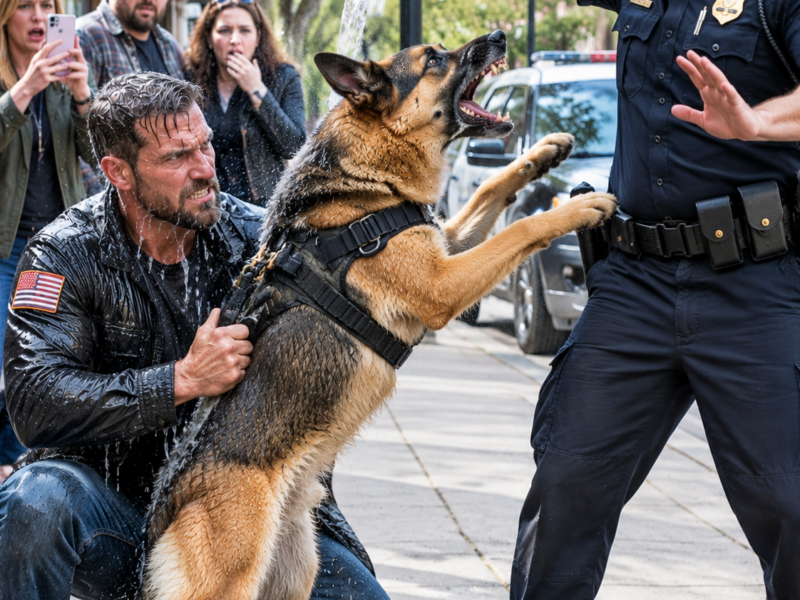
“I was standing outside a gas station in rural Virginia when a police officer slammed my face against the hood of my truck, called my service dog a filthy mutt
I stared at Harris.
He stared back.
For a moment, the only sounds were the rain hitting the pavement, the alarm ringing inside the gas station, and the gunfire coming from the black SUV.
Then Harris reached for his radio.
“Stand down!” he shouted. “This isn’t what we agreed on!”
One of the gunmen turned toward him.
“Shut your mouth, Harris!”
That was all I needed to hear.
They knew each other.
I pressed myself against the side of my truck, trying to keep my injured leg beneath me.
Ranger stayed close, his body low and his eyes fixed on the two men near the pumps.
I gave him a quiet command.
“Cover.”
He moved behind the rear wheel, exactly where I had trained him to go.
I had no weapon.
My phone was somewhere near the gas station entrance, and my truck keys were still in my pocket.
I had spent years learning how quickly a situation could turn deadly.
But this wasn’t a battlefield.
There were civilians inside that building.
And I wasn’t going to let two armed men turn a gas station into one.
The gunman with the rifle moved toward the entrance.
“Where’s the witness?” he yelled.
Harris lifted his head.
“What witness?”
The gunman pointed his weapon at him.
“Don’t play stupid. The kid inside recorded everything.”
My eyes shifted toward the glass door.
The young attendant was crouched behind the counter.
He was still holding his phone.
So this wasn’t about a traffic violation.
The men wanted that recording.
And Harris had been trying to take Ranger and me into custody before they arrived.
I looked at the officer.
“Who are they?”
He didn’t answer.
“Who are they, Harris?”
He swallowed.
“You don’t understand.”
“Then explain it.”
A bullet struck the pavement inches from my boot.
Harris ducked.
The second gunman was moving around the far side of my truck.
I knew I couldn’t stay where I was.
“Ranger, here.”
My dog moved toward me, staying low.
I reached for his harness and pulled him behind the concrete base of the gas pump.
Then I noticed something lying beneath Harris’s cruiser.
A small black object.
A phone.
Its screen was illuminated.
A notification appeared.
TRANSFER COMPLETE — 9:42 P.M.
Harris saw me looking at it.
“Don’t touch that!”
His reaction told me more than any confession could have.
The gunman near the truck shouted, “Get the phone!”
Harris looked at him.
“Which one?”
“The one under your car!”
I didn’t move.
The gunman did.
He stepped into the open, rifle raised.
I pulled Ranger down as another burst of gunfire struck the pump behind us.
The smell of gasoline grew stronger.
The gas station attendant screamed again.
I knew we had seconds before someone made a terrible mistake.
I looked at Ranger.
He looked back at me.
“Stay.”
I moved toward the edge of the concrete barrier, keeping my hands visible.
“Harris!”
He looked up.
“Tell your friends to stop shooting!”
“They’re not my friends!”
The words came out too quickly.
The gunman near my truck turned his head.
“Shut up!”
Harris looked terrified.
For the first time that evening, I believed he might be more afraid of the men in the SUV than he was of me.
Then a voice came through his radio.
“Unit Twelve, respond. Shots fired. We have your location.”
Harris grabbed the radio.
“Dispatch, this is Twelve. Officer needs assistance. Multiple armed suspects.”
He hesitated.
Then he added something that made me look at him.
“One suspect is a military-trained male with a dangerous dog.”
I stared at him.
Even now, he was trying to make me the threat.
The gunman laughed.
“That’s what you told us, Harris. Remember?”
The radio fell from Harris’s hand.
I heard sirens in the distance.
The gunman near the pumps looked toward the road.
“We have to leave.”
The second man shook his head.
“Not without the drive.”
“What drive?”
Harris looked at me.
Then he looked toward the phone beneath his cruiser.
I understood.
The recording wasn’t the only thing they wanted.
There was something else.
Something that could connect Harris to whatever was happening.
And suddenly, I understood why he had been so desperate to search my truck.
He wasn’t looking for drugs or weapons.
He was looking for something he thought I had.
The gunman raised his rifle again.
“Last chance, Harris. Where is it?”
Harris’s voice trembled.
“I told you. I don’t have it.”
The man stepped closer.
“Then where’s the dog tag?”
I looked down at Ranger.
His vest had a small metal identification plate attached near the chest.
I had never thought much about it.
It contained his military working dog number and a retired-service designation.
But beneath the plate was a small, stitched pocket.
I had never opened it.
Not once.
Ranger had worn that vest for almost a year.
I had assumed the pocket was part of the standard equipment.
Now I looked at Harris.
He was looking at the same place.
And I finally understood why he had wanted to take the dog.
He wasn’t afraid of Ranger.
He was afraid of what Ranger might be carrying.
The first police cruiser arrived with its siren blaring.
A second followed.
The gunmen abandoned the pumps and ran toward the SUV.
One of them fired several shots toward the arriving officers before climbing into the passenger seat.
The driver accelerated, sending gravel and water across the parking lot.
The SUV disappeared behind the trees.
I didn’t chase them.
I stayed with Ranger.
The arriving officers took cover behind their vehicles, shouting commands.
“Hands where we can see them!”
I raised both hands.
“Former Navy. I’m unarmed. My service dog is trained and under control.”
A young officer approached from behind a cruiser.
“Keep your hands up!”
“Understood.”
He glanced at my dog.
“Is he going to bite?”
“Not unless someone gives him a reason.”
The officer didn’t smile.
“Keep him close.”
I gave Ranger the command to lie down.
Then I heard Harris groaning beside his cruiser.
One of the responding officers hurried toward him.
“Officer down!”
Harris had been hit in the shoulder.
Blood was spreading across his uniform.
The officer applying pressure looked at me.
“Did you shoot him?”
“No.”
“Did you see who did?”
“Yes. Two men in a black SUV.”
“Do you know them?”
I looked at Harris.
He turned his face away.
“No,” I answered. “But I think he does.”
The young attendant finally came out from behind the counter.
His hands were shaking so badly that he nearly dropped his phone.
“Officer?”
The responding officer turned.
“I recorded everything.”
He held up his phone.
“All of it. The first traffic stop, the guns, everything.”
Harris lifted his head.
“Give me that phone.”
The young man stepped backward.
“No.”
“You don’t know what you’re doing.”
“I know what I saw.”
The officer beside Harris looked at him.
“Sir, stop talking.”
An ambulance arrived shortly afterward.
Paramedics treated Harris and transported him to the hospital.
Before they loaded him into the ambulance, he looked at me.
His expression wasn’t angry anymore.
It was something closer to desperation.
“Listen to me,” he said.
I didn’t move.
“You need to give them the vest.”
I looked down at Ranger.
“Why?”
Harris closed his eyes.
“Because if they find out what’s inside it, they’ll come after you again.”
The ambulance doors shut.
And just like that, I was left standing in a parking lot full of broken glass, spent shell casings, and unanswered questions.
The first thing I did after the police secured the scene was check Ranger.
I ran my hands over his legs, his chest, and his neck.
He had a small cut near one ear from flying glass, but otherwise he was fine.
I pressed my forehead against his.
“Good boy.”
His tail moved once against the wet pavement.
The gas station attendant approached me.
“I’m Daniel,” he said.
“Mike.”
He looked at Ranger.
“He’s incredible.”
“He’s better at staying calm than most people I know.”
Daniel gave a nervous laugh.
Then his expression changed.
“Can I tell you something?”
“Go ahead.”
“That officer has been coming here for months.”
I looked at him.
“What do you mean?”
“He comes in late at night. Sometimes he meets people in the parking lot. They don’t buy anything.”
“Who?”
“Different people. Mostly men in expensive cars.”
Daniel glanced toward the road.
“I thought it was some kind of drug deal.”
“Did you ever see anything?”
He nodded.
“About three weeks ago, I saw Harris hand a package to a man in a gray sedan. The man gave him an envelope.”
“Did you record it?”
Daniel looked down at his phone.
“I did.”
I stared at him.
“Why didn’t you tell the police?”
He shrugged.
“Because he was the police.”
That answer stayed with me.
Daniel wasn’t a coward.
He was a young man who had seen enough to understand that telling the wrong person could make his life dangerous.
I gave him my number.
“Keep the original recording. Don’t edit it. Don’t send it to anyone who calls you claiming to be an officer.”
He nodded.
“Are you going to be okay?”
I looked at Ranger.
“I think we’ll manage.”
But I wasn’t sure.
I got home just after midnight.
My leg was aching, my head hurt, and Ranger needed his ear cleaned.
I locked the doors and checked the windows before sitting at the kitchen table.
The house felt unusually quiet.
Ranger lay beside my chair.
I removed his vest.
The little stitched pocket was still there.
I turned it over in my hands.
It was heavier than I remembered.
There was a tiny zipper hidden beneath the fabric flap.
I opened it.
Inside was a small silver storage drive wrapped in a piece of black cloth.
I stared at it for several seconds.
Then I remembered something.
During our final deployment, our unit had been assigned to protect a logistics convoy carrying sensitive communications equipment.
One of the vehicles had been attacked.
Three American contractors had died.
The official investigation concluded that the attack was the result of a communications failure.
But our team leader, Lieutenant Commander James Walker, had never believed that explanation.
He had suspected someone was leaking convoy routes.
Two weeks before his death, Walker had asked me to take Ranger’s vest to the equipment office.
He said it needed a repair.
I remembered handing it over.
I remembered getting it back.
I had never checked the inside pocket.
The drive could have been there ever since.
I connected it to an old laptop that wasn’t linked to the internet.
The drive contained dozens of files.
Photographs.
Audio recordings.
Scanned documents.
And a folder labeled:
OPERATION NIGHT GLASS — ORIGINAL RECORDS.
My hands became cold.
I opened the first document.
It was a list of convoy schedules.
Several entries had been highlighted in red.
The dates matched attacks that had killed American personnel.
I opened another file.
It contained a spreadsheet with names, payments, and account numbers.
One name appeared repeatedly.
Daniel Harris.
I leaned back.
The same officer who had humiliated me in the parking lot had been connected to a corruption investigation involving military intelligence.
But there was more.
The last file was an audio recording.
I pressed play.
A man’s voice came through the laptop speakers.
“Walker knows about the leak. We can’t let him get the files to the investigation team.”
Another voice answered.
“What about the handler?”
“He’s not the problem. The dog is carrying the evidence.”
I stopped breathing for a moment.
The recording continued.
“Then make sure the dog never reaches Virginia.”
I replayed the last sentence.
The date on the file was eleven months old.
It had been recorded three days before Walker died.
I looked at Ranger.
He was lying on the floor, watching me.
I reached down and touched the small silver plate on his vest.
“Walker knew,” I whispered.
Ranger lifted his head.
I remembered the last time I saw my team leader.
He had stood beside the transport aircraft, one hand resting on Ranger’s head.
He had looked exhausted.
“Take care of him, Mike,” he had told me.
“Always.”
I had thought he meant the dog.
Now I wasn’t sure.
The next morning, I called an old friend.
Lieutenant Commander Sarah Mitchell had worked with our unit during the investigation.
She was now assigned to a federal investigative task force in Washington.
We hadn’t spoken in months.
When she answered, I didn’t waste time.
“Sarah, I need you to listen carefully.”
“Mike? What’s happened?”
I told her about the gas station.
The gunmen.
Harris.
The storage drive.
She didn’t interrupt.
When I finished, she was silent for several seconds.
“Do you still have the drive?”
“Yes.”
“Don’t connect it to anything else. Don’t send it electronically. Don’t take it to a local police department.”
“Sarah, what is on it?”
“I can’t discuss that over the phone.”
“That’s not good enough.”
“Mike, listen to me. We closed that investigation because we were told the original evidence had been destroyed.”
“It wasn’t.”
“I know.”
I sat straighter.
“You know?”
“Walker sent me a message the night before he died. He said he had secured a backup. He didn’t tell me where.”
I looked at Ranger.
“Well, he left it with the dog.”
Sarah exhaled.
“Can you get to Washington?”
“Yes.”
“Come directly to my office. I’ll arrange a secure meeting.”
“Is there anyone I should avoid?”
She hesitated.
“Anyone who knew about the original investigation.”
That was a surprisingly long list.
Before hanging up, she said something else.
“Mike, there’s one more thing.”
“What?”
“Harris wasn’t the only local officer involved.”
My stomach tightened.
“Who else?”
“I’ll tell you when you get here.”
I didn’t go straight to Washington.
First, I called a lawyer I trusted.
Then I made a copy of the files using an isolated computer and placed the original drive in a sealed evidence container.
I didn’t want one missing device to destroy the entire investigation.
By noon, I was on the road.
Ranger sat in the passenger seat.
Every few miles, I checked the rearview mirror.
I couldn’t shake the feeling that someone was following us.
Near Stafford, a dark pickup appeared behind me.
It stayed there for almost twenty minutes.
When I changed lanes, it changed lanes.
When I slowed down, it slowed down.
I took the next exit and pulled into a crowded shopping center.
The pickup continued straight.
I waited.
Five minutes later, it came back through the parking lot.
The driver never looked directly at me.
But I saw him raise his phone.
I started the truck.
Ranger’s ears lifted.
“Easy, buddy.”
I called Sarah.
“I’m being followed.”
“Where are you?”
I gave her the location.
“Don’t approach anyone. Stay somewhere public. I’m sending a federal agent to meet you.”
Twenty minutes later, a black government sedan pulled in beside me.
A woman stepped out.
She wore plain clothes and carried a badge.
“Michael Carter?”
“Yes.”
“I’m Agent Laura Bennett. Sarah sent me.”
I checked her identification.
Then I looked at her.
“How do I know you aren’t part of the problem?”
She didn’t seem offended.
“You don’t. That’s why Sarah told me to bring a second agent and meet you in a public place.”
A man stepped out of the sedan.
He introduced himself as Agent Collins.
Both agents examined the evidence container without opening it.
Then Bennett looked at Ranger.
“That’s the dog?”
“His name is Ranger.”
She crouched slightly.
“Hello, handsome.”
Ranger sniffed her hand.
Then he sat beside me.
Bennett smiled.
“Sarah said he was trained.”
“She was being polite. He’s smarter than most people.”
For the first time that day, I almost smiled.
The meeting in Washington took place in a secure federal building.
Sarah was waiting in a conference room.
She looked older than I remembered.
There were dark circles beneath her eyes, and her hair was tied back more tightly than usual.
When she saw Ranger, she stopped walking.
“Well, look at you.”
Ranger approached her and rested his head against her hand.
She rubbed his ears.
“Walker would have loved seeing you two.”
I placed the evidence container on the table.
“Tell me what happened.”
Sarah opened a folder.
“Operation Night Glass began after several military convoys were attacked using information that should never have left secure channels.”
“Walker suspected a leak.”
“Yes. He found evidence that someone inside the contractor network was selling movement schedules.”
“To whom?”
“Private security companies. Criminal brokers. At least one foreign intelligence intermediary.”
I stared at the documents.
“How many people died?”
Sarah looked down.
“Eleven Americans across four incidents. Possibly more.”
The number settled over the room.
I thought about Walker.
He had been the kind of officer who remembered everyone’s birthday.
He once drove two hours to deliver a replacement wedding ring to a sailor who had lost his in a training accident.
He had believed people deserved to come home.
And someone had turned that belief into a business opportunity.
Sarah continued.
“Walker discovered that Harris was passing information to a local intermediary. Harris wasn’t part of the original military leak, but he was helping move money and suppressing reports.”
“Why would a Virginia police officer be involved?”
“Because the intermediary operated through shell companies registered in the county. Harris provided protection and helped identify witnesses.”
“And the other officer?”
Sarah slid a photograph across the table.
It showed a man in a police uniform.
I recognized him immediately.
Officer Mark Ellison.
He had arrived at the gas station after the shooting.
“Ellison was involved?”
Sarah nodded.
“He was the one who gave Harris information about your arrival.”
I stared at her.
“How?”
“Your vehicle registration. Your home address. Your travel history.”
I thought about the dark pickup.
“Who else knows?”
“We don’t know yet.”
Sarah opened another file.
“There’s something you need to understand about Walker’s backup.”
She placed a printed photograph on the table.
It showed Ranger as a younger dog, standing beside Walker.
On the back, Walker had written:
If anything happens, protect the handler. The evidence is only useful if someone survives to deliver it.
I read it twice.
Then I sat down.
For eleven months, I had believed my team leader had simply left me a dog to care for.
Now I understood that he had trusted me with the last piece of evidence he possessed.
And he had trusted Ranger to carry it.
The investigation moved quickly after that.
The agents verified the digital files, recovered deleted financial records, and identified several accounts connected to the payments.
Daniel’s gas station recordings provided independent evidence of Harris’s meetings.
The footage from the traffic stop also showed him deliberately provoking me before the SUV arrived.
But there was still one missing piece.
The identity of the man who had ordered the attacks.
The audio recording contained a voice, but the quality was poor.
Sarah had a theory.
She thought the voice belonged to a former defense contractor named Richard Voss.
Voss had managed logistics contracts overseas and was under investigation for financial misconduct.
He had disappeared shortly after Walker’s death.
“Can you identify him?” Sarah asked.
I listened again.
The voice was familiar, but not enough to make a reliable identification.
Then I remembered something from our deployment.
Walker had once received a phone call from a contractor during a convoy briefing.
The man had said almost exactly the same phrase.
“Make sure the package never reaches the destination.”
At the time, I hadn’t thought much of it.
Now I recognized the rhythm of the voice.
I looked at Sarah.
“That’s him.”
She leaned forward.
“Are you certain?”
“I’m certain enough to tell you where I heard it before.”
Sarah nodded.
“That’s what we needed.”
Two days later, federal agents located Voss at a private property outside Richmond.
He was arrested without incident.
The investigation uncovered financial records connecting him to the shell companies, along with messages arranging payments to Harris and Ellison.
Harris survived his gunshot wound.
When he was stable enough to be questioned, he initially denied everything.
Then investigators showed him the recordings.
He asked for a lawyer.
Ellison tried to leave the state.
He was stopped at an airport.
Neither man had expected a retired military working dog to be the reason their operation finally unraveled.
Three weeks after the gas station shooting, I visited Harris in the hospital.
He was under federal guard.
His right arm was in a sling, and his uniform was gone.
For a moment, he looked smaller without it.
He glanced at Ranger.
“Still got the dog.”
I stood beside the bed.
“His name is Ranger.”
Harris looked away.
“Yeah. I know.”
I didn’t sit down.
“Why?”
He rubbed his forehead with his left hand.
“I needed money.”
“That’s it?”
“No.”
He swallowed.
“I owed people. My wife had left. My son wasn’t speaking to me. I started taking money for small favors. Checking plates. Looking the other way. It got bigger.”
“And then you helped them kill Americans?”
His face tightened.
“I didn’t know they were going to kill anybody.”
“Walker did.”
Harris looked at the floor.
“He came close to finding everything.”
“So you tried to stop him.”
“I was told to retrieve the drive. That’s all.”
“You brought two armed men to a gas station and let them open fire.”
“I thought they’d scare you.”
I stared at him.
“You thought bullets would scare me?”
He didn’t answer.
Then he looked at Ranger.
“I didn’t know he was carrying the evidence.”
I leaned forward slightly.
“You knew enough to try to take him away from me.”
Harris’s eyes became wet.
“My daughter used to have a dog like that.”
I didn’t respond.
“She loved him. We had to put him down last year.”
He paused.
“I thought about her when I saw your dog.”
For a second, I wondered if there was still some decent part of him buried beneath everything he’d done.
Then I remembered Daniel hiding behind the counter.
I remembered the gunfire.
I remembered Walker.
“Officer Harris, you had a choice every time someone handed you money. You kept making it.”
He closed his eyes.
I turned toward the door.
“Mike?”
I stopped.
“I’m sorry.”
I looked back at him.
“Be sorry when you tell the families what happened.”
Then I left.
The trial began eight months later.
The courtroom was packed.
Daniel testified about the meetings he had witnessed and the recordings he had preserved.
The federal agents presented the financial documents.
Sarah explained how the leaked convoy information had led to multiple attacks.
I testified about the gas station encounter.
I described Harris’s behavior, the SUV, and the radio transmission.
Then the prosecution played the recording from Ranger’s vest.
The courtroom became silent.
When Walker’s voice came through the speakers, I felt my throat tighten.
He sounded exactly as I remembered.
Calm.
Measured.
Almost amused.
“Mike, if you’re hearing this, I probably didn’t get the chance to explain everything.”
I lowered my eyes.
“I know you’ll take care of the dog. He’s always been better at choosing people than we are.”
A few people in the courtroom smiled sadly.
Then Walker’s voice became serious.
“There’s something else you need to know. The evidence isn’t about revenge. It’s about the people who never made it home. Make sure their families get the truth.”
The recording ended.
I sat still.
For months, I had carried the drive like a burden.
Now I understood why Walker had trusted me with it.
He hadn’t wanted me to hunt down the people responsible.
He had wanted me to make sure they could no longer hide.
The jury returned its verdict after several days.
Richard Voss was convicted of conspiracy, fraud, and multiple federal offenses connected to the attacks.
Harris and Ellison were convicted of corruption, obstruction, and their roles in the conspiracy.
The evidence also led to additional arrests.
Some of the families finally learned what had happened to their loved ones.
Not every loss could be repaired.
But at least the truth was no longer buried.
The following spring, I drove to Arlington National Cemetery.
The sky was clear, and the grass had turned a deep green.
I brought Ranger with me.
He walked slowly beside my left leg, his leash loose in my hand.
We stopped at a section where several of the men from our unit were buried.
I knelt beside Walker’s headstone.
For a while, I didn’t say anything.
Ranger sat beside me.
“I found it, James,” I finally whispered.
“The files. The people responsible. All of it.”
A breeze moved through the trees.
“I wish you could have been here.”
I reached into my jacket and removed the small silver storage drive.
It was no longer needed as evidence.
The original had been returned to me after the case concluded.
I placed it in a small box beside the flowers.
Not because I wanted to forget what happened.
Because I didn’t want to carry it forever.
Ranger lowered his head against my knee.
I rubbed the fur behind his ears.
“You did good, buddy.”
He looked toward the rows of white headstones.
Then he looked back at me.
I smiled.
For the first time in a long while, the silence didn’t feel like something I needed to fight.
A few weeks later, Daniel called me.
He had left the gas station job and started studying criminal justice at a community college.
“I’ve been thinking about that night,” he said.
“That’s not surprising.”
“I keep wondering what would have happened if I hadn’t recorded anything.”
I looked out the kitchen window.
“Maybe nothing would have changed that night. But the truth would have taken longer to come out.”
He was quiet.
Then he said, “I want to work in investigations someday.”
“Then remember what you learned.”
“What’s that?”
I watched Ranger sleeping on the rug.
“Doing the right thing doesn’t always feel safe. Sometimes it just means refusing to pretend you didn’t see something.”
Daniel thanked me.
Before hanging up, he asked if he could visit sometime.
I told him he was welcome.
My life didn’t become perfect after the trial.
My leg still hurt when the weather changed.
Some nights, I still woke up remembering the sound of gunfire.
And there were days when I wondered whether I had done enough for the men who never came home.
But Ranger was there.
He still followed me from room to room.
He still rested his head on my knee when my pain became difficult.
And he still watched strangers with that steady, thoughtful expression that had once made a corrupt police officer uncomfortable.
One afternoon, I took him to the same gas station.
The broken window had been replaced.
The pumps were freshly painted.
Daniel wasn’t there anymore, but the new attendant recognized Ranger.
“That’s the dog from the shooting, right?”
I nodded.
He smiled.
“Glad he’s okay.”
I looked down at Ranger.
“So am I.”
We walked back toward the truck.
Before I opened the door, I noticed the small patch on his vest.
MILITARY WORKING DOG — RETIRED.
I ran my fingers over the words.
For years, I had thought retirement meant leaving the past behind.
But standing there beside him, I finally understood something.
Ranger hadn’t been carrying a weapon.
He hadn’t been carrying a secret for his own sake.
He had been carrying the truth for people who could no longer speak for themselves.
And the best thing I could do for the man who trusted us with it was not to seek revenge.
It was to make sure the truth reached the people who deserved it.
I opened the passenger door.
Ranger climbed in, turned around twice, and settled into his seat.
I started the engine.
For once, when we drove away from that gas station, I didn’t look in the rearview mirror.
The End.









