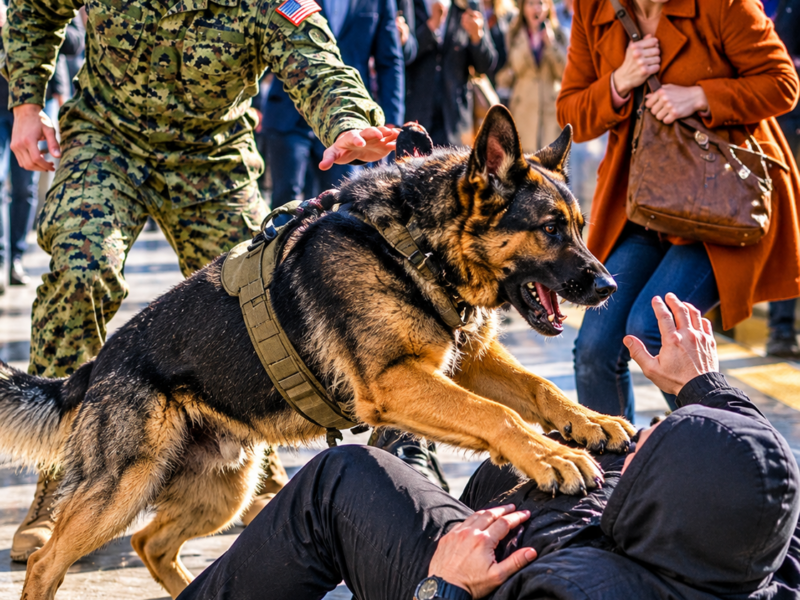
“I was standing on a crowded train platform when my phone lit up with a breakup text from the woman I thought I was going to marry
The phone was still pressed against my ear when I watched Emily’s face change.
She had heard my former commander’s voice through the speaker.
“Daniel, listen carefully,” Colonel Richard Morgan said. “You need to get away from that woman. Don’t ask questions. Don’t investigate anything. Just leave.”
I looked at the photograph in Emily’s hand.
“Sir, how do you know what she showed me?”
There was a pause.
A long one.
Then he said, “Because I know exactly what she’s carrying.”
I felt Ranger press against my leg.
“Then tell me why there’s a photograph of Marcus alive eleven days after you told us he was dead.”
The silence that followed was different.
It wasn’t confusion.
It was recognition.
“Where are you right now?” Morgan asked.
“Union Station.”
“Stay there. I’m sending someone.”
I almost laughed.
Three years earlier, I would have followed that order without hesitation.
Now, after seeing that photograph, I wasn’t sure whether the man on the other end of the line was trying to protect me or silence me.
“Who are you sending?”
“Someone you can trust.”
The call ended.
Emily slowly slipped the photograph back into her bag.
“That wasn’t a friendly conversation,” she said.
“No.”
“Are you going to hand me over to him?”
I looked at her.
She had every reason to expect me to say yes.
I was a former SEAL. My career had been built around following orders, protecting teammates, and trusting the people who stood beside me.
But the photograph had introduced a question I couldn’t ignore.
“Not until I know why my dead friend is standing in that picture.”
We left the platform through a side corridor.
I didn’t want to walk through the main entrance where the man in the navy coat had photographed us.
Ranger stayed close, occasionally looking over his shoulder.
Emily walked quickly, but her right hand never left the strap of her bag.
Outside, the rain had become heavier.
I led her toward a small coffee shop across the street, one with large windows and enough people inside that nobody could approach us unnoticed.
We took a table near the back.
Ranger settled beneath it.
Emily ordered tea. I ordered coffee I didn’t really want.
For almost a minute, neither of us spoke.
Then I asked, “Tell me about Marcus.”
Her fingers tightened around the paper cup.
“His full name was Marcus Reed. He was a military intelligence analyst before he disappeared.”
“Disappeared?”
“That’s what the official records say.”
I shook my head.
“He died during an extraction operation in Syria. I was there.”
“I know.”
“You don’t understand. I saw the vehicle explode. We lost communications. The recovery team found what they said were his remains.”
Emily looked down.
“Did you see his body?”
I opened my mouth.
Then stopped.
I remembered the smoke.
The debris.
The confusion.
The medical officer telling us there was nothing more to recover.
“No,” I finally said.
“Did you personally identify him?”
“No.”
Emily nodded slowly.
“That’s where my investigation started.”
She opened her bag and removed a small digital recorder.
“I’ve been investigating a private defense contractor called Blackridge Security for almost eight months. They had a logistics contract connected to your operation.”
I recognized the name.
Blackridge had provided transportation and security support for several missions in the region.
“What does that have to do with Marcus?”
“Three months ago, a former Blackridge employee contacted me. He claimed the company had been moving intelligence personnel through unofficial channels. People who were supposedly dead or missing were being relocated under different identities.”
I stared at her.
“That’s a serious accusation.”
“I know.”
“Do you have proof?”
She placed the recorder between us.
“I have a recording of someone discussing Marcus Reed’s transfer.”
“Who?”
She hesitated.
“Your commanding officer.”
The coffee shop suddenly seemed quieter.
I looked at the recorder.
“You’re telling me Colonel Morgan was involved?”
“I’m telling you I heard his voice.”
I leaned back.
For a moment, I couldn’t find anything to say.
Morgan had been the person who recommended me for selection. He had visited injured members of our unit in the hospital and attended funerals when their families couldn’t bear to stand alone.
He had stood beside me at Marcus’s funeral.
He had put a hand on my shoulder and told me we had done everything we could.
I remembered believing him.
“Play it,” I said.
Emily pressed the button.
Static filled the space between us.
Then a man’s voice emerged.
“Reed is still useful. Keep him off the official channels until the transfer is complete.”
A second voice asked, “And Hayes?”
The first man answered.
“Hayes believes the extraction failed. Keep it that way.”
The recording ended.
I didn’t move.
I recognized both voices.
The first belonged to Morgan.
The second belonged to a man named Victor Shaw, the operations coordinator who had been responsible for arranging our transportation during that mission.
Victor had also attended Marcus’s funeral.
I looked at Emily.
“Where did you get this?”
“From the former employee. He disappeared two weeks after giving it to me.”
“Did you contact the authorities?”
“Twice. The first time, nobody responded. The second time, someone warned me that I was putting myself in danger.”
“Who warned you?”
She looked at me.
“Someone using an official government email address.”
I rubbed my forehead.
This was bigger than a missing soldier.
It involved people who had access to military records, transportation contracts, and classified information.
And somehow, my name had been included in their conversations.
Before I could ask another question, Ranger lifted his head.
His ears pointed toward the front window.
A black SUV had pulled up across the street.
The passenger door opened.
A man stepped out.
Gray baseball cap.
Same man from the platform.
“Emily,” I said quietly. “Don’t turn around.”
Her face lost its color.
“He’s here?”
“Yes.”
I slipped the recorder into my jacket.
“Take your bag. We’re leaving through the back.”
We walked toward the kitchen entrance.
The manager objected when we passed through the restricted area, but I apologized and kept moving.
Behind us, the front door opened.
A familiar voice called Emily’s name.
We reached the alley just as the man appeared in the doorway.
“Daniel!”
I turned.
He had one hand raised.
“You’re making a mistake. We can explain everything.”
I recognized the voice.
Victor Shaw.
I had spent months working with that man.
He had once stayed awake for thirty-six hours coordinating an extraction because he refused to leave anyone behind.
Now he was standing in an alley with two men who had been following a journalist.
“Then explain why you were following her,” I said.
Victor’s expression tightened.
“Because she doesn’t know what she’s holding.”
Emily stepped closer to me.
“Then tell me what happened to Marcus.”
Victor glanced at her bag.
“Not here.”
“That’s what everyone keeps telling me.”
He looked at me.
“Daniel, I need you to listen. Marcus is alive, but the situation is much more complicated than you think.”
My mouth went dry.
“Where is he?”
Victor lowered his voice.
“Somewhere he shouldn’t be.”
I took one step forward.
“Where?”
He shook his head.
“If you want him alive, stop asking questions in public.”
Then he turned and walked back toward the street.
The two men followed.
Emily stood motionless beside me.
I looked at her.
“Did you know he was alive?”
“No,” she whispered. “I suspected. That’s all.”
I wanted to believe her.
But I had learned a long time ago that believing someone and trusting them were two different things.
We got into my rental car and drove toward a hotel near Capitol Hill.
I chose a place with a staffed front desk and cameras covering the entrance.
I checked in under my own name.
It was a risk, but I wanted a record of where we were if anything happened.
Once inside the room, Emily placed her bag on the bed.
Ranger inspected the room, sniffed the door, then settled beside it.
I locked the deadbolt.
“Start from the beginning,” I said.
She sat on the edge of the bed.
“My father was a military intelligence officer. He died when I was twenty-four.”
I hadn’t expected that.
“Was he connected to Blackridge?”
“Not directly. But before he died, he was investigating irregularities in military contractor payments. He told me some companies were being paid to move people who didn’t officially exist.”
She looked toward the window.
“I thought he was talking about financial fraud. After he died, I found a notebook among his belongings. It contained references to Blackridge and several military operations.”
“Why didn’t you go to the authorities?”
“I did. They told me the notebook contained nothing actionable.”
“And you believed them?”
“I was twenty-four. I wanted to believe there was a reasonable explanation.”
She opened her bag and took out a small photograph.
It showed a younger version of her standing beside an older man.
“My father.”
I nodded.
“Then, eight months ago, I received an envelope at my office. No return address. Inside was a photograph of Marcus Reed.”
I looked closer.
“Who sent it?”
“I don’t know. But there was a handwritten note.”
She turned the photograph over.
It said:
HE DIDN’T DIE.
I sat down.
“Why didn’t you tell me all this at the station?”
“Because I didn’t know whether I could trust you.”
That answer hurt more than I expected.
“Yet you knew who I was.”
“I knew your name from the recording. I also knew you were the only person from that operation who wasn’t mentioned in the financial documents.”
I stared at her.
“Then why did those men warn you about me?”
“Because they didn’t want us together.”
She reached into the lining of her bag and pulled out a folded piece of paper.
“There’s something else.”
It was a handwritten list of dates and locations.
One entry had been circled.
November 18.
Forty-eight hours from then.
“What is this?”
“An exchange.”
“Between whom?”
“I don’t know. The former employee told me it was connected to Marcus. He said if I could get the recording to the right person, we’d finally learn where he was being held.”
I studied the paper.
Then I noticed a small notation at the bottom.
A location.
A warehouse outside Baltimore.
I looked at Emily.
“Why didn’t you go there?”
“Because I don’t know who to trust.”
I looked toward Ranger.
He was staring at the hotel door.
His ears had risen again.
A moment later, someone knocked.
Three slow knocks.
I moved toward the door but didn’t open it.
“Who is it?”
A woman’s voice answered.
“Room service.”
I hadn’t ordered anything.
I drew Emily back from the door.
“Stay behind me.”
The handle moved slightly.
Then a small envelope slid beneath the door.
Footsteps retreated down the hallway.
I waited several seconds before retrieving it.
Inside was a photograph.
It showed Marcus Reed sitting at a table in a room with white walls.
He looked older.
His hair was longer, his face thinner, but I knew him.
On the back, someone had written:
HE ASKED FOR YOU.
I sat on the edge of the bed.
For three years, I’d carried the weight of believing I had failed to bring my friend home.
Now I was looking at evidence that he had been alive all along.
Emily touched my shoulder.
“Daniel…”
I turned the photograph over again.
There was another line written beneath the first.
DON’T LET MORGAN FIND HIM FIRST.
I barely had time to process it before my phone rang.
This time, it wasn’t Morgan.
It was an unknown number.
I answered.
A man’s voice came through, weak and distorted.
“Hayes?”
I stopped breathing.
“Marcus?”
There was a pause.
Then a familiar laugh.
Not the loud laugh I remembered from deployment.
A tired, broken sound.
“Still taking orders from Morgan?”
I closed my eyes.
“Where are you?”
“Doesn’t matter. Listen to me. You need to get Emily away from this.”
“She knows about you.”
“I know.”
“Marcus, what happened?”
He took a shaky breath.
“Blackridge wasn’t just moving intelligence officers. They were moving people who had access to information someone wanted buried.”
“Who?”
“People like me.”
I gripped the phone.
“Why did they tell us you were dead?”
“Because I found something.”
“What?”
Before he could answer, the call crackled.
Then his voice dropped.
“Daniel, do you remember the night we extracted the civilians from the village?”
I remembered.
A damaged building.
A convoy.
A little girl with a yellow backpack.
And an order to leave before sunrise.
“Yes.”
“We weren’t supposed to extract them.”
I frowned.
“What are you talking about?”
“The people we rescued had witnessed something. Blackridge was transporting prisoners through that village. Some were American citizens.”
I looked at Emily.
She was listening now, her hand covering her mouth.
Marcus continued.
“I found the transfer records. Names, dates, payments. Morgan knew about it. Shaw knew. I confronted them.”
“And then?”
“They arranged my death.”
My throat tightened.
“Why didn’t you contact us?”
“I tried. They told me if I contacted anyone from the unit, they’d kill my family.”
I sat completely still.
“Your family?”
“My wife. My daughter.”
I remembered Marcus showing me a picture of his little girl during a deployment briefing.
She had been missing two front teeth and wearing a pink sweater.
“Are they safe?”
“I don’t know.”
His voice cracked.
“Daniel, I need you to find them.”
Before I could answer, I heard a door slam on his end.
“Marcus?”
“Someone’s coming.”
“Where are you?”
He whispered a series of numbers.
Then he said something that made my blood run cold.
“Don’t trust the person who gives you the warehouse address.”
The call ended.
I looked at the paper Emily had given me.
The warehouse outside Baltimore.
November 18.
I slowly lifted my eyes toward her.
“Where did you get that address?”
She looked confused.
“From the former employee. Why?”
“Marcus just told me not to trust the person who gives us that address.”
Emily’s face changed.
“Daniel, I swear I didn’t know.”
I believed that she was frightened.
I wasn’t yet certain she was innocent.
I put the photograph and the paper on the desk.
Then I noticed something.
The handwriting on the warehouse note looked familiar.
Not like Emily’s.
Not like Marcus’s.
It was the same distinctive block lettering I had seen on the operational documents Morgan used to distribute before every mission.
Colonel Morgan had written that address.
I picked up my phone.
“He’s not sending us to find Marcus,” I said quietly.
“Then what is he doing?”
I looked at the door.
“He’s sending us somewhere he can control.”
For the next hour, I made no calls and sent no messages.
I needed to think.
The obvious move was to contact the FBI, but I had no way of knowing whether the people involved had access to the same information channels.
Emily suggested reaching out to a former colleague of her father’s.
His name was Thomas Bennett, a retired federal investigator who had helped her after her father’s death.
I agreed to meet him.
But I made one condition.
No warehouse.
No private military contacts.
No one who had worked under Morgan or Shaw.
We met Bennett the next morning at a diner in Alexandria.
He was sixty-two, wore reading glasses, and had the kind of tired expression that comes from spending decades watching people lie for a living.
He listened without interrupting.
When Emily played the recording, he closed his eyes.
“That’s Morgan,” he said.
“You recognize him?” I asked.
“I interviewed him seven years ago during a contractor investigation. Nothing came of it.”
“Why?”
“Because the evidence disappeared.”
He looked at Emily.
“Your father was right about Blackridge.”
Emily lowered her eyes.
“Then why didn’t anyone listen?”
Bennett took a slow breath.
“Because he was trying to expose a network that had people in places where nobody wanted questions asked.”
He opened a folder and slid a document across the table.
It contained payment records connected to Blackridge.
Several transfers were marked with the same code.
MR-17.
I looked at it.
“Marcus Reed?”
Bennett nodded.
“His personnel file was altered three days after the operation. Officially, he was dead. Financially, his identity remained active.”
Emily leaned forward.
“Can you locate him?”
“Not from this.”
Bennett took another page from the folder.
“But I can tell you something about the warehouse.”
I felt my shoulders tense.
“What?”
“It’s not a storage facility. It used to be a private detention site. Blackridge surrendered the property on paper last year, but someone has continued paying the utility bills.”
“Who?”
Bennett pointed to a company listed on the document.
“An account controlled by Victor Shaw.”
I looked at Emily.
The warehouse wasn’t a random meeting location.
It was connected to the man who had approached us at the coffee shop.
Bennett folded his hands.
“I can get this evidence to an independent federal team. But I need the original recording and the photograph.”
Emily shook her head.
“I can’t give you everything yet.”
“Why not?”
“Because if we hand over the evidence and Marcus disappears again, we’ll never know what happened to him.”
Bennett didn’t argue.
Instead, he looked at me.
“Hayes, you need to understand something. Your friend may be alive, but finding him could put everyone around him in danger.”
I thought about the little girl in the pink sweater.
Then I thought about the last time I had seen Marcus.
He’d been laughing over a terrible cup of coffee, telling me he planned to teach his daughter how to ride a bicycle when he got home.
“I know,” I said.
“But I’m not leaving him there.”
Bennett nodded.
“Then we do this properly.”
He gave us a number for a federal agent he trusted.
Not a friend.
Not a former teammate.
Someone whose involvement could be documented and whose actions could be independently verified.
That afternoon, Emily and I provided copies of the recording and documents to the agent.
We kept the originals secure.
For the first time since the station, I felt as though we were moving toward something that might actually bring the truth into the open.
Then the agent called.
He had found a second location connected to Marcus.
A small property in rural Maryland.
The records suggested that someone had been living there under a different identity.
There was no guarantee Marcus was still there.
But it was the first lead that hadn’t come from Morgan or Shaw.
We drove there the following morning.
Ranger sat in the back seat, watching the road through the window.
Emily barely spoke.
At one point, she turned toward me.
“Do you think he’ll recognize you?”
I kept my eyes on the road.
“I hope so.”
“And if he doesn’t?”
I didn’t answer.
The property was a modest farmhouse surrounded by bare trees.
A rusted mailbox stood beside the driveway.
No vehicles.
No lights.
I parked near the road.
Ranger began whining softly.
I opened the back door.
He jumped down, sniffed the air, and walked toward the house.
Then he stopped.
His tail moved.
He looked back at me.
For the first time in three years, I felt a small piece of hope.
I approached the front door and knocked.
Nothing.
I knocked again.
A floorboard creaked inside.
Then a voice called through the door.
“Go away.”
I recognized it immediately.
“Marcus?”
Silence.
Then the door opened a few inches.
A man stood behind it.
He had lost weight. His hair was gray at the temples, and a pale scar ran along his jaw.
But his eyes were the same.
For several seconds, neither of us moved.
Then he looked past me and saw Ranger.
His expression broke.
“Well, I’ll be damned.”
Ranger pushed through the opening and pressed his head against Marcus’s chest.
Marcus dropped to one knee, wrapping both arms around the dog.
“Hey, buddy.”
His voice shook.
“You remembered me.”
I stood in the doorway, unable to speak.
Marcus looked up.
“Daniel.”
I stepped forward and pulled him into an embrace.
He felt thinner than I remembered.
But he was alive.
For a long time, neither of us said anything.
Then he whispered, “I’m sorry.”
I pulled back.
“For what?”
“For letting you bury me.”
I shook my head.
“You didn’t have a choice.”
He looked toward Emily.
“You’re the journalist.”
She nodded.
“I’ve been trying to find you.”
Marcus gave a tired smile.
“Then you’ve probably made more enemies than you realize.”
We went inside.
The farmhouse was sparsely furnished.
There were old newspapers on the table, a secondhand laptop, and a child’s drawing taped to the refrigerator.
I recognized the handwriting at the bottom.
Love, Lily.
Marcus saw me looking.
“She’s my daughter.”
“Where is she?”
“With my sister. I haven’t seen her in two years.”
He lowered his eyes.
“I was afraid they’d use her to make me cooperate.”
I sat across from him.
“Tell us everything.”
Marcus spent the next two hours explaining what had happened after the operation.
The civilians we had rescued had witnessed Blackridge transporting prisoners through an unauthorized detention network.
Some of those prisoners had information about illegal contracts and payments.
Marcus had discovered that the company was using military operations to conceal those transfers.
He had confronted Morgan.
Morgan had promised to investigate.
Instead, Marcus had been taken to a secure facility and informed that his death had already been reported.
They told him his family would be protected if he cooperated.
When he refused, they showed him photographs of his wife and daughter.
“They didn’t have to hurt them,” he said. “They just had to make me believe they could.”
He had spent months being moved between locations.
Eventually, a former Blackridge employee helped him escape.
That employee was the same person who had contacted Emily.
“Why didn’t you come home?” I asked.
Marcus looked at the child’s drawing on the refrigerator.
“Because I didn’t know who was watching.”
He explained that the first time he tried to contact his family, someone intercepted the message.
His wife received an anonymous photograph of Lily leaving school.
After that, he stopped trying.
I felt anger rise in my chest.
“They used your daughter to keep you quiet.”
He nodded.
“And they used your funeral to make sure nobody went looking.”
Emily placed her recorder on the table.
“Can you testify?”
Marcus looked at it.
“Yes.”
Then he looked at me.
“But I need to know something first.”
“What?”
“Did Morgan ever tell you why he ordered the extraction that night?”
I shook my head.
“He said we were rescuing civilians.”
Marcus looked away.
“That was only half the mission.”
He explained that our team had unknowingly been sent to recover a ledger containing records of Blackridge’s prisoner transfers.
The civilians were witnesses.
The ledger was evidence.
The official mission report had been altered to make the operation look like a failed extraction.
The explosion had provided the perfect explanation for Marcus’s disappearance.
I thought about the men who had been left behind.
The orders we had followed.
The funerals.
The families who had spent years believing the official story.
“How many people were involved?”
“Enough that I stopped counting.”
Then Marcus reached beneath the table and pulled out a small metal case.
Inside were several storage drives and a handwritten notebook.
“This is what they were looking for.”
Emily leaned closer.
“Is this the original evidence?”
“Part of it.”
He opened the notebook.
There were names, dates, payments, and locations.
Some of the names belonged to military personnel.
Others belonged to private contractors and government officials.
One name appeared repeatedly.
Richard Morgan.
Another was Victor Shaw.
I looked at Marcus.
“Why didn’t you give this to the investigator who helped you escape?”
“Because I didn’t trust him either.”
He looked at Emily.
“But I trust her father’s work.”
Emily stared at the notebook.
“How do you know about my father?”
Marcus hesitated.
“Because he was the first person who tried to expose the network.”
The room fell silent.
“Your father contacted me before the operation,” Marcus continued. “He believed Blackridge was moving prisoners under false identities. He gave me copies of some records.”
Emily’s eyes filled.
“Why didn’t he tell me?”
“Maybe he was trying to protect you.”
Marcus reached into the metal case and removed a folded letter.
It had Emily’s name written on the front.
She stared at it for a long time before taking it.
Inside was a short handwritten note.
Emily,
If this ever reaches you, it means I wasn’t able to finish what I started.
Don’t let anyone convince you that asking questions is a betrayal.
Some people will tell you that silence keeps families safe. Sometimes silence is exactly what puts them in danger.
I love you.
Dad.
Emily covered her mouth.
I looked away to give her a moment.
For years, she had believed her father died leaving behind a mystery she couldn’t solve.
Now she had his handwriting in her hands.
Marcus let the silence settle.
Then he said, “There’s one more thing.”
He opened the notebook to the final page.
A list of names appeared beneath a heading.
WITNESSES REQUIRING PERMANENT REMOVAL.
I scanned the page.
My name was there.
Emily’s name was there.
And beneath them was the name of Marcus’s wife.
I looked up.
“Does she know?”
He shook his head.
“Not yet.”
My phone vibrated.
The federal agent’s name appeared on the screen.
I answered.
“Hayes, I need you to listen carefully. We have a problem.”
“What?”
“Colonel Morgan has requested an emergency meeting with the investigation team.”
“Why?”
“He’s claiming the evidence is fabricated. He’s also saying you’re holding a missing military asset.”
I looked at Marcus.
The agent continued.
“There’s something else. Victor Shaw has been arrested.”
I felt a brief sense of relief.
Then the agent spoke again.
“He was carrying a document authorizing the transfer of Marcus Reed to a secure government facility.”
I stared at the phone.
“Who authorized it?”
A pause.
“Colonel Morgan.”
Marcus stood slowly.
“He’s coming for me.”
The agent lowered his voice.
“We’re arranging protection. But you need to move now.”
We left the farmhouse through the back entrance.
Marcus took the metal case.
Emily carried her father’s letter.
I kept Ranger close.
We drove to a secure location arranged by the federal team.
For the next several hours, everything happened quickly.
Investigators verified Marcus’s identity.
His testimony matched the financial records.
The original storage drives contained enough information to establish that Blackridge had operated unauthorized detention facilities and concealed the movement of prisoners.
But the case wasn’t finished.
Morgan still had powerful allies.
And he knew we had the evidence.
That evening, he called me.
I answered with the investigator listening on another line.
“Daniel,” Morgan said.
His voice sounded almost gentle.
“I heard you’ve been spending time with Marcus.”
I said nothing.
“He’s confused. He’s been through a terrible experience. You need to let professionals handle this.”
“Why did you tell me he was dead?”
A long pause.
“Because that was the only way to keep the operation contained.”
“You let me bury him.”
“We were protecting national security.”
“No, sir. You were protecting yourselves.”
His voice hardened.
“You have no idea what would happen if all of this became public.”
I looked through the glass partition at Marcus.
He was sitting with Emily, reading his daughter’s old drawing.
“Maybe the families of those people deserve to know.”
Morgan exhaled.
“Don’t make yourself a victim of something you can’t understand.”
I ended the call.
The investigation moved forward.
Within days, federal authorities secured the remaining records and detained several people connected to Blackridge.
Morgan was placed under investigation.
Shaw agreed to cooperate after realizing the evidence against him was extensive.
The case eventually exposed years of unauthorized prisoner transfers, falsified records, and financial misconduct.
It also established that several people who had been officially listed as dead were still alive.
Not all of them were found.
But Marcus was no longer one of the missing.
Three weeks later, I stood outside a small house in Virginia.
Marcus was on the porch with his wife, Sarah.
She had been told he died three years earlier.
When she opened the door and saw him, she didn’t scream.
She didn’t run.
She simply stared at him as if her mind couldn’t decide whether the man standing in front of her was real.
Marcus took one step forward.
“Sarah.”
Her hand rose to her mouth.
Then she crossed the porch and struck his chest with both fists.
“You were dead,” she whispered.
“I know.”
“You let me bury you.”
“I know.”
She hit him again, then collapsed against him.
Marcus held her as she cried.
I stood near the driveway with Ranger.
There were some moments that didn’t belong to anyone else.
A few minutes later, a little girl came out of the house.
Pink sweater.
Missing front teeth.
Lily.
She stopped when she saw Marcus.
He knelt.
“Hey, sweetheart.”
She stared at him.
“Are you really my daddy?”
Marcus’s face crumpled.
“Yes.”
She ran toward him.
He caught her in his arms and held her tightly.
I looked down at Ranger.
His tail moved slowly.
For three years, I had believed my friend was gone.
Now I was watching him hold the daughter he had thought he might never see again.
And I realized that bringing Marcus home had been only the beginning.
Some wounds don’t disappear when the truth comes out.
Some families need time to learn how to live with it.
The following month, Emily published her investigation.
She included the financial records, the testimony, and the evidence connecting Morgan and Shaw to the cover-up.
She also wrote about the families who had spent years believing their loved ones were dead.
Her father’s letter remained private.
She told me it was the one piece of the story she wanted to keep for herself.
We met for coffee a week after the article was published.
She looked exhausted, but lighter.
“Do you regret getting involved?” she asked.
I thought about the breakup message I’d received at Union Station.
The ring still sat in my apartment drawer.
The woman who had sent that message had never called again.
For a while, I had thought that losing her was the worst thing that could happen to me that day.
It wasn’t.
That day had given me a different kind of choice.
I could have gone home, ignored the woman in the red coat, and continued grieving a friend who was still alive.
Instead, Ranger had noticed something I hadn’t.
And I had stopped long enough to listen.
“No,” I said. “I don’t regret it.”
Emily smiled.
“Neither do I.”
We didn’t rush into anything.
We had both been through too much to mistake gratitude for love or shared danger for a promise.
But we kept in touch.
Sometimes we’d meet for coffee.
Sometimes she’d bring documents she wanted me to help her understand.
And sometimes we’d simply sit in silence while Ranger rested his head on her shoes.
Six months later, I received a photograph from Marcus.
It showed him standing in a backyard with Lily riding a bright blue bicycle.
Sarah was holding the seat.
Marcus had one hand raised, ready to catch his daughter if she lost her balance.
The message underneath said:
First ride without training wheels. Wish you could’ve seen it.
I stared at the picture for a long time.
Then I put it on my refrigerator.
Beside it, I placed another photograph.
One of Ranger and me outside Union Station.
The day my life had gone in a direction I never could have predicted.
I still don’t know why my relationship ended that afternoon.
Maybe the woman I loved had found someone else.
Maybe there were reasons she never wanted to explain.
Eventually, I stopped needing an answer.
The ring went into a small box, and I donated the money I’d saved for the wedding to a program supporting families of missing service members.
I wasn’t trying to replace what I’d lost.
I was trying to make something useful out of it.
One evening, Emily came over for dinner.
She brought a bottle of sparkling water and a stack of notebooks.
Ranger greeted her at the door, carrying his favorite worn tennis ball.
She laughed and crouched to take it from him.
“Still keeping you out of trouble?” she asked me.
“Mostly.”
She looked at the photographs on the refrigerator.
“Marcus sent you another one?”
I nodded.
She studied the picture of Lily on her bicycle.
“She’s getting so big.”
“Yeah.”
For a moment, we stood quietly in the kitchen.
Then Emily reached for my hand.
“Daniel, I know that day at the station was difficult for you.”
I looked at her.
“I’ve had worse days.”
“I know. But I don’t want you to think you have to be strong every minute.”
I looked down at our hands.
For most of my life, I had believed strength meant keeping everything inside until the job was finished.
Ranger had taught me something different.
Sometimes strength meant noticing when someone needed help.
Sometimes it meant admitting you needed it, too.
I squeezed Emily’s hand.
Outside, rain tapped softly against the kitchen window.
It reminded me of Union Station, the cold platform, the message on my phone, and the photograph that had changed everything.
I had arrived there thinking I was losing the future I’d planned.
I left with something I hadn’t known I needed.
A second chance to bring someone home.
And a German Shepherd who, when the rest of the world was busy looking the other way, had known exactly where I needed to go.
THE END.









