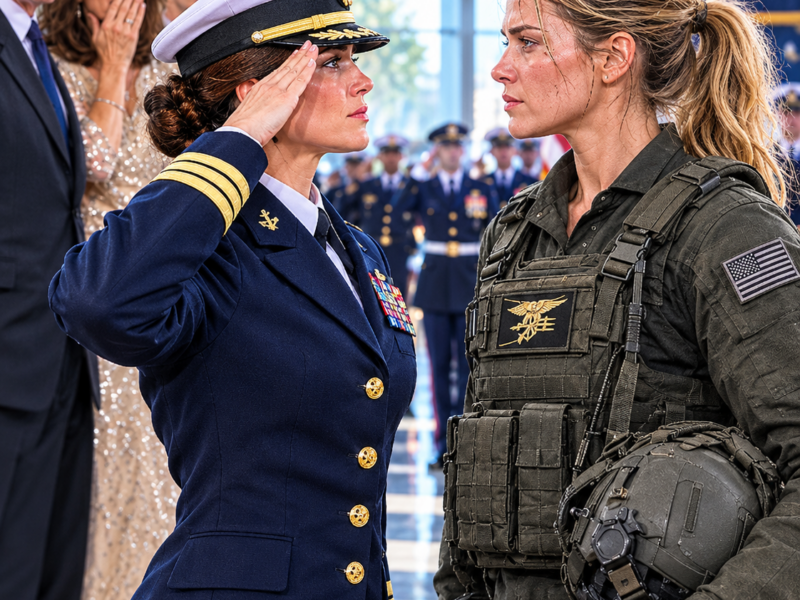
“I was standing in the middle of my brother’s retirement ceremony at Naval Station Norfolk when his lieutenant commander suddenly stopped in front of me
The envelope trembled slightly in Lieutenant Commander Hayes’s hand.
I recognized the classification marking immediately.
It was not something that belonged at a retirement reception, surrounded by civilians, family members, and officers who had no reason to know what was inside.
I glanced toward the double doors at the back of the hall.
“Lieutenant Commander, where did you get that?”
“From the Naval Special Warfare records office, ma’am.”
“Who authorized its release?”
He hesitated.
“Rear Admiral Whitaker.”
The name made me look at him again.
“Admiral Whitaker is retired.”
“Yes, ma’am. He contacted me three days ago.”
My father stepped closer.
“Would somebody please explain what’s happening?”
I turned toward him.
“Not here, Dad.”
His face reddened.
“Your brother is being honored today. I won’t have some kind of performance taking over his ceremony.”
Daniel looked uncomfortable.
“Claire, maybe you should just tell us what’s going on.”
I looked at the envelope again.
Seven years.
Seven years of believing that the operation in September 2019 had been closed, reviewed, and properly accounted for.
Apparently, someone had been keeping a different record.
“Hayes, I need a private room.”
“Already arranged, ma’am.”
He nodded toward a side corridor.
Before I could move, Daniel stepped between us.
“Wait. This is my retirement ceremony. I think I deserve to know why a Navy officer is addressing my sister like she’s some kind of commanding general.”
Hayes remained professional.
“Sir, your sister holds a command position that deserves the appropriate military courtesies.”
Daniel looked at me.
“You’re a commander?”
“Yes.”
“Since when?”
“Several years.”
He laughed once, but there was no humor in it.
“And you never thought to mention that?”
I met his eyes.
“I tried telling you about my promotion. Mom said you were too busy preparing for your deployment.”
His mouth opened, then closed.
I remembered that phone call clearly.
I’d been sitting in a small office in Virginia, still wearing my uniform after a long day, when I called home.
Mom answered.
I told her I’d been selected for a command assignment.
She asked whether I could help Daniel with his paperwork.
That was the entire conversation.
I hadn’t called again.
“Let’s go,” I told Hayes.
We walked toward the corridor.
Behind us, I heard my mother whisper, “I don’t understand.”
Neither did I.
But I was beginning to suspect that the truth had been deliberately kept from more than just my family.
The private conference room was small, with a long wooden table, four chairs, and a framed photograph of the American flag.
Hayes closed the door.
Daniel followed us inside.
So did Rebecca.
My parents remained outside, although I could hear my mother speaking anxiously to someone in the hallway.
I placed my purse on the table.
“Start from the beginning.”
Hayes set the envelope down.
“On September 17, 2019, your unit conducted an extraction operation in the eastern Mediterranean.”
I nodded.
“I remember.”
“You were the ground commander.”
“I remember that, too.”
Daniel pulled out a chair.
“Wait. You commanded a team overseas?”
I didn’t answer.
Hayes continued.
“The mission involved recovering three American intelligence personnel who had been compromised during an operation.”
I folded my arms.
“Two intelligence officers and one communications specialist.”
“Correct.”
He slid the envelope toward me.
“Your after-action report stated that all three were extracted successfully.”
“That’s what happened.”
“Officially, yes.”
The room became quiet.
I looked at him.
“What does that mean?”
He took a breath.
“One of the personnel was never included in the final recovery record.”
My fingers stopped moving.
“Who?”
Hayes looked at the sealed envelope.
“Major Thomas Bennett.”
I sat down.
Thomas.
I hadn’t heard that name spoken in seven years.
He had been the senior intelligence officer attached to the operation.
A former Marine with a quiet voice, a dry sense of humor, and an irritating habit of drinking coffee that had been sitting on a burner for hours.
He was the reason we’d been able to locate the compromised intelligence team.
He had also been the last person I saw before our extraction helicopter lifted off.
“Thomas was listed as killed in action,” I said.
“Yes, ma’am.”
“His body was never recovered.”
“Correct.”
I stared at the envelope.
“Then what’s this?”
Hayes didn’t answer immediately.
Instead, he pulled out a second document.
It was a copy of an old operational status report.
The date was September 21, 2019.
My eyes moved down the page.
Then I saw it.
A handwritten notation beside Thomas Bennett’s name.
STATUS: RECOVERED. TRANSFER AUTHORIZED.
I read it again.
“No.”
Hayes leaned forward.
“Ma’am?”
“That’s not possible.”
“Why?”
“Because I was the last person who saw him alive.”
I remembered the extraction site.
The air smelled of diesel, dust, and burning metal.
Our communications specialist had been bleeding through a bandage.
The second intelligence officer was barely conscious.
Thomas had stayed behind to help me secure the perimeter.
He’d insisted he was only a few steps behind me.
Then the secondary blast came.
The radio went dead.
When the helicopter returned, there was no sign of him.
I had ordered a second search.
My superior had refused.
We had wounded personnel aboard, fuel limitations, and hostile forces closing in.
I had made the decision to leave.
It was the hardest order I’d ever given.
Three weeks later, I received confirmation that Thomas had been presumed killed.
I had carried that decision for seven years.
And now someone was telling me he’d been recovered.
“Who transferred him?” I asked.
Hayes looked uncomfortable.
“The authorization bears the signature of Colonel Richard Morgan.”
My father’s name.
For a second, I couldn’t process the words.
Then I looked up.
“My father?”
Daniel slowly turned toward the door.
“That’s not possible.”
Hayes placed another document on the table.
“Colonel Morgan was listed as the approving authority for a classified medical evacuation.”
I stood.
“My father wasn’t part of that command.”
“That’s correct.”
“Then why was he signing transfer orders?”
Hayes lowered his voice.
“That’s what Admiral Whitaker has been trying to establish.”
I looked at the document again.
The signature was unmistakable.
My father had been a colonel in the Army before retiring.
He had spent his career in logistics and administrative command.
He knew military procedures.
He knew how records moved.
But he had never been assigned to the operation.
I heard Daniel whisper, “Mom said Dad never had anything to do with your missions.”
I turned toward him.
“Apparently, Mom didn’t know everything either.”
Hayes opened the envelope carefully.
Inside were several printed pages, a photograph, and a handwritten note.
The photograph showed a man sitting in a hospital chair.
His hair was longer than I remembered.
His face was thinner.
But I recognized him immediately.
Thomas Bennett.
He was alive.
My hand went to the edge of the table.
“Where was this taken?”
“At a medical facility in Germany. The photograph is dated February 2020.”
I looked at the picture again.
Thomas was holding a newspaper.
A wedding ring was visible on his left hand.
I had never known he was married.
“Who took it?”
“We believe a medical officer attached to the transfer team.”
“Believe?”
Hayes looked at me.
“Because the original photograph disappeared from the official file.”
I placed it down.
“Where is Thomas now?”
“That’s the difficult part.”
I stared at him.
“He’s missing?”
“Not exactly.”
“Then explain.”
Hayes glanced at Daniel and Rebecca.
“I received a message from Admiral Whitaker saying that Major Bennett had recently contacted him.”
My voice became quieter.
“What did he say?”
“That he wanted to speak with you.”
I closed my eyes.
For seven years, I had wondered whether Thomas had known I was leaving him behind.
Whether he’d understood why I couldn’t bring the helicopter back.
Whether he’d died thinking I’d abandoned him.
Now I was being told he’d survived.
And someone had apparently made sure I never knew.
“Where is he?”
Hayes pulled out his phone.
“Admiral Whitaker gave me an address.”
He wrote it on a small piece of paper.
It was in Norfolk.
Less than twenty minutes from the retirement ceremony.
I looked at the address.
“Why didn’t he contact me directly?”
Hayes hesitated.
“Ma’am, the admiral said there was a reason.”
“What reason?”
He looked down at the document bearing my father’s signature.
“He believed the person responsible for keeping Major Bennett hidden was still close to your family.”
Nobody spoke.
Daniel looked at me.
Then toward the door.
“Are you saying Dad did this?”
I didn’t answer.
Because I didn’t know.
And because the possibility was too painful to consider.
My father had spent years telling me I was selfish.
He had criticized my absences.
He had called my career an escape.
But he had never once asked about the operation that had nearly destroyed me.
Not once.
I gathered the documents.
“Hayes, I need copies of everything.”
“Yes, ma’am.”
“Nobody leaves this room with these papers.”
“Understood.”
I turned toward Daniel.
“I’m going to find out what happened.”
He stood.
“I’m coming with you.”
I looked at him.
“This isn’t your responsibility.”
“She’s my mother. He’s my father. You’re my sister.”
He swallowed.
“And apparently, I don’t know anything about any of you.”
Rebecca placed a hand on his shoulder.
“I’ll come, too.”
I nodded.
Then I looked at Hayes.
“You’re coming.”
“Yes, ma’am.”
When we entered the reception hall, my parents were standing near the buffet.
My mother rushed toward us.
“Claire, what’s happening?”
I looked at her.
“Did you know Dad signed a transfer order for Major Thomas Bennett in September 2019?”
Her face changed.
It was subtle.
A brief tightening around her mouth.
Then she looked at my father.
He didn’t move.
“Richard?”
My father set his glass down.
“I think we need to discuss this somewhere else.”
I felt a chill move through me.
“Why?”
He glanced around the room.
“Because this isn’t the place.”
“That’s what I said seven years ago when I asked you why my operation had been sealed.”
He looked directly at me.
For the first time that afternoon, he didn’t have an immediate answer.
Daniel stepped closer.
“Dad, did you know someone survived that operation?”
My father looked at him.
“Daniel, stay out of this.”
“No.”
My brother’s voice was firm.
“You’ve spent my entire life telling me to respect the uniform. I just retired after twenty-two years. I think I can ask you one question about what happened to my own sister.”
My father looked toward the other guests.
Then he walked toward the exit.
“Come with me.”
I followed him outside.
The November air was cold enough to sting my cheeks.
A row of cars lined the parking lot.
My mother came behind us, holding her coat closed.
My father stopped near his vehicle.
“Thomas Bennett was never supposed to come back into your life.”
The words landed harder than any explanation could have.
I stared at him.
“What?”
He rubbed his forehead.
“You don’t understand the circumstances.”
“Then help me understand.”
He looked toward Hayes.
“Is he still in possession of those documents?”
“Yes, sir.”
“Then he shouldn’t be.”
Hayes remained silent.
I stepped forward.
“Don’t you dare try to turn this into a records issue.”
My father looked at me.
“You have no idea what you’re dealing with.”
“Then tell me.”
He glanced at my mother.
She was crying now.
Not loudly.
Just standing there with tears running down her face.
“Richard,” she whispered.
He ignored her.
“Thomas was compromised. His extraction was never officially authorized.”
I shook my head.
“I was there. I ordered the extraction.”
“You ordered the recovery of the three personnel listed in your mission brief.”
“Thomas was part of that mission.”
“Not in the way you think.”
I stared at him.
“What does that mean?”
My father looked at the parking lot.
Then back at me.
“Thomas had been passing information to an outside intelligence network.”
The words sounded absurd.
“That’s a lie.”
“His communications were flagged before the operation.”
“Then why was he attached to my team?”
“Because we needed to know who else was involved.”
I felt my throat tighten.
“You used my unit to retrieve him?”
“No.”
“Then why did you sign the transfer?”
He didn’t answer.
I took another step closer.
“Did you know he was alive?”
My father finally looked at me.
“Yes.”
The parking lot seemed suddenly enormous.
I heard a car door slam somewhere behind us.
A few guests were leaving the ceremony.
But all I could hear was that one word.
Yes.
“How long?”
He swallowed.
“Seven years.”
I stared at him.
Seven years of birthdays.
Seven years of holidays.
Seven years of phone calls where my mother asked whether I was eating properly and my father asked when I planned to find a real job.
Seven years of carrying the memory of leaving a man behind.
And my father had known.
“Why?”
He looked away.
“Because bringing him back would have exposed information that could have endangered people.”
“Which people?”
“I can’t tell you.”
“Did Thomas betray us?”
My father hesitated.
That hesitation told me more than his answer would have.
“I believed he did,” he said.
I stepped back.
“You believed?”
“Claire, the intelligence was complicated.”
“And you let me spend seven years believing I had abandoned a man who was already safe.”
His face hardened.
“You made the decision to leave him.”
I looked at him.
There it was.
The familiar attempt to shift the weight onto me.
“You signed the order that concealed his recovery.”
“I did what I thought was necessary.”
“Without telling me.”
“You were emotionally involved.”
I almost laughed.
“Emotionally involved?”
“You trusted him.”
“He was my teammate.”
“He was a liability.”
I looked toward my mother.
She was still crying.
“Did you know?”
She shook her head quickly.
“Not everything.”
“That’s not an answer.”
“I knew your father had been involved in something. He told me it was confidential.”
“Did you know Thomas was alive?”
She looked at the ground.
Then whispered, “I found out two years ago.”
My chest tightened.
“Two years?”
She nodded.
“He called the house.”
My father turned sharply.
“Patricia.”
She flinched.
I looked at her.
“What did he say?”
Her voice trembled.
“He asked whether you were still in Virginia. He said he needed to speak with you.”
“Why didn’t you tell me?”
She wiped her cheeks.
“Your father said it would put you in danger.”
I turned toward him.
“And you believed him?”
She looked at me helplessly.
“I was afraid.”
I didn’t know what to say.
For years, my mother had been the person I called when I couldn’t sleep.
She had sent me birthday cards overseas.
She had mailed cookies to a base in Afghanistan.
She had told me she missed me.
And when she learned that the man I’d believed dead was alive, she said nothing.
Daniel was standing several feet away.
His face had gone pale.
“Mom, you knew?”
She looked at him.
“I didn’t know what to do.”
He shook his head.
“You could have told us.”
My father raised his voice.
“Enough.”
I looked at him.
“No. We’re not finished.”
He stepped closer.
“Claire, listen to me. Thomas’s survival was part of a classified counterintelligence investigation. You had no clearance to access the details.”
I looked at Hayes.
He hadn’t moved.
“Is that true?”
Hayes answered carefully.
“Commander Morgan held the appropriate operational clearance at the time. The investigation’s existence was never disclosed to her.”
My father closed his eyes.
I nodded slowly.
“So you kept me out of an investigation involving my own mission.”
“To protect you.”
“From what?”
He didn’t answer.
Then Hayes spoke.
“Ma’am, Admiral Whitaker’s instructions were specific. He wanted you to hear Major Bennett’s account before making any decisions about the operation.”
My father looked at him.
“Where is he?”
Hayes glanced at the address in my hand.
“At the residence listed here.”
My father took a step forward.
“You can’t go there.”
I met his eyes.
“Watch me.”
He lowered his voice.
“If you see him, you may not like what he has to say.”
I folded the paper and placed it in my purse.
“I’ve spent seven years living with what I thought he had to say.”
Then I walked away.
Daniel followed.
Rebecca came after him.
Hayes opened the passenger door of his vehicle.
My mother called my name.
I stopped, but I didn’t turn around.
“Claire, please.”
Her voice broke.
“I never wanted to hurt you.”
I looked over my shoulder.
“I know, Mom.”
It was the truth.
But it wasn’t forgiveness.
Not yet.
The address led us to a modest brick house in a quiet Norfolk neighborhood.
There were two cars in the driveway.
A small American flag hung beside the front porch.
I sat in the passenger seat for nearly a minute before getting out.
My hands were shaking.
Daniel stood beside me.
“Do you want me to come in?”
I looked at him.
“Yes.”
He nodded.
Hayes remained in the vehicle.
“I’ll wait here, ma’am.”
I walked up the front steps.
Before I could knock, the door opened.
A woman in her late thirties stood in the doorway.
She had dark hair pulled into a loose ponytail and wore a gray sweater.
She looked at me for several seconds.
Then she smiled sadly.
“Claire Morgan?”
“Yes.”
“I’m Emily Bennett.”
I glanced at the wedding ring in the photograph I’d seen earlier.
“Thomas’s wife?”
She nodded.
“Come in.”
The living room was warm.
A child’s drawing was attached to the refrigerator with a magnet.
There were family photographs on the wall.
One showed Emily standing beside a man in a baseball cap.
Thomas.
He looked older, but the smile was unmistakable.
I stared at the photograph.
Emily followed my gaze.
“He’s in the study.”
I turned toward her.
“Is he all right?”
She paused.
“He’s been waiting a long time for this.”
Then she opened the door.
Thomas sat beside a desk near the window.
His left leg was supported by a brace.
His hair had turned almost completely gray.
There was a thin scar running from his temple toward his jaw.
But his eyes were the same.
For several seconds, neither of us spoke.
Then he looked at me and smiled faintly.
“Still drinking terrible coffee, Commander?”
I pressed my lips together.
The sound that came out of me was somewhere between a laugh and a sob.
“You’re alive.”
He nodded.
“Last time I checked.”
I crossed the room.
I wanted to ask a hundred questions.
Instead, I stood in front of him.
“Why didn’t you contact me?”
His smile disappeared.
“I tried.”
“Not hard enough.”
He looked down.
“You’re right.”
The answer caught me off guard.
I pulled out a chair.
“Tell me what happened.”
Thomas looked toward Emily.
She nodded and quietly closed the door behind her.
He folded his hands.
“Before I tell you about the operation, you need to know something about your father.”
I leaned forward.
“I know enough.”
“No, Claire. You know what he did to you. You don’t know why he did it.”
I stared at him.
“Then tell me.”
Thomas took a breath.
“Your father wasn’t protecting a secret about me. He was protecting a secret about the person who ordered the operation.”
I felt my shoulders tighten.
“Who?”
He reached into the desk drawer and removed a small black notebook.
It was old, its corners worn, with a faded strip of tape along the spine.
“I kept this because I knew one day someone would need to see it.”
He placed it between us.
I opened the cover.
The first few pages contained dates, names, and operational notes.
Then I saw a familiar signature.
Colonel Richard Morgan.
But it wasn’t the only one.
Beneath it was the signature of a senior intelligence official.
A man whose name appeared in my original mission authorization.
Thomas tapped the page.
“Your father didn’t initiate the investigation, Claire. He was ordered to conceal what happened.”
I looked up.
“By whom?”
He turned the notebook around.
I read the name.
Rear Admiral Whitaker.
For a moment, the room felt very small.
“Whitaker?”
Thomas nodded.
“He’s the reason I survived. He’s also the reason I disappeared.”
I sat back.
“That doesn’t make sense.”
“It will.”
Thomas opened the notebook to a page dated September 14, 2019.
Three days before our operation.
He pointed to a line of text.
“Your mission was designed around the recovery of two intelligence officers. The communications specialist was added later.”
I frowned.
“That’s not what my briefing said.”
“I know.”
“Thomas, I personally reviewed the mission brief.”
“And someone changed it before it reached you.”
I studied the notes.
“Why?”
“Because the communications specialist was carrying evidence of an unauthorized intelligence transfer.”
I remembered the man we’d extracted.
His name had been Michael Reeves.
He’d been injured during the operation.
I’d ordered him stabilized first.
Thomas continued.
“The evidence implicated an outside contractor and several senior officers. Your unit was supposed to retrieve the personnel and the data before anyone could destroy it.”
I looked at the notebook.
“And you?”
“I was the one who discovered the transfer.”
“Then why did the report say you were compromised?”
“Because I refused to hand over the evidence to the people who were involved.”
I felt my jaw tighten.
“Who was involved?”
Thomas hesitated.
“One of the senior officers was Whitaker.”
I looked at him.
“Then why did he help you?”
“Because he realized too late that the operation had been manipulated by someone above him.”
“Who?”
Thomas didn’t answer.
Instead, he opened the notebook to another page.
There was a list of names.
Beside several of them were dates and handwritten notes.
One name had been circled.
Colonel Richard Morgan.
I stared at it.
“You’re telling me my father was involved?”
“No.”
Thomas shook his head.
“He was the person who helped me survive.”
I frowned.
“Then why conceal me?”
“Because I had evidence that could destroy the careers of several people, and your father was ordered to keep that evidence from being traced.”
“By Whitaker?”
Thomas nodded.
“At first, he believed he was protecting national security. Later, he discovered the investigation had been compromised.”
I thought of my father’s face in the parking lot.
His fear.
His anger.
His insistence that I shouldn’t see Thomas.
“What happened after you were recovered?”
Thomas leaned back carefully.
“I was taken to Germany. I spent months in medical treatment. My injuries were severe, and my memory was unreliable for a while.”
He paused.
“When I recovered, I was told the official record listed me as dead.”
“Why didn’t you challenge it?”
“I did.”
“And?”
“They told me that if I made contact with you, your unit would be pulled into an investigation that had already cost people their careers.”
I stared at him.
“So you stayed silent?”
“I thought I was protecting you.”
I looked toward the window.
Outside, a young boy rode a bicycle along the sidewalk.
A dog barked somewhere down the street.
Ordinary life continued.
Meanwhile, I had spent seven years carrying a decision that wasn’t what I believed it to be.
Thomas reached for the notebook.
“There’s something else.”
I turned back.
He removed a folded sheet of paper from the back cover.
It was a handwritten statement.
My name appeared at the top.
Below it was a detailed account of the extraction.
I began reading.
The report described the moment the helicopter left the landing zone.
It described the secondary blast.
It described the order I had given to return for the missing personnel.
Then I reached the final paragraph.
“Commander Morgan demonstrated sound judgment under operational pressure and acted in accordance with the mission’s primary objective.”
I read the sentence twice.
I looked at Thomas.
“You wrote this?”
He nodded.
“I submitted it before they told me the investigation was closed.”
I swallowed.
“Then why was it never included in my file?”
“Because someone removed it.”
“Who?”
Thomas looked at me.
“I don’t know.”
I sat quietly.
Then he said something that hurt more than I expected.
“Claire, I never blamed you for leaving.”
My eyes burned.
“I ordered the helicopter to leave.”
“You had wounded people aboard.”
“I could have gone back.”
“Maybe. But you had people depending on you.”
He leaned forward.
“Do you remember what I told you before the extraction?”
I looked at him.
I remembered the radio crackling.
The smoke.
His hand gripping my shoulder.
But I couldn’t remember his exact words.
Thomas smiled.
“I told you to get them home.”
My throat tightened.
“You said you’d be right behind me.”
“I intended to be.”
He looked down at his leg.
“Things didn’t go according to plan.”
For a moment, the room was silent.
Then I asked the question I’d been carrying for seven years.
“Why did you want to see me now?”
Thomas looked toward the door.
“Because Whitaker is dying.”
I frowned.
“What?”
“He has terminal cancer. He contacted me six weeks ago. He wants the truth documented before he dies.”
I looked at the notebook.
“And my father?”
Thomas nodded.
“He has a copy of the original investigation.”
“Where?”
“In his house.”
I sat up.
“Then why hasn’t he released it?”
Thomas looked at me.
“Because the document names the people responsible. And one of them is still serving.”
The room seemed to tilt slightly.
“Who?”
Thomas hesitated.
Then he said, “Admiral Charles Whitaker wasn’t the only person involved. The final authorization came from someone in the Secretary of Defense’s office.”
I looked at him.
“You’re saying this goes that high?”
“I’m saying the people who altered the mission brief had access to information that should never have been shared.”
He slid the notebook toward me.
“There’s enough here to reopen the investigation.”
I looked at the signatures again.
Then at the photograph of Thomas.
For the first time in seven years, I understood that the operation had not simply gone wrong.
Someone had arranged for it to go wrong.
And my father had been caught in the machinery afterward.
But there was still one question I couldn’t let go.
“Thomas, did you ever find out who leaked the location?”
He looked at me for a long time.
Then he reached into his desk and removed a small envelope.
“I found this in the medical records when I was transferred to Germany.”
He placed it on the table.
The envelope contained a photocopy of a message.
It was a short communication sent forty-eight hours before the operation.
The recipient list included three senior officers.
I recognized two names.
The third made my fingers go numb.
Daniel Morgan.
My brother.
I stared at the page.
“No.”
Thomas didn’t look away.
“I know.”
“Daniel was never assigned to that operation.”
“I know.”
“He was stationed in San Diego.”
“I know.”
I shook my head.
“Then why is his name here?”
Thomas leaned forward.
“Because someone used his credentials to access the mission schedule.”
I looked at the timestamp.
September 15, 2019.
Two days before we deployed.
I remembered Daniel calling me that week.
He’d asked whether I was going overseas.
I’d told him I couldn’t discuss details.
He’d laughed and said he was only asking because Mom wanted to know when I’d be home.
I had thought nothing of it.
Now the memory sat differently.
I stood.
“I need to talk to him.”
Thomas nodded.
“I expected you would.”
I took the photocopy.
My hands were steady now, although my stomach felt hollow.
When I returned to the living room, Daniel was standing beside the window.
He looked at my face.
“What happened?”
I held out the document.
“Tell me why your credentials were used to access my mission schedule two days before the operation.”
He read the page.
His expression changed.
Then he sat down.
“I didn’t do this.”
“I didn’t say you did.”
“Claire, I swear.”
I watched him carefully.
“Did you give anyone your login?”
He shook his head.
“No.”
“Did anyone have access to your workstation?”
He hesitated.
“Possibly.”
“Who?”
Daniel rubbed his hands together.
“At the time, I was working on a joint logistics assignment. There was a civilian contractor who needed access to a scheduling system.”
“What was his name?”
He looked at me.
“Martin Cole.”
I waited.
Daniel swallowed.
“Mom’s cousin.”
I stared at him.
My mother’s cousin, Martin, had worked for a defense contractor for years.
I’d met him at family gatherings.
He was the sort of man who remembered everyone’s birthday and always asked whether the military was treating me well.
My mother had once called him the most dependable person in the family.
“Why would he need your credentials?”
Daniel shook his head.
“He said his access was delayed. He needed to verify a shipment schedule.”
“And you gave him your login?”
“I thought it was temporary.”
I stared at him.
“Daniel.”
“I know.”
He looked down.
“I was a lieutenant then. I was trying to get a project approved. He told me it would save weeks of paperwork.”
“Did you ever report it?”
“No.”
I sat opposite him.
“Why?”
He rubbed his forehead.
“Because I knew I shouldn’t have done it.”
The answer was quiet.
And believable.
My brother had not necessarily betrayed me.
But he had made a careless decision that someone else had used to endanger my team.
“Did you tell Dad?”
Daniel shook his head.
“No.”
“Did Martin ever mention the operation?”
He looked up sharply.
“Actually, yes.”
I waited.
“He called me the day after you deployed. He asked whether everything had gone according to schedule.”
My stomach tightened.
“What did you tell him?”
“Nothing. I told him I didn’t know anything.”
Daniel looked at me.
“I thought it was just a weird question.”
I closed my eyes briefly.
Martin had known about the operation.
And he’d had access to Daniel’s credentials.
I looked toward Hayes, who had entered the living room behind us.
“Lieutenant Commander, I need you to contact Admiral Whitaker.”
Hayes nodded.
“Yes, ma’am.”
“Tell him we have a possible source of the credential breach.”
“Understood.”
I looked at Daniel.
“You’re going to need to make a formal statement.”
He nodded slowly.
“I will.”
For the first time that day, I saw something different in my brother’s face.
Not jealousy.
Not defensiveness.
Shame.
“I’m sorry,” he said.
I looked at him.
“I believe you.”
He blinked.
“You do?”
“Yes. But believing you doesn’t make what happened harmless.”
He nodded.
“I know.”
We left Thomas’s house shortly before midnight.
I had the notebook, the copied statement, and the photograph of Thomas.
Daniel drove behind Hayes’s vehicle.
My phone rang as we approached the highway.
The caller ID showed an unknown number.
I answered.
“Commander Morgan.”
A man’s voice came through.
“Claire, it’s Richard.”
My father.
I didn’t speak.
“I need you to come home.”
“I’m not coming anywhere with you.”
“Please.”
Something in his voice was different.
The anger was gone.
So was the certainty.
“Your mother found something.”
“What?”
“The original file.”
I gripped the phone.
“Where?”
“In my study.”
“Why are you calling me?”
He was silent for a moment.
Then he said, “Because I think it’s time you knew what I actually did.”
I looked at the road ahead.
“Are you going to tell me the truth?”
“Yes.”
“All of it?”
Another pause.
“All of it.”
I ended the call.
Daniel pulled alongside us at a red light.
He rolled down his window.
“Was that Dad?”
I nodded.
“What did he want?”
I looked at the folded document in my lap.
“To talk.”
Daniel stared ahead.
“Are you going?”
I watched the traffic light turn green.
“Yes.”
The house was dark when we arrived.
My mother opened the door before I could knock.
She looked exhausted.
Her eyes were swollen, and her hair was tied back loosely.
“He’s in the study,” she said.
I walked down the hallway.
The family photographs were still hanging on the walls.
There was one from my high school graduation.
Daniel stood beside me, smiling.
My father had his hand on my shoulder.
I remembered being proud of that picture.
Now I wondered how many things in that house had been hiding a different story.
My father sat behind his desk.
A thick folder lay in front of him.
He looked older than he had that afternoon.
“Sit down, Claire.”
I remained standing.
“Talk.”
He nodded.
Then he opened the folder.
Inside were copies of classified communications, transfer orders, and several handwritten notes.
“I was contacted three days after the operation,” he began.
“By Whitaker?”
“Yes.”
“He told you Thomas was alive?”
“Yes.”
“Why didn’t he tell me?”
My father looked down.
“Because Thomas had evidence that could implicate senior officers in an unauthorized intelligence operation.”
“That still doesn’t explain why you hid him.”
He took a breath.
“Whitaker believed there was a leak inside the intelligence chain. He wanted to protect Thomas until the source could be identified.”
“And you agreed.”
“I did.”
“Why?”
“Because the evidence included names of people who had access to classified mission information. Some of those people had influence over promotions, assignments, and investigations.”
I stared at him.
“Did you know about Martin Cole?”
He nodded.
“I learned about him later.”
“How much later?”
“Several months.”
I felt anger rise in my chest.
“Then why didn’t you tell me?”
“Because the investigation was still active.”
“Seven years, Dad.”
He closed his eyes.
“I know.”
I looked at the folder.
“What did you actually do?”
He turned one document toward me.
It was a formal transfer authorization.
His signature appeared at the bottom.
“I arranged Thomas’s medical evacuation under a restricted identity. I believed it was temporary.”
“And then?”
“Then the investigation became politically complicated. People began disappearing from their positions. Records were altered. Whitaker was pressured to close the case.”
“Who pressured him?”
My father looked at me.
“Martin Cole’s company had contracts with several agencies. He wasn’t acting alone.”
“Who else?”
He slid another document across the desk.
There were three names.
One was Martin Cole.
Another was a senior intelligence official.
The third was a civilian executive connected to the contractor.
I recognized the name from the original mission authorization.
My father spoke quietly.
“Whitaker eventually discovered that the operation had been manipulated to recover evidence, not personnel.”
I looked up.
“What?”
“Someone knew your team would be sent into a compromised area. They wanted the communications specialist and the data he carried.”
I felt my stomach tighten.
“And Thomas?”
“He discovered the plan. He tried to stop it.”
I remembered the blast.
The smoke.
The radio cutting out.
The helicopter lifting away.
My father continued.
“Thomas was injured while protecting the evidence. Whitaker arranged his recovery. I helped keep him hidden because we didn’t know who else was involved.”
I looked at him.
“Then why did you let me believe he was dead?”
He didn’t answer immediately.
Then he said, “Because I was afraid.”
It was the first honest sentence I’d heard from him that day.
“Afraid of what?”
“That if I told you, you would go looking for the truth.”
I stared at him.
“Of course I would.”
“I know.”
“And you thought lying to me was better?”
He lowered his head.
“I thought keeping you alive was more important than keeping you happy.”
I shook my head.
“You didn’t keep me safe, Dad. You left me alone with something that wasn’t mine to carry.”
His face crumpled slightly.
“I know.”
I had expected him to defend himself.
To mention duty.
To talk about classified information and difficult decisions.
Instead, he sat behind his desk, looking like a man who had finally run out of reasons.
My mother entered quietly.
She placed a glass of water beside me.
Then she looked at my father.
“Tell her the rest.”
He glanced at her.
“Patricia.”
“No,” she said.
“She deserves to know.”
My father opened the folder again.
He removed a handwritten letter.
The paper was creased and yellowed.
“I wrote this seven years ago,” he said.
I took it.
The first line was addressed to me.
Claire,
If you ever learn what happened, you may never forgive me.
I stopped reading.
My father looked at the floor.
“I wanted to give it to you. Every year, I thought about it.”
“Why didn’t you?”
“Because I was ashamed.”
I looked at him.
“That didn’t stop you from criticizing my career.”
He nodded.
“I know.”
I folded the letter.
For a long moment, none of us spoke.
Then my father stood.
“I can’t undo what I did.”
“No.”
“But I can give you everything I have.”
He pushed the folder toward me.
“Every document. Every name. Every communication.”
I looked at the papers.
This was the evidence that could reopen the investigation.
It was also the evidence that could destroy my father’s reputation.
I understood then why he had hesitated.
He wasn’t simply afraid of losing his position.
He was afraid of becoming the man his daughter could no longer respect.
I gathered the folder.
“You’re going to provide a sworn statement.”
He nodded.
“Yes.”
“And you’ll tell the investigators exactly what happened.”
“Yes.”
I studied his face.
“Even if it means consequences?”
He looked at me.
“Especially then.”
The following weeks were difficult.
The Navy’s investigative authorities reopened the case.
Thomas provided his testimony.
My father submitted his records and admitted his role in the concealment.
Daniel gave a formal statement about the credentials he’d shared with Martin Cole.
It was painful watching my brother explain how a shortcut he’d taken years earlier had been used in a classified operation.
He never tried to excuse it.
He accepted the investigation’s findings and the professional consequences that followed.
Martin Cole was eventually arrested after investigators uncovered additional evidence connecting him to unauthorized disclosures and fraudulent contracting activity.
The investigation also exposed a broader network of people who had manipulated access to classified operational information.
Some resigned.
Others faced criminal charges.
Rear Admiral Whitaker gave his final testimony from a hospital room.
He died three weeks later.
Before he passed, he sent me a short handwritten note.
It contained only one sentence.
“Commander Morgan, you were never supposed to carry the blame for what happened that night.”
I kept it.
Not because it changed the past.
But because, after seven years, someone had finally put the truth into words.
Thomas recovered enough to attend a small ceremony honoring the personnel involved in the original extraction.
His walking was still difficult.
He used a cane.
But when he entered the room, I stood and greeted him.
This time, there were no secrets between us.
My father attended, too.
He stood at the back, wearing a dark suit.
He didn’t approach me until the ceremony was over.
“Claire.”
I turned.
He looked at Thomas, then back at me.
“I owe you an apology.”
I waited.
“I made decisions that weren’t mine to make. I told myself I was protecting you, but I was protecting myself from the consequences of telling you the truth.”
He swallowed.
“I don’t expect you to forgive me.”
I looked at the man who had taught me how to tie my shoes, how to drive, and how to stand straight when I was nervous.
For years, I’d wanted him to be proud of me.
Now I understood that his pride was no longer something I could build my life around.
“I don’t know if I can forgive you yet,” I said.
He nodded.
“But I don’t want to spend the rest of my life carrying anger for you either.”
His eyes filled.
“That’s fair.”
I looked toward Thomas, who was speaking with Daniel.
“Trust takes longer to rebuild than it takes to break.”
“I understand.”
I wasn’t sure he did.
But for once, I didn’t feel responsible for making him understand everything.
My relationship with Daniel changed, too.
We began talking more honestly.
Not about medals or promotions.
About the mistakes we’d made, the things we’d lost, and the years we’d spent trying to earn approval from the same two people.
One evening, several months later, he called me.
“Hey, Claire.”
“Hey.”
“Do you remember when Mom used to say you never finished anything?”
I laughed softly.
“Unfortunately.”
“I think she owes you an apology.”
“She does.”
He was quiet.
Then he said, “I’m proud of you.”
I looked out my apartment window at the lights of Norfolk.
“Thank you.”
He cleared his throat.
“I should’ve said it a long time ago.”
“Yes, you should have.”
He laughed.
I did, too.
It wasn’t a perfect reconciliation.
But it was a beginning.
My mother started calling more often.
At first, our conversations were awkward.
She would ask about the weather or whether I’d eaten dinner.
Sometimes she would apologize.
Sometimes she would simply stay on the phone long enough for the silence to become comfortable.
I let her.
Forgiveness wasn’t a switch I could turn on because someone finally admitted they were wrong.
It was something I would decide for myself, one honest conversation at a time.
The following spring, I visited Thomas and Emily.
Their son was playing in the backyard.
He had a baseball glove almost as large as his head.
Thomas sat on the porch, watching him.
I lowered myself into the chair beside him.
“How’s the leg?”
“Still attached.”
I smiled.
“Good sign.”
He handed me a cup of coffee.
I took one sip and made a face.
“Thomas, this is terrible.”
He grinned.
“Some things never change.”
We watched his son chase a ball across the grass.
After a while, Thomas spoke.
“Do you still think about that night?”
“Sometimes.”
“Do you still blame yourself?”
I looked at the child running toward his father.
“No.”
Thomas nodded.
“Good.”
I turned toward him.
“I think about it differently now.”
“How?”
“I remember the people who made it home. I remember the decisions I had to make. And I remember that I did the best I could with what I knew.”
He smiled.
“That’s all any of us can do.”
A few months later, Daniel invited me to another family gathering.
It wasn’t a military ceremony.
There were no speeches, no framed photographs, and no rows of officers.
Just a backyard barbecue, folding chairs, and my mother’s slightly overcooked hamburgers.
My father stood near the grill.
When I arrived, he walked over.
“Claire.”
“Hi, Dad.”
He looked at me for a moment.
Then he held out a small box.
I opened it.
Inside was an old photograph of me in my first military uniform.
I was barely twenty, standing beside a transport aircraft, my hair pulled back tightly and my expression serious.
On the back, my father had written something.
I turned it over.
“I should have been proud of you then, too.”
I read the sentence twice.
Then I closed the box.
“Thank you.”
He nodded.
He didn’t ask for forgiveness.
He didn’t tell me how much he’d suffered.
He simply stepped aside and let me walk into the backyard.
For the first time, that was enough.
Later, as the sun began to set, Daniel raised a glass.
“To family,” he said.
Everyone lifted theirs.
I looked around the yard.
My mother was laughing with Rebecca.
My father was listening to Thomas tell a story.
Daniel stood beside me.
Nothing was perfect.
Some things would never be the same.
But the truth was no longer hidden behind a sealed envelope or a carefully rehearsed explanation.
I had spent years believing that my greatest failure was the night I left a man behind.
Now I knew the truth.
My greatest mistake would have been allowing someone else’s silence to define the rest of my life.
I looked down at the photograph in my hands.
The young woman in uniform was still standing straight, still looking ahead, still waiting for someone to tell her she had done enough.
I wished I could go back and tell her something.
That she didn’t need to earn the right to be respected.
That her service mattered, even when nobody at home understood it.
And that sometimes the people who love us can hurt us deeply without ever understanding the weight of what they’ve done.
Across the yard, my father caught my eye.
He raised his glass slightly.
I returned the gesture.
It wasn’t absolution.
It wasn’t forgetting.
It was simply the first honest peace we’d shared in a very long time.
The end.









