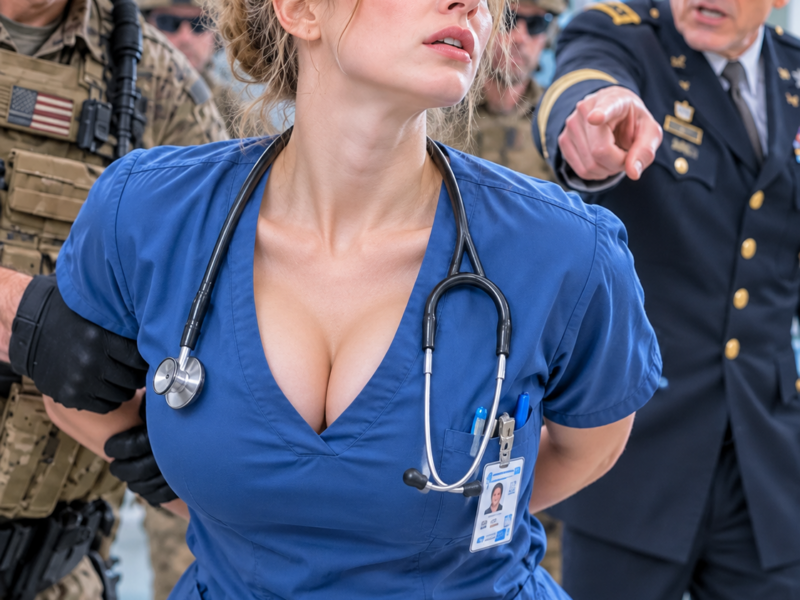
“I was standing in the middle of a military hospital when a colonel slammed a bloodstained surgical report onto the table and demanded to know
I stared at the colonel, waiting for him to explain what he meant.
Nobody in the room moved.
Dr. Carter had gone pale, and the medical records officer was holding the folder so tightly that the edges bent beneath his fingers.
“Colonel,” Dr. Carter finally said, “I think we’re getting ahead of ourselves.”
Colonel Hayes didn’t even turn toward him.
“That’s an interesting thing to say, Doctor. Especially considering you’ve spent the last three weeks trying to prevent this investigation.”
“That’s not true.”
“Then you won’t mind explaining why the original surgical report disappeared from the hospital archive.”
Dr. Carter’s mouth opened, but no words came out.
I looked down at Major Reed’s signature again.
Six years earlier, I had promised that man I would never use the skills he taught me unless someone had absolutely no other chance of surviving.
He had made me repeat that promise twice.
At the time, I thought he was simply being strict.
Now I wondered whether he had been afraid of something.
“Colonel,” I said, “I need to know what happened to Major Reed.”
Hayes studied me for a moment.
“That’s why I’m here.”
He gestured toward the conference room door.
“Come with me. Both of you.”
Dr. Carter shifted in his chair.
“Sir, I have patients to see.”
“You’ll have time for that after we finish.”
The colonel picked up the folder and walked out.
I followed him, but before I reached the doorway, Peter Lawson quietly caught my sleeve.
“Emily.”
I turned.
His face looked different from the frightened expression he’d worn earlier.
There was guilt in it.
“Don’t sign anything,” he whispered.
“What are you talking about?”
He glanced toward Dr. Carter, then lowered his voice.
“They’ve been looking for that training file for months.”
Before I could ask another question, he stepped away.
I followed the colonel down a long corridor toward the administrative wing.
The building smelled of disinfectant and burnt coffee.
Outside, the November rain tapped against the windows.
Hayes led us into a small interview room with a conference table and three chairs.
He closed the door.
“Sit down, Emily.”
I remained standing.
“I’d rather know why my name is in a classified military record.”
The colonel nodded as if he had expected that answer.
“Fair enough.”
He placed the photograph of Daniel Brooks on the table.
Then he removed another photograph from the folder.
It showed Major Thomas Reed standing beside a group of military medical personnel.
I was in the picture.
Younger, thinner, with my hair pulled back and a look of exhaustion that I remembered well.
I hadn’t seen that photograph since the day it was taken.
“Where did you get this?” I asked.
“From Reed’s personal records.”
I touched the corner of the photograph.
“Why was it classified?”
“Because Major Reed wasn’t simply training medical personnel.”
He paused.
“He was part of a special military trauma program designed for situations where conventional medical support was unavailable.”
I remembered those training sessions.
The abandoned warehouse outside Fort Bragg.
The makeshift operating tables.
The exercises conducted with the lights switched off.
The long nights when Reed would place unfamiliar instruments in my hands and ask me to identify them without looking.
He never called it a special program.
He called it preparation.
“How many people were involved?” I asked.
“Seven.”
I looked at the photograph again.
There were six other people standing behind me.
I recognized three.
One had died during deployment.
Another had retired.
The third was Peter Lawson’s former supervisor.
“What happened to them?”
“That’s what we’re trying to establish.”
Colonel Hayes leaned forward.
“Six months ago, Major Reed was killed in what was officially described as a vehicle accident.”
I swallowed.
“I know. I attended his funeral.”
“Did you know he had requested a meeting with military investigators two days before his death?”
“No.”
“Did you know he had sent several encrypted files to a secure military account?”
I shook my head.
“Or that those files disappeared shortly after his death?”
The room seemed smaller.
I looked at Daniel’s photograph.
“Why is Sergeant Brooks connected to this?”
Hayes opened the folder.
“Because Daniel was part of a reconnaissance unit that discovered an illegal medical supply operation during an overseas deployment.”
“Illegal supplies?”
“Medical equipment, blood products, surgical materials. Items that were supposed to be delivered to field hospitals but were diverted elsewhere.”
I felt my stomach tighten.
“Who was responsible?”
“We don’t know yet. But the operation involved people with access to military medical logistics.”
The colonel tapped the photograph.
“Daniel’s unit found evidence. Before they could report it, they were ambushed.”
I remembered Daniel gripping my wrist in the emergency room.
Not all of them.
“Did he know who attacked his unit?”
“He believes he did.”
“Who?”
Hayes didn’t answer.
Instead, he opened a second folder and removed a printed email.
The sender’s name had been blacked out.
The subject line read: MEDICAL TRANSFER — PRIORITY.
The date was the same day Daniel had been injured.
Below it was a list of names.
One of them was Dr. Michael Carter.
I looked toward the colonel.
“He’s involved?”
“We’re investigating.”
“Why haven’t you arrested him?”
“Because suspicion isn’t evidence.”
I thought about the missing report, the pressure to change my documentation, and the way Carter had described my involvement as an exaggeration.
“Then what do you need from me?”
Hayes rested both hands on the table.
“Your memory of that operation. Every detail.”
I sat down.
For the next hour, I described the blackout.
The failed generator.
The instruments I had used.
The moment Daniel’s blood pressure began dropping.
The exact position of Dr. Carter when I asked for the vascular clamp.
Hayes wrote everything down.
When I finished, he asked one question.
“Did Dr. Carter leave the operating room at any point?”
I closed my eyes, trying to remember.
The lights had gone out.
Someone had moved toward the door.
There had been a metallic sound near the instrument table.
Then a voice.
“I’ll get the backup equipment.”
I opened my eyes.
“Yes.”
“Who?”
“I thought it was one of the residents.”
“Was it Dr. Carter?”
I wasn’t sure.
I remembered the sound of his shoes moving away.
I remembered his voice becoming distant.
But the room had been chaotic.
“I can’t say for certain.”
Hayes nodded.
“That’s fine.”
He closed his notebook.
“There’s one more thing.”
He took a small evidence envelope from his briefcase.
Inside was a silver military identification tag.
Major Thomas Reed’s name was engraved on it.
I reached for the envelope.
“Where did you find this?”
“It was recovered from a storage locker registered to Reed.”
“Why are you showing me?”
“Because there’s a recording attached to it.”
My fingers stopped.
“What recording?”
The colonel opened his laptop.
A small audio file appeared on the screen.
The recording began with static.
Then I heard a familiar voice.
Major Reed.
“Emily, if you’re hearing this, something has happened, and I wasn’t able to explain it to you in person.”
I covered my mouth.
His voice was older than I remembered.
Tired.
But unmistakably his.
“I need you to understand something. The work we did wasn’t about making nurses into surgeons. It was about teaching people to keep others alive when the system around them failed.”
A brief pause followed.
Then he continued.
“Some people learned that skill for the wrong reasons.”
I looked at Colonel Hayes.
He was watching me carefully.
Reed’s voice returned.
“There’s a file hidden in the place where we first trained. The original records are inside. If anyone asks you to sign a statement saying you acted alone, don’t do it.”
The recording ended.
I sat motionless.
The place where we first trained.
The warehouse.
“Why didn’t you tell me this before?” I whispered.
Hayes closed the laptop.
“Because we didn’t know whether you were involved.”
I looked at him sharply.
“You thought I was part of it?”
“We had evidence that someone inside the program was leaking information. We didn’t know who.”
“And now?”
“Now I think Reed was trying to protect you.”
I stood.
“Then I want to go to that warehouse.”
The colonel didn’t immediately respond.
“That’s not a good idea.”
“Major Reed left something there. Something connected to Daniel Brooks. And I want to know why my name was hidden.”
Hayes studied me.
Finally, he nodded.
“We’ll go tomorrow morning.”
But before we left the room, his phone rang.
He listened for a few seconds.
His expression changed.
“What do you mean he left?”
A pause.
“How long ago?”
He ended the call.
I knew before he spoke.
“Dr. Carter has left the hospital.”
“Did he resign?”
“No.”
The colonel looked at the closed door.
“He’s missing.”
We drove to the old training warehouse just after sunrise.
It stood on the edge of a former military maintenance facility, surrounded by rusted fencing and overgrown grass.
The building had been closed for years.
Rainwater had collected in the potholes along the access road.
Colonel Hayes brought two investigators.
I brought the photograph of Major Reed.
I wanted something familiar in a place that suddenly felt like a graveyard.
The warehouse door was secured with a heavy chain.
One investigator cut through it.
Inside, dust covered everything.
The smell was exactly as I remembered it.
Old metal.
Machine oil.
Damp concrete.
And something faintly medicinal.
I walked toward the back room.
The makeshift operating table was still there.
So was the battered cabinet where Reed used to keep surgical instruments.
I ran my fingers across its surface.
“That’s where he taught you?” Hayes asked.
“Yes.”
I remembered one particular evening.
I had been twenty-three, exhausted after a double shift, and furious because Reed had made me repeat the same emergency procedure until my hands shook.
“Why are you so determined to teach me this?” I had asked him.
He had looked at me for a long time.
“Because one day, someone will tell you that you aren’t qualified to save a life.”
He had placed a hand on my shoulder.
“Don’t let their arrogance become somebody else’s death.”
I swallowed the memory.
“Colonel, he said the file was hidden where we first trained.”
Hayes looked around.
“Where would that be?”
I thought for a moment.
Then I remembered the old supply cabinet.
Reed had always kept one drawer locked.
He once told us never to open it because it contained outdated equipment.
I pulled the cabinet open.
The drawer was still locked.
One of the investigators used a small tool to force it.
Inside was a metal case wrapped in a faded surgical cloth.
My hands trembled as I removed it.
The case contained a stack of training records, several handwritten notebooks, and a small digital recorder.
There was also a photograph.
It showed Reed standing beside Dr. Carter.
They were younger.
Both were wearing military medical uniforms.
I turned the photograph over.
A date was written on the back.
Six years earlier.
Underneath it were four words.
THE FIRST BETRAYAL.
Colonel Hayes took the photograph from me.
“Do you know what this means?”
I shook my head.
But the notebook beside it contained an entry that made my throat tighten.
Reed had written:
“Michael believes the program should be controlled by those who understand its financial value. I told him it was designed to save lives, not generate contracts.”
I looked up.
“Dr. Carter knew Major Reed before I joined the hospital.”
“Apparently.”
I opened another page.
There were names.
Dates.
Medical supply shipments.
And a series of handwritten notes about missing equipment.
The deeper I read, the more familiar the details became.
Some of the missing supplies had appeared in the records for Daniel’s deployment.
Others were listed as destroyed, even though the shipment receipts showed they had been delivered.
I reached the last page.
There was a sentence underlined three times.
“THE BLACKOUT WAS NEVER AN ACCIDENT.”
I read it again.
Then a sound came from somewhere behind us.
A metal door closing.
The investigators immediately drew their weapons.
“Stay behind me,” Hayes ordered.
I stepped away from the cabinet.
A man appeared at the end of the corridor.
Dr. Michael Carter.
His coat was wet from the rain.
His face looked exhausted.
“Put those papers down,” he said.
Hayes raised his weapon.
“Doctor, don’t move.”
Carter glanced at the notebook in my hands.
“Emily, you don’t understand what you’re holding.”
“Then explain it.”
He looked toward the colonel.
“Can we speak privately?”
“No.”
Carter sighed.
For the first time since I had known him, he looked less like a powerful surgeon and more like a frightened man.
“Major Reed was going to destroy everything.”
“Everything what?” I asked.
“The program. The contracts. The people who depended on it.”
“People depended on stolen medical supplies?”
His eyes shifted.
“You think it’s that simple?”
I took one step toward him.
“Daniel Brooks nearly died because somebody diverted equipment that should have been available to his unit.”
Carter’s expression tightened.
“I didn’t know he would be injured.”
“That doesn’t answer my question.”
He looked down.
Then he said something I hadn’t expected.
“I helped Reed build the program.”
I stared at him.
“Why?”
“Because I believed in it. At first.”
He rubbed his forehead.
“We trained medical personnel to handle emergencies when equipment failed or conventional support wasn’t available. The program saved lives. It was supposed to remain small and confidential.”
“What changed?”
“Funding.”
He gave a bitter laugh.
“People wanted results. They wanted contracts. They wanted the training methods, the equipment specifications, the personnel lists. Eventually, someone realized that the program could be used to justify expensive procurement deals.”
“And you agreed?”
“I thought I could control it.”
He looked at the photograph.
“Reed disagreed.”
I waited.
Carter’s voice dropped.
“He discovered that certain supply shipments were being deliberately redirected. He wanted to report it. I told him to wait.”
“Why?”
“Because the people involved weren’t just businessmen. Some had military authority. Some had friends in the department. I was afraid.”
“Afraid of losing your position?”
He didn’t answer.
That was answer enough.
“Then Daniel’s unit found the records,” I said.
Carter nodded.
“Reed had asked them to secure evidence of the missing shipments. Daniel was carrying a copy when his team was attacked.”
My fingers tightened around the notebook.
“Who attacked them?”
Carter looked toward Hayes.
“I don’t know the names of everyone involved.”
“Who gave the order?” Hayes demanded.
Carter hesitated.
Then he named a senior logistics officer whose signature appeared repeatedly in Reed’s notebook.
The colonel immediately radioed his investigators.
Carter continued.
“After the ambush, Daniel was brought here. I was told to make sure the evidence disappeared before he could recover.”
I stared at him.
“So you tried to keep him from surviving?”
“No.”
His answer came too quickly.
“I was told to make sure the records were removed. I didn’t know anyone planned to hurt him again.”
“Then why did you try to erase my name from the surgical report?”
Carter’s face changed.
For several seconds, he said nothing.
Then he looked directly at me.
“Because I recognized the technique.”
I felt the air leave my lungs.
“What?”
“The vascular repair you performed. Reed taught it to you, didn’t he?”
I nodded slowly.
Carter looked away.
“That technique was documented in the original program records. If investigators connected you to it, they would eventually discover the training program and the missing files.”
“That’s why you wanted me to change the report?”
“Yes.”
“Not to protect me.”
He closed his eyes.
“At first, I told myself it was.”
I couldn’t find anything to say.
Hayes stepped forward.
“Doctor, you’re coming with us.”
Carter didn’t resist.
But as the investigators approached, he turned toward me one last time.
“Emily, there’s something else you need to know.”
I stayed where I was.
“What?”
He swallowed.
“Reed knew the blackout at the hospital might happen.”
My skin went cold.
“What are you talking about?”
“He received a warning about a planned power disruption at the facility. He tried to report it before his death.”
The colonel grabbed his arm.
“Who planned it?”
Carter looked at me.
“I don’t know if the person who arranged it knew Daniel was in surgery. But someone wanted the hospital records inaccessible during that window.”
I remembered the lights disappearing.
The failed generator.
The continuous alarm.
And Daniel’s hand gripping my wrist.
Not all of them.
I looked at Hayes.
“Was the blackout caused deliberately?”
“We’ll investigate the electrical system and the maintenance records.”
Carter was escorted away.
I stood in the dusty warehouse, holding Major Reed’s notebook.
The colonel approached.
“Emily, I need you to understand that this evidence changes everything.”
I nodded.
But I wasn’t thinking about the contracts or the missing equipment anymore.
I was thinking about the young soldier who had been brought into my emergency room with a bullet in his body and a warning on his lips.
I wanted to know whether he had survived for nothing.
Daniel Brooks woke up two days after the warehouse discovery.
I was in the intensive care unit when his eyes opened.
His breathing was shallow, and his voice was barely audible.
“Where am I?”
“Fort Adams. You’re safe.”
He looked at me for a long moment.
Then his eyes moved toward the door.
“Is Reed there?”
I pulled a chair closer.
“No, Daniel.”
He stared at the ceiling.
“Right.”
I waited.
He swallowed painfully.
“Did you find it?”
“The records?”
He nodded.
“Yes. We found them.”
His eyes filled.
“Then he wasn’t lying.”
I leaned forward.
“Daniel, I need you to tell me exactly what happened overseas.”
He looked at the window.
For a while, he said nothing.
Then he began.
His unit had been assigned to observe a suspected weapons transfer.
During the mission, they noticed a convoy carrying medical supplies through an area where no field hospital had been scheduled.
The shipment records didn’t match the markings on the vehicles.
Daniel’s commanding officer ordered them to investigate.
They discovered that crates marked for military medical units were being transferred to private contractors.
Some contained blood products.
Others contained emergency surgical equipment.
A few were labeled with the same program code that appeared in Reed’s notebook.
“We took photographs,” Daniel said.
“Then someone knew we had them.”
He closed his eyes.
“The first shot hit our radio operator. The second vehicle blocked the road. We couldn’t call for help.”
I listened without interrupting.
“Three men died before we got out. I was carrying the storage drive when I got hit.”
“Why did you tell me not to let them send you back?”
His eyes moved toward me.
“Because I knew somebody had access to the hospital.”
I felt a chill.
“Who?”
“I didn’t know then. But I recognized one of the men who came to collect my belongings.”
He paused.
“He wore a medical department badge.”
I thought about the hospital corridors.
The records office.
The people who had entered Daniel’s room while he was unconscious.
“Did you recognize him?”
Daniel nodded.
“Dr. Carter.”
I lowered my eyes.
“He was involved.”
“I know.”
Daniel’s voice cracked.
“Did you find out who killed Reed?”
I didn’t answer immediately.
“We have evidence that connects the missing supplies to the people he was investigating. The military is looking into his death.”
Daniel turned his head toward me.
“Major Reed saved my life once.”
“When?”
“During training. I was a new soldier. I injured my leg during an exercise, and he stayed with me until the evacuation team arrived.”
He tried to smile.
“He told me that a person wasn’t brave because they never got scared. They were brave because they didn’t leave somebody behind.”
I looked down at my hands.
That sounded exactly like Reed.
Daniel reached for my wrist.
“That’s why I asked for you.”
I frowned.
“What do you mean?”
“Before I lost consciousness, I heard someone say your name. One of the medics recognized it from the emergency contact information Reed had given us.”
I remembered the old training record.
My name.
His signature.
The note about keeping my identity hidden.
Daniel continued.
“Reed told our unit that if anything happened to him, we should find the people he trusted.”
I swallowed.
“And he trusted me?”
Daniel gave a faint nod.
“He said you were the one person who would never confuse saving a life with serving an institution.”
I turned toward the window because I couldn’t let him see my eyes.
For six years, I had carried the memory of Reed as a man who had taught me skills I never expected to use.
Now I understood that he had also trusted me with something more difficult.
The choice to tell the truth even when doing so could cost me everything.
The investigation lasted four months.
The senior logistics officer named in Reed’s notebook was arrested after investigators recovered financial records linking him to the diverted shipments.
Two private contractors lost their military agreements.
Several officers were suspended.
The investigation into Reed’s death remained open longer than anyone wanted.
The official report eventually concluded that his vehicle had been deliberately tampered with.
There wasn’t enough evidence to identify everyone involved, but the accident was no longer considered accidental.
Dr. Carter was charged with falsifying medical records, obstructing the investigation, and participating in the unauthorized removal of evidence.
He cooperated after his arrest.
His testimony helped investigators recover the encrypted files Reed had sent before his death.
But his cooperation didn’t erase what he had done.
When I saw him for the last time, he was sitting in a small interview room with his hands folded.
He looked older.
“Emily,” he said.
I remained standing.
“I don’t expect you to forgive me.”
“Good.”
He nodded.
“I thought keeping quiet would protect the hospital.”
“No. You thought keeping quiet would protect your career.”
He looked down.
For once, he didn’t argue.
“You’re right.”
I left without saying anything else.
Some apologies arrive too late to become invitations.
Others are simply the first honest thing a person has said in years.
Daniel was discharged in the spring.
He still needed rehabilitation, and his doctors weren’t sure whether he would ever return to active duty.
I visited him on his last afternoon at Fort Adams.
He was sitting beside the window, trying to button his shirt with one hand.
“Need help?” I asked.
He shook his head.
“Got it.”
He struggled for another minute before finally managing the button.
Then he smiled.
“See? Progress.”
I laughed.
For the first time in months, the sound came easily.
He handed me a small envelope.
“What’s this?”
“Something I found in my personal effects.”
Inside was a photograph of Major Reed.
He was standing in the old warehouse, wearing the same tired expression I remembered from our training days.
On the back, in his handwriting, were the words:
“To Emily. Never forget that the point of all this is the person on the table.”
I held the photograph against my chest.
Daniel watched me quietly.
“He talked about you a lot,” he said.
“Did he?”
“Mostly when people weren’t listening.”
I smiled through the tears.
“He was good at that.”
Daniel looked down at his hands.
“I don’t know what happens next for me.”
“Neither do I.”
“I might not go back to the field.”
“That’s okay.”
He looked at me.
“Is it?”
I pulled the chair closer.
“Daniel, you don’t owe the Army your life just because you survived giving it everything you had.”
He sat quietly with that.
Then he nodded.
Six months later, I stood in front of a small group of nurses at Fort Adams.
The hospital had created a new emergency training program based on the lessons recovered from Reed’s files.
This time, the program was fully documented.
The instructors were properly certified.
The purpose was clear.
No secret personnel lists.
No hidden contracts.
No one expected nurses to perform procedures outside their legal scope.
Instead, we trained people to recognize emergencies, stabilize patients, communicate under pressure, and keep functioning when equipment failed.
I had been asked to help design the curriculum.
At first, I refused.
I didn’t want another room full of people looking at me as though I was supposed to become someone I wasn’t.
But then I remembered Reed’s photograph.
The person on the table.
So I accepted.
On the first day, a young nurse raised her hand.
“Ma’am, what if the doctor tells us to step back, but we believe the patient needs something else?”
I looked at her.
“Then you speak up. You explain what you’re seeing. You follow your training, your scope of practice, and the emergency protocols.”
She nodded.
“And what if nobody listens?”
I paused.
“Then you keep advocating for the patient. Quietly if you have to. Loudly if you must. But you never confuse someone’s title with the truth.”
The room became still.
After the session, I walked past the old surgical wing.
The coffee machine was still broken.
Someone had taped a handwritten note to it.
PLEASE STOP TRYING TO FIX THIS WITH A BUTTER KNIFE.
I smiled.
It was an ordinary hospital again.
Not perfect.
Not free from mistakes.
But no longer a place where the truth could be buried simply because someone important preferred silence.
I kept Major Reed’s photograph in the top drawer of my desk.
Sometimes, when the night shift became difficult, I took it out and looked at his handwriting.
I used to think his greatest lesson was how to keep my hands steady in the dark.
I was wrong.
His greatest lesson was knowing when to bring something into the light.
And every time I walked into an operating room, I remembered the young soldier who had asked me not to let them send him back.
He had survived.
Major Reed’s truth had survived.
And I had finally learned that saving a life was only the beginning of the responsibility we carried afterward.
THe end.









