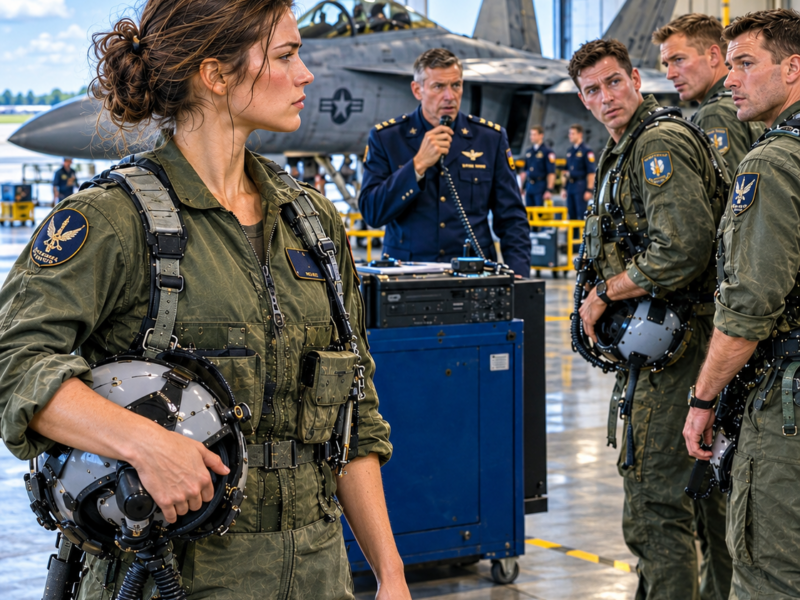
“I was standing in the Fallon officers’ club when a senior pilot raised his beer and joked that I could barely park a truck, let alone fly an F/A-18 Super Hornet
I looked at the folder in Captain Vasquez’s hand.
It was sealed, marked with my name, and carried the insignia of the Naval Strike and Air Warfare Center.
Shooter stepped aside as she entered the ready room.
“Lieutenant Reyes,” she said. “My office. Now, please.”
I picked up my kneeboard and followed her.
The door closed behind us.
For several seconds, neither of us spoke.
Captain Vasquez placed the folder on her desk and motioned toward the chair opposite her.
“Have a seat.”
I sat down.
“Am I in trouble, ma’am?”
One corner of her mouth moved.
“No. If you were in trouble, I wouldn’t have brought you into my office before breakfast.”
She opened the folder.
Inside were copies of my original tactics thesis, my flight evaluation reports, the after-action reports from Fallon, and a letter bearing the signature of a Navy captain assigned to the Naval Strike and Air Warfare Center.
Vasquez slid the letter across the desk.
“Read the second paragraph.”
I looked down.
The letter explained that the center had been reviewing the implementation of updated ingress doctrine across several fleet squadrons.
During that review, an evaluator had noticed that the author of the original research paper was now assigned to VFA-31.
They wanted me to attend an advanced tactics evaluation at Fallon the following week.
Not as a student.
As a candidate for a specialized instructor development program.
I read the paragraph twice.
“Ma’am, I thought this was a routine exercise evaluation.”
“It was.”
“Then why are they requesting my original training records?”
“Because the weapons school observers were impressed with your performance. More importantly, they want to understand how you arrived at your decisions.”
I looked at the papers.
There was something I didn’t understand.
“Why now?”
Vasquez folded her hands.
“Because your thesis was adopted into the tactical guidance, but the people who developed the original doctrine have never had the opportunity to evaluate the person who challenged it.”
She paused.
“And because your performance here suggests that your work wasn’t an academic exercise. You can apply it.”
I lowered my eyes to the letter.
For years, I’d imagined opportunities arriving as dramatic moments.
A phone call.
A congratulatory handshake.
Someone telling me that everything I’d sacrificed had finally paid off.
Instead, it was a Tuesday morning in a beige office in Nevada, with a stack of paperwork and a captain waiting for me to finish reading.
“What happens if I accept?”
“You’ll be evaluated by a panel of instructors and operational planners. If you perform well, they’ll recommend you for a temporary assignment supporting the advanced tactics curriculum.”
“How long?”
“Initially, six months.”
Six months away from my squadron.
Six months of being the junior officer in a room full of people who had probably forgotten more about naval aviation than I currently knew.
I looked up.
“Will I still fly?”
“That depends on the assignment and your qualifications. But this isn’t a punishment, Reyes.”
“I didn’t think it was, ma’am.”
“Good. Because I don’t want you accepting it simply because you think it’s the next thing you’re supposed to do.”
That caught me off guard.
She leaned back.
“There’s a difference between being good at something and wanting your entire life to become that thing.”
I considered the question.
When I was fourteen, I’d flown a small Cessna over the Texas Panhandle.
The instructor had placed my hand on the yoke and told me to keep the wings level.
I’d looked outside and seen the horizon stretch endlessly in both directions.
I hadn’t wanted to be anywhere else.
I still didn’t.
“I want to fly, ma’am,” I said. “I also want to make sure the next person who gets into that cockpit has better tools than the person before them.”
Vasquez studied me.
“That’s a reasonable answer.”
She pushed the folder toward me.
“You have until Friday to decide.”
I picked it up.
As I reached the door, she spoke again.
“One more thing.”
I turned.
“Don’t spend the next week trying to prove that you deserve to be there.”
I waited.
“Spend it finding out whether they’re actually worth your time.”
I nodded.
“Yes, ma’am.”
When I returned to the ready room, Shooter was standing beside the coffee machine.
He glanced at the folder.
“Everything okay?”
“Apparently.”
“Apparently?”
I put the folder into my flight bag.
“They want to evaluate my tactics research.”
He nodded slowly.
“That’s a good opportunity.”
“Maybe.”
He looked at me as if he wanted to say something else.
Then he picked up his coffee.
“Reyes.”
“Yes?”
“I owe you an apology.”
The room was beginning to fill.
Two pilots stopped talking.
Dice, sitting near the window, looked up from his phone.
Shooter continued.
“Not just for the parking joke. For the way I treated you when you arrived.”
I didn’t interrupt.
“I decided what you were before I saw you fly. I used your experience level as an excuse to dismiss your judgment. And when you performed well, I kept moving the standard.”
He looked uncomfortable.
That was probably the first honest thing I’d seen him do in three weeks.
“I’ve done that before,” he added. “I shouldn’t have.”
I considered my answer.
“You’re right.”
He nodded.
I wasn’t going to tell him it was fine.
It hadn’t been.
But I also wasn’t going to make him perform an apology for the benefit of everyone listening.
“Thank you for saying it,” I said.
He looked relieved, though he tried not to show it.
Then Dice spoke from the window.
“Well, that’s two things I didn’t expect before eight in the morning.”
A few people laughed.
This time, the laughter wasn’t aimed at me.
It was simply the sound of a room becoming comfortable again.
Over the next four days, something changed in the squadron.
Not dramatically.
There were no speeches.
Nobody gathered everyone around and announced that I had earned their respect.
Instead, the changes appeared in small details.
Rook began asking me questions about fuel planning.
Kwan invited me to review a mission profile with her.
Kowalski, my plane captain, started leaving a fresh cup of coffee beside my helmet before morning briefs.
And Shooter stopped interrupting junior pilots when they disagreed with him.
I noticed that last one.
One afternoon, Rook was explaining a proposed route during a planning session.
His calculations were off by several miles.
Shooter opened his mouth.
I saw the familiar expression cross his face.
Then he stopped.
“Walk us through your fuel assumptions again, Walsh.”
Rook did.
He found the error himself.
Shooter nodded.
“Good. Fix it before tomorrow.”
After the meeting, I passed him in the hallway.
He glanced at me.
“Trying something new.”
“Seems to be working.”
He gave a short laugh.
“Don’t get used to it.”
But I noticed he was smiling.
On Friday morning, I signed the acceptance paperwork.
I would attend the advanced tactics evaluation the following week.
The evaluation panel arrived on Monday.
There were four members.
Captain Andrew Mercer, a former weapons school instructor.
Commander Elise Park, an operational planner.
Lieutenant Colonel Daniel Brooks, assigned as a joint-service observer.
And Commander Thomas Bell, who had been involved in reviewing the original doctrine my thesis challenged.
Bell was the one I watched most carefully.
He was in his early fifties, with silver hair and a habit of taking notes without looking at the person speaking.
He shook my hand.
“Lieutenant Reyes. I’ve read your work.”
“Thank you, sir.”
“Some of it twice.”
I smiled politely.
“Was that a compliment?”
He looked at me for a moment.
“It was an admission that I didn’t understand it the first time.”
I liked him immediately.
The evaluation began with a classroom presentation.
I was given a tactical scenario and asked to explain how I would structure a mission under changing threat conditions.
I spent forty minutes reviewing the information.
Then I stood before the panel.
I explained my assumptions, identified the limitations of the available intelligence, and presented my recommended planning framework.
Commander Bell interrupted me halfway through.
“You’re assuming the opposing force will react to your initial maneuver in a predictable way.”
“Yes, sir.”
“Why?”
“Because the scenario specifies an established response pattern.”
“Established patterns change.”
“Agreed.”
He leaned back.
“Then why build your plan around one?”
I looked at the scenario again.
It was a fair question.
I considered the information before answering.
“Because I don’t need the opposing force to behave predictably throughout the engagement. I only need to understand what their available options are at the moment they detect us.”
Bell stopped writing.
I continued.
“If their response changes, our plan changes. The purpose of the model isn’t to predict every decision they’ll make. It’s to preserve enough flexibility that their decision doesn’t eliminate ours.”
For a moment, nobody spoke.
Commander Park looked down at her notes.
Captain Mercer leaned forward.
Bell finally nodded.
“Continue.”
I did.
The next evaluation was in the simulator.
It was more difficult.
The scenario involved rapidly changing environmental conditions, unexpected system failures, and conflicting information from multiple sources.
The evaluators were not looking for a perfect performance.
They wanted to see how I responded when perfection was no longer possible.
I made one mistake.
A small one, but a mistake.
I initially misread a change in the simulated weather picture and committed too much attention to correcting a secondary parameter.
I caught it, adjusted my priorities, and recovered the scenario.
During the debrief, Bell pointed to the recording.
“Here. At this point, you were behind the situation.”
“Yes, sir.”
“What did you miss?”
“I treated two pieces of information as equally important when they weren’t.”
“Why?”
“Because I was trying to preserve the original plan instead of reassessing the mission.”
He watched me.
“Would you make the same decision again?”
“No, sir.”
“Why not?”
“Because the mission doesn’t care how much work I put into the original plan.”
Mercer laughed quietly.
Bell didn’t.
He simply wrote something in his notebook.
The final evaluation was an oral board.
Three hours.
No notes.
No preparation beyond the material I’d already studied.
They questioned my research, my assumptions, my decisions during the Fallon exercise, and the limitations of the doctrine I’d proposed.
At one point, Commander Park asked me something I hadn’t expected.
“Lieutenant, your thesis has influenced training guidance across multiple units. Do you believe that makes your approach correct?”
I considered it.
“No, ma’am.”
She raised her eyebrows.
“Explain.”
“Research should improve the questions we ask. It shouldn’t become another set of assumptions nobody is allowed to challenge.”
Bell looked up.
I continued.
“If someone finds a better approach tomorrow, I hope they prove me wrong.”
For the first time, Bell smiled.
The evaluation concluded at 1630.
I returned to the ready room and placed my flight bag beside the window.
Dice looked up.
“How bad?”
“Three hours.”
He winced.
“That’s not a good sign.”
“It wasn’t pleasant.”
“Did they make you draw anything?”
“Several things.”
“Then you’re alive. Congratulations.”
I laughed.
Shooter approached from the other side of the room.
“How’d it go?”
“I made a mistake in the simulator.”
He nodded.
“Good.”
I looked at him.
“Good?”
“If you hadn’t, I’d assume they gave you an easy scenario.”
I shook my head.
“That’s a terrible way to evaluate people.”
“Probably.”
He took a drink of coffee.
“Still, better than pretending you never make mistakes.”
For a few seconds, we stood there without speaking.
Then he said something I hadn’t expected.
“I’d like you to review the new ingress syllabus with me.”
I raised an eyebrow.
“Why?”
“Because I’ve been teaching the old version for three years, and I don’t want to make the same mistake with the next group.”
I looked at him.
“Are you asking me to help?”
“I’m asking you to tell me where I’m wrong.”
That was a better question.
“I can do that.”
He nodded.
“Good.”
The evaluation results arrived two days later.
Captain Vasquez called me into her office.
This time, she didn’t have a sealed folder.
She had one sheet of paper.
The panel had unanimously recommended me for the advanced tactics instructor development program.
The recommendation included a temporary assignment at the Naval Strike and Air Warfare Center, subject to final command approval.
I read the letter.
Then I read it again.
“Congratulations, Lieutenant.”
“Thank you, ma’am.”
Vasquez stood and walked to the window.
“There’s something I want you to understand before you accept the next assignment.”
I waited.
“Your performance has attracted attention. Some of that attention will be useful. Some of it won’t.”
She turned toward me.
“People will want to make you a symbol. They’ll want your story to mean something convenient to them.”
I knew what she meant.
The first woman in a particular room.
The youngest person to accomplish a particular task.
The pilot who had challenged an established doctrine.
Those things were true.
But they weren’t the reason I woke up at 0500 to study weather charts.
“Don’t let anyone turn you into a recruiting poster,” she said.
I almost smiled.
“I’ll try not to, ma’am.”
“Don’t try. Do the work.”
I signed the acceptance.
The following week, the squadron held a small gathering at the officers’ club.
It wasn’t an official ceremony.
There were no decorations or speeches.
Just cold beer, bad lighting, and a group of pilots who had gradually become something closer to a team.
Kowalski was there, still wearing his maintenance uniform.
Rook had managed to spill half his drink before sitting down.
Dice was in his usual spot, quietly observing everyone.
Shooter stood near the bar.
When I arrived, he lifted his glass.
“To Phantom.”
The others raised theirs.
I looked around the table.
Three weeks earlier, most of these people hadn’t known what to do with me.
Some had laughed when I was mocked.
Others had simply watched.
Now they were raising their glasses.
I wasn’t going to pretend those first weeks hadn’t happened.
But I also knew that people could change.
Sometimes the most important thing a person could do was recognize that they’d been wrong and stop repeating the mistake.
Shooter approached me after the others had started talking.
“There’s something I’ve been meaning to ask.”
“Go ahead.”
“That night I made the parking joke. You didn’t even look angry.”
“I was angry.”
He seemed surprised.
“Really?”
“Of course.”
“Then why didn’t you say anything?”
I looked at him.
“Because I didn’t know you well enough to care what you thought.”
He laughed.
“Fair.”
I took a sip of my drink.
“Besides, arguing with someone who has already decided you’re incompetent is usually a waste of fuel.”
He looked down at his glass.
“I deserved that.”
“Probably.”
For a moment, neither of us spoke.
Then he asked, “Did you really write that thesis because you thought the existing doctrine was wrong?”
I shook my head.
“Not exactly.”
“What do you mean?”
“I wrote it because I watched a training scenario go wrong during an exercise. The people involved followed the prescribed procedure correctly, but the situation still developed in a way the procedure didn’t account for.”
He listened.
“I kept thinking about it afterward. I wanted to understand why the plan had failed even though everyone had done what they were trained to do.”
“And?”
“And I realized the problem wasn’t the people. It was the assumptions behind the plan.”
Shooter looked toward the television.
“I’ve spent three years teaching those assumptions.”
“I know.”
“That bothers me.”
“It should.”
He gave a quiet laugh.
I continued.
“But it doesn’t mean those three years were wasted. You taught people what you believed was the best method available. Now you know more.”
He studied me.
“You make it sound simple.”
“It isn’t.”
I looked around the room.
“Changing your mind is usually harder than learning something new.”
Shooter nodded slowly.
That was the first conversation we had that didn’t feel like either of us was trying to win.
Two weeks later, I left Fallon for the instructor development assignment.
The morning I departed, the desert was still dark.
My truck was packed.
My flight bag sat on the passenger seat.
I stopped outside the ready room before heading to the airport.
The building looked exactly as it had on my first morning.
Same beige walls.
Same narrow hallway.
Same smell of burnt coffee.
Inside, the whiteboard displayed the week’s flight schedule.
I noticed that Shooter had written a new training note beneath the morning sorties.
REVIEW: ADAPTIVE INGRESS GEOMETRY — REYES FRAMEWORK.
I stood there for a moment.
Then I heard footsteps.
Dice appeared in the doorway.
“Leaving without saying goodbye?”
“I didn’t want to interrupt the morning.”
He leaned against the doorframe.
“You know, I recognized your name the first day you arrived.”
I turned toward him.
“What?”
He smiled slightly.
“I’d seen your paper during an earlier tactics discussion. I didn’t know what you looked like, but I recognized the author initials.”
“Why didn’t you say anything?”
“Because I wanted to see whether you were going to tell us yourself.”
“And?”
“You didn’t.”
“Why would I?”
Dice laughed.
“Exactly.”
He looked at the whiteboard.
“You’re going to do well.”
“I hope so.”
He shook his head.
“That’s not what I said.”
I smiled.
Then he stepped forward and offered his hand.
I shook it.
“Take care of them,” I said.
“We’ll try.”
I walked out.
At the airport, I received a message from Shooter.
It was a photograph of the ready room whiteboard.
Under the new training note, he’d written another sentence.
“Nobody gets better by pretending they already know everything.”
There was no signature.
I knew who had written it.
I saved the photograph.
The instructor development program lasted six months.
It was harder than I expected.
The instructors were demanding.
The academic workload was substantial.
And the students were often more experienced than I was.
Some had combat deployments.
Some had thousands of flight hours.
A few had been teaching tactics longer than I’d been wearing a uniform.
I learned quickly that having a good idea and being able to teach it were different skills.
The first time I presented my research to a room full of senior instructors, I made the mistake of assuming everyone understood the terminology.
They didn’t.
One commander stopped me halfway through.
“Lieutenant, I understand what you’re proposing. I don’t understand why you think the average fleet pilot should care.”
I paused.
It was the most useful criticism I’d received in months.
I went back to my presentation.
I removed several pages of mathematical detail.
I added practical examples.
I rebuilt the lesson around decisions pilots actually had to make.
The next time I presented it, the room was different.
People asked questions.
They challenged the assumptions.
They discussed how the method might fail under different conditions.
Nobody was impressed by my academic grade.
They wanted something they could use.
I began to understand that the real purpose of doctrine wasn’t to prove that its authors were intelligent.
It was to help someone make a better decision when there wasn’t enough time to think.
During my final month, Commander Bell visited the classroom.
He sat in the back while I taught a group of instructors.
Afterward, he waited until the room had emptied.
“You’ve improved,” he said.
“Thank you, sir.”
“Your first presentation was technically excellent.”
I smiled.
“That sounds like a criticism.”
“It is.”
He picked up one of the lesson handouts.
“You were explaining the work. Today, you were teaching people how to use it.”
I considered that.
“That’s the goal.”
He nodded.
Then he said something that stayed with me.
“Don’t confuse being the person who discovered something with being the person who owns it.”
I looked at him.
“Sir?”
“Once an idea enters the fleet, it belongs to the people who have to use it. Your responsibility is to keep improving it, not to protect your reputation.”
I thought about my thesis.
About the missing author credit in the updated manual.
About the hours I’d spent working alone because I wanted the answer more than I wanted recognition.
“Understood, sir.”
He handed me the paper.
“Good. Now go teach someone else.”
My final assignment recommendation came through at the end of the program.
I was being considered for a permanent instructor billet, with continued opportunities to fly operationally.
I accepted.
But before leaving for the next assignment, I returned to Fallon for a short visit.
The desert looked exactly the same.
The mountains still sat low on the horizon.
The sky was still impossibly blue.
I walked into the ready room at 0645 on a Tuesday morning.
For a moment, nobody noticed me.
Then Rook looked up.
“Phantom?”
I smiled.
“Morning, Walsh.”
He stood.
“You’re back.”
“Just visiting.”
Dice turned around in his chair.
“Look at that. The famous instructor.”
“Don’t start.”
Shooter came out of his office carrying a coffee cup.
He stopped when he saw me.
“Reyes.”
“Commander.”
He glanced at the empty chair near the window.
“Still your favorite seat?”
I looked at it.
Three weeks earlier, I’d sat there because nobody had invited me to sit anywhere else.
Now there was a small stack of briefing papers on the table beside it, and someone had placed a fresh cup of coffee in front of the chair.
I picked it up.
“Looks like it.”
Shooter leaned against the table.
“We’ve been using the revised ingress lesson with the new pilots.”
“How’s it going?”
“Better than I expected.”
“Any problems?”
“Several.”
I smiled.
“Good.”
He laughed.
“We’ve also had a few arguments about your original assumptions.”
“Even better.”
He looked toward the whiteboard.
“Rook found a limitation in one of the scenarios. We’re testing a modification next week.”
I nodded.
“Send me the results.”
“Already did.”
I looked at him.
“You did?”
He shrugged.
“Thought you’d want to see them.”
For a moment, I didn’t know what to say.
Then he added, “You were right about one thing.”
“Which thing?”
“Changing your mind is harder than learning something new.”
I smiled.
“You’re learning.”
He shook his head.
“Don’t push it, Phantom.”
The room filled with laughter.
Not the laughter I’d heard on my first Friday night.
This time, I was part of it.
I stayed for the morning brief.
Rook presented the modified training scenario.
His voice shook slightly at first, but he continued.
Shooter asked him three difficult questions.
Rook answered two correctly and admitted he didn’t know the third.
Shooter nodded.
“Find out. Bring it back tomorrow.”
Then he looked around the room.
“That’s how we do this. Nobody gets a free pass, and nobody gets dismissed before they’ve had the chance to show their work.”
His eyes briefly met mine.
He didn’t need to say anything else.
After the brief, I walked out toward the flight line.
A Hornet was starting its engines.
The familiar mechanical whine rose above the desert morning.
I stood beside the hangar and watched the aircraft taxi toward the runway.
For years, I’d thought the hardest part of becoming a fighter pilot would be earning the qualification.
I was wrong.
The hardest part was learning how to keep earning the trust that came with it.
And sometimes, the people who challenged you most were not the ones who knew the most.
They were the ones who had forgotten that everyone starts somewhere.
I still remembered Shooter’s first joke.
I remembered the laughter.
I remembered how carefully I’d held my drink while pretending the words hadn’t landed.
But I also remembered the morning he stood in front of the squadron and admitted he’d been teaching something incorrectly.
That mattered more to me than his apology.
Because respect wasn’t something he could give me as a favor.
It was something we had to build through the work.
Before I left, I opened my kneeboard.
The old notes were still there.
Names.
Observations.
Short assessments I’d written during my first nights at Fallon.
I found Shooter’s name.
The word beside it had been crossed out weeks earlier.
Afraid.
Below it, I’d written Done.
I looked at the two words for a moment.
Then I turned to a clean page and wrote something new.
“Listen before you decide.”
I closed the kneeboard.
Outside, the Nevada sun was climbing over the mountains.
The flight line was waking up.
Somewhere behind me, Rook was asking Dice another question.
Shooter was correcting a schedule.
Kowalski was preparing an aircraft.
And the next generation of pilots was getting ready to fly.
I had arrived at Fallon wanting to prove that I belonged.
I left understanding something better.
The goal was never to become the person nobody could question.
It was to become the person who could keep learning, even when the whole room was watching.
I looked once more at the Hornet moving toward the runway.
Then I headed back inside.
There was work to do, and for the first time, I knew I didn’t have to do it alone.
THE end.









