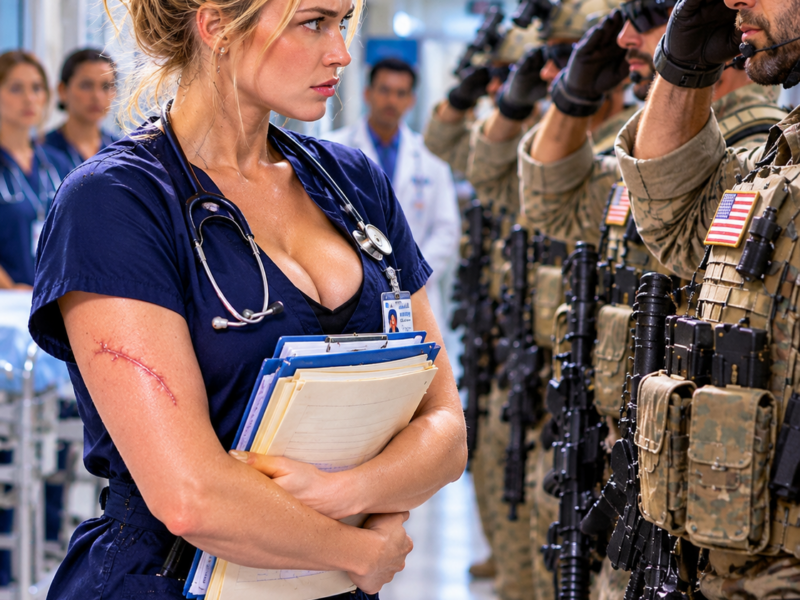
“I was standing in Oakidge Memorial’s emergency room when a six-man special operations team stormed through the doors, ignored every doctor in sight
Major Donovan stood beside the gurney, his hand finally lowered.
For a moment, nobody in the emergency room moved.
The monitors continued their steady beeping. A nurse called for another unit of blood. Somewhere behind me, a child was crying.
But all I could hear was the name he had just used.
Captain Lawson.
I hadn’t heard it spoken aloud in three years.
“Not here,” I said.
Donovan looked around the room. His eyes passed over Courtney, Amanda, Dr. Prescott, and the half-dozen staff members pretending not to stare.
“Understood.”
“Get him into Trauma Two. Now.”
The wounded soldier groaned as we transferred him. I pressed a dressing against his chest wound while another nurse connected the monitor.
“What’s his name?” I asked.
“Sergeant First Class Elias Reed,” Donovan answered. “He was hit during an extraction.”
“How long ago?”
“Forty minutes.”
“Any other injuries?”
“Possible shrapnel in the left shoulder. We couldn’t get a clear assessment in the field.”
I glanced at the monitor.
His oxygen saturation was dropping.
“Get respiratory in here. Two large-bore IVs. Type and cross. I want blood ready.”
My voice sounded exactly as it had three years earlier.
Calm.
Certain.
Unshakable.
It was the voice I used when fear threatened to take over a room.
Donovan watched me work.
“Captain—”
“Not now, Major.”
He stopped.
I cut away the soldier’s vest and examined the wound. The bullet had entered below his right collarbone. There was blood in his chest, but his breathing was still present.
“Possible hemothorax,” I said. “We need imaging and a trauma surgeon.”
Dr. Prescott stepped forward.
“I’ll take over.”
I didn’t look up.
“Then take over. But don’t move him until we’ve stabilized his airway.”
His jaw tightened.
For once, he didn’t argue.
The next twenty minutes passed in a blur of pressure, blood, orders, and focused hands.
When the surgeon arrived, I gave him a concise report and stepped back.
Reed was taken upstairs.
The doors closed behind him.
Only then did I realize my hands were shaking.
I pulled off my gloves.
Donovan waited near the hallway.
“Come with me,” he said quietly. “We need to talk.”
I looked at the wounded man’s empty gurney.
“Five minutes.”
We walked into a small consultation room. Donovan closed the door, but didn’t sit.
He looked older than I remembered. There was a new scar near his temple and gray at his hairline.
Three years ago, he had been a man who could walk through a burning building without blinking.
Now he looked like someone who had spent three years carrying a weight nobody else could see.
“Tell me what happened,” I said.
He placed a sealed folder on the table.
“Two nights ago, our team recovered a damaged encrypted drive during an operation overseas. The files contained mission logs, casualty reports, and an internal investigation that was supposed to have been destroyed.”
I stared at the folder.
“Which operation?”
“Black Lantern.”
My stomach tightened.
The room seemed to shrink around me.
Black Lantern was the mission that had ended my military career.
The mission that had left my body covered in scars.
The mission that had taken six people from my team.
And the mission I had spent three years trying not to remember.
“That operation was closed,” I said.
“That’s what we were told.”
“Then why are you here?”
“Because the drive contains evidence that someone deliberately sent our unit into an ambush.”
I said nothing.
Donovan opened the folder.
He slid a photograph across the table.
It showed a damaged military transport vehicle surrounded by smoke and debris. I recognized the hillside immediately.
I recognized the road.
And I recognized the person kneeling beside the wreckage.
Me.
My uniform was torn. My left arm was burned. My face was streaked with blood.
I was holding pressure against a wounded operator’s neck.
The photograph had been taken seconds before the explosion that changed my life.
“Where did you get this?”
“From the recovered drive.”
“Who took it?”
“We don’t know.”
He placed another photograph beside it.
This one showed a man standing beside a communications vehicle before the mission began.
I knew him.
Colonel Richard Hale.
He had approved the operation.
He had signed the report that declared our losses unavoidable.
He had also stood in front of a military review board and told them I had abandoned my post.
I looked up.
“He’s dead.”
“Officially.”
The words landed harder than I expected.
“What does that mean?”
“His death was reported fourteen months ago. But the drive shows that someone using his old authorization credentials accessed classified mission files last month.”
“Someone stole his credentials.”
“That’s possible.”
“Or someone wants us to think he’s alive.”
Donovan nodded.
“That’s why we came.”
I leaned back against the wall.
“You came to a hospital in Seattle with a wounded soldier because you think Colonel Hale is alive?”
“We came because Reed recognized your name in the recovered files. He insisted on finding you.”
“Why?”
Donovan hesitated.
Then he said something I had never expected to hear.
“Because you weren’t the only person who survived that night.”
My throat tightened.
“Who else?”
“Specialist Daniel Mercer.”
I closed my eyes.
Danny.
He had been twenty-four, funny, reckless, and convinced that every problem could be solved with a bad joke and a roll of duct tape.
I had carried him out of the transport after the explosion.
I had felt his pulse disappear beneath my fingers.
I had closed his eyes myself.
“I watched him die,” I whispered.
“I know.”
“I checked his pulse.”
“I know.”
“I stayed with him until the evacuation team pulled me away.”
Donovan lowered his eyes.
“Captain, the casualty report was falsified.”
I looked at him.
“What?”
“Mercer was listed as deceased. But the recovery files show he was transferred to a private medical facility under a false identity.”
My chair scraped backward.
“Where is he?”
“We don’t know yet.”
“Then find him.”
“We’re trying.”
“Don’t tell me you’re trying. Tell me what you know.”
Donovan took a breath.
“Three months after Black Lantern, someone began moving money through a chain of private security companies. The payments went to medical facilities, former intelligence contractors, and people connected to Hale.”
“And Mercer?”
“One payment was made under the name Daniel Morris.”
I stared at the photograph.
For three years, I had believed Danny was buried in a military cemetery.
I had attended a memorial service.
I had listened to his mother cry.
I had stood in a dress uniform while someone read words about sacrifice.
And now Donovan was telling me the man I had mourned might still be alive.
“Why didn’t you tell me sooner?”
“We didn’t have proof until two nights ago.”
“Three years, Major.”
His expression hardened with shame.
“I know.”
I looked away.
There were questions I wanted to ask, but one stood above the rest.
“Why did Hale target our unit?”
Donovan opened the folder again.
“Because Black Lantern wasn’t a rescue mission.”
I felt the old coldness return.
“What was it?”
“An extraction. Our orders were to recover a source who had information about an illegal weapons network. The source was supposed to be waiting at the landing zone.”
“But he wasn’t there.”
“No. The coordinates were wrong. The route was compromised. And the people waiting for us knew exactly where we would arrive.”
I remembered the first burst of gunfire.
The radio going dead.
The transport tipping onto its side.
The smell of burning fuel.
I remembered dragging men through the dirt while the sky filled with orange light.
I remembered the moment my own sleeve caught fire.
And I remembered hearing a voice over the radio.
A voice telling us to hold position.
A voice that belonged to Colonel Hale.
“He knew,” I said.
Donovan nodded.
“He knew the landing zone was compromised.”
“Then why did he send us in?”
“Because the source had evidence connecting him to the weapons network. Hale wanted the source silenced. Our unit was supposed to disappear with him.”
I felt sick.
We hadn’t been unlucky.
We hadn’t been outmaneuvered.
We had been sacrificed.
“And the official report blamed me.”
“Yes.”
“Because I survived.”
“Because you survived and could contradict the report.”
I stared at the folder.
“They said I had disobeyed orders. They said I abandoned my team.”
Donovan’s voice softened.
“You saved everyone you could reach.”
“Not everyone.”
“No one could have saved everyone.”
I hated that sentence.
I had heard it from doctors, commanders, counselors, and people who wanted to comfort me without understanding what it meant.
No one could have saved everyone.
But I could still remember every face.
Every name.
Every hand I had held.
I pushed the folder away.
“Why did you come to me now?”
“Because the files contain a second part of the operation. A list of people Hale intended to eliminate after the mission.”
He turned the page.
My name was there.
So were the names of Donovan, Reed, and three other surviving members of the unit.
Below them was a final entry.
A location.
Oakidge Memorial Hospital.
I stopped breathing.
“What is that?”
“An access record. Someone used a restricted terminal inside this hospital to search your employment file yesterday.”
I stared at him.
“Who?”
“We don’t know.”
“Then you have no reason to believe I’m in danger.”
“Captain, someone knew you were here before we did.”
A knock sounded at the door.
Before either of us could answer, it opened.
Dr. Prescott stood in the doorway.
His face was pale.
“Sorry to interrupt,” he said. “Hannah, there’s a situation downstairs.”
I stood immediately.
“What happened?”
“Security found someone in the staff records room. He had a badge that didn’t belong to him.”
Donovan was already moving.
“Where is he?”
“Main corridor. Security has him.”
“Is anyone hurt?”
Prescott shook his head.
“No. But he asked for Hannah.”
My skin went cold.
Donovan reached for his phone.
“Lock down the floor. Nobody enters or leaves without being checked.”
Prescott looked between us.
“What is going on?”
I had no time to explain.
“Take me to him.”
Donovan caught my arm.
“Absolutely not.”
“Someone came here looking for me. I’m not hiding behind a locked door while hospital security handles it.”
“You don’t know who he is.”
“Neither do you.”
For a moment, we stared at each other.
Then Donovan nodded to one of his operators.
“Stay with her.”
We entered the main corridor.
Two security officers stood near the staff records room. Between them was a thin man in a dark jacket.
His hands were cuffed behind his back.
His hair was gray at the temples.
He looked up when I approached.
And smiled.
“Hello, Captain.”
I knew his face.
Not from Black Lantern.
From the military review board.
He had sat behind Colonel Hale, taking notes while I was questioned.
His name was Martin Voss.
A civilian intelligence contractor.
The man who had told the board my account was inconsistent.
The man who had recommended that my service record be sealed.
“What are you doing here?” I asked.
Voss tilted his head.
“Checking on an old colleague.”
“You broke into hospital records.”
“I was looking for a file.”
“Mine?”
“Among others.”
Donovan stepped forward.
“Who sent you?”
Voss looked at him.
“You’re still following the wrong people, Major.”
“Answer the question.”
Voss smiled again.
“You think Hale is the problem.”
Donovan’s jaw tightened.
“Where is he?”
“Closer than you think.”
Before Donovan could respond, Voss turned back to me.
“Did they tell you about the recording?”
I froze.
“What recording?”
“The final transmission from Black Lantern.”
Donovan looked sharply at me.
“We recovered it,” he said.
“Then you know.”
Voss’s smile faded.
“Do you?”
He looked at the security officers.
“Ask your captain what she heard before the explosion.”
I stepped closer.
“I heard my commanding officer order an evacuation.”
“No,” Voss said quietly. “You heard something else.”
I remembered a voice.
A second voice.
A brief transmission beneath the static.
I had never been sure whether it was real.
Voss watched my face.
“There it is.”
Donovan seized his jacket.
“Enough.”
Voss didn’t resist.
“You’re wasting time. The people who matter are already moving.”
“Who?”
Voss leaned toward Donovan.
“Your wounded man knows.”
Donovan released him.
We all looked toward the elevator.
Reed.
The soldier we had brought in.
The soldier who had insisted on finding me.
I ran.
The elevator doors opened on the surgical floor.
A nurse stood outside the recovery area, speaking urgently into her phone.
“Where is Sergeant Reed?” I asked.
She pointed toward the room at the end of the hall.
“He woke up. He asked for you.”
I entered.
Reed was pale beneath the hospital lights. His chest dressing was clean, and the monitor showed a steady rhythm.
He turned his head.
“Captain.”
“Don’t talk too much.”
“I need to.”
“Then make it quick.”
He reached toward the bedside table.
There was a small black memory card inside a clear specimen bag.
“Mercer gave me this.”
I stopped.
“When?”
“Before the operation.”
“Where is he?”
Reed swallowed.
“Alive.”
The word seemed to fill the room.
“Where?”
“He was being held at a medical compound outside Tacoma. We were sent to get him out.”
“Who sent you?”
“Donovan. But we weren’t the first team.”
He closed his eyes briefly.
“Mercer said Hale was coming back for him.”
“Why?”
“Because Mercer kept the original mission recording.”
I took the bag.
“Does this card contain it?”
“Yes. And a list of everyone who helped falsify the report.”
I looked at Donovan, who had entered behind me.
“Did you know about the compound?”
“We knew there was a possible location. We didn’t know Mercer was there until Reed confirmed it.”
“Then why did you bring Reed here instead of taking him somewhere secure?”
“Because Mercer insisted you had to hear the recording before anyone else.”
Reed gripped my wrist.
“Captain, there’s something else.”
“What?”
“Mercer said the person who gave Hale the landing coordinates wasn’t an intelligence officer.”
I waited.
“He said it was someone from our own unit.”
The room went silent.
Donovan’s expression changed.
“That’s impossible.”
Reed shook his head.
“That’s what he said.”
I looked down at the memory card.
For three years, I had blamed Hale.
I had blamed the people who signed the report.
I had blamed myself for believing the orders.
But now the past had opened another door.
“Who?” I asked.
Reed’s eyes moved toward Donovan.
Then he whispered a name.
“Captain Aaron Shaw.”
I felt the air leave my lungs.
Shaw had been our communications officer.
He had been the one who checked the coordinates.
The one who confirmed the landing zone.
The one who disappeared after the explosion.
His body had never been recovered.
Donovan stepped back.
“No.”
Reed nodded.
“Mercer said Shaw was alive. He said Shaw had been working with Hale from the beginning.”
Donovan looked as though someone had struck him.
“I trained with that man for six years.”
“So did I,” I said.
The memory card felt impossibly small in my hand.
We moved to a secure conference room.
Donovan called his command liaison and arranged for the recording to be transferred to an authorized forensic team.
I refused to leave until I heard it.
The audio began with static.
Then came familiar voices.
The radio chatter of a team preparing for extraction.
The call signs.
The location checks.
My own voice confirming that the landing zone was clear.
Then Shaw.
“Coordinates verified. No movement on the eastern ridge.”
A pause.
Hale’s voice followed.
“Proceed as planned.”
The recording continued.
Gunfire.
Shouting.
A warning about the eastern ridge.
Then my voice.
“Command, we’re taking fire. Landing zone compromised. Request immediate extraction.”
Static.
A second voice.
Shaw.
“Hold position. No extraction authorized.”
I closed my eyes.
That was the order I remembered.
The order that had kept us trapped.
Then another transmission came through.
Hale.
“Confirm all personnel remain in the kill zone.”
Donovan’s face went white.
The recording continued.
A third voice interrupted.
It was faint, almost buried beneath the interference.
“Negative. Lawson has the source. She’s moving him to the secondary route.”
My breath caught.
That was me.
I had taken the source away from the landing zone.
I had found him injured beneath the transport and carried him toward the ravine.
I had thought nobody knew.
The voice continued.
“Do not let her reach extraction.”
Then Shaw spoke again.
“Understood.”
The recording ended with an explosion.
Nobody spoke for several seconds.
Finally, Donovan looked at me.
“You got the source out.”
“Who was he?”
“The man they were trying to silence.”
“Name?”
Donovan checked the file.
“Dr. Samuel Price. A weapons systems engineer.”
I remembered a man with blood on his face, gripping my sleeve.
He had been trying to tell me something.
I had thought he was delirious.
“He survived?”
“According to the file, he was recovered by a separate evacuation team and placed under witness protection.”
I stared at the screen.
“So Hale didn’t just sacrifice our unit. He wanted Price dead.”
“Yes.”
“And Shaw helped him.”
Donovan nodded.
“That explains why the mission record was changed. Shaw provided the coordinates. Hale gave the orders. Voss helped bury the evidence.”
I looked at the closed conference room door.
“And Mercer?”
“Mercer copied the original transmission before it disappeared. He must have kept a backup.”
The room suddenly felt too small.
“Then we find him.”
Donovan’s phone rang.
He answered, listened, and his expression darkened.
“What?”
A pause.
“When?”
He ended the call.
“What happened?” I asked.
“Voss is gone.”
“What?”
“Hospital security transferred him to a patrol unit. The patrol unit never reached the station.”
“Who took him?”
“We don’t know.”
I stood.
“Then he’s still working with them.”
Donovan nodded.
“And now they know we have the recording.”
A nurse appeared at the door.
“Captain Lawson? There’s a visitor asking for you.”
I frowned.
“Who?”
“She says her name is Evelyn Mercer.”
My heart tightened.
Danny’s mother.
I hadn’t spoken to her since the memorial service.
I found her in the family waiting area.
She stood beside a vending machine, clutching a small handbag with both hands.
When she saw me, her face crumpled.
“Hannah.”
I crossed the room.
“I’m sorry,” I whispered.
She shook her head.
“No. Don’t apologize.”
Her eyes filled with tears.
“They told me he was dead.”
“I know.”
“I buried an empty coffin.”
I couldn’t speak.
She reached into her handbag and pulled out a folded photograph.
It showed Danny standing beside a hospital bed.
He was thinner than I remembered.
His hair was longer.
But he was alive.
On the back was a handwritten message.
Mom, I’m safe. Please don’t look for me until Hannah knows the truth.
I pressed the photograph to my chest.
“How did you get this?”
“It arrived at my house yesterday. No return address.”
She took a shaky breath.
“I didn’t know what to do. Then I saw the news about the hospital incident. Someone had posted a picture of the soldiers outside Oakidge. I recognized your face.”
I looked at her.
“Someone sent you here?”
“I think so.”
Donovan joined us.
He examined the photograph without touching it.
“We need to get you somewhere safe.”
Evelyn looked at him.
“Is my son alive?”
Donovan hesitated.
Then he nodded.
“We believe he is.”
She began to cry.
Not the desperate crying of the memorial service.
This was different.
It was the sound of someone who had spent three years grieving and had suddenly been given permission to hope.
I held her hand.
“We’re going to bring him home.”
Donovan arranged protection for Evelyn and moved her to a secure location.
I stayed at the hospital until the end of my shift, but I didn’t sleep that night.
I kept seeing the recording.
The coordinates.
The order to hold position.
The moment my own voice had been marked as a threat.
At dawn, Donovan returned with new information.
The forensic team had traced the last payment connected to Mercer to a warehouse near the Port of Tacoma.
A private medical transport company owned the building.
The same company had received payments from Hale’s network.
“He’s there,” Donovan said.
“How certain?”
“Not certain enough to send a full team blind.”
“Then what are we waiting for?”
“Authorization.”
I stared at him.
“Three years ago, we waited for authorization while our people died.”
He looked down.
“I know.”
“Then don’t make that mistake again.”
He held my gaze.
“We won’t.”
This time, the operation was planned differently.
Local law enforcement was notified.
A federal investigator who had been quietly pursuing the weapons network joined the team.
The location was secured from the outside before anyone entered.
I was not supposed to go.
Donovan made that very clear.
“You are a civilian now,” he said.
“I’m a nurse.”
“You’re also the person Hale wants silenced.”
“And Mercer is my friend.”
“That doesn’t make you bulletproof.”
“No. It makes me unwilling to abandon him.”
Donovan studied me for a long moment.
Then he handed me a small radio.
“You stay with the medical team at the perimeter. You do not enter the building.”
I nodded.
It wasn’t the answer I wanted.
But it was the safest way to help.
The warehouse stood near the water, surrounded by chain-link fencing and old shipping containers.
Rain fell in thin silver lines.
The team moved in.
Minutes passed.
Then a voice crackled over the radio.
“One secured. Moving to the rear rooms.”
Another voice.
“Medical assistance requested.”
I gripped the radio.
“What’s the injury?”
No answer.
“Donovan, what’s the injury?”
Static.
Then his voice.
“We found Mercer.”
My eyes filled before I could stop them.
“Is he alive?”
A pause.
“Yes.”
I covered my mouth.
“Bring him out.”
They emerged several minutes later.
Two operators carried a stretcher.
A man lay beneath a gray blanket.
His face was thinner, his beard untrimmed, and his right arm was supported by a brace.
But when he turned his head, I saw the familiar eyes.
Danny.
I ran to the stretcher.
He looked at me for a long moment.
Then he smiled faintly.
“Hey, Captain.”
My knees nearly gave way.
I took his hand.
“You’re late.”
He gave a weak laugh.
“Traffic.”
I cried then.
Not quietly.
Not politely.
I cried with my forehead against his hand while the medical team checked his pulse and breathing.
For three years, I had carried his death like another wound beneath my uniform.
Now his hand was warm.
His fingers moved against mine.
He was real.
He was alive.
And I had found him.
The federal investigators recovered documents, communications equipment, and financial records from the warehouse.
They also found Shaw.
He was hiding in an office above the medical rooms.
When officers brought him outside, he looked directly at me.
He didn’t appear frightened.
He looked annoyed.
“Lawson,” he said. “You should have stayed retired.”
I stepped toward him.
Donovan moved between us.
“Don’t.”
I looked at Shaw.
“Why?”
He shrugged.
“Orders.”
“Six people died.”
“That was the mission.”
“No. That was your choice.”
His face hardened.
“You don’t understand what was at stake.”
“Then explain it.”
He said nothing.
“You gave them our coordinates. You held our extraction. You knew we were trapped.”
Shaw looked toward the water.
“Hale said the source was too dangerous to let go.”
“And the rest of us?”
He turned back.
“You were acceptable losses.”
The words were quiet.
Almost casual.
For a second, I couldn’t move.
Then I understood something.
He had never believed our lives mattered.
Not mine.
Not Donovan’s.
Not Danny’s.
Not the six people whose names had been carved into a memorial wall.
We had been numbers on a report.
And he had expected us to remain numbers forever.
“You’re going to have to say that again,” I said.
He frowned.
“Why?”
“Because this time, people are listening.”
The federal investigator stood behind him.
A recording device was already running.
Shaw looked down.
For the first time, his confidence disappeared.
Colonel Hale was arrested two days later.
He had been living under a false identity in a private residence outside Vancouver, Washington.
The evidence recovered from the warehouse connected him to the weapons network, the falsified mission report, and the attempted murder of the surviving members of our unit.
Martin Voss was found in a rented vehicle near the state line.
He had been trying to leave the country.
The investigation lasted eleven months.
There were hearings, interviews, sealed documents, and days when I sat in a courtroom listening to strangers describe the worst night of my life as a series of tactical decisions.
I testified.
So did Donovan.
So did Danny.
The original recording was played in full.
No one interrupted it.
No one called my memory unreliable.
No one suggested I had abandoned my team.
When the judge asked whether I wished to make a statement, I stood.
I had prepared pages.
I had written every name.
Every detail.
Every moment I had remembered.
But when I faced the room, I put the papers down.
“I spent three years believing that I had failed my team,” I said. “I believed that if I had been faster, stronger, or smarter, I could have brought everyone home.”
I looked at Hale.
“You knew that. You used it. You took the worst moment of our lives and turned it into a weapon against the people who survived.”
My voice shook, but I continued.
“The truth is that we did not abandon our mission. We did not abandon each other. We were betrayed by people who thought our lives were expendable.”
I looked toward Danny.
“And the people who survived deserve to be remembered as more than casualties in a report.”
The room was silent.
For the first time, I felt no need to defend myself.
The evidence spoke.
The truth had finally been heard.
Hale and Shaw were convicted on multiple federal charges.
Voss pleaded guilty and agreed to testify about the cover-up.
The weapons network was dismantled.
The military review of my case was reopened.
My record was cleared.
I was offered reinstatement.
I declined.
Not because I hated the uniform.
I didn’t.
I had loved the people inside it.
But I had built a life in Seattle, one patient at a time, one ordinary morning at a time.
I wasn’t ready to give that up.
Danny recovered slowly.
There were surgeries, physical therapy, and nights when the memories returned hard enough to leave him shaking.
Evelyn visited him every day.
Sometimes she brought food.
Sometimes she brought old photographs.
Sometimes she simply sat beside his bed and held his hand.
The first time he walked without assistance, she cried so hard that he had to remind her he wasn’t going anywhere.
Donovan visited often.
He and Danny argued about football, bad coffee, and the quality of hospital television.
They laughed more than I expected.
I think all of us needed to learn how to do that again.
As for Oakidge Memorial, things changed there too.
Dr. Prescott was the first to approach me after the investigation became public.
He found me in the supply room one evening.
He looked uncomfortable.
“Hannah, can we talk?”
I set down the box of dressings.
“About what?”
He rubbed the back of his neck.
“I owe you an apology.”
I waited.
“I questioned your judgment. I allowed my frustration to affect how I treated you. I should have listened when you raised concerns.”
“Yes,” I said.
He nodded.
“I also should have stopped the comments from the other staff.”
“Yes.”
He looked at the floor.
“I was wrong.”
I didn’t rush to make him feel better.
An apology wasn’t a magic key.
It didn’t erase months of humiliation or restore the trust he had damaged.
But it was a beginning.
“Then do better,” I said.
“I will.”
He left.
A week later, Courtney and Amanda approached me near the nurses’ station.
Neither looked comfortable.
Courtney spoke first.
“We heard about everything.”
I continued reviewing a chart.
“Okay.”
“We didn’t know who you were.”
I looked up.
“Would that have made it acceptable?”
She opened her mouth, then closed it.
Amanda shifted her weight.
“We were just joking around.”
“No,” I said. “You were making a person into a target because you thought nobody important would object.”
Their faces changed.
I didn’t raise my voice.
I didn’t need to.
“My scars were never an invitation for you to invent stories about me. And my past shouldn’t be the reason you treat me with basic respect.”
Courtney looked down.
“I’m sorry.”
Amanda nodded.
“Me too.”
I accepted their apologies without pretending the past had disappeared.
Then I returned to work.
The hospital didn’t transform overnight.
People still made mistakes.
Patients still arrived frightened and angry.
Some nights were long.
Some mornings were harder.
But the whispers stopped.
And when a new nurse joined the department with a visible scar along her jaw, I made sure she knew she didn’t have to explain it to anyone.
One evening, several months after the trial, I found Danny sitting in the hospital garden.
He was wearing a simple jacket over his rehabilitation clothes.
His right arm still moved stiffly, but he was getting stronger.
He looked up as I approached.
“Do you ever think about going back?” he asked.
“To the military?”
He nodded.
“Sometimes.”
“Do you miss it?”
I considered the question.
“I miss the people. I miss knowing exactly who was standing beside me. I don’t miss the orders that made us disposable.”
Danny nodded.
“Fair.”
He looked at the scar that disappeared beneath my sleeve.
“Does it still hurt?”
“Sometimes.”
“Do you wish it wasn’t there?”
I sat beside him.
“For a long time, I did.”
“And now?”
I watched the rain gather on the garden leaves.
“Now I think it reminds me that I made it through something I didn’t think I could survive.”
Danny smiled.
“That’s a better answer than I expected.”
“Don’t get used to it.”
He laughed.
For a while, we sat without speaking.
Then he reached into his jacket and pulled out a small envelope.
“Your birthday present.”
“My birthday was two months ago.”
“I’ve been busy.”
Inside was a photograph.
It showed our old team standing together before Black Lantern.
Donovan was grinning.
Shaw was at the edge of the group.
Danny was making a ridiculous face.
I stood in the middle, younger and unscarred, one hand resting on the shoulder of the youngest medic.
On the back, Danny had written six names.
The names of the people we lost.
Below them were three more.
The names of the people who had survived.
And beneath all of them, one sentence.
We were never expendable.
I traced the words with my thumb.
For years, I had remembered that night through smoke, blood, and the sound of men calling for help.
Now I could remember something else.
The faces of the people who had stood beside me.
The people who had come back.
The people who had refused to let the truth disappear.
I returned to the emergency department the next morning.
The same doors opened.
The same monitors beeped.
The same fluorescent lights made everything look a little too pale.
A new trauma alert came through.
A young man had been pulled from a wrecked car.
His mother was running behind the paramedics, crying his name.
The team moved.
I pulled on my gloves.
“Let’s get him inside.”
The patient was bleeding heavily.
His mother stood near the wall, trembling.
I caught her eye.
“We’re going to take care of him,” I said.
She nodded, unable to speak.
And I went to work.
There was no salute.
No dramatic entrance.
No one in the room knew what I had once been.
They only knew I was the nurse standing beside their son when he needed someone.
That was enough.
Later, after the patient was stable, I stepped into the staff bathroom and rolled up my sleeve.
The scars were still there.
They hadn’t faded into nothing.
They never would.
I ran my fingers gently over the uneven skin.
Once, I had hidden them because I thought people would see only damage.
Now I understood that they were part of my story, but they were not the whole story.
I was not the rumor Courtney had spread.
I was not the failure Hale had written into a report.
I was not the ghost of a soldier who had died three years earlier.
I was Hannah Lawson.
A nurse.
A friend.
A survivor.
And when the emergency department doors opened again, I walked back into the light without pulling my sleeve down.
The End.









