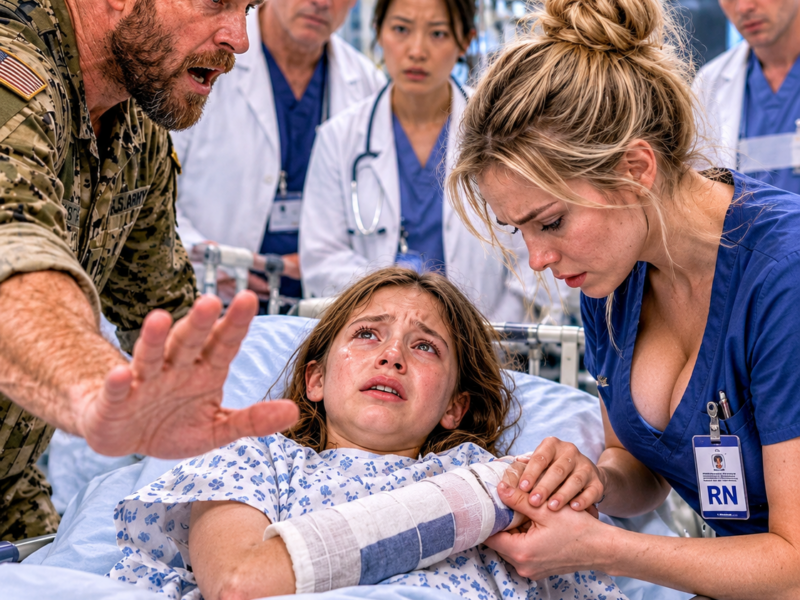
“I was standing beside Trauma Room 1 when a wounded Navy SEAL grabbed the surgeon’s wrist, stared straight at me, and whispered a name nobody in that hospital had ever heard
The silver-haired officer didn’t look away from me.
“Captain Cho, step outside with us.”
I glanced at the patient.
His blood pressure had stabilized, but his breathing remained shallow. The surgeon was checking the ultrasound again, and two nurses were preparing additional blood products.
“Not until he’s stable.”
The officer nodded once.
“Understood.”
Dr. Marcus Vale finally found his voice.
“This is a hospital. You cannot simply walk in and issue orders to my staff.”
The officer turned toward him.
“Dr. Vale, I’m Commander James Whitmore, United States Navy. This is a federal matter.”
Vale straightened his coat.
“That doesn’t give you authority over my department.”
The second man opened the black identification case and presented a badge.
“Special Agent Robert Hayes, Naval Criminal Investigative Service.”
Vale’s expression changed slightly.
Only slightly, but I noticed.
“What exactly is this about?”
Hayes removed a sealed document.
“That depends on how much you already know.”
Vale looked toward me.
For the first time, he wasn’t looking at me like an incompetent nurse.
He was looking at me like someone who might recognize something he had spent years hiding.
I turned back to the patient.
“His pressure is dropping again.”
The monitor showed eighty-eight systolic.
The surgeon moved closer.
“We need to take him to surgery.”
“Agreed,” I said.
The wounded operator opened his eyes.
His fingers moved against the blanket.
“Raven.”
I leaned toward him.
“I’m here.”
He swallowed painfully.
“Don’t let them take the drive.”
I looked at him.
“What drive?”
His eyes shifted toward the silver-haired officer.
“Daniel…”
Then his eyelids closed.
The cardiac monitor continued its steady rhythm.
I looked at Commander Whitmore.
“Who is Daniel?”
His jaw tightened.
“Not here.”
“He’s been dead for three years.”
“I know.”
“Then why is this man talking about him?”
Whitmore looked at the black case.
“Because Daniel may have left something behind.”
Before I could ask another question, the surgical team wheeled the patient toward the operating room.
I watched until the doors closed.
Then I turned to the commander.
“Now you can talk.”
He glanced at Vale.
“Somewhere private.”
“No,” I said.
“If this involves my past, I want him to hear it.”
Vale laughed nervously.
“I have no idea what you’re talking about.”
Agent Hayes placed the sealed folder on a nearby counter.
“That’s an interesting statement, considering your name appears on several documents connected to an unauthorized military trauma research program.”
The color disappeared from Vale’s face.
I looked at him.
“Research program?”
He folded his arms.
“This is absurd.”
Hayes opened the folder.
“Twenty-seven military patients. Altered medical records. Unreported complications. Financial transfers from a private defense contractor.”
Vale shook his head.
“Those records are confidential.”
“They’re evidence.”
I looked from the folder to the commander.
“Why are you showing me this?”
Whitmore took a slow breath.
“Because your former unit has been investigating the same operation for nearly a year.”
I felt the scar beneath my sleeve.
Three years earlier, I had been part of a Navy medical evacuation team operating in Afghanistan.
We weren’t an ordinary hospital team.
We went where wounded personnel couldn’t wait for evacuation. We treated people in damaged buildings, behind vehicles, and sometimes in the middle of places where every second mattered.
My partner had been Daniel Mercer.
He was thirty-two, sarcastic, stubborn, and one of the few people who could tell when I was frightened even when I refused to admit it.
We had worked together for almost four years.
Then came Kandahar.
A medical extraction went wrong.
An explosion tore through our position while we were moving wounded soldiers toward an evacuation point.
Daniel pushed two injured men behind cover.
I went back for him.
I remembered the dust, the screaming, and the way my hands slipped against his blood-covered uniform.
I remembered holding his hand until the medic beside me quietly said there was nothing more to do.
For three years, I had replayed that moment.
I had wondered whether I could have moved faster.
Whether I had missed something.
Whether one different decision might have brought him home.
Whitmore knew all of it.
“You were never supposed to carry that responsibility alone,” he said.
I looked away.
“Don’t.”
He stopped.
Agent Hayes closed the folder.
“Captain, there’s something else.”
I turned back.
“The wounded operator is Lieutenant Ethan Cole. He was part of a medical transport security team that discovered irregularities in the research program.”
“What kind of irregularities?”
“Patients receiving experimental treatments without informed consent. Complications being concealed. Medical records being changed after the fact.”
My eyes moved toward Vale.
He was no longer smiling.
Hayes continued.
“Lieutenant Cole was transporting evidence when his vehicle was attacked. The official report described the incident as an accident.”
“And it wasn’t?”
“We believe it was an attempt to recover the evidence.”
I remembered the patient’s words.
Don’t let them take the drive.
“Where is it?”
Hayes looked at Whitmore.
“That’s what we’re trying to find.”
Vale suddenly stepped away from the counter.
“This conversation is over. You’re interfering with hospital operations.”
Whitmore didn’t move.
“You’re welcome to remain silent, Doctor.”
“I am the medical director.”
“Not for much longer.”
Vale’s eyes narrowed.
“You have no idea what you’re accusing me of.”
Hayes pulled out another document.
“Then perhaps you can explain why a research payment was transferred into an account connected to your private foundation three days after a patient died.”
Vale stared at the page.
His silence was answer enough.
But I had another question.
“Why was I brought into this?”
Whitmore looked at me.
“Because Daniel was investigating the same contractor before the Kandahar incident.”
The hallway seemed to grow quieter.
“What?”
“He believed someone was using military medical records to identify vulnerable patients and move them into experimental treatment programs.”
I shook my head.
“Daniel never told me that.”
“He couldn’t.”
“Why?”
“Because he suspected someone inside the operation was passing information.”
I looked down at my hands.
All those years, I had believed Daniel’s death was the end of the story.
Now I was being told that the man I had blamed myself for losing might have been investigating something much bigger.
“Why didn’t anyone tell me?”
Whitmore’s expression softened.
“Because the investigation was classified, and because you were grieving. We believed keeping you away from it was the safest option.”
I gave a short, humorless laugh.
“You let me believe I had lost him for nothing.”
Whitmore didn’t defend himself.
That was almost worse.
Before he could answer, a nurse hurried toward us.
“Captain Cho?”
I turned.
She was holding a small plastic evidence bag.
“Something was found in the patient’s clothing.”
Inside was a damaged metal key.
It was attached to a narrow strip of black fabric.
I recognized the stitching.
Daniel had used the same kind of fabric to mark his equipment.
My fingers went cold.
“Where did you find this?”
“In the lining of his vest.”
Agent Hayes took the bag carefully.
“That’s likely connected to the drive.”
I looked at the key.
There was a tiny number engraved on its surface.
317.
Whitmore read it aloud.
“Storage unit?”
I nodded slowly.
“Possibly.”
“Do you know where?”
I did.
Three years earlier, Daniel had rented a storage unit outside Norfolk.
He used to joke that it was where he kept all the things he didn’t trust me to throw away.
I had forgotten about it.
Or maybe I had tried to.
“There’s something in Norfolk,” I said.
Whitmore looked at Hayes.
“We’ll need a warrant.”
Hayes nodded.
“And we’ll need to secure the hospital before anyone else realizes what we found.”
Vale took another step toward the exit.
Two security officers moved to block his path.
He stared at them.
“Get out of my way.”
One of them spoke calmly.
“Doctor, please remain here.”
Vale looked at me.
“You have no idea what you’re getting involved in.”
I held his gaze.
“I think I’ve been involved longer than you realize.”
For the first time, he had no response.
An hour later, Lieutenant Ethan Cole was out of surgery.
The surgeon told us that the bleeding had been controlled, but the next twenty-four hours would be critical.
I stood beside his recovery room, watching the ventilator move.
Whitmore approached quietly.
“We’re going to Norfolk.”
I nodded.
“I know.”
“You don’t have to come.”
I looked at him.
“Daniel left something for me. I’m going.”
He didn’t argue.
At 7:30 that morning, we left Mercy Harbor in two vehicles.
I sat in the back seat with Agent Hayes.
For most of the drive, I watched the highway pass through the window.
I hadn’t been to Norfolk in three years.
Daniel had loved that city.
He liked the water, the old diners, and the smell of salt in the air.
He once told me that if he ever left the Navy, he’d buy a little house near the coast and never wake up before eight.
I had told him he’d last three days.
He had laughed.
“Two, maybe.”
I closed my eyes.
When we reached the storage facility, the morning sun was already bright.
The building was ordinary.
Rows of metal doors, faded numbers, and a security office with a vending machine humming beside the entrance.
Unit 317 was near the back.
The key turned easily.
Inside were several cardboard boxes, a folding chair, an old duffel bag, and a small wooden desk.
I stepped inside slowly.
Nothing had changed.
There was even a coffee mug on the desk with a chipped handle.
Daniel’s handwriting was still visible on a label attached to one of the boxes.
ELENA’S TERRIBLE COFFEE.
I almost smiled.
Then I noticed a photograph tucked beneath the mug.
It showed Daniel and me standing beside a helicopter after a difficult evacuation.
He was holding up two fingers behind my head.
I was laughing.
I hadn’t seen that photograph since the week before he died.
I picked it up.
On the back, he had written:
“One day, when this is all over, we’ll have that coffee by the water.”
My throat tightened.
Agent Hayes stood near the entrance.
“Captain, there’s something beneath the desk.”
I crouched.
A small metal panel had been fitted into the underside.
The number 317 was engraved on it.
I used the key.
The panel opened.
Inside was a compact encrypted storage device.
Hayes carefully removed it.
“That’s probably what Cole was carrying.”
Whitmore looked around the unit.
“Anything else?”
I noticed a folded envelope behind the desk.
My name was written across it.
Not Captain Cho.
Not Raven.
Just Elena.
I opened it.
The letter was short.
“Elena,
If you’re reading this, something happened before I could explain.
I know you blame yourself for Kandahar.
You need to stop.
You didn’t leave me behind. You saved the people I asked you to save.
I made a choice, and I would make it again.
There’s something bigger happening with the medical program. I couldn’t prove who was involved, but I found evidence that patients were being used without their knowledge.
If I can’t finish this, find the records.
And please, don’t spend the rest of your life hiding from a day you survived.
Daniel.”
I read it twice.
Then a third time.
The room was silent.
For three years, I had carried one memory like a punishment.
Now the man I thought I had failed had left me a message telling me that I had done exactly what he wanted.
I sat on the folding chair.
I didn’t cry loudly.
I just pressed the letter against my chest and let the tears come.
Whitmore gave me time.
When I finally stood, Hayes was already preparing the storage device for examination.
“We’ll need to take this to our forensic team.”
“Can you tell what’s on it?”
“Not yet.”
I looked at the device.
“Then don’t let anyone access it without documenting everything.”
Hayes gave a small nod.
“Understood.”
It was the first time that morning someone had spoken to me like a colleague instead of a wounded memory.
The device contained more than the investigation team expected.
Over the next several hours, forensic specialists recovered spreadsheets, patient records, internal messages, and payment logs.
The records showed that a private defense contractor called Asterion Medical Systems had been funding an experimental trauma treatment program through a network of medical foundations.
The program itself wasn’t necessarily illegal.
The problem was how it had been conducted.
Patients were being enrolled without proper consent.
Serious complications were being hidden.
In several cases, records had been altered to make unsuccessful treatments appear successful.
Dr. Vale had been one of the program’s hospital coordinators.
His private foundation had received substantial payments.
But he wasn’t the only person involved.
One name appeared repeatedly in the financial records.
Richard Harlan, Mercy Harbor’s chief operating officer.
The same man who had publicly praised Vale for his commitment to military medicine.
I stared at the screen.
“He’s still at the hospital.”
Hayes nodded.
“We know.”
“Then he may know we’ve found the drive.”
Whitmore looked toward the door.
“We’ve already notified the federal team.”
My phone rang.
It was a number from Mercy Harbor.
I answered.
“Cho.”
A familiar voice came through.
“Elena, this is Walter Briggs.”
I stood immediately.
“Mr. Briggs? Is everything okay?”
“I’m fine. Better than fine, actually.”
I heard him clear his throat.
“There’s something you should know.”
“What is it?”
“That hospital administrator, Harlan. He came to see me yesterday.”
I exchanged a look with Hayes.
“What did he want?”
“He asked me whether you had ever worked in military medicine.”
I tightened my grip on the phone.
“What did you tell him?”
“That you were the best nurse I’d ever had.”
Despite everything, I smiled faintly.
Walter continued.
“Then he asked whether I had noticed you talking to the wounded soldier.”
“Did you?”
“Of course. I’m old, not blind.”
I looked toward the commander.
“Mr. Briggs, did he say anything else?”
Walter hesitated.
“He told me that people who dig into old records sometimes lose their jobs.”
My smile disappeared.
“Did he threaten you?”
“Not exactly. But he wanted me to understand something.”
“What?”
Walter lowered his voice.
“He said the hospital had been very good to me, and it would be unfortunate if that changed.”
I closed my eyes.
“Thank you for telling me.”
“Elena?”
“Yes?”
“Whatever you’re dealing with, don’t let them make you small again.”
I couldn’t answer immediately.
“Thank you, Walter.”
When I ended the call, Hayes was already speaking into his radio.
“We have a possible obstruction witness at Mercy Harbor. Get someone to protect him.”
Whitmore turned to me.
“You’re going back.”
It wasn’t a question.
I nodded.
The federal team moved quickly.
By the time we reached Mercy Harbor, two agents had already secured the administrative offices.
Richard Harlan was waiting in the main conference room.
He was in his late fifties, neatly dressed, with silver hair and the kind of smile that never quite reached his eyes.
“Commander Whitmore,” he said. “I assume there’s a reasonable explanation for this disruption.”
Hayes placed a copy of the recovered financial records on the table.
“We’d like to discuss your relationship with Asterion Medical Systems.”
Harlan barely glanced at the papers.
“I oversee hospital operations. We work with numerous research organizations.”
“Did you authorize payments to Dr. Vale’s private foundation?”
Harlan folded his hands.
“I’d need to review the records.”
“Did you know military patients were being enrolled without proper consent?”
His expression remained calm.
“That’s a serious accusation.”
I stepped forward.
“Twenty-seven patients.”
Harlan looked at me.
“Excuse me?”
“Twenty-seven military patients. Their records were altered, their complications hidden, and their families were given incomplete information.”
Harlan sighed.
“Nurse Cho, I understand you’ve had a difficult morning, but you aren’t familiar with the administrative details.”
I looked at him.
“You’re right. I’m familiar with the patients.”
His smile faded.
“Perhaps you should let the investigators handle this.”
“That’s what I’ve been doing.”
Hayes placed another document on the table.
“This transfer was authorized using your executive credentials.”
Harlan studied the page.
For the first time, his hands moved.
He adjusted his watch.
“Those credentials could have been accessed by someone else.”
“Then you won’t mind explaining the security logs.”
He said nothing.
A federal agent approached and quietly informed Hayes that they had obtained authorization to seize Harlan’s office computers.
Harlan stood.
“I want legal counsel.”
“You’re entitled to that,” Hayes replied.
As the agents escorted him away, he turned toward me.
“You think this makes you a hero?”
I didn’t answer.
He shook his head.
“People like you never understand how complicated these programs are.”
I looked at the folder on the table.
“People like me understand what happens when someone becomes a number instead of a person.”
He was taken away.
For a moment, I remained in the conference room.
Then I noticed something on the bottom page of the financial records.
A date.
The day Daniel died.
I looked closer.
A payment had been authorized to Asterion Medical Systems just hours before the Kandahar extraction.
My stomach tightened.
“Hayes.”
He came back.
“Look at this.”
He read the date and frowned.
“That transfer was made before the attack.”
“Was it connected to Daniel?”
“We don’t know yet.”
“Find out.”
He nodded.
The investigation continued for several weeks.
Asterion’s executives were questioned.
Several hospital administrators were placed on leave.
Dr. Vale was formally charged after investigators uncovered falsified research records and financial transactions.
Richard Harlan faced separate charges related to fraud and obstruction.
But the most important evidence came from Daniel’s records.
His messages showed that he had discovered a connection between the contractor and an officer responsible for coordinating medical transport intelligence.
The officer had been sharing patient movement schedules and research information with Asterion representatives.
That information had exposed several military medical teams to unnecessary danger.
Daniel had been trying to document the connection when the Kandahar mission was compromised.
The investigation eventually established that the explosion had been caused by an attack on the extraction route.
It was not a random equipment failure.
However, there was no evidence that Daniel had been deliberately targeted.
The officer had provided information recklessly and had helped conceal the consequences, but the attack itself had been carried out by an enemy force.
I had spent three years believing that I should have been able to save Daniel.
Now I understood that there were things I could never have controlled.
That knowledge didn’t erase the grief.
It simply gave it somewhere else to go.
Six weeks after the night Ethan Cole arrived at Mercy Harbor, I visited him in rehabilitation.
He was sitting beside the window, his left arm in a sling.
When he saw me, he smiled.
“Raven.”
I shook my head.
“Elena.”
He considered that.
“Elena, then.”
I pulled a chair beside his bed.
“How are you feeling?”
“Like somebody used me as a punching bag.”
“That’s not a medical diagnosis.”
“It’s the most accurate one I’ve got.”
I smiled.
For a few minutes, we talked about ordinary things.
Then his expression became serious.
“Daniel asked me to find you.”
I looked at him.
“When?”
“Before the operation.”
He took a breath.
“He knew the investigation might take years. He told me that if anything happened to him, I should make sure you understood something.”
I waited.
“He said you were the best medic he’d ever worked with.”
I looked down.
“He said you had a habit of taking responsibility for things that weren’t yours.”
A quiet laugh escaped me.
“That sounds like Daniel.”
Ethan continued.
“He also said you would probably hate hearing any of this.”
“He’s right.”
“But he wanted you to know that he never blamed you for what happened.”
I pressed my lips together.
For a long moment, neither of us spoke.
Then Ethan reached toward the bedside table.
He picked up a small envelope.
“I was supposed to give you this when I was sure you’d be ready.”
I took it carefully.
Inside was a photograph.
Daniel and me, standing beside the helicopter.
The same photograph I had found in the storage unit.
But there was something written across the bottom in blue ink.
“Next time, coffee by the water. No excuses.”
I laughed through the tears.
Ethan watched me.
“He talked about you a lot.”
I folded the photograph carefully.
“Thank you for bringing it to me.”
He nodded.
“One more thing.”
I looked up.
“He said the name Raven was never supposed to be something you were ashamed of.”
I looked at the photograph again.
For the first time, hearing that name didn’t feel like being dragged backward.
It felt like remembering someone who had loved me enough to trust me.
When I returned to Mercy Harbor, the hospital board had already begun restructuring the emergency department.
Dr. Vale was gone.
Harlan was no longer in charge.
The research program had been suspended, and independent investigators were reviewing every affected patient record.
The hospital also established a new patient advocacy office to help families understand what had happened.
I was offered my old military rank back.
Commander Whitmore made the offer personally.
“You have nothing left to prove,” he said.
I looked at the paperwork.
“I know.”
“Then what do you want?”
I thought about the three years I had spent trying to become invisible.
I thought about Daniel’s letter.
I thought about Walter watching my hands as I changed his dressing.
“I want to stay here.”
Whitmore raised an eyebrow.
“At Mercy Harbor?”
“Yes.”
“After everything that happened?”
I nodded.
“I know what this place needs.”
A few weeks later, I accepted the position of director of the hospital’s new military trauma program.
It wasn’t a ceremonial title.
I spent my days training emergency nurses, reviewing trauma procedures, and helping doctors recognize injuries that could become fatal if overlooked.
I also insisted on one rule.
No patient would ever be treated as a research number.
Every consent form would be reviewed.
Every complication would be documented.
Every family would receive honest answers.
Some doctors found me demanding.
I could live with that.
One afternoon, Walter Briggs came to my office for a follow-up appointment.
He walked in slowly, carrying two paper cups of coffee.
“I brought you something.”
I looked at the cups.
“Is one of those mine?”
“Unless you suddenly started drinking coffee with sugar.”
I laughed.
He placed one on my desk.
Then he noticed the photograph beside my computer.
Daniel and me, standing next to the helicopter.
“That’s him?”
I nodded.
“Daniel.”
“Good-looking fellow.”
“He thought so.”
Walter chuckled.
Then he looked at me more carefully.
“You seem different.”
I leaned back.
“Different how?”
“Like you’re finally sleeping.”
I looked toward the window.
For the first time in years, I wasn’t thinking about the sound of the explosion.
I still remembered Daniel’s final moments.
I still missed him.
Some mornings, a familiar smell or a certain phrase could bring the memories back so clearly that I had to stop what I was doing.
But I no longer believed that remembering him meant I had to punish myself.
I picked up the coffee.
“Maybe I’m getting better.”
Walter nodded.
“That’s usually how it starts.”
After he left, I opened Daniel’s letter one more time.
I had kept it in the top drawer of my desk, folded carefully inside a protective sleeve.
I read the final sentence.
“Please, don’t spend the rest of your life hiding from a day you survived.”
I placed the letter beside his photograph.
Outside my office, the emergency department was busy.
A nurse hurried past carrying a tray.
A doctor called for additional equipment.
Somewhere down the corridor, a monitor began sounding an alarm.
I stood up automatically.
For a moment, I caught my reflection in the glass.
Blue scrubs.
Hair tied back.
A pale scar beneath my left sleeve.
I was still the same woman.
I was simply no longer trying to disappear.
I walked toward the trauma bay.
A young nurse was standing beside a patient, looking uncertain as the senior doctor questioned her assessment.
I recognized the expression on her face.
I had worn it for three years.
I stepped beside her.
“Tell me what you’re seeing.”
She looked surprised.
“The blood pressure is falling, but the heart rate isn’t responding the way I expected.”
“Good. What else?”
She glanced at the monitor.
“The neck veins are distended.”
I nodded.
“Then don’t ignore what you’re seeing just because someone louder has a different opinion.”
Her shoulders relaxed slightly.
The doctor turned toward us, ready to object.
I met his eyes.
“Let’s look at the ultrasound.”
He paused.
Then he moved aside.
As I helped the young nurse prepare the equipment, I felt the photograph in my pocket.
Daniel was still part of my life.
Not as a wound I had to keep reopening.
Not as a mistake I could never forgive myself for.
But as the person who had once stood beside me and trusted me to do the right thing.
That night, after my shift ended, I drove toward the coast.
I parked near the water and walked down to the pier.
The air smelled of salt and rain.
I carried two coffees.
One for me.
One for Daniel.
I placed his cup beside me on the wooden bench and watched the waves move beneath the lights.
For a long time, I said nothing.
Then I smiled at the empty space beside me.
“We finally made it, partner.”
The water kept moving.
The coffee slowly cooled.
And for the first time in three years, I went home without feeling that I had left him behind.
The name Raven had once reminded me of everything I had lost.
Now, when I heard it, I remembered everything Daniel had trusted me to carry.
I had spent years learning how to save other people.
It had taken me much longer to understand that I was allowed to save myself.
The scar remained beneath my sleeve.
But I no longer hid it.
And I no longer hid from the woman who had earned it.
The end.









