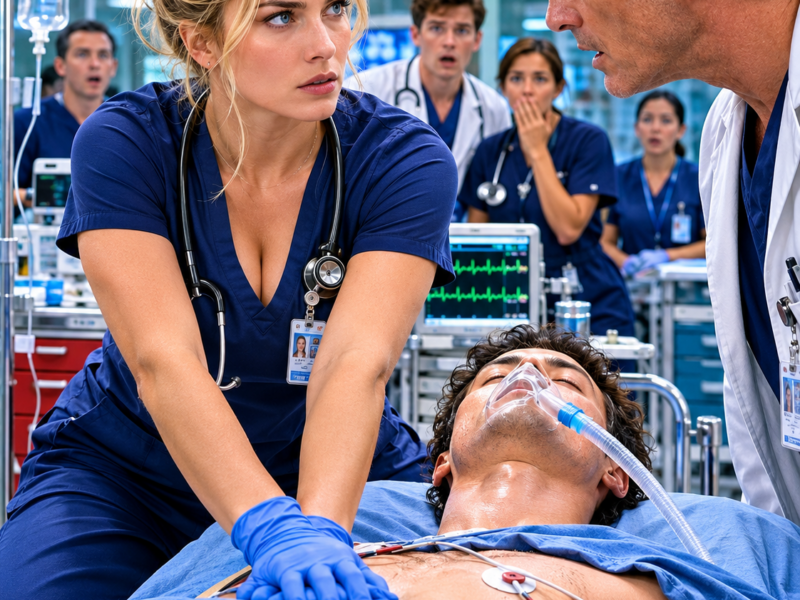
“I was standing beside the supply cart in Vanderbilt University Medical Center when a surgeon ordered me to step away from a dying man’s chest
“Because the doctor who died that night was my husband.”
The words came out quietly.
But they changed the temperature of the room.
Dr. Augusta Lynn lowered the paper.
Dr. Weston stopped moving.
Even Conrad Ellery, who had spent the entire morning looking for a reason to have me dismissed, seemed unable to find anything to say.
I stared at the grain of the conference table.
His name was Daniel DeLynn.
He had been thirty-two years old, a combat physician, and the kindest man I’d ever known.
We had been married for four years.
He used to leave handwritten notes inside my lunch bag, even when we were deployed together and eating cold food from military ration packs.
One of his favorite notes said, “Come home with all your pieces. I’ll take care of the rest.”
I had kept that note in my wallet.
It was still there.
“Zara,” Weston said carefully, “you don’t have to explain anything you aren’t comfortable discussing.”
“I know.”
I took a breath.
“But if we’re going to discuss my qualifications, we should probably discuss why they’re incomplete.”
Dr. Lynn folded her hands.
“Please continue.”
I looked at the paper in front of her.
The final paragraph described an extraction operation in northeastern Syria, eighteen months earlier.
It mentioned four wounded Rangers.
It mentioned a helicopter destroyed by ground fire.
It mentioned a medical officer killed during the incident.
What it didn’t mention was what happened before the helicopter went down.
And what it didn’t mention was why I had never wanted to perform another emergency thoracotomy.
I began there.
Daniel and I had been assigned to the same surgical support element for almost three years.
He was an emergency physician who could make a frightened nineteen-year-old soldier laugh while removing shrapnel from his shoulder.
I was the senior medic.
We worked well together because neither of us needed to prove anything to the other.
He trusted my hands.
I trusted his judgment.
On the night of the crash, our team was supporting a Ranger operation in the Deir ez-Zor region.
The extraction helicopter was hit during departure.
It came down hard enough to scatter equipment across the ground and tear open the side of the aircraft.
Daniel was inside.
So were four wounded Rangers.
I reached the wreckage before the second medical team arrived.
The helicopter was burning.
One of the Rangers had a severe abdominal injury.
Another had a chest wound.
A third was unconscious and bleeding from his head.
The fourth was trapped beneath part of the aircraft structure.
Daniel was still conscious when I found him.
He had a deep wound across his abdomen and was struggling to breathe.
I dropped beside him.
“Don’t move.”
He looked at me and tried to smile.
“That’s usually my line.”
“Save your breath.”
“You’re terrible at following orders.”
I pressed gauze against the wound.
His hand found my wrist.
“How many?”
“Four others.”
“Take care of them first.”
“Daniel, I’m not leaving you.”
His expression changed.
Not fear.
Something more painful.
Recognition.
He knew I was about to make the decision every medic hopes never to face.
He squeezed my wrist.
“Zara, look at me.”
I did.
“You’re not choosing between me and them. You’re doing your job.”
I wanted to argue.
I wanted to tell him that there were other people who could treat the Rangers.
I wanted to tell him that I was his wife before I was his medic.
But the helicopter was burning, and one of the Rangers was losing his pulse.
So I went to work.
For the next ninety minutes, I kept four men alive with equipment that would barely have qualified as a basic emergency kit in a civilian hospital.
We had no functioning operating room.
No electricity.
No anesthesiologist.
Only headlamps, portable monitors, blood supplies, and the people who refused to stop fighting.
Daniel helped me whenever he could.
Even with his own injuries, he kept giving instructions.
At one point, I heard him call my name.
I turned.
He was watching me from beside the wreckage.
“Zara.”
“What?”
“You’re doing good.”
I nodded and went back to the wounded Ranger in front of me.
It was the last time he spoke.
By the time the extraction team reached us, all four Rangers were alive.
Daniel wasn’t.
I didn’t cry when they brought his body away.
I didn’t cry when I signed the paperwork.
I didn’t cry during the flight back.
I simply sat beside the four men we’d saved and watched the sunrise through a small aircraft window.
Three weeks later, I stood at his funeral in Tennessee wearing a black dress and holding a folded flag.
After that, I couldn’t enter an operating room without hearing the helicopter.
I left the military six months later.
I completed the civilian nursing requirements, moved to eastern Tennessee, and eventually accepted the position at Vanderbilt.
I wanted ordinary work.
Ordinary emergencies.
Patients who arrived with broken bones, infected wounds, and illnesses that could be treated without someone shouting that incoming fire was thirty seconds away.
I wanted to be Zara again.
Not the medic.
Not the widow.
Just a woman who could go to the grocery store without checking the exits.
When I finished, nobody spoke for several seconds.
Dr. Lynn removed her glasses.
“I’m sorry,” she said.
I nodded.
“Thank you.”
Ellery looked down at the table.
“Why didn’t you tell anyone?”
I turned toward him.
“Because I applied for a nursing position, Dr. Ellery. Not a position where people would stare at me every time I walked into a room.”
He opened his mouth.
Then closed it.
Weston finally spoke.
“Zara, there’s something else I need to tell you.”
He slid another sheet of paper across the table.
It was a credentialing summary.
My military experience had been reviewed by the appropriate authorities, and my previous surgical training had been independently verified to the extent permitted by the relevant regulations.
“I’ve requested a formal review of your qualifications,” he said. “I’m also recommending that you join the trauma team under the hospital’s established credentialing and supervision requirements.”
I looked at him.
“Thank you.”
“Don’t thank me yet. There will be questions. There will be paperwork. And there will be people who don’t understand why you know what you know.”
He glanced at Ellery.
“But nobody is going to pretend last night didn’t happen.”
Dr. Lynn closed the folder.
“We’ll proceed with the credentialing review. Until then, your duties will remain within your authorized nursing scope, with any additional clinical responsibilities requiring proper approval.”
It was a reasonable decision.
I respected it.
Ellery, however, wasn’t finished.
“There’s still the issue of the procedure,” he said.
Weston turned.
“What issue?”
“She opened a patient’s chest without authorization. We can’t simply ignore that.”
“You’re right,” Weston replied.
Ellery looked relieved.
Then Weston continued.
“We’ll review the clinical decisions made by everyone in that room. Including yours.”
The relief disappeared.
“Mine?”
“Yes. You were the physician responsible for the patient. When the patient arrested, you hesitated. When Zara offered you the instrument, you didn’t take it. When the patient needed immediate intervention, you stood beside the counter.”
“I was assessing the risks.”
“Then we’ll assess that assessment.”
Weston stood.
“Conrad, six weeks of additional trauma simulation. No exceptions.”
Ellery looked toward Dr. Lynn.
She didn’t rescue him.
The meeting ended shortly afterward.
I walked into the hallway, where the morning shift was beginning to fill the hospital with familiar sounds.
A cart rattled past.
Someone laughed near the nurses’ station.
A patient complained about the temperature of his coffee.
Ordinary life.
I was grateful for it.
But I wasn’t prepared for the man standing near the elevators.
He was tall, broad-shouldered, and wearing a faded Army jacket.
His hair had turned gray at the temples.
I recognized him immediately.
“Sergeant Cole?”
He turned.
For a moment, he looked confused.
Then his face softened.
“Zara?”
I hadn’t seen him since the crash.
Sergeant Michael Cole had been the senior Ranger I’d treated that night.
He was also the man who had been trapped beneath the helicopter structure.
He walked toward me slowly.
“I heard you were here.”
“Who told you?”
“Weston. He called an old contact. Word gets around.”
I looked at him.
“How are you?”
He gave a small laugh.
“Still breathing. Apparently, I’m stubborn.”
His eyes moved over my face.
Then he looked down at my hands.
“I heard about last night.”
I didn’t know what to say.
He nodded toward the elevator.
“Can we talk?”
We found an empty family waiting room.
The room smelled of coffee and disinfectant.
A small television played the morning news with the sound turned down.
Cole sat across from me.
For a while, neither of us spoke.
Then he reached into his jacket and removed a small envelope.
“I’ve been carrying this around for eighteen months.”
I looked at it.
My name was written on the front.
The handwriting was Daniel’s.
I stopped breathing for a moment.
“Where did you get that?”
“Daniel gave it to me before the crash.”
I didn’t reach for it.
Cole placed it on the table.
“He told me to give it to you if he didn’t make it.”
My fingers moved toward the envelope, then stopped.
“Why didn’t you send it?”
Cole looked down.
“Because I didn’t think you were ready.”
I stared at him.
“You had eighteen months to decide that?”
“I know.”
His voice cracked slightly.
“I’m sorry.”
I picked up the envelope.
The paper was worn at the corners.
The seal had never been broken.
I opened it carefully.
Inside was a folded sheet of paper and a small photograph.
The photograph showed Daniel and me standing outside our apartment in Tennessee.
He was holding two paper cups of coffee.
I was laughing at something outside the frame.
It had been taken three weeks before the crash.
I unfolded the letter.
“Zara,
“If you’re reading this, then something happened that I couldn’t control.
“First, I want you to know that I love you. I know I say that every day, but I don’t think there’s any harm in writing it down.
“Second, I need you to promise me something.
“Don’t spend the rest of your life trying to make the last day different.
“You’ll replay every decision. You’ll wonder whether you should have stayed with me, whether you could have done more, whether you missed something.
“But I know you.
“You would have tried to save everyone, even if it cost you everything.
“That’s one of the things I love about you.
“Just don’t confuse being alive with being responsible for everyone else’s survival.
“You deserve a life that belongs to you.
“Not to the Army.
“Not to the people we couldn’t save.
“Not even to me.
“Come home with all your pieces.
“I’ll take care of the rest.
“Daniel.”
I read it twice.
The second time, the words blurred.
For eighteen months, I’d carried the belief that leaving the military meant I had abandoned the only life Daniel and I understood.
I’d thought that choosing civilian nursing was a way of running away.
But he had known me better than I knew myself.
He hadn’t wanted me to spend my life trapped in that night.
He had wanted me to come home.
Cole sat quietly across from me.
“I should’ve given you that letter sooner.”
I wiped my face.
“Yes.”
He nodded.
“I know.”
I looked at him.
“Why did you wait?”
He hesitated.
“Because I was angry.”
“At me?”
“At myself. At the Army. At the helicopter. At the fact that Daniel died and the rest of us walked away.”
He rubbed his hands together.
“I kept thinking that if I’d been stronger, faster, or less trapped, maybe I could’ve helped him.”
I looked at the man who had spent eighteen months carrying his own version of the same guilt.
“Michael, Daniel didn’t die because you couldn’t move a helicopter.”
Cole’s eyes filled.
“He told me to take care of you.”
“He told you to take care of the wounded.”
“He said both.”
I laughed through my tears.
That sounded like Daniel.
Cole stood after a few minutes.
“I should get going. My wife is waiting downstairs.”
I folded the letter and returned it to the envelope.
“Thank you for bringing it.”
He nodded.
Then he hesitated at the door.
“One more thing.”
“What’s that?”
“When you saved Marcus last night, you didn’t look like someone who was trying to prove anything.”
I looked at him.
“You looked like the person Daniel always said you were.”
He gave me a small salute.
I didn’t return it.
I simply nodded.
After he left, I sat alone for another ten minutes.
For the first time since the crash, I allowed myself to cry without trying to stop.
Not because I had failed Daniel.
Because I finally understood that I hadn’t.
Marcus Webb woke up four days later.
I was checking his blood pressure when his eyes opened.
At first, he looked frightened.
He tried to move, but the ventilator and chest tubes prevented him from doing much.
“Easy, Marcus,” I said. “You’re in Vanderbilt. You’ve had surgery. You’re safe.”
His eyes moved toward me.
He tried to speak.
I adjusted the communication board near his bed.
He pointed slowly to the letters.
WHO?
I smiled.
“Zara. I’m one of the nurses who helped take care of you.”
He pointed again.
DID I DIE?
I pulled a chair beside his bed.
“Not this time.”
He stared at me.
Then his eyes filled with tears.
I placed a tissue beside his hand.
“Your family is coming up soon. Your mother has called about twelve times.”
He managed a weak smile.
“She’s worried.”
“That’s what mothers do.”
His mother arrived twenty minutes later.
She was a small woman with silver hair, wearing a sweatshirt from a local Tennessee high school.
The moment she saw him awake, she covered her mouth.
“Oh, sweetheart.”
Marcus reached for her hand.
She bent over the bed and kissed his forehead.
I quietly stepped outside.
Some moments didn’t need a nurse standing in the middle of them.
A few minutes later, she came into the hallway.
“Are you Zara?”
“Yes, ma’am.”
She took both my hands.
“Someone told me you helped save my son.”
I looked down.
“A whole team helped.”
“But they said you were the one who wouldn’t give up.”
I didn’t know what to say.
She hugged me.
It was an awkward hug because she was crying and I was still wearing gloves from the previous room.
But I let her hold me.
“Thank you,” she whispered.
I closed my eyes.
For years, I had believed that saving someone meant I had to carry them afterward.
That every life I touched became another responsibility I could never put down.
Marcus’s mother was simply thanking me.
She wasn’t asking me to become part of their family.
She wasn’t asking me to replace anyone.
She was grateful.
And I could accept that.
The next six weeks were not easy.
The hospital completed its review of the incident.
My actions in trauma bay three were examined by a multidisciplinary panel.
They reviewed the patient’s condition, the available options, the timeline, the medical records, and the decisions made by every clinician present.
I cooperated fully.
The final report acknowledged that the emergency intervention had been performed outside my documented civilian scope of practice.
It also recognized that the patient’s condition had been immediately life-threatening and that the circumstances required a thorough review of the clinical decisions made in the room.
The hospital did not simply turn me into a hero.
There were policies to follow, qualifications to verify, and boundaries that existed for good reasons.
I understood that.
My military experience was independently reviewed, and my additional clinical credentials were processed through the appropriate channels.
Weston helped arrange supervised trauma training and a formal pathway for advanced responsibilities.
He never treated me like a miracle worker.
I appreciated that more than he knew.
“You’re going to make mistakes,” he told me one afternoon.
We were standing outside the trauma department, watching an ambulance pull into the bay.
“Everyone does.”
“I know.”
“The difference between a good clinician and a dangerous one isn’t that the good clinician never makes mistakes.”
He looked at me.
“It’s that they know when to stop, ask for help, and listen.”
I nodded.
“Understood.”
He smiled.
“Good. Now go get some lunch.”
Meanwhile, Ellery changed.
Not overnight.
Not dramatically.
But enough that people noticed.
He began arriving early for trauma simulation.
He stopped dismissing questions from nurses.
He learned everyone’s names.
One evening, I found him in the skills laboratory practicing emergency thoracic procedures on a training mannequin.
He looked up when I entered.
“DeLynn.”
“Dr. Ellery.”
He removed his gloves.
“I owe you an apology.”
I waited.
He looked uncomfortable.
“I was wrong in trauma bay three. I knew something was happening, and I couldn’t make myself commit to a decision.”
He looked down at the mannequin.
“I’ve spent years being told I was exceptional. I think I started believing that being exceptional meant I would always know exactly what to do.”
I leaned against the counter.
“And now?”
“Now I know I don’t.”
For a moment, neither of us spoke.
Then he added, “I also shouldn’t have called you Nelson.”
I raised an eyebrow.
“That’s what you’re apologizing for?”
He almost smiled.
“It’s on the list.”
I let out a quiet laugh.
“Start with learning my name.”
“I have.”
He looked at my badge.
“Zara.”
“Good.”
I turned toward the door.
“Keep practicing, Dr. Ellery.”
He nodded.
“I will.”
It wasn’t friendship.
It wasn’t forgiveness in some grand, cinematic sense.
It was simply the beginning of professional respect.
And that was enough.
Three months after the night Marcus came into trauma bay three, I received a letter from his family.
It was handwritten by his mother.
She told me Marcus had been discharged from rehabilitation and was slowly learning to walk longer distances.
He still had pain.
He still had appointments.
He still had a long recovery ahead.
But he had gone home.
At the bottom of the letter was a photograph.
Marcus stood beside his cement truck, wearing a baseball cap and holding a small sign.
The sign read:
“Still here.”
I pinned the photograph inside my locker.
The next morning, Weston found me looking at it.
“Good outcome?”
“Very good.”
He glanced at the photograph.
“That young man is going to be buying us coffee for the rest of our careers.”
I smiled.
“His mother probably will too.”
Weston leaned against the locker beside mine.
“How are you doing, Zara?”
It was a simple question.
But I knew he wasn’t asking about my shift.
“I’m getting there.”
He nodded.
“That’s all anyone can ask.”
I reached into my pocket and touched the folded letter Daniel had written.
I still carried it.
But I no longer read it every night.
Some days I didn’t think about the crash at all.
Other days, the sound of a helicopter passing overhead still made my shoulders tighten.
Healing wasn’t a straight line.
I was beginning to understand that it didn’t need to be.
On the anniversary of Daniel’s death, I drove to the small cemetery where he was buried.
The sky was gray, and the grass was wet from an overnight rain.
I carried two cups of coffee.
One for me.
One for him.
I sat beside his grave and placed the second cup on the stone ledge.
For a while, I watched the steam disappear into the cold air.
“I got your letter,” I said.
A breeze moved through the trees.
“Michael finally brought it to me.”
I smiled faintly.
“You would’ve liked that he survived. He’s got a wife now. Still complains about everything.”
I paused.
“And I saved someone.”
I looked at the engraved name.
“His name is Marcus. Twenty-six. Works with cement trucks. His mother thinks I’m some kind of miracle.”
I laughed softly.
“She doesn’t know how many people helped.”
The cemetery was quiet.
I reached into my pocket and unfolded Daniel’s letter.
I didn’t need to read it.
I knew every word.
Instead, I placed it against the stone for a moment.
“I think I’m finally learning how to come home, Daniel.”
My eyes filled, but I didn’t look away.
“I miss you. I always will.”
I folded the paper and returned it to my pocket.
Then I stood, picked up my coffee, and walked back toward the car.
I didn’t feel like I was leaving him behind.
I felt like I was finally carrying him in a way that didn’t hurt quite so much.
That evening, I returned to Vanderbilt for another overnight shift.
The emergency department was busy.
A child had broken his arm.
An elderly man was waiting for test results.
Two ambulances were approaching the entrance.
The familiar rhythm of the hospital surrounded me.
At 11:42 p.m., a new nurse joined our team.
She looked nervous, kept checking her badge, and seemed unsure where to put her hands.
I recognized that expression.
I walked over and introduced myself.
“Hi. I’m Zara.”
She smiled with visible relief.
“I’m Emily. It’s my first night.”
“Then I’ll show you around.”
As we passed trauma bay three, she slowed down.
“Is this where the big cases come in?”
“Some of them.”
“Does it ever get easier?”
I considered the question.
Then I looked through the glass at the empty bed.
“You get better at knowing what needs to be done. But you never stop remembering that the person in that bed has a life waiting for them outside this building.”
Emily nodded.
I handed her a fresh pair of gloves.
“Come on. I’ll show you where we keep the supplies.”
We walked down the hallway together.
A monitor beeped somewhere behind us.
An ambulance pulled up outside.
And for the first time in a long time, the sound didn’t take me back to the night I had lost Daniel.
It brought me back to the people still waiting for help.
I touched the small photograph in my locker as I passed.
Daniel’s handwriting was still folded in my pocket.
His promise had never been that I would forget him.
It was that I would keep living.
And that night, beneath the bright lights of Vanderbilt University Medical Center, I finally did.
The End.









