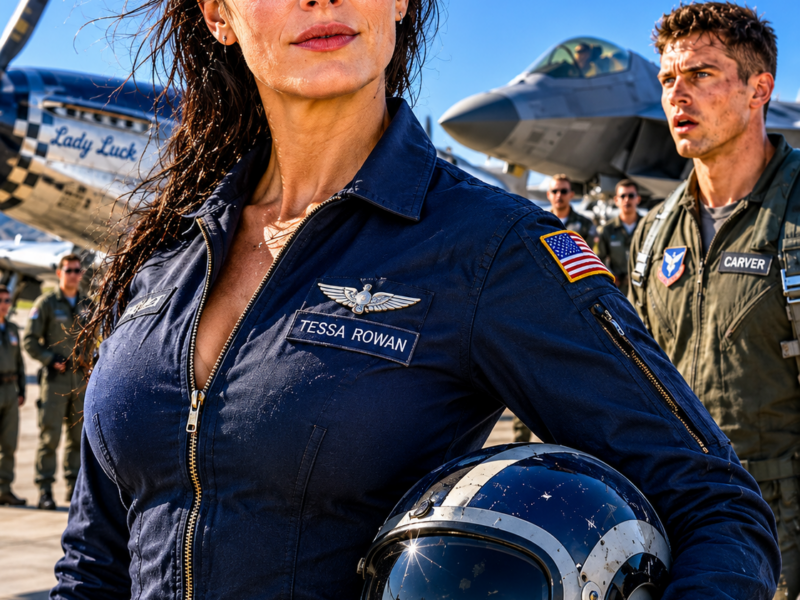
“I was standing beside a flight schedule at Desert Falcon Air Expo when a young F-22 pilot laughed at the name beside a vintage Mustang
I stared at the four words on the back of the photograph.
YOU DIDN’T LEAVE US.
For a moment, the noise of the air show disappeared.
The words were written in black ink, the letters uneven, as though whoever had held the pen had been fighting exhaustion or pain.
I turned the photograph over again.
It showed the narrow mountain valley at Coral Valley, taken from somewhere above the eastern ridge. Smoke drifted across the lower slopes. The remains of a vehicle burned near a cluster of rocks, and several soldiers were gathered beside a makeshift casualty station.
I recognized the position.
I remembered the smell of burning fuel, the radio calls overlapping in my headset, and the way the mountains had swallowed every sound except gunfire.
But I didn’t recognize the man standing near the center of the photograph.
“Where did you get this?” I asked.
Wade didn’t answer immediately.
He watched me with the careful expression of someone who knew he was carrying something heavier than a piece of paper.
“From Sergeant First Class Daniel Mercer,” he said. “He was the company medic at Coral Valley.”
I looked at the photograph again.
“Daniel made it?”
“Yes, ma’am. He’s alive. Retired two years ago.”
I swallowed.
For fourteen years, I had carried the memory of those soldiers without knowing what happened to most of them.
I knew the official report said all twenty-three had survived the engagement. I knew the mission had been classified for a time, and that the details had eventually been reduced to a few paragraphs in a commendation file.
But I had never met the men.
I had never heard their voices again.
And I had never known that one of them had kept a photograph.
“Why are you showing me this now?” I asked.
Wade glanced toward the younger pilots.
“Because Sergeant Mercer asked me to find you if I ever got the chance.”
“Why?”
Wade took a breath.
“There’s something you need to know about that day.”
I looked at him.
“What?”
He lowered his voice.
“The official account says you made three dry passes after your cannon ran out.”
I nodded slowly.
“I remember.”
“Mercer says there were four.”
The number seemed too small to matter.
I had spent years remembering that valley in fragments. The fire warning. The hydraulic pressure dropping. The vibration through the controls. The voices calling for help.
I remembered the dry passes.
I remembered the last one.
But I couldn’t remember whether there had been three or four.
“Maybe he counted differently,” I said.
Wade shook his head.
“He says the fourth pass was the one that saved his life.”
I looked at the photograph again.
A soldier near the bottom edge was kneeling beside another man. His helmet was missing, and his uniform was dark with dirt.
I couldn’t make out his face.
“Where is Mercer now?”
“He’s waiting outside the main gate.”
I looked up sharply.
Wade nodded.
“He drove in this morning. He didn’t want to come onto the flight line until he knew you were here.”
For the first time since landing, I forgot about the Mustang.
“Why didn’t you tell me?”
“I wanted to make sure you were the right Tessa Rowan.”
I almost smiled.
“How many women named Tessa Rowan do you know who flew an A-10 at Coral Valley?”
“Not many.”
The corner of his mouth moved.
Then he became serious again.
“There’s another reason he came.”
I waited.
“He has something that belonged to the man who sent the broken-arrow call.”
My hand tightened around the photograph.
The company commander had been Captain Michael Harlan.
I remembered his voice clearly.
Not because he shouted, but because he didn’t.
His transmissions had been controlled, even when the situation around him was collapsing.
He had directed his men to cover the wounded, coordinate their movement, and keep their heads down while I made each pass.
During the final minutes, he had transmitted one sentence that stayed with me longer than any medal citation.
“Ghost Rider, if you can hear me, we’ve got people still moving.”
I had answered, “I see you.”
Then I had turned the aircraft back toward the valley.
I looked at Wade.
“Captain Harlan?”
Wade nodded.
“That’s who Mercer wants to talk about.”
I folded the photograph carefully and slipped it into my canvas bag.
“Take me to him.”
Wade led me away from the aircraft.
The young pilots moved aside as we passed.
Adrien remained near the Mustang, watching us go.
I noticed him looking at the photograph in my hand, but he didn’t ask a question.
At the edge of the staging area, Wade stopped beside a security vehicle.
A gray-haired man stood near the passenger door.
He was in his late forties, maybe fifty, with a slight limp and a weathered face. He wore a dark blue jacket over a plain shirt, and he held a second photograph in his left hand.
When he saw me, he didn’t move.
Neither did I.
Then he took one step forward.
“Captain Rowan?”
I hadn’t heard that name used for me in years.
“That’s right.”
He looked at my face as though he were trying to match it to a memory that had been kept alive for too long.
“I’m Daniel Mercer.”
I extended my hand.
He took it with both of his.
“Ma’am,” he said quietly. “I owe you a thank-you.”
I looked at him.
“You don’t owe me anything.”
He shook his head.
“That’s what I expected you to say.”
He handed me the second photograph.
This one was older and more damaged.
It showed a group of soldiers standing beside a wrecked vehicle. Some were smiling. Others looked exhausted. One man had a bandage wrapped around his head.
Captain Harlan stood in the middle.
I recognized him immediately.
He was holding a small radio handset and looking toward the camera with a tired grin.
I touched the edge of the photograph.
“He made it?”
Mercer nodded.
“He did.”
The answer came so simply that it took me a moment to understand it.
I had always assumed Harlan had survived. The official casualty report had listed all twenty-three soldiers as evacuated, but I had never learned what happened to him afterward.
“Where is he?”
Mercer looked down.
“That’s the part I came to tell you.”
The silence between us grew.
“Michael died last winter,” he said. “Cancer. He was sixty-one.”
I lowered the photograph.
“I’m sorry.”
“He talked about you until the end.”
I looked at him.
“Why?”
Mercer rubbed his thumb along the photograph’s worn corner.
“Because he never believed you understood what happened after your last pass.”
I remembered the radio going quiet.
I remembered the aircraft shuddering as I pulled away from the valley.
I remembered the engine temperature rising and the controls becoming heavier.
And I remembered the moment when I finally realized I couldn’t make another pass.
I had wanted to stay.
But the aircraft was failing, and there was nothing left to give.
“Captain Harlan told me to get out,” I said.
“He did.”
“I argued.”
“I know.”
I looked at him sharply.
Mercer gave a faint smile.
“He told us about that, too.”
For the first time, I felt the beginning of something close to relief.
I had spent fourteen years wondering whether the men below thought I had abandoned them when I turned toward home.
Mercer seemed to read the question on my face.
“Captain Harlan never thought that.”
“Then why did he write that message?”
Mercer glanced at the photograph in my hand.
“Because he wanted you to understand what the last pass meant.”
He reached into his jacket and removed a small envelope.
The paper was yellowed, folded twice, and sealed with a strip of clear tape.
My name was written across the front.
Tessa Rowan.
No rank.
No call sign.
Just my name.
“I found this in his personal effects,” Mercer said. “He asked me to give it to you if I ever found you.”
I stared at the envelope.
“Did you read it?”
“No.”
“Why not?”
He gave a tired smile.
“Because it wasn’t written to me.”
I took it.
My hands were steady, but I didn’t open it immediately.
I looked at Wade.
Then at Mercer.
“Why wait fourteen years?”
Mercer glanced toward the flight line, where the Mustang sat in the sunlight.
“Because I didn’t know where to find you. And because for a long time, I wasn’t ready to talk about that day.”
I understood.
Some memories don’t become easier just because the calendar keeps moving.
I slipped the envelope into my bag.
“Thank you for bringing it.”
Mercer nodded.
Then he looked toward the aircraft.
“That Mustang is beautiful.”
I followed his gaze.
“She’s a good airplane.”
He smiled.
“Captain Harlan would’ve liked that.”
I looked back at him.
“Did he ever talk about the A-10?”
“Every year.”
I raised an eyebrow.
“He used to tell people that the ugliest airplane in the sky had the prettiest sound he’d ever heard.”
I laughed.
It surprised me.
Not because it was particularly funny, but because I hadn’t laughed about Coral Valley in years.
Mercer watched me for a moment.
Then he said, “He also told us something else.”
“What?”
“He said you weren’t the reason we survived.”
I looked down.
Mercer continued.
“He said the reason we survived was that twenty-three men kept doing their jobs while one pilot gave them the time to do it.”
I looked at him.
“He never let us turn you into some kind of miracle,” Mercer said. “He wanted us to remember that we had a responsibility, too.”
I thought about the soldiers in that valley.
The ones who carried their wounded.
The ones who kept their positions.
The ones who stayed with their friends when every instinct must have told them to run.
I had never thought of it that way.
For fourteen years, I had remembered the flight as a sequence of decisions I had made alone.
But it hadn’t been alone.
Not really.
“Thank you,” I said.
Mercer nodded.
Then he stepped back.
“I won’t keep you.”
He began walking toward the parking area, then turned once more.
“One more thing, Captain.”
I looked up.
“He said the fourth pass wasn’t about the enemy.”
I waited.
“He said you made it because you saw a soldier trying to drag another man behind a rock. You were out of ammunition, the aircraft was damaged, and you still turned around.”
I remembered.
A flash of movement near the southern slope.
A man crawling.
Another man reaching for him.
The aircraft had been shaking so badly that I could barely keep the nose steady.
I had turned back because I couldn’t leave them in the open.
Mercer nodded toward the photograph.
“That soldier was me.”
He didn’t wait for me to respond.
He walked away.
I stood beside the security vehicle until Wade touched my shoulder.
“Come on, ma’am. You should get some water.”
I nodded.
But my thoughts were still in the valley.
For the first time in fourteen years, I knew the face of the man I had gone back for.
And I knew he had lived.
The air show continued around us.
The public address system announced another demonstration. A jet engine started somewhere near the far end of the runway. Children shouted near the food stalls.
Life moved on, as it always did.
Wade walked me toward a quiet maintenance building where the noise was less intense.
I sat on a metal bench and finally opened the envelope.
Inside was a handwritten letter, several pages long.
The first line was enough to make me stop.
“Captain Rowan, I hope you know that we heard you.”
I read the rest slowly.
Harlan wrote that he remembered the first transmission from my aircraft.
He remembered the way my voice sounded through the radio, calm and almost irritated, as though the weather were a minor inconvenience.
He remembered telling his men to move when they heard my cannon.
He remembered the first time the A-10 came through the valley and the enemy positions went quiet.
He remembered the fire warning.
And he remembered the moment I told him my ammunition was gone.
He wrote that he had known what that meant.
He knew I could leave.
He knew the aircraft was damaged.
He knew I had already done more than anyone could reasonably ask.
But when I made the next pass, he understood that I hadn’t come to save the mission.
I had come to save the men.
There was a paragraph about the fourth pass.
Harlan wrote that he had seen Mercer dragging a wounded soldier across an exposed section of ground.
The enemy had begun firing again.
He had ordered Mercer to leave the man and take cover.
Mercer refused.
Harlan had been preparing to move toward them when the Mustang-shaped shadow of the A-10 swept across the rocks.
The enemy fire shifted.
The two soldiers reached cover.
The man Mercer had been dragging survived.
So did Mercer.
Harlan wrote that he had never told me any of this because he thought the official report would be enough.
Then he admitted he had been wrong.
He wrote:
“You probably went home believing you had failed because you couldn’t stay until every last shot was fired. I want you to know that we never thought you failed us. We watched you leave with one engine burning, and we knew you were still fighting to bring that aircraft home. You had given us the time we needed. We had to do the rest.”
I stopped reading.
My eyes had reached the end of the page, but I couldn’t make myself turn it over.
Wade sat beside me without speaking.
After a while, I folded the letter and placed it on my lap.
“I thought about that valley every time I flew,” I said.
Wade looked at me.
“Even after I left the military?”
“Especially after.”
I stared at my hands.
“I used to wonder if I should’ve stayed longer.”
Wade leaned forward, elbows on his knees.
“Would another pass have changed anything?”
“I don’t know.”
“Would it have brought another twenty-three people home?”
I looked at him.
He didn’t push the question.
He didn’t need to.
“I couldn’t make that decision again,” I said.
“Then maybe you don’t have to.”
I looked down at the letter.
For years, I had believed the most important part of Coral Valley was the moment I decided to turn back.
Now I was beginning to understand that the most important part might have been the moment I finally turned away.
Not because I wanted to.
Because I had to trust the people below to finish what we had started.
I folded the letter carefully and put it in the envelope.
“Do you know what happened to the other twenty-two?”
Wade nodded.
“Some stayed in. Some retired. A few moved into civilian work. Mercer has kept in touch with most of them.”
“All twenty-three?”
“All twenty-three.”
I looked at him.
“How?”
“That’s what soldiers do sometimes. They keep checking on the people who were there.”
I smiled faintly.
“Would you mind giving me his number?”
Wade reached into his pocket and handed me a small card.
Mercer’s name and phone number were written on it.
On the back, someone had added a second line.
Coral Valley Survivors’ Reunion — October 18.
I looked up.
“They’re having a reunion?”
“Every year,” Wade said. “This year, Mercer wanted to invite you.”
I studied the date.
“Where?”
“Colorado Springs.”
I looked toward the flight line.
The afternoon sun had moved farther west, and the heat shimmered above the runway.
I had planned to leave the base as soon as my flight was finished.
I’d booked a cheap hotel for one night, then intended to drive home the following morning.
I had no intention of staying in anyone’s memory longer than necessary.
But now I was holding a letter from a man who had spent his final months trying to tell me something I had needed to hear.
I looked at Wade.
“Do you think they’d want me there?”
He gave me a small, knowing smile.
“Ma’am, I think they’ve been waiting fourteen years.”
I didn’t attend the reunion immediately.
There were practical things to arrange.
I had a Mustang to get home, maintenance records to finish, and a life that had never been particularly good at making room for unexpected journeys.
But I kept the date.
And over the following weeks, I found myself taking the envelope out of my desk drawer more often than I expected.
Sometimes I read the letter from beginning to end.
Sometimes I stopped at the first line.
Sometimes I simply held the paper and thought about the men in the photograph.
In late September, I called Daniel Mercer.
He answered on the third ring.
“Mercer.”
“It’s Tessa Rowan.”
There was a pause.
Then I heard him exhale.
“Captain.”
“You don’t have to call me that.”
“I know.”
He sounded amused.
“Old habits.”
We spoke for nearly an hour.
He told me about the men who had made it home, the families they had built, and the ones who still met for coffee every month.
He told me that one of the survivors had become a firefighter.
Another coached high school baseball.
One had opened a small repair shop in Ohio.
He told me that two of them had passed away since the operation, and that the group still remembered them every year.
Then he asked whether I would come to the reunion.
I looked at the calendar on my desk.
“Yes,” I said.
“I’ll be there.”
He didn’t say anything for a moment.
Then he answered quietly.
“Good. We’ll save you a seat.”
On October 18, I drove into Colorado Springs under a pale blue sky.
The reunion was being held in a small veterans’ hall near the edge of town.
There were no cameras, no formal speeches, and no military bands.
Just folding tables, paper plates, coffee urns, and photographs arranged along the walls.
I parked outside and sat in the car for several minutes.
I could hear people laughing inside.
A man called someone’s name.
Another voice answered.
It sounded ordinary.
That was what made it difficult.
I had spent so many years imagining the valley that I hadn’t prepared myself for the possibility that the men who survived it would be standing in a room arguing about football.
I finally opened the door.
Daniel saw me first.
He crossed the room with a smile.
“You came.”
“I said I would.”
He shook my hand.
Then he turned toward the group.
“Everybody, this is Tessa Rowan.”
The room quieted.
Twenty-one men stood or turned in their chairs.
Some were older than I remembered. Most had gray hair. A few walked with canes.
One man wore a baseball cap with the name of a small town embroidered across the front.
Another had a little girl sitting beside him, probably his granddaughter.
They looked at me.
I looked at them.
For a second, I was back in the valley.
Then a man near the window stood up.
He was tall, with a broad face and a silver beard.
I recognized his eyes before I recognized anything else.
“Captain Harlan’s right-hand man,” he said.
I shook my head.
“Sergeant Miller?”
He smiled.
“Retired Master Sergeant Miller now.”
I laughed softly.
“Congratulations.”
He stepped closer.
“There’s someone I want you to meet.”
He turned toward a younger man sitting near the wall.
The man was in his thirties, with dark hair and a quiet expression.
“This is Caleb,” Miller said. “The soldier Mercer was dragging behind that rock.”
I looked at him.
Caleb stood.
He was thinner than I expected, and he moved carefully, favoring his left leg.
He extended his hand.
“Ma’am.”
I took it.
“How’s your leg?”
He smiled.
“Still attached.”
A few men laughed.
Then his expression changed.
“I don’t remember much from that day,” he said. “I remember the first explosion. I remember the radio. I remember someone pulling me by my vest.”
He glanced at Mercer.
“Then I remember the sound of your aircraft.”
I looked down.
“I wish I could say I remember seeing you.”
“You did.”
He reached into his pocket and pulled out a small photograph.
It showed a younger version of himself standing beside a hospital bed, his leg wrapped in a thick bandage.
On the back was a date.
The day after Coral Valley.
“Mercer gave me this,” he said. “He told me you came back for us.”
I looked at the photograph.
Caleb continued.
“I spent a long time thinking I was alive because someone else had to risk everything. I didn’t know what to do with that.”
I looked up.
He shrugged.
“Eventually I became a paramedic. Figured if someone had given me a chance to get home, I could spend a little time helping other people get theirs.”
I couldn’t answer immediately.
He smiled.
“That’s what I wanted you to know.”
I nodded.
“Thank you for telling me.”
He returned to his seat.
One by one, the others came over.
Some shook my hand.
Some hugged me.
Some simply said my name.
A man named Paul told me he had been carrying a photograph of the A-10 on his refrigerator for years.
Another said his son had joined the Air Force after hearing the story.
One woman, the wife of a survivor, came over and told me that her husband had never been able to talk about Coral Valley until the last few years.
She thanked me for giving him more time with their children.
I listened.
I didn’t try to explain what I had done.
I didn’t know how.
I had spent years thinking of myself as the person who flew the aircraft.
But in that room, I began to understand that the story belonged to more people than I had ever realized.
The soldiers who carried the wounded.
The medic who refused to leave.
The commander who kept the company together.
The families who waited at home.
And the pilot who had tried to hold the sky open long enough for all of them to survive.
Later that afternoon, Mercer asked me to sit near the front.
He placed a small wooden box on the table.
“This belonged to Captain Harlan,” he said.
I opened it.
Inside was a set of old dog tags, a folded map, and a small metal pin shaped like an A-10.
There was also a handwritten note.
I recognized Harlan’s writing immediately.
Mercer watched me read it.
“He asked us to give you that pin.”
I held it in my palm.
“Why?”
Mercer smiled.
“He said you had earned it twice.”
I looked at him.
“Once for what you did in the valley. And once for carrying it with you afterward.”
I closed my hand around the pin.
For the first time in fourteen years, I didn’t feel the need to defend the decision I had made that day.
I didn’t need to explain why I had stayed.
Or why I had finally left.
The men in that room already understood.
A few weeks later, I returned to Desert Falcon.
Not for another air show.
I had been invited to speak to a group of young pilots during a training seminar.
When I arrived, the briefing tent looked almost exactly as it had that morning.
Same canvas walls.
Same folding chairs.
Same smell of coffee and jet fuel.
But this time, the room was quieter when I walked in.
Adrien Carver was there.
He stood near the front, speaking with a senior instructor.
When he saw me, he straightened.
“Miss Rowan.”
“Lieutenant.”
He walked over.
“I heard you attended the Coral Valley reunion.”
“I did.”
He nodded.
“How did it go?”
I considered the question.
“Better than I expected.”
He looked at the small metal pin attached to my bag.
“Is that from the engagement?”
I touched it.
“From the men who came home.”
He nodded slowly.
Then he asked something I hadn’t expected.
“Do you think I was wrong that morning?”
I looked at him.
He continued before I could answer.
“About the way I judged you. I know I was wrong about the airplane. But I keep thinking about how quickly I decided who you were.”
I studied him.
“You’re young, Lieutenant.”
He looked down.
“That’s not an excuse.”
“No,” I said. “It isn’t.”
He accepted that without argument.
I continued.
“But you can learn from it.”
He nodded.
“I have been trying.”
I looked at the young pilots gathering around the table.
They were skilled, ambitious, and confident.
Some would become excellent aviators.
Some would make mistakes.
A few might someday face decisions they couldn’t prepare for in a simulator.
I knew that because I had once been one of them.
“Do you know what the biggest mistake I ever made as a pilot was?” I asked.
Adrien shook his head.
“Thinking experience meant I could stop listening.”
He looked up.
I told him that every aircraft had its limits, and every pilot had blind spots.
The most dangerous thing in the cockpit wasn’t always a mechanical failure or bad weather.
Sometimes it was the belief that you had already understood everything worth knowing.
Adrien listened.
Then he said, “I won’t forget that.”
I nodded.
“Good.”
The seminar began.
I spoke about aircraft handling, judgment, and the difference between confidence and certainty.
I told them that a good pilot had to trust the machine, but never mistake its sophistication for invulnerability.
I told them that technology could widen the margin for error, but it could never remove the responsibility to make good decisions.
And I told them about Coral Valley.
Not the version in the official report.
Not the version that made me sound brave.
I told them about the twenty-three men who kept moving when they were frightened.
I told them about the medic who refused to abandon a wounded soldier.
I told them about Captain Harlan, who kept his voice steady when everything around him was falling apart.
Then I told them about the moment I had to turn away.
When I finished, the room stayed quiet.
Adrien was sitting near the front.
He raised his hand.
“Ma’am, can I ask you something?”
“Go ahead.”
“When you turned away from the valley, did you know they would survive?”
I looked at him.
“No.”
He waited.
“I knew they had a chance.”
I paused.
“Sometimes that’s all you get. A chance. You do what you can with it, and then you trust the people beside you to carry the rest.”
Adrien lowered his hand.
For a moment, nobody spoke.
Then the instructor thanked me, and the seminar moved on.
When it ended, Adrien walked me to the door.
“I’ve been thinking about what you said at the air show,” he told me.
“Which part?”
“That confidence gets you off the ground, but something else brings you home.”
I smiled faintly.
“Have you figured out what that something else is?”
He considered it.
“Knowing when the mission isn’t about you.”
I looked at him.
It was a better answer than I had expected.
“That’s a good place to start.”
He held the door open.
As I stepped outside, I heard the sound of an aircraft starting up on the far side of the runway.
The deep rumble of the Mustang’s Merlin engine wasn’t there.
It was a modern jet, clean and powerful, built with systems I had never flown and never needed to.
I watched it taxi toward the runway.
Adrien stood beside me.
“Beautiful machine,” he said.
“It is.”
He glanced at me.
“Would you ever fly one?”
I smiled.
“I think I’ll stick with my old airplane.”
He laughed.
Then he asked, “Do you still fly the Mustang because of what happened in the valley?”
I thought about that for a moment.
“No.”
I looked toward the runway.
“I fly it because I still love flying.”
The jet accelerated and lifted into the afternoon sky.
I watched until it disappeared beyond the clouds.
Then I adjusted the strap of my canvas bag and started toward the parking lot.
Inside the bag were the photographs, the letter, and Captain Harlan’s small metal pin.
They were no longer reminders of something I had failed to finish.
They were reminders of twenty-three men who had finished it together.
And somewhere, in a quiet house in Colorado, a photograph still sat on a shelf with four words written across the back.
YOU DIDN’T LEAVE US.
For fourteen years, I had believed the hardest part of Coral Valley was staying in the fight.
I finally understood that sometimes the hardest part was learning to come home.
The End.









