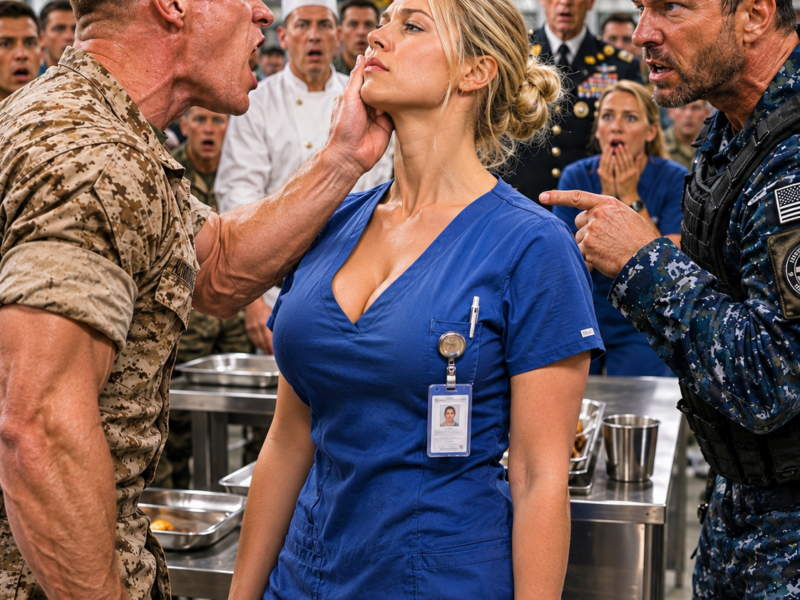
“I was slapped across the face in front of 200 Marines by a sergeant who thought I was just a hospital nurse—and when I tasted blood and calmly told him to sit down
The first person to move after Senior Chief Mercer saluted me was Ellis Grady.
He took one step closer, his cane tapping against the tile.
“Commander Howerin,” he said again, his voice unsteady. “I thought you were still overseas.”
“I came home, Ellis.”
He looked at the blood on my lip.
“Who did that?”
I glanced at Branick.
“Sergeant Branick.”
Grady’s jaw tightened.
Behind him, Mercer remained standing at attention. He had not asked for an explanation, and I knew he was waiting for me to decide how much of one I wanted to give.
Branick looked from the badge at my waist to the senior chief.
“She’s an officer?”
Mercer finally turned his head.
“Yes, Sergeant.”
Branick swallowed.
“But she was wearing scrubs. She didn’t identify herself.”
I looked at him.
“You don’t need someone’s rank to know you shouldn’t hit them.”
He opened his mouth, but no words came.
The north doors opened again.
Corporal Lamar returned with the duty noncommissioned officer, followed closely by First Sergeant Marisol Cruz.
Cruz took in the scene in seconds.
Her eyes went to my face, then to Branick, then to Aguilar sitting at the table.
“Who witnessed this?”
About forty hands went up.
She nodded once.
“Nobody leaves this building until we’ve taken statements.”
Then she turned to the duty NCO.
“Secure the camera footage. Both entrances and the central dining area. Nobody touches anything.”
Branick shifted in his chair.
“First Sergeant, there’s been a misunderstanding.”
Cruz looked at him.
“Then you’ll have an opportunity to explain it.”
She turned toward me.
“Commander, do you need medical attention?”
“I’ll get checked after we make sure Lance Corporal Aguilar is all right.”
Aguilar looked up sharply.
“Ma’am, I’m fine.”
I could see his hands trembling.
His injured leg was extended beneath the table, and the crutch Branick had taken was still resting beside the sergeant’s chair.
I walked over and picked it up.
“Here.”
He accepted it without looking at me.
“I’m sorry,” he whispered.
I crouched slightly so I could meet his eyes.
“For what?”
“For causing all this.”
“Teao, listen to me. You wanted to eat lunch with your fellow Marines. That’s all you did.”
He looked down.
“If I hadn’t tried to stand…”
“You didn’t hit me.”
“But—”
“You didn’t hit me.”
I waited until he looked at me again.
“Don’t take responsibility for something another person chose to do.”
He nodded, although I could tell he didn’t believe me yet.
That was going to take time.
Sergeant Major Dwight Kesler arrived nine minutes later.
He was a broad-shouldered man in his early fifties with a quiet manner that made people stop talking before he even reached them.
He walked straight to Branick.
“Stand up.”
Branick stood.
“Did you strike Commander Howerin?”
“Sergeant Major, she grabbed my arm first.”
“That wasn’t my question.”
Branick glanced toward the tables.
“Yes, Sergeant Major.”
“Did you take Lance Corporal Aguilar’s crutch?”
“I was joking.”
“Did he ask you to give it back?”
Branick hesitated.
“Yes.”
“And did you give it back?”
No answer.
Kesler looked at him for several seconds.
“Sergeant, are you telling me that whether you put your hands on somebody depends on what they’re wearing?”
Branick’s face reddened.
“No, Sergeant Major.”
“Then explain why you keep mentioning her clothing.”
Branick had no answer.
Kesler turned toward Cruz.
“Escort him out. He is not returning to this dining facility until further notice.”
Two Marines from Branick’s company stepped forward.
As they led him toward the north doors, he kept his eyes on the floor.
He never looked at me.
The room remained quiet long after he was gone.
Only when the doors closed did the sound of trays and conversations slowly return.
I finally sat down.
My cheek was beginning to swell, and the inside of my mouth tasted like metal.
Sandival brought me ice wrapped in a napkin.
“Ma’am, you need stitches.”
“I know.”
“Then why are you still sitting here?”
I looked across the table.
Aguilar was trying to eat his lunch one-handed while keeping his injured leg comfortable.
“Because he hasn’t finished.”
Sandival followed my gaze.
Her expression softened.
“You’re something else, Commander.”
“Not today, I’m not.”
She laughed quietly.
It was the first normal sound I’d heard in nearly an hour.
Mercer stayed beside my table.
Grady sat opposite me, his cane resting against the bench.
For a while, neither man spoke.
Then Grady looked down at his prosthetic leg.
“Third socket,” he said.
I nodded.
“Last time you told me it was the second.”
“They said the second one was going to be the last.”
“It rarely works that way.”
He smiled faintly.
“You still remember everything.”
“Not everything.”
He looked at me for a long moment.
“You remembered the compound.”
I remembered it.
March.
A damaged building, smoke, an overturned vehicle, and a radio that kept cutting out.
Grady had been one of the casualties.
He had a badly fractured femur, internal injuries, and a leg that had lost enough blood supply that the surgeons eventually had no choice.
I had helped coordinate the evacuation.
There had been a decision about which helicopter would take him and which casualty would wait.
It was a decision I’d argued about with a surgeon who believed another patient had a better chance of surviving the journey.
We had disagreed.
Loudly.
Grady had made it.
The other Marine had made it, too.
But I had never forgotten the faces.
“Commander,” Grady said quietly, “I owe you my life.”
“No.”
He frowned.
“I was doing my job.”
“You put me on that first helicopter.”
“Because you needed it.”
“You argued with the surgeon.”
“Because I thought he was wrong.”
He shook his head.
“That’s what I’m saying.”
I looked at him.
“Ellis, you don’t owe me anything. You came home. That’s enough.”
He lowered his eyes.
For a moment, I thought he might cry.
Then he straightened and reached for his coffee.
“I heard you were taking command of this ward.”
“I am.”
“Then I guess the place is in good hands.”
I looked at Aguilar.
“That’s what I’m trying to find out.”
By early afternoon, the investigation had begun.
The military police collected names and contact information.
The duty NCO secured the surveillance recordings.
Every Marine who had witnessed the incident was asked to provide a statement.
I went to the hospital clinic.
Three stitches were needed to close my lower lip.
The physician also found a small fracture near my left cheekbone.
When I looked in the mirror afterward, half my face had turned a deep purple.
Captain Bril, the hospital director for nursing services, came to see me.
He stood in the doorway for a moment before speaking.
“Commander, I heard what happened.”
“I’m all right.”
“That’s not what I asked.”
I gave him a tired smile.
“Then I’m angry.”
He pulled a chair beside the examination bed.
“Your transfer date is Monday. I can delay it.”
“No.”
“June, you’ve just been assaulted by a Marine on the installation. You have a facial injury. You don’t have to prove anything by showing up.”
“I’m not trying to prove anything.”
“Then why insist?”
I looked at him.
“Because Ward 6 has been waiting for a commander for months. Those patients have already had enough uncertainty.”
He studied me for a moment.
“You’re going to make my life difficult.”
“Probably.”
He shook his head, but there was a smile at the corner of his mouth.
“Get some rest.”
I didn’t get much.
The next eleven days were spent answering questions, reviewing evidence, and watching the story grow beyond the dining hall.
At first, I believed the investigation would be straightforward.
There were more than forty witnesses.
Two camera angles showed the incident.
The footage clearly captured Branick taking Aguilar’s crutch, the young Marine trying to stand, my intervention, and the strike.
But then Corporal Lamar came forward.
His statement was four pages long.
It began three months before the incident.
He described an incident involving a private first class in the barracks.
Branick had become angry during an argument about a missing piece of equipment.
The private had been shoved against a locker.
When he complained, another Marine told him to forget it.
“He’s a sergeant,” the Marine had said. “You don’t want to make yourself a problem.”
The private never filed a report.
Lamar had witnessed it.
He had said nothing.
Until now.
When First Sergeant Cruz asked him why he had waited so long, he stared at his hands.
“Because I thought that was how things worked.”
Cruz didn’t interrupt.
“I thought if you made trouble for someone above you, you’d be the one who paid for it.”
She let the silence sit.
Then she said, “That’s exactly why we have a reporting process.”
Lamar nodded.
“I know that now.”
His statement changed the investigation.
The command began reviewing Branick’s previous disciplinary history.
The incident outside the bar in Jacksonville was reopened.
His recent evaluations were examined.
His platoon commander provided additional documentation about declining performance and repeated problems with his behavior.
Branick had been struggling.
That much was true.
His fiancée had left him.
His career was no longer moving in the direction he’d expected.
He had begun drinking heavily and had become increasingly hostile toward people he considered weaker than himself.
But none of that explained away what he had done.
And the private first class in the barracks had been carrying the consequences long before I entered the chow hall.
On the fourth day, Branick was placed in pretrial confinement.
The charges were eventually referred to a general court-martial.
Striking a superior commissioned officer.
Assault consummated by a battery.
Conduct prejudicial to good order and discipline.
His defense attorney contacted me before the hearing.
She wanted to discuss the fact that I had made physical contact with Branick before he struck me.
I agreed to meet.
She was a civilian attorney named Anne Petroian, and she was professional, calm, and much more prepared than I expected.
She placed a copy of the incident report on the table.
“Commander, you understand that my client maintains you initiated physical contact?”
“I do.”
“You reached for his forearm.”
“Yes.”
“Without first identifying yourself as an officer.”
“Correct.”
“And you were wearing unmarked hospital scrubs.”
“Yes.”
She folded her hands.
“Then perhaps you can explain why you didn’t identify yourself.”
I looked at her.
“Because he was holding a wounded Marine’s crutch and encouraging that Marine to stand on an injured leg.”
“Couldn’t you have called for security?”
“I could have.”
“Couldn’t you have moved Lance Corporal Aguilar away?”
“I could have.”
She waited.
I continued.
“I’ve reviewed those moments many times. There are things I could have handled differently. I could have left the table sooner. I could have called the duty NCO earlier.”
I paused.
“But none of those decisions put my hand against his face.”
Petroian looked down at her notes.
I knew she was doing her job.
I didn’t resent her for it.
The court-martial began in January.
By then, the swelling had disappeared from my face.
The scar inside my lower lip remained.
I wore my service dress uniform to testify.
The gold on my sleeve felt unfamiliar after weeks of wearing hospital scrubs.
The courtroom was smaller than the chow hall, but the silence felt heavier.
Branick sat beside his attorney.
He looked thinner.
His hair was shorter, and the confidence I’d seen in the dining hall had disappeared.
He did not look at me when I entered.
The prosecutor asked me to describe the incident.
I explained Aguilar’s injury, the crutches, the frame, and the seven surgeries.
I described Branick’s comments.
I explained that I had asked him to move.
Then I described the moment he took the crutch.
“Did Lance Corporal Aguilar attempt to stand?”
“Yes.”
“Why was that dangerous?”
“His leg was still healing around an external fixation frame. A sudden loss of balance or twisting motion could have compromised the reconstruction.”
“What did you do?”
“I supported him and returned him to the bench.”
“And then?”
“I reached for the crutch and Branick’s forearm.”
“Why?”
“To prevent him from continuing to interfere with the patient.”
The prosecutor nodded.
“Did you strike Sergeant Branick?”
“No.”
“Did you threaten him?”
“No.”
“Did you strike him at any point?”
“No.”
Then came the cross-examination.
Petroian approached slowly.
“Commander, you’ve said you were concerned about Lance Corporal Aguilar’s safety.”
“Yes.”
“But you also knew Sergeant Branick was a trained Marine.”
“Yes.”
“You knew he might react physically if you grabbed his arm.”
“I knew it was possible.”
“Yet you did it anyway.”
“I did.”
She paused.
“Do you believe you handled the situation perfectly?”
“No.”
The answer surprised her.
I continued.
“I wish I’d removed Aguilar from the table sooner. I wish I’d called for assistance before things escalated. I have thought about those decisions many times.”
I looked toward the court members.
“But I won’t confuse an imperfect decision with permission for someone to hit another person.”
Nobody moved.
Petroian returned to her table.
The prosecutor called Lance Corporal Aguilar the following morning.
He walked into the courtroom without crutches.
The external frame had been removed in November, exactly as planned.
His gait was still slightly uneven, and he had a long rehabilitation ahead of him.
But he was standing on his own.
When he took the oath, his hands were steady.
The prosecutor asked him what happened at the chow hall.
Aguilar described the comments.
He described Branick taking his crutch.
He described trying to stand because he wanted it back.
Then he described watching me catch him.
“Did Commander Howerin strike Sergeant Branick?” the prosecutor asked.
“No, sir.”
“What did you see?”
“She grabbed his arm and tried to get the crutch away from him.”
“And what happened next?”
“He hit her.”
Aguilar’s voice tightened.
“Right across the face.”
The prosecutor asked whether he had felt responsible afterward.
Aguilar looked down.
“Yes, sir.”
“Why?”
“Because she wouldn’t have been there if I hadn’t asked her to come with me.”
The courtroom remained quiet.
Then he lifted his head.
“But I know that’s not true anymore.”
I looked at him.
He continued.
“I just wanted to eat lunch with my Marines. I didn’t think that was asking too much.”
His voice broke once.
He took a breath and finished his testimony.
I had seen him cry before.
I’d watched him endure dressing changes, failed physical therapy sessions, and the first time he tried to put weight on his healing leg.
But that morning, watching him stand before a room full of strangers and tell the truth, I felt prouder than I had during many formal ceremonies.
The prosecution also called Corporal Lamar.
His testimony was difficult.
He explained why he had laughed at Branick’s jokes.
He explained why he had remained seated when Aguilar was being humiliated.
And he explained what had happened to the private first class in June.
The defense challenged his credibility.
They suggested he was trying to protect himself.
Lamar didn’t deny it.
“Maybe I am,” he said.
“But that doesn’t change what I saw.”
When the prosecutor asked why he had finally decided to speak, he looked toward Branick.
“Because I watched someone get hurt in front of two hundred people, and I realized I’d been helping this happen by staying quiet.”
The court members deliberated for two hours and eleven minutes.
They returned with their verdict.
Guilty on all three charges.
At sentencing, Branick was reduced to the lowest enlisted pay grade, ordered to forfeit his pay and allowances, sentenced to fourteen months of confinement, and given a bad-conduct discharge.
His military career was over.
But the part I remember most happened after the hearing.
His attorney approached me in the corridor.
“Commander, my client would like to apologize.”
I looked through the open doorway.
Branick was sitting alone.
I thought about the slap.
I thought about the private first class who had been too frightened to report what happened in the barracks.
I thought about Aguilar’s hands trembling around the edge of the table.
“All right,” I said.
Petroian brought him over.
Branick stopped a few feet away.
For several seconds, he said nothing.
Then he began talking.
He spoke about his fiancée leaving.
He spoke about the pending disciplinary case.
He spoke about being unable to sleep and how everything seemed to be falling apart.
He said he had been angry for months.
He said he hadn’t meant to hit me.
He said he was sorry.
I listened until he finished.
Then I asked him one question.
“Do you remember Lance Corporal Aguilar?”
He looked confused.
“Yes, ma’am.”
“Do you remember taking his crutch?”
“Yes.”
“He’s in the parking lot.”
Branick looked toward the doors.
“Why are you telling me?”
“Because he’s the person you humiliated before you ever touched me.”
He said nothing.
“He’s waiting for a ride. You have about ten minutes.”
I stepped aside.
I didn’t know whether Branick would go.
I didn’t ask.
I walked away before I could turn his decision into another thing I needed to carry.
Two days after the incident, my official change of command had gone ahead as scheduled.
I stood in front of the Ward 6 staff wearing my service dress uniform.
Three stitches were still healing inside my lip, and the bruise along my cheek had faded to a yellowish shadow.
Captain Bril had offered to postpone the ceremony.
I refused.
The ceremony itself was simple.
There were no speeches about heroism.
No one mentioned the chow hall.
I read my orders, signed the necessary documents, and took responsibility for the ward.
Afterward, the staff returned to work.
That was exactly how I wanted it.
The following weeks taught me more about Ward 6 than the eleven days before my appointment.
The staff worked hard, but they were exhausted.
Two nursing positions had been vacant for nineteen months.
Patients who needed help getting to appointments sometimes waited too long.
Families called repeatedly because nobody had time to return their messages.
The official reports showed acceptable staffing levels.
The actual ward told a different story.
I started meeting with every member of the team.
Not just officers and senior nurses.
Everyone.
The night-shift corpsmen.
The civilian technicians.
The people who cleaned the rooms and changed the linen.
I wanted to know what they saw when nobody important was watching.
Some conversations were uncomfortable.
One nurse told me she’d stopped reporting equipment shortages because nothing changed.
A corpsman admitted he sometimes skipped breaks to help patients get to therapy.
Another told me that limited-duty Marines often avoided common areas because they were embarrassed by the attention.
I wrote everything down.
Then I started fixing what I could.
The two vacant positions were finally filled.
We established a better process for reporting concerns.
We created a system for patients who needed assistance traveling to the mess hall.
And I made one rule very clear.
No patient would ever be made to feel that their recovery was a favor being granted to them.
Some Marines would return to full duty.
Others wouldn’t.
Neither outcome made one person’s service more valuable than another’s.
Aguilar continued rehabilitation.
His progress was slow.
Some mornings, he arrived at therapy frustrated because his leg wouldn’t bend the way he wanted.
Other days, he came back from physical training smiling because he’d managed another small improvement.
I never promised him he’d return to his old unit.
I knew better than to make promises I couldn’t keep.
Instead, we focused on the next appointment, the next exercise, and the next step.
In March, he walked into my office without knocking.
“Commander?”
I looked up from a stack of reports.
“What’s wrong?”
“Nothing.”
He stood there awkwardly.
“Just wanted to tell you I ran.”
I put my pen down.
“Ran?”
“Well, jogged. A little.”
I smiled.
“How far?”
“Across the therapy gym.”
“That’s good.”
He shrugged, trying to hide his pride.
“Didn’t look like much.”
“Seven months ago, you couldn’t walk across a parking lot.”
He looked at his leg.
“Yeah.”
Then he looked back at me.
“Thanks for coming to lunch that day.”
I shook my head.
“Thank you for asking me.”
He smiled.
For a moment, he looked like the twenty-year-old who had first arrived on Ward 6, before the surgeries and the frame and the months of wondering whether his body would ever feel like his own again.
“Do you think I’ll ever go back to my unit?”
I considered the question carefully.
“I think you’ll have a chance to find out what your body can do. That’s what we’re working toward.”
He nodded.
It wasn’t the answer he wanted.
But it was an honest one.
And he had learned to value honesty more than easy reassurance.
Months passed.
The story of the chow hall slowly became part of the hospital’s history.
New Marines arrived who knew nothing about it.
The staff stopped talking about Branick.
His name appeared occasionally in paperwork, but he was no longer part of our daily lives.
I never learned whether he went to speak with Aguilar in the parking lot that afternoon.
I never asked.
There are things people have to decide without an audience.
What mattered to me was that Aguilar no longer believed the incident had been his fault.
He still had difficult days.
Some nights, the pain returned.
Some mornings, he got frustrated with the slow pace of recovery.
But he began eating in the mess hall again.
At first, he went with another patient.
Later, he went with two Marines from his old company who had started visiting him regularly.
By the end of the year, he was walking there without assistance.
One afternoon, I found him sitting at the same table where Branick had taken his crutch.
He was laughing with a group of Marines.
There was a tray in front of him.
A glass of water beside it.
Nothing remarkable.
Just lunch.
He noticed me standing near the entrance and lifted his hand.
“Commander!”
I walked over.
“How’s the food?”
“Still terrible.”
I laughed.
“Some things never change.”
He moved his tray to make room for me.
I sat down.
Across the room, a young Marine with a brace on his leg was trying to carry a tray and open the door at the same time.
Aguilar noticed him.
He stood, walked over, and took the tray.
The young Marine started to protest.
“I’ve got it.”
Aguilar smiled.
“I know. I’m just hungry too.”
He carried the tray to an empty table.
I watched them sit down together.
Something about the scene stayed with me.
It wasn’t the court-martial.
It wasn’t the verdict.
It wasn’t even the day Senior Chief Mercer saluted me in front of two hundred Marines.
It was that small moment.
A young man who had once been humiliated for needing help had learned how to offer help without taking away someone else’s dignity.
That was the kind of recovery I wanted to see on Ward 6.
A few weeks later, Sandival came into my office during the night shift.
She noticed my badge hanging from my waistband.
For the first time since I’d arrived at Cordell, it was facing outward.
She pointed at it.
“You finally turned it around.”
I looked down.
“I did.”
“Why?”
I thought about the question.
For eleven days, I’d kept it turned backward because I didn’t want patients or staff treating me differently.
I wanted to see the ward as it really was.
But after the incident, I had begun to understand something else.
A badge wasn’t only about authority.
Sometimes it told a frightened young Marine who was responsible for listening.
“Because there are patients who need to know who’s on the floor,” I said.
Sandival nodded.
“And maybe who they can come to.”
“Exactly.”
She glanced toward the corridor.
“Commander, bed four needs his evening dressing change.”
I stood.
“Let’s go.”
We walked down the hall together.
The ward smelled of antiseptic and fresh laundry.
A monitor beeped softly behind a closed door.
Somewhere, a patient was laughing at something on television.
I stopped outside bed four.
The name on the chart had changed.
Aguilar had been discharged weeks earlier.
For a moment, I remembered him sitting on the edge of that bed, staring at the door and wondering whether he could make it to lunch.
I reached into my pocket and felt the old brass coin resting there.
I’d carried it through deployments, hospital corridors, and more difficult nights than I could count.
I had never shown it to Branick.
I had never needed to.
The people who understood what it meant already knew.
I turned toward Sandival.
“How’s the new patient doing?”
“He’s scared. First surgery is tomorrow.”
I nodded.
“Then let’s make sure he knows what to expect.”
And I went inside.
Because the most important thing I’d learned in all those years wasn’t how to command a room full of people.
It was how to make sure the person sitting alone in a hospital bed never had to wonder whether anyone would stand beside him.
The End.









