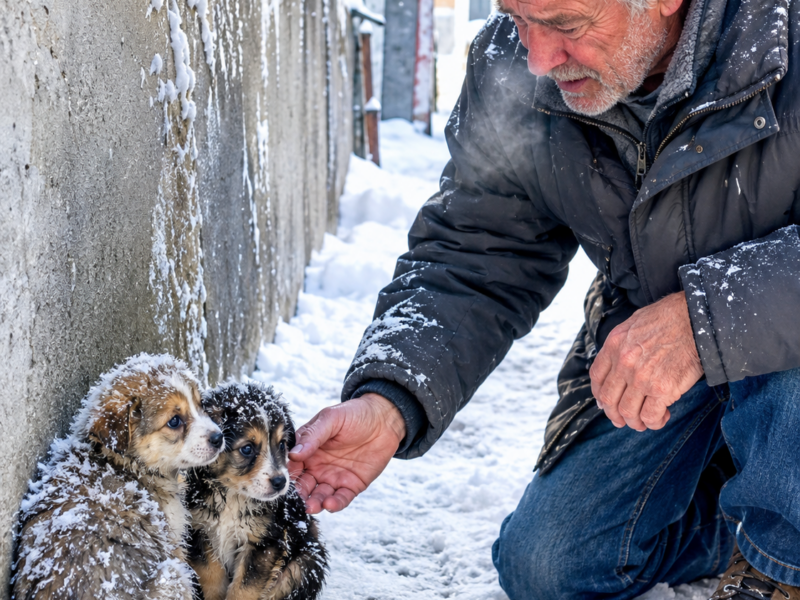
“I was sixty-eight years old when I found two freezing puppies clinging to a crumbling stone wall behind an abandoned farmhouse in Vermont
The man’s voice came again from outside the farmhouse.
“Hannah, I don’t want to do this in the cold. Just bring me the envelope.”
Hannah’s fingers tightened around my arm so hard that her nails pressed through my jacket.
I slipped the photograph inside my coat and guided her behind the kitchen counter.
“Do you know him?” I whispered.
She nodded.
“His name is Richard Cole. He used to work with Margaret.”
“Doing what?”
“Helping animals.”
That answer made no sense.
My wife had spent years volunteering at the local shelter, organizing food drives, and finding homes for abandoned dogs. She’d never mentioned anyone named Richard Cole, and she’d certainly never told me she was involved in anything dangerous.
I looked at the envelope in Hannah’s hand.
“What did Margaret ask you to protect?”
Hannah shook her head.
“She told me to give you the letter only when I found the puppies. She said you’d understand why when you saw them together.”
Outside, Richard knocked three times.
Not loudly.
Not angrily.
Almost politely.
That was what made me uneasy.
“Hannah, the old woman is gone. You don’t owe her anything anymore.”
Hannah’s face went white.
“Don’t listen to him,” she whispered. “That’s what he told me when Margaret died.”
I had spent fourteen months learning how to survive grief by keeping my world small. I paid my bills, repaired what needed fixing, and avoided questions that had no useful answers.
But my wife had left me a photograph, a letter, and two puppies who might have died in the snow.
Whatever Margaret had been trying to tell me, I wasn’t going to let someone else decide whether I deserved to hear it.
I took Hannah by the elbow and led her toward the rear door.
“There’s another exit?”
She pointed toward a narrow hallway.
“Through the mudroom. It opens into the old barn.”
We moved quietly through the dark house.
Behind us, Richard tried the front door.
It creaked open.
“Walter?” he called.
My blood ran cold.
He knew I was there.
I pushed Hannah into the mudroom and followed her outside.
The barn stood twenty yards away, its roof sagging under years of snow. I could hear Richard moving through the farmhouse behind us.
We hurried into the barn and closed the door.
I pulled out my phone.
One bar of service.
I called 911 and gave the dispatcher the address, explaining that a man had threatened us and was entering the property without permission.
Then I turned to Hannah.
“Now tell me everything.”
She stared at the envelope.
“Margaret started helping me almost three years ago. I worked at a small animal rescue in Barre. We took in dogs from overcrowded shelters, neglected farms, and people who couldn’t afford veterinary care.”
“Why didn’t she tell me?”
“Because she didn’t want you to worry.”
I almost laughed at that.
Margaret had once hidden a broken wrist from me for two days because she didn’t want me to cancel a fishing trip.
“Go on.”
Hannah drew a shaky breath.
“Richard was one of our donors. He paid for surgeries, foster supplies, and emergency boarding. At first, he seemed wonderful. He’d bring food, volunteer on weekends, and help transport animals to new homes.”
“What changed?”
“Money started disappearing. Donations were being recorded under different names. Some animals were listed as adopted, but nobody could find their new owners.”
She looked toward the barn door.
“Margaret noticed the records didn’t match.”
My stomach tightened.
“What did she discover?”
“That Richard was selling some of the dogs through people who bred them illegally. Others were being passed to buyers without proper health checks or records. He’d been using the rescue to make the transactions look legitimate.”
I stared at her.
“Margaret found out someone was abusing the system, and she never told me?”
“She was afraid you’d try to confront him.”
That sounded like my wife.
Not because she thought I was reckless, but because she knew I had a stubborn streak that could turn a reasonable concern into a personal battle.
“What do the puppies have to do with it?”
Hannah hesitated.
“Their mother was one of the dogs Richard took. She was pregnant when she disappeared from the rescue’s records.”
“Where is she now?”
Hannah’s eyes filled with tears.
“We don’t know.”
The words landed heavily between us.
I thought of the two tiny bodies pressed against the stone wall, the red ribbon, and the tag asking someone to bring them home.
“Did Margaret find the puppies?”
“Not these puppies. She knew their mother was pregnant, and she suspected Richard would try to sell the litter before anyone discovered what had happened. She started gathering evidence.”
“What kind of evidence?”
“Copies of adoption forms, receipts, messages, and photographs. She kept them somewhere safe.”
I looked at the photograph I’d taken from the kitchen.
“Here?”
“No. Margaret only used this farmhouse to meet me when she didn’t want Richard seeing us together.”
A noise came from the other side of the barn.
Footsteps crunched through the snow.
Hannah grabbed my sleeve.
“He’s coming.”
I looked around for another exit and spotted a narrow door at the far end of the building.
“Go.”
We slipped through it and emerged beside a row of dead apple trees.
My truck was parked beyond the stone wall, but Richard’s car blocked the path back to the road.
I could see him standing beside it, holding a flashlight.
He wasn’t searching randomly.
He was watching the farmhouse as if he knew exactly where we would emerge.
I guided Hannah behind the trees.
“Stay here.”
“No, Walter.”
“I’m not going to fight him. I’m going to make sure he doesn’t follow us.”
I stepped out where he could see me.
“Richard!”
He turned.
For the first time, I saw his face clearly.
He was in his early sixties, with silver hair, a neatly trimmed beard, and a long wool coat that looked far too expensive for the weather.
He lowered the flashlight.
“Mr. Bennett. I’m sorry we’ve met under these circumstances.”
“You came looking for a letter.”
“That letter contains private information about a rescue organization. Hannah has misunderstood what she was involved in.”
“Then explain it to me.”
He sighed as though I were making an unpleasant evening longer than necessary.
“Your wife was a good woman. Kind, generous, and unfortunately too trusting. She got caught up in a dispute over some missing animals. I tried to help her resolve it.”
“By leaving two puppies in the snow?”
His expression hardened.
“I had nothing to do with those puppies.”
“Then why do you want the letter?”
“Because Hannah stole confidential records, and she has been making accusations for months.”
I studied him.
He spoke calmly, but his eyes kept moving toward the trees.
He wasn’t worried about the letter alone.
He was worried about who might have heard our conversation.
“I called the police,” I told him.
Richard glanced at his watch.
“Then they’ll arrive shortly. I’d suggest you let them handle this.”
He started toward his car.
Before opening the door, he looked back at me.
“Margaret loved you very much, Walter. She didn’t want you involved in any of this.”
Then he drove away.
I watched his taillights disappear beyond the trees.
Hannah came out of hiding.
“He’s lying.”
“I know.”
“But how?”
I thought about his careful words.
He hadn’t denied knowing about the puppies until I’d accused him of leaving them. He’d called the records private, not false. And he’d spoken about Margaret as if he knew what she would have wanted, even after her death.
“Because if he really wanted to protect Margaret’s memory, he wouldn’t have threatened you in the middle of the night.”
The sheriff’s deputy arrived ten minutes later.
He took our statements, searched the farmhouse, and photographed the envelope without opening it. Richard’s vehicle was gone, but the deputy promised to contact him in the morning.
I wasn’t satisfied.
Neither was Hannah.
We left the property and drove to the veterinary clinic, where the puppies were spending the night.
The smaller puppy had improved enough to lift her head when I entered the treatment room. The golden one was curled beside her in a heated kennel, his breathing steady and his paws tucked beneath his chest.
I sat on the floor beside them.
“You’re going to be all right,” I whispered.
The black-and-tan puppy crawled toward my hand.
She pressed her nose against my fingers, then settled beside the golden puppy again.
I noticed the ribbon around her neck had been removed, but the little brass tag lay on the counter.
Emily Carter, the veterinarian, came in carrying two small bottles of medication.
“They’re doing better,” she said. “They’ll need careful feeding and monitoring, but I think both will recover.”
I told her about Richard and the visit to the farmhouse.
She listened without interrupting.
When I finished, she looked at the brass tag.
“Did you ever find out what the date means?”
I picked it up.
The date was October 17, the day Margaret had died.
Until that moment, I’d assumed the tag had been made afterward as a tribute.
But the edges were worn, and the engraving had darkened with age.
It had been made long before her death.
I turned it over again.
The initials M.B. were cut deeply into the brass.
“Someone wanted these puppies connected to Margaret,” I said.
Emily nodded.
“Or wanted you to recognize the connection.”
I looked at Hannah.
She had gone very still.
“There’s something I haven’t told you,” she said.
I waited.
“Margaret gave me the ribbon and tag six weeks before she died. She told me to attach them to one of the puppies if the litter was ever found.”
“Why?”
“She said you’d understand when you saw the date.”
I looked at the tag again.
“She knew she was dying?”
Hannah nodded.
“Her doctors had told her the cancer was progressing. She knew she didn’t have much time.”
I closed my hand around the brass.
Margaret had known.
She had known she was leaving me, and she’d spent some of her final weeks preparing for something she believed I would need to understand.
I wanted to be angry with her.
I wanted to ask why she’d carried another secret into her final days when I’d sat beside her bed and promised her she didn’t have to face anything alone.
But then I remembered how frightened she’d been the last time I asked whether she wanted to talk about her illness.
She’d smiled, squeezed my hand, and told me she wanted to spend the afternoon watching birds at the window.
I hadn’t pressed her.
Maybe she’d been trying to spare me.
Maybe she’d been protecting someone else.
Or maybe she hadn’t known how to tell me that the world we’d built together contained a part of her life I had never seen.
The next morning, I took Hannah to my house.
I made coffee, set out bread and eggs, and watched her look around the kitchen.
“Margaret used to talk about this place,” she said.
“She talked about it to everyone.”
Hannah smiled faintly.
“She said you always pretended to dislike the animals she brought home, but you were the one who got up at night to feed them.”
I looked away.
“She had a habit of exaggerating.”
“She said you were the kindest person she’d ever met.”
That stopped me.
I hadn’t felt kind in a long time.
I’d felt tired, lonely, and increasingly irritated by how much effort it took to get through an ordinary day.
I sat down across from Hannah.
“Let’s open the letter.”
The envelope was sealed with a strip of clear tape.
Inside was a folded sheet of paper, a small key, and a photograph.
The photograph showed Margaret standing beside a wooden kennel, smiling at a group of puppies. Behind her was a woman I didn’t recognize, holding a clipboard.
On the back, Margaret had written a date and a sentence.
“The day we decided that every animal deserved a second chance.”
I unfolded the letter.
Walter,
If you’re reading this, Hannah has found the puppies, and I am no longer there to explain why I asked her to bring them to you.
I wish I could tell you this over coffee at our kitchen table. I wish I could see you roll your eyes and tell me that I’ve made another animal-related mess for you to clean up.
But if I have learned anything from our life together, it is that love doesn’t always arrive in a form we expect.
Sometimes it arrives cold, frightened, and covered in mud.
Sometimes it asks us to trust before we understand.
I know how lonely you will feel when I am gone. I know you will tell yourself that you are too old to begin again, that your heart has already done all the loving it can manage.
Please don’t believe that.
I have one more favor to ask.
Help Hannah protect the animals Richard has been taking. The key enclosed with this letter opens a storage cabinet at the old rescue building. Inside are copies of the records I gathered. They will help prove what happened.
I wanted to tell you everything, but I was afraid you’d try to protect me by taking the burden onto yourself. You always did that, even when I didn’t ask.
I am not asking you to become a detective or a hero.
I’m asking you to do what you’ve always done when something helpless needs you.
Show up.
And Walter, please don’t keep the puppies because you think you owe me something.
Keep them if you find that your home has room for them.
Keep them if their little paws make you smile.
Keep them if you discover that your heart, despite everything, is still alive.
I love you.
Margaret
I read the letter once.
Then I read it again.
By the third time, the words had blurred.
Hannah quietly pushed a tissue box toward me.
I took one and laughed softly at myself.
“She always knew how to get the last word.”
“She talked about you all the time,” Hannah said.
I folded the letter carefully.
“What happened at the rescue building?”
“Richard’s business was never limited to the animals we lost. Margaret believed he had been falsifying records for years. She gathered enough evidence to expose him, but she was afraid he would destroy the files if he knew where she kept them.”
I looked at the key.
“Then we go there.”
The old rescue building stood on the edge of Barre, a weathered former dairy barn that had been converted into kennels and storage rooms.
Hannah drove because she knew the property better than I did.
When we arrived, I noticed a new padlock on the side entrance.
The windows were dark.
“Richard said the organization closed last spring,” Hannah said. “But someone has been coming here.”
I examined the padlock.
It wasn’t the same kind Margaret’s key would open.
We walked around the building until Hannah found a narrow service door at the rear.
The lock on that door was older.
I slid Margaret’s key into it.
It turned.
Inside, the air smelled of dust, hay, and the faint lingering scent of disinfectant.
Sunlight slipped through cracks in the boarded windows.
Hannah led me to a small office beside the former treatment room. A filing cabinet stood against the wall, its bottom drawer missing.
The key opened a narrow storage cabinet hidden behind a stack of old blankets.
Inside were three binders, a small digital recorder, and a sealed plastic bag containing printed emails.
Margaret had labeled each binder with a date.
The first contained adoption records.
The second contained veterinary bills and donation receipts.
The third contained handwritten notes, photographs, and copies of messages between Richard and several buyers.
I flipped through the pages slowly.
There were names, dates, and amounts of money.
Some of the animals had been listed as adopted by families who didn’t exist.
Others had been transferred to businesses that had no veterinary licenses.
The evidence was organized, methodical, and heartbreaking.
Margaret had spent months putting it together.
Then Hannah found a page clipped to the inside cover of the third binder.
It was a handwritten list of puppies, each identified by a short description.
Near the bottom were two entries.
One described a golden male with a white chest.
The other described a black-and-tan female with a red ribbon.
Beside both entries, Margaret had written the same word.
“Recovered.”
I stared at the page.
“She knew where they were?”
Hannah shook her head.
“No. She knew they were missing. She wrote that word after she found evidence they’d been taken out of the rescue system.”
A noise sounded outside.
A vehicle had pulled into the gravel lot.
Hannah looked through the window.
Her face drained of color.
“It’s Richard.”
I closed the binder and slipped Margaret’s letter into my coat.
“Call the sheriff.”
She reached for her phone.
No signal.
I tried mine.
Nothing.
Richard stepped out of his vehicle and walked toward the side entrance.
He had a key.
I heard it turn in the lock.
Hannah backed away from the door.
“He knows the files are here.”
I looked around the office.
There was no second exit, only a small window above the desk.
I was sixty-eight years old, my knees were stiff, and the last thing I wanted was to crawl through a window into a patch of thorny bushes.
But Margaret’s records were too important to leave behind.
I handed Hannah the plastic bag of emails.
“Get the original documents into your bag. I’ll keep him busy.”
“No, Walter.”
“Hannah, please.”
She looked at me for a long moment, then began gathering the binders.
Richard entered the hallway.
“Walter,” he called. “I hoped you’d be sensible enough to stay out of this.”
I stepped into the doorway.
“You knew Margaret was gathering evidence.”
“She was confused about what she was seeing.”
“She was very careful with dates and numbers for someone who was confused.”
He smiled.
“She was a good woman. She didn’t understand how complicated these things could be.”
“You mean how profitable?”
His smile disappeared.
“You’re making accusations you don’t understand.”
“Then explain why two puppies were left in the snow.”
For the first time, his composure cracked.
“They were supposed to be delivered to a buyer. The transport fell through, and someone panicked.”
“So you abandoned them?”
“I didn’t put them there.”
“Who did?”
He said nothing.
I took one step toward him.
“Did you tell someone to leave them there?”
Richard looked past me toward the office.
“Where are the records?”
“Somewhere you won’t get them.”
He lunged toward the doorway.
I stepped aside, and he struck the wall with his shoulder.
It wasn’t much of a fight.
I was old enough to know that the bravest thing I could do was avoid one.
I shoved a rolling metal cart into his path and moved toward the exit.
Hannah emerged behind me with the binders and bag clutched to her chest.
Richard caught her sleeve.
She twisted free, leaving a strip of fabric in his hand.
Then a voice rang out from the entrance.
“Richard Cole! Step away from them!”
Two sheriff’s deputies stood in the doorway.
Hannah had managed to send an emergency text before we lost service, and the message had gone through.
Richard raised his hands.
For the first time since I’d met him, he looked genuinely frightened.
The deputies arrested him without further struggle.
As they led him outside, he turned toward me.
“You have no idea what you’re doing, Walter.”
I looked at the binders in Hannah’s arms.
“Neither did you, apparently.”
The investigation that followed was slower and less dramatic than the confrontation at the rescue building.
Investigators spent months verifying the records, interviewing former employees, and locating buyers who had received animals through Richard’s network.
Some of the dogs were found in breeding operations.
Others had been neglected or passed between owners who had no idea their adoption papers were false.
A few were never located.
Richard was charged with animal cruelty, fraud, falsifying records, and related offenses. Several people who had purchased animals knowingly through his operation faced charges of their own.
Hannah’s testimony helped establish how the rescue’s records had been manipulated.
Margaret’s careful documentation gave investigators the evidence they needed to build a case that could withstand scrutiny.
The case didn’t restore every missing animal.
It didn’t undo what had happened to Margaret.
But it stopped Richard from taking more.
The puppies recovered steadily.
The golden male began eating eagerly, gaining weight and discovering that shoes were excellent toys. The smaller female remained cautious around strangers, but she followed me everywhere once I brought her home.
Rachel came to visit the first weekend.
She stood in the kitchen watching the puppies tumble across the floor.
“Dad, you said you might need some help.”
“I do.”
She folded her arms.
“With what?”
I pointed at the golden puppy, who had managed to drag a dish towel halfway across the room.
“Apparently, I’m living with two criminals.”
Rachel laughed.
It was the first time I’d heard her laugh freely in my house since Margaret’s funeral.
She knelt to stroke the smaller puppy.
“Have you named them?”
I shook my head.
“I was waiting.”
“For what?”
I looked at the little black-and-tan female.
“To see who they were.”
Rachel smiled.
“That’s exactly what Mom would have said.”
The golden puppy was named Charlie because he greeted everyone as if they were an old friend.
The female became Maggie.
Not Margaret.
Just Maggie.
It felt important to give her a name that belonged to the life ahead of us rather than the one I’d lost.
In the months that followed, my house grew louder.
Charlie barked at the mail carrier.
Maggie slept beside my chair and followed me into the garden.
Both puppies developed a habit of racing toward the back door whenever I reached for my coat.
They needed walks, training, and veterinary appointments.
They needed me to get out of bed even on mornings when grief made the room feel impossibly heavy.
I stopped skipping breakfast.
I started driving past the shelter and turning into the parking lot.
Eventually, I began volunteering there on Saturdays, helping with repairs and taking the older dogs for walks.
Hannah visited often.
She helped establish a new foster program with stricter financial controls and transparent adoption records.
The first time I watched a frightened dog leave the shelter with a family, I thought of Margaret’s letter.
Love doesn’t always arrive in a form we expect.
Sometimes it arrives cold, frightened, and covered in mud.
I had once believed that sentence was about the puppies.
Now I understood that it was about me, too.
A year after I found Charlie and Maggie, I returned to the abandoned farmhouse.
The stone wall had been repaired, and the old cardboard box was long gone.
Snow lay along the roadside, bright beneath the winter sun.
Charlie bounded ahead on his leash, while Maggie stayed close enough that her shoulder brushed my leg.
I carried the brass tag in my pocket.
For months, I’d kept it beside Margaret’s photograph on the mantel. Today, I’d brought it because I finally knew what I wanted to do with it.
I knelt beside the wall and attached the tag to a small wooden marker I’d made in my garage.
It didn’t have Margaret’s name on it.
It simply read, “For every life that still deserves a chance.”
Maggie pressed her nose against my hand.
I scratched behind her ears, and she leaned into me with the quiet confidence of an animal who had finally learned she would be safe.
For the first time in a long while, I didn’t feel as though I was standing beside something that had ended.
I felt as though I was standing at the beginning of something I hadn’t expected to have.
That evening, I sat by the fireplace with Charlie asleep across my boots and Maggie curled against my side.
Margaret’s photograph rested on the mantel above us.
I still missed her.
I missed her voice in the kitchen, her laughter in the garden, and the way she’d reach for my hand whenever a sad story appeared on the evening news.
There were days when the silence returned, and I had to remind myself that healing didn’t mean forgetting.
But the house no longer felt empty.
It felt lived in.
Before bed, I took Margaret’s letter from the drawer and read the last paragraph once more.
She had asked me to show up.
Not to solve every problem.
Not to save every animal.
Not to prove that I was still young enough to be useful.
Just to show up when something helpless needed me.
I had thought my heart was too old for another beginning.
Turns out, it had simply been waiting for a reason to open the door.
The end.









