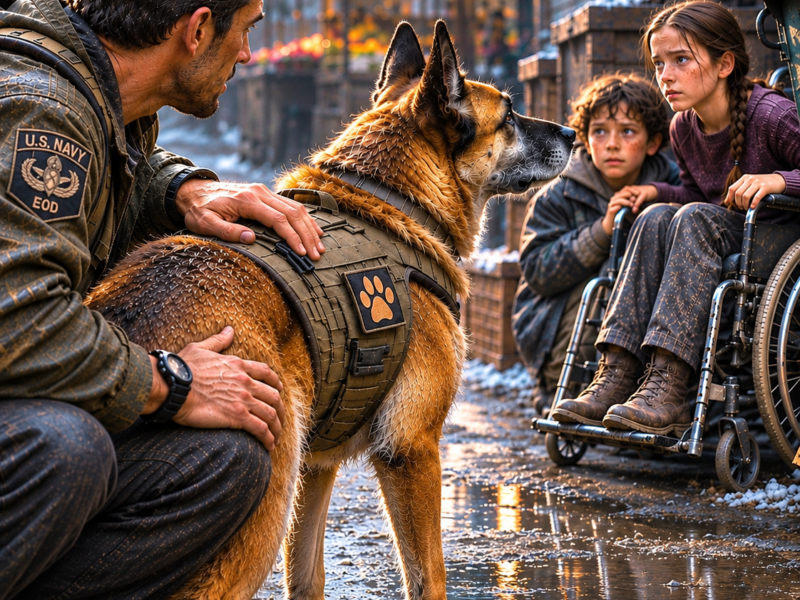
“I was sitting outside a gas station in Red Hollow when a ten-year-old girl refused the sandwich I offered her, even though her little brother was staring at it like he hadn’t eaten in days
I still had Gerald Tate’s words in my head when I pulled into Martha Keane’s driveway.
Her house sat at the end of a quiet street, surrounded by oak trees and a garden that looked like someone had been tending it for forty years.
A woman in her late sixties opened the door before I could knock twice.
“You must be Ethan Harrow.”
“Yes, ma’am.”
“Carol said you’d come. Get inside. The coffee’s fresh.”
I followed her into a kitchen that smelled of cinnamon and old books.
She poured two cups, glanced at Ranger, and placed a bowl of water beside the refrigerator.
“Now tell me about the children.”
I explained what I’d found, starting with the cottage and ending with Clara’s admission about the June visit.
Martha listened without interrupting.
When I mentioned Gerald Tate, she set her cup down.
“Heard you were asking about the Wind children. We need to talk first.”
“The Wind children?”
“That’s what some people call them. Clara and Owen. Ruth’s grandchildren.”
She folded her hands.
“Don’t contact anyone else until you understand what you’re walking into.”
“Gerald already called me.”
Her expression tightened.
“Of course he did.”
“Who is he?”
“He’s been on the county family services board for eleven years. He’s not corrupt, Ethan. He’s not some villain who enjoys hurting children.”
“Then why would he want to separate them?”
“Because he believes in procedure. And sometimes procedure becomes more important than the people it’s supposed to protect.”
She went to a filing cabinet and pulled out a folder.
Inside were notes from several years of county meetings.
“A ten-year-old with mobility needs and a five-year-old with no placement history often end up on different lists. Different care requirements, different available homes, different assessments.”
“And siblings become strangers?”
“Not always. But it happens.”
She sat opposite me.
“I’ve tried for three years to get the county to prioritize keeping siblings together whenever it’s safe and practical. Gerald has blocked every amendment.”
“What can we do?”
Martha looked at me carefully.
“You could apply to become their temporary guardian.”
“Can I?”
“I’m certified to serve as a temporary guardian, and my record is clean. But Gerald has considerable influence over the approval process.”
“Then we give him a reason to approve it.”
“That’s easier said than done.”
She opened another folder.
“The county needs more than a kind man who buys sandwiches. It needs to see a functioning support system. A safe home, medical care, schooling, transportation, reliable food, and people who will still be there when you’re gone.”
I looked down at the papers.
“How long do we have?”
“Gerald could request an expedited review at any time.”
“Give me a number.”
Martha considered it.
“Twelve days, perhaps less.”
I nodded.
“Then let’s get started.”
She raised an eyebrow.
“You don’t even live here.”
“No. But I know how to organize people, and I know how to keep a promise.”
Martha studied me for a moment.
Then she smiled faintly.
“All right, Navy man. Let’s see what Red Hollow can do.”
By the end of that afternoon, we had a plan.
The first person we visited was Roy Dillard, who ran the Saturday farmers’ market.
His hands were rough, his beard was white, and he looked at me suspiciously when I explained why we were there.
“Ruth used to come around near closing,” he said.
“She’d buy whatever she could afford.”
“Did you know the children were living alone?”
Roy rubbed the back of his neck.
“I knew they came around sometimes. I assumed somebody was looking after them.”
“That’s what everybody assumed.”
He looked toward the market stalls.
For a while, neither of us spoke.
Then he pointed at a stack of wooden boards.
“What do you need?”
“Food support. Not leftovers thrown in a bag. A proper community pantry.”
He frowned.
“How would that work?”
“Vendors set aside a portion of their real surplus. Fresh produce, bread, eggs, whatever they can contribute. We organize distribution and keep records.”
“Why records?”
“Because the county needs to see this isn’t a temporary burst of sympathy.”
Roy stared at me.
Then he picked up his phone.
“I’ll call Morales and Henderson.”
Within an hour, three vendors had agreed to participate.
One offered bread twice a week.
Another promised fresh vegetables.
A third volunteered to manage the inventory.
Nobody wanted their names printed on a banner.
They simply wanted the children to have food.
The next morning, we visited Dale Callaway, who owned a small electrical company.
He listened to the situation, walked through the cottage, and examined the old wiring.
“That panel is older than my truck,” he muttered.
“Can you make it safe?”
He looked at Clara’s handwritten calendar on the refrigerator.
“Already planning to.”
When I offered to pay, he shook his head.
“Don’t make this weird, Harrow. Just tell me when the county wants to inspect it.”
By the second day, six people had volunteered.
By the third, there were twelve.
Martha arranged a transportation schedule.
Roy organized the pantry.
Dale began repairing the cottage.
A woman named Patricia Hill, the school enrollment coordinator, offered to help Owen start kindergarten.
And Dr. Elaine Yates, a pediatric occupational therapist from Carver County, agreed to evaluate Clara’s wheelchair on short notice.
It was happening faster than I’d expected.
But I knew enthusiasm could disappear just as quickly.
So I kept asking the same question.
“What happens when I’m gone?”
Every person had to answer it.
Roy would manage food distribution.
Dale would oversee maintenance.
Patricia would coordinate school transportation.
Martha would handle the guardianship and regular check-ins.
We were building something that didn’t depend on one person.
On the fourth day, I returned to the cottage with Martha.
Clara was sitting at the kitchen table, making bookmarks.
Owen was drawing a dog with six legs.
“Six legs?” I asked.
“He needs extra speed,” Owen explained.
Ranger gave him a look that suggested he disagreed.
Martha pulled out a chair.
“Clara, we’d like to talk to you about something.”
The girl put down her markers.
“Is something happening?”
“Not bad news,” Martha said. “We’re working on a way for you and Owen to stay together here in Red Hollow.”
Clara’s expression barely changed.
“How?”
“I may be able to become your temporary guardian.”
She stared at Martha.
“What’s the catch?”
Martha nodded slowly.
“That’s a fair question. The county has to approve it. We also have to show them that this arrangement is safe and sustainable.”
“And Mr. Tate?”
“He’ll have a say.”
Clara looked at me.
“He’s the man who called you?”
“Yes.”
“Does he want us separated?”
“He believes the standard placement process is safer.”
“That means yes.”
I didn’t correct her.
Martha leaned forward.
“Clara, nobody here is asking you to pretend everything is fine. We’re asking you to let us help make it better.”
The girl looked down at her wheelchair.
Then she asked the question I’d been expecting.
“What happens if the county says no?”
Martha didn’t look away.
“Then we’ll appeal, and we’ll keep advocating for you. I won’t promise there won’t be difficult days.”
Clara nodded.
“Okay.”
Owen raised his hand.
“Can Ranger come too?”
I laughed.
“If Martha agrees.”
Martha gave the dog a suspicious look.
“That depends. Does he shed?”
“Constantly.”
“Then we’ll negotiate.”
For the first time, Clara laughed.
It was a small sound, almost accidental, but I noticed it.
That afternoon, Martha told me something else.
“Gerald filed for an expedited review. The board meets in four days.”
“Four?”
“Yes.”
“Can we be ready?”
“We have to be.”
She hesitated.
“There’s another problem. Gerald will argue that this entire support network was engineered by an outsider and may collapse once you return to duty.”
“He’s not entirely wrong to ask that.”
“No. Which is why we need to demonstrate that these people have relationships with the children independent of you.”
I looked across the yard.
Clara was showing Owen how to arrange his colored pencils.
“I can do that.”
“Good. But don’t forget the children need to be part of this conversation, too.”
That evening, I sat on the porch while Ranger rested his head on my boots.
Martha came outside carrying two mugs of coffee.
“Gerald isn’t a bad man,” she said.
“You’ve mentioned that.”
“He has a granddaughter. Seven years old. He started working with family services after his own sister struggled to raise her children.”
“Then why is he so rigid?”
“Because he has spent eleven years trying to prevent mistakes. Somewhere along the way, he began treating every unusual arrangement as a potential mistake.”
I watched the porch light flicker.
“What would change his mind?”
“Evidence. And perhaps hearing from someone he hasn’t already categorized as a risk.”
“Clara.”
Martha nodded.
“But don’t put that burden on her unless she wants it.”
The next morning, Clara came to me herself.
“I heard the meeting is soon.”
“That’s right.”
“Can I come?”
“Of course.”
“Can I talk?”
I studied her face.
“Only if you want to.”
She looked toward the cottage.
“I’ve been sitting here all week while everybody talks about me. I want them to hear what it’s actually like.”
I nodded.
“Then we’ll make sure you get that chance.”
The wheelchair assessment took place that afternoon.
Dr. Yates arrived with measuring equipment, a clipboard, and a calm manner that immediately put Clara at ease.
She checked the seat depth, the wheel alignment, the footrests, and the position of Clara’s back.
Every few minutes, she asked whether something hurt.
Clara answered no at first.
Then, when the therapist adjusted the armrest, she winced.
“Does that happen often?” Dr. Yates asked.
“Sometimes.”
“How long have you been sitting like this?”
“About two years.”
The therapist examined the bent axle again.
She wrote several notes and took measurements.
When she finished, she asked Clara to roll across the room.
The chair pulled to the right.
Clara corrected it without thinking.
Dr. Yates watched carefully.
“How much effort does that take?”
“Not much.”
“Clara, I want you to try something.”
She adjusted the temporary support and repositioned the footrest.
“Now try again.”
Clara pushed forward.
The chair moved straight.
She stopped halfway across the room.
Then she looked down at her hands.
“That’s easier.”
Dr. Yates nodded.
“It should have been this easy all along.”
The report was four pages long.
The chair was two sizes too large, the axle was damaged, and the seating position placed unnecessary strain on Clara’s back.
But the final paragraph mattered most.
It stated that Clara’s mobility limitations could be better supported with properly fitted equipment, accessible entrances, and routine occupational therapy.
It did not describe a child who was incapable of participating in daily life.
It described a child who had been expected to manage without the tools she needed.
When Martha read the report, she exhaled.
“This changes things.”
“Enough?”
“Enough to make Gerald listen.”
The night before the hearing, I found Clara sitting alone in the living room.
Owen was asleep.
She was holding the glass jar with the eighty-three dollars.
“Can’t sleep?” I asked.
She shook her head.
“Do you think they’ll believe me?”
I sat on the floor beside her.
“I think they’ll hear you.”
“That’s not the same.”
“No. It isn’t.”
She rolled the jar between her palms.
“Grandma used to say grown-ups always know what they’re doing.”
I looked at the photograph on the wall.
“Your grandmother sounds like she was trying to make you feel safe.”
“She told me to take care of Owen.”
“And you did.”
Clara looked at me.
“Was that enough?”
I took a moment before answering.
“You were ten years old. You did more than any child should ever have been asked to do.”
Her lips trembled.
She turned away before I could see whether she was crying.
The following morning, we drove to the county building.
Clara sat beside Martha.
Owen rode in the back with Ranger, holding a stuffed rabbit.
The hearing room was smaller than I’d imagined.
Four board members sat behind a long table.
Gerald Tate was on the right.
He wore a gray suit and had a stack of neatly arranged papers in front of him.
He looked older than he had sounded on the phone.
When the meeting began, Martha presented the temporary guardianship application.
She explained the support network, the cottage repairs, the food program, school arrangements, and the medical assessment.
Gerald listened without interrupting.
When Martha finished, he adjusted his glasses.
“Mr. Tate,” one board member said, “would you like to respond?”
He stood.
“First, I want to acknowledge the generosity of the Red Hollow community. What has been organized in less than two weeks is commendable.”
He glanced at me.
“But good intentions assembled in ten days do not automatically constitute a placement plan.”
I expected that.
He continued.
“The children have been without a verified legal guardian for seven months. The June caseworker visit recorded an adult guardian as present, but that information has not been substantiated.”
Martha shifted in her chair.
Gerald continued.
“Clara has significant mobility needs. Owen is entering kindergarten. Their requirements differ, and a county-approved placement would ensure access to appropriate services.”
He paused.
“I recommend protective placement pending a full home assessment.”
The room went quiet.
Martha leaned toward the microphone.
“With respect, the proposed arrangement already includes a home assessment, educational support, medical care, and an established local guardian.”
Gerald shook his head.
“Those arrangements have existed for approximately ten days.”
I looked toward Clara.
Her hands were folded in her lap.
I could see her fingers pressing against each other.
I stood.
“I’m not a formal party to this application, but I’d like to ask for two minutes.”
Gerald looked at me.
“Mr. Harrow, this hearing is about the children’s welfare, not your personal involvement.”
“I understand. But I think Clara would like to speak.”
The board chair turned toward the girl.
“Clara, would you like to say something?”
She looked at Martha.
Martha nodded.
Then Clara moved her wheelchair closer to the table.
Her voice was quiet at first.
“Mr. Tate, you’re right about one thing. Good intentions aren’t enough.”
Gerald looked at her.
“But I need you to understand something. When Grandma died, I didn’t have a plan. I didn’t know how to pay bills. I didn’t know what would happen if the electricity stopped working.”
She paused.
“I just knew Owen needed breakfast.”
Owen looked up from his stuffed rabbit.
Clara continued.
“I told the caseworker my aunt was getting groceries because I thought she’d take him away. I know I shouldn’t have lied.”
Her voice shook.
“But I wasn’t trying to trick anyone. I was scared.”
The room was completely still.
“I’ve taken care of Owen since March. I’m not saying that because I want people to think I’m special. I did it because there was nobody else.”
She glanced at her brother.
“He’s five. He doesn’t know what temporary means. He knows what it means when somebody leaves.”
She looked back at the board.
“If you send us somewhere else, please don’t make him think I stopped wanting him.”
Gerald lowered his eyes to the papers.
Clara continued.
“This town didn’t fail us because everybody was bad. It failed us because nobody knew what was happening. Now people know. They’re helping.”
She took a breath.
“I don’t need someone to fix everything. I just want to go to school, have a chair that doesn’t hurt my back, and keep my brother.”
She stopped.
No one moved for several seconds.
Then the chairwoman called for a fifteen-minute recess.
Outside the hearing room, Clara sat beside Martha.
Owen was playing with Ranger near the hallway window.
I crouched beside her.
“You did good.”
“I almost didn’t say the part about Owen.”
“Why?”
“Because I didn’t want them to think I was using him.”
I shook my head.
“You told them the truth. That’s all.”
She looked down at her hands.
“I hope it’s enough.”
The board returned after twenty minutes.
Gerald stood before the chairwoman could speak.
“I’d like to make a statement.”
She nodded.
He removed his glasses.
“For eleven years, I’ve learned not to trust how things feel over how they function. It’s a habit that comes with this work.”
He looked toward Clara.
“My recommendation today was functionally consistent with our standard procedures. But I haven’t adequately considered what is actually functioning in this community.”
He turned a page.
“I was also unaware that the June intake form had recorded an unverified adult guardian without further investigation. That failure should not have been overlooked.”
Martha looked at me.
Gerald continued.
“I will not oppose the temporary guardianship arrangement. I request a home assessment within seven days and a thirty-day review.”
He paused.
“If the assessment is satisfactory, I will support the full application.”
The chairwoman looked around the table.
The vote was four to zero in favor of proceeding with Martha’s temporary guardianship, pending the home assessment.
Clara didn’t cheer.
She simply leaned toward Owen and whispered something in his ear.
He wrapped both arms around her.
That was enough.
Outside, Gerald approached me.
“Mr. Harrow.”
“Yes?”
“I owe those children an apology.”
I looked at him.
“Then you should give them one.”
He nodded.
“I intend to.”
The following week was a blur of inspections, paperwork, and appointments.
The cottage passed its safety inspection.
Dale finished the electrical work.
Roy delivered the first organized pantry boxes.
The school approved Owen’s enrollment.
And Dr. Yates submitted the equipment grant application.
Martha called me one afternoon.
“Clara’s new wheelchair has been approved.”
I was standing outside my temporary rental.
“How long until it arrives?”
“About three weeks.”
“Good.”
There was a pause.
“There’s something else.”
“What?”
“Gerald wants to meet with you.”
I sighed.
“Of course he does.”
“He says it’s about sustainability.”
I arrived at the county office the next morning.
Gerald was sitting alone at a conference table.
A photograph of a little girl stood beside his laptop.
“Your granddaughter?” I asked.
He nodded.
“Seven years old.”
He turned the photograph toward me.
“She asked me why some children have to leave their homes when their parents die. I didn’t know how to explain it.”
I sat down.
“Why did you ask to see me?”
He opened a folder.
“I want to understand what you’ve built.”
I explained the pantry, the transportation schedule, the cottage repairs, and the medical support.
He listened carefully.
Then he asked the question I’d expected.
“What happens if Martha becomes unavailable?”
“Roy handles food. Dale handles repairs. Patricia handles school transportation. The county has the medical records. Nobody is responsible for everything.”
“And if you leave?”
“I already have.”
He looked up.
“What?”
“My military leave ends soon. I have duties to return to.”
He leaned back.
“So the arrangement was built around a man who won’t be here.”
“No. It was built around people who live here.”
He studied the folder.
Then he closed it.
“I’ve been working on a sibling priority amendment for years.”
“Martha told me.”
“I kept insisting that exceptions should be rare. I still believe that. But I also think our system should recognize when keeping siblings together is part of their safety.”
He took a breath.
“I sent the wrong message when I contacted you.”
I nodded.
“Yes, you did.”
“I apologize.”
I didn’t offer him an easy answer.
“An apology doesn’t undo what Clara went through.”
“No,” he said. “It doesn’t.”
He looked down at the photograph of his granddaughter.
“But perhaps we can make sure fewer children have to face what she did.”
A few days later, I received orders to report back to my unit.
I told Martha first.
She didn’t look surprised.
“I figured this day would come.”
“I’ll be reachable.”
“That isn’t the same as being here.”
“No. It isn’t.”
She gave me a tired smile.
“Then keep your promises carefully, Ethan.”
I visited the cottage that evening.
Clara was sitting at the kitchen table, finishing a bookmark.
Owen was drawing Ranger again.
This time the dog had four legs.
“Your artwork is improving,” I told him.
“He has to look professional.”
Clara smiled.
I sat beside her.
“I have to go back to work.”
She put down her pencil.
“When?”
“Tomorrow morning.”
She nodded.
For a moment, she looked like she might ask me not to go.
Instead, she said, “Are you coming back?”
“Yes.”
“People say that.”
“I know.”
I reached into my jacket and took out a small card.
It had my phone number and email address.
“Call me when you need to. Not just when something goes wrong.”
She accepted it carefully.
“Okay.”
Then she handed me the bookmark she’d been making.
It was blue, with a small dog drawn at the bottom.
At the top, she’d written one sentence.
“Ranger is my best friend.”
I smiled.
“That’s a good sentence.”
“It’s true.”
I slipped it into my pocket.
“Then I’ll keep it.”
The next three months were not easy.
There were paperwork delays.
Owen struggled with the first few weeks of kindergarten.
Clara had days when her back hurt and days when she missed her grandmother so much that she refused to leave her room.
Martha called me regularly.
Sometimes she needed help with a form.
Sometimes she simply wanted to tell me that Owen had learned a new word.
I called the children every Sunday.
Ranger sat beside me during every video call.
Owen always asked when the dog was coming home.
Clara usually asked about work.
But occasionally, she would show me something she’d made.
The first update about the wheelchair arrived on a Thursday.
“Dr. Yates says it’s ready.”
A photograph followed.
Clara was sitting in a properly fitted chair, her shoulders relaxed, her feet supported, and her hands resting comfortably on the wheels.
The next message came a week later.
“It’s weird. I don’t have to fight it.”
I read that sentence several times.
In November, the Callaway Market Community Pantry served its first eleven families.
Roy sent me a photograph of the volunteers standing beside a table covered in bread, vegetables, and canned goods.
Clara was in the middle.
She had a stack of handmade bookmarks in her lap.
The money she earned from them was no longer needed to keep the electricity on.
She donated it to the pantry’s school-supply fund.
Then, on a Saturday morning in December, my phone rang.
It was Martha.
“You should come home.”
“What’s happened?”
“Nothing bad.”
She paused.
“Actually, something very good.”
I took the first available flight.
When I arrived in Red Hollow, Ranger was practically pulling me toward the cottage.
The front door opened before I reached the steps.
Owen ran outside.
“ETHAN!”
He crashed into my legs.
Ranger nearly knocked us both over.
Clara appeared in the doorway.
Her new wheelchair moved smoothly over the ramp Roy had built.
She looked taller somehow.
Or perhaps she simply wasn’t trying so hard to make herself smaller.
“You’re late,” she said.
“I had to fly.”
“That’s still late.”
I laughed.
“Fair enough.”
Martha was sitting at the kitchen table with a folder in front of her.
Gerald Tate stood beside the refrigerator.
I looked from one to the other.
“What’s going on?”
Martha slid the folder toward me.
“The county approved the full guardianship.”
I opened it.
Not temporary.
Not sixty days.
Not ninety days.
Full guardianship.
Martha Keane was now legally responsible for Clara and Owen.
The approval included ongoing support for Clara’s medical needs, school arrangements, and regular family services reviews.
I looked up.
“Congratulations.”
Martha smiled.
“Don’t congratulate me yet. I have to live with two children and a dog who thinks he’s the landlord.”
Owen raised his hand.
“Ranger is the landlord.”
“Apparently.”
Gerald cleared his throat.
“I also wanted to tell you something.”
He placed another document on the table.
“The sibling priority amendment passed at the last board meeting.”
Martha stared at him.
“What?”
“Four votes in favor. No objections.”
He turned toward Clara.
“It won’t solve every problem. But siblings won’t automatically be placed on separate lists simply because their needs are different.”
Clara looked at the paper.
“Does that mean other brothers and sisters won’t have to be separated?”
“Not by default,” Gerald answered. “The board will still consider each child’s safety, but keeping families together will be given proper priority.”
Clara looked at Martha.
Then at me.
“Is it because of us?”
Gerald shook his head.
“It’s because of what you helped us understand.”
He hesitated.
“And because I should have listened sooner.”
Clara didn’t say anything.
She reached for the folder and carefully turned the pages.
There were words she didn’t understand, so Martha sat beside her and explained them.
After a while, Clara looked up.
“Can I keep a copy?”
“Of course,” Martha said.
Owen had become distracted by the apple pie on the counter.
“Can we eat now?”
Martha laughed.
“That’s why I brought it.”
I looked around the cottage.
The cardboard was gone from the window.
The kitchen was warm.
The refrigerator was full.
A new ramp connected the front door to the yard.
And on the wall, beside the photograph of Grandma Ruth, Clara had placed the bookmark she had given me.
I walked over to look at it.
The words were still there.
“Ranger is my best friend.”
Below them, in smaller handwriting, she’d added something.
“People can come back, too.”
I stood there for a long moment.
When I turned around, Clara was watching me.
“Do you remember what you promised me?” she asked.
“I do.”
“You said you wouldn’t build something that fell apart when you left.”
I nodded.
“Did I keep it?”
She glanced toward Martha, then Roy’s pantry schedule pinned to the refrigerator, then the school calendar.
“Yes.”
Her voice was quiet.
“But I think you helped us build something better than that.”
I waited.
“Something that doesn’t need you to stay every day.”
I smiled.
“That’s exactly what I wanted.”
She rolled toward the table.
Owen was already trying to sneak a second slice of pie.
“Don’t let him take the whole thing,” she called.
Martha pretended not to notice.
Gerald laughed.
And Ranger, who had spent years searching buildings for people who needed help, settled beneath the kitchen table with his head resting against Owen’s shoes.
I thought about the first afternoon I’d met them.
The eighty-three dollars in a glass jar.
The sandwich Clara had refused to eat.
The fear in her voice when she told me the county might separate them.
For a long time, I’d believed that rescuing someone meant getting them out of danger.
Sometimes it does.
But sometimes the most important thing is helping build a place where they no longer have to live in survival mode.
Clara didn’t need me to become her hero.
She needed adults who would show up, do the work, and keep showing up after the crisis was over.
That evening, as the sun disappeared behind the trees, Owen fell asleep on the couch with Ranger beside him.
Clara was finishing another bookmark at the kitchen table.
Martha was washing dishes.
I stood by the doorway, watching the little cottage glow with warm light.
For seven months, two children had been waiting for someone to notice they were alone.
Now, when Clara looked toward the door, she no longer looked afraid that everyone was leaving.
She simply looked up to see who was coming home.
The End.









