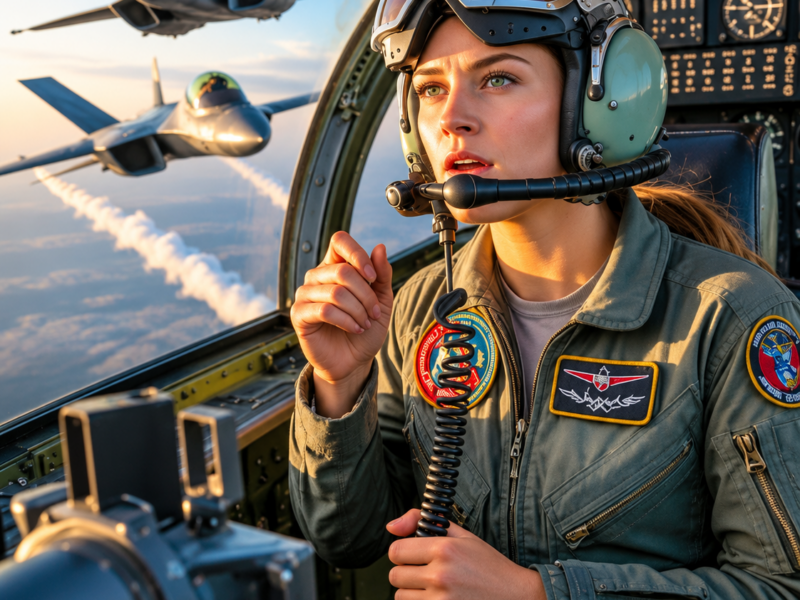
“I was sitting in seat 12A on Flight 447 when the captain announced a minor technical issue, and the businessman beside me casually asked if I could help
The first breaker came out with a sharp click.
For half a second, nothing happened.
Then the control column grew heavier beneath my hands.
Not a little heavier. Not the familiar resistance of an aircraft responding to turbulence or a change in airspeed. It felt as if someone had attached a steel cable to the other end and started pulling.
“Sarah?” Mark asked.
“I feel it.”
The second breaker was still in.
The aircraft rolled two degrees to the right.
I corrected gently, refusing to fight the airplane with more force than necessary. At thirty-seven thousand feet, with the flight-control computers behaving unpredictably, every movement mattered.
“Hold the bank,” I said. “Don’t touch anything else until I tell you.”
Mark nodded. His face was pale, and sweat had gathered along his hairline. He was a pilot, but he was also a sick man who had been struggling to remain conscious for the last twenty minutes.
I couldn’t afford to let him become another casualty.
“Mark, look at me.”
He raised his eyes.
“If you feel like you’re going to pass out, tell me immediately. Don’t try to be a hero.”
A weak smile crossed his face.
“Funny. I was about to say the same thing to you.”
I almost smiled back.
Almost.
The airplane shuddered.
A warning tone sounded, followed by another.
The autopilot had already disconnected. The flight director was gone, and several indications on the primary flight display were disagreeing with one another. The aircraft was still flying, but the systems that normally helped a pilot understand exactly what it was doing had become unreliable.
I had to trust what I could verify.
Airspeed.
Attitude.
Altitude.
The feel of the controls.
And the horizon outside.
“Washington Center, United Four Forty-Seven,” I called. “We are in the middle of a flight-control computer reset. We have temporary control degradation. Maintain our current priority handling.”
The controller answered immediately.
“United Four Forty-Seven, understood. Emergency services are standing by at Pittsburgh. Your escort aircraft remain with you.”
I glanced through the windshield.
Two dark shapes were visible beyond the clouds, one on either side of us.
The F-22s.
Venom One and Venom Two.
They had been following us for several minutes, maintaining a careful distance. Their presence was reassuring, but it also reminded me how serious the situation had become.
A passenger airliner was not supposed to need fighter escorts on a routine domestic flight.
“Venom One to United Four Forty-Seven,” a calm male voice came through the radio. “We have visual on your aircraft. Your wings are level. No visible structural damage.”
“Thank you, Venom One,” I replied. “We appreciate the company.”
“Copy that. We’re staying with you.”
Mark reached for the next breaker.
“Wait.”
He froze.
I studied the indications again.
The left and right control surfaces were no longer responding in the same way. One system showed a command that the other did not appear to recognize. If we continued the reset without confirming the correct sequence, we could make the situation worse.
“Read me the checklist again.”
Mark swallowed and looked down.
His voice trembled slightly as he began.
I listened to every word.
Not because I didn’t know what we were doing, but because experience had taught me that familiarity could become dangerous. The moment a pilot started skipping steps because something felt obvious was the moment mistakes found a way in.
We completed the next verification.
Then I nodded.
“Second breaker.”
Mark pulled it.
The aircraft gave a low mechanical groan.
The control column briefly went almost weightless.
My stomach tightened.
“Easy,” I whispered.
The nose drifted upward.
I eased the pressure forward, making a correction so small that a passenger in the cabin might not have noticed it.
But I noticed.
The airplane was responding.
Not smoothly.
Not predictably.
But it was responding.
“Altitude?”
“Thirty-six thousand nine hundred feet,” Mark answered.
“Speed?”
He checked the standby indication and read it aloud.
I compared it with the other available data.
The numbers were close enough to make sense.
That was something.
“United Four Forty-Seven, Pittsburgh Approach,” another controller said. “We have you on radar. Expect vectors for runway two-eight left. Weather is acceptable, but winds are increasing. Do you have a landing capability?”
I looked at Mark.
Then at the instruments.
Then through the windshield at the distant ground.
“We’re working toward one,” I answered. “We are not declaring the aircraft fully controllable yet.”
“Understood. We will keep the approach clear.”
The cabin interphone crackled.
A faint voice came through.
“Flight deck?”
I recognized it as one of the flight attendants, though I couldn’t remember her name.
“Go ahead.”
“It’s Emma. I’m in the forward galley. The passengers are asking what’s happening.”
I felt a brief wave of relief.
At least one cabin crew member was still conscious.
“Emma, listen carefully. We are experiencing a technical emergency, but we are maintaining control. I need you to keep everyone seated with their seat belts fastened. Do not let anyone stand or move around.”
“Understood.”
“Is anyone else awake?”
There was a pause.
“Two passengers are helping. One of them says she’s a nurse. We’re checking on the others.”
“Good. Keep the aisle clear. If anyone is having trouble breathing, tell me immediately.”
“I will.”
The interphone went quiet.
I turned back to the windshield.
The cloud layer below us had begun to break apart.
For the first time since taking the controls, I could see patches of land.
We were getting closer to Pittsburgh.
And we were running out of time.
“Sarah,” Mark said.
I looked over.
“The computer is coming back.”
A small status indicator had changed.
Then another.
The flight-control system was beginning to reinitialize.
I kept my hands steady.
“Don’t celebrate yet.”
“I wasn’t.”
“You were thinking about it.”
He gave a short laugh that turned into a cough.
I watched the system indications.
One by one, the computers completed their startup sequence.
The control column still felt heavy, but the response was becoming more consistent.
I made a shallow left input.
The aircraft turned.
I eased back to neutral.
The turn stopped.
I made a small right input.
The airplane responded again.
For the first time in what felt like an hour, I allowed myself to breathe.
“Washington Center, United Four Forty-Seven. We have recovered partial flight-control response. Request continued vectors to Pittsburgh.”
“United Four Forty-Seven, roger. Turn right heading zero-nine-zero. Descend and maintain flight level two-five-zero when able.”
I acknowledged the instruction.
Mark looked at me.
“Does that mean we’re back?”
“No.”
His expression fell.
“It means we have a chance.”
The F-22s moved slightly closer.
“United Four Forty-Seven, Venom One,” the fighter pilot said. “Your aircraft appears stable from our position. We are seeing no unusual movement of the wings or tail.”
“Copy, Venom One. Thank you.”
There was a pause.
Then the voice returned.
“Ma’am, if I may ask, are you the pilot currently flying?”
I looked at the radio.
“That’s correct.”
“Would you mind confirming your call sign?”
I hesitated.
It was a strange question in the middle of an emergency.
“Viper.”
The radio went silent for a moment.
Then Venom One answered.
“Viper. Understood.”
Something changed in his tone.
Not surprise exactly.
Recognition.
“It’s an honor to fly alongside you, ma’am.”
I kept my eyes on the instruments.
“Let’s save the introductions until we’re on the ground.”
“Yes, ma’am.”
Mark glanced at me.
“You’re famous?”
“Not today.”
He shook his head, but I caught the smallest trace of a smile.
I had never liked the attention that came with my old call sign. Eleven confirmed air-to-air kills had made it into official records, along with an Air Force Cross and more headlines than I had ever wanted.
But none of that mattered here.
I wasn’t in a fighter.
I wasn’t in a combat zone.
I was responsible for 180 people who had boarded an ordinary flight expecting to arrive in Pittsburgh.
That was the only thing that mattered.
“United Four Forty-Seven,” Pittsburgh Approach called. “We need to discuss your landing configuration. Can you confirm the status of your flaps and landing gear?”
I checked the available indications.
“Landing gear indication is currently normal. Flap system remains uncertain. We need time to verify deployment.”
“Understood. We can accommodate a longer final approach.”
I looked at Mark.
“Let’s test the configuration gradually.”
He checked the relevant procedures.
We moved through them carefully, confirming each response before making another change.
The first flap setting produced a warning.
I stopped.
“Hold there.”
Mark read the indications again.
The system was showing an inconsistency between the commanded position and the reported position.
I did not need a second warning to understand the risk.
“Tell Approach we may need to land with a reduced flap setting.”
Mark transmitted the message.
Pittsburgh responded without hesitation.
“United Four Forty-Seven, understood. Runway two-eight left is available. Emergency vehicles are positioned along the runway. You are cleared to continue when ready.”
I looked at the runway information.
Two-eight left.
A long strip of pavement.
A place where the airplane could stop.
It was the first destination that had felt real since the emergency began.
But getting there was going to be difficult.
“Sarah,” Mark said quietly.
“I’m listening.”
“Can I ask you something?”
“Go ahead.”
“Were you really going to take this flight as a passenger and not tell anyone who you were?”
I glanced at him.
“Yes.”
“Why?”
I considered the question.
“Because sometimes I want to be nobody.”
He nodded.
I understood that he wouldn’t fully understand.
The people who knew me from military service often saw the medals, the missions, the records, and the call sign. They rarely saw the years of training, the sleepless nights, or the names of people who hadn’t come home.
I had boarded Flight 447 hoping for an ordinary afternoon.
Instead, I had found myself in the cockpit of a failing airplane.
“Approach checklist,” I said.
Mark turned back to his work.
The descent began.
At twenty-five thousand feet, the aircraft remained stable.
At twenty thousand, the control response was still consistent.
At fifteen thousand, we began to feel turbulence.
I made small corrections, avoiding sudden movements.
The fighter pilots remained with us.
“Viper, Venom Two,” the second pilot said. “We have a visual on your left wing. There is no visible damage. You appear stable.”
“Thank you, Venom Two.”
“Any assistance needed?”
“Keep the airspace clear and stay with us.”
“Affirmative.”
I looked down at the city beginning to emerge through the clouds.
Pittsburgh.
The rivers were visible in the distance, reflecting the late afternoon light.
I had seen the city from the air before, but never like this.
Never with so much depending on the next few minutes.
“Flight attendants,” I said over the interphone. “Prepare the cabin for an emergency landing. All passengers must remain seated, seat belts fastened, and loose items secured. Brace instructions will follow.”
Emma answered immediately.
“Understood.”
I heard movement in the background.
Then a passenger’s voice.
“Are we going to crash?”
The question came through the open interphone, frightened and unfiltered.
I closed my eyes for half a second.
Then I answered.
“No. We’re going to land.”
I didn’t know whether that was a promise or a prayer.
But I needed them to hear confidence.
I needed to believe it myself.
At ten thousand feet, the aircraft began to descend more slowly.
The flight-control computers were stable, but the flap indications remained inconsistent.
I chose not to request a configuration that I couldn’t verify.
A reduced-flap landing would mean a higher approach speed and a longer stopping distance.
It would also mean fewer moving parts between us and the ground.
I told Pittsburgh Approach exactly what we were doing.
They coordinated with the tower and confirmed that emergency equipment was ready.
“United Four Forty-Seven,” Approach said. “Runway two-eight left. Winds two-six-zero at twelve knots. Cleared to continue the approach.”
I acknowledged.
The runway appeared ahead of us, a gray line against the surrounding landscape.
“Mark, gear?”
“Down and locked. Three green.”
“Good.”
“Flaps?”
“Remain at the verified setting.”
He nodded.
I adjusted the power and kept the aircraft aligned.
The airspeed was higher than I wanted, but it was within the range we had calculated for the configuration.
I checked the runway again.
Long enough.
Clear.
Waiting for us.
“Cabin crew, prepare for landing.”
Emma’s voice came back.
“Cabin secured.”
I placed both hands on the controls.
My palms were damp.
I had flown combat missions where a single mistake could cost an entire formation.
I had landed damaged aircraft with warning lights flashing across the cockpit.
I had once brought an aircraft home after losing hydraulic pressure during a training exercise.
But none of those experiences felt like this.
In those situations, I had been responsible for myself and the people beside me.
Now there were 180 lives behind me.
Some were sleeping.
Some were praying.
Some were holding hands with strangers.
And some were probably wondering why the woman in seat 12A had disappeared into the cockpit.
“United Four Forty-Seven, Pittsburgh Tower. Wind two-six-zero at twelve knots. Runway two-eight left, cleared to land. Emergency vehicles standing by.”
“Cleared to land, two-eight left.”
The runway grew larger.
I could see the centerline.
I could see the touchdown zone.
I could see the emergency vehicles positioned along the side.
“Speed is good,” Mark said.
I nodded.
The airplane crossed the threshold.
I reduced power gradually.
The nose stayed steady.
The runway rushed toward us.
For one brief moment, I thought the aircraft might float.
Then the main landing gear touched down.
A heavy thump traveled through the floor.
The airplane bounced slightly.
I held the attitude steady.
The wheels came down again.
This time, they stayed down.
“Reverse thrust,” I said.
Mark confirmed the indication.
The engines responded.
The aircraft began to slow.
I kept it straight, making small corrections as the runway markings passed beneath us.
The speed dropped.
Eighty knots.
Sixty.
Forty.
Twenty.
Then we were rolling at a speed where the aircraft no longer felt like an enormous machine trying to escape us.
It was just an airplane.
A very heavy airplane.
On a runway.
With all its passengers alive.
I brought it to a stop.
For several seconds, neither of us spoke.
The cockpit was filled with the sound of cooling systems, warning tones, and our own breathing.
Then Mark leaned back.
“Oh my God.”
I looked at him.
“We’re on the ground.”
He covered his face with one hand.
I turned off the runway and followed the tower’s instructions toward the designated stopping area.
Fire trucks and ambulances moved alongside us.
Their lights flashed against the cockpit windows.
“United Four Forty-Seven, Pittsburgh Tower. Confirm you are stopped and able to evacuate if necessary.”
I keyed the radio.
“Pittsburgh Tower, United Four Forty-Seven. We are stopped. Aircraft is under control. We request medical assistance for the flight crew and affected passengers.”
“Understood. Emergency services are approaching.”
I released the controls.
My hands were shaking.
I hadn’t noticed until that moment.
Mark looked at me.
“You did it.”
I stared at the instrument panel.
“No,” I said quietly. “We did.”
The cabin interphone crackled again.
“Flight deck, this is Emma.”
“Go ahead.”
“We’re down?”
“Yes.”
A breathless laugh came through the speaker.
“We’re down.”
I heard applause somewhere behind her.
Then crying.
Then the unmistakable sound of people cheering.
I closed my eyes.
For the first time since the emergency began, I allowed the fear to reach me.
My throat tightened.
My eyes burned.
I leaned forward and rested my forehead against the edge of the instrument panel.
I had spent years learning how to keep fear from controlling my decisions.
But I had never learned how to stop feeling it afterward.
The door opened several minutes later.
Emergency responders entered the aircraft, followed by medical teams.
The captain and first officer were taken out on stretchers.
The two sick flight attendants were escorted to ambulances.
Mark insisted that he was well enough to walk, though the paramedics disagreed and took him for examination.
I remained in the cockpit until a medic asked me to come down.
When I stepped onto the airport pavement, the evening air felt strangely cold.
The first thing I noticed was the sound.
Not alarms.
Not warnings.
Not radio calls.
Just people.
Passengers were gathering in a secure area near the terminal, some wrapped in blankets, others speaking to medical staff.
A young boy stood beside his mother.
He was holding a small stuffed dinosaur.
When he saw me, he pointed.
“That’s the lady who flew the plane.”
His mother looked embarrassed.
“I’m sorry. He’s been asking about you.”
I crouched slightly.
“What’s your dinosaur’s name?”
“Rocket.”
“Good name.”
The boy studied me.
“Were you scared?”
I could have given him the answer people expected.
I could have said no.
Instead, I told him the truth.
“Yes. Very scared.”
He looked confused.
“But you still flew?”
I nodded.
“Being scared doesn’t mean you stop doing what needs to be done.”
He considered that for a moment.
Then he held out his dinosaur.
I smiled.
“Rocket helped too, I think.”
His mother laughed through her tears.
I stood and walked toward the medical area.
A paramedic checked my blood pressure and asked whether I had any dizziness, nausea, or chest pain.
I told her I was fine.
She gave me a look that suggested she didn’t believe me.
I didn’t argue.
The first news crews began gathering outside the airport’s secure perimeter.
A reporter was already speaking into a camera.
“An extraordinary emergency landing here in Pittsburgh, where a passenger with military aviation experience reportedly took control of a commercial aircraft after both pilots became incapacitated.”
I turned away.
I didn’t want to hear the story become something it wasn’t.
I hadn’t defeated an enemy.
I hadn’t performed a miracle.
I had made a series of decisions with incomplete information and tried to keep 180 people alive.
That was all.
Or at least, that was what I thought.
Then a man in a dark suit approached me.
He carried a folder and wore an identification badge from the federal aviation authorities.
“Major Castellano?”
I nodded.
“I’m Daniel Mercer. I’m with the investigative team. We need to speak with you when you’re medically cleared.”
“About the aircraft?”
“About the aircraft, the crew, and what happened before the emergency.”
His expression was serious.
“There’s something you should know. The initial examination suggests the flight-control problem may not have been an ordinary software malfunction.”
I stared at him.
“What do you mean?”
He opened the folder.
“We found evidence of an unauthorized change to the maintenance software. The update was installed shortly before the aircraft was released for service.”
I felt the cold evening air against my face.
“Was it deliberate?”
“We don’t know yet.”
He turned one page.
“And the medical situation aboard the aircraft may be connected.”
I looked toward the ambulances.
The captain was being transferred to another vehicle.
The first officer was still unconscious.
“Do you know what caused the illness?”
“Preliminary tests suggest exposure to a contaminant. We are investigating the crew meal preparation and handling process.”
I thought about the captain’s shaking hands.
The first officer’s inability to speak.
The flight attendants collapsing one after another.
Then I thought about the timing.
The software update.
The crew meal.
The sudden loss of control.
Three failures.
One flight.
It was too much to call coincidence.
“Do you believe someone intended to bring this aircraft down?” I asked.
Mercer didn’t answer immediately.
“We believe someone may have attempted to create a situation in which the aircraft could not be controlled. Whether the goal was to destroy the aircraft, test a method, or send a message remains unknown.”
I looked at him.
“Who knew the flight schedule?”
“We’re investigating that.”
“Who had access to the software?”
“We’re investigating that too.”
I exhaled slowly.
“Then you need to start with everyone who touched that aircraft before it left Washington.”
Mercer nodded.
“We already have.”
A few minutes later, I was escorted to a medical vehicle.
Before I climbed inside, I looked back at the Boeing 767.
The aircraft sat beneath the airport lights, surrounded by emergency vehicles and investigators.
From the outside, it looked almost ordinary.
A few scuffs.
A few open service panels.
A line of responders moving around it.
No one looking at it would have guessed what had happened at thirty-seven thousand feet.
No one would have guessed how close we had come.
My phone had been placed in a sealed evidence bag, but an officer returned it after documenting the device.
It began vibrating almost immediately.
Missed calls.
Messages.
Notifications.
I ignored most of them.
One message caught my attention.
It was from my former squadron commander.
The message was short.
I heard about Flight 447. Call me when you’re safe.
I stared at it for a moment.
Then I typed a reply.
I’m safe. Everyone made it down.
I put the phone away.
At the hospital, doctors checked me for possible exposure to the same contaminant that had affected the crew.
They found no symptoms.
The captain and first officer remained under observation.
Both flight attendants were expected to recover.
The two deadheading pilots were also receiving treatment.
The investigation continued through the night.
I was interviewed twice.
The first interview focused on the emergency itself: the control inputs, the system warnings, the reset procedure, the landing configuration, and the communications with air traffic control.
The second interview focused on the people.
The passengers.
The crew.
The maintenance personnel.
And the man who had been sitting beside me in row twelve.
The businessman from seat 12C.
His name was Daniel Price.
He had been polite when we first spoke, asking whether I traveled often and whether I was visiting Pittsburgh for work.
I had told him I was just passing through.
Now he sat across from me in a hospital conference room, looking like a man who had aged ten years in one afternoon.
“I knew there was something different about you,” he said.
I raised an eyebrow.
“Different?”
“You were calm. Even before everything happened. You looked like you knew what to do.”
I shook my head.
“I was reading a book.”
He glanced at the paperback that had been placed on the table.
The cover had hidden the technical manual underneath.
“I noticed that.”
I looked at him carefully.
“Did you notice anything else?”
He hesitated.
“Before the emergency, I saw someone near the galley. A man in a maintenance uniform.”
I sat forward.
“What did he look like?”
“Middle-aged. Dark hair. Maybe in his forties. He was carrying a small case.”
“Did you see his badge?”
“No. I assumed he worked for the airline.”
“Did he speak to anyone?”
Daniel thought for a moment.
“He spoke to one of the flight attendants. She looked confused, but she let him through.”
I wrote down the description.
“Are you certain he was wearing a maintenance uniform?”
“Yes.”
“Could you identify him again?”
“I think so.”
That information was passed to the investigators.
They later confirmed that a contractor had entered a restricted maintenance area before the flight.
His access credentials had been valid.
His employment record was not.
Someone had created a temporary identity using information from a real employee.
The contractor had disappeared before investigators could locate him.
The software update had been signed with credentials belonging to a technician who had been on medical leave.
The contaminated meal containers had passed through a catering facility with a broken security camera.
Each discovery revealed another gap.
Each gap suggested planning.
But there was no clear explanation of who had ordered it or why.
Three days after the landing, I returned to Washington.
The airline issued a statement praising the crew and acknowledging the extraordinary circumstances.
The military released a brief confirmation that an Air Force officer had been aboard the aircraft and had assisted during the emergency.
The two F-22 pilots were identified only by their callsigns.
Venom One sent me a message through an official channel.
We kept our eyes on you all the way down. Glad you made it home, Viper.
I read it twice.
Then I put the phone away.
I wasn’t ready to talk about the flight.
Not yet.
The next week, I attended a private briefing with the investigative team.
They had recovered portions of the aircraft’s software logs and identified the unauthorized update.
The change had been designed to interfere with the flight-control system after a specific sequence of events.
It wasn’t a simple virus.
It was a carefully prepared modification that exploited a weakness in the aircraft’s maintenance process.
The crew illness had created the conditions that allowed the aircraft to be left without its normal human safeguards.
The investigators still couldn’t prove that the two events had been planned by the same person, but the evidence was increasingly difficult to dismiss.
A senior investigator placed a photograph on the table.
It showed a man wearing a maintenance uniform.
His face was partially obscured by a cap.
“Do you recognize him?” she asked.
I studied the photograph.
The face looked familiar, but I couldn’t be certain.
Then I noticed something.
A small scar near the man’s left ear.
I remembered seeing it when he passed through the cabin.
“That’s him,” I said.
The investigator leaned forward.
“You’re sure?”
“I can’t identify him from the face alone. But I remember the scar. And I remember the case he was carrying.”
She nodded.
“We’ll add that to the record.”
I sat back.
“Have you found him?”
“Not yet.”
The room became quiet.
Then she said something that made my stomach tighten.
“We have reason to believe the person responsible may have known that you were aboard the flight.”
I stared at her.
“Why would anyone care about me?”
“We don’t know.”
“Then why tell me?”
“Because your presence may have changed the outcome.”
I looked at the photograph again.
The man in the maintenance uniform.
The false credentials.
The compromised software.
The sick crew.
The failed flight controls.
Someone had created a trap.
And I had happened to be sitting in seat 12A when it closed around us.
I left the briefing room with more questions than answers.
For weeks, the investigation continued.
The captain eventually regained full health.
The first officer recovered more slowly but was expected to return to flying.
Emma, the flight attendant who had kept the cabin organized, received a commendation from the airline.
Mark returned to work after several weeks of medical treatment.
He called me one evening.
“I’ve been thinking about that landing,” he said.
“So have I.”
“You know what I remember most?”
“What?”
“The moment the airplane touched down. I thought the whole world had stopped.”
I smiled faintly.
“It felt that way.”
“Then I heard you say, ‘We’re on the ground.’”
I was quiet.
“I didn’t realize how much I needed to hear it until you said it.”
We spoke for a few more minutes.
Before hanging up, he said, “If you ever need someone to sit beside you on another flight, I’m available.”
I laughed.
“Only if you promise not to get sick.”
“No guarantees.”
For the first time since Flight 447, the memory didn’t feel entirely like a wound.
It felt like something I could carry.
Months later, the official report confirmed that the aircraft had suffered an intentional software compromise.
The investigators also concluded that the crew’s illness had likely resulted from deliberate contamination.
They could not publicly identify the person who had coordinated the operation.
Several individuals were arrested in connection with the forged credentials and the unauthorized maintenance access.
The investigation into the larger network remained classified.
I was never given the full story.
Perhaps I never would be.
But I learned one thing from that flight.
Training doesn’t make fear disappear.
Experience doesn’t guarantee that every decision will be correct.
And courage isn’t always the dramatic moment people imagine.
Sometimes courage is simply keeping your hands steady when every warning light tells you that something is wrong.
Sometimes it is asking for help.
Sometimes it is refusing to take one more risk when the safer choice is to wait.
And sometimes it is looking at 180 strangers behind you and deciding that their lives matter more than your own fear.
I still fly.
I still travel.
And every now and then, I still choose a window seat.
But I no longer think of a routine flight as something guaranteed.
I think of the people in the cockpit.
The crew in the cabin.
The mechanics who sign off the aircraft.
The controllers watching the radar.
And all the invisible decisions that have to go right before an airplane ever leaves the ground.
Flight 447 taught me that an ordinary day can become extraordinary in a matter of seconds.
It also taught me that survival is rarely the work of one person.
It is the result of people choosing to trust one another when there is almost no time left.
I boarded that Boeing 767 as a passenger.
I left it knowing that 180 people had been given another chance to go home.
And if I ever hear someone ask whether a person can make a difference in a crisis, I will remember the sound of that first breaker coming out.
The weight of the controls.
The runway growing larger through the windshield.
And the moment the wheels finally touched the ground.
My name is Major Sarah Castellano.
My call sign is Viper.
And I will never forget Flight 447.
The end.









