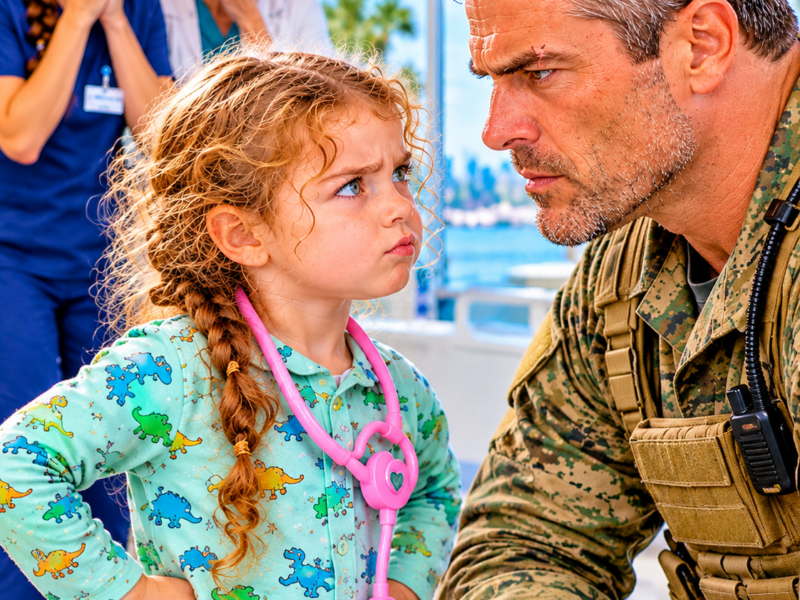
“I was sitting alone outside a VA hospital in San Diego, trying to convince myself that I didn’t need anyone’s help, when a four-year-old girl marched straight up to my wheelchair
Lily looked up at me with those enormous brown eyes, waiting for an answer.
“Did you know my daddy?”
Her mother, Sarah, stood beside her, one hand resting gently on Lily’s shoulder. I could hear the faint sounds of traffic beyond the VA hospital parking lot, but suddenly everything around me seemed very far away.
I looked at the photograph in Lily’s hands again.
The man in the picture wore a Navy corpsman uniform. His smile was familiar. So was the unit insignia on his sleeve.
I had seen that face through dust, smoke, and blood.
I had heard his voice when I thought I was going to die.
And I had made him a promise.
A promise I had spent three years pretending I had forgotten.
“Yes,” I finally whispered. “I knew your daddy.”
Lily’s face lit up.
“Was he brave?”
I swallowed.
“He was the bravest man I ever met.”
She smiled, satisfied, then turned to her mother.
“See? I told you he knew him.”
Sarah didn’t smile.
She studied me carefully, as if she could sense there was something beneath my words.
“Jack,” she said quietly, “how did you know him?”
I looked down at my hands.
Because the truth wasn’t a simple story about two soldiers who had crossed paths.
It was a story about a man who had saved my life and asked me to do one thing in return.
And I had failed him.
“Can we talk somewhere private?” I asked.
Sarah hesitated before nodding.
Lily tugged at her sleeve.
“Can I give Jack another sticker while you talk?”
Sarah gave a small, uncertain smile.
“Of course, sweetheart.”
Lily dug into her toy medical kit and pulled out a bright blue star.
She pressed it onto the back of my hand.
“This one is for telling the truth,” she said.
Then she skipped toward the little play area near the waiting room.
Sarah watched her go before turning back to me.
“I’m listening.”
I took a breath.
“Your husband saved my life in Afghanistan.”
Her expression changed.
Not dramatically. She didn’t gasp or cover her mouth.
She simply became very still.
“He was part of the rescue team after our unit was hit,” I continued. “We’d been pinned down. Two of my teammates were gone. I was badly injured, and I couldn’t move.”
“Marcus and Daniel?” she asked.
I nodded.
“You knew their names?”
“They were mentioned in the reports. My husband told me about the men he couldn’t bring home.”
I looked at the photograph again.
“He found me beneath part of a collapsed wall. I was bleeding badly. He stayed with me while the rest of the team worked to get us out.”
My voice tightened.
“I remember him holding pressure against my wound and telling me to keep my eyes open. I remember asking him if I was going to die.”
Sarah’s eyes were already shining.
“What did he say?”
I almost smiled.
“He told me he had a little girl waiting for him at home, and he wasn’t going to let me make him late.”
Sarah pressed her lips together.
“Lily was two months old.”
“He showed me a picture of her. A tiny baby wrapped in a yellow blanket.”
Sarah looked away.
“That sounds like him.”
I continued before I could lose my nerve.
“When they finally got me onto the evacuation helicopter, he climbed in beside me. He was exhausted. His uniform was covered in blood, but he kept talking.”
I closed my eyes.
“He told me about you. About how you sang to Lily when she couldn’t sleep. About how he wanted to teach her to ride a bicycle. He said he had never been good at imagining the future until he met her.”
Sarah wiped her cheek.
“He talked about us all the time.”
“I know.”
I stared at the blue star on my hand.
“Before they took him to another casualty, he grabbed my wrist. He made me promise something.”
Sarah’s voice dropped.
“What?”
I had rehearsed this conversation hundreds of times in my head.
Every time, I found a reason to stop before the words came out.
But Lily’s sticker was still on my hand.
And I was tired of lying.
“He asked me to find you if he didn’t make it home.”
Sarah’s face tightened.
“He said that?”
“He told me he wanted someone who had been there to tell you what happened. Not just a report. Not just a folded flag and a few official words.”
I paused.
“He wanted you to know that he was thinking about you and Lily until the very end.”
Sarah looked down at the floor.
“He never came home.”
“I know.”
“And nobody ever told me he said that.”
My chest tightened.
“I should have.”
She looked at me then, and there was no anger in her expression yet.
Just a pain so deep that it made me feel smaller than I had in years.
“Why didn’t you?”
I could have blamed the surgeries.
The nightmares.
The long months of rehabilitation.
The way I woke up screaming and couldn’t bear to hear helicopters overhead.
I could have told her that after the operation, I didn’t know how to be a person anymore.
But none of those explanations changed what I had done.
“I was afraid,” I said.
Sarah waited.
“I came home in a wheelchair. I couldn’t sleep. I couldn’t walk without help. I couldn’t look at photographs of my team without feeling like I had stolen the life that should have belonged to someone else.”
My voice broke.
“Your husband saved me, and I couldn’t even do the one thing he asked.”
Sarah sat down on the bench.
For a long moment, neither of us spoke.
Then she asked, “Did he suffer?”
The question landed harder than anything else.
I remembered the smoke.
The shouting.
The medic’s hands moving quickly.
I remembered the way his voice had sounded when he told me to keep breathing.
I chose my words carefully.
“He was conscious when I last saw him. He was doing his job. He was helping people. He wasn’t alone.”
Sarah closed her eyes.
“Thank you.”
“I wish I had come sooner.”
“So do I,” she whispered.
I nodded.
I deserved that.
From the play area, Lily suddenly called out.
“Mommy! Jack needs a checkup!”
Sarah gave a small, tired laugh.
“He’s been assigning you appointments, hasn’t he?”
“She doesn’t give people much choice.”
“She gets that from her father.”
A few minutes later, Lily marched back with her toy stethoscope around her neck.
“Jack, I need to listen to your heart again.”
I held out my wrist.
She shook her head.
“Not there. Your heart is inside.”
She placed the plastic stethoscope against my chest.
I tried not to laugh as she leaned forward with a serious expression.
Then she frowned.
“It’s too quiet.”
I looked at Sarah.
She shrugged gently.
“She’s four. Her medical opinions are still developing.”
Lily moved the stethoscope to my other side.
“Maybe it needs a hug.”
Before I could answer, she wrapped both arms around my waist as far as she could reach.
My body went rigid.
I hadn’t been hugged by a child since before the deployment.
For a second, I couldn’t breathe.
Then I slowly rested one hand on her back.
And something inside me gave way.
I began to cry.
Not the quiet tears I had learned to hide in hospital rooms.
Not the angry tears I wiped away before anyone could see.
I cried like a man who had finally stopped trying to hold up a wall that had been collapsing for three years.
Lily didn’t move.
She simply patted my arm.
“It’s okay,” she whispered. “Sometimes hearts get tired.”
Sarah knelt beside us.
“Lily, sweetheart, give Jack a little room.”
But I shook my head.
“It’s okay.”
For the first time in years, I didn’t want someone to give me room.
I wanted someone to stay.
That afternoon, Sarah and Lily left after Lily made me promise to come back for another checkup.
I sat in the parking lot long after they were gone.
My phone was in my hand.
There was a number I had saved three years earlier and never called.
My former unit commander.
I pressed the call button.
He answered after two rings.
“Sullivan?”
“Sir. It’s Jack.”
There was a pause.
“It’s good to hear your voice. How are you doing?”
I looked at the yellow sun sticker on my wheelchair armrest.
“Not great, sir. But I think I’m ready to talk.”
We spoke for nearly an hour.
I told him about Lily.
About her father.
About the promise.
When I finished, my commander was quiet.
Then he said, “You know, Jack, keeping a promise doesn’t mean you have to stop grieving. It means you finally let someone share the truth with you.”
I stared at the hospital entrance.
“I don’t know what to do next.”
“Start by showing up.”
It sounded almost too simple.
But maybe simple was what I needed.
The following Saturday, I went to Sarah’s house.
I nearly turned around twice before reaching the front door.
I had brought a small package wrapped in plain brown paper.
When Sarah opened the door, she looked surprised.
“Jack?”
“Hi.”
She glanced at the package.
“What’s that?”
“Something I should have brought three years ago.”
She stepped aside and let me in.
Lily was sitting on the living room rug, arranging stuffed animals in a line.
When she saw me, she jumped up.
“MY PATIENT!”
She ran over and stopped just short of my wheelchair.
“Did you get better?”
“I’m working on it.”
She nodded as if that was an acceptable medical update.
“Good. I have more stickers.”
Sarah sat across from me while Lily returned to her animals.
I placed the package on the coffee table.
Inside was a small cloth pouch.
I opened it carefully.
A military identification tag rested in my palm.
It belonged to her husband.
Sarah’s hand flew to her mouth.
“I found it in my belongings after the hospital transferred me,” I said. “I should have returned it immediately.”
She reached for it with trembling fingers.
“He was wearing this when he left.”
“I know.”
“I thought it was lost.”
“I kept it because I couldn’t bear to let go of the last thing I had from that day.”
I looked at her.
“But it was never mine to keep.”
Sarah held the tag against her chest.
For a long moment, she couldn’t speak.
Then she asked, “Can you tell me his last words?”
I nodded.
“He told me to stay alive. He said you and Lily needed to know that he loved you. And then he made me promise to find you.”
I took a breath.
“He said, ‘Don’t let them remember me only as the man who died. Tell them I was happy. Tell them I was a husband and a father first.’”
Sarah began to cry.
I had carried those words for three years.
Now they belonged where they should have been all along.
Lily crawled onto the couch beside her mother.
“Is that Daddy’s necklace?”
“It’s his tag, sweetheart,” Sarah whispered.
“Jack brought it back?”
Sarah nodded.
Lily looked at me.
“You found it!”
“I did.”
She thought for a moment.
“Does that mean Daddy can come home now?”
The question broke something in both of us.
Sarah pulled her close.
“No, baby. Daddy can’t come home.”
Lily’s little face fell.
“But we have his tag.”
“We do.”
“Then we can remember him.”
Sarah kissed the top of her head.
“Every day.”
I looked away, giving them a moment.
But Lily reached out and caught my fingers.
“You can remember him with us.”
I looked at Sarah.
She didn’t answer for her daughter.
She simply waited.
And for the first time, I understood that the promise hadn’t been about delivering a message and walking away.
It had been about making sure the people he loved didn’t have to carry his memory alone.
“I’d like that,” I said.
Over the next few weeks, I became a familiar face at their house.
Not every day.
Not as someone trying to replace the man they had lost.
Just as Jack.
The grumpy man in the wheelchair who was terrible at drawing animals and couldn’t convince Lily that broccoli was not a personal enemy.
Sarah and I talked slowly.
Some days we talked about her husband.
Other days we talked about ordinary things: work, grocery bills, the weather, and how hard it was to raise a little girl who asked a hundred questions before breakfast.
I learned that Sarah had returned to teaching part-time.
She learned that I had stopped attending physical therapy whenever the memories became too heavy.
She didn’t lecture me.
She simply asked if I wanted company the next time I went.
I said no the first time.
The second time, I said maybe.
The third time, I let her come.
Lily insisted on being my official medical supervisor.
She made a chart with stickers for every appointment I attended.
A red heart meant I had worked hard.
A yellow sun meant I had smiled.
A blue star meant I had told the truth.
At first, I thought it was silly.
Then I started looking forward to earning them.
My physical therapist noticed the difference.
“You’re pushing yourself more,” she said one morning.
“Someone’s keeping track.”
“Someone?”
I showed her the sticker chart Lily had drawn.
She smiled.
“Looks like you have a good team.”
I looked at the little paper stars.
“Yeah,” I said. “I think I do.”
The hardest day came three months later.
Sarah invited me to a small memorial gathering for her husband.
It was the first time I had stood among people who knew him before the war, people who had stories that had nothing to do with his death.
His sister told me he used to sing terribly in the kitchen.
His best friend remembered how he once drove two hours to help someone change a flat tire.
Sarah shared a story about their first date.
Lily sat beside her, holding the military tag in a small velvet pouch.
When it was my turn to speak, I stood with the help of my cane.
My legs trembled.
My voice nearly disappeared.
I looked at the people gathered in front of me.
“I knew him in a place where everything was frightening,” I began. “I knew him when people were hurt and when the world seemed to be falling apart.”
I paused.
“But that isn’t the only version of him I want you to remember.”
I looked at Sarah and Lily.
“He talked about his family. He talked about coming home. He talked about teaching his daughter to ride a bicycle. He was proud of his work, but he was even prouder of being her father.”
Lily was watching me closely.
“He saved my life. I will never be able to repay that. But I can spend the rest of mine making sure his daughter knows what kind of man he was.”
My voice shook.
“And I can finally stop treating my survival like something I need to apologize for.”
The room was silent.
Then Sarah stood and took my hand.
“You don’t owe him an apology for living, Jack.”
I looked at her.
“You were one of the people he brought home with him,” she said. “Even if you came back broken.”
I couldn’t speak.
She squeezed my hand.
“He would have wanted you to live.”
For the first time, I believed her.
That evening, Lily approached me with a folded piece of paper.
“I made you something.”
It was a drawing of three people standing beneath a huge yellow sun.
One was a little girl with brown curls.
One was a woman holding her hand.
The third was a man in a wheelchair.
Above them, in uneven letters, she had written:
MY FAMILY AND MY PATIENT.
I laughed softly.
“I’m your patient?”
She nodded.
“Forever.”
I looked at Sarah.
She smiled, and there was something peaceful in her expression that I hadn’t seen before.
I folded the drawing carefully and placed it in my jacket pocket.
That night, I went home and took the old photograph of my unit from the drawer.
For three years, I had kept it face down.
I turned it over.
Marcus was laughing.
Daniel was making a ridiculous face behind him.
And Lily’s father stood beside them, one arm around a teammate, smiling like the world was still full of possibilities.
I sat with that photograph for a long time.
I remembered the operation.
I remembered the loss.
But this time, I also remembered the promise.
And I understood something I hadn’t been able to understand before.
Surviving wasn’t the same as betraying the people who hadn’t made it home.
Sometimes surviving meant carrying their kindness forward.
The next morning, I went back to the VA hospital for physical therapy.
I didn’t wait outside alone.
I went inside.
I completed every exercise.
When the therapist asked me to try a few extra steps, I didn’t refuse.
I was still in pain.
I still had bad nights.
I still missed the men I had lost.
But I no longer believed that grief was the only thing I had left.
After my session, I found a small yellow sticker on my wheelchair.
A smiling sun.
Lily must have slipped it there during her visit with Sarah the day before.
On the back, in her crooked handwriting, were five words:
YOU ARE GETTING STRONGER.
I held it between my fingers and smiled.
A year earlier, I had believed my life ended on that dusty road in Afghanistan.
I thought the man who returned in a wheelchair was only the remains of someone better.
But a four-year-old girl had marched up to me and announced that I was her patient.
She hadn’t asked me to be fearless.
She hadn’t asked me to walk.
She hadn’t asked me to stop missing the people I loved.
She had simply asked me to let someone care.
And slowly, I had learned how.
On the anniversary of the day I first met Lily, she stood in front of my wheelchair with her toy stethoscope.
“Checkup time,” she announced.
I held out my arm.
She shook her head.
“Today, I have a new question.”
“What’s that?”
She looked up at me.
“Are you still sad?”
I thought about it.
“Yes,” I said honestly. “Sometimes.”
She nodded.
“That’s okay. You can be sad and happy.”
I smiled.
“That’s a pretty good diagnosis.”
She placed the stethoscope against my chest and listened very seriously.
Then she grinned.
“Your heart is louder now.”
I looked at Sarah.
She was standing behind Lily, smiling through tears.
And I finally understood what the little girl had been trying to teach me from the beginning.
I hadn’t needed someone to fix me.
I had needed someone to remind me I was still here.
I leaned forward and kissed the top of Lily’s curls.
“Thank you, Doctor.”
She giggled.
“You’re welcome, Jack.”
Then she took my hand and led me toward the hospital doors.
For the first time in three years, I didn’t feel like I was being dragged back into the world.
I felt like I was choosing to walk into it.
The End.









