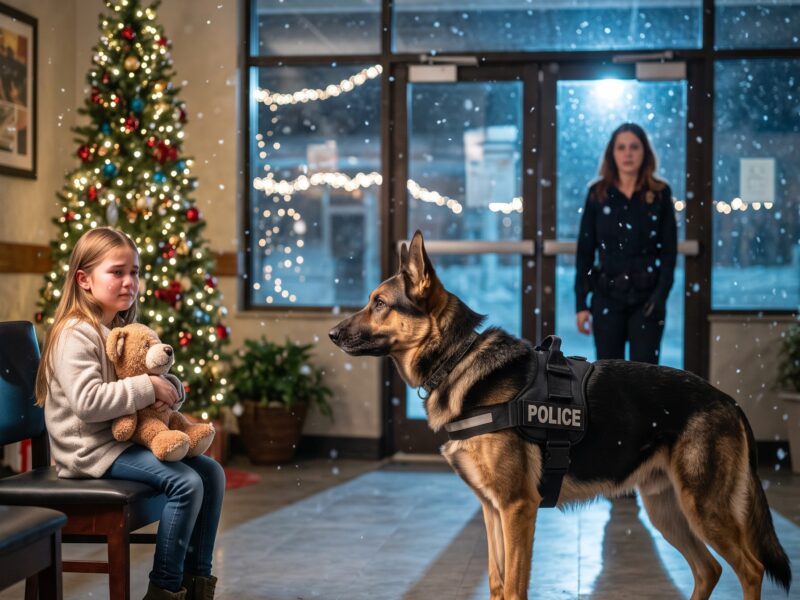
I was sitting alone on a freezing Christmas Eve outside a Denver bus station when a police officer told me to move along
The biting Denver wind cut straight through the threadbare wool of my coat, carrying with it the heavy scent of motor oil, exhaust fumes, and frozen asphalt. It was Christmas Eve, and the world had closed its doors to anyone who could not afford a ticket to somewhere warm. Snow had been falling for over an hour, laying down a silent, powdery shroud that smoothed over the rough edges of the bus station curb where I sat. Streetlights cast pale amber cones against the dark, through which crystalline flakes swirled like dust motes caught in an abandoned theater. Every few minutes, automatic glass doors slid open behind me, releasing a brief gust of heated air that carried the faint, cruel aroma of roasted coffee and cinnamon rolls, only to snap shut again, leaving the cold to bite twice as hard.
I pulled my knees tighter against my chest, wrapping both arms around the battered brown suitcase resting on my lap. The faux leather was cracked at the seams, held together by stubborn stitching and years of shared memories. Inside that suitcase was my entire existence: two hand-knit sweaters that still faintly carried the lavender soap I used back when I had a washing machine, a small framed photograph of my daughter Clara smiling on her college graduation day, and an envelope. It was a thick, cream-colored envelope, sealed and pristine, entirely devoid of a return address. It had sat at the bottom of my wardrobe for three months, untouched, because looking at it felt like stepping toward the edge of an abyss.
My husband, Thomas, had died three months ago. He was an archivist and land surveyor for the municipal water authority, a quiet, meticulous man who spent forty years tracing forgotten deeds and subterranean pipes beneath the city. The coroner had ruled it an accidental fall down the stone cellar stairs of an old intake station near the Platte River. A sudden loss of balance, they called it. A tragic misstep in the dark. But immediately after the service, before the funeral flowers had even begun to wilt, the world I knew unraveled with terrifying speed. Clara, my only child, had looked at me through eyes hollowed by an emotion I mistook for grief. She told me she could not bear the sight of me in our home, that every breath I drew reminded her of her father, and that she needed absolute space.
“Don’t call me, Mom,” she had whispered into my ear at the cemetery gate, her fingers digging so violently into my forearm that the bruises lingered for two weeks. “Don’t come to my apartment. Don’t stay in the house. Just disappear for a little while. Please.”
I thought she was drowning in sorrow. I thought she was breaking under the weight of an unbearable loss, the way young people sometimes do when the pillar of their world snaps without warning. So I obeyed. I packed a few clothes into our old holiday suitcase, stayed in cheap motels along Colfax Avenue until my savings dwindled to single bills, and tried calling her every morning. For the first two weeks, it rang until voicemail clicked on. By the third week, the line was disconnected. Yesterday, my bank card was declined at a grocery counter. I had eighty-four dollars in cash left in my pocket, no roof over my head, and a one-way bus ticket to Omaha scheduled for dawn. I was leaving Denver because there was simply no place left for me to stand without freezing.
A heavy crunch of boots on packed snow startled me.
“Ma’am, you can’t sleep here,” a firm, deep voice called out.
I blinked against the falling snow and looked up. Standing above me was a tall police officer wrapped in a high-visibility winter parka, his breath blooming in white clouds under the yellow lamp. Beside his left knee, taut on a leather lead, stood a massive German Shepherd wearing a tactical K-9 vest. The dog’s dark eyes reflected the streetlamps, his ears cocked high, his black-and-tan coat dusted with fine powder.
“I’m not sleeping, officer,” I whispered, my voice cracked and hoarse from hours of breathing frozen air. “I have a ticket. The terminal lobby was full, and the security guard asked people without express seats to step outside until boarding.”
The officer’s eyes softened slightly, taking in my graying hair, my trembling hands, and the thin fabric of my shoes. “The waiting area shouldn’t be turning people out in this weather. It’s twenty degrees. Let me see your ticket.”
I reached into my pocket, but before my fingers could grasp the slip of paper, the dog moved.
German Shepherds trained for police work are machines of discipline. They do not twitch without an order; they do not wander. Yet this dog took two measured paces forward, dragging the leather lead through the officer’s gloved grip, and stopped inches from my knees.
“Buddy, heel,” the officer commanded, his tone sharpening instantly as his hand tightened on the lead. “Buddy, stay.”
The dog completely ignored him. Slowly, deliberate as a shadow, the animal lowered his haunches and sat down directly beside my suitcase. He did not growl, nor did he bare his teeth. Instead, he pressed his broad, warm flank firmly against my trembling shins, turned his head, and fixed his dark, intelligent eyes directly upon the cracked zipper of my luggage.
The officer frowned, his posture shifting from routine patrol weariness to sharp suspicion. His right hand instinctively hovered near the utility belt at his hip. “He’s never done that before. Buddy doesn’t break heel for anyone. What do you have in that bag, ma’am?”
“Nothing,” I stammered, terror spiking through my chest. “Just clothes. Old sweaters. A picture of my daughter.”
Buddy lowered his muzzle and drew in a long, deep breath along the seam of the bag. His wet nose twitched. Then, with an eerie, human-like precision, the dog raised his right front paw and scratched twice at the brass pull-tab of the zipper.
“Stand up slowly, keep your hands where I can see them, and unzip it,” the officer said, his voice flat, professional, and uncompromising.
I didn’t argue. My limbs felt made of wet clay as I slid off the frozen metal bench and knelt in the snow. My fingers were shaking so violently that I fumbled with the metal clasp three times before the teeth finally parted. The smell of old wool and lavender drifted into the winter air.
“Move the clothes aside,” the officer instructed, leaning down with his flashlight switched on.
I lifted the blue cable-knit sweater, then the red cardigan Thomas had bought me four Christmases ago. Beneath them lay the silver-plated frame holding Clara’s portrait. And beneath the frame sat the sealed envelope.
The beam of the flashlight locked onto the white paper. The officer reached down with a gloved hand and lifted it. The surface was unmarked except for a single word written in dark blue ink across the center: Evelyn.
“It’s just a letter,” I whispered, tears finally breaking free and freezing against my cheeks. “My daughter gave it to me right after the burial. She told me not to open it unless I felt I had nowhere else left to go. I was too afraid of what it might say. I thought she was telling me she hated me.”
The officer looked at the handwriting, then down at Buddy, who had rested his chin squarely on top of the open suitcase, never taking his eyes off the paper.
“Open it,” the officer said softly, handing the envelope to me.
My frozen thumbs struggled with the heavy bond paper, tearing the flap until it yielded. Inside was a single folded sheet torn from a legal ledger. I unfolded it under the harsh yellow cone of the flashlight. The handwriting was not Clara’s careful cursive; it was the frantic, jagged scrawl of a person whose hand was shaking uncontrollably.
Mom, if you’re reading this, please don’t believe what they told you about Dad’s death.
The breath left my lungs in a violent gasp. The bus station, the rumble of idling engines, the distant sound of church bells ringing across downtown—everything vanished into a dead, ringing silence.
They made it look like a fall because of the map he found in the 1954 flood surveys. He tried to hide the original blueprints before they came to the house. If you are still in Denver, you are in danger. They watched the funeral. They watched you leave. I had to push you away so they wouldn’t think we were talking. I took Dad’s backup drive to the old waterworks pump house on 8th. Mom, do not trust anyone with a gold badge from the municipal office. If you still have the house key on Dad’s ring, do not lose it. It isn’t for our house.
The flashlight beam trembled. I looked up and saw that the police officer was reading over my shoulder. His jaw had tightened until a muscle twitched in his cheek.
“Who told you your husband died accidentally?” he asked, his voice barely louder than the falling snow.
I could not speak. The past three months rushed through my mind like a torrent of icy river water. Thomas hadn’t been clumsy; he had walked those concrete catwalks for four decades. The week before he died, his work phone had vanished from the kitchen counter, and when I asked about it, he told me he had misplaced it in the reservoir basin. Then there was his home office, which he had begun locking from the inside—something he had never done in thirty-four years of marriage. And the night before they found his body, I had woken up at three in the morning to the sound of dry grass crunching beneath our bedroom window, followed by a low, dry whisper that called my name into the glass.
Suddenly, Buddy stiffened.
The German Shepherd’s ears flattened against his skull. A deep, resonant growl rolled in his throat, vibrating through the leash. The officer spun around, his left hand snapping the dog back to attention while his right dropped to the snap of his holster.
“Buddy, quiet,” the officer hissed.
Across the four-lane boulevard, partially obscured by the thick curtain of snowfall, a pair of high-intensity LED headlights flickered to life. A black full-size SUV sat idling against the curb of an empty commercial lot. The vehicle had no license plate on its front bumper. Slowly, with a deliberate, agonizing crawl, the passenger side door pushed open into the snow.
A slender figure stepped down into the slush, pulling a dark hood over her head. The streetlight caught her pale face for a single, illuminated second.
It was Clara.
She stood motionless on the opposite curb, staring straight across the road through the swirling white flakes, her eyes locked directly on mine. She looked thinner, her coat hanging loose, her hands buried deep in her pockets. She parted her lips as if to scream my name across the traffic.
Before a single sound could escape her throat, Buddy broke into a frantic, deafening volley of barks, lunging against the leather strap with enough force to pull the officer two steps off balance. In that exact second, from the shadowed interior of the SUV behind Clara, a second door clicked open.
The deafening roar of Buddy’s bark seemed to shatter the freezing air into jagged pieces. The officer, whose name tag read HARRIS, hauled back on the tactical lead with both hands, his boots skidding through the gray slush on the sidewalk. “Clara!” I screamed, the word ripping from my throat before my mind could register the danger. I took a wild step off the curb toward the street, but Harris caught the heavy sleeve of my winter coat with an iron grip, yanking me backward behind the safety of a concrete transit pillar.
“Stay down!” Officer Harris ordered, his voice cutting through the wind with sharp authority. “Get behind the pillar and do not move!”
Across the snowy expanse of the boulevard, Clara took a single, frantic step toward me, her arms outstretched, her eyes wide with unmasked panic. “Mom, run!” she screamed. The wind caught her voice, scattering it against the brick facade of the bus station.
Behind her, the rear door of the black SUV swung fully open. A man stepped down into the snow. He was tall, dressed in a heavy charcoal overcoat with a dark watch cap pulled low over his forehead. He didn’t rush. He moved with a cold, calculated efficiency that made the hair on the back of my neck stand up. In his right hand, half-concealed beneath the drape of his coat, was a compact black object that gleamed under the streetlamps. He seized Clara by the upper arm with brutal force, yanking her backward toward the vehicle like a ragdoll.
“Let her go!” I shrieked, fighting against Officer Harris’s grip, but the officer was immovable.
“Dispatch, this is Unit 44, I have an active ten-thirty-three at the Market Street station, female in distress, black late-model Suburban, Colorado plates unknown, suspect armed—” Harris spoke rapidly into the shoulder mic clipped to his lapel, but the only response was a harsh screech of static that dissolved into dead air. He clicked the radio twice more, grimacing. “Signal’s jammed. They’re running local interference.”
Buddy lunged again, teeth bared, saliva foaming at his lips as he strained toward the road. The man in the charcoal coat glanced directly across the street, his eyes locking onto Harris’s uniform, then down at me huddled behind the concrete pillar. He didn’t look frightened by the presence of a police officer; his expression was entirely devoid of emotion, like an exterminator assessing an inconvenient nest. He muttered something to the driver inside the SUV, shoved Clara violently into the back seat, and vaulted in after her.
The doors slammed shut. The tires spun violently against the packed snow, kicking up plumes of dirty ice, before catching traction and rocketing away down 16th Street, its taillights bleeding red into the storm until they vanished around the corner.
Silence crashed down on the bus station once more, broken only by the panting of the dog and the shuddering sobs tearing through my chest.
“She’s alive,” I wept, sinking down against the concrete pillar, my fingers digging into the wet stone. “She was trying to save me. She pushed me away to keep me safe, and now they have her.”
Officer Harris didn’t tell me to calm down. He knelt beside me, his tactical flashlight resting on his knee, and picked up the torn letter from the snow where I had dropped it. Buddy settled beside my hip, whining softly now, his large head resting over my frozen boots as if shielding me from the cold.
“Evelyn,” Harris said, reading the name on the envelope again. He looked up at me, his eyes dark with an intensity that went far beyond standard police procedure. “Your husband was Thomas Vance, wasn’t he?”
I froze, staring at him through my tears. “How do you know that?”
Harris unzipped the front of his heavy patrol parka. Beneath it, pinned to the left breast of his uniform shirt, was an ordinary silver shield of the Denver Police Department. But clipped directly beneath it, pinned discreetly to the inner flap of his tactical vest where the public would never see it, was a small brass emblem shaped like an eight-pointed star.
“Because three weeks ago, Thomas came to the district station,” Harris said quietly, his eyes darting toward the empty street to ensure we were alone. “He didn’t go to the detectives. He asked for my father, Captain Robert Harris, who retired five years ago. My dad and your husband served together in the National Guard forty years ago. When Thomas found out my dad was in a hospice care facility in Aurora, he came down to the motor pool looking for me.”
The cold seemed to vanish, replaced by a suffocating numbness. “What did he say to you?”
“He was terrified, Evelyn. He looked like a man who hadn’t slept in a month,” Harris whispered, his voice barely carrying over the hum of the nearby terminal generator. “He told me he had discovered something buried in the city’s historical water infrastructure records. A series of private utility diversions dating back to the late 1950s that bypassed the city meters directly beneath the old industrial rail corridor. Thousands of acres of municipal land that were officially listed as contaminated swampland had been dried out, retrofitted with unauthorized industrial drainage, and secretly deeded over to a shell corporation controlled by three city commissioners and a private development trust.”
“Land development?” I asked, bewildered. “Thomas was an archivist. He spent his life looking at paper. Why would someone kill him over fifty-year-old dirt?”
“Because that dirt isn’t swamp anymore,” Harris replied, his jaw tightening. “That land sits right under the newly approved multi-billion-dollar transit expansion project north of downtown. The city is preparing to purchase those parcels back next month for eight hundred million dollars of public money. If Thomas proved the land was stolen from the city sixty years ago through forged water easements, the trust gets nothing, the developers go to federal prison for grand fraud, and three high-ranking officials lose everything. Thomas told me he made two copies of the original surveyor ledgers. He said he hid one in the pump house on 8th Street, and the second one…”
Harris paused, his eyes dropping to the letter in his hands.
“…and the second one he entrusted to Clara,” I whispered, finishing his sentence.
“The letter says something else,” Harris said, tapping the bottom of the page. “Read the last line again. Carefully.”
I took the trembling paper from his hand, squinting under the flashlight beam.
If you still have the house key on Dad’s ring, do not lose it. It isn’t for our house.
My breath caught. I reached into the deep interior pocket of my winter coat. My fingers wrapped around a heavy brass ring containing three keys: the little silver key to our mailbox, the deadbolt key to our suburban front door, and a third key that Thomas had carried for as long as I could remember. It was heavy, dark bronze, with an intricate barrel shape and an old-fashioned square bow. I had asked him about it decades ago, and he had laughed, telling me it was just a keepsake from his grandfather’s old workshop in Golden.
I pulled it out into the beam of the flashlight.
Buddy leaned forward, his nose grazing the bronze metal, and gave a single, quiet whimper.
“That’s not a house key,” Harris said, his voice dropping an octave. “That’s a mechanical master key for the manual intake valves of the 1928 Cheesman reservoir transfer tunnels beneath the city. My dad had one just like it when he worked municipal security during the floods.”
Suddenly, the crackle of the officer’s shoulder radio burst through the quiet, but it wasn’t the regular dispatcher’s voice. A deep, smooth voice came over the emergency channel, completely overriding the patrol frequency.
“Officer Harris,” the voice spoke calmly through the static. “We know you have Mrs. Vance. We also know you have her husband’s key. Step away from the woman and leave the terminal. A city transport unit is three minutes out to relieve you of your assignment. Do not make your father’s final days in hospice uncomfortable.”
Harris’s face drained of color. He stared at the small black radio, then reached up with a steady hand and clicked the power dial completely to off. He looked at me, the snow settling on his shoulders like powdered glass.
“They tapped my patrol unit’s location beacon,” Harris said, his voice flat with sudden, deadly clarity. “They didn’t just stumble on us here. They tracked me to you. And that means nobody in dispatch or central command can be trusted.”
“What about Clara?” I cried, clutching the bronze key against my chest. “They have my baby!”
“They won’t hurt her yet,” Harris said, standing up and hauling me gently to my feet with one arm, while his other hand kept Buddy on a short, firm leash. “They took her because she doesn’t have what they need. She ran because she couldn’t find the ledger at the pump house. The ledger is locked inside the valve control vault beneath 8th Street. That key in your hand is the only thing on earth that can open that steel bulkhead without blowing half the avenue to pieces.”
He kicked my old suitcase shut with the heel of his boot and scooped it up by the handle.
“Where are you taking me?” I asked, my knees shaking as the wind howled down the avenue.
“To the only place in Denver where their radios and traffic cameras can’t see us,” Harris said, pulling me toward a narrow, dark alleyway behind the bus terminal that led down toward the sunken concrete banks of Cherry Creek. “We’re going underground.”
We took three hurried steps into the shadow of the alley when a metallic click sounded from the darkness near the fire escape above our heads. Buddy froze, his ears pinning back, his teeth flashing in the dark as a red laser dot appeared on the center of Officer Harris’s chest.
“Down!” Harris roared, throwing his entire weight into me.
We slammed against the frozen concrete of the alleyway just as a sharp, suppressed phut echoed above us, followed instantly by the sickening smack of lead pulverizing brick precisely where Harris’s chest had been a fraction of a second before. Shards of masonry showered over my coat. Buddy didn’t bark; he moved with lethal, predatory speed, lunging toward the rusted metal stairs of the fire escape, his claws scrabbling against the icy iron rungs as he surged upward into the gloom.
A muffled cry of pain and a heavy metallic clatter rattled from the landing twelve feet above us. A sniper rifle tumbled down through the open grating, clattering onto the snow-covered asphalt beside my boots. Above us, the frantic scuffle of boots against metal was punctuated by the violent, tearing snarls of the German Shepherd.
“Buddy, off! Down!” Harris shouted, scrambling to his feet and drawing his service weapon.
The dog dropped down from the lowest rung of the fire escape, landing lightly in the snow, his muzzle flecked with dark blood and scraps of black synthetic fabric. Above, the sound of someone limping heavily across the gravel rooftop faded into the whistling winter wind.
“Move! Now!” Harris gripped my arm, pulling me up by the collar of my coat. He didn’t bother looking for the fallen rifle; he knew every second we remained beneath the open sky was a death sentence.
He dragged me deeper into the labyrinthine service alleys behind the bus station, turning sharply past industrial dumpsters and humming ventilation shafts. Buddy trotted half a pace ahead, his head low, ears swiveling to catch every echo bouncing between the narrow brick canyons. Snow fell thicker now, swirling into blinding white sheets that stung our eyes and swallowed our footprints almost as quickly as we made them.
After three frantic blocks, we stumbled out onto the concrete pedestrian descent that led down to the Cherry Creek path. In the summer, tourists and cyclists filled this sunken concrete channel, but tonight it was an abandoned frozen canal, a dark trough cutting straight through the heart of the city, shielded from the view of street-level traffic cameras by high stone retaining walls.
Harris guided me down the slick concrete ramp. The icy wind howled through the subterranean channel like a living thing, whipping freezing mist from the half-frozen creek against our faces. Halfway down the path, under the massive concrete belly of the Speer Boulevard overpass, Harris stopped before a heavy, rusted steel bulkhead set directly into the stone retaining wall.
Above the door, faded yellow letters stenciled fifty years ago read: DENVER MUNICIPAL WATER BOARD – DRAINAGE ACCESS 4-B – AUTHORIZED PERSONNEL ONLY.
Harris reached behind the neck of his body armor, pulled out a flat titanium pry bar from a utility pouch, and jammed it into the gap beside the ancient padlock securing the latch. With a sharp, violent heave that strained the muscles in his neck, the rusted hasp snapped with a brittle crack that sounded like a gunshot in the hollow beneath the bridge. He hauled the heavy iron door open, revealing a yawning rectangle of absolute, pitch-black darkness that smelled of damp earth, old iron, and stagnant subterranean water.
“Get inside,” he breathed, checking the empty pathway behind us.
Buddy didn’t hesitate. The dog slipped into the black void as if he knew the terrain intimately. I stepped through the threshold, my shoes splashing into an inch of icy sludge, and Harris pulled the heavy iron door shut behind us, leaving only a hairline crack so the latch wouldn’t engage and trap us inside.
The silence that enveloped us was instant and suffocating. The howling wind and the muffled roar of the city disappeared, replaced by the rhythmic, echoing drip of water somewhere deep within the stone labyrinth. Harris switched on his tactical flashlight, setting the beam to a low, crimson glow to prevent the light from reflecting outward through the seam of the door.
The red light illuminated a circular tunnel lined with damp, curved concrete blocks, stretching out into the dark ahead. Rust-eaten pipes the thickness of tree trunks ran along the ceiling, held by corroded iron brackets.
“Are we safe here?” I whispered, my voice trembling so hard my teeth clicked together.
“For an hour, maybe less,” Harris replied, his breath pluming red in the dim light. He knelt beside Buddy, checking the dog’s paws and muzzle with quick, practiced hands. “They have city blueprints, Evelyn. If the people behind this are the city commissioners Thomas was investigating, they have access to every municipal maintenance map ever drawn. They will realize where we went the moment they find that broken lock.”
He looked up at me, his eyes shadowed under the brim of his cap. “Give me the key.”
I reached into my pocket, pulling out the heavy bronze key. The metal felt ice-cold against my palm. Harris took it, holding it up to the crimson light. Etched along the barrel of the key, previously obscured by decades of pocket grime, was a tiny series of numbers: 1954-W-09.
“What does that mean?” I asked.
“Nineteen fifty-four was the year of the Great South Platte flood,” Harris explained, his voice low and hollow in the tunnel. “Half of lower Denver was submerged. The city council created an emergency diversion tunnel beneath the old rail yards to drain the floodwaters into the lower aquifer. But according to what Thomas told me before he died, that flood was used as an excuse. The city engineers secretly built a secondary diversion line—one that permanently altered the water table beneath two square miles of land north of the city, drying out hundreds of acres of valuable industrial ground that was officially documented as unusable marsh.”
“And Thomas found the original survey records,” I realized, the horror finally crystallizing in my mind. “The records that proved the city didn’t own the land anymore because private developers had quietly claimed the dry ground using forged deeds.”
“Not just private developers,” Harris said grimly. “The trust was founded by three families. One of those families belongs to Marcus Vance.”
The name hit me like a physical blow. I swayed on my feet, catching myself against the slimy, freezing wall of the tunnel. “Marcus? Thomas’s brother?”
“Your brother-in-law sits on the regional transit authority board, Evelyn,” Harris said, his voice flat with bitter certainty. “He was the one who personally sponsored the bill to purchase that land back for the new light rail corridor for eight hundred million dollars. Thomas didn’t just uncover a municipal scandal. He uncovered that his own brother had orchestrated a multi-generational theft against the city—and was about to cash out the largest payout in Colorado history.”
“No,” I wept, shaking my head in the red darkness. “Marcus was at the funeral. He held my hand. He paid for the casket. He told me he would take care of everything…”
“He paid for the casket because he put Thomas in it,” Harris said without pity. “Thomas went to Marcus first, Evelyn. He thought his brother was an honest man who didn’t know about the fraud. He showed Marcus the surveyor’s ledger three days before he died. Thomas thought Marcus would help him take it to the federal prosecutor. Instead, Marcus realized his entire empire was about to collapse.”
A cold, hollow void opened in the pit of my stomach. Every sweet word Marcus had spoken to me at the wake, every hand on my shoulder, every expression of fabricated sympathy—it had all been an interrogation. He hadn’t been comforting a grieving widow; he had been searching my face, waiting to see if Thomas had told me the truth before they pushed him down those cellar stairs.
“And Clara knew,” I whispered, the agonizing puzzle finally assembling itself. “Clara found Dad’s personal journal after he died. That’s why she pushed me away. She knew Marcus was watching me. She knew if I stayed in that house, Marcus would have his people stage another ‘accident’ for both of us.”
“Clara took the backup drive containing the digital scans of the ledger,” Harris said, nodding. “She tried to hide it at the old 8th Street pump house, but Marcus’s men were already watching the perimeter. She couldn’t get in without this bronze key. That’s why she was at the bus station tonight. She wasn’t fleeing, Evelyn. She was trying to intercept you before you boarded that bus to Omaha, because she knew you had the key on Thomas’s ring.”
Suddenly, Buddy’s head snapped upward toward the roof of the tunnel.
The dog didn’t growl. He stood perfectly rigid, every muscle in his seventy-pound frame locked like steel, his nose pointing directly toward the iron drainage grates set into the concrete ceiling thirty yards ahead of us.
Through the damp stillness of the subterranean passage, a sound drifted down from above.
It was the heavy, synchronized thud of boots walking across the frozen steel grating of the street level above our heads. Then came the mechanical whine of an electric saw biting into metal, followed by the muffled sound of a man speaking into a radio through the drainage shaft.
“They’re in the secondary drainage interceptor. Seal both ends of the Cherry Creek culvert. Bring the girl down through the 8th Street intake shaft. If the widow doesn’t hand over the key within ten minutes, put a bullet through her daughter’s knee.”
Harris instantly cut the red flashlight, plunging us into total, terrifying darkness. In the black void, his gloved hand found my shoulder, pressing me down against the freezing floor of the tunnel.
“We don’t have an hour,” Harris whispered against my ear, the cold steel of his drawn service weapon brushing against my sleeve. “They aren’t looking for the ledger anymore, Evelyn. They’re using Clara as bait to draw us straight into the vault.”
The complete darkness of the tunnel pressed against my eyes like physical weight. Beside me, Buddy’s warm body trembled with restrained tension, his breathing shallow and silent through his nose. Above our heads, the sharp whine of the electric saw suddenly died, replaced by the heavy, echoing thud of an iron maintenance hatch slamming open against the pavement sixty feet behind us.
A sharp beam of halogen light pierced the black air near the entrance we had just used, cutting through the damp mist like a blade.
“Harris!” a voice boomed down the tunnel, amplified by the curved concrete walls until it sounded like it came from every direction at once. The voice was smooth, cultured, and horribly familiar. It was Marcus.
“Officer Harris, I know you can hear me,” my brother-in-law called out, his tone conversational, as if he were addressing a board meeting rather than hunting his family through a sewer. “You’re a decorated veteran, son. Your father was a good cop before his mind started slipping in that home. It would be a terrible tragedy if the state board found irregularities in his pension records tomorrow morning. Or if the auxiliary power to his medical wing experienced a sudden… mechanical failure during this winter storm.”
I felt Harris stiffen beside me in the dark. The fabric of his tactical vest pulled tight as his breathing hitched. His fingers dug hard into the concrete floor.
“And Evelyn,” Marcus continued, his voice edging closer as boots began sloshing through the shallow water behind us. “My dear, foolish Evelyn. Did you really think Thomas was a saint? He spent forty years helping this city build its foundations, and when he saw an opportunity to secure his family’s generational wealth, he lost his nerve. He was weak. He wanted to give eight hundred million dollars back to a corrupt municipal council that doesn’t care about you or your daughter. I’m trying to protect what is ours. Clara understands that now. Don’t you, sweetheart?”
A muffled scream of rage and pain echoed down the corridor, followed by the unmistakable sound of a palm striking flesh.
“Don’t touch her!” I nearly screamed, but Harris’s hand clamped hard over my mouth, holding me down against the wet stone with immovable strength.
“Keep moving,” Harris breathed into my ear, his lips barely moving. “Slowly. Keep your weight on the balls of your feet. Do not splash.”
He released me, keeping one hand on the collar of Buddy’s vest. Crawling on hands and knees through the freezing sludge, we moved deeper into the labyrinth. The concrete floor sloped downward, carrying us further beneath the foundation of the city. The air grew thicker, heavy with the mineral stench of raw limestone and decades of stagnant underground seepage. The halogen beams behind us swept the curved walls, casting monstrous, elongated shadows that danced over the ceiling, but the natural curve of the tunnel bought us precious yards of concealment.
After fifty yards of agonizing crawling, the narrow pipe opened into a cavernous underground chamber. The sound of our movement was swallowed by the vastness of the space. Harris brought up his penlight, shielding the tiny white beam between his fingers, and swept it across the room.
It was an ancient subterranean pump station, abandoned when the city modernized its water works in the late 1970s. Massive cast-iron turbine housings, green with corrosion and as large as locomotives, sat bolted to concrete pedestals. Above them hung a web of rusted steel catwalks, chains, and counterweights. In the center of the far wall, flanked by two towering pressure valves, stood a massive vault door made of solid, four-inch-thick steel. It looked like the door of a bank vault, complete with a heavy mechanical wheel and a central keyway lined with dark, machined bronze.
Above the vault, painted in peeling black letters, was the designation: RESERVOIR ARCHIVE & EMERGENCY BYPASS CONTROL – 1954.
“This is it,” Harris whispered, helping me to my feet. My knees were scraped raw, my trousers soaked in ice water, but the adrenaline surging through my veins burned away the pain. “The original municipal survey ledgers are inside that room. If we can get inside and lock the bulkhead from within, this door can withstand high-yield industrial explosives. There’s an emergency communication cable linked directly to the federal marshals’ dispatch that runs through this facility’s historic defense line.”
“How do we get Clara away from them?” I asked, my voice shaking as I stared at the dark entrance of the tunnel behind us.
“We don’t go to them,” Harris said, his face cold, pale, and completely resolved. “We make them bring her here.”
He turned to the vault door. “Give me the key.”
I handed him the heavy bronze key. Harris slid the notched barrel into the lock. It clicked into place with a heavy, satisfying metallic bite that echoed through the cavern like a rifle shot.
Behind us, at the mouth of the tunnel, the flashlight beams snapped toward the sound.
“They’re in the pump room!” a harsh voice shouted.
“Hold your fire!” Marcus’s voice bellowed, authoritative and sharp. “Don’t hit the door! If that key shears off in the tumbler, we’ll have to blast the foundation, and the whole street will come down!”
Footsteps pounded through the shallow water. Four men emerged from the darkness into the vast chamber, their tactical weapons raised, the bright beams of their flashlights illuminating the rusted machinery. In the center walked Marcus Vance. He was wearing an expensive cashmere coat over a tailored suit, entirely out of place in the wet concrete filth of the sewer. In his left hand, he held Clara by the hair, dragging her forward. Her face was bruised, her lip split and bleeding, her hands bound behind her back with heavy zip-ties. But when her eyes found mine across the twenty yards of rusted iron and shadows, there was no defeat in them—only a fierce, desperate defiance.
“Mom!” she cried out. “Don’t give it to him! The ledger has the names of the entire development board! He can’t sell the land without it!”
One of the armed men beside Marcus raised the butt of his submachine gun toward Clara’s ribs, but Marcus held up a hand, stopping him. He stepped forward onto the central concrete floor, smiling with the practiced warmth of an elder statesman.
“Evelyn,” Marcus said, spreading his arms wide. “Look at yourself. Look at your daughter. Freezing to death in a drainage ditch on Christmas Eve. Is this what Thomas wanted for you? He died for an abstract moral principle that nobody remembers. This city doesn’t care about surveyor maps from 1954. But this money… this money means Clara never has to work a day in her life. It means you spend the rest of your years in a villa in Santa Fe instead of riding a Greyhound bus with eighty dollars in your purse.”
“You killed my husband,” I said, my voice steady, stripped of all fear by the sheer, unadulterated hatred burning in my chest. “You pushed your own brother down a flight of stone stairs because he wouldn’t let you steal from the people he served.”
Marcus’s smile vanished. The mask of familial warmth peeled away, revealing the cold, reptilian calculation beneath.
“Thomas was an idiot,” Marcus spat, his voice dropping into a harsh, vicious hiss. “He spent his life cataloging dust. He thought honesty was a currency. I spent thirty years turning this state into an empire, and I will not let a dead man’s notebook take it away from me.”
He drew a small, silver-plated automatic pistol from his coat pocket and pressed the cold muzzle directly against the side of Clara’s temple.
“Officer Harris,” Marcus said softly. “Turn the key. Open that bulkhead, bring out the ledgers, and slide them across the floor. If that door isn’t open in five seconds, I will paint this machinery with your niece’s brains, and then I will take the key from your corpse.”
Harris didn’t move. His hand remained resting on the bronze key in the vault door. “You won’t shoot her, Marcus. If you shoot her, Evelyn drops the key into the turbine drainage pit behind this catwalk. It’s three hundred feet of flooded shaft. You’ll never see those papers, and the transit bill expires at midnight on December thirty-first. You’ll default on your private loans, and your investors will put you in the river just like you did to Thomas.”
Marcus’s jaw tightened. His finger took up the slack on the pistol’s trigger. “Try me, boy.”
“Buddy,” Harris whispered under his breath, barely moving his lips.
The dog, who had been lying flat in the deep shadows beneath the massive cast-iron turbine housing, shifted his weight forward onto his haunches. His ears twitched toward Harris’s voice.
“Evelyn,” Harris murmured without looking at me. “When I say go, you turn that bronze key all the way to the right and haul that wheel counterclockwise. Do not look back.”
“One,” Marcus counted, his eyes narrowing. “Two…”
“Buddy, attack!” Harris bellowed.
The German Shepherd launched out of the shadows like a black artillery shell. He didn’t go for Marcus. With brilliant, savage training, the dog hurled his entire body through the air directly into the chest of the gunman holding the submachine gun on Marcus’s right flank. The impact sounded like two cars colliding. The man let out a strangled shriek as seventy pounds of bone and muscle smashed him flat against the concrete floor, Buddy’s jaws clamping down with crushing force onto his weapon arm.
The submachine gun fired wild, sending a deafening burst of automatic fire chewing into the ceiling. Chunks of concrete and iron shrapnel rained down into the chamber.
“Clara, drop!” Harris screamed, firing his service pistol twice in rapid succession. The rounds struck the second armed guard in the center of his chest, hurling him backward into the dark water of the intake pool.
Marcus staggered back, blinded by the muzzle flashes and the chaos. He tried to adjust his aim toward Clara, who had thrown herself violently onto the wet floor behind a steel stanchion.
“Now, Evelyn!” Harris yelled, charging forward into the crossfire to shield Clara with his own body.
I spun toward the vault door, grabbed the heavy bronze key with both hands, and turned it with all the strength left in my broken, exhausted body. The internal tumblers groaned, a massive mechanical lock clicked open, and the heavy steel wheel began to spin.
The steel wheel spun with a deafening screech of long-dormant gears. I threw my entire weight against the recessed handle of the vault door, my boots finding purchase on the slick, algae-covered concrete. The four-inch slab of solid iron shifted, grinding open on rusted hinges that groaned like dying beasts.
Behind me, the cavernous pump room had descended into absolute warfare. Gunfire thundered against the stone walls, the concussive blasts rattling the fillings in my teeth and filling the damp air with the acrid, blinding stench of burnt cordite.
“Clara! Get in!” I screamed, turning toward the open chamber.
Through the haze of gunsmoke and the strobe-like flash of muzzle fire, I saw Harris tackling the remaining armed guard to the floor, the two men rolling through the freezing water in a desperate, brutal struggle for control of a weapon. Buddy was a whirling terror of teeth and muscle, pinning Marcus’s primary enforcer against the base of the cast-iron turbine housing, keeping him from raising his rifle.
Marcus was on his feet. The cashmere coat was torn, his hair wild with panic. He had lost his silver pistol in the initial scramble, but his hand came up clutching a heavy steel maintenance spanner he had torn from a nearby tool rack. His eyes were completely deranged, fixed entirely on the yawning darkness of the open vault.
“The books!” he shrieked, his voice cracking into a high, hysterical pitch. “The books are mine!”
Clara, her hands still zip-tied behind her back, surged up from the concrete floor. With a desperate, feral cry, she threw her shoulder directly into Marcus’s knees as he lunged toward the vault. Marcus lost his footing, his boots slipping in the bloody slush, and he crashed heavily against the metal catwalk railing. The impact knocked the breath from his lungs in a wet gasp, but he scrambled upward, his face twisted in murderous rage, raising the heavy spanner to bring it down across Clara’s skull.
“Marcus!” I roared.
He paused for a fraction of a second, looking up at me standing in the doorway of the vault.
In my hand, I held the heavy brass surveyor’s ledger that had been resting on a steel pedestal just inside the door—a massive, leather-bound volume stamped with the gold seal of the Denver Water Authority, 1954.
“You want it?” I screamed, stepping back toward the narrow edge of the turbine overflow shaft—a bottomless black pit in the corner of the room where the roar of subterranean water churned hundreds of feet below. “Come and get it!”
Greed overwhelmed every ounce of reason left in his mind. He abandoned Clara, scrambling across the slick floor on all fours like a rabid beast, reaching out with clawed fingers toward the heavy book.
“Give it to me, you stupid bitch!” he snarled, lunging forward with the spanner.
I didn’t flinch. I waited until his fingertips were inches from the leather binding.
“Thomas says hello,” I whispered.
I hurled the five-pound ledger with all my might—not into the pit, but straight into his face.
The heavy, brass-cornered book struck Marcus squarely between the eyes with a sickening crack that broke his nose. He let out a shriek of agony, dropping the spanner and clutching his shattered face with both hands. The momentum of his lunge carried his boots onto the thin layer of ice covering the edge of the catwalk. His heels slipped out from under him.
His arms flailed wildly, grasping at empty air. He hit the rusted railing, which gave way with a screech of shearing iron.
For one terrifying second, Marcus dangled over the lip of the overflow shaft, his fingers clawing at the slick, wet rim of the concrete pedestal. He looked up at me, blood pouring through his fingers, his eyes wide with the realization of what lay below.
“Evelyn!” he choked out, his voice turning into a pathetic, childlike whimper. “Help me! Please! We’re family!”
I stood over him, my chest heaving, the icy mist of the tunnel settling on my face. I looked down at the man who had murdered my husband, hunted my child, and left me to freeze to death on a bench like an abandoned stray.
“My family is standing behind me,” I said coldly.
Marcus’s fingers slipped from the slimy stone. He didn’t even have time to scream before the black void swallowed him, followed several seconds later by a distant, heavy splash far below, which was immediately drowned out by the thunderous, unceasing roar of the subterranean current.
Silence crashed down upon the pump station.
The last guard lay unconscious beneath the crushing weight of Buddy’s paws, the dog’s chest heaving in deep, exhausted pants, his amber eyes watching Harris for the next command. Harris sat back against a concrete support pillar, his breath ragged, holding his side where a bullet had grazed his tactical vest, tearing open the fabric and leaving a long, bleeding furrow along his ribs.
“Harris!” I rushed toward him, sinking into the freezing water beside his knee.
“I’m okay,” he wheezed, managing a grim, bloody smile as he reached down to stroke Buddy’s broad head. “Vest caught the brunt of it. Just broken ribs. Get Clara.”
I scrambled over to Clara. My trembling fingers found the pocket knife in Harris’s utility belt, and I sliced through the thick plastic zip-ties binding her wrists. The moment her hands were free, she threw her arms around my neck with such violent force that we both collapsed onto the wet concrete.
We clung to each other in the dark, sobbing into the damp fabric of our coats, our tears mixing with the filth and blood of the underground.
“I’m sorry, Mom,” Clara wept, her voice breaking against my shoulder. “I’m so sorry. I had to make them think you didn’t know anything. If Marcus thought Dad told you about the ledger, he would have had you killed before the funeral was even over. I tried to lead them away from you… but they caught me at the pump house yesterday… they were going to kill you at the bus station…”
“I know, baby,” I whispered, kissing her bruised forehead, her frozen hair, her trembling hands. “I know. It’s over. It’s finished.”
Harris hauled himself to his feet using the rusted handrail. He picked up the heavy leather ledger from the floor where it had fallen after striking Marcus. The book was damp, but the thick, wax-sealed pages inside were perfectly preserved. He flipped it open under the light of his tactical torch.
There, written in the precise, elegant handwriting of my late husband, were the complete, undeniable records: the forged land transfers, the altered flood maps, the secret corporate accounts, and the signatures of Marcus Vance and three sitting members of the municipal development council.
Harris walked over to the interior wall of the vault, reached through the heavy steel door, and pulled down a red emergency lever labeled US MARSHAL TIE-LINE – DEFENSE SECTOR 7.
High above our heads, through the drainage shafts cutting up to the streets of Denver, the faint, wailing chorus of dozens of approaching sirens began to echo through the storm.
Twenty minutes later, heavy tactical boots hammered down the concrete steps of the 8th Street access tunnel. Beams of blinding white light filled the pump room as a dozen federal agents in tactical gear secured the perimeter, their weapons lowered the moment they recognized Harris’s badge and the seal on the ledger. Paramedics wrapped Clara and me in thick, foil-lined blankets, guiding us out through the long underground passages toward the surface.
When we finally emerged onto 8th Street, the night sky was beginning to break into the pale, lavender glow of Christmas morning. The snowstorm had passed, leaving behind a pristine, untouched blanket of white that covered the entire city like a clean sheet. Red and blue emergency lights flashed silently against the snow-covered facades of the buildings, illuminating half a dozen federal command vehicles and ambulances.
Reporters were already gathering behind police tape at the corner, their cameras flashing, but the federal agents pushed them back, forming a protective corridor for us.
They loaded Clara and me into the back of a warm ambulance, handing us thermal cups of hot, sweet tea. Harris stood beside the open rear doors, his side tightly bandaged by an emergency medic, his uniform torn and blackened with soot. Beside his knee sat Buddy, his head held high, looking around at the flashing lights with calm, watchful pride.
“The federal prosecutor just signed twenty-two arrest warrants,” Harris said quietly, leaning against the ambulance frame. “The mayor’s office is calling an emergency press conference for nine o’clock. The transit land is being returned to the public trust, and Marcus’s entire shell company has been frozen by the Department of Justice.”
He reached into his pocket and pulled out the heavy bronze key, holding it out to me.
“Your husband wasn’t just an archivist, Evelyn,” Harris said, his voice thick with emotion. “He saved this city eight hundred million dollars. And he left enough evidence in that vault to make sure you and Clara are protected by federal mandate for the rest of your lives.”
I looked at the bronze key resting on his palm, then gently closed his fingers over it.
“Keep it, Officer Harris,” I whispered. “Give it to your father when you visit him this morning. Tell him Thomas’s work is finished.”
Harris looked down at the key, a single tear cutting a clean path through the soot on his cheek, and nodded slowly. “I will.”
He turned to his partner. “Buddy. Say goodbye.”
The great German Shepherd stepped up into the rear of the ambulance, resting his massive, warm chin gently on my knees. I wrapped my arms around his neck, burying my face in his thick fur, feeling the steady, powerful rhythm of his heartbeat.
“Thank you,” I whispered into the dog’s ear. “Thank you for sitting with me.”
Buddy gave a soft, low chuff, his tail thumping twice against the metal floor of the ambulance, before stepping back down into the clean, untrodden snow beside Harris.
As the ambulance doors clicked shut and the vehicle pulled away into the quiet morning streets of Denver, Clara leaned her head against my shoulder, her hand firmly entwined with mine. Outside the frosted windows, church bells began to ring across the waking city, announcing the arrival of Christmas Day. For the first time in three months, the world was silent, the road ahead was clear, and we were finally, truly going home.
The end.









