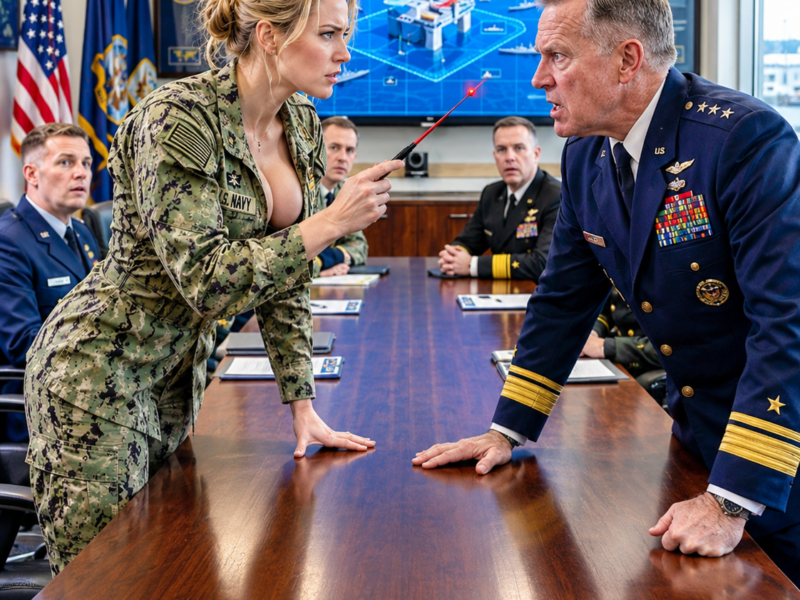
“I was publicly ordered to leave a classified Navy briefing and fetch coffee by a two-star admiral who called me ‘sweetheart’
The name the hostage whispered next was almost lost beneath the static.
“Sterling.”
Nobody in the operations center moved.
I stared at the communications console, waiting for the man to repeat himself.
“Say that again,” I ordered.
A burst of interference crackled through the speakers.
Then the voice returned.
“Admiral… Richard Sterling. He’s the one who gave them the coordinates.”
Across the room, Sterling’s chair scraped against the floor.
“That’s absurd,” he snapped. “This is an enemy deception. They’re trying to fracture our command structure.”
I didn’t look at him.
“Marker One, this is Asbury. Repeat your current status.”
The operator answered immediately.
“Two hundred feet below the holding area. We have visual confirmation of two hostages. No visual on the third. We have approximately four minutes before the enemy patrol reaches our position.”
“Hold your position.”
“Ma’am, we’re exposed.”
“I understand. Hold.”
I turned toward the intelligence officer.
“Get me the original transmission package for the extraction coordinates. Every version, every access log, every person who opened the file.”
The officer began typing.
Sterling stepped closer.
“Admiral Hayes, you’re allowing an unverified prisoner to interfere with an active military operation.”
I finally faced him.
“And you’re unusually concerned about a transmission that hasn’t even been authenticated.”
His jaw tightened.
“Watch your accusations.”
“I haven’t accused you of anything yet.”
Secretary Kessler, who had remained at the rear of the command center, approached the console.
“Evelyn, what’s happening?”
“Someone may have compromised our mission. I need to know whether the warning is real before I move those operators.”
Kessler looked toward the communications technician.
“Can we authenticate the source?”
The technician shook his head.
“Not yet, sir. The signal is coming from an encrypted American field radio, but we’re getting interference from the rig’s internal communications system.”
I leaned over the console.
“Try the secondary authentication protocol. Use the emergency challenge phrase.”
A few seconds passed.
Then the hostage spoke again.
“November… Delta… Seven.”
I closed my eyes briefly.
That was the first half of an authentication sequence assigned to the missing CIA operative.
His name was Daniel Mercer.
Forty-six years old. Twelve years in the Agency. Two previous overseas assignments with Naval Special Warfare.
He wasn’t just another intelligence officer.
He had helped build the intelligence network that made Operation Obsidian Tide possible.
“Ask him for the response phrase,” I said.
The technician relayed the request.
Static.
A breath.
Then three words came through.
“Winter doesn’t forgive.”
I looked at the intelligence officer.
He nodded.
“Authentication confirmed, ma’am. That’s Mercer.”
I turned toward Kessler.
“The warning is genuine.”
Sterling shook his head.
“That proves nothing about me.”
“No,” I replied. “It proves that one of our people believes someone inside this command betrayed them.”
I returned my attention to the mission screen.
“Marker One, listen carefully. Your original extraction corridor is compromised. Do not proceed to the eastern pickup point.”
“Copy. What is the alternate?”
I studied the bathymetric map.
The submarine was still holding position twelve nautical miles from the rig, but the enemy’s awareness of our planned route meant we couldn’t assume the water was safe anymore.
There was one alternative.
A narrow underwater ravine running along the southern side of the structure.
It was deeper, colder, and considerably more difficult to navigate.
It also meant crossing beneath the radar’s blind zone.
“New extraction point is Echo Three. I’ll transmit the coordinates through the secondary encrypted channel.”
The operator paused.
“Ma’am, Echo Three adds nine minutes to our return.”
“Then you’ll have nine more minutes to stay alive.”
“Understood.”
I looked at the technician.
“Send it.”
The coordinates appeared on the tactical display.
For several seconds, everything seemed to settle.
Then the technician’s expression changed.
“Admiral…”
“What?”
“Someone just accessed the new coordinates.”
I looked at him sharply.
“From where?”
He checked the screen again.
“An internal terminal. Building access code indicates this command center.”
The room went silent.
Sterling took another step toward the console.
“That is impossible. The network is isolated.”
“Apparently not,” I said.
The technician opened the access record.
A user credential appeared.
COMMANDER T. GREGSON.
Every head turned.
Gregson stood near the rear wall, his face suddenly pale.
“That’s not possible,” he whispered.
Sterling moved immediately.
“Commander, explain yourself.”
Gregson swallowed.
“Sir, I didn’t access anything.”
The technician shook his head.
“Your credentials authenticated the session.”
“I said I didn’t do it!”
Sterling stepped between Gregson and the console.
“Admiral Hayes, this is becoming a circus. We have an active rescue operation, and you’re conducting a witch hunt.”
I studied him.
Then I noticed something.
Gregson wasn’t looking at Sterling.
He was staring at the admiral’s right hand.
Sterling had been holding a small black access device.
A security token.
The same kind used to authorize restricted operational files.
I looked at the technician.
“Can you identify the physical device used for that authentication?”
“Working on it.”
Sterling closed his hand around the token.
“Enough. This briefing is over.”
He turned toward the exit.
“Admiral Sterling,” I said.
He stopped.
“Where are you going?”
“To make a call.”
“Nobody leaves this room until we establish whether our communications have been compromised.”
His shoulders stiffened.
“I am a flag officer in the United States Navy.”
“And I am the operational commander responsible for the lives currently hanging beneath that oil rig.”
I gestured to the two Marine guards.
“Secure the exits.”
They moved immediately.
Sterling stared at them.
“This is outrageous.”
I turned back to the technician.
“Continue.”
A few seconds later, he spoke.
“Admiral, we have a match.”
He enlarged the access record.
“The credential belonged to Commander Gregson, but the physical security token was assigned to Admiral Sterling.”
Kessler stepped closer.
“Are you certain?”
“Yes, sir. The token serial number is registered to Admiral Sterling’s command account.”
Gregson looked at his superior.
His expression had changed.
It wasn’t just fear anymore.
It was recognition.
“Sir,” he said quietly.
Sterling turned.
“Not one word, Commander.”
Gregson’s lips trembled.
“You told me it was just a routine intelligence exchange.”
Sterling’s face became motionless.
I felt the room shift.
“What intelligence exchange?” I asked.
Gregson looked at me, then at Kessler.
“Three weeks ago, Admiral Sterling asked me to prepare a classified briefing package containing the original rescue coordinates, estimated force composition, and proposed insertion route.”
Sterling’s voice became dangerously quiet.
“Think very carefully about what you’re saying.”
Gregson swallowed.
“He told me it was being sent to an allied maritime security liaison. He said it was approved at the highest level.”
“Did you verify the recipient?”
“No, ma’am.”
“Why not?”
“Because it came from the admiral.”
I looked at Sterling.
“Who received the package?”
He didn’t answer.
Kessler’s expression hardened.
“Richard, I strongly recommend you start explaining.”
Sterling laughed once.
It was a dry, ugly sound.
“You people have no idea what you’re dealing with.”
“Then enlighten us,” I said.
He looked at the tactical display.
The operators were still beneath the rig.
Twenty-four men were depending on us to make the right decisions.
Three Americans were waiting for rescue.
And one of our own officers might have delivered their lives into enemy hands.
Sterling finally spoke.
“The intelligence exchange was intended to protect American interests.”
“By giving hostile forces our operational coordinates?”
“You don’t understand the larger picture.”
“Then explain it.”
He glanced at the Secretary.
“Three months ago, we received intelligence suggesting that the militia holding those CIA personnel was connected to a regional network supported by a foreign intelligence service. We had an opportunity to identify the network’s leadership.”
I felt my stomach tighten.
“You used three American operatives as bait.”
“Not intentionally.”
“Then what was the plan?”
He hesitated.
“An intermediary promised access to the network. In exchange, he wanted evidence that the United States was preparing a maritime intervention.”
Kessler stared at him.
“You gave foreign intelligence our military planning?”
“I gave them a preliminary package. It wasn’t supposed to contain the final assault details.”
I glanced at the technician.
“Was the final package transmitted?”
He nodded slowly.
“Yes, ma’am. The original file was accessed and exported four days ago.”
Sterling’s face lost color.
Four days ago.
The same day our satellite intelligence had become outdated.
The same day the enemy had apparently prepared for our arrival.
I understood then.
The outdated intelligence wasn’t simply a mistake.
Someone had made sure we were looking at an old picture while the enemy prepared a new battlefield.
“Who was the intermediary?” I asked.
Sterling looked toward the floor.
“I don’t know.”
“That’s not an answer.”
“I was dealing with someone who called himself Bishop.”
The name meant nothing to me.
But it meant something to Gregson.
He closed his eyes.
“Sir…”
Sterling snapped.
“Shut up.”
Gregson’s voice cracked.
“Bishop wasn’t an allied liaison.”
I turned toward him.
“Who was he?”
Gregson swallowed.
“He was a private intelligence broker. He approached the admiral through a retired defense contractor. I handled the correspondence.”
Kessler rubbed his forehead.
“How much information was transferred?”
Gregson looked ashamed.
“Everything in the briefing package.”
I looked back at the screen.
The mission was no longer simply a rescue.
It was a race against a betrayal that had already reached the enemy.
“Marker One, report.”
The operator answered immediately.
“Ma’am, we’ve reached the underside of the target deck. We have two hostages secured. Third package remains unaccounted for.”
“Do you have a possible location?”
“Negative. We found evidence of recent movement through an access corridor leading to the upper maintenance level.”
“Any enemy activity?”
“Multiple armed personnel moving toward the holding area.”
I looked at the tactical map.
“Can you reach the maintenance level?”
A pause.
“Possible. But we would have to split the element.”
I considered the risk.
Splitting the team would reduce our ability to defend the hostages during extraction.
But leaving Mercer behind wasn’t an option.
“Negative on splitting the element. Secure the two hostages and prepare to move. I want eyes on that maintenance corridor before you commit.”
“Understood.”
I looked at the drone operator.
“Can you give me a thermal sweep of the upper level?”
“Trying now.”
The screen shifted.
The oil rig appeared in ghostly shades of gray and white.
Several heat signatures moved around the upper decks.
Then one stood out.
A single figure was separated from the others.
He was sitting against a metal wall.
His hands were bound.
His head was tilted forward.
“Zoom in.”
The image sharpened.
The figure raised his face.
Daniel Mercer.
Alive.
“Marker One, I have visual confirmation of Mercer on the upper maintenance level.”
“Copy. Can you confirm condition?”
I watched the image.
Mercer lifted his head again.
He was holding something in his right hand.
A small metallic object.
Then he looked directly toward the drone.
And raised two fingers.
I recognized the signal.
It wasn’t a request for rescue.
It was a warning.
“He’s signaling an explosive threat,” I said.
The weapons specialist moved closer.
“Ma’am, there are several heat signatures surrounding him.”
“Look beneath the maintenance platform.”
The drone operator adjusted the angle.
A second image appeared.
The maintenance level was connected to a lower support structure by a narrow steel staircase.
Along the staircase were several small heat signatures.
Too regular to be human.
Explosive devices.
“He’s been placed near a secondary demolition system,” the specialist said.
“Can you identify the trigger?”
“Not from this angle.”
I leaned closer.
Mercer shifted his right hand.
He was tapping the metal object against the wall.
Three times.
Pause.
Three times again.
Then once.
I knew the pattern.
It was an old field signal.
The number seven.
I opened the mission file.
Mercer had been carrying an emergency transmitter during his assignment.
Its activation sequence required a manual reset.
Seven seconds.
He was telling us the device had a delayed trigger.
“Marker One, do you have access to the upper maintenance level without crossing the staircase?”
“Negative. Only route is through the central ladder.”
I studied the structure.
There was another possibility.
The old oil rig had a ventilation shaft running along its northern support column.
It wasn’t marked on the latest satellite imagery.
But it appeared in an engineering schematic buried in the original construction records.
I pulled up the file.
“Technical team, confirm the northern ventilation shaft.”
A young lieutenant began searching.
“Found it, ma’am. It’s approximately thirty inches wide and runs from the lower machinery compartment to the maintenance deck.”
“Can an operator fit through?”
The weapons specialist considered it.
“Without full equipment, possibly.”
I looked at the mission commander.
“Can one man reach Mercer through that shaft?”
“Yes, ma’am. But he’d have to go alone.”
“Then send your most experienced operator.”
There was a pause.
“Understood.”
I didn’t like sending one man into an unfamiliar confined space.
But I liked leaving Mercer beside a demolition system even less.
“Tell him to keep his weapon secured until he’s clear of the shaft. No unnecessary movement. No heroics.”
“Copy.”
The next six minutes felt longer than the previous two hours.
On the screen, one heat signature separated from the group.
It moved toward the northern support column.
Then disappeared.
“Operator entering the shaft,” the technician reported.
Sterling had stopped speaking.
He was watching everything now.
I couldn’t tell whether he was horrified by the danger or simply beginning to understand the consequences of his actions.
“Marker One, status.”
“Operator is halfway up. No contact with hostiles.”
Another minute passed.
Then the radio crackled.
“Visual on Mercer.”
The operator’s voice was barely audible.
“He’s conscious. Appears injured. I have a possible trigger device attached to the railing.”
I gripped the edge of the console.
“Can you safely extract him?”
“Working.”
The screen showed a brief movement near the maintenance deck.
Then the operator’s voice returned.
“Mercer is moving. I have him.”
“Excellent. Prepare to return to the team.”
A sudden burst of gunfire interrupted the transmission.
The technician looked up.
“Multiple hostile signatures converging on the maintenance level.”
“Marker One, report!”
Static.
Then a voice.
“Contact! Contact! We have incoming fire!”
The operations center erupted into movement.
I stepped toward the primary console.
“All elements, hold your extraction route. Do not engage beyond what is necessary to protect the packages.”
The radio crackled.
“One operator hit. Mobile. Mercer is with us. We’re moving toward the eastern drop point.”
I looked at the map.
The original eastern route was compromised.
The southern ravine was our only safe option.
But the militia had begun moving toward the eastern side.
They were anticipating our original extraction.
“Marker One, divert to Echo Three immediately.”
“Copy. Echo Three.”
The drone operator suddenly called out.
“Admiral, we’ve got another problem.”
“What now?”
“Hostile vessel departing the northern side of the rig. Fast-moving skiff. Appears to be heading toward the southern ravine.”
I looked at the screen.
A small vessel was moving through the water.
Its navigation lights were off.
It was heading directly toward our alternate extraction corridor.
“They know we’re changing routes,” I said.
Kessler moved closer.
“Can the submarine intervene?”
“Not without risking detection.”
I studied the vessel’s movement.
It wasn’t heading toward the rig.
It was positioning itself between the oil platform and the deeper water.
They weren’t trying to fight our team.
They were trying to cut off the only remaining route home.
I turned toward the communications technician.
“Can you establish a direct encrypted channel with the USS Texas?”
“Yes, ma’am.”
“Put the captain through.”
A few seconds later, a calm male voice came over the speaker.
“Texas, Captain Morgan.”
“Captain, this is Hayes. I need your assessment of the southern approach.”
“Acoustic picture is deteriorating. We have a surface vessel moving above our planned corridor.”
“Can you reposition?”
“Affirmative, but it’ll take time.”
“How much?”
“Seven minutes.”
I looked at the mission clock.
Our operators had approximately three minutes before the enemy reached their position.
“Can you launch a decoy?”
“Yes, ma’am. But it may reveal our general location.”
“Do it. Draw that vessel away from the southern ravine.”
“Understood.”
The submarine launched a small acoustic decoy.
On the surface, the hostile skiff changed course.
It turned toward the false signature.
The Texas began moving.
I watched the tactical markers.
One minute.
Two.
Three.
Then the mission commander came over the radio.
“Marker One to Asbury. We’re at the drop point. Preparing water entry.”
“Texas, confirm extraction readiness.”
“Ready, Admiral.”
“Bring them home.”
The thermal image showed several figures appearing at the eastern edge of the rig.
Then they disappeared over the railing.
One by one, they entered the water.
“First package in the water.”
“Second package in the water.”
“Third package…”
The radio went silent.
I stared at the display.
“Marker One, confirm third package.”
Static.
Then a voice.
“All packages in the water. One operator injured. Mercer is conscious. Moving toward the Texas.”
I released a breath I hadn’t realized I was holding.
“Copy. Continue extraction.”
The mission clock reached 03:04.
The operators had been on the rig for less than two minutes.
But those two minutes had nearly cost us everything.
“Texas confirms all personnel aboard,” the captain reported.
The room erupted in applause.
Someone shouted.
Another technician slapped a colleague on the shoulder.
I remained at the console.
“Medical status?”
“Three hostages alive. One operator wounded. All personnel accounted for.”
“Any fatalities?”
“None, ma’am.”
I closed my eyes for a moment.
Then I removed my headset.
“Secure the operational feed. Preserve every transmission and access log. Nobody deletes anything.”
Kessler approached.
“Excellent work, Evelyn.”
“Thank you, sir.”
He glanced toward Sterling.
The admiral stood beside the rear console.
His face was pale.
His hands were trembling slightly.
“Richard,” Kessler said.
Sterling looked up.
“I can explain.”
“Not here.”
“Mr. Secretary, I was trying to secure intelligence access. I never intended for American personnel to be harmed.”
Kessler’s expression remained cold.
“Three American citizens were captured. Twenty-four operators were nearly killed. You compromised a classified mission and concealed the breach.”
“I didn’t know they would execute the hostages.”
I stepped closer.
“Did you know the enemy had the coordinates?”
Sterling looked at me.
For the first time since I had entered the briefing room, he seemed unable to find a response.
“Did you know?” I repeated.
He lowered his eyes.
“I suspected.”
The words were barely audible.
Kessler turned toward the two Marine guards.
“Admiral Sterling is relieved of operational duties pending a formal investigation. Secure his communications devices and restrict his access to classified systems.”
Sterling looked up sharply.
“You can’t do this.”
“I can, and I am.”
He turned toward Gregson.
“And Commander Gregson?”
Gregson stood rigidly.
“I’ll cooperate fully, sir.”
Kessler nodded.
“That would be wise.”
Sterling looked at me one last time.
There was anger in his eyes, but it was mixed with something else.
Fear, perhaps.
Or the realization that the men and women he had treated as pieces on a chessboard had nearly paid for his ambition with their lives.
“Admiral Hayes,” he said.
I waited.
“I didn’t think it would go this far.”
I looked at him for a long moment.
“Neither did the three Americans sitting in that holding room.”
He had no answer.
The Marines escorted him out.
I watched the door close, then turned back toward the medical report.
There were still people who needed us.
And I had no intention of making the mistake of thinking the mission was over simply because the extraction was complete.
By sunrise, the three CIA operatives had been transferred to a secure medical facility in San Diego.
Daniel Mercer was the last one I visited.
He was lying in a hospital bed with a bandage around his forehead and an IV in his arm.
His face was bruised.
His right wrist was swollen.
But when he saw me enter, he managed a tired smile.
“Admiral Hayes.”
“Daniel.”
He tried to sit up.
“Don’t,” I said. “You’ve done enough moving for one night.”
He laughed weakly.
“Your team has an interesting way of arriving at a party.”
“They’re not known for being subtle once they get inside.”
He looked toward the window.
For a few seconds, neither of us spoke.
Then he reached toward the bedside table.
There was a small plastic evidence bag containing a damaged flash drive.
“That’s why they kept me upstairs,” he said.
I picked it up.
“What is it?”
“Copies of the original intelligence exchange. I managed to download them before they captured me.”
“Why didn’t you destroy it?”
“Because I thought somebody might need proof.”
He looked directly at me.
“Sterling wasn’t working alone.”
I felt my shoulders stiffen.
“Who else?”
“His intermediary. The man he called Bishop.”
“Do you know his real name?”
Mercer shook his head.
“Not for certain. But I saw his face during a meeting three days before we were taken. He was wearing a civilian contractor badge.”
“What company?”
“Northstar Maritime Solutions.”
I recognized the name.
Northstar was a defense contractor with several active Navy logistics agreements.
It had recently received a substantial contract involving maritime surveillance systems.
I looked down at the evidence bag.
“Did Sterling know who Bishop really was?”
“I think he knew enough not to ask.”
I pulled a chair closer to the bed.
“Daniel, I need you to tell me everything you remember.”
He nodded.
Then he began.
The meeting had taken place in a private conference room in Singapore.
Sterling had not been physically present, but he had joined through an encrypted video connection.
Bishop had promised access to a regional intelligence network that could identify the people funding the militia.
In exchange, he wanted early access to the American rescue planning package.
Mercer had discovered the exchange through an intercepted communication.
Before he could report it, his team was compromised.
“They knew our movements before we made them,” he said. “They knew which port we’d use. They knew the names of our local contacts.”
“Did you identify the source?”
“No. But I found a reference to an internal file called Blue Lantern.”
I wrote the name in my notebook.
“What’s Blue Lantern?”
“An intelligence sharing program. At least, that’s what the documents called it.”
“Was it legitimate?”
He shook his head.
“Not the version I saw.”
I looked at the damaged drive.
“Thank you, Daniel.”
He caught my sleeve before I stood.
“Admiral.”
I turned.
“Those men who came for us… they didn’t hesitate. Even when they knew they were walking into a trap.”
I nodded.
“They knew the risks.”
“I want you to tell them something.”
“What?”
“Thank you.”
I gave his hand a brief squeeze.
“I will.”
The investigation lasted six weeks.
What began as an inquiry into one compromised operation became a much larger examination of classified intelligence transfers, contractor relationships, and unauthorized access to military planning systems.
The evidence from Mercer’s flash drive proved authentic.
Investigators traced the Blue Lantern program to a small group of contractors who had been selling operational information to foreign intelligence brokers.
Northstar Maritime Solutions had been the primary conduit.
Bishop was eventually identified as a former intelligence contractor named Malcolm Voss.
He had built a network of intermediaries who offered seemingly legitimate intelligence-sharing opportunities to senior officials.
Sterling had accepted access to information he believed would advance his position and strengthen his political influence.
He had convinced himself that he was making a calculated trade.
But the people on the other side of the transaction had never intended to honor their promises.
They wanted American operational data.
And Sterling had given it to them.
Commander Gregson’s testimony helped investigators reconstruct the communications chain.
He admitted that he had prepared several intelligence packages without verifying their recipients.
He also revealed that Sterling had repeatedly instructed him to keep certain exchanges off the normal reporting system.
Gregson was not cleared of responsibility.
He lost his command position and faced a formal reprimand for his role in the unauthorized transfers.
But his cooperation helped expose the larger network.
Sterling’s career ended in a closed hearing.
He was relieved of command, stripped of access to sensitive operational assignments, and ultimately retired under the weight of the investigation.
The Navy referred the evidence of his conduct for further legal review.
I never attended the hearing.
I had no interest in watching a man’s career collapse.
What mattered was that the truth had been established.
And that the three people we had gone to retrieve were alive.
Two months after Operation Obsidian Tide, I returned to Coronado.
The fog was rolling in from the Pacific again.
I stood near the waterfront with my leather notebook tucked under one arm.
A group of young sailors were running along the path.
Their boots struck the pavement in uneven rhythm.
One of them slowed when he recognized the Trident on my uniform.
“Good morning, Admiral.”
“Morning.”
He hesitated.
“Ma’am, can I ask you something?”
“Go ahead.”
“Is it true you were the one who planned Obsidian Tide?”
I looked toward the water.
“Yes.”
He seemed surprised that I had answered so simply.
“My instructor said the operation changed how the Navy approaches maritime rescues.”
“It changed a few things.”
He nodded.
Then his eyes moved to the gold insignia on my chest.
“Ma’am, can I ask one more thing?”
“Sure.”
“How did you get people to listen to you when they didn’t believe you belonged in the room?”
I considered the question.
There was a time when I might have answered with something about rank, authority, or proving people wrong.
But I had learned something more useful over the years.
“Sometimes they won’t listen,” I said. “You do the work anyway. You make sure the people depending on you have a chance to come home.”
He nodded slowly.
“Yes, ma’am.”
Then he returned to his run.
I watched him disappear into the morning fog.
My thermos was sitting on the concrete wall beside me.
The coffee had gone cold.
I opened my notebook and turned to the page where I had written the original mission coordinates.
Beneath them was a small note I’d made after the operation.
Twenty-four operators.
Three hostages.
Zero lives lost.
I ran my thumb over the ink.
For fifteen years, I had worked in places where nobody knew my name.
I had never needed recognition.
I had never needed a room full of admirals to understand what I could do.
But I had learned that silence and humility were not the same as allowing someone else’s arrogance to endanger the people under your command.
I closed the notebook.
The Pacific stretched out in front of me, dark blue beneath the morning light.
Somewhere beneath that water, the USS Texas was moving through another quiet patrol.
And somewhere, twenty-four operators were sleeping in their own beds.
That was the part of the job I cared about.
Not the stars on my collar.
Not the applause in the command center.
Not the admiral who had once mistaken me for a secretary.
Just the simple fact that when the sun came up, the people I had sent into the darkness had come home.
I picked up my thermos and walked toward the base.
The fog began to lift behind me.
The End.









