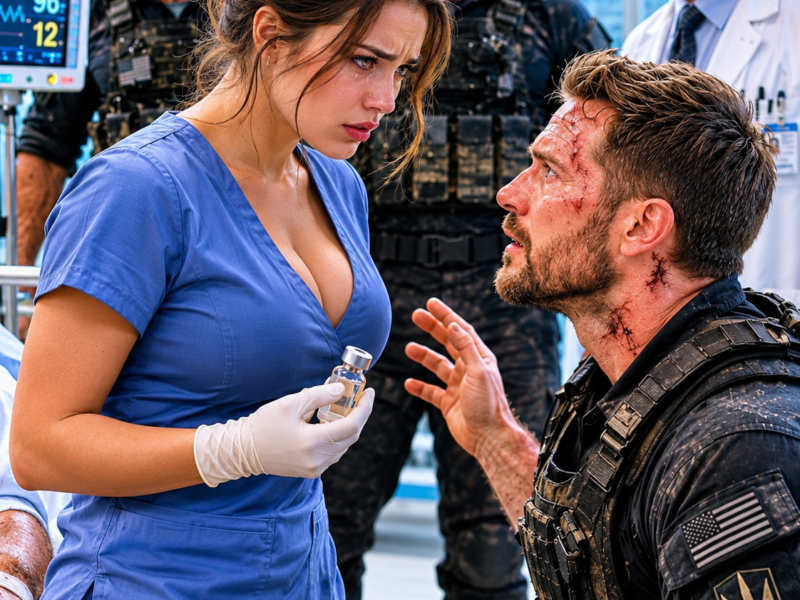
“I was ordered to stop treating the wounded Navy SEAL because the commanding officer said his injuries made him a lost cause
The signature at the bottom of the report was mine.
Or at least, someone had made it look like mine.
I stared at the paper while the security officer waited beside the door.
The report stated that I had personally received Daniel Hayes’s belongings at 1:26 a.m., including a small encrypted storage device, and voluntarily transferred it to an unidentified military official.
I had done neither.
“That’s not my signature,” I said.
The officer, a middle-aged man named Sergeant Lewis, glanced down at the document.
“It looks pretty close.”
“It isn’t close. I was treating the patient at 1:26. Check the medical records.”
He didn’t answer immediately.
“Ma’am, I need you to come with me.”
“Where?”
“Administrative security.”
I looked toward Daniel’s bed.
The surgical team was preparing to move him upstairs, and Dr. Miller was checking the ultrasound results one more time.
“He’s about to go into surgery.”
“Another nurse is taking over.”
“I need to tell Dr. Miller what happened.”
Sergeant Lewis lowered his voice.
“Please don’t make this harder than it needs to be.”
I wanted to argue, but Daniel’s monitor suddenly began alarming again.
Dr. Miller turned toward me.
“Emily, I need you here.”
The security officer hesitated.
I stepped away from him and returned to Daniel’s bedside.
“His oxygen is dropping,” I said.
Dr. Miller checked the monitor.
“Get anesthesia down here. Now.”
As I adjusted Daniel’s oxygen mask, I noticed something else.
His left hand was curled tightly against his palm.
There was a small smear of blood near his thumb.
I gently opened his fingers.
A torn piece of black plastic was wedged beneath them.
It was no bigger than a fingernail.
On one side were three tiny silver letters.
E.C.
My initials.
I looked at Daniel’s face.
For a moment, I wondered whether he had somehow recognized my name before losing consciousness.
Then the surgical team wheeled him out.
I followed until the operating room doors closed.
Dr. Miller turned to me.
“Emily, what did you find?”
I showed him the plastic.
He studied it carefully.
“Where did this come from?”
“His hand.”
He looked toward the hallway.
“Don’t give that to anyone until we understand what we’re dealing with.”
I swallowed.
“Doctor, what do you think is happening?”
He rubbed his forehead.
“I think somebody is very interested in what that man brought back from his last mission.”
“And the report?”
“I think somebody wants you to look responsible for losing it.”
Before I could respond, Sergeant Lewis appeared again.
This time, he wasn’t alone.
Two men in civilian clothes stood behind him.
The taller one held up an identification card.
“Emily Carter?”
“Yes.”
“My name is Daniel Price. Naval Criminal Investigative Service.”
He showed me the badge again.
“We need to speak with you about Commander Mitchell.”
Dr. Miller crossed his arms.
“She’s working a medical emergency.”
Price nodded.
“Then I’ll keep this brief.”
He looked at the small piece of plastic in my hand.
“Where did you get that?”
“From the patient’s hand.”
His expression changed.
“Give it to me.”
I hesitated.
“Why?”
“Because it may be evidence in an ongoing investigation.”
“Then why does the report say I handed over the entire device?”
Price exchanged a glance with his partner.
“Because somebody filed that report before the evidence was officially logged.”
The hallway seemed to grow quieter.
“Who?”
He didn’t answer.
Instead, he asked me something I wasn’t expecting.
“Did Daniel Hayes say anything to you before he lost consciousness?”
I remembered his fingers tightening around my wrist.
“Don’t let them take the drive.”
Price closed his eyes for a second.
“That’s what I was afraid of.”
I felt my stomach tighten.
“What does that mean?”
He glanced toward the operating room doors.
“It means Commander Mitchell isn’t supposed to be anywhere near this hospital.”
I stared at him.
“He’s the commanding officer of the team.”
“Not anymore.”
Price took a breath.
“Commander Mitchell was relieved of operational authority six weeks ago. He’s currently under investigation for unauthorized access to classified mission records.”
I thought about the way he had stood over Daniel’s bed.
The way he had ordered the doctors to stop treatment.
The way he had reacted when Daniel mentioned the drive.
“Then why is he here?”
“That’s what we’re trying to establish.”
Price asked me to come to a small security office.
Dr. Miller objected, but I told him I would only be gone for a few minutes.
Before leaving, I looked through the glass toward the operating room.
The red light above the doors was still on.
Daniel was fighting for his life.
And somewhere in the hospital, a man who had tried to stop his surgery was walking freely through the corridors.
The security office was cold and smelled faintly of burnt coffee.
Price placed three photographs on the table.
The first showed Daniel Hayes in military uniform.
The second showed Commander Mitchell standing beside a group of men outside a building.
The third showed a small black storage device.
“That device was recovered from a mission overseas,” Price explained. “It contains records that could expose a serious security breach.”
“Then why did Daniel bring it here?”
“Because he believed somebody inside the command structure was selling information.”
I looked at the second photograph.
“Commander Mitchell?”
Price didn’t confirm it.
He didn’t have to.
“Three weeks ago, Daniel contacted an investigator outside his chain of command. He said he had evidence that someone had been leaking mission details.”
“Did he identify the person?”
“No.”
“Why not?”
“Because the last time he tried to report the problem, two members of his team were sent into an operation using information that had already been compromised.”
I remembered the three injured SEALs in the neighboring room.
“Those men?”
“Yes.”
Price leaned forward.
“Daniel believed the leak was responsible for what happened to them.”
I stared at the photographs.
“Then the injuries tonight weren’t an accident.”
“We don’t know that yet.”
He slid another page across the table.
It showed a timeline of the team’s movements before the incident.
Several locations had been blacked out.
One entry had been highlighted.
A message sent from an internal military account at 11:42 p.m.
The message read:
TARGET PACKAGE RECOVERED. TEAM RETURNING WITH DEVICE.
“Who sent this?” I asked.
“We’re still tracing it.”
“Was it sent before the team was attacked?”
Price nodded.
I felt a chill move down my arms.
“Someone knew what they had.”
“Someone knew what they were carrying,” he corrected.
I thought about the commander standing beside Daniel’s bed.
Then I remembered something.
“Daniel had a wedding ring on a chain.”
Price looked up.
“His wife died two years ago.”
I looked down at the photograph again.
“Why would he be wearing it like that?”
“Because he never takes it off.”
For the first time, Price’s voice softened.
“He told his teammates that it reminded him there was still something worth coming home for.”
I looked away.
I had seen that ring rise and fall against his chest while he struggled to breathe.
I hadn’t known what it meant.
Now I couldn’t stop thinking about it.
Price gathered the photographs.
“Emily, I need you to understand something. If somebody has already forged your signature, they may be trying to make you the person responsible for losing that device.”
“Why me?”
“Because you’re new. You have limited authority, limited connections, and no reason for anyone to believe you over a senior officer.”
I thought about the seven months I had spent trying to prove I deserved my position.
The extra shifts.
The missed family dinners.
The nights I had gone home wondering whether I was good enough.
Someone had apparently decided that made me an easy person to sacrifice.
“Am I allowed to go back to my patient?”
Price nodded.
“Yes. But don’t speak to Commander Mitchell alone.”
When I returned to the trauma area, the three injured SEALs were awake.
One had his arm in a sling.
Another had stitches running across his forehead.
The third, a broad man with a bruised jaw, sat upright in his bed despite the nurse repeatedly telling him to rest.
His name was Marcus Reed.
“You’re the nurse who was with Hayes?” he asked.
I nodded.
“How is he?”
“Still in surgery.”
Marcus looked down at his hands.
“He’s stubborn. He’ll make it.”
I wanted to believe him.
“Can I ask you something?”
He looked up.
“Anything.”
“Was tonight really a training accident?”
His expression changed.
The man in the next bed stopped moving.
Marcus glanced toward the doorway before answering.
“No.”
“What happened?”
He took a breath.
“We were sent to recover a source. The intelligence said the location was secure.”
“And it wasn’t?”
“It was an ambush.”
I lowered my voice.
“Did Daniel know someone was leaking information?”
Marcus stared at me.
“Who told you that?”
“An investigator.”
He leaned back against the pillow.
“Daniel had been trying to find out who was giving away our movements. He didn’t trust anyone anymore.”
“Not even Commander Mitchell?”
Marcus let out a bitter laugh.
“Especially Commander Mitchell.”
The nurse’s station phone rang.
A nurse answered, listened, and looked toward me.
“Emily, security needs you.”
I turned back to Marcus.
“Do you know what was on the drive?”
He hesitated.
“Not everything.”
“Anything?”
He looked directly at me.
“Names. Dates. Transfers. People who were supposed to be dead.”
I frowned.
“People who were supposed to be dead?”
Marcus nodded slowly.
“Some of the mission reports didn’t match what actually happened. Men listed as killed in action had apparently been seen months later. Others were declared missing, but their families were told something different.”
My mouth went dry.
“Are you saying someone falsified casualty reports?”
“I’m saying Daniel found something that shouldn’t exist.”
Before I could ask more, the nurse called my name again.
I stepped into the hallway.
Commander Mitchell was standing beside the elevators.
He looked calm.
Almost bored.
“Nurse Carter.”
I stopped.
“Commander.”
“I hear you’ve been talking to investigators.”
“That’s correct.”
His eyes moved briefly to my hands.
“Be careful who you trust. People investigating military matters don’t always understand what they’re looking at.”
“Neither do people who order doctors to abandon patients.”
His expression hardened.
“You have no idea what you’re involved in.”
“Then explain it.”
He stepped closer.
“That man in surgery is dangerous. He’s confused, compromised, and carrying information that could put American lives at risk.”
“Then why did you try to stop his surgery?”
For the first time, I saw something shift behind his eyes.
Not anger.
Fear.
He glanced toward the operating room.
Then he leaned close enough that I could smell the coffee on his breath.
“Because if Hayes wakes up, people are going to die.”
I held his gaze.
“Maybe you should be worried about the people who already have.”
He straightened.
“You’re making a serious mistake.”
Then the elevator doors opened, and he walked inside.
I stood there until the doors closed.
A few minutes later, Dr. Miller came out of surgery.
His surgical cap was damp, and there was a crease between his eyebrows.
“He’s alive,” he said.
I let out a breath I hadn’t realized I was holding.
“Is he stable?”
“For now. We found internal bleeding and a complication near his chest that was causing his oxygen levels to deteriorate. We controlled it.”
“Can he wake up?”
“Possibly. But the next twelve hours matter.”
I nodded.
“Can I check on him?”
Dr. Miller smiled faintly.
“You’ve earned that much.”
Daniel was in intensive care.
Machines surrounded his bed, and a ventilator moved air into his lungs.
His face looked pale beneath the overhead lights.
The wedding ring chain rested against the hospital gown.
I pulled a chair beside him.
“You’re going to have to explain a lot when you wake up,” I whispered.
I checked his IV line.
Then I noticed something tucked beneath the edge of his pillow.
A folded piece of paper.
I looked toward the doorway.
Nobody was there.
I carefully pulled it out.
It was a small photograph.
Four men stood together in front of a military vehicle.
Daniel was on the left.
Marcus was next to him.
The other two men were unfamiliar.
On the back, someone had written a date and a short sentence.
WE DIDN’T LEAVE HIM THERE.
I read it twice.
Then I noticed the fourth man.
His face had been circled in black ink.
It was Commander Mitchell.
I turned the photograph over again.
The date was from almost three years earlier.
That was before Daniel’s wife had died.
Before the current investigation.
Before the ambush.
I was still studying it when Daniel’s fingers moved.
His eyes opened slightly.
I leaned toward him.
“Daniel?”
His gaze shifted toward the photograph.
He tried to speak, but the ventilator prevented it.
I touched his hand.
“Don’t try. You’re safe.”
He shook his head weakly.
Then his eyes moved toward the door.
I followed his gaze.
Commander Mitchell was standing outside the glass.
Watching us.
Daniel’s fingers tightened around mine.
A tear slipped from the corner of his eye.
He moved his lips.
I leaned closer.
It took several attempts before I understood the words.
“Not… Mitchell.”
I looked at him.
“What?”
He struggled to breathe.
“His… son.”
Then his eyes closed again.
I stood there, trying to understand.
His son?
I remembered the photograph.
I remembered Price’s warning.
And suddenly, I wondered whether we had been looking at the wrong man.
I called Price immediately.
He arrived twenty minutes later with his partner.
I showed him the photograph and told him what Daniel had said.
Price studied the circled face.
“Do you recognize this man?”
“No.”
He turned the photograph toward the light.
Then he went very still.
“What?” I asked.
He looked at me.
“This is Lieutenant Aaron Mitchell.”
“Commander Mitchell’s son?”
Price nodded.
“He’s been missing for eleven months.”
I looked back at Daniel.
“Why would Daniel have a picture of him?”
Price carefully placed the photograph into an evidence sleeve.
“Because Aaron was part of the original investigation.”
“What investigation?”
Price didn’t answer immediately.
Instead, he called someone.
A few minutes later, another investigator arrived carrying a thin folder.
Inside were several photographs, copies of reports, and a military personnel record.
Aaron Mitchell had served in the same unit as Daniel.
He had disappeared during an operation that had officially ended with three casualties.
But there was a problem.
The report listed Aaron among the dead.
His remains had never been recovered.
“Daniel believes Aaron is alive?” I asked.
Price nodded.
“Or he knows what happened to him.”
I thought about the sentence on the back of the photograph.
We didn’t leave him there.
“What does that mean?”
Price looked toward Daniel’s bed.
“That’s what we need him to tell us.”
The next hour passed slowly.
The hospital began to fill with morning staff.
Outside, the sky changed from black to a pale gray.
At 5:38 a.m., Marcus asked to see Daniel.
Dr. Miller initially refused.
Marcus insisted.
“He saved my life twice,” he said. “I need to know he’s still here.”
We eventually allowed him to visit for a few minutes.
He stopped beside the bed and looked down at his friend.
“Come on, Hayes,” he whispered. “You’ve got people waiting.”
Then he noticed the photograph in the evidence sleeve.
His expression changed.
“Where did you get that?”
“Under his pillow,” I answered.
Marcus stared at the circled face.
“That’s Aaron.”
“We know,” Price said.
Marcus looked toward the investigator.
“Then you know Mitchell has been lying.”
Price nodded.
“Tell us what happened.”
Marcus pulled up a chair.
For a long moment, he said nothing.
Then he began.
Three years earlier, Daniel, Marcus, Aaron, and another SEAL named Thomas had been assigned to a mission overseas.
During the operation, their team received intelligence that a hostile group was holding an American informant.
The information was wrong.
The location was already compromised.
Their vehicle was hit, and the team became separated.
Thomas was killed.
Aaron was severely wounded.
Daniel and Marcus managed to get him to temporary shelter.
But the extraction never arrived.
Instead, they received a message ordering them to withdraw and leave the area.
The order had come through Commander Mitchell.
Aaron was still alive.
Daniel refused to leave him.
For nearly two days, the team remained hidden while trying to keep Aaron alive.
Then another message came.
This time, it ordered them to surrender their location and wait for a different extraction team.
Marcus looked down at his hands.
“Daniel thought it was a setup. He said the message sounded wrong.”
“Why?” Price asked.
“Because the commander used a phrase that wasn’t part of our normal communication protocol.”
“What phrase?”
Marcus swallowed.
“Bring the package home. Leave the weight behind.”
I felt my skin prickle.
“That sounds like Aaron was being treated as cargo.”
Marcus nodded.
“Daniel understood it the same way.”
He continued.
Eventually, Daniel and Marcus managed to get Aaron out through a separate route.
But they couldn’t bring him home.
Aaron had been transferred to a medical facility under a false identity after the team discovered that the official extraction channel had been compromised.
The two men had agreed to keep him hidden until they could find someone trustworthy.
Daniel had spent months gathering proof that Aaron was alive and that the original casualty report had been falsified.
The encrypted drive contained copies of the records.
Not just evidence of the mission breach.
Evidence that several people had been using false casualty reports to conceal unauthorized transfers of personnel and classified equipment.
I stared at Marcus.
“Why would anyone do that?”
“Money. Leverage. And because people who officially don’t exist are easy to move around.”
Price closed the folder.
“Do you know where Aaron is now?”
Marcus shook his head.
“Daniel was the only one who had the latest location.”
The room fell silent.
Then Daniel’s monitor changed.
His eyelids moved.
I stepped toward him.
“Daniel? Can you hear me?”
His eyes opened.
He looked at Marcus first.
Then at Price.
Finally, his gaze settled on me.
I leaned closer.
“The drive is missing,” I told him. “But we’re trying to find it.”
His voice was barely audible.
“Not missing.”
Price stepped forward.
“Where is it?”
Daniel looked toward me.
“She has it.”
I stared at him.
“What?”
He moved his hand weakly toward the hospital gown.
“Your… badge.”
I touched the plastic name badge pinned to my uniform.
There was a small crack along the lower edge.
I had noticed it earlier but assumed it had broken during the chaos.
I turned it over.
Behind the plastic backing was a tiny memory card.
My hands began to shake.
Daniel gave the faintest nod.
“Didn’t trust… anyone else.”
I looked at him.
“You hid it in my badge?”
He closed his eyes briefly.
“Only person… who didn’t know.”
I sat down slowly.
For the first time since the ambulances arrived, I understood why he had grabbed my wrist.
He hadn’t been asking me to protect a mysterious object.
He had been asking me to protect the evidence.
And because I knew nothing about it, I had been the one person he could trust.
Price took the memory card into custody after documenting its location and confirming that I had not accessed it.
He immediately contacted his team.
The first files were reviewed under controlled conditions.
They included mission logs, altered casualty reports, and records of unauthorized transfers.
One name appeared repeatedly.
Aaron Mitchell.
Another appeared beside it.
Robert Mitchell.
But the evidence also showed something unexpected.
Commander Mitchell had not personally ordered the ambush that injured Daniel’s team.
He had been trying to recover the drive because his son was still alive, and the information on it could expose his role in helping Aaron disappear.
That didn’t make him innocent.
It made the situation more complicated.
Price explained that Mitchell had originally helped Daniel get Aaron out after discovering the operation had been compromised.
But later, he had used his position to conceal the truth, hoping to protect his son from prosecution and himself from the consequences of falsifying military records.
When Daniel refused to hand over the evidence, Mitchell panicked.
He tried to stop the surgery because he feared Daniel would identify him and expose everything.
But the man who had arranged the ambush was someone else.
A senior intelligence contractor whose name appeared in the recovered files.
Price’s team located him before noon.
Commander Mitchell was detained for questioning.
He didn’t resist.
As he passed the ICU, he stopped outside Daniel’s room.
Through the glass, he looked at the man whose life he had tried to place below his own fear.
For a few seconds, neither spoke.
Then Mitchell lowered his head.
I didn’t know whether it was regret or simply exhaustion.
Maybe it was both.
Daniel survived the next twelve hours.
Then the next day.
His recovery was slow, painful, and full of setbacks.
But he made it.
Two weeks later, he was sitting in a rehabilitation chair when I brought him a cup of coffee.
He looked thinner, and his movements were careful.
But his eyes were clear.
“You’re still here,” he said.
“Unfortunately for you, yes.”
He smiled.
It was the first time I had seen him do it.
“Thank you, Emily.”
I placed the coffee on the table.
“You don’t owe me anything.”
He looked down at the ring hanging from his neck.
“That’s not true.”
He told me that his wife, Sarah, had been a nurse.
She had died after a long battle with cancer.
During her final weeks, she had made him promise something.
“If you ever come home,” she had told him, “don’t spend the rest of your life punishing yourself for surviving.”
Daniel had kept the ring because he was still learning how to keep that promise.
I didn’t know what to say.
So I sat beside him.
Sometimes silence is the kindest thing you can offer someone.
A month later, the investigation became public within the limits of what could safely be disclosed.
The contractor was charged with multiple offenses related to the compromised operation and falsified records.
Several military officials faced disciplinary proceedings.
The official casualty records were corrected.
Aaron Mitchell was found alive at a secure medical facility.
He had survived, but his injuries had left him with lasting physical limitations.
When he finally returned to the United States, he met Daniel and Marcus privately.
Commander Mitchell was not present.
Daniel told me later that Aaron had asked him why he had spent so much time trying to bring him home.
Daniel’s answer was simple.
“Because you were still alive.”
I never forgot that sentence.
Neither did the hospital.
The forged report bearing my signature was traced to an administrative account accessed by someone working with the contractor.
My name was formally cleared.
I was offered an opportunity to transfer to a different department, but I stayed in emergency medicine.
Not because I wanted to prove anything to the people who had doubted me.
I stayed because I had learned that a person’s life should never become less valuable because someone powerful has decided they are inconvenient.
Six months after that night, I received a small envelope at the nurses’ station.
Inside was a photograph.
Daniel stood between Marcus and Aaron.
All three men were wearing civilian clothes.
They looked tired, older, and a little uncomfortable in front of the camera.
On the back, Daniel had written:
You didn’t know us.
You didn’t owe us anything.
You saved a man anyway.
Beneath that, he had added one more sentence.
“Sarah would have liked you.”
I kept the photograph in my locker.
Not because it reminded me of a dramatic night or an investigation that made the news.
It reminded me of a young nurse who had stood beside a hospital bed while a powerful man told her to stop trying.
And it reminded me that the most important decision I made that night wasn’t about the drive, the evidence, or the people hiding behind military titles.
It was about the man whose hand had reached for mine when he had almost nothing left.
I still remember the sunrise that came through the ICU windows.
For the first time in twelve hours, Daniel’s breathing was steady.
The men who had arrived at the hospital as casualties were alive.
The truth had finally found its way into the light.
And somewhere in my locker, beneath my spare stethoscope and a packet of crackers, three men had left me a photograph that I would never throw away.
The end.









