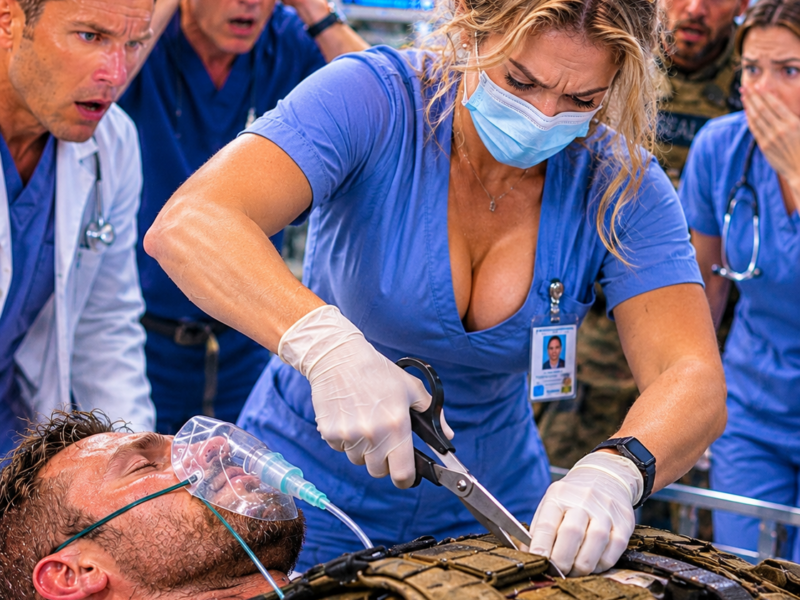
“I was ordered to step away from a dying Navy SEAL because I was ‘just a nurse,’ but when I cut open his blood-soaked tactical vest
“Callaway? As in ATF National Response Team?”
The voice coming through the radio was quieter now.
I took the device from Master Chief Boon.
“Yes. This is Nora Callaway. I need Lieutenant Reyes to stop the cutting operation immediately.”
There was a brief silence.
Then Reyes answered.
“Ma’am, we’ve already got the customs crew positioned. They say the container has been cleared.”
“Who cleared it?”
“Port security.”
“Did they physically inspect both hinges?”
Another pause.
“Negative.”
“Then nobody touches that door.”
Behind me, Dr. Pelham stepped forward.
“This is absurd. You cannot give instructions to a military team from inside my emergency department.”
I ignored him.
“Lieutenant, listen carefully. The first device was mounted at the left hinge. The copper wire I recovered appears to be part of its firing circuit. I believe the right hinge may contain a second charge.”
Reyes breathed into the radio.
“Are you certain?”
“I’m certain enough that I wouldn’t let anyone stand near that door.”
Master Chief Boon moved closer.
“Reyes, you heard her. Pull everyone back.”
“Understood.”
“At least three hundred feet,” I added. “Keep the customs crew behind a substantial barrier. Request the bomb squad. Nobody should approach the container until the specialists arrive.”
Reyes answered immediately.
“Moving now.”
I handed the radio back to Boon.
My fingers were steady.
They hadn’t been this steady in four years.
Dr. Pelham stared at me.
“What exactly did you just do?”
I looked at the damaged vest.
“Possibly saved five more lives.”
He shook his head.
“You are a nurse.”
“Today, that’s what my badge says.”
Tessa stood beside me, her eyes moving between my face and the copper wire.
“Nora, what does ATF National Response Team mean?”
Before I could answer, the emergency department doors opened.
A woman in a dark jacket entered with two federal agents.
She was in her early fifties, with short silver hair and an expression that made people straighten without knowing why.
Her eyes found me immediately.
“Nora Callaway.”
I turned.
“Special Agent Helen Marsh.”
She approached and briefly looked at the vest.
“Tell me you didn’t just find another one.”
“I found a fragment of a firing circuit. The first charge was on the left hinge.”
Marsh examined the evidence bag.
“And the second?”
“Likely on the opposite side. We need to let the bomb squad confirm it.”
She nodded.
Then she looked at the room.
“Who was in charge of this patient’s treatment?”
Dr. Pelham stepped forward.
“I am.”
Marsh looked at him.
“Then I suggest you explain why the nurse you just attempted to remove from this room is the person who recognized an explosive device.”
Pelham opened his mouth.
Nothing came out.
Tessa finally spoke.
“Because he wouldn’t listen.”
Marsh glanced at her.
“That sounds familiar.”
She turned back to me.
“Four years, Nora. Four years without a single word.”
I looked down.
“I wasn’t planning on coming back.”
“I know.”
“Then why are you here?”
Her expression softened.
“Because someone at the port recognized the name on your old incident report. And because the last time you found a secondary charge, it changed the way this country trains its response teams.”
I felt the old pressure return to my chest.
“Please don’t.”
Marsh stopped.
She understood.
Not everything, perhaps, but enough.
She looked toward the recovery corridor.
“Is Mercer stable?”
“He’s going to surgery. The chest tube should be placed immediately.”
“Then let’s make sure he gets there.”
I watched the stretcher disappear through the doors.
Only when it was gone did I realize how tightly I had been gripping the edge of the counter.
Four years earlier, I had stood beside another stretcher.
That one had carried Ben Howell.
And I had never really left that room.
The first time I met Ben, he was eating a cold cheeseburger on the hood of an ATF vehicle.
It was nearly midnight outside a warehouse in Houston.
I was twenty-seven, recently assigned to a national response team, and convinced that everyone around me was more experienced than I was.
Ben was thirty-four.
He had a crooked smile, a habit of talking to equipment as though it could understand him, and a terrible sense of humor.
He looked at my untouched dinner.
“You’re not going to eat that?”
“I’m reviewing the site map.”
“That’s not an answer.”
“It’s the answer you’re getting.”
He laughed and handed me half his burger.
“Welcome to the team, Callaway.”
We worked together for almost two years.
Ben taught me how to read the details people missed.
A fresh scratch on a doorframe.
A wire that didn’t belong.
A patch of dust disturbed by someone who claimed nobody had entered a room.
He used to say that the most dangerous part of an investigation was deciding you already knew enough.
“One more look,” he would tell me.
“Even when we’re tired?”
“Especially when we’re tired.”
The warehouse operation in Houston was supposed to be routine.
A tip had identified an illegal weapons storage site.
Our team was assigned to assess the structure and identify possible hazards before the main entry team arrived.
I was first through the initial doorway.
I checked the visible area and reported that it appeared clear.
Ben followed.
Then we reached a second door.
I saw nothing unusual.
No obvious damage.
No visible wiring.
No movement.
I called the area safe.
The explosion came seconds later.
The blast threw me against the wall.
I remember the ringing in my ears.
I remember looking down and seeing blood across my hands.
And I remember Ben lying several feet away.
He was still conscious when I reached him.
He looked at my face and tried to smile.
“Hey, Callaway.”
I pressed my hands against his wound.
“Don’t talk.”
“You’re always telling me what to do.”
“Ben, stay with me.”
His eyes shifted toward the doorway.
“Second door,” he whispered.
I didn’t understand.
He tried again.
“Always check…”
Then his voice disappeared.
Ben died before the ambulance arrived.
The investigation later determined that the second doorway had been rigged with a concealed device.
I had checked the first entrance carefully.
I had failed to question the second.
The official review found that the team had been working from incomplete intelligence and that several procedural safeguards had failed.
But I remembered only one sentence.
I had called the area safe.
For months, I couldn’t sleep.
Whenever I heard a metal door slam, my body reacted before my mind understood what had happened.
I eventually left the team.
When Mercy Harbor offered me a nursing position, I accepted.
I told myself that helping people in a hospital would be different.
I could still save lives without ever looking at another doorway.
I was wrong.
“Are you with me?”
Tessa’s voice brought me back.
We were standing in the hallway outside Trauma Bay One.
She held two cups of water.
I took one.
“Sorry.”
“You don’t owe me an apology.”
She studied my face.
“Was Ben your partner?”
I nodded.
“More than that. He was my friend.”
Tessa looked toward the ambulance entrance.
“Is that why you came here?”
“Partly.”
“Because you thought a hospital would be quieter?”
I gave a tired smile.
“I thought it would be easier.”
She placed a hand on my shoulder.
“You don’t have to tell me everything. But you don’t have to pretend nothing happened, either.”
I looked at her.
For two years, Tessa had defended me without knowing what she was defending.
She had noticed the trembling hands, the sleepless nights, and the way I sometimes went silent when certain alarms sounded.
Yet she had never pushed.
“Thank you,” I said.
She nodded.
Then she glanced at my hands.
“You’re shaking again.”
I looked down.
She was right.
The adrenaline was fading.
I put the cup on the counter and pressed my palms together until the tremor eased.
Across the hallway, Dr. Pelham was speaking to the hospital administrator.
His gestures were sharp.
He kept pointing toward me.
I couldn’t hear every word, but I recognized the tone.
He was trying to turn what had happened into a disciplinary issue.
Tessa noticed.
“He’s not going to let this go.”
“He can try.”
“Nora, he could make trouble for your license.”
I looked at her.
“I followed the hospital’s emergency resuscitation protocol.”
“I know. I signed it.”
“Then let him explain that to the review board.”
For the first time that night, Tessa smiled.
At 5:18 a.m., Master Chief Boon returned from the ambulance bay.
His face was drawn.
“Bomb squad has arrived.”
I stood.
“Did they inspect the right hinge?”
He nodded.
“They found a second device.”
Nobody spoke.
Boon continued.
“Same basic construction. Same type of charge. If Reyes had cut through that hinge, the customs crew would have been standing directly beside it.”
Tessa covered her mouth.
Agent Marsh closed her eyes briefly.
Then she looked at me.
“How did you know?”
I pointed to the evidence bag.
“The wire was still attached to a section of the firing circuit. Its direction and placement suggested it wasn’t an isolated fragment.”
Marsh nodded.
“The bomb technicians will complete the examination, but your warning prevented another casualty.”
Boon stepped closer.
He was a large man, but his voice had become unexpectedly gentle.
“Those were my men.”
I didn’t answer.
“Reyes has two kids. One of the customs officers just got married. The youngest SEAL has been with our team less than a year.”
He swallowed.
“I need you to understand what you did.”
I looked toward the floor.
“I understand what could have happened.”
Boon placed his hand over his chest.
It wasn’t a military salute.
It was something more personal.
“Thank you.”
I nodded.
For some reason, those two words were harder to accept than all the shouting I had heard from Pelham.
Dr. Pelham approached us shortly after sunrise.
He had removed his white coat.
Without it, he looked smaller.
“Agent Marsh, I’d like to clarify the situation.”
Marsh turned.
“Go ahead.”
“Miss Callaway acted independently and performed a procedure without my authorization.”
Marsh looked at him for several seconds.
“Was the patient in cardiac arrest?”
“Yes.”
“Was the procedure covered by the hospital’s emergency protocol?”
Pelham hesitated.
“It depends on the circumstances.”
“Was the patient dying?”
“Yes.”
“Did her intervention restore a pulse?”
He looked toward me.
“Yes.”
Marsh folded her arms.
“Then I suggest you choose your next words carefully.”
Pelham’s jaw tightened.
“I was responsible for that trauma bay. I cannot have staff disregarding the chain of command.”
I stepped forward.
“Doctor, I tried to tell you what I was seeing.”
He looked at me.
“You were making assumptions.”
“I was identifying an emergency.”
“You had no way to know the extent of the injury.”
I gestured toward the vest.
“The injury was hidden beneath the armor. That’s why I asked you to look.”
His eyes moved away.
For a moment, I saw something that looked like embarrassment.
Then it disappeared.
“I will be filing a formal report.”
“That’s your right,” Marsh said.
“And I will be requesting an investigation into her actions.”
“That is also your right.”
Pelham turned to leave.
Before he reached the elevator, Dr. Lillian Shaw, the hospital’s chief medical officer, arrived with two members of the hospital board.
She had apparently received the incident report during her drive to work.
“Dr. Pelham.”
He stopped.
“I need you in the administrative conference room.”
“Now?”
“Now.”
She looked at me.
“Miss Callaway, I’d like you to join us as well.”
Pelham’s expression hardened.
“She’s not a department head.”
Dr. Shaw didn’t blink.
“Neither are you at the moment.”
The meeting lasted nearly two hours.
The hospital had a recording of the trauma bay, including Pelham’s instructions and my repeated warnings.
The footage showed that I had identified the likely cause of the patient’s condition before the emergency team had exhausted its initial interventions.
It also showed Pelham dismissing me.
Tessa provided a written statement.
Dr. Voss admitted that he had noticed the ventilation difficulty but had been too intimidated to challenge the attending physician.
That admission seemed to trouble him more than anything else.
When Dr. Shaw asked why he hadn’t spoken up, he looked down.
“I was afraid of being wrong.”
She nodded.
“And if you had been right?”
He didn’t answer.
At the end of the meeting, Pelham was removed from his position as trauma lead pending a formal review.
The hospital also initiated a review of his conduct toward nursing staff.
I didn’t celebrate.
I knew he had made a serious mistake, but I also knew that humiliation alone wouldn’t repair the culture that had allowed it.
People had been afraid to speak.
That was the real problem.
Outside the conference room, Dr. Shaw stopped me.
“Nora, may I ask you something?”
“Of course.”
“Why didn’t you tell us about your ATF background when you applied?”
I looked at her.
“Because I wanted to work as a nurse.”
“That’s all?”
I considered the question.
“No. I also wanted to stop being the person who walked into dangerous rooms.”
She studied me.
“Did you succeed?”
I looked down the hallway toward the emergency department.
“I thought I had.”
She nodded slowly.
“I’d like to discuss a new position with you.”
“What position?”
“Director of emergency trauma education.”
I wasn’t expecting that.
She continued.
“We need someone who understands how quickly an ordinary emergency can become a mass casualty event. Someone who can train nurses and physicians to recognize risks before they become disasters.”
I shook my head.
“I’m not sure I’m ready.”
“Then we won’t decide today.”
She handed me a card.
“Think about it.”
Two days later, I visited Cole Mercer in the intensive care unit.
His chest tube was still in place, and his voice was rough from the breathing tube he had needed during surgery.
But he was awake.
Master Chief Boon stood beside his bed.
When Mercer saw me, he attempted to sit up.
“Don’t,” I said.
He gave a weak smile.
“You’re the nurse who cut my vest.”
“That’s one way to describe it.”
Boon laughed quietly.
“She’s the reason you’re still here.”
Mercer looked at me.
“I heard you talking.”
I pulled a chair closer.
“What did you hear?”
“Somebody telling me to breathe.”
He looked down at the blanket.
“I thought I was underwater.”
The paramedics had said the blast happened near the harbor.
Mercer explained that a shipping container had been flagged during a routine security inspection.
He and his team had been asked to examine the area while customs personnel checked the cargo documentation.
He remembered approaching the left hinge.
Then a flash.
Then nothing.
“Who knew the container would be there?” I asked.
He frowned.
“Port security. Customs. Our command.”
“Did anyone seem unusual?”
He thought for a moment.
“One contractor.”
“What contractor?”
“Guy named Daryl. He worked with the port’s security maintenance team.”
Boon looked up.
“Did he approach you?”
“Before the inspection. He asked whether we were checking both doors.”
I felt my shoulders tighten.
“Why?”
“Didn’t think much of it. I told him we would inspect whatever we needed.”
Boon leaned closer.
“Did he have access to the container?”
Mercer nodded.
“He was carrying a maintenance badge.”
I looked at Boon.
That detail mattered.
A person who knew the inspection schedule and had access to the container could potentially have placed the devices.
But it was still only a lead.
I didn’t want to turn suspicion into an accusation.
“Tell Agent Marsh,” I said.
Boon nodded.
“We will.”
Mercer looked at me again.
“Can I ask you something?”
“Sure.”
“Why did you know what was wrong with me?”
I glanced at his chest tube.
“Experience.”
“Military?”
“Something like that.”
He smiled faintly.
“Thought so.”
I stood to leave.
Then he said something that stopped me.
“That wire you found.”
I turned.
“What about it?”
“I remember seeing someone near the container before the blast. He was wearing a red maintenance jacket.”
I looked at Boon.
“Did you see his face?”
Mercer shook his head.
“Not clearly. But I remember one thing.”
“What?”
“He had a scar across his left hand.”
I didn’t respond immediately.
Because I remembered the same detail from the evidence photographs of the Houston warehouse.
A man in a red jacket.
A scar across his left hand.
I had never known his name.
But I had seen him standing near the second doorway moments before Ben died.
Agent Marsh arrived at Mercy Harbor that afternoon.
I showed her the notes from my conversation with Mercer.
She listened without interrupting.
When I mentioned the scar, she opened her laptop.
“You’re certain?”
“I remember it clearly.”
She searched through a secure case database.
After several minutes, she turned the screen toward me.
A photograph showed a man in his forties with a red jacket and a visible scar across his left hand.
His name was Daryl Vance.
He had worked as a private security contractor at several ports along the East Coast.
He had also been investigated in connection with the Houston warehouse operation four years earlier.
My throat tightened.
“That’s him.”
Marsh studied my face.
“You’re sure?”
“Yes.”
She closed the laptop.
“Then we have a connection between two investigations.”
I sat down.
“Was he responsible for Ben’s death?”
“We don’t know that.”
“But he was there.”
“Possibly. We have to distinguish what you remember from what we can prove.”
I nodded.
She was right.
I had learned that lesson the hard way.
Marsh leaned forward.
“There’s something else. Vance disappeared from his last registered address two weeks ago.”
“Do you think he’s connected to the port incident?”
“We think someone with access to the container may have provided information about the inspection.”
I looked at her.
“Could he have known Mercer would be there?”
“That’s what we’re investigating.”
I stared at the photograph.
For four years, I had imagined the man in the red jacket as a shadow from a terrible day.
Now he had a name.
And he might be connected to the explosion that had nearly killed Cole Mercer.
I wanted answers.
But I also knew what happened when people allowed anger to make decisions for them.
“Let your team handle the investigation,” I said.
Marsh nodded.
“That’s what I wanted to hear.”
Three weeks passed.
Cole Mercer was transferred to a rehabilitation facility.
The bomb squad completed its report, confirming that the second device had been positioned on the opposite hinge.
The customs crew and the SEAL team had escaped without injury.
The port investigation expanded.
Daryl Vance was eventually located through a vehicle registered to a relative.
He was arrested after investigators recovered materials connected to the container and communications with a third-party contractor.
His attorney denied the allegations.
The case would take months to resolve.
But investigators had enough evidence to connect him to the port attack and to reopen the earlier Houston investigation.
They also discovered that Vance had worked for a private logistics company that had provided security services at both locations.
It wasn’t proof that he had personally killed Ben.
But it was the first credible lead anyone had found in four years.
Agent Marsh called me when the new information came in.
“Nora, I wanted you to hear this from me.”
I was sitting in the hospital cafeteria.
“What is it?”
“Vance has agreed to cooperate.”
I stopped stirring my coffee.
“He wants a deal?”
“That’s what it looks like.”
“What does he know?”
“He has information about the Houston operation. We’re still verifying it.”
I stared at the coffee.
“Does he know what happened to Ben?”
Marsh paused.
“He says he does.”
I closed my eyes.
“Then I want to hear it.”
“Nora, you should understand that this may not give you the answer you’re hoping for.”
“I know.”
“Are you sure?”
I looked through the cafeteria window toward the emergency department.
“I spent four years avoiding this conversation. I’m ready to have it.”
The interview took place in a federal building in Baltimore.
Vance sat across from me behind a table.
His hair had gone gray at the temples.
The scar on his left hand was still visible.
He looked at me for several seconds.
“Callaway.”
I didn’t respond.
He glanced toward Marsh.
“She wants to know about Houston.”
Marsh nodded.
Vance folded his hands.
“The warehouse was supposed to be empty.”
“Who told you that?”
“A man who worked for the company.”
“Name?”
He gave it.
The name meant nothing to me, but Marsh wrote it down.
Vance continued.
“We were paid to make sure the inspection team didn’t find what was stored inside.”
“Who placed the device?”
He looked down.
“I did.”
The room seemed to become smaller.
I kept my hands flat on the table.
“Did you know people would be inside?”
“Yes.”
“Did you know Ben Howell was there?”
He hesitated.
“I knew there was a team.”
I swallowed.
“Did you see him after the explosion?”
Vance nodded.
“He was alive when you reached him.”
I looked at him.
“How do you know?”
“I was watching from outside.”
My fingers tightened.
“Why didn’t you help?”
He looked away.
“I was told to leave.”
I stared at him.
For four years, I had wondered whether there was something I could have done differently.
Now I was sitting across from the man who had placed the device.
I wanted to ask him whether Ben had been afraid.
Whether he had said anything else.
Whether he had suffered.
But I already knew those answers would not bring him back.
“Why did you do it?”
Vance took a long breath.
“Money.”
The answer was so ordinary that it almost made me sick.
He continued.
“I was paid to prepare the site. I didn’t know who would be entering until the morning of the operation.”
“You knew they were investigators.”
“Yes.”
“And you still armed the device.”
He lowered his eyes.
“Yes.”
I looked at the scar on his hand.
“Did you build the second device too?”
“Yes.”
“Did you intend for the team to die?”
He didn’t answer immediately.
Then he nodded.
I stood.
Marsh looked at me.
“Are you okay?”
I wasn’t.
But I was no longer confused.
For four years, I had blamed myself for failing to see something that another man had deliberately hidden.
That didn’t erase the fact that I had made mistakes.
But it changed what those mistakes meant.
I had not killed Ben.
The man sitting across from me had chosen to put other people’s lives at risk.
I looked at him one final time.
“Ben trusted people to do the right thing.”
Vance said nothing.
I walked out.
Outside the building, Marsh found me standing near the parking lot.
The wind was cold.
I had brought a jacket but hadn’t put it on.
“How are you feeling?”
I looked at the road.
“Angry.”
“That’s understandable.”
“And relieved.”
She nodded.
“Those can exist together.”
I took a slow breath.
“Did Ben know?”
“Know what?”
“That the warehouse was compromised.”
Marsh shook her head.
“He didn’t have the information you have now.”
I looked down.
“Then I need to stop rewriting that day in my head.”
She placed a hand on my shoulder.
“That might take time.”
“I know.”
I looked at her.
“But I want to try.”
When I returned to Mercy Harbor, Dr. Shaw was waiting in her office.
She had the proposal for the new emergency trauma education program spread across her desk.
“We’ve been reviewing your idea,” she said.
I sat down.
“What did you decide?”
“We want you to lead it.”
I looked at the document.
The program would train nurses, physicians, paramedics, and security personnel to recognize unusual injury patterns, identify concealed hazards, and communicate across departments during major emergencies.
It would also establish a formal system allowing any staff member to raise a safety concern without fear of humiliation or retaliation.
I read the last section twice.
“Everyone gets to speak?”
“Everyone.”
I looked up.
“Even when the senior doctor disagrees?”
Dr. Shaw smiled.
“Especially then.”
I signed the proposal.
For the first time since leaving the ATF, I felt as though I was choosing what came next rather than running away from what came before.
A month later, Cole Mercer returned to Mercy Harbor for a follow-up appointment.
He walked slowly, but he was no longer carrying an oxygen tank.
Master Chief Boon accompanied him.
When they entered my office, Mercer held out a small envelope.
“Something from the team.”
I opened it.
Inside was a photograph of the three SEALs standing beside the ambulance bay.
Cole was in the middle.
His left arm rested in a sling, but he was smiling.
On the back, someone had written:
“To the nurse who looked twice.”
I laughed softly.
“Who wrote this?”
Boon raised his hand.
“Me.”
I placed the photograph beside the one I kept of Ben.
Mercer noticed it.
“That’s your partner?”
I nodded.
“Ben Howell.”
He studied the photograph.
“Would he have liked what you did?”
I looked at Ben’s smile.
“Yes.”
Mercer nodded.
“Then I guess we owe him something too.”
I looked at him.
“What do you mean?”
He pointed toward the photograph.
“Somebody taught you to look twice. You used that lesson to save us.”
I didn’t answer.
Because he was right.
Ben had taught me to question what looked obvious.
And even after his death, that lesson had remained.
The new program began on a Monday morning.
I stood in the hospital training room in front of forty nurses and doctors.
Dr. Voss sat in the second row.
Tessa stood near the back with her arms folded.
Dr. Pelham wasn’t there.
His disciplinary review had resulted in his removal from the trauma leadership position, and he was required to complete additional professional training before returning to clinical duties.
I hadn’t asked for him to be fired.
I had asked for the hospital to change.
The first slide appeared on the screen.
It contained a photograph of a damaged tactical vest.
Underneath were four words.
LOOK BEYOND THE OBVIOUS.
I faced the room.
“Before we begin, I want you to understand something.”
The room quieted.
“You will sometimes be the most junior person in a room. You may notice something that someone with twenty years of experience misses.”
I paused.
“Speak.”
A young nurse in the front row raised her hand.
“What if the doctor doesn’t listen?”
I looked at her.
“Speak again, if the situation requires it. Use the chain of command. Document what you see. Ask for help.”
I glanced around the room.
“But don’t confuse someone’s authority with proof that they’re right.”
Tessa smiled.
I continued.
“Medicine is not a competition over who gets to be heard. It’s a team effort built around the person who needs us.”
For a moment, I remembered Ben.
I remembered the warehouse.
I remembered the second door.
Then I looked at the people in front of me.
“Every person in this room has something important to contribute. Never let pride make you miss it.”
After the session, Dr. Voss approached.
He looked uncomfortable.
“I owe you an apology.”
I waited.
“I saw that the patient wasn’t ventilating properly. I thought something was wrong, but I didn’t challenge Dr. Pelham.”
He looked down.
“I was afraid of embarrassing myself.”
I nodded.
“Fear is normal.”
“I know. But I should have spoken.”
“Next time, speak.”
He nodded.
“I will.”
I extended my hand.
He shook it.
It wasn’t a dramatic reconciliation.
It was simply two people agreeing to do better.
That evening, I stayed late to finish the training schedule.
The emergency department was busy.
A cart rolled down the hallway.
A monitor sounded.
Someone called for a physician.
The hospital continued moving around me.
I opened the top drawer of my desk and took out Ben’s photograph.
For a long time, I had kept it hidden.
Now it stood beside the picture of Cole Mercer and his team.
Two photographs.
Two reminders of people whose lives had crossed mine in ways I would never forget.
I ran my thumb along the edge of Ben’s picture.
“One more look,” I whispered.
I could almost hear him laughing.
“Especially when we’re tired.”
I placed the photograph back on the desk.
Then I turned off the office light and walked toward the emergency department.
A young nurse was standing beside a patient, studying a monitor.
Her expression was uncertain.
The attending physician was already preparing to leave the room.
“Doctor,” she said. “I think we should look at the left side again.”
He stopped.
“What did you see?”
She pointed toward the patient.
The doctor turned back.
I stood in the doorway and watched them examine the finding together.
Nobody dismissed her.
Nobody told her to step aside.
They simply listened.
And that was when I understood that the most important thing I had brought from my old life wasn’t my ability to recognize a dangerous wire or read the marks left by an explosion.
It was the responsibility to speak when something didn’t look right.
Ben had taught me that.
Mercy Harbor had finally learned it too.
I still carried the scars on my hands.
I still remembered the warehouse in Houston.
But I no longer stood against the wall, waiting for someone important to notice me.
I had found a place where my experience could help others, and where the next young nurse wouldn’t have to choose between obeying a loud voice and protecting a life.
Before leaving, I looked once more at the two photographs on my desk.
Then I turned out the light.
For four years, I had believed the second door was where my story ended.
Now I knew it was where I had learned how to begin again.
The end.









