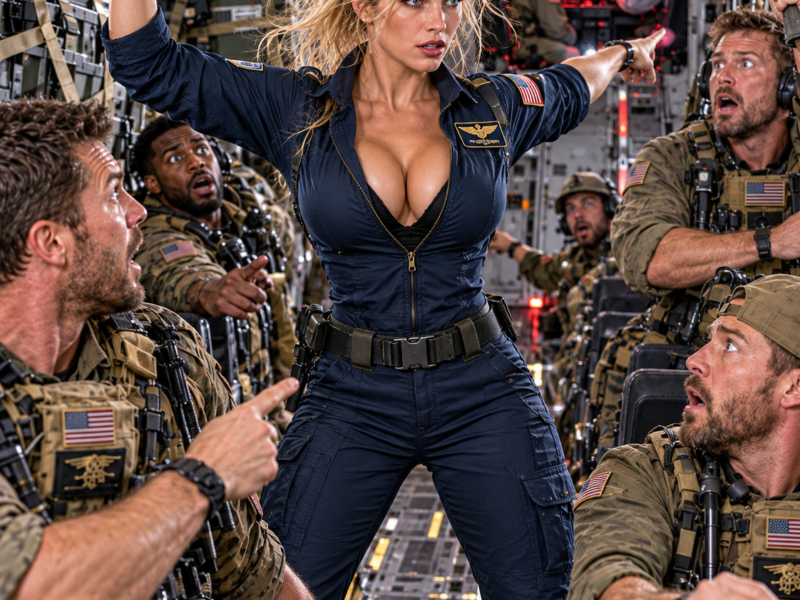
“I was ordered to stay away from the cockpit while fourteen Navy SEALs watched, but when the captain collapsed at 31,000 feet
“Night Hawk, if you’re aboard that aircraft, do NOT trust the maintenance report.”
I recognized the voice before the transmission finished.
“Colonel James Whitaker?”
There was a brief burst of static.
Then the voice returned.
“Olivia. Thank God. I was hoping you wouldn’t be on that aircraft.”
I stared at the radio.
Three years.
Three years since I’d heard that voice.
Three years since I’d walked out of a Navy briefing room carrying a sealed envelope that ended my operational flying career.
And now James Whitaker was speaking to me at 31,000 feet.
“Colonel, explain why you’re on this frequency.”
“There’s no time. Listen carefully. The aircraft’s maintenance history has been compromised.”
I glanced at the flight instruments.
“Are you saying the component installed on this aircraft is defective?”
“I’m saying it was never supposed to be installed.”
Lieutenant Daniel Foster looked at me.
“Commander, what is he talking about?”
I raised one hand, asking him to remain focused on flying.
“Colonel, I need specifics.”
Another burst of static interrupted the transmission.
Then Whitaker spoke again.
“Three years ago, the same component was recovered after your final mission. It was supposed to be destroyed.”
My mouth went dry.
I remembered that mission.
I remembered the warning.
I remembered the sudden loss of reliable instrument readings over the North Atlantic.
And I remembered the aircraft commander ordering me to abandon the flight.
I hadn’t.
I’d brought the aircraft home.
But the official investigation blamed the incident on my failure to follow procedure.
My operational clearance was suspended.
The final report described my actions as reckless.
Nobody mentioned the defective component.
Nobody mentioned the maintenance discrepancy I’d reported before departure.
I had spent three years trying to move beyond that night.
Now the same problem was appearing in front of me.
“Colonel,” I said, “who authorized this installation?”
“I don’t have that information yet.”
“Then why did you call me?”
“Because someone knew you were aboard.”
I turned toward Ryan Mitchell.
He was standing behind my seat, listening.
His face had changed.
“Commander Mitchell,” I said, “did you know anything about this aircraft’s maintenance history?”
He shook his head.
“No. We were told the transport had passed inspection.”
“Who told you?”
“The flight operations office.”
“Name?”
“Captain Warren received the final paperwork.”
I looked toward the unconscious captain.
Foster was still working through the aircraft’s indications.
“Daniel, how long has Captain Warren been feeling unwell?”
“About twenty minutes before the emergency.”
“Did he take any medication?”
“Not that I know of.”
I checked his breathing and pulse as best I could without interfering with the flight crew’s duties.
He was alive, but unresponsive.
“Ryan, get the medical kit. Tell Brooks to bring it forward.”
Mitchell moved immediately.
It was the first time all night he’d followed one of my instructions without questioning it.
A few moments later, Tyler Brooks appeared at the cockpit entrance with the medical kit.
“Ma’am, what do you need?”
“Ask the medic to come forward. Captain Warren needs medical attention.”
Brooks glanced at the captain.
“Yes, ma’am.”
He turned to leave.
Then he looked back at me.
“Commander?”
“Yes?”
“Is there anything we can do?”
I looked at him.
“Keep everybody calm. Secure the equipment and follow the crew’s instructions.”
He nodded and disappeared.
I returned to the instruments.
The aircraft remained controllable, but the abnormal indications were continuing.
I wasn’t going to pretend that I knew more than the manuals or that a familiar warning automatically meant the same failure had occurred.
I needed the technical crew, the flight documentation, and accurate information.
Most importantly, I needed Foster to keep flying.
“Daniel, talk to me. What are you seeing?”
He explained the warnings and the actions he had already taken.
I listened carefully, then helped him cross-check the indications against the aircraft’s approved emergency procedures.
We worked methodically.
No dramatic movements.
No unnecessary adjustments.
Just one decision at a time.
Ryan stood behind us, unusually quiet.
Finally, Foster looked toward me.
“Commander, I have the aircraft stable for now.”
“Good. Keep monitoring everything. We need a diversion airport and medical support waiting.”
He nodded.
I contacted air traffic control through the appropriate radio channel and requested priority handling.
The controller responded professionally.
“Military transport, confirm number of persons aboard.”
“Sixteen crew and passengers, with one pilot requiring immediate medical assistance.”
I looked toward the rear compartment.
There were fourteen SEALs, two flight crew members, and me.
The count was correct.
“Request the nearest suitable military airfield with emergency medical services.”
The controller acknowledged.
Then Ryan spoke.
“Can I ask you something?”
“Not right now.”
“Three years ago. The Night Hawk incident. Were you really responsible for what happened?”
I looked at him.
He seemed almost embarrassed to ask.
“I brought the aircraft home with everyone alive.”
“That’s not what I asked.”
“I know.”
I returned my attention to the instruments.
“Three years ago, I reported a maintenance discrepancy before a mission. The report was dismissed. When the aircraft developed problems, I made decisions based on the information available to me.”
“And the investigation?”
“Blamed me.”
Ryan looked at the floor.
“Why didn’t you appeal?”
“I did.”
“What happened?”
I gave him a small, tired smile.
“They told me the investigation was complete.”
He said nothing.
A few minutes later, the medic arrived.
He examined Captain Warren and began assessing his condition.
“He’s breathing normally,” the medic reported. “But he’s not responding. We need medical evaluation as soon as we land.”
I nodded.
“Thank you.”
I looked back at the flight instruments.
The aircraft had begun a controlled diversion under Foster’s direction.
The cabin remained tense, but the SEALs were doing their jobs.
Then the radio crackled again.
“Night Hawk, this is Whitaker. Do you copy?”
I pressed the transmit control.
“Go ahead.”
“I have the maintenance records.”
“Read me the component identification.”
He gave me a number.
I looked at the notation again.
It matched.
“Where did you get that?”
“From the original inspection archive. The component was marked as unsuitable for operational use following your mission.”
“Who signed the rejection?”
“Commander Olivia Hayes.”
I closed my eyes briefly.
I remembered signing that report.
I had written that the component should be removed from service pending a full engineering review.
I had personally handed the paperwork to the maintenance officer.
And now it was aboard another military aircraft.
“Colonel, who approved its release?”
There was a pause.
“That’s the problem.”
“What problem?”
“The digital authorization was entered under your old credentials.”
I stared at the radio.
“That’s impossible.”
“Someone used your identity.”
Ryan stepped closer.
“How could they access a retired commander’s credentials?”
Whitaker answered before I could.
“That’s what we’re investigating.”
I felt a cold pressure settle in my chest.
Someone had not merely reused a defective component.
They had made it appear that I had approved it.
Again.
“Colonel, where is the original authorization?”
“At Naval Aviation Maintenance Command.”
“Secure it.”
“I’m trying.”
“No, Colonel. You need to make sure nobody changes or destroys that record.”
He paused.
“Understood.”
I looked at Ryan.
“Someone wants this to look like my mistake.”
His jaw tightened.
“Why would anyone do that?”
I didn’t answer.
Because I had begun to understand that the person responsible might not be a stranger.
Three years earlier, there had been only a handful of people with access to my maintenance report.
One of them was a senior officer who had stood beside me during the investigation.
Captain Nathan Cole.
He had been my squadron operations officer.
He had also been the person who assured me that the defective component would be removed.
I had trusted him.
More than I should have.
“Colonel,” I said into the radio, “where is Nathan Cole?”
Whitaker didn’t answer immediately.
Then he said, “He’s currently serving as deputy director of aviation readiness.”
My fingers tightened.
“Does he know I’m aboard this aircraft?”
“I can’t confirm that.”
“Find out.”
A warning tone interrupted us.
Foster checked the display.
“Commander, we’re getting another abnormal indication.”
I leaned closer.
“What changed?”
He explained the new reading.
We checked the relevant procedures and cross-referenced the system information.
The aircraft remained controllable, but the situation required careful management.
“Daniel, stay with the approved diversion plan. Don’t chase the warning.”
He nodded.
I looked toward Ryan.
“How far away are the SEALs from their equipment?”
“Most of the gear is secured. Brooks is checking the restraints.”
“Good. Keep them seated.”
Ryan turned toward the cargo compartment.
Then he stopped.
“Commander Hayes?”
I looked up.
“Thank you.”
I didn’t respond.
There would be time for that later.
If we got one.
The diversion airport was now preparing for our arrival.
The controller confirmed emergency services would be waiting.
Foster continued communicating with air traffic control while I helped him organize the information needed for the approach.
We had no room for pride.
No room for arguments.
Only the aircraft and the people inside it.
Several minutes later, Ryan returned.
“All fourteen men are accounted for.”
“Good.”
He looked toward Captain Warren.
“How is he?”
The medic answered.
“Still unconscious, but stable enough for transport to the medical team on the ground.”
Ryan nodded.
Then he looked at me.
“Olivia, I owe you an apology.”
I glanced at him.
“For what?”
“For calling you a supply clerk. For blocking the cockpit. For assuming you had no qualifications.”
I turned back toward Foster.
“We can discuss that after we land.”
He nodded.
“Understood.”
It was a small thing.
But I noticed it.
The man who had spent the morning treating me like an inconvenience was finally listening.
The landing was not easy.
The weather had deteriorated, and the aircraft was carrying an unresolved technical problem.
Foster remained at the controls.
I supported him by monitoring the information available to us and helping him work through the required procedures.
The approach seemed to take forever.
Then the runway lights appeared through the darkness.
“Runway in sight,” Foster said.
“Continue,” I replied.
The aircraft descended.
The landing gear indication came up.
Foster checked it.
Then checked it again.
“Three green.”
I looked at the display.
“Confirmed.”
The runway rushed toward us.
The wheels touched down with a heavy jolt.
The aircraft bounced slightly, then settled.
Foster maintained control as we slowed.
When we finally came to a stop, nobody spoke for several seconds.
Then Brooks’ voice came over the intercom.
“Are we down?”
Ryan looked at me.
I allowed myself the smallest smile.
“Tell your men we’re on the ground.”
Brooks’ voice broke into laughter.
A few seconds later, the cargo compartment erupted in relieved applause.
I didn’t join in.
I was looking at the cockpit instruments.
The aircraft had landed.
But the mystery that had brought us here was still sitting inside its maintenance records.
And somebody had deliberately put my name on it.
Within minutes, emergency medical personnel reached the aircraft.
Captain Warren was transferred to an ambulance.
The doctors later determined that he had suffered a serious neurological event requiring immediate treatment.
He survived.
Foster was taken for evaluation and a formal debriefing.
The SEALs were escorted to a secure holding area while the aircraft was placed under inspection.
I was asked to remain.
I expected an ordinary post-flight interview.
Instead, two naval investigators approached me.
One introduced himself as Commander Elaine Porter.
The other carried a thick folder.
“Commander Hayes, we need to discuss the component installed on this aircraft.”
I looked at the folder.
“Do you have the original maintenance report?”
Commander Porter nodded.
“We do.”
“Then you know I didn’t authorize its release.”
She exchanged a glance with the other investigator.
“That’s why we’re here.”
She opened the folder.
The first page contained my old report.
The second contained the new authorization.
Both carried my digital credentials.
But there was a difference.
The old report had my actual signature.
The new authorization contained a timestamp from six days earlier.
I pointed to it.
“Where was I six days ago?”
“Your personnel records show you were in Virginia.”
“Correct. I was attending a civilian logistics conference.”
The investigator nodded.
“Did you have access to the Navy’s maintenance authorization system?”
“No.”
“Did you attempt to log in?”
“Absolutely not.”
Commander Porter turned another page.
“We traced the authorization to an administrative terminal at Naval Aviation Maintenance Command.”
“Who used it?”
“We’re still investigating.”
I leaned forward.
“Then you need to speak to Nathan Cole.”
Her expression changed.
“You know Captain Cole?”
“I worked with him three years ago.”
“Why did you mention him?”
“Because he had access to the original component rejection report.”
Commander Porter closed the folder.
“Captain Cole has already been notified.”
I looked at her.
“Has he been interviewed?”
“Not yet.”
“Why not?”
“Because he’s currently unavailable.”
Something about the way she said it bothered me.
“Unavailable where?”
She hesitated.
“He’s aboard a Navy transport aircraft heading toward Norfolk.”
I looked at the clock.
“When did it depart?”
“Approximately forty minutes ago.”
I slowly sat back.
“Commander, I think you need to stop that aircraft.”
She studied me.
“Why?”
“Because if Cole knows we found the component, he’ll try to destroy whatever evidence remains.”
The second investigator opened his mouth.
Before he could respond, Commander Porter’s phone rang.
She answered.
Listened.
Then her face went pale.
“Say that again.”
She looked at me.
“Captain Cole’s aircraft has changed its destination.”
I stood.
“Where is it going?”
She lowered the phone.
“An undisclosed military installation.”
I felt the room tighten around me.
“He’s running.”
Commander Porter didn’t disagree.
She immediately contacted her superiors.
I was told to wait while the investigators coordinated with aviation command.
But I wasn’t going to sit quietly.
I had spent three years waiting for someone to take my original report seriously.
I wasn’t going to lose the evidence again.
“Commander Porter, I need to see the full maintenance archive.”
“That’s classified.”
“I know.”
“You no longer have operational clearance.”
I looked at her.
“Then authorize a supervised review.”
She studied me for a long moment.
Finally, she nodded.
“Come with me.”
The archive was inside a secure office near the maintenance hangar.
A technician brought up the records associated with the component.
We found the original rejection notice.
Then we found the digital authorization.
And beneath it was an administrative access log.
One name appeared repeatedly.
Nathan Cole.
But something else caught my attention.
The authorization had been entered using a terminal assigned to the aviation readiness office.
The same office where Cole worked.
I pointed to the screen.
“There’s your access point.”
The technician opened the associated records.
A second user had accessed the file just three minutes after Cole.
The name was unfamiliar.
A civilian systems administrator named Mark Ellison.
“Who is he?” I asked.
The technician checked.
“Contractor. Maintenance information systems.”
“Does he work directly for Cole?”
“I don’t know.”
Commander Porter looked at the technician.
“Find out.”
While he worked, my phone vibrated.
A message had arrived from an unknown number.
It contained a photograph.
A man standing beside an aircraft hangar.
I recognized Nathan Cole immediately.
He was holding a folder.
On the back of the photograph was a handwritten sentence:
“Ask him why he kept the original.”
I showed Commander Porter.
She looked at the image.
“Where did you get this?”
“I don’t know.”
She called the investigators assigned to locate Cole.
No answer.
Then my phone rang.
It was Colonel Whitaker.
“Olivia, we have a problem.”
“What happened?”
“Cole has been located.”
“Where?”
“An old maintenance facility outside Norfolk.”
“Is he in custody?”
“No.”
I closed my eyes.
“Then what are we waiting for?”
“Because he requested to speak with you.”
I stared at the phone.
“Me?”
“Yes.”
“Why?”
Whitaker lowered his voice.
“He says he has evidence proving your original investigation was deliberately falsified.”
I looked toward Commander Porter.
She had heard enough to understand.
“Colonel, I’m coming.”
Whitaker hesitated.
“Olivia, there’s something else.”
“What?”
“He says he knows who ordered the component installed on your aircraft three years ago.”
I felt my mouth go dry.
“Who?”
Whitaker took a breath.
“He’s refusing to say anything until he sees you.”
The facility outside Norfolk looked abandoned.
Its hangar doors were rusted, and weeds had grown through cracks in the concrete.
Two military vehicles were parked near the entrance.
Commander Porter insisted on accompanying me.
I didn’t argue.
When we entered, I saw Cole standing beside a workbench.
He looked older than I remembered.
His hair had gone gray at the temples, and his uniform was missing the polished confidence I’d once associated with him.
He turned.
“Olivia.”
I stopped several feet away.
“Captain.”
He looked at Commander Porter.
“I asked to speak to her alone.”
“That’s not happening,” she replied.
Cole sighed.
“Fine.”
He opened a metal case on the workbench.
Inside were several folders, a small external drive, and a handwritten maintenance log.
I recognized the log immediately.
It was the original record from my final mission.
The one I’d been told no longer existed.
I stepped closer.
“Where did you get that?”
Cole looked at me.
“I kept it.”
“Why?”
“Because I knew what they were going to do.”
“Then why didn’t you tell the investigators?”
He lowered his eyes.
“Because I was afraid.”
I stared at him.
“You let them destroy my career.”
“I know.”
“You watched them accuse me of recklessness.”
“I know.”
“You knew I had reported the defective component.”
His voice cracked.
“Yes.”
I felt my hands trembling.
“Then tell me why.”
Cole pulled out a chair.
He sat down slowly.
“Three years ago, the component was scheduled for disposal. The manufacturer had issued a warning, but replacing every affected unit would have cost millions.”
I listened.
“The readiness office was under pressure to keep aircraft available. Senior management wanted the units returned to service.”
“Who?”
Cole looked at Commander Porter.
Then back at me.
“Rear Admiral Thomas Vance.”
The name meant something.
Vance had been responsible for aviation readiness when I was still flying.
He had praised my emergency landing publicly.
He had also signed the recommendation to suspend my operational clearance.
I felt sick.
“You’re saying an admiral ordered the component installed?”
Cole nodded.
“He approved the waiver.”
“Why did you put my name on the authorization?”
“I didn’t.”
I stared at him.
He opened another folder.
Inside was a printed email.
The sender was Mark Ellison.
The recipient was a restricted maintenance account.
The subject line read:
“Night Hawk Credentials Restored.”
My stomach tightened.
Cole pointed to the message.
“Ellison had access to the old credential database. He restored your authorization profile and used it to release the component.”
I looked at the timestamp.
Six days earlier.
“Why?”
Cole looked at me.
“Because someone wanted the next incident to be blamed on you.”
Silence filled the hangar.
Commander Porter stepped forward.
“Do you have evidence of Admiral Vance’s involvement?”
Cole nodded.
He removed a small flash drive from the case.
“Everything is here. The original reports, the waiver, the emails, and the payment records.”
I looked at him.
“Why are you giving this to us now?”
He swallowed.
“Because after tonight, I realized they were going to keep doing it.”
“Tonight?”
He nodded.
“When I heard your call sign on the emergency frequency, I knew what had happened.”
He looked down.
“I remembered the last time you saved an aircraft that should never have been in the air.”
For a moment, I couldn’t speak.
Then I asked the question that had haunted me for three years.
“Why didn’t you defend me?”
Cole’s eyes filled.
“I was afraid I’d lose everything.”
I stared at him.
“And I did.”
He nodded.
“I know.”
There was no excuse in his voice.
No attempt to make himself look better.
Just a man finally acknowledging what his silence had cost someone else.
Commander Porter took possession of the evidence.
She informed Cole that he would be required to give a formal statement.
He agreed.
Then she contacted federal investigators.
The next forty-eight hours were a blur of interviews, document reviews, and emergency briefings.
Rear Admiral Vance was placed under investigation.
Mark Ellison was arrested after investigators recovered evidence that he had accessed restricted credentials without authorization.
Several senior maintenance officials were suspended.
The original component rejection report was authenticated.
The digital authorization carrying my name was confirmed as fraudulent.
And the investigation into my final mission was reopened.
For the first time in three years, somebody was asking what had actually happened.
But there was one more person I needed to see.
Commander Ryan Mitchell.
I found him in the medical waiting area near the hospital.
His SEALs were safe.
Captain Warren was recovering.
Foster had been released after evaluation.
Ryan was sitting alone with a paper cup of coffee.
He looked up when I entered.
“Commander Hayes.”
I sat across from him.
“How are your men?”
“Fine. All accounted for.”
“Good.”
He nodded.
For several seconds, neither of us spoke.
Then he said, “I owe you more than an apology.”
I waited.
“I spent the entire morning treating you like you didn’t belong on that aircraft.”
“You did.”
He gave a tired smile.
“Fair enough.”
He looked down at his coffee.
“When the emergency started, I thought I knew exactly what needed to happen. I thought I could take control of everything because that’s what I do.”
I listened.
“But I couldn’t fly that aircraft. I couldn’t help the captain. And I couldn’t even recognize the person who could.”
He rubbed his forehead.
“I was so concerned with your job title that I ignored what you were telling me.”
I looked at him.
“People make assumptions.”
“That doesn’t excuse mine.”
“No. It doesn’t.”
He nodded.
Then he said something unexpected.
“Tyler told me what happened with the cargo paperwork.”
I raised an eyebrow.
“Did he?”
“He said you caught the medical supplies discrepancy before we departed.”
“That’s my job.”
“Exactly.”
He looked at me.
“And I treated your job like it didn’t matter.”
I considered his words.
Then I gave him a small nod.
“That’s a better apology.”
He smiled faintly.
Before I left, he stood.
“Olivia?”
“Yes?”
“Would you consider speaking to my team?”
“About what?”
“About what happened tonight. About recognizing experience, and listening when someone raises a concern.”
I thought about it.
“Only if you speak first.”
He looked surprised.
“Me?”
“Yes. Tell them what you got wrong.”
He looked down.
Then he nodded.
“Fair enough.”
Three weeks later, I returned to Virginia.
The Navy had officially restored my operational credentials pending the outcome of the reopened investigation.
I was offered a position in aviation safety oversight.
The salary was considerably higher than my logistics job.
The title was impressive.
And for the first time in years, nobody was asking me to explain why I had left flying.
But I didn’t accept immediately.
I went home and sat in my kitchen for a long time.
My apartment was quiet.
On the counter sat the old leather identification holder I’d carried aboard the transport.
I opened it.
The photograph was still there.
Commander Olivia Hayes.
Night Hawk.
I remembered the woman in that photograph.
She had been confident.
Ambitious.
Certain that doing the right thing would eventually be enough.
Then I remembered the woman I’d become.
Quieter.
More cautious.
Someone who preferred to work behind a laptop rather than explain herself to people who had already decided who she was.
I wondered whether returning to aviation would mean returning to the life that had hurt me.
The following morning, Colonel Whitaker called.
“Have you made a decision?”
“I’m thinking.”
“That’s not an answer.”
“It usually means I haven’t decided.”
He laughed.
Then his voice softened.
“Olivia, you don’t owe the Navy another day of your life.”
I looked at the identification holder.
“I know.”
“But there are young pilots who need someone who understands what happens when maintenance warnings are ignored.”
I said nothing.
“Whatever you decide, don’t let what happened three years ago make the decision for you.”
After the call, I drove to the airfield.
I stood near the fence and watched a transport aircraft climb into the morning sky.
Its engines produced a deep, familiar roar.
For the first time in three years, I didn’t feel the urge to turn away.
I accepted the aviation safety position the following week.
My first assignment was to review maintenance reporting procedures across several military transport units.
I wasn’t returning to operational flying.
Not yet.
But I was returning to the place where I could make a difference.
The investigation continued for months.
Rear Admiral Vance eventually faced a court-martial.
The evidence established that he had authorized the improper return of rejected components to service and participated in concealing the resulting maintenance risks.
Mark Ellison admitted to restoring my credentials and falsifying the authorization.
Captain Nathan Cole cooperated with investigators.
He was disciplined for his role in the original cover-up and for failing to report what he knew.
His cooperation did not erase his silence.
It did, however, help establish the truth.
The official report from my final mission was corrected.
My record was cleared.
The Navy issued a formal acknowledgment that my decisions during the emergency had been consistent with the information available and had prevented the loss of the aircraft and its crew.
I received a letter from the Chief of Naval Operations.
I read it once.
Then I put it in a drawer.
I had spent three years waiting for someone to admit I wasn’t the person they had described.
When the admission finally came, it felt smaller than I expected.
What mattered more was that the same maintenance failures would be harder to hide.
Six months after the emergency, I was invited to speak to Ryan Mitchell’s SEAL unit.
I almost declined.
Then Tyler Brooks sent me a message.
“Commander, the guys want to hear from you. Even Ross.”
I smiled.
The briefing room was full when I arrived.
Fourteen men sat in two rows.
Ryan stood at the front.
He introduced me without mentioning my former call sign.
“Today, we’re hearing from Commander Olivia Hayes. She was assigned to our aircraft as a logistics coordinator. When the emergency happened, she stepped forward, and I made the mistake of questioning whether she belonged there.”
He looked toward his men.
“I was wrong.”
Nobody laughed.
He turned toward me.
“Commander, the floor is yours.”
I stood in front of the room.
I didn’t show them my medals.
I didn’t display my flight records.
I simply told them what had happened.
I explained the maintenance warning.
I talked about the original mission.
I told them about the years I had spent believing that my career had ended because I had failed.
Then I spoke about the difference between confidence and competence.
“Confidence is useful,” I said. “But confidence without the willingness to listen can become dangerous.”
The room was silent.
I continued.
“Somebody may have less authority than you. They may have a different job title. They may not look like the person you expect to have the answer.”
I looked directly at Ryan.
“That doesn’t mean they’re wrong.”
He nodded.
At the end of the briefing, Ross approached me.
He looked uncomfortable.
“Commander?”
“Yes, Chief?”
“I owe you an apology too.”
“For what?”
“The spreadsheet joke.”
I smiled.
“Don’t worry. I’ve heard worse.”
He laughed.
Then he became serious.
“I didn’t know what you had done before.”
I looked at him.
“That’s the point, Chief. You shouldn’t have needed to know.”
He nodded slowly.
Tyler came over and shook my hand.
“Good to have you back, Commander.”
I thanked him.
As I was leaving, Ryan caught up with me in the hallway.
“Olivia.”
I turned.
He held out a small package.
“What’s this?”
“Something the team wanted you to have.”
I opened it.
Inside was a framed photograph of the transport aircraft after landing.
The fourteen SEALs stood beneath the wing.
Foster was there.
Captain Warren had joined them after recovering.
And in the center stood Ryan, holding a small handwritten sign.
It read:
“THE PERSON WE ALMOST DIDN’T LISTEN TO.”
I laughed quietly.
Then I noticed something written along the bottom of the frame.
In Tyler’s handwriting:
“Next time, we’ll read the paperwork.”
I looked up at Ryan.
He was smiling.
For the first time, I believed it was genuine.
“Thank you,” I said.
He nodded.
“Thank you for getting us home.”
I carried the photograph back to my office.
I placed it beside the old identification holder.
One showed the woman I had been before my career collapsed.
The other showed the woman who had learned to keep going even after the uniform was taken away.
I used to think Night Hawk was the most important part of my identity.
Now I understood that the call sign had never been what made me a pilot.
It was the training.
The discipline.
The judgment.
And the willingness to speak when something wasn’t right, even when the person standing in front of me outranked me.
A few weeks later, I received a message from a young female logistics specialist stationed overseas.
She had been assigned to a maintenance unit and was struggling with a supervisor who dismissed her concerns.
She wrote:
“Ma’am, sometimes I feel like nobody sees anything beyond my job title. How did you keep going?”
I read the message twice.
Then I typed a reply.
“Do your work carefully. Document what you find. Ask the questions that need to be asked. And never confuse somebody else’s inability to recognize your experience with a lack of experience on your part.”
I sent it.
Then I looked out my office window.
A C-130 was taking off in the distance.
Its engines echoed across the airfield.
I didn’t need to be in the cockpit to feel connected to it anymore.
For three years, I had believed that losing my wings meant losing the person I used to be.
But that night over the Atlantic had taught me something I couldn’t have learned in any flight simulator.
Sometimes the most important person aboard an aircraft isn’t the one sitting in the pilot’s seat.
Sometimes it’s the person who notices what everyone else has overlooked—and refuses to stay silent.
THE END.









