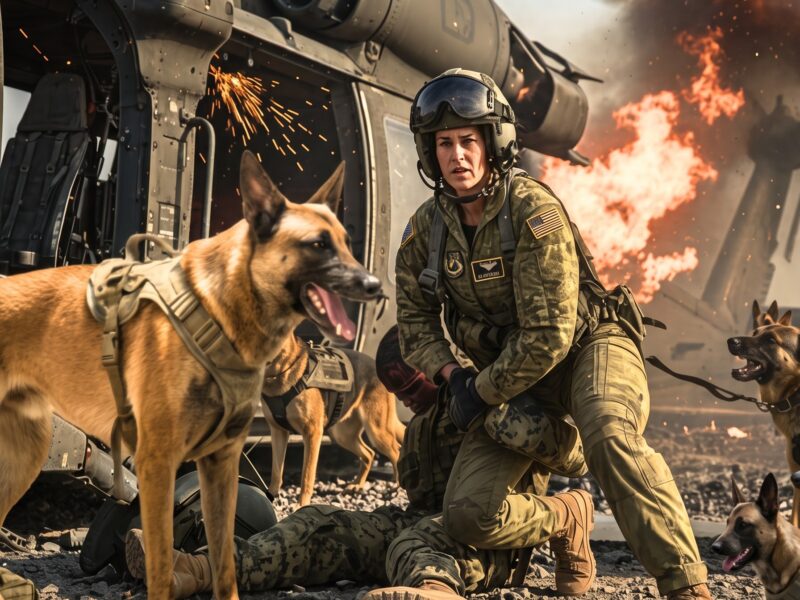
I was ordered to leave a military hangar after a classified operation, but before I could reach the gate, all twenty-four K9s broke formation
The reinforced steel doors of Hangar Four hissed as they parted, venting the smell of burnt turbine oil, spent hydraulic fluid, and cold oceanic salt air into the cavernous bay. Outside, across the tarmac of Naval Air Station Whidbey Island, a midnight squall lashed the runway lights, turning the concrete into a black mirror. Inside, the massive sodium lamps hung suspended fifty feet above, casting an amber, sterile glow over the polished concrete deck.
I stepped down from the crew chief’s hatch of the MH-60M Black Hawk, my combat boots ringing hollow against the wet floor. Beside me, Chief Warrant Officer Marcus Vance—our flight lead and pilot-in-command—walked with his flight helmet tucked under his left arm. His olive flight suit was blackened with soot across the shoulder harness, his knuckles raw and bruised from the collective stick. His jaw was set like granite, eyes hollowed by shock, staring straight ahead at nothing.
Operation Nightfall had been an utter catastrophe.
Two hours earlier, our bird had crossed the jagged tree line of the Olympic Peninsula on an ultra-low-level extraction flight to recover a high-value reconnaissance cell operating under Joint Special Operations Command. It was supposed to be a dark insert: zero comms, zero transponder, terrain-following radar cutting through mountain fog. But the moment our skids touched down in the clearing near Lake Cushman, the night erupted.
It was not an ambush by foreign insurgents. It was a surgical, perfectly timed intercept by an unmarked paramilitary strike team armed with heavy-caliber anti-materiel rifles and radio-frequency jammers. They knew our exact entry vector. They knew our secondary egress channel. They had been waiting for us in the brush like executioners.
Our starboard engine took two direct rounds through the cowling, detonating the auxiliary oil pump in a shower of white-hot titanium fragments. Our door gunner, Petty Officer Second Class Miller, had been thrown from the port hatch into the freezing black waters of the ravine during the violent evasive turn. Lieutenant Commander Cole, the tactical team leader on the ground, had disappeared into the burning timber trying to draw fire away from our rotors so Marcus could pull pitch and lift us out.
We had limped back across the Puget Sound on a single screaming turbine, the airframe vibrating so violently that the rivets in the overhead bulkhead sheared off like dry twigs. We landed with six hundred pounds of fuel left in the cells—barely enough to taxi off the active strip.
And before the blades had even finished their dying spin, the rumor was already spreading through the command channels like wildfire: someone in the cockpit had sold the operational frequency. Someone had uploaded our secondary flight path to an unauthorized server twenty minutes prior to wheels-up.
The brass was looking at Marcus Vance.
I followed him toward the maintenance locker to drop our survival vests, but as we crossed the center line of the hangar floor, the air went completely dead.
Along the western bulkhead, drawn up in two immaculate ranks of twelve, sat the twenty-four working dogs of the 1st Special Operations Canine Detachment. These were not base security dogs. They were Belgian Malinois and East German working-line Shepherds—titanium-toothed, combat-tested multipurpose canines trained for hostage rescue, counter-terrorism, and high-altitude airborne operations. They were wearing their full tactical harnesses, GPS beacons, and ceramic chest plates, their fur still damp from an aborted training drop aborted due to the storm.
Behind them stood their handlers—twelve combat controllers and twelve Navy master-at-arms handlers—standing at rigid parade rest, their eyes fixed strictly forward. But as Marcus and I took another three steps, their eyes shifted. They weren’t looking at the flight deck. They were looking at Marcus.
Heavy combat boots crunched against the concrete.
From the shadows of the flight operations office, a Navy SEAL stepped into the amber light. He wore sterile AOR2 camouflage without rank insignia, his plate carrier stripped of name tapes, carrying only a suppressed Sig Sauer MCX slung across his chest. His name was Master Chief Brett Callahan. I had seen him twice before during pre-mission briefings; he was the liaison officer between naval intelligence and the special projects directorate that had sanctioned tonight’s operation.
Callahan stopped six feet in front of Marcus, his hands resting casually on the top of his weapon sling. His face was weathered, pale, and entirely devoid of human warmth.
“Pilot,” Callahan said, his voice flat, razor-sharp, and cutting through the quiet hum of the hangar’s environmental blowers. “Go home.”
Marcus stopped. He didn’t drop his helmet. “Master Chief, the post-flight debriefing is mandatory under NAVAIR regs. We have two men unaccounted for out in sector four. Miller went down in the water. Commander Cole was still engaging when we broke contact. We need search and rescue airborne before the storm grounds the sector.”
“Search and rescue has already been reassigned to tactical assets from McChord,” Callahan said without blinking. “You are relieved of flight status effective immediately, Warrant Officer Vance. You will report to the security holding annex at building four-one-two at zero-eight-hundred for formal deposition. Your flight logs, your survival gear, and your personal comms remain here. You’re done.”
“What happened out there, Callahan?” Marcus asked, his voice trembling with a terrifying blend of grief and fury. “Someone gave them our radar envelope. We took fire before the wheels even touched the dirt. That was an ambush.”
“That is an open investigation,” Callahan replied, taking a half-step forward, his eyes narrowing into slits. “And until the regional inspector general finishes reviewing the data link, you are considered a person of primary interest. Walk out the gate, Vance. Don’t make me have the shore patrol escort you off the flight line in irons.”
I felt a surge of rage burn through my throat. “Master Chief, with respect, I sat in the crew chief jump seat. Vance saved that aircraft. If he hadn’t executed that autorotation turn when the number two engine blew, we’d all be buried in fifty feet of glacial silt.”
“I wasn’t speaking to you, Crew Chief,” Callahan snapped, his gaze flickering toward me like a whip. “Stand down.”
Across the hangar, a sound broke the silence.
It was not a man’s voice. It was the sharp, metallic snap of a lead being jerked against a steel ring.
On the far end of the front rank, a massive, sable-coated German Shepherd with broad shoulders and scarred ears slowly pushed himself up from the sit position. His name was Thor, the detachment’s primary tracking lead. His handler, a seasoned Master-at-Arms named Keller, immediately reacted.
“Thor, sit!” Keller barked, his hand tightening around the heavy nylon lead. “Fuss!”
The dog ignored him.
He didn’t twitch; he didn’t whine. He turned his heavy head with deliberate, chilling purpose and locked his dark amber eyes directly onto Marcus Vance.
Then, two paces down the line, a lean Belgian Malinois rose. Then another. Then three more.
Within five seconds, the immaculate discipline of the elite canine detachment dissolved into an impossible, coordinated rebellion. Twenty-four combat-hardened dogs rose to their feet simultaneously, their eyes fixed across the hundred feet of empty concrete, their bodies tense as coiled steel cables.
“What the hell are you doing?” Callahan yelled, turning toward the line. “Handlers, secure your animals!”
“Hold them!” Keller shouted, his boots skidding across the floor as Thor hauled against the harness with terrifying, mechanical power. “Thor, platz! Down! Down!”
Commands in German, Dutch, and English exploded across the hangar: Blijf! Sitz! Leave it! Down!
None of them listened.
With a synchronized, terrifying deliberate pace, twenty-four dogs tore the leads from their handlers’ hands or dragged the grown men two steps across the wet floor before the handlers were forced to release the leashes to avoid being dragged down. The animals moved in an unbroken, silent wave, fanning out across the polished gray floor, their claw tips clicking against the epoxy in a terrifying, rhythmic cadence.
Callahan reached down to unholster his sidearm. “Shoot them if you have to! Get control of those dogs!”
“Don’t you dare draw that weapon, Callahan!” Keller roared from the back, sprinting forward. “They aren’t aggressive! They aren’t attacking!”
They weren’t attacking.
They didn’t sprint. They didn’t bark. They didn’t bare their fangs. They walked with heads held low, shoulders rolling, forming an impenetrable, circular perimeter around Marcus, myself, and the blackened tail rotor of our damaged Black Hawk.
Thor, the lead Shepherd, pushed his way through the circle, stepped directly between Marcus and Callahan, and sat down. His broad back faced Marcus; his bared chest faced the Navy SEAL. A low, vibrating hum began deep within Thor’s chest—a vibration so deep I could feel it through the soles of my flight boots.
The other twenty-three dogs closed the ring. They sat shoulder-to-shoulder, an unbroken wall of fur, muscle, and tactical ceramic, boxing Marcus and me inside their perimeter while facing outward toward Callahan, the handlers, and the operations office.
Callahan stood frozen, his hand still resting on the grip of his pistol, five feet from Thor’s black muzzle. Sweat broke across the SEAL’s forehead.
“Keller,” Callahan hissed, not daring to take a backward step. “Call your beast off.”
Keller reached the edge of the circle, his face deathly pale, his hands raised in surrender. “I… I can’t, sir. Look at their postures. They aren’t in attack drive. They’re on defensive alert. In ten years of handling special operations canines, I have never seen twenty-four animals break protocol to form an off-leash protection ring. They only do this for one reason.”
“What reason?” Callahan demanded.
“When they identify a primary asset under active, lethal threat,” Keller whispered, staring at Marcus with wide, terrified eyes. “They aren’t trying to hurt anyone. They are shielding him. They won’t let anyone touch that pilot.”
The silence inside Hangar Four was deafening, broken only by the steady, metronomic hum of the overhead halogen lamps and the wet, labored panting of twenty-four military working dogs standing guard over our aircraft.
Callahan’s fingers remained locked around the grip of his sidearm, the knuckles white beneath his weathered skin. His posture was rigid, balanced on the balls of his boots like a boxer anticipating a strike. “Step away from the aircraft, Vance,” Callahan said, his voice dropping into a dangerous, gravelly register. “You’re compromising the integrity of a military installation. Tell these handlers to clear this deck right now, or I’ll have base security roll in with riot gear.”
“They don’t take commands from me, Master Chief,” Marcus said, his voice remarkably steady despite the chaos. “They take commands from Keller and the detachment lead. And from the look of it, they aren’t listening to them either.”
Keller, the detachment’s senior trainer, slowly walked the outer edge of the canine perimeter, keeping his hands open, palms facing outward. He tried to lock eyes with Thor, his personal partner for six years through deployments in Syria and the Horn of Africa. “Thor, look at me,” Keller pleaded in a quiet, tense murmur. “Fuss, boy. Heel. What do you see, buddy?”
Thor didn’t even flick his ear toward his master’s voice. His entire focus remained locked on Callahan. His lips curled back just a fraction of an inch, revealing four silver-crowned titanium canines that gleamed under the amber lights. A second dog—a dark brindle Malinois named Ares, trained specifically for explosives and concealed contraband detection—suddenly broke from the perimeter, circled the tail boom of the Black Hawk, and stopped directly beneath the open cargo door.
Ares sat down, raised his snout into the air, and let out a single, mournful howl that echoed off the high corrugated roof like a siren.
My chest tightened. “Keller, why is Ares alerting on the bird?”
“Ares doesn’t alert on fuel or oil,” Keller said, his eyes widening as he looked through the canine ring toward the helicopter. “He’s dual-certified. Scent tracking and tactical forensic recovery. He only hits on biological evidence or accelerants.”
I didn’t ask for permission. I turned my back on Callahan and climbed up the crew chief’s steps into the darkened cabin of the Black Hawk. The smell inside was nauseating: hydraulic smoke, scorched insulation, and the metallic tang of dried blood. Miller’s gunner belt hung limp from the ceiling ring, swaying gently in the drafts that cut through the open bay.
Ares trotted up the ramp behind me, completely ignoring the handlers outside. The dog wedged his nose between the heavy nylon troop seats, sniffing furiously along the aluminum floorboards until he reached the rear bulkhead—the hidden compartment where the emergency survival gear and the classified flight-data recorders were mounted.
He began scratching frantically at the aluminum latch with both front paws, whining with an intensity that bordered on madness.
“Move back, Ares,” I whispered, kneeling beside him on the damp non-skid floor.
I popped the quick-release pins on the maintenance hatch and hauled the metal cover off its hinges. The interior was pitch black. I pulled a tactical penlight from my flight suit sleeve and clicked it on.
The light illuminated a bundle shoved deep into the avionics recess—something that had never been there during our pre-flight inspection at sixteen-hundred hours.
It was a standard-issue Ops-Core ballistic flight helmet, shattered along the right ear cup, soaked in fresh, tacky crimson blood. Mounted to the front of the helmet was an AN/PVS-31 night-vision bracket, snapped clean in half by what looked like the impact of a rifle bullet.
My hands went completely numb. I reached in with trembling fingers and pulled the helmet into the light.
Painted across the rear velcro panel in faded white stenciled lettering was a callsign: GHOST-01.
Beneath it was a name tape: COLE, L. CDR.
“Marcus,” I choked out, my voice cracking so hard it barely carried across the cabin. “Get up here. Now.”
Marcus climbed into the cabin, his boots slipping on the oil-slick floor. When the beam of my penlight hit the bloody helmet in my hands, every ounce of color drained from his face until he looked like a walking corpse. He reached out, his raw fingers touching the shattered composite shell.
“Cole was wearing this when we were hovering over Lake Cushman,” Marcus breathed, his eyes wide with horror. “I watched him sprint toward the tree line with his rifle up. He had his helmet on. He never came back to the aircraft. How the hell did this get into our avionics bay?”
“Someone put it in here,” I said, cold sweat trickling down my spine beneath my heavy body armor. “Someone put this in the rear compartment after we landed.”
“No,” a voice drifted from the canine ring outside. “Not after you landed.”
I looked out through the open cabin door. Keller was standing at the edge of the circle, pointing down at Thor’s tactical harness. Attached to the steel D-ring of the dog’s collar, caught in the heavy nylon webbing, was a two-inch strip of torn ripstop fabric. It was scorched along the edge, soaked in muddy swamp water, and patterned in the exact same experimental maritime camouflage worn exclusively by Cole’s reconnaissance team.
“Thor had that caught in his collar when we returned from the sector four perimeter an hour ago,” Keller said, his voice trembling with a terrifying realization. “We were running an exterior drag along the south tree line near the airfield’s drainage canal. Thor pulled me into the ditch and hit on a scent trail that led directly to the security gate of this hangar. That wasn’t an abandoned strip of cloth, Marcus. Cole didn’t die at Lake Cushman.”
Marcus gripped the edge of the helicopter door frame, his knuckles turning white. “Cole made it back to the island?”
“He didn’t just make it back,” I whispered, looking from the bloody helmet to the canine perimeter that was holding Callahan at bay. “He was brought here. Or he was hunted here.”
I pulled out my encrypted ruggedized tablet from my flight vest—the digital mission log that synced automatically with base flight operations through the local tactical network. I bypassed the standard maintenance checklist and accessed the raw, uncompiled telemetry file from our onboard mission computer.
The raw data told a horrifying story that never appeared on the command screens.
Our primary flight plan to Lake Cushman had been electronically overwritten forty-two minutes after takeoff by a remote terminal inside this very hangar. The override had originated from Terminal Seven—the classified intelligence desk assigned exclusively to Master Chief Brett Callahan. The transmission hadn’t just rerouted us; it had broadcasted our transponder ping across an unencrypted maritime channel for twelve seconds—just long enough for a ground-based tracking radar to lock onto our tail.
Even worse, the aircraft’s cockpit voice recorder had been manually paused for eight minutes during our return flight, wiping the exact moment Marcus had called in the emergency distress frequency over the radio.
“Marcus,” I said, holding the screen toward him. “Look at the IP signature. The leak didn’t come from your cockpit. The override command was sent from inside this hangar while we were still fifty miles out over the Strait.”
“Shut it down!” a voice roared from the concrete floor.
We looked up.
Callahan had drawn his Sig Sauer MCX, snapping the safety off with a loud, distinct mechanical click that echoed through the vast bay. He raised the barrel, aiming it squarely at Marcus’s chest through the cabin doorway.
“Step down from that aircraft with your hands behind your heads!” Callahan ordered, his eyes wild, the veins standing out along his neck like cords. “Both of you! Now!”
Every single dog in the perimeter moved at the exact same fraction of a second.
Twenty-four throats opened in unison, releasing a sound that rattled the corrugated steel walls of the hangar—a wall of deafening, savage, bone-chilling growls that resonated through the floorboards like an earthquake. Thor took two paces forward, his ears pinned flat against his skull, his teeth exposed, crouched low in an attack posture that left no doubt that the moment Callahan pulled that trigger, the dog would tear out his throat before the empty casing could hit the deck.
The twelve handlers behind the dogs reached for their own sidearms, but they didn’t aim at the dogs.
Keller drew his standard-issue Beretta, leveled it directly at Callahan’s back, and cocked the hammer.
“Drop the weapon, Master Chief,” Keller said, his voice ice-cold and deadly. “You point a rifle at my dogs again, and I will put you on the concrete.”
Callahan didn’t lower the gun. He smiled—a small, bitter, desperate grin that made the hair on the back of my arms stand on end.
“You think you’re getting out of this hangar, Sergeant?” Callahan whispered. “You think this ends with a court-martial?”
He reached up with his left hand, tapped the auxiliary control pad mounted on his plate carrier, and entered a four-digit override code.
High above our heads, the massive industrial electric winches engaged with a terrifying groan. The four-ton reinforced steel hangar doors—the only exit to the flight line—began to slide shut, sealing us inside the air-conditioned tomb of Hangar Four.
The heavy steel blast doors slammed shut with a concussive boom that vibrated through the reinforced concrete deck, cutting off the howl of the storm outside and trapping us in the stale, pressurized air of the hangar. The emergency warning strobes on the ceiling began flashing a harsh, blinding amber, casting long, frantic shadows of men and dogs across the white walls.
Callahan didn’t flinch. Even with twenty-four combat canines snarling at his knees and Keller’s service pistol leveled at the base of his skull, the SEAL’s expression had shifted from panic to a terrifying, calculated calm.
“You’re all making a catastrophic mistake,” Callahan said, his voice cutting clearly beneath the wail of the facility’s air circulation blowers. “You think you’ve uncovered a rogue operation? You think this is about a stolen flight path? You handlers have no idea what was being brought across the border tonight.”
“Shut your mouth, Callahan,” Keller said, his boots taking two slow, deliberate steps forward until the muzzle of his pistol was four inches from Callahan’s tactical vest. “Put the rifle on the deck. Safety on. Hands interlocked behind your head. If you twitch toward that radio again, I’ll take your kneecap off.”
Callahan slowly, almost casually, lowered the barrel of his MCX. He let the weapon drop to the full extension of its two-point sling, resting against his hip, but he did not interlock his fingers. He looked past Keller, past the snarling wall of dogs, straight up into the open cabin of the Black Hawk where Marcus and I stood.
“Vance,” Callahan called out, his voice smooth as silk. “Ask your crew chief what was in the auxiliary pod under your port pylon. Ask him why your gross takeoff weight was eight hundred pounds heavier leaving the staging area in Abbotsford than the flight manifest indicated.”
I looked at Marcus. Marcus looked at me, his eyes bloodshot and filled with sudden, agonizing doubt.
“What is he talking about, Miller?” Marcus whispered, his voice cracking. “We checked the balance sheets at sixteen-hundred. The auxiliary pod was empty. We were carrying extra JP-8 fuel for the low-level hover.”
“The pod wasn’t empty,” a voice rasped from the shadows.
It didn’t come from Callahan. It didn’t come from the handlers.
It came from the emergency radio handset resting on the center console inside the Black Hawk’s darkened cockpit.
The speaker crackled with heavy, oscillating static, the squelch circuit fighting through layers of local electronic jamming. A voice was trying to punch through—weak, labored, wet with the sound of punctured lungs, but instantly recognizable to every man who had served in the 160th Special Operations Aviation Regiment.
“Pilot…” the radio hissed.
The entire hangar seemed to freeze. Even the dogs ceased their growling, their ears swiveling in perfect unison toward the helicopter’s cockpit window, their bodies vibrating with acute, sensory recognition.
Marcus dove across the center console, grabbing the coiled cord of the radio handset. He hit the push-to-talk toggle with his thumb. “Ghost-Zero-One! This is Vance! Cole, is that you? Identify your grid! Where are you?”
Static hissed through the speaker for three agonizing seconds. Then came the sound of shallow, ragged breathing, followed by the clinking of metal against concrete.
“I’m… inside the perimeter,” Lieutenant Commander Cole’s voice whispered, barely above a breath. “Beneath… maintenance tunnel three. Under the floor… Vance, listen to me…”
“Cole, we have an active perimeter in Hangar Four,” Marcus spoke rapidly into the mic, his eyes darting toward the closed blast doors. “Callahan is here. He’s trying to pin the leak on us. Where is Miller? Did Miller make it out of the water?”
A wet, bitter cough tore through the radio.
“Miller… is dead,” Cole rasped, the words tearing through my heart like shrapnel. “Callahan’s sweep team… pulled him out of the lake twenty minutes after you lifted. They put two rounds in his chest… right there on the gravel bank.”
A collective gasp went up among the handlers standing on the floor. Keller’s face went dead white. Miller was twenty-two years old, a kid from Iowa who had joined the unit six months ago.
“Why?” Marcus yelled into the microphone, tears finally breaking from his eyes and running through the soot on his cheeks. “Why are they doing this, Cole?”
“The pod…” Cole gasped, his voice fading rapidly as if he were losing consciousness. “The pod wasn’t empty. It contained the biometric archives… from the joint task force server in Vancouver. The names of sixty-four undercover operatives… across the Pacific rim. Callahan’s private contractors were staging the handover at Lake Cushman. Vance… they didn’t want to shoot you down… they wanted you to land so they could take the bird… and make it look like you defected with the drives…”
The radio crackled violently as Cole took a shuddering breath.
“Vance… Callahan isn’t alone,” the dying commander whispered. Four words followed that turned the blood in my veins to solid ice: “Trust none of them.”
“Cole! Cole, talk to me!” Marcus screamed into the mic.
Nothing. Only the flat, rhythmic hiss of dead air.
On the hangar floor, Callahan began to laugh. It was a low, dry chuckle that started in his chest and bubbled up into the sterile air of the bay. He looked up at the ceiling mounted surveillance cameras, then glanced toward the heavy blast doors that sealed us from the tarmac.
“You really should have taken the deal, Vance,” Callahan said softly. “You could have walked out of here. A quiet dishonorable discharge. A civilian life. Now? Now you’re all casualties of an active terrorist breach.”
“What did you do, you bastard?” Keller roared, jabbing his pistol hard into Callahan’s ribs.
Callahan didn’t even look at him. He raised his left wrist and tapped the tactical display of his watch.
“You think this facility’s communications are jammed because of the storm?” Callahan murmured. “The storm is fifty miles out. The jammer is mounted on the roof of this very hangar. And the rapid-response team currently cutting through the auxiliary maintenance doors isn’t naval security. They’re private assets from the Special Projects branch. They don’t take prisoners. And they don’t leave witnesses who have listened to classified frequencies.”
At that exact second, the heavy hydraulic emergency lights over the western maintenance entrance snapped from green to crimson.
The sound of an oxyacetylene torch hissed from the far side of the reinforced steel wall. Chunks of white-hot slag began to vomit onto the concrete floor as the hinges of the pedestrian escape hatch were severed from the outside.
Thor didn’t wait for a command.
The massive sable Shepherd spun around, abandoning Callahan completely, and launched himself toward the glowing seams of the maintenance door. The other twenty-three dogs broke ranks with him, forming an interlocking wedge of muscle, teeth, and body armor, planting their paws thirty feet from where the steel was melting away.
They weren’t protecting Marcus from Callahan anymore.
They were preparing to hold the line against an invading army.
The stench of melting steel and burning flux flooded the hangar as the five-foot section of the maintenance access door began to glow a dull, cherry red. Through the widening gap, the blue hiss of the industrial cutting torch sounded like a hornet’s nest tearing through the wall.
“Move! Take defensive positions!” Keller shouted, breaking the paralysis that had gripped the detachment. He grabbed Callahan by the scruff of his plate carrier, kicking his legs out from under him and driving the SEAL face-first into the concrete deck. “Tie him off! Use the nylon leads! Wrap him to the tie-down rings!”
Two handlers sprinted forward with heavy steel carabiners and five-thousand-pound test nylon straps, pinning Callahan’s arms behind his back and lashing him securely to the recessed mooring rings embedded in the flight deck. Callahan didn’t resist. He lay against the cold concrete, his face twisted in a mocking grin, his eyes fixed on the sparks showering down from the melting door.
“You’re dead men, all of you,” Callahan whispered, his teeth coated in blood from the impact with the floor. “They have thermite breaching charges. The moment that plate drops, they’ll flood this bay with CS gas and flashbangs. Your dogs won’t even be able to breathe.”
“Shut up!” Marcus roared, leaping down from the Black Hawk’s cabin with Cole’s bloody flight helmet under his arm and his standard-issue M9 pistol drawn. He sprinted toward Keller. “Keller! The ventilation system! If they deploy gas through that breach, the air handlers will suck it straight into the central intake and circulate it through the entire bay in thirty seconds!”
I hit the deck right behind Marcus, my boots skidding on the hydraulic oil. “The fire suppression controls! In the maintenance alcove on the north bulkhead! The Halon system has an emergency purge sequence—it can pull fifty thousand cubic feet of air out of this room every minute through the floor sumps!”
“Go!” Keller ordered, chambering a round in his service pistol and kneeling behind an aluminum rolling toolbox for cover. “Take two handlers with you! The rest of you, line the catwalks! If that door falls, engage on my command!”
The twenty-four dogs stood their ground, unbroken, forming an immovable crescent ten paces from the glowing steel plate. Thor’s back was arched, the hair along his spine standing up in a three-inch ridge of coarse sable fur. His ears were flattened, his tail held rigid, his teeth bared in a continuous, deafening roar that vibrated against our chest plates. Beside him, Ares and the other twenty-two Malinois and Shepherds matched his stance, not a single animal retreating an inch despite the blinding heat radiating from the cutting torch.
I sprinted toward the north bulkhead, ducking low beneath the wings of a parked C-26 transport plane. Two canine handlers—Petty Officers Chen and Martinez—ran with me, their carbines raised, covering the high maintenance catwalks overhead.
We reached the industrial control panel. A heavy glass enclosure protected the red levers of the facility’s emergency systems. I didn’t bother looking for a key; I swung the butt of my heavy tactical flashlight, shattering the glass in an explosion of safety crystals.
I reached inside and slammed my palm down on the yellow toggle marked VENTILATION ISOLATION – MANUAL OVERRIDE.
Above us, the deafening scream of the roof-mounted air intake blowers died instantly. A series of heavy pneumatic baffles slammed shut with deep, rhythmic clunks, sealing the room’s ventilation ducts before the breaching team could drop gas into the circulation system.
“Now the floodlights!” Chen shouted, pointing to the main breaker array. “If they come through that door with night vision, we blind them!”
“No!” I yelled back, grabbing his wrist. “Kill the overhead lights completely! Our dogs hunt by scent, sound, and vibration! Their contractors rely on optics! If we plunge this bay into pitch black, those animals will tear them apart before they can identify their targets!”
Martinez looked at me, a fierce, reckless grin spreading across his face. “Cut the mains.”
I grabbed the heavy three-phase master disconnect switch and yanked it downward with all my weight.
The hangar plunged into absolute, terrifying darkness.
The wail of the sirens died. The blinding amber halogen lamps flickered out. The only light remaining in the five-hundred-foot room was the dull orange glow of the cutting torch biting through the steel maintenance door across the bay.
A second later, the steel gave way.
With a deafening, metallic crash that sounded like a falling shipping container, the six-hundred-pound cut section of the blast door toppled inward, slamming flat onto the concrete floor in a massive cloud of sparks, soot, and smoke.
Through the rectangular breach, three heavy stun grenades were hurled into the dark room.
BANG-BANG-BANG!
The concussive blasts were blinding—consecutive flashes of pure white magnesium light that would have permanently disoriented any human relying on naked vision or night-vision intensifier tubes. The shockwaves tore through the hangar, rattling the Black Hawk’s rotor blades and sending a shower of loose bolts raining down from the high steel rafters.
“Breach! Breach! Move in! Clear left!” a synthesized voice barked from the darkness of the opening.
Four men in heavy, unmarked black combat armor, wearing full-face enclosed ballistic helmets equipped with thermal optics, stepped over the fallen steel plate. Their short-barreled automatic weapons were fitted with infrared aiming lasers that cast thin, invisible lines of light through the drifting smoke.
They expected to find stunned, blinded sailors cowering on the deck.
They did not expect what was waiting in the shadows.
A low, guttural click came from Keller’s throat—the tactical signal for release.
“Fass,” Keller whispered into the dark.
From the black void beneath the aircraft wings, twenty-four four-legged shadows launched forward without a single sound.
They didn’t bark. They didn’t growl. They moved with the terrifying, silent velocity of predatory cats.
The first contractor through the breach barely had time to swing his rifle before Thor hit him at thirty miles an hour. The dog’s entire seventy-pound mass slammed directly into the man’s chest plate, throwing him backward against the jagged, glowing edges of the cut doorway. Before the man could regain his breath, Thor’s titanium-reinforced jaws clamped down over the weapon arm, crushing the forearm bone through the ballistic fabric with a sickening, audible snap.
The man shrieked, his rifle clattering to the floor.
To the left and right, the remaining three contractors were utterly overwhelmed. Ares and two Malinois hit the second point-man simultaneously—one striking the knee, tearing the ligaments with a savage, twisting jerk, while the other took the shoulder, driving the two-hundred-pound operative flat onto the concrete. The remaining two contractors opened fire, their suppressed weapons spitting dull, mechanical bursts of full-automatic fire into the gloom, but their thermal sights were useless against twenty-four erratic, low-profile targets moving through a sea of dissipating smoke.
“Fall back! Fall back!” a voice screamed from outside the breach. “They’ve got war dogs! Fall—”
The voice was cut short as two more Shepherds vaulted clean through the opening into the rain-swept alleyway outside, dragging the perimeter lookout down into the gravel.
From behind the cover of the Black Hawk, Marcus and the handlers opened fire, sending disciplined, single-shot rounds snapping through the breach, suppressing anyone attempting to reinforce the assault team. The concrete around the doorway exploded in clouds of gray dust as high-velocity rounds punched through the drywall and corrugated sheeting.
Within forty-five seconds, the breach was completely silent.
Four elite mercenary operatives lay disarmed, immobilized, and groaning on the bloodstained floor of Hangar Four, each pinned beneath the crushing paws and bared fangs of two massive working dogs who stared down at their throats with cold, unyielding precision.
I stepped out from the shadow of the maintenance panel, my flashlight clicking on, sweeping the beam across the carnage.
Marcus walked forward, his boots stepping over the spent brass casings littering the deck. He stopped before the contractor Thor was pinning to the floor. With the toe of his flight boot, Marcus kicked the man’s ballistic helmet off, revealing the pale, sweaty face of an active-duty private military contractor whose neck bore the tattoo of a revoked intelligence unit.
“Where is Commander Cole?” Marcus asked, his voice shaking with a cold, terrifying rage.
The contractor spat a mouthful of blood onto Marcus’s boot. “Go to hell, pilot. You’re already dead. The commander’s buried under ten feet of concrete.”
Suddenly, Thor lifted his head from the man’s arm.
The German Shepherd turned his snout toward the floor beneath our feet. He took three paces toward the center of the bay, lowered his nose to the iron grating of a primary stormwater drainage trench set into the foundation, and let out a sharp, piercing bark that echoed straight down into the black abyss below.
The iron grating in the center of the hangar floor was four feet wide and twenty feet long, designed to drain thousands of gallons of water during hangar washdowns or foam discharge emergencies. It led directly into the subterranean maintenance utility tunnels built during the Cold War—a sprawling network of concrete catacombs that connected the flight line hangars to the deep-water docks of Crescent Harbor.
Thor stood over the rusted iron bars, his paws wedged between the slots, whining with a frantic, desperate rhythm. Ares joined him, shoving his muzzle into the black void beneath the floor, drawing in deep, wet breaths of the stagnant subterranean air.
“He’s down there,” Marcus said, kneeling beside the dog. “Cole said he was in maintenance tunnel three. The drainage trench connects directly to the lower conduit.”
“Chen, get the heavy pry bars from the crash cart!” Keller ordered, his breath coming in ragged gasps as he kept his sidearm leveled at the four subdued mercenaries. “Martinez, secure these prisoners to the tool lockers! If any of them flinches, tell the dogs to finish it!”
Two handlers dragged Callahan and the four wounded contractors toward the structural steel support pillars, lashing them securely with heavy cargo straps. Thor and Ares never moved from the grate; their bodies remained rigid, shivering with anticipation, their eyes locked on the darkness below.
Chen sprinted back carrying two five-foot steel demolition bars. He slammed the hardened chisels into the edge of the iron grate. Marcus and I grabbed the second bar, wedging our weight against the rusted frame. With a violent, grinding screech of corroded metal, the two-hundred-pound section of iron broke free from its concrete lip. We hauled it backward, sending it crashing onto the epoxy floor.
A blast of cold, foul-smelling air rushed up from the hole—smelling of brackish seawater, rotting seaweed, and the sharp, undeniable copper stench of fresh arterial blood.
I clicked my tactical flashlight onto its maximum twelve-hundred-lumen setting and angled the beam down into the shaft.
A vertical steel ladder descended fifteen feet into a narrow, arched concrete conduit. Halfway down the rungs, a fresh, wet handprint was smeared across the rusted metal. At the base of the ladder, floating in six inches of oily, slow-moving runoff water, sat an empty magazine from a Sig Sauer P226 pistol.
Thor didn’t wait for us to descend.
Before Keller could grab his harness, the seventy-pound Shepherd leaped clean into the opening, dropping fifteen feet into the shallow water below with a heavy, explosive splash. He scrambled to his feet instantly, shook the dirty water from his flank, and tore down the dark tunnel toward the north, his claws scrabbling furiously against the slimy concrete pipe.
“Thor!” Keller yelled, swinging his legs over the lip of the opening and sliding down the vertical ladder with the agility of an acrobat. “Vance, Crew Chief, on me! Chen, hold the top of the hole! If anything moves up there that isn’t wearing navy blue, put it down!”
Marcus and I dropped down the ladder right behind Keller, our boots slamming into the freezing, calf-deep runoff.
The tunnel was barely six feet high, lined with ancient ceramic electrical insulators and steam pipes whose lagging was rotting in damp chunks. Our flashlight beams cut through clouds of pale, subterranean mist that hovered over the dark water. Fifty yards ahead, the sharp, rhythmic echoes of Thor’s barking guided us through the labyrinth.
We rounded a sharp bend where the conduit intersected an older, abandoned brick pump room dating back to the Second World War.
There, slumped against the rusted housing of an antique water pump, sat Lieutenant Commander Cole.
His tactical vest was shredded across the chest, held together by strips of black electrical tape. His face was a mask of gray exhaustion, his eyes sunken, his skin shivering violently from the advanced stages of hypothermia. In his right hand, he held his empty service pistol, the slide locked back. In his left hand, clutched against his abdomen with a grip so tight his knuckles were white as bone, was a military-spec, waterproof Pelican hard case sealed with red Department of Defense tamper-evident tape.
Thor was lying in the freezing water beside him, his massive head resting gently on Cole’s lap, licking the cold, bloodstained fingers of the wounded commander with a tenderness that brought tears to my eyes.
“Cole!” Marcus shouted, splashing through the water and dropping to his knees beside his friend.
Cole blinked slowly against the glare of our flashlights. A faint, broken smile touched the corner of his cracked lips. “Vance… you took… your sweet time…”
“Hold on, brother,” Marcus said, ripping open his flight suit to pull out an emergency pressure dressing. “We have the hangar secure. We have Callahan in custody. The cavalry is coming.”
“Callahan was just… the courier,” Cole whispered, his voice rattling with fluid in his lungs. He weakly lifted the hard case, pushing it against Marcus’s chest. “Take it… Vance. The whole network… is on this drive. Every payoff… every altered flight envelope… the coordinates of the extraction team that murdered Miller…”
Marcus took the case, his hands trembling with emotion. “You brought this all the way from the clearing?”
Cole shook his head weakly, his hand resting on Thor’s wet fur. “Didn’t bring it… alone. I was… gut-shot in the timber. Couldn’t walk. Crawled into the drainage culvert… near the lake. Thor’s detachment was running an exercise… along the sector perimeter. Thor found me… in the dark. He carried the emergency beacon… back to Keller’s truck… while I dragged myself through the culvert.”
Cole looked at Keller, who was kneeling beside him, his fingers checking the weak, thready pulse in the officer’s neck. “Your dog… remembered my scent from the training drop in Kodiak two years ago, Keller. He didn’t track me as an enemy. He tracked me as a downed team member. He led me through the perimeter fence… right into the utility access under the tarmac.”
“He came back for you,” Keller whispered, tears tracking through the soot on his cheeks as his hand stroked the dog’s head. “He broke formation in the hangar because he knew you were bleeding to death under the floorboards.”
“And Callahan knew,” I realized, looking at the bloody helmet we had found in the Black Hawk’s bay. “Callahan found Cole’s helmet in the drainage ditch outside the hangar an hour ago. He realized Cole was still alive inside the perimeter. He planted that helmet in Marcus’s aircraft to frame him for Cole’s murder before Cole could reach the command staff.”
A heavy, low rumbling began to shake the concrete ceiling above our heads.
It wasn’t gunfire. It was the deep, thundering roar of multiple heavy turboshaft engines descending onto the tarmac directly above the hangar.
Through the drainage grates, the blinding white beams of searchlights swept across the flight line, followed by the distinctive, high-pitched mechanical whine of two MH-60T Jayhawk rescue helicopters and a massive CH-53E Super Stallion touching down on the active runway.
Above the ladder opening, Chen’s voice shouted down the shaft: “Keller! Vance! It’s the Admiral’s security detail! Rear Admiral Harris is on the deck with two platoons of Marine security forces! They’ve breached the hangar doors! The whole base is locked down under presidential authority!”
Marcus closed his eyes, leaning his forehead against Cole’s shoulder, a single, shuddering sob escaping his chest. The nightmare was over.
Ten minutes later, tactical litters were lowered down into the conduit.
Navy corpsmen worked with breathtaking speed, stabilizing Cole with plasma infusions and thermal warming blankets before hauling him carefully up into the warm, illuminated expanse of the hangar. Marcus, Keller, and I climbed up the rungs behind them, emerging into a scene of overwhelming military force.
The hangar doors had been ripped completely off their tracks by two Marine heavy recovery vehicles. The entire vast space was flooded with fifty heavily armed Marines in full combat gear, their weapons covering every corner of the facility. At the center of the bay stood Rear Admiral Harris, Commander of Naval Air Forces Pacific, flanked by four federal agents from the Naval Criminal Investigative Service.
Callahan and the four contractors were already in heavy steel handcuffs, being loaded into the rear of an armored transport van under the direct supervision of federal marshals. When Callahan passed Marcus, he didn’t smile anymore. He looked at the black hard case clutched in Marcus’s hands, then down at the blood on the floor, and his head dropped in complete, total defeat.
Admiral Harris walked across the blood-slick deck, his polished shoes stopping inches from Marcus’s boots. His gaze moved from Marcus’s soot-blackened face, to the shattered Black Hawk sitting silent on its gear, and finally down to the twenty-four military working dogs who stood gathered around their handlers, their coats matted with dirt, their tongues out, exhausted but victorious.
Marcus snapped to attention, saluting with rigid, trembling precision. “Rear Admiral Harris, sir. Chief Warrant Officer Vance reporting. The flight logs were compromised. The classified intelligence drive has been recovered. Ghost-Zero-One is alive.”
Admiral Harris returned the salute with slow, solemn gravity. He did not look at the paperwork; he looked straight into Marcus’s eyes.
“At ease, Warrant Officer,” the Admiral said, his voice deep and resonant. “We intercepted the secondary satellite transmission Callahan was bouncing through the Vancouver node twenty minutes ago. We know you saved that aircraft, son. And we know what you did to protect that evidence.”
The Admiral turned, his eyes sweeping across the twenty-four canines sitting in an unbroken rank across the center of the hangar floor.
Thor sat at the head of the formation, his head held high, his ears perked toward the morning light that was beginning to bleed through the open doors. His tactical vest was torn, his fur stained with salt water and hydraulic fluid, but his amber eyes were as bright and steady as the sunrise.
Admiral Harris took three paces toward the massive German Shepherd. Slowly, with profound respect, the two-star admiral knelt on both knees upon the cold, oil-stained concrete deck. He reached out with bare hands, taking Thor’s broad, scarred head gently between his palms.
“Good boy,” the Admiral whispered, his voice thick with uncharacteristic emotion. “You saved this command, soldier. You brought them home.”
Thor gave a single, soft chuff, his tail thumping twice against the floor, before resting his wet nose against the Admiral’s gold-braided shoulder board.
Two hours later, as the morning sun broke through the clouds over the snow-capped peaks of the Cascades, Marcus and I sat on the rear ramp of the Black Hawk, wrapped in thick wool blankets, holding steaming mugs of black coffee.
Across the flight line, the medevac helicopter carrying Lieutenant Commander Cole lifted off, banking gently toward Harborview Medical Center in Seattle, its rotor wash whipping the fresh snow into shimmering gold dust. The doctors had confirmed he would survive.
Keller walked over to the helicopter ramp, unhooking Thor’s working lead and letting the great dog climb up beside Marcus.
Thor didn’t ask for permission. He stepped onto the aluminum floor, turned around three times, and laid his heavy body across Marcus’s boots, resting his chin squarely on the pilot’s knee. Marcus set his coffee down, buried his hands in the thick, coarse fur around the dog’s neck, and let the quiet tears fall freely onto the animal’s coat.
They had tried to brand him a traitor. They had tried to erase his crew in the freezing waters of an unmarked lake. They had turned the power of an entire shadow network against one helicopter and two pilots.
But against thirty miles of frozen timber, against corrupt brass and heavily armed contractors, one ancient, unbreakable truth had held the line: the silent, incorruptible loyalty of twenty-four animals who answered not to ranks, badges, or lies—but to the truth they carried in their blood.
The end.









