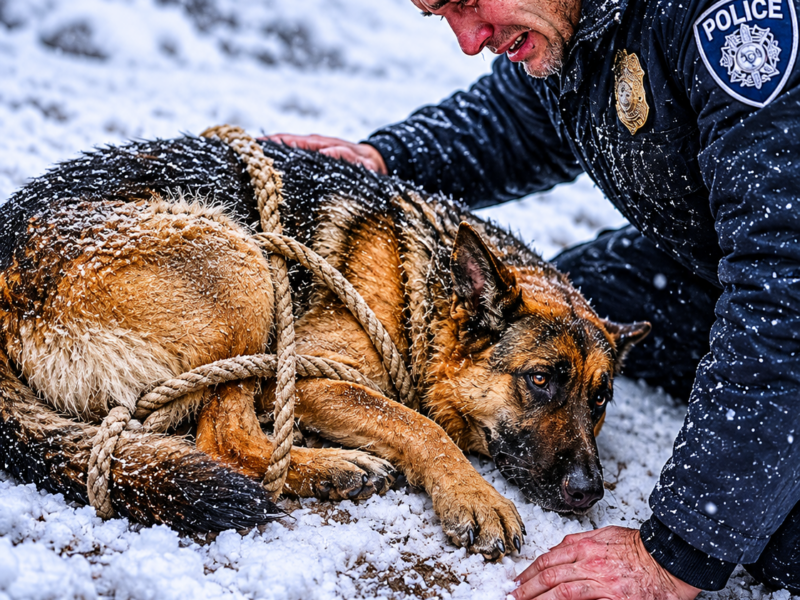
“I was kneeling in the snow beside a German Shepherd everyone in North Haven believed had died three years earlier when he suddenly grabbed my sleeve and pulled toward an abandoned freight depot
I looked at the handwritten note again.
“Do not reactivate K9-27. Transfer status must remain closed.”
Clare stood beside the examination table, her arms folded tightly across her chest. Ava still had one hand resting on Ranger’s neck, as if she was afraid he might disappear if she let go.
“Whoever entered this note knew the dog was alive,” I said.
“Or knew someone might discover he was,” Clare replied.
Ranger lifted his head.
His ears pointed toward the clinic’s front door.
A moment later, a vehicle rolled slowly across the parking lot.
I moved to the window.
A gray SUV passed the building without stopping. Its headlights swept across the waiting room, then vanished around the corner.
“Do you know that vehicle?” Ava asked.
“No,” I said.
But Ranger knew something.
He had gone rigid, his eyes fixed on the empty parking lot.
I called Sheriff Rebecca Sloan.
She arrived twenty minutes later, still wearing her winter coat, with snow gathering on her shoulders. Rebecca was forty-seven, practical, and not easily impressed by theories. She listened without interrupting while I explained the chip record, the handwritten note, and Danner’s name.
When I finished, she looked at Ranger.
“Three years,” she said quietly. “And nobody reported seeing him?”
“Apparently not.”
“Where was he?”
“I don’t know yet.”
Rebecca examined the printed record.
“Frank Danner retired shortly after Reeves died,” she said. “He handled evidence and property records for the department. I remember him. He was the person everyone called when paperwork went missing.”
“Convenient.”
“Maybe. But we don’t accuse someone because a database entry looks suspicious.”
“I agree.”
She looked at me for a long moment.
“Ethan, you were Reeves’s closest friend. That makes this personal.”
“It was personal three years ago, too. I just did a good job pretending otherwise.”
Rebecca said nothing.
She asked Clare to preserve the clinic records and requested a copy of the chip history. Then she told me she would review the original investigation file.
Before leaving, she crouched in front of Ranger.
“Good to see you, old boy.”
Ranger sniffed her hand.
Rebecca stood.
“Let’s find out what happened.”
The next morning, I went to the Reeves house.
I had driven past it dozens of times since Michael died. Every time, I told myself Sarah needed space. Every time, I found another reason not to knock.
The truth was uglier.
I had been afraid of looking into the face of the family I had promised to protect and admitting I had failed them.
Sarah opened the door.
For a second, neither of us spoke.
She looked older than she had three years earlier, though not in the way people usually mean. Her expression had acquired the tired patience of someone who had learned not to expect answers.
Then she saw Ranger standing beside me.
Her hand flew to her mouth.
“Oh, my God.”
Ranger stepped forward.
Sarah dropped to her knees and wrapped both arms around his neck.
He pressed his head against her shoulder.
She cried into his fur, making a sound I had not heard since Michael’s funeral.
Ava appeared behind her.
“Mom?”
She saw Ranger and hurried down the hall.
For several minutes, the three of them stayed together on the front porch while I stood outside in the cold.
Finally, Sarah looked up at me.
“Where have you been, Ethan?”
I swallowed.
“I should have come sooner.”
“That isn’t an answer.”
“No. It isn’t.”
She stood and wiped her cheeks.
“Come inside.”
The living room still held pieces of Michael’s life. His old hiking boots sat near the back door. A framed photograph of him and Ranger rested on the bookshelf. There was even a coffee mug with a chipped handle that he had refused to throw away.
I sat on the edge of the couch.
Sarah remained standing.
“Tell me everything.”
So I did.
I told her about the chip, the status marked deceased, Danner’s name, and the note. I told her Rebecca had opened a review of the original investigation.
Sarah listened with her jaw tight.
When I finished, she walked to a small cabinet and pulled out a black notebook.
“Michael left this with me,” she said. “I found it in his desk after the funeral. I didn’t know what to make of it.”
She handed it to me.
The first pages contained ordinary things: grocery lists, training notes, reminders about Ava’s school events. Then the handwriting changed.
There were dates, inventory numbers, and references to municipal storage depot records.
Several entries were underlined.
Third disposal audit rejected. Danner says the paperwork is complete.
Same property listed twice. Different destinations.
Original transfer sheets missing.
The final entry was dated two days before Michael died.
If they close this file, the copies need to reach county review. Eli has the intake numbers.
I looked up.
“Who is Eli?”
“I don’t know,” Sarah said. “Michael never mentioned him to me.”
She turned a page.
A section had been torn out near the back.
“Was that already missing?”
“Yes. I found the notebook that way.”
I stared at the ragged edge.
“Did Michael ever say he was afraid?”
Sarah hesitated.
“Not afraid for himself. He said someone was moving things through the depot and making the records look legitimate. He thought it involved more than missing equipment.”
“Why didn’t you tell the investigators?”
“I did. They said it was probably routine property disposal. They asked whether Michael had been under stress. They asked if he had been sleeping.”
Her voice hardened.
“They never asked why his backup camera was missing.”
I felt something cold settle in my chest.
“His camera?”
“He carried it in his vehicle. The investigators told me they couldn’t locate it.”
I looked down at the notebook again.
Michael had tried to tell someone.
And somewhere along the way, the evidence had disappeared.
That afternoon, Rebecca called me to the station.
She had pulled the old case file and placed several documents across her desk.
“Michael filed three audit requests concerning the municipal storage depot,” she said. “All three were closed by Danner.”
“Who approved the closures?”
“Danner signed two. The third has a supervisor’s approval, but the supporting documents are missing.”
“Was the depot ever searched?”
“According to the report, yes.”
“According to the report.”
Rebecca leaned back.
“I know what you’re thinking. We’re going to verify it before we do anything.”
She showed me photographs from the original incident.
Michael’s patrol vehicle had been found near the municipal storage depot. There was damage to the passenger side, a broken fence, and evidence of a fire in a storage building.
But there was no photograph of Ranger.
No recovered remains.
No veterinary report.
No clear explanation for how the dog had supposedly died.
“Why did everyone accept that?” I asked.
“Because the official report said the animal was lost in the fire.”
“Lost isn’t the same as confirmed dead.”
“I know.”
Rebecca tapped one of the pages.
“There’s another problem. The original inventory of recovered items doesn’t match the final property record.”
I leaned closer.
A portable camera was listed as recovered in the first inventory.
In the final record, it was marked destroyed.
“Someone changed this.”
“Possibly. We need the original documents.”
She picked up the phone.
“I’ve requested a county investigator and an independent records specialist. Until then, nobody touches the depot.”
“Danner?”
“I’m sending someone to speak with him.”
I left the station with Michael’s notebook in my jacket.
On the way home, I stopped at the old training field.
Ranger walked beside me, slower than I remembered. His coat was rough, and his back legs stiffened whenever he crossed uneven ground. But when I threw a worn training ball across the grass, his eyes brightened.
He brought it back carefully.
For a moment, I could almost see Michael standing beside him.
Then I heard a voice behind me.
“Officer Cole?”
A boy stood near the fence, holding a camera with both hands. He looked about twelve, with a knit hat pulled down over his ears.
“I’m Owen Parker,” he said. “I think I know that dog.”
I glanced at Ranger.
“Where did you see him?”
Owen opened the camera screen.
“I take pictures of trains near the old freight annex. A few months ago, I saw a man with a German Shepherd there.”
He enlarged the photograph.
The image was grainy. A gray SUV sat beside a loading platform. A man stood near a metal door, his face turned away.
Beside him was a German Shepherd.
The right ear was bent at the tip.
The dog’s muzzle had a pale streak.
I felt my throat tighten.
“Are you sure this was the same dog?”
Owen nodded.
“I thought it was strange because the dog kept looking toward the door. Like he wanted to go inside.”
“When was this?”
“About four months ago. I didn’t think it mattered until I saw the picture of Ranger online.”
He showed me the photograph’s date.
Four months earlier.
Ranger had been alive and at the freight annex.
I asked Owen to preserve the original image and not post it anywhere. Then I called Rebecca.
By evening, she had secured a warrant request for the annex and arranged for the county investigator to join the search.
We arrived the following morning.
The freight annex stood beyond a line of rusted tracks, its brick walls dark with age and its windows covered in dust. Snow had collected against the loading doors.
Ranger stepped out of the vehicle.
He sniffed the air, then moved toward the eastern side of the building.
“Easy,” I whispered.
He stopped at a metal door with a faded number painted above it.
K-27.
Rebecca looked at me.
“That number appears in the old property records.”
The county investigator tested the door.
Locked.
A maintenance worker arrived with a key ring. After several attempts, one key turned.
The door opened with a groan.
Inside was a narrow utility corridor. Old shelving lined the walls. Most of the shelves were empty, but a set of fresh scrape marks crossed the concrete floor.
Ranger moved to the far end and stopped beside a section of wall.
He pawed at the bottom edge.
The investigator crouched.
“That’s not attached properly.”
They removed a narrow metal panel.
Behind it was a shallow compartment containing plastic storage bins.
Inside the bins were folders.
Hundreds of them.
The labels matched municipal property numbers from Michael’s notebook.
Rebecca put on gloves and opened the nearest folder.
Her expression changed.
“These are original transfer sheets.”
The official records said the equipment had been destroyed or disposed of. The papers in front of us showed that some items had been transferred to private storage companies.
Others had been moved to locations that did not exist in the city’s inventory system.
Several signatures appeared repeatedly.
Frank Danner’s.
The county investigator began photographing everything.
Then Rebecca found a small digital camera in a sealed evidence pouch.
A handwritten label was attached.
Michael Reeves — backup camera.
My hands went cold.
The camera had been listed as destroyed three years earlier.
Rebecca looked at the investigator.
“Secure it. Document its location. Nobody handles it without recording every step.”
The camera was sent to the county lab.
While we waited, I returned to the annex with Ranger and searched the corridor.
Near the back wall, he found a small piece of blue fabric caught on a broken shelf.
I recognized it immediately.
Michael’s old uniform jacket had a blue lining.
I held the fabric between my fingers.
For three years, I had imagined the final moments of my friend’s life. I had pictured flames, smoke, confusion, and the terrible certainty that I should have been there.
Now I wondered whether Michael had been trying to leave the building when someone stopped him.
The thought nearly brought me to my knees.
The county lab recovered footage from the camera.
Rebecca asked me to watch it with her.
The first clips showed Michael documenting the depot inventory. He spoke clearly into the camera, reading out property numbers and explaining discrepancies.
Then came the final recording.
Michael stood in a dim room, his face tired but determined.
“If this reaches county review,” he said, “the original sheets are in the annex. The disposal records have been altered. Equipment listed as destroyed is being transferred out through private contractors.”
He looked over his shoulder.
“I’ve made copies. Eli has the intake numbers. If anything happens to me, he knows where to take them.”
A sound came from outside the frame.
Michael turned.
A man stepped into view.
Frank Danner.
He looked directly at Michael.
“You were told to leave the records alone,” Danner said.
Michael’s voice remained steady.
“They’re public property records. People deserve to know where their equipment went.”
Danner moved closer.
“You have no idea what you’re interfering with.”
“I know enough.”
The image shook.
Then the recording ended.
Rebecca paused the screen.
Neither of us spoke for a while.
Finally, she said, “We need to find Eli.”
We found him through an old employment record.
Eli Carter was sixty-one and had worked as an intake clerk at the annex before retiring. He lived alone in a small house on the outskirts of North Haven.
When we arrived, he opened the door only a few inches.
He looked at Ranger.
Then at me.
“Michael said you’d come someday.”
I felt my pulse quicken.
“You knew him?”
Eli opened the door.
“I helped him copy the intake records. I should have spoken up years ago.”
He led us to a kitchen table covered with old envelopes and paper files.
“I was responsible for logging incoming property,” he said. “When equipment arrived, I recorded the number, condition, and destination. Then I noticed the same items appearing under different numbers.”
He opened a folder.
“Some equipment was supposedly destroyed, but it was being sent to private warehouses. Some items were sold. Some disappeared completely.”
“Who was involved?”
“Danner handled the paperwork. He wasn’t alone, but I don’t know everyone.”
“Why didn’t you go to the police?”
Eli looked down.
“Because the people signing those forms were police officers and city officials. I had a wife and two daughters. I thought staying quiet would keep them safe.”
He reached into a drawer and took out a sealed envelope.
“Michael left this with me. He said I should give it to you if anything happened.”
The envelope was addressed to Ethan Cole.
My name.
In Michael’s handwriting.
I opened it carefully.
Inside was a short letter.
Ethan, if you’re reading this, I couldn’t get the records out in time. I’m sorry I didn’t tell you sooner. I know you would have helped, but I didn’t want to put you or your family in danger. Ranger knows the annex. Trust him. And don’t let them turn this into another closed file.
I read it twice.
The last line blurred.
Tell Sarah and Ava I love them. Tell them I tried to come home.
I lowered the letter.
For three years, I had carried the belief that Michael died because I wasn’t beside him.
Now I understood that he had been trying to protect me.
It did not make his death easier.
It made the silence worse.
Eli continued explaining the records, but I barely heard him.
Then Ranger stood.
His ears turned toward the back door.
A vehicle had stopped outside.
Rebecca moved to the window.
“Stay here,” she said.
She stepped onto the porch and spoke to someone.
A moment later, a man’s voice rose in anger.
“Those records belong to the department.”
I knew that voice.
Frank Danner.
Rebecca blocked the doorway.
“You need to step away from the property.”
“I have every right to inspect those records.”
“Not without authorization.”
Danner looked past her and saw me.
His face changed.
“Cole.”
I stepped onto the porch.
“You knew Ranger was alive.”
Danner’s eyes moved to the dog.
For a second, something like recognition crossed his face.
Then he looked away.
“I don’t know what you’re talking about.”
“The chip record was accessed sixty-three days after Michael’s death. Your name was attached to it.”
“Records get updated. Mistakes happen.”
“Not when someone writes a note telling everyone to keep a dead dog listed as dead.”
Danner’s jaw tightened.
“You have no idea what you’re doing.”
“I know what Michael was doing.”
Danner stepped forward.
“You should have left this alone.”
Rebecca moved between us.
“That’s enough.”
Danner tried to push past her.
The county investigator, who had been waiting near the driveway, stepped forward and ordered him to stop.
Danner resisted for a moment, then backed away.
He was not arrested that afternoon. Rebecca made it clear that any detention would follow the evidence and the legal process.
But his expression told me something had changed.
He was no longer certain the records would stay buried.
That evening, a heavy snowstorm rolled across the county.
Eli had agreed to give a formal statement the next morning. Rebecca arranged for a deputy to check on him overnight.
But before the deputy arrived, Eli called.
His voice was strained.
“I think someone is outside.”
Then the line went dead.
Rebecca dispatched two units.
I followed in my own vehicle, with Ranger in the passenger seat.
The snow was so thick that the road disappeared beyond my headlights. When we reached Eli’s property, his front door stood open.
“Eli!” I shouted.
No answer.
Ranger moved toward the side of the house, nose low.
I followed him through the snow.
He stopped near a detached utility building.
A faint sound came from inside.
Three knocks.
Then silence.
The door was jammed by a fallen shelf. I pushed against it, but it would not move.
“Eli! Can you hear me?”
A weak voice answered.
“I’m here.”
The deputy arrived with a pry bar. Together, we forced the door open.
Eli was on the floor, shivering, with a bruised shoulder. A shelf had fallen across the entrance after someone had forced the lock.
Ranger went straight to him.
Eli reached for the dog’s neck.
“Michael’s dog,” he whispered.
I knelt beside him.
“Can you stand?”
“With help.”
We got him outside and into the ambulance.
The deputy found fresh tire tracks behind the building. They led toward the county road but disappeared beneath the snow.
This time, there would be no quiet conversation about a simple accident.
Rebecca ordered the property secured and requested a forensic examination.
Eli survived.
The next morning, he gave his statement.
He identified the records, explained the false transfers, and described the pressure Danner had put on him. He also provided the names of two private contractors who had received equipment listed as destroyed.
The investigation widened.
Within weeks, county auditors uncovered a pattern of fraudulent transfers stretching back several years. Several former officials were questioned. Danner was charged with evidence tampering, obstruction, and conspiracy-related offenses after investigators connected him to the altered records and the attempted destruction of evidence.
Other charges followed as the case developed.
The camera footage, original transfer sheets, Eli’s testimony, and the chip history formed a chain of evidence that could no longer be dismissed as a clerical mistake.
The original report on Michael’s death was reopened.
Investigators found that the fire at the municipal storage depot had been deliberately set to destroy records. The evidence showed Michael had confronted Danner during the incident and was injured while trying to escape. His death had been classified as an accident despite inconsistencies that had never been properly investigated.
I will never forget the day Rebecca came to my house with the updated report.
She stood in my kitchen holding a folder.
“We can’t give you every answer,” she said. “But we can finally tell Sarah and Ava what the evidence supports.”
I looked at Ranger, sleeping beside the fireplace.
“Did Michael know he wasn’t coming home?”
Rebecca lowered her eyes.
“We found evidence that he tried to call for help. The call never reached dispatch.”
I closed my eyes.
For three years, I had replayed the night of his death and wondered what I could have done differently.
There was no answer that could undo it.
But there was finally a record that told the truth.
Sarah and Ava came to the station when the report was released.
Rebecca explained the findings carefully. She did not promise certainty where the evidence could not provide it.
Sarah listened without moving.
Ava held Ranger’s leash.
When Rebecca finished, Sarah reached for the report.
“Can I have a copy?”
“Of course.”
She held it against her chest.
Then she looked at me.
“Michael was trying to come home.”
I nodded.
“He was.”
Ava knelt beside Ranger.
“He didn’t forget us.”
“No,” I said. “He never did.”
The following spring, North Haven held a memorial for Michael.
It was not the ceremony he should have received three years earlier. It could not give him back the years he had missed or erase the pain his family had carried.
But this time, the department did not call his death an unfortunate accident and move on.
They read his service record.
They acknowledged his work uncovering the property fraud.
They recognized his courage in protecting public records and trying to get the truth to the people who needed it.
Ranger stood beside Sarah and Ava throughout the ceremony.
When the honor guard finished, Ava placed Michael’s old badge beneath his photograph.
Then she rested a hand on Ranger’s head.
“He should have been here,” she whispered.
I stood beside her.
“I know.”
After the ceremony, Sarah approached me.
“I was angry with you for a long time,” she said.
“You had every reason.”
“I thought you stayed away because you didn’t want to remember him.”
“I stayed away because I couldn’t stand remembering him.”
She looked toward Ranger.
“Michael would have wanted you to keep looking.”
“I should have.”
“Yes,” she said. “You should have.”
It was not forgiveness.
Not completely.
But it was honest, and honesty was something we had all been denied for too long.
Over the next several months, Ranger grew stronger.
Clare helped us manage his arthritis and arranged for him to receive the care he needed. She also began working with retired service dogs who had nowhere to go after their working years ended.
She named the program Ranger House.
The first time I visited, Ranger walked through the open doorway without hesitation.
There were soft beds, wide outdoor spaces, and a quiet room where older dogs could rest. Clare had put Michael’s photograph on a small shelf near the entrance.
“He would have liked this,” I told her.
“I think he would have,” she said.
Ava began volunteering there on weekends.
She had been accepted into the University of Minnesota’s pre-veterinary program, and she talked about her classes with the kind of excitement I had not seen in years.
Sometimes she brought her textbooks to my house and studied at the kitchen table while Ranger slept near her feet.
Sarah started coming over too.
At first, she stayed for coffee.
Later, she stayed for dinner.
We did not pretend the years apart had never happened. We talked about Michael, about the things we missed, and about the questions that might never have answers.
But we stopped treating his memory like a room none of us could enter.
One afternoon, I took Ranger back to the old training field.
The snow had melted, and new grass was beginning to push through the ground.
I carried Michael’s old training ball in my pocket.
Ranger looked at me, waiting.
“Ready?”
I tossed it a short distance.
He trotted after it, picked it up, and returned.
His pace was slower now. His muzzle was almost entirely silver. But his eyes still held the same steady focus.
I sat on the bench and let him rest beside me.
For a long time, I watched the empty field.
I thought about the night Michael died, the years of silence that followed, and the dog who had somehow survived long enough to bring us back to the truth.
I used to believe loyalty meant never letting go.
Now I understood it meant refusing to let the people we loved disappear into a lie.
Ranger rested his head on my knee.
I placed one hand on his neck.
“We found it, buddy,” I whispered. “We found the truth.”
He closed his eyes.
And for the first time in three years, I felt that I could breathe without carrying the weight of an unanswered question.
Michael was gone.
Nothing would change that.
But his name was clear again. His family knew he had fought to protect them. And the dog everyone had declared dead was finally home.
I stayed on that bench until the sun began to sink behind the trees.
Then I stood, clipped Ranger’s leash to his collar, and walked with him toward the road.
We were going home.
The end.









