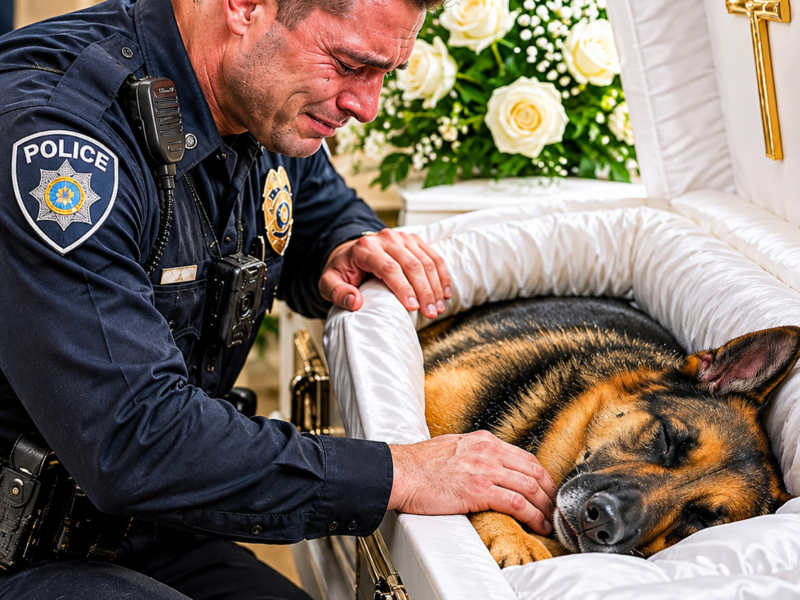
“I was kneeling beside my German Shepherd’s white coffin, preparing to say goodbye to the partner who had stood beside me for seven years
By the time I reached the veterinary clinic on the north side of Spokane, the snow had turned to gray slush along the roads.
Knox lay wrapped in the funeral blanket across the back of my SUV. His breathing was still shallow, and every time I glanced into the rearview mirror, I feared I would see his chest stop moving.
I had called Emily Carter only once.
The moment she heard the words “Knox is alive,” she told me to use the rear entrance.
Emily was thirty-eight, athletic, with auburn hair usually tied into a practical ponytail and clear green eyes that rarely missed small details. She had treated police and working dogs for more than a decade and had cared for Knox for the past four years.
She was calm around frightened owners, but she had very little patience for careless medical records.
When I carried Knox inside, she stopped in the hallway.
For one second, her professional expression disappeared.
“They told me he was dead.”
“So did they.”
She didn’t waste another second.
She guided us into an examination room, called two trusted technicians, and began checking his vital signs.
I stood outside the room, staring through the narrow glass panel.
Emily adjusted the monitoring equipment. One technician prepared a warming blanket. The other drew blood.
Knox barely moved.
My phone vibrated.
It was Lily.
Did you keep my tag with him?
I looked at the small metal tag in my palm.
I have it. It’s safe.
I almost typed something else.
I almost told her Knox was alive.
But I couldn’t make her go through another emotional collapse if his condition suddenly worsened.
So I put the phone away.
Nearly three hours passed before Emily stepped into the hallway.
“He’s still extremely weak,” she said. “But his breathing is more consistent, and his heart rhythm is stable.”
I stared at her.
“His heart?”
Emily understood.
“The report you received says sudden cardiac failure. That doesn’t match what I’m seeing.”
She brought me into a small consultation room and opened Knox’s medical records.
His examination from three weeks earlier showed a healthy heart, normal blood work, and no significant concerns.
Then she showed me the preliminary toxicology results.
“There is evidence of a powerful veterinary sedative in his system,” she said. “Enough to suppress his normal responses severely.”
I felt my jaw tighten.
“Could it make him appear dead?”
“In some circumstances, a heavy dose could make an animal appear unresponsive, with extremely shallow breathing and a very weak pulse. But I won’t speculate about exactly what happened until the testing is complete.”
“Was it prescribed?”
“There’s no legitimate administration documented in the records I received.”
Emily led me back to the examination room.
She gently separated the fur near Knox’s right shoulder.
“There’s something else.”
Beneath his coat was a small mark consistent with a recent injection.
I stared at it.
“Could someone have given him medication after he collapsed?”
“It’s possible. But then there should be a record. The dose, the time, the reason, and the person who administered it.”
She turned the computer screen toward me.
“There isn’t one.”
I looked at Knox.
Someone had given him an unrecorded drug. Someone had reported him dead. And someone had signed a veterinary release form without involving the veterinarian who knew his medical history.
This was no longer just an unexplained medical emergency.
It was a chain of decisions that had nearly ended with my dog being buried alive.
Knox’s eyes opened halfway.
I stepped closer.
“Hey, buddy.”
His left ear shifted toward my voice.
He tried to lift his head but couldn’t hold it up.
I placed my hand beside his paw.
He looked at me.
Emily watched quietly.
“He recognizes you.”
I nodded.
“Yeah.”
“Don’t ask him to do anything. He needs rest.”
I looked down at the metal tag in my hand.
“Can he make it?”
Emily didn’t offer false comfort.
“He has a real chance. That’s what I can tell you right now.”
I stayed until she insisted I get some food and sleep.
But I didn’t go home.
There was someone I needed to find.
Noah Price was outside the K9 training facility, reorganizing a stack of training cones that already looked perfectly organized.
He looked up when I approached.
His shoulders tightened.
“You wanted to tell me something at the funeral?”
He glanced toward the main building.
“Not here, sir.”
We walked behind the kennels to an empty training yard.
Snow rested along the fence line. The field was deserted.
I didn’t tell him Knox was alive.
Not yet.
“What happened at the warehouse?”
Noah rubbed his hands against his trousers.
“You got called over to the south loading bay for that paperwork issue. You were gone maybe five minutes.”
I remembered.
Knox had stayed with Noah while I checked the discrepancy.
“He went straight back toward truck 17,” Noah continued.
“Why?”
“He alerted.”
I studied his face.
“Are you sure?”
“Yes, sir. He wasn’t wandering around. He gave a trained alert. The same one he uses when he detects something he’s been trained to find.”
“What happened next?”
“A man came over from Northwest Evidence Transit. Victor Hail.”
I knew the name.
Victor Hail was forty-nine, carefully dressed, with dark silver hair and the polished confidence of someone accustomed to dealing with city officials and corporate clients.
He had built Northwest Evidence Transit from a small regional storage company into one of the largest private evidence contractors in the area.
“What did he want?”
“He told me to get Knox away from the truck. Said the vehicle wasn’t part of the inspection.”
“And you moved him?”
Noah nodded.
“I thought I was following an instruction from someone authorized to be there.”
“What happened after that?”
“About twenty minutes later, I saw one of Northwest’s employees walking toward the K9 rest area with a white veterinary supply case.”
My stomach tightened.
“Did you recognize him?”
“No. I’d seen him before, but I never knew his name.”
“Did you tell anyone?”
Noah looked down.
“I didn’t think it mattered until Knox collapsed.”
“Why didn’t you come to me?”
He swallowed.
“Because I was afraid.”
“Of what?”
He hesitated.
“Eight months ago, something similar happened with another dog.”
I waited.
“Her name was Ekko. Belgian Malinois. Seven years old. She alerted on one of Hail’s trucks during an inspection.”
“What happened to her?”
“Two days later, I was told she’d been transferred out of district.”
“Where?”
“I asked. My supervisor said it wasn’t the concern of a rookie officer.”
Noah’s voice dropped.
“I never saw her again.”
Before I could respond, his phone vibrated.
He checked the screen.
The color drained from his face.
“What?”
He showed me the email.
Effective immediately, Officer Noah Price was removed from all K9 assignments pending an administrative review.
There was no explanation.
No return date.
I read it twice.
“Did anyone tell you why?”
“No.”
I looked toward the main building.
Somebody had learned that Noah was talking.
And they wanted him away from the dogs.
The next morning, I sat across from Detective Maya Collins in an internal affairs office three floors above police headquarters.
Maya was forty-four, tall and lean, with closely cropped black hair and sharp eyes. She had spent nearly eighteen years in law enforcement, much of that time investigating cases other officers preferred to avoid.
She was not someone who accepted an accusation simply because the person making it wore a badge.
I explained everything.
Knox’s collapse.
The unexplained sedative.
The injection mark.
The gray truck.
Noah’s account.
And the missing dog named Ekko.
Maya listened without interrupting.
When I finished, she folded her hands on the desk.
“I believe you have legitimate questions.”
“Questions? My dog was almost buried alive.”
“And if you want whoever did this held accountable, we need evidence that will survive an investigation.”
I leaned forward.
“Where do we start?”
“Records.”
She opened her computer.
Northwest Evidence Transit had handled hundreds of sealed evidence shipments between police warehouses, forensic facilities, long-term storage sites, and disposal contractors.
Most of the records looked ordinary.
Some did not.
Maya showed me a shipment that had left the Airway Heights warehouse with a documented weight of one amount and arrived at its destination almost six hundred pounds lighter.
“Could be a scale problem,” I said.
“Possibly.”
She opened another.
This one arrived three hundred pounds heavier than the electronic inventory suggested.
Then another shipment showed a resealing time that occurred after the truck had supposedly departed.
The inconsistencies were different, but they appeared often enough to deserve attention.
“How many?”
“Enough that I don’t like it.”
Maya’s voice remained calm.
But I had learned that when she said something like that, she had already found more than she was willing to discuss.
By noon, she had requested preservation of the relevant transport records.
I returned to the K9 facility and found Noah in a records room.
He was no longer allowed to work with the dogs. His temporary assignment involved sorting old equipment logs.
“Maya is looking at Northwest,” I told him.
He glanced up.
“Internal affairs?”
“Yes.”
He hesitated.
“There’s something else I remembered.”
I waited.
“Truck 17 almost never left when the schedule said it did.”
He pulled an old dispatch log toward me.
“Most of their trucks departed between nine and ten at night. Number 17 sometimes sat at the warehouse for another forty minutes.”
“Where did it go afterward?”
Noah pointed to an old routing note.
“An abandoned cold storage property west of Spokane. It used to belong to a food distributor.”
“Was that an authorized evidence stop?”
He shook his head.
“Not according to the routing information I could access.”
I photographed the record and sent it to Maya.
Her reply arrived almost immediately.
Do not go there.
I typed back.
I wasn’t planning to.
Her response came a few seconds later.
That answer does not comfort me.
While Maya worked through the transportation records, Emily was examining another part of the case.
She had requested the old veterinary and transfer records for Ekko.
The Belgian Malinois had a clear history in the department’s system until eight months earlier.
Vaccinations.
Training certifications.
Annual examinations.
Handler notes.
Then the records suddenly stopped.
There was one transfer entry.
It said Ekko had been reassigned out of district.
But there was no receiving clinic, no new handler information, no updated vaccination record, and no confirmation that another department had accepted her.
Emily called me.
“I can prove Ekko left the local roster.”
“Can you prove where she went?”
“No. That’s the problem.”
She paused.
“I checked Knox’s microchip history, too.”
I straightened.
“What about it?”
“There’s a scan logged at 11:06 p.m. on the night he collapsed.”
I stared at the wall.
“The report says he was dead before that.”
“I know.”
She turned her monitor toward the camera.
The device registration was listed beneath the timestamp.
Northwest Evidence Transit.
Someone using equipment registered to that company had scanned Knox nearly an hour after the official time of death.
For the first time, the investigation had something stronger than suspicion.
It had a record.
Maya immediately ordered the information preserved.
That afternoon, Lily arrived at the clinic with our neighbor, Margaret Ellis.
Margaret was sixty-eight, with silver hair and a practical kindness that had helped our family through more difficult years than I could count.
She had brought my winter police jacket, which I had accidentally left in the clinic lobby.
Lily walked through the front entrance while I was speaking with Emily.
Then she saw the recovery room.
Knox was lying beneath a light blanket, his head raised slightly.
Alive.
Lily stopped.
I turned.
Neither of us moved for several seconds.
“Dad?”
I crouched in front of her.
“He’s alive.”
She looked at me, then back at Knox.
“You said he was gone.”
“We thought he was.”
“That isn’t what I asked.”
Her eyes filled.
I had no answer that could make the last two days disappear.
“Can I see him?”
Emily nodded.
“Slowly. Don’t ask him to move.”
Lily entered the recovery room and sat on the floor several feet away.
She didn’t rush toward him.
She simply looked at him.
“Hi, Knox.”
His ears shifted.
Lily’s lips trembled.
“You don’t have to come to me.”
Knox tried to stand.
His first attempt failed, and I stepped forward instinctively.
Emily touched my arm.
“Let him decide.”
Knox rested for several seconds, then tried again.
This time, he managed to stand.
His legs trembled beneath him.
One slow step.
Then another.
He crossed the short distance and lowered his head into Lily’s lap.
She wrapped her arms gently around his neck.
I looked away.
I needed a moment.
Later, while Lily sat beside him, she asked a question I hadn’t considered.
“If someone wrote down that Knox was dead when he wasn’t, how do we know they told the truth about Ekko being transferred?”
I stared at her.
An eleven-year-old had just identified the weakness in the story.
My phone rang.
Noah.
I stepped into the hallway.
“Daniel?”
“What happened?”
“They searched my locker.”
My shoulders tightened.
“What did they find?”
“A box of veterinary sedatives.”
I closed my eyes.
“What kind?”
“The same kind they said Knox had in his system.”
“Are they yours?”
“No. I’ve never seen them before.”
The investigation had just found its first human suspect.
And someone had chosen Noah.
By sunrise, he was no longer simply removed from K9 duty.
He had been placed on full administrative suspension. His access credentials were disabled, and the medication found in his locker was being treated as potential evidence against him.
On paper, the accusation looked convincing.
Noah had access to the canine area.
He had been alone with Knox during the warehouse inspection.
And now medication connected to the dog’s collapse had appeared among his belongings.
I stood beside Maya in the internal affairs records room while she reviewed the evidence report.
“He didn’t do this,” I said.
Maya didn’t look up.
“That may be true.”
“It is true.”
“Then help me prove it.”
She turned the monitor toward me.
Each bottle carried a manufacturing number and distribution code.
Maya compared them with the police veterinary inventory.
They did not match.
None of the bottles had ever been assigned to the department’s K9 medical stock.
Instead, the purchase records led to Northwest Evidence Transit.
The medication had been bought six months earlier under a veterinary support account used for working animals around secured storage facilities.
Then another name appeared.
Bradley Sloan.
He was thirty-three, narrow-faced, pale, with straight dark hair combed neatly to one side. He had worked around the department’s canine supply rooms for eleven months before leaving city employment four months earlier.
His former coworkers remembered him as polite, quiet, and eager to satisfy supervisors.
Three months after leaving, Sloan had accepted a logistics position at Northwest Evidence Transit.
His direct reporting line now led to Victor Hail.
Maya enlarged an access record.
“Sloan knew the canine facility,” she said. “He knew the supply rooms, the locker layout, and the staff schedules.”
I looked at the screen.
“He knew where Noah kept his things.”
Maya raised a hand.
“We have evidence of access. We don’t yet have evidence of what he did with it.”
That was enough to change the direction of the inquiry.
At the clinic, Knox was getting stronger.
He managed several slow steps across the recovery room before stopping beside my leg.
Emily immediately pointed toward his padded bed.
“Don’t encourage him.”
“I said three words.”
“You have a face that encourages bad decisions.”
Knox looked between us.
Emily crouched beside him.
“His strength is returning, but he isn’t going back to work.”
My smile faded.
I hadn’t said he would.
But she was right. I had been imagining his recovery as a return to patrol, to training, and to the next search.
For nearly seven years, that had been our routine.
Now I had to consider that getting Knox back might mean accepting that his working life was over.
At home that evening, Lily had brought Knox’s old equipment into the living room.
Retired collars, worn leads, training towels, a cracked rubber ball, and several harnesses lay across the carpet.
“You know we don’t need every piece of this,” I said.
She didn’t look up.
“You said that before.”
“Yes.”
“And I ignored you.”
“Correct.”
She pulled an older black tactical harness from the bottom of the box.
A small rectangular object dropped onto the carpet.
I picked it up.
It was a compact harness camera the K9 unit had tested during training exercises years earlier. Newer equipment had replaced it, and I had assumed the old device had been cleared out.
I turned it over.
“Where did you find this?”
“Inside the harness.”
“Does it still work?”
“I don’t know.”
I found the removable memory card.
An hour later, Maya was standing in my living room wearing gloves.
“You removed the card?”
“I wanted to know if there was one.”
“You could have called me first.”
“I called you after I removed it.”
She gave me a look.
Lily watched from the kitchen table.
“Is Dad in trouble?”
Maya turned toward her.
“Not officially.”
“That was unnecessary,” I said.
For the first time that day, Maya almost smiled.
The camera was documented and sent for examination.
Most of the memory had been overwritten or damaged, but several fragments remained recoverable.
Late that night, Maya called.
“Daniel, you need to see something.”
I returned to headquarters.
A technician had recovered one short video file.
The footage showed the evidence warehouse. Knox moved between storage rows, the camera rising and falling with his steps.
I recognized the eastern loading section.
Then truck 17 appeared.
Knox approached it and stopped.
“That’s the alert,” I said.
The rear door opened.
The camera captured part of the interior.
Several containers matched the declared evidence shipment.
Others did not.
They were sealed boxes carrying identification labels absent from the manifest Maya had already reviewed.
Then Victor Hail stepped into view.
He stood beside the truck, calm and composed.
For several seconds, he looked toward Knox.
Then his eyes shifted directly toward the small camera mounted on the dog’s harness.
The file ended.
Maya replayed the final seconds once.
Then she closed the video.
“From this point forward,” she said, “we’re no longer investigating whether you were right.”
I waited.
“We’re investigating how long this has been happening.”
The following afternoon, another person contacted me.
Frank Dawson was a retired K9 trainer, sixty-two years old, broad-shouldered, with a close white beard and weathered hands shaped by more than thirty years working around police dogs.
He had retired four years earlier after his wife’s long illness left him exhausted and increasingly detached from the job.
Frank had always been patient with dogs and less comfortable around people.
He told me he had heard that investigators were asking questions about Ekko.
“I should have said something sooner,” he began.
“What do you know?”
“Two other canines alerted during Northwest inspections. Both were removed from active duty soon afterward.”
“Under what circumstances?”
“One was listed as having behavioral problems. The other was medically retired.”
“Did you question it?”
Frank looked down.
“I accepted the paperwork. My wife was sick. I wanted to retire. I told myself someone above me knew more than I did.”
“You couldn’t have known everything.”
“I knew enough to wonder.”
He handed Maya a collection of old kennel notes and dates.
They did not prove misconduct by themselves, but they extended the pattern farther back than Ekko.
That night, Maya called again.
“I found truck 17.”
“Where?”
“It’s scheduled for outbound transport tomorrow morning.”
“From the main warehouse?”
“No. The cold storage property Noah mentioned.”
I stood beside Knox’s recovery bed.
“When?”
“Eight-fifteen.”
Maya paused.
“And Daniel?”
“Yeah?”
“Do absolutely nothing until I call you.”
I looked at Knox.
The truck that had hidden behind altered paperwork for months was about to move again.
Before sunrise, Maya had submitted a request for a search warrant covering the abandoned cold storage property west of Spokane, truck 17, and any secured rooms connected to Northwest’s operations.
The recovered harness footage, the microchip scan, the transport discrepancies, and the medication records gave her enough evidence to seek formal authority.
By eight, the warrant had been approved.
When Maya called, I was standing beside Knox.
“I’m coming with you,” I said.
“No.”
“That warehouse exists because Knox found something.”
“And that’s exactly why you’re not walking through it before the evidence team does.”
“Maya—”
“If Hail is charged, his attorneys will examine every person who touched anything in that building. You’re the handler of the dog he allegedly tried to remove from the picture. You’re emotionally involved, and everyone knows it.”
I looked through the glass at Knox.
“I can help.”
“You already have. Now let the investigators do their job.”
Her voice softened slightly.
“I need this case to survive longer than your anger.”
That ended the argument.
Shortly after nine, officers secured the cold storage property.
The complex stood behind rusted fencing and wind-bent weeds. Its faded metal walls looked abandoned, but newer tire tracks crossed the snow outside.
Truck 17 sat beside one of the loading bays.
Maya’s team began the search.
I remained at Emily’s clinic, trying to focus on the fact that Knox was finally sleeping peacefully.
Then my phone rang.
“We found something outside,” Maya said.
Forty minutes later, she called again.
An old canine harness had been discovered near the rear fence, partially hidden beneath a collapsed plastic storage crate.
The officers had photographed it and sealed it in an evidence bag.
There were letters scratched into the metal clasp.
EKKO.
I stared at the screen.
Eight months earlier, the department had told Noah that the Belgian Malinois had been transferred out of district.
Now part of her equipment was lying behind an abandoned warehouse used by Northwest.
Maya had secured permission for Emily to evaluate Knox before bringing him near the property.
She agreed to a brief, controlled visit, provided Knox showed no signs of fatigue.
When we arrived, Emily made the conditions clear.
“He is not performing a full operational search. He is still recovering. If he gets tired, we leave.”
I nodded.
Near the rear fence, Knox noticed the sealed evidence bag.
His head lifted.
His posture changed.
It wasn’t excitement.
It was recognition.
He moved closer, smelled the outside of the bag, then looked toward me.
Emily examined the worn clasp through the plastic.
“Ekko,” she said quietly.
Knox turned toward the loading building.
Maya watched him.
Emily folded her arms.
“No pushing him.”
“I haven’t said anything.”
“You don’t need to.”
Knox took another step.
Emily studied him carefully.
His breathing was steady, but he was still weaker than before.
“If he goes inside,” she said, “it will be brief. No extended search. The second I say stop, we stop.”
Maya nodded.
“One section. Under supervision.”
I clipped on Knox’s leash.
For nearly seven years, that movement had been automatic.
Now it felt different.
I crouched beside him.
“You don’t have to prove anything, buddy. You already did your job.”
Knox looked at me.
I gave the familiar search signal.
He moved forward.
Inside the warehouse, two long rows of containers stretched beneath cold fluorescent lights. Investigators left space around us as Knox moved slowly through the first aisle.
He passed the second row.
Then he stopped near the far wall.
A plain metal door stood ahead, marked only with an old inventory number.
Knox sat straight back, focused.
The same alert I had seen thousands of times.
Maya immediately took control.
The door was opened under the authority of the warrant.
Inside were shelves of sealed evidence containers and transport cases.
Some were supposed to be stored at other facilities.
Others carried identification numbers that had disappeared from the electronic tracking system months earlier.
In an adjoining office, investigators found paper files connecting Northwest employees to repeated changes in transfer records, resealing logs, storage destinations, and canine retirement paperwork.
Maya stood over one open file.
“How bad?” I asked.
“Years.”
The records showed a pattern.
Whenever certain canines repeatedly reacted to suspicious Northwest shipments, administrative explanations appeared soon afterward.
Behavioral problems.
Medical retirement.
Transfer.
The dogs had been removed from assignments that might bring them into contact with Northwest operations again.
Someone had turned trained warnings into personnel problems.
Knox looked toward a narrow hallway at the far end of the storage room.
Emily checked him.
“He’s getting tired.”
I nodded.
“We’re done.”
But Knox continued watching the hallway.
He wasn’t pulling or barking.
He simply refused to look away.
Maya noticed.
“Let’s see what’s down there.”
Knox stayed beside me while the investigators continued without him.
At the end of the hallway stood a smaller locked room not shown on the main property layout.
The door opened.
Everyone stopped.
Inside were three working dogs.
They were separated into individual spaces with food, water, blankets, and basic care supplies. They appeared uncertain around the unfamiliar people entering the room, but there were no immediate signs requiring emergency veterinary intervention.
Emily moved forward to assess them.
Then one of the dogs stood.
A seven-year-old Belgian Malinois with a lean fawn body, dark facial mask, and amber eyes.
Ekko.
Frank Dawson had been asked to remain nearby because of his knowledge of the older canine files.
When Maya brought him to the doorway, he stopped walking.
For several seconds, he couldn’t speak.
“Ekko,” he whispered.
The dog turned toward him.
Frank covered his mouth with one hand.
“I thought she was gone.”
Maya arranged for Noah to come to the property for identification.
His suspension was still in place while the medication evidence was reviewed, but he had worked around Ekko enough to recognize her.
When he entered the room, he didn’t rush toward her.
He knelt several yards away and raised one hand in an old kennel signal.
“Come.”
Ekko’s ears moved forward.
Noah repeated the signal.
The Malinois hesitated.
Then she crossed the room.
Noah didn’t reach for her.
She completed the distance herself and stopped beside him.
He closed his eyes.
I understood that expression.
It was the look of someone who had spent months wondering whether he had failed a partner who could no longer answer him.
Across the warehouse, Maya’s team found additional access records.
Bradley Sloan had entered the K9 facility during the period before the sedatives were discovered in Noah’s locker.
The medication batch matched Northwest’s purchase records.
The evidence established that Noah had not brought the bottles into the department.
Maya approached him.
“The suspension related to those bottles is being withdrawn.”
Noah looked up.
“You mean they know I didn’t put them there?”
“We have evidence that the medication came from Northwest’s supply batch and that an outside employee had access to the area where your locker was located.”
His shoulders finally relaxed.
He looked down at Ekko.
“I thought I’d lost everything.”
“You haven’t,” Maya said.
Outside, movement drew attention near the rear gate.
Victor Hail was attempting to leave the property in a dark SUV.
Officers stopped him before he reached the road.
He was taken into custody without incident.
I could see him across the loading yard.
The man who had stood beside truck 17.
The man whose company records connected the unexplained shipments, the missing canine equipment, and the unrecorded medication.
For a moment, I wanted to walk toward him.
I wanted to ask why he had done it.
I wanted to know how he could look at a working dog and see a problem to be eliminated.
But Knox leaned against my leg.
He was exhausted.
I crouched and removed the working lead.
“We’re done, partner.”
He lowered his head against my shoulder.
I didn’t look back at Victor Hail.
The people responsible would answer to the investigators and the courts.
I had already found what mattered most.
Knox had brought us to the truth.
And now I was taking my partner home.
Three weeks later, Spokane had begun to thaw.
Snow still clung to shaded parking lots, but the afternoons were brighter, and meltwater ran beneath the curbs.
The investigation continued beyond truck 17 and the cold storage warehouse.
Investigators reconstructed years of transportation records, altered chain-of-custody entries, and unusual storage transfers.
Victor Hail and several employees were formally charged as the inquiry expanded.
Northwest Evidence Transit lost its city contracts, and every evidence route it had handled was placed under review.
Maya called me only when there was something important to report.
“The case is moving without you now,” she said one afternoon.
I was sitting outside Emily’s clinic while Knox rested beside my chair.
“That sounds intentional.”
“It is.”
For weeks, I had wanted every detail.
Now that the system was finally producing answers, I realized I didn’t need to hear every one of them.
The department established an independent review process for sensitive evidence transportation and K9 medical or transfer records.
No working dog connected to a disputed assignment could simply disappear behind an administrative entry without outside verification.
Emily was asked to serve as an independent veterinary adviser for canine health transfers and retirement reviews.
She showed me the appointment letter.
“You’re smiling,” I said.
“I’m reading.”
“You’re smiling while reading.”
She folded the paper.
“Go bother your retired dog.”
That brought me to the most important decision.
Knox was recovering well.
His coat had begun to shine again, and he could cross the clinic yard comfortably without assistance.
But Emily was firm.
“He can have a good life, Daniel. A very good one. But no more patrol work.”
I looked toward Knox, who was lying beneath a bare maple tree.
His muzzle was grayer now.
His eyes were still alert, but his body tired more quickly than it used to.
“For nearly seven years,” I said, “I imagined his retirement as the end of something.”
Emily nodded.
“Sometimes it is.”
I watched Knox lift his head as Lily’s voice sounded from the clinic entrance.
“Maybe this is the beginning of something else.”
Emily smiled.
“That’s a better way to think about it.”
Noah came by the following day.
His suspension had been removed from his record, and the department formally acknowledged that the medication found in his locker had not been his.
He looked different without the weight of the accusation.
Still young.
Still lean.
Still with sandy hair that never seemed to sit perfectly in place.
But the tension in his shoulders was gone.
“They offered me handler certification,” he said.
I looked at him.
“With Ekko?”
He smiled.
“She’s still in rehabilitation. But she responds to me.”
We watched through the clinic window as Ekko walked beside him in the yard.
She was cautious around unfamiliar people, but when Noah raised his hand, her attention settled immediately on him.
“You taking the position?” I asked.
He barely let me finish.
“Absolutely.”
Frank Dawson began volunteering at the retired K9 rehabilitation center that had taken in the other recovered dogs.
He repaired fence panels, cleaned feeding stations, and spent long afternoons sitting beside dogs that no longer understood why nobody was giving them commands.
He never made speeches about redemption.
He simply kept showing up.
And I think that was what he needed most.
Knox’s retirement ceremony was deliberately small.
No formation.
No polished speech.
No ceremonial goodbye.
I had already watched him lie in a white coffin once while he was still alive.
I wasn’t interested in making him stand through another ending.
I signed the final retirement papers and clipped on his familiar black leash.
Noah stood near the kennel entrance with Ekko beside him.
Frank was nearby.
Emily watched from the clinic doorway.
I raised one hand.
Noah returned the gesture.
Then I opened the truck door.
“Come on, partner.”
Knox climbed in carefully.
That afternoon, Lily was waiting in the front yard.
She held a new leather collar with both hands.
I parked beside the house and stepped out.
She didn’t rush toward the truck.
“What does it say?” I asked.
She turned the small metal plate around.
Knox, home.
I smiled.
“Good choice.”
I opened the rear door.
Knox stood there for several seconds.
He looked at the house, the grass, and then Lily.
She remembered how weak he had been at the clinic.
Instead of running toward him, she walked into the yard, sat down, and waited.
Knox stepped from the truck.
No command.
No search signal.
No expectation.
He crossed the yard slowly.
When he reached Lily, she wrapped her arms gently around his shoulders.
Knox lowered his head against her.
I turned away for a moment.
Three weeks earlier, I had knelt beside a white coffin believing this moment had been taken from us forever.
Now my daughter was holding her best friend in our own front yard.
Later, I arranged for the empty coffin to be donated to a small educational exhibit about working dogs and responsible retirement.
It was displayed without a body inside.
I liked that.
For once, emptiness didn’t mean loss.
It meant someone had survived.
Months passed.
Ekko completed rehabilitation and officially returned to work with Noah.
Frank sent me a photograph from their first formal training day.
Ekko sat alert beside Noah, while the young officer looked almost too proud to hide it.
Knox learned a different routine.
Morning walks.
Waiting for Lily’s school bus.
Sleeping in patches of sunlight.
Following me from room to room for no practical reason at all.
He still watched the doors when someone knocked.
He still tilted his head when Lily spoke to him.
And sometimes, when I came home from work, he would rise slowly from his bed and meet me at the entrance.
Not because I had given a command.
Because he wanted to.
In early spring, I took Lily and Knox to Lake Coeur d’Alene.
The afternoon was cool but bright. The water stretched blue-gray beneath the sky, and the mountains beyond the lake still carried snow near their peaks.
Lily walked ahead along the shoreline.
Knox followed at an easier pace.
He was slower now, and more gray covered his muzzle, but there was peace in the way he moved.
I stayed several yards behind.
After a while, Knox stopped.
He turned his head and looked back.
For seven years, he had done that everywhere we went.
Training yards.
Parking lots.
Warehouses.
Unfamiliar buildings.
Always checking.
Always making sure I was still there.
I lifted one hand.
He watched me for another second, then turned and continued toward Lily.
A little later, he looked back again.
I was still there.
This time, there was no warehouse waiting, no truck number 17, no hidden door, no evidence route, and no next assignment.
Knox had only one job left.
To come home every day.
And for the rest of his life, home would be waiting.
I still think about that morning in the funeral home.
The white coffin.
The quiet room.
The small metal tag Lily had made with her own hands.
And the faint movement beneath my palm.
I could have accepted the report.
I could have trusted the signature.
I could have let grief convince me that there was nothing left to question.
But something didn’t feel right.
So I looked again.
That one small breath led us to a missing dog, a young officer who had been framed, and an evidence operation hidden behind years of paperwork.
It gave Ekko a chance to come home.
It gave Noah his future back.
It gave Frank an opportunity to make peace with the questions he had once been afraid to ask.
And it gave my daughter something I had almost taken from her.
One more morning with Knox.
I used to think loyalty was about following orders, completing a mission, and standing beside someone until the job was finished.
Knox taught me something different.
Sometimes loyalty means noticing what others overlook.
Sometimes it means refusing to accept an easy answer.
And sometimes, the bravest thing a person can do is simply look again when everyone else has turned away.
Maybe faith works that way, too.
Not always through a grand sign or a sudden miracle.
Sometimes it comes as one faint breath in a silent room.
A small reminder that the story isn’t over yet.
Knox never needed another medal.
He had already given more than enough.
He deserved warm mornings, long naps, Lily’s laughter, and a home where nobody expected him to risk his life again.
And every evening, when I watched him settle beside the front door, I remembered the words on that little metal tag.
Knox, always come home.
He did.
The End.









