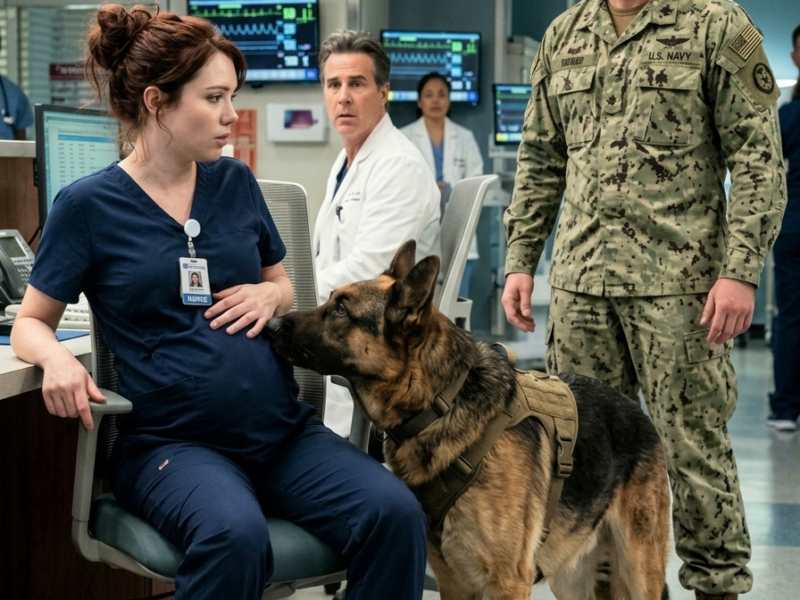
I was kneeling beside a Navy SEAL’s K9 outside a locked hospital room when the dog suddenly blocked his handler from reaching me, and the SEAL coldly asked, “Can I help you?”
The fluorescent lights of the third-floor corridor in Bethesda Naval Hospital hummed with a low, agonizing vibration that seemed to align perfectly with the pulsing ache behind my eyes. The smell was instantly recognizable—a harsh mixture of harsh antiseptic, dried floor wax, and the sterile coldness that only lives in places where people come to die or be kept against their will. It was 2:15 AM. The floor had been cleared of non-essential staff hours ago, leaving only the soft click of my heels echoing off the linoleum as I moved past closed doors and darkened nurse stations.
I wasn’t supposed to be here. Visitors had been turned away at eight o’clock, but I hadn’t come through the main entrance. I had used an emergency stairwell access door that should have been locked, following a trail of unanswered messages and a growing, suffocating dread that had consumed me for the last seventy-two hours.
Then I saw him standing at the far end of the hallway, right outside Room 314.
He was tall—easily six-foot-three—wearing a dark tactical uniform stripped of unit patches, though the distinct cut of his gear and the absolute stillness in his posture marked him instantly. He looked exhausted, the shadows under his sharp jaw deep and gray, but there was nothing relaxed about him. Beside his left boot sat a massive Belgian Malinois. The dog’s coat was a rich sable, his ears pinned forward, his dark intelligence focused entirely on the empty corridor until the exact moment my shoe squeaked against the floor.
The dog shifted instantly, his weight dropping low into a tactical stance. His eyes locked onto mine with a cold, terrifying precision.
I froze, my hand instinctively pulling my heavy trench coat tighter around my throat. I tried to maintain composure, lowering my head and taking a measured step toward the adjacent hallway that led toward the diagnostic labs. I tried to walk past, acting like an overworked technician or an off-shift staff member who belonged in the sterile quiet.
The Malinois didn’t buy it. A low, rolling growl vibrated deep within his chest, a sound so primal it echoed off the narrow walls and made the hairs on the back of my neck stand up.
The man didn’t flinch. He simply shifted his weight, his calloused right hand tightening its grip on the short, thick nylon leash attached to the dog’s heavy-duty tactical harness. He stepped directly into my path, cutting off the main corridor.
“Can I help you?” he asked.
His voice was a flat, icy rasp—devoid of hostility, yet entirely devoid of warmth. It was the voice of a man accustomed to giving orders that were followed without question, a man who viewed every unknown variable in his environment as an imminent threat to be neutralized.
I stopped ten feet away, my heart hammering against my ribs like a trapped bird. “I’m… I’m just looking for my sister,” I stammered, hating the weakness in my tone. “She’s an overnight resident on this floor.”
His dark eyes traversed my face, analyzing every subtle twitch of my eyes, the posture of my shoulders, the way my breathing had shallowly hitched. His expression hardened into something carved from granite. “Visiting hours ended six hours ago. The resident quarters are on the fourth floor, accessible only through the south elevator tower. You’re in a restricted recovery wing.”
“I got lost,” I said quickly, taking half a step backward, pretending my hands weren’t shaking inside my pockets. “I’ll just head back to the main lobby.”
I turned my shoulder, preparing to retreat back toward the safety of the stairwell, desperate to put distance between myself, this dangerous stranger, and the oppressive weight of the hallway.
Then the leash went slack.
The Malinois didn’t wait for a command. With a sudden, explosive movement, the dog pulled free from the handler’s grip, his claws tearing against the polished floor as he lunged straight toward me. A gasp caught in my throat. I braced myself for the impact, expecting two hundred pounds of biting pressure to tear into my arm, closing my eyes against the inevitable violence.
The attack never came.
Instead, the dog slid to a stop inches from my knees. He didn’t bite. He didn’t bark. He pressed his wet, cold nose directly against the wool fabric of my coat pocket, inhaling deeply, and then let out a sharp, high-pitched whine that sounded almost like a cry of recognition.
The silence that followed was suffocating.
The handler stood frozen, his hand still suspended in the air where the leash had been. The coldness in his eyes shattered, replaced by a sudden, intense shock. “Ranger,” he commanded, his voice dropping an octave, laced with disbelief. “Heel. Ranger, back!”
The dog ignored him completely. He pressed his forehead against my hip, leaning his entire body weight into me, his tail giving two tentative, low wags.
I looked down into the dog’s golden-brown eyes, and a wave of memories so violent it made my knees buckle washed over me. The memory of a small tactical compound in North Carolina, of morning dust rising off the training fields, of a young, energetic pup who used to steal my gloves whenever I sat on the porch waiting for the team to return.
“You remember me,” I whispered. The words slipped past my lips before my conscious mind could filter them, soft and fragile in the silence of the hospital floor.
The handler moved. In two long, silent strides, he closed the distance between us, his shadow towering over me. His face had transformed from distant suspicion to a deadly, razor-sharp focus. “What did you say?” he demanded, his hand moving inches toward the side of his tactical belt. “Who are you?”
Panic surged through me. I backed away, pressing my spine against the cold glass of a framed medical certificate on the wall. “Nothing. I didn’t say anything. Get your dog off me.”
Ranger didn’t retreat. He reached up with his heavy front paw and scraped violently at the lower right pocket of my coat. The heavy fabric shifted, exposing the sharp outline of the small, rectangular metal object resting inside.
A heavy-duty, clearance-level hospital keycard.
Ranger’s whine shifted into a sharp, insistent growl—not directed at me, but at the card itself.
Ethan reached out, his hand open, his posture commanding. “Hand it over. Now.”
“Don’t,” I breathed, clutching the outside of my pocket. “It’s mine.”
He looked at me for a long, agonizing moment. His eyes traveled from my trembling hands up to my throat, where the high collar of my coat had shifted during my sudden movement. In the harsh fluorescent light, a sliver of pale, jagged tissue was exposed—a deep, jagged scar that snaked down from beneath my ear, disappearing beneath my collarbone.
Ethan’s breath hitched. The air left his lungs in a quiet, ragged exhale. The lethal edge in his posture didn’t soften, but it changed shape into something far more dangerous: recognition.
His voice dropped to an intense whisper that sent a chill straight down my spine. “Where did you get that scar?”
I couldn’t answer him. The blood in my ears was pumping so loudly it muffled the ambient noise of the building. How could I tell him? How could I explain that three years ago, that very scar was the physical mark left by a burning beam falling across my chest—the precise moment my world burned to ash?
Three years ago, my family had buried an empty casket. They had been given official reports, signed by government officials and dental inspectors, declaring that I had died in an explosion and fire that destroyed our home in rural Virginia. They believed I was dead. They believed my husband, Captain Thomas Vance, had perished beside me.
I had let them believe it. I had run away with a ruined face and a new name because I had been terrified. On the night of the fire, before the flames consumed the living room, I hadn’t been alone with my husband. I had seen the men who entered our house. I had seen the tactical insignias on their sleeves, and I had seen Thomas hand them a encrypted drive before the first device was detonated. I had survived by crawling through a drainage pipe behind the shed, bleeding and burned, knowing that whoever had ordered that strike had resources that spanned the entire military hierarchy.
Someone had been hunting me ever since. Someone who knew I had survived, leaving subtle warnings in my various safehouses over the years—a misplaced key, a broken lock, a single black feather on my windshield.
Ethan slowly reached up and removed his tactical gloves, dropping them onto the floor without looking. His knuckles were raw, scarred from years of close-quarters combat. “My name is Ethan Cole,” he said, his eyes scanning every line of my face, searching for a ghost. “I was the team lead for Bravo Element. Thomas Vance was my commander.”
“I know who you are, Ethan,” I whispered, the name tasting like ash on my tongue. “I saw your picture on his desk every day for four years.”
His eyes narrowed to razor slits, his breath catching in his chest. “Clara?” he breathed, the name coming out as a stunned revelation. “Clara… you died in Richmond. I helped search the rubble myself.”
Before I could answer, before I could tell him that the ashes he searched were staged, Ranger suddenly spun around.
The dog didn’t look at us anymore. He dropped into a deep, aggressive stance, his lip curling back to reveal rows of gleaming teeth, staring directly at the locked metallic door of Room 314 behind us. He began scratching violently at the reinforced bottom panel, his heavy claws making a horrible, screeching sound against the steel.
“Ranger, quiet!” Ethan commanded, but his own hand instinctively dropped to the side of his belt, his eyes snapping to the door.
A heavy electronic lock clicked nearby. A door at the end of the wing opened, and a nurse in blue scrubs stepped into the corridor carrying a tray of covered specimen vials. She stopped dead in her tracks when she saw us clustered around the restricted door.
Her gaze drifted from Ethan’s tactical gear to the snarling Malinois, and finally to my face. The moment her eyes met mine, every ounce of color drained from her skin. The plastic tray in her hands tilted, and two glass vials shattered against the floor, splashing red solution across the white linoleum.
“You…” she stammered, her voice thin and terrified. “You’re not supposed to be here. Neither of you.”
I felt the last bits of warmth drain from my body. Ethan stepped between me and the nurse, his body shielding me instinctively, his voice dropping into that terrifying, cold command tone. “Why isn’t she supposed to be here? Who is inside Room 314?”
The nurse didn’t answer. She backed away toward the security desk, her hand reaching blindly for the wall-mounted distress button. “Security is already on their way. You need to leave. He said if anyone came looking for that file—”
“Who said?” Ethan growled, taking a massive step toward her.
She didn’t answer. She turned and fled down the corridor, the heavy double doors swinging shut behind her with a soft pneumatic hiss, leaving us in complete isolation once again.
Ranger barked once—a deafening, sharp sound that echoed in the tight space—and slammed his forepaws against the door of Room 314.
My fingers were trembling so violently I could barely function, but I pulled the metallic keycard out of my coat pocket. I held it out toward Ethan.
“I didn’t steal this from a hospital,” I said, my voice cracking under the immense weight of the truth. “I found this two hours ago inside my sister’s apartment in downtown D.C. She’s been missing for forty-eight hours. She left this tucked inside a hidden compartment in her Bible, wrapped in a note that had my real name on it.”
Ethan took the card from my fingers. His eyes dropped to the clear black lettering printed beneath the Bethesda Naval Hospital emblem.
It wasn’t a standard visitor pass. It was a high-level medical proxy card, granting unrestricted access to the dark-site trauma recovery unit. And printed directly beneath the authorization bar code was the owner’s full legal name:
CAPTAIN THOMAS VANCE – PATIENT 09-BRAVO
Ethan looked from the card back to my face, his jaw clenching so hard the muscles jumped beneath his skin. The shock in his eyes gave way to a cold, terrible understanding. “Thomas,” he breathed, the name barely audible. “They told the unit he was killed in action during the residential breach. They gave us sealed caskets.”
“He didn’t die,” I whispered, tears finally breaking through my resolve and spilling down my cold cheeks. “And neither did I. But whatever is behind that door, Ethan… it isn’t just a medical secret. It’s the reason we were both hunted.”
Behind the thick, reinforced steel door of Room 314, a heavy mechanical thud echoed. The sound of a heart monitor—slow, deliberate, and hollow—vibrated through the wall. Then came the unmistakable drag of a heavy metallic frame being moved against the floor from the inside.
Ranger lowered his head, his growl deepening into a continuous, terrifying rumble. He stepped directly up to the keycard reader beside the handle, his nose pointing at the electronic sensor, waiting.
He hadn’t been tracking a intruder. He had been tracking the scent of his former master—the man he had searched for across three years of military cover-ups, lies, and blood.
Ethan raised the keycard to the digital scanner. “If I swipe this,” he said quietly, his eyes meeting mine with absolute intensity, “there is no going back. Whatever is in there changes everything.”
“Swipe it,” I said.
The red light on the scanner flickered, turned yellow, and then, with a sharp electronic beep, flashed a solid, glowing green. The heavy magnetic locks inside the door disengaged with a loud, mechanical CLANG.
The heavy steel door didn’t swing open automatically. It unsealed with a slow release of pneumatic pressure, releasing a cloud of air that smelled of ozone, heavy disinfectants, and something metallic—like old copper and stagnant water.
Ethan didn’t hesitate. He pushed the door inward, his body low, his hand hovering over his sidearm. Ranger slipped through the gap before the door was fully open, his tactical harness scraping against the frame.
I stepped into the room behind them, my heart hammering against my chest so hard I could barely breathe.
The room was vast, but it looked nothing like a standard hospital recovery suite. There were no windows. The walls were covered in soundproofing acoustic panels painted a dull, industrial gray. In the center of the space stood a single hospital bed surrounded by bank after bank of advanced monitoring equipment, mechanical ventilators, and automated IV infusion pumps that hummed with a rhythm like a mechanical heartbeat.
And sitting on the edge of the bed, illuminated only by the pale blue glow of the telemetry monitors, was a man.
He was thin—shrunken almost to the bone compared to the broad-shouldered warrior I had married seven years ago. His hair was streaked with gray, cropped short, and his left arm was encased in a dark carbon-fiber brace that ran from his wrist up under his hospital gown. But when he raised his head, his pale blue eyes caught the light.
“Thomas…” The word escaped my throat before I could stop it, a broken, agonizing sound.
The man froze. He didn’t turn toward me immediately. His eyes locked onto Ranger, who had stopped three feet away. The Belgian Malinois didn’t attack. He dropped to his belly, crawling forward inch by inch, whining softly, resting his heavy snout directly onto the man’s bare, cold foot.
Thomas’s hand—trembling violently—reached down and touched the dog’s head. “Hey, buddy,” he whispered. His voice was ruined, raspy and dry, like gravel grinding together. “You found me.”
Then, slowly, Thomas turned his head toward us. His gaze swept past Ethan and landed squarely on my face.
He didn’t scream. He didn’t jump up. His eyes simply widened, filling with a terror so profound that his heart monitor instantly began to beep rapidly, the digital screen flashing yellow warning alerts across the room.
“Clara?” he rasped, pushing himself back against the headboard, his hands clawing at the white sheets. “No… no, no, no. Ethan, why is she here? Why did you bring her here? You were supposed to keep her away!”
Ethan didn’t move from his position by the door, but his face was white as chalk. “Keep her away? Thomas, we thought she was dead! You told the unit she was dead! You signed the official casualty reports!”
“I had to!” Thomas shouted, a harsh, coughing fit interrupting his words. He clutched his chest, gasping for air as the monitors chimed frantically. “If they knew she survived the fire, they would have finished it! I made a deal with them! I gave them everything—the codes, the access protocols, my own freedom—just to keep her name off the target list!”
I took a step forward, my hands shaking so violently I had to ball them into fists. “A deal with who, Thomas? Who burnt our house down? Who has been watching me for three years?”
Thomas looked at me, tears streaming down his hollow cheeks, tracking through the faint, silver scars that crossed his own jawline. “It wasn’t a rogue element, Clara. It wasn’t an enemy force.” He looked up at Ethan, his eyes filled with a desperate, terrible truth. “It was Command. It was the Admiral.”
Ethan went rigid. “Admiral Vance? Your father?”
“He isn’t my father anymore,” Thomas spat, the bitterness in his voice cold enough to freeze the air in the room. “He’s the director of Project Aegis. Three years ago, my unit uncovered what Aegis actually was—it wasn’t a defense initiative. It was an domestic surveillance and tactical elimination protocol designed to target internal military whistleblowers before they could reach Congress.”
Thomas pointed a trembling finger at the monitors surrounding his bed. “I tried to wipe the servers. I tried to destroy the data core at our house before they arrived. But they caught us. My father gave me a choice that night in the flames: enter this facility under a dark-site designation, submit to their medical trials for advanced combat recovery, and stay dead… or watch Clara be executed in front of me.”
“I saw them,” I whispered, the realization hitting me like a physical blow. “The men who came into the house… they weren’t wearing hostile uniforms. They were wearing Navy insignia.”
“They let you escape, Clara,” Thomas said, his voice breaking. “Or at least, my father let you think you escaped. He kept you on a leash. He allowed you to live under false names just far enough away to keep me compliant. Every time I refused to cooperate with his directives in this room, he sent me a photo of you—getting coffee in Richmond, buying groceries in Norfolk, entering your sister’s apartment in D.C.”
Ethan took a slow, deliberate step into the center of the room. His hand dropped entirely from his sidearm, hanging loose at his side as he stared at his former commander. “Your sister… Sarah,” Ethan said, turning his head toward me. “The keycard. How did Sarah get it?”
“Sarah discovered the truth three days ago,” Thomas said, his chest heaving as he struggled for oxygen. “She works in the Navy’s administrative logistics department. She stumbled across a dark-budget line item funding a specialized life-support pod in Bethesda under my old service number. She came here. She used her clearance to clone a master keycard from the duty nurse’s terminal.”
Thomas looked at me with pure panic in his eyes. “Clara, where is Sarah now?”
“She’s gone,” I said, my voice barely audible over the hum of the ventilators. “Her apartment was turned upside down. Her phone is off. The only thing left was this keycard taped inside her Bible.”
“They have her,” Thomas whispered, closing his eyes as a single tear slipped down his cheek. “My father has her. And if you’re here… if you used that card…”
Before he could finish his sentence, the digital display on the wall-mounted hospital monitor flickered violently. The steady blue telemetry line vanished, replaced by a flashing red alert box that illuminated the dark room:
SECURITY BREACH – LEVEL 4 LOCKDOWN INITIATED
A harsh, low-frequency alarm began to pulse through the walls—not the bright, ringing siren of a fire alarm, but the quiet, rhythmic horn of a tactical lockdown. The heavy mechanical locks on the door behind us slammed shut with a series of heavy metallic thuds.
The lights in the room plunged into darkness, leaving only the ominous, flashing red emergency beacons above the doorway.
“Ethan!” Thomas yelled, trying to swing his legs over the side of the bed, but the heavy carbon-fiber brace locked his knees in place. “They knew the card was swiped! The moment she scanned it at the wing perimeter, it triggered an automated ping to the Admiral’s personal detail!”
Ethan was already moving. He slammed his weight against the heavy steel door, checking the electronic lock. The keypad was dead, its screen dark. “We’re sealed in,” Ethan said, his voice dropping into the flat, dangerous tone of a soldier in an ambush. “They’ve isolated the entire third floor.”
Ranger stood up, his ears pinned back, his body tense as a bowstring. He faced the ventilation grate near the ceiling, letting out a low, continuous growl that vibrated through the floorboards.
From deep within the ventilation shaft, a faint, metallic hiss began to echo.
“Halon gas,” Ethan said instantly, pulling his tactical shirt up over his nose and mouth. “They aren’t coming to arrest us, Thomas. They’re scrubbing the room.”
“No,” Thomas gasped, coughing as the first faint wisps of odorless, heavy gas began to sink toward the floor. “The maintenance hatch… behind the telemetry rack. It leads to the utility sub-basement!”
Ethan didn’t ask questions. He surged forward, grabbing the massive metal equipment rack that held six heavy cardiac monitors and ripping it away from the wall with a brute force born of pure adrenaline. Behind it sat a heavy, round iron access hatch secured by a manual wheel lock.
“Clara, get over here!” Ethan roared over the rising sound of the gas system.
I ran to the wall, holding my coat over my mouth as the air in the room grew suddenly thin and ice-cold. My chest felt tight, my lungs screaming for oxygen as the Halon displaced the room’s atmosphere.
Ethan spun the iron wheel with both hands, his muscles straining against years of rust and neglect. With a sharp metal screech, the hatch unsealed, swinging open to reveal a pitch-black vertical shaft dropping into the depths of the hospital structure.
“Go!” Ethan ordered, grabbing my shoulder and shoving me toward the opening. “There’s a ladder! Down to the bottom, now!”
“What about Thomas?” I screamed, looking back through the gathering haze of gas.
Thomas was on his feet, but his limbs were failing. He collapsed to his knees beside the bed, his face pale, gasping for air that was no longer there. Ranger was tugging frantically at his hospital gown with his teeth, trying to pull his master toward the wall.
Ethan didn’t hesitate. He lunged across the room, scooping Thomas’s emaciated frame up onto his broad back in a fireman’s carry. “Ranger, through the hatch! Lead!”
The Belgian Malinois leaped cleanly into the dark shaft, his claws echoing as he caught his balance on the metal staging platform below. I scrambled down the freezing iron rungs of the ladder, the darkness swallowing me whole, while Ethan followed right behind me, carrying the heavy weight of my husband on his shoulders.
Above us, the steel hatch slammed shut as the pressure in Room 314 equalized.
We dropped into the damp, echoing pitch-black of the sub-basement, surrounded by the rush of subterranean water pipes and the distant, heavy footsteps of armed men descending the main stairwell above.
The air in the sub-basement was thick with humidity and the metallic stench of iron rust. Overhead, massive steam pipes ran in parallel lines across the concrete ceiling, hissing steam into the darkness like sleeping monsters. The only light came from the narrow beam of a tactical flashlight Ethan had pulled from his belt, its white light cutting through the swirling mist.
Ethan lowered Thomas gently against a damp concrete pillar. Thomas was gasping, his throat clicking as he fought to recover from the gas exposure. Ranger immediately crouched beside him, pressing his heavy body against Thomas’s ribs to keep him warm.
“How many?” Ethan asked, his voice low as he checked the magazine of his sidearm, the sharp click of the metal slide echoing in the narrow corridor.
Thomas sucked in a ragged breath, leaning his head back against the concrete. “Standard detail for an asset recovery… four men. Fully kitted. Thermal optics, suppressed sidearms. If my father sent his primary team, it’s led by Vance’s former XO… Miller.”
Ethan’s jaw tightened. “Miller was with us in Fallujah. He knows how I move.”
“He knows how we all move,” Thomas corrected, reaching out to grasp Ethan’s tactical vest. “Ethan… you can’t fight them in here. Not with me as dead weight and Clara unprotected. The sub-basement runs two miles east, connecting the main naval hospital to the old subterranean cold-war bunkers beneath the navy yard. There’s an exit shaft near the old boiler building on 4th Street.”
“And your father?” I asked, kneeling beside Thomas, my hand finding his cold, scarred fingers. “What will he do when he finds Room 314 empty?”
Thomas looked at me, his blue eyes hollow in the flashlights beam. “He’ll burn the entire building if he has to, Clara. To the world, I died three years ago. If my body isn’t in that room, it means the entire Aegis protocol is compromised. He cannot afford for me to walk out into the daylight.”
A loud, metallic crash echoed from the vertical shaft behind us.
The heavy iron hatch at the top of the ladder had just been blown off its hinges. The muffled sound of tactical boots hitting the iron rungs began to vibrate down through the concrete structure.
“They’re down,” Ethan said flatly. He clicked off his flashlight, instantly plunging us into absolute, suffocating darkness. “Ranger, heel.”
The dog moved silently, his nails making no sound on the wet concrete floor as he positioned himself at Ethan’s knee.
“Clara, take Thomas’s right arm,” Ethan whispered into the dark, his voice steady despite the overwhelming odds. “We move quiet, we move fast. If shooting starts, you drop flat to the deck and don’t move until I tell you.”
We moved through the dark subterranean labyrinth like ghosts. I supported Thomas, his weight heavy and desperate against my side, his breath coming in shallow hitches. We navigated through narrow service corridors, stepping over rusting pipes and puddle-filled drainage ditches, guided only by Ethan’s hand occasionally touching my shoulder to indicate a turn.
Behind us, two hundred yards back, pale green beams of night-vision lasers began to sweep through the darkness, cutting through the steam like light sabers.
“They’re using thermal,” Ethan whispered, stopping us in an alcove behind a massive industrial water boiler. “Our heat signatures are glowing like flares in this cold air. They’ll catch us before we reach the boiler house exit.”
“The steam lines,” Thomas choked out, pointing a trembling finger toward a valve array mounted on the wall above us. “The main pressure release for the hospital laundry system. It’s manual… if you crack that valve, it will flood this entire section of the corridor with three hundred degree vapor. It’ll blind their thermals.”
“It’ll burn us alive if we’re caught in it,” Ethan replied.
“Not if we’re on the other side of the blast door,” Thomas said, pointing ten yards ahead to a heavy, rust-covered iron door marked DANGER – HIGH VOLTAGE. “That door leads to the old rail tunnel. It’s sealed with a mechanical drop-bar.”
Ethan looked at the approaching laser beams. They were moving fast, coordinated, sweeping every corner with deadly efficiency. We had less than thirty seconds before they rounded the main junction.
“Take him to the door,” Ethan commanded me, pulling a heavy tactical knife from his chest rig. “Get ready to drop the bar behind me.”
“Ethan, no!” I whispered, grabbing his arm.
He looked at me, his eyes dark and unwavering in the faint light. “I spent three years thinking I failed Thomas that night in Richmond. I thought I left my team leader to burn. I’m not failing him twice, Clara. Get to the door!”
I grabbed Thomas around the waist, dragging him through the puddles toward the heavy iron blast door ten yards away. Thomas was barely conscious now, his feet dragging uselessly against the concrete, but he forced himself forward through sheer force of will.
We reached the blast door. I grabbed the heavy iron wheel on the wall, straining with all my remaining strength to break the rusted seal. The iron screeched, flaking rust onto my face and hair, but slowly, the mechanism began to yield.
Behind us, at the end of the corridor, a voice echoed through the steam—cold, amplified, and entirely devoid of emotion.
“Captain Vance. Sergeant Cole. Stand down. You are in possession of classified naval assets. Surrender immediately or lethal force will be authorized.”
It was Miller.
Ethan didn’t answer with words. He lunged toward the steam valve array, driving the heavy steel hilt of his tactical knife directly into the emergency pressure release pin.
With a deafening, terrifying roar, the high-pressure steam line ruptured.
A blinding, white wall of superheated vapor erupted into the corridor, filling the narrow concrete space instantly. Screams of pain echoed from the far end of the hallway as the thermal optics worn by the tactical team amplified the sudden, massive infrared bloom, blinding them instantly, while the sheer heat forced them back.
“Go! Inside!” Ethan roared, emerging from the wall of steam like an apparition, his face reddened by the heat.
He threw Thomas through the opening of the blast door. I scrambled in right behind him, followed by Ranger, who was barking hysterically at the wall of fog. Ethan lunged through last, grabbing the inner edge of the heavy iron door and slamming it shut with a deafening metallic thud that cut off the roar of the steam.
I lifted the heavy steel drop-bar and slammed it down into its iron brackets, locking the door from the inside.
Silence descended upon us instantly—a thick, heavy silence broken only by the sound of our ragged breathing and the slow dripping of condensation from the curved ceiling of the old rail tunnel.
We were in an abandoned subway shaft, built in the early 1940s to connect the naval hospital to the central rail network. The ground was covered in rotten wooden ties and rusted steel tracks that stretched out into the infinite blackness before us.
Thomas collapsed onto his back on the gravel, gasping for air, his face pale gray. Ranger immediately began licking his cheeks, whining softly.
Ethan leaned against the locked blast door, his chest heaving, his dark uniform dripping with condensation and sweat. He turned his flashlight on, directing the light down toward his own sidearm. He dropped the magazine into his hand, counting the rounds by feel.
“Fourteen rounds,” Ethan said softly. “No spare mags. And Miller’s team will break through that blast door in less than ten minutes with an oxy-acetylene torch.”
I knelt beside my husband, holding his cold hand in mine. “Thomas… where does this tunnel go?”
Thomas opened his eyes slowly, looking up at the curved brick archway above us. “It goes to the old Navy Yard station… beneath 8th Street. But that’s not where we need to go, Clara.”
He reached into the pocket of his hospital gown with a hand that shook violently, pulling out a small, metallic flash drive secured around his neck by a thin dog-tag chain.
“What is that?” Ethan asked, stepping closer.
“It’s everything,” Thomas whispered, his eyes filling with tears as he pressed the small piece of metal into my palm. “The real Aegis files. The names of every officer involved, the financial trail, the locations of the other dark-site recovery pods… and the footage from our house three years ago.”
He looked at me, his fingers tightening around mine with a strength I didn’t think he still possessed. “Sarah didn’t just find my keycard, Clara. She found the master encryption key. That’s why they took her. She put it on this drive and slipped it into my room right before she was captured.”
“Thomas…” I sobbed, pressing the drive to my chest.
“You have to take it to the Federal Courthouse in D.C.,” Thomas rasped, his voice dropping to a desperate whisper. “There is a Deputy Director at the Department of Justice named Marcus Vance… my uncle. He’s the only man in the city my father hasn’t been able to buy or intimidate. If you give him this drive, it ends. Everything ends.”
Suddenly, a loud, high-pitched screech echoed from the iron blast door behind us.
A bright, blue-white point of light burned through the center of the heavy steel. A stream of sparks erupted into the darkness as an oxy-torch began to cut through the metal lock.
Miller’s team was through.
Ethan looked at the burning steel, then turned his gaze down the long, dark stretch of the rail tunnel. His face settled into a look of absolute, calm resolve—the expression of a man who had already made his peace with what was coming.
“Take the dog,” Ethan said quietly, reaching down to unhook Ranger’s short leash from his belt and handing it to me.
“Ethan, no,” I said, my voice rising in panic. “We can all make it! We can carry him!”
“We can’t carry him two miles through a tunnel before they catch us, Clara,” Ethan said, his tone entirely devoid of fear, filled only with a quiet, undeniable logic. “Thomas can’t run. If you try to carry him, they catch all three of us, and that drive never reaches the Justice Department. My mission three years ago was to protect this unit. I failed then. I’m not failing tonight.”
He looked down at Thomas. Thomas reached up, grabbing Ethan’s arm. The two men—brothers forged in the fire of war and betrayal—looked at each other for a long moment without saying a single word.
“Bring them down, Ethan,” Thomas whispered, his voice thick with emotion.
“Count on it, Boss,” Ethan replied with a cold, faint smile.
Ethan turned to me. He reached out and grabbed my shoulder, his grip firm and steady. “Run, Clara. Keep moving east down the tracks. Don’t look back. Don’t stop for anything until you see daylight.”
He looked at the Belgian Malinois. “Ranger… protect her.”
The dog let out a low bark, his tail giving a single, precise wag. He understood.
Ethan unlatched his heavy tactical vest, dropping it to the ground to increase his speed, holding only his sidearm in his right hand. He turned his back on us and began walking deliberately back toward the blast door, where the blue flame of the torch was already half-way through the iron bar.
“Go!” Ethan roared over his shoulder.
I grabbed Thomas’s arm, slinging it over my shoulder with every ounce of strength left in my battered body. Ranger moved into position beside us, pressing his side against Thomas to help support his weight.
We stepped out into the pitch-black length of the rail tunnel, moving away from the light, as the sound of shattering iron and heavy gunfire began to tear the night apart behind us.
The darkness inside the abandoned subway tunnel was complete—a heavy, suffocating blackness that seemed to press against my skin. The only way we could navigate was by keeping one hand on the damp brick wall of the tunnel while Ranger trotted half a step ahead, his sharp senses guiding us over the uneven wooden ties and rusted metal rails.
Behind us, the sound of gunfire had ceased.
The absolute silence that followed was far more terrifying than the roar of the weapons. It meant the engagement at the blast door was over. It meant Ethan had either stopped them… or he was gone. I refused to let my mind dwell on the second possibility. I squeezed the metallic flash drive tightly in my palm until the corners bit into my skin, letting the physical pain keep me anchored to reality.
Thomas’s weight was becoming almost impossible to bear. His body was burning with a sudden, violent fever—a reaction to the Halon gas and the sheer physical trauma of being dragged from his life-support system. His boots dragged continuously through the gravel, his head resting heavily against my shoulder.
“Clara…” he mumbled, his voice slurred, his words barely intelligible. “Stop… you have to… leave me…”
“Shut up, Thomas,” I whispered, tears cutting clean tracks through the dirt and soot on my face. “I spent three years mourning you. I spent three years believing I was completely alone in the world. I am not leaving you in this sewer.”
“You… you don’t understand…” Thomas gasped, his legs completely buckling beneath him. We both crashed down onto the cold gravel tracks, a sharp pain shooting through my knees as I hit the sharp stone ballast.
Ranger instantly circled back, his cold nose nudging my neck, letting out a soft, frantic whine.
“Thomas! Get up!” I pleaded, pulling on his arm, but he was a dead weight. His eyes were rolling back into his head, his breathing coming in wet, rattling gasps.
“The drive…” Thomas rasped, his hand weakly pushing my chest away. “It… it has a GPS beacon inside the casing… Clara… my father… he didn’t just track the keycard… he was tracking the encryption key the entire time…”
My heart stopped.
I scrambled to open my hand, staring down at the small metal flash drive in the dark. In the microscopic seam near the USB connector, a tiny, faint red diode was pulsing slowly—once every three seconds.
A tracker.
Sarah hadn’t known. In her desperation to save Thomas, she had brought a tracking device straight into the darkness with us.
Before I could process the horror of the realization, a beam of harsh, white light erupted in the tunnel behind us—half a mile back, but moving fast.
“They’re in the shaft!” I screamed silently, pulling Thomas’s arm back over my shoulder with a sudden surge of pure, unadulterated panic. “Thomas, please! Stand up!”
He couldn’t. His body had given out completely.
Ranger dropped into a low crouch, facing back toward the distant light. A low, terrifying growl echoed from his chest, his lip curling back over his white teeth.
Then, through the darkness, a voice carried down the long brick cylinder—not over a loudspeaker, but echoing off the curved walls with a terrifying, familiar clarity.
“Clara.”
It wasn’t Miller.
It was an older voice—cultured, calm, and entirely devoid of heat. A voice I had heard over holiday dinners, a voice that had offered toasts at my wedding seven years ago.
Admiral Richard Vance.
“Clara, stop running,” the voice echoed through the dark, accompanied by the measured, rhythmic crunch of multiple sets of combat boots on gravel. “You have been remarkably resilient, my dear. Truly. But this foolishness ends tonight. You cannot escape the grid.”
I squeezed my eyes shut, holding Thomas’s limp body in my arms on the cold ground.
“You think you are saving him, Clara,” the Admiral’s voice continued, drawing closer with every second. The bright white light of their high-powered lanterns was illuminating the brick archways just a hundred yards away now. “Look at him. He is a broken shell. He has been sustained only by the very medical technology my program provided. Without his daily stabilization protocols, he will be dead in two hours anyway. You are suffering for a corpse.”
“He’s my husband!” I screamed into the darkness, my voice echoing off the damp brick walls. “And you’re a monster!”
A soft, dark laugh echoed down the tunnel. “I am a pragmatic man, Clara. I built a system that protects this nation from internal decay. My son understood that once, before his sentimentality blinded him. Give me the drive, Clara. Walk away. I will give you a new identity, unlimited funds, a life in absolute peace in whatever corner of the world you choose. But the drive stays here.”
The light was fifty yards away now. I could see their silhouettes—four heavily armed men in dark tactical gear, with the tall, broad figure of Admiral Vance walking calmly behind them, wearing a immaculate dark overcoat.
I looked at Thomas. His eyes were half-open, staring up at the dark ceiling of the tunnel. His hand reached up, his fingers brushing against my scar—the scar his father’s men had given me three years ago.
“Clara…” Thomas whispered, his voice faint as a breeze. “The river…”
I froze. “What?”
“The tunnel… twenty yards ahead…” Thomas rasped, his eyes locking onto mine with a final, desperate burst of clarity. “The old storm drainage outlet… it dumps directly into the Anacostia River… take the drive… swim…”
“No, Thomas! I won’t leave you!”
“You aren’t leaving me,” Thomas whispered, a faint, beautiful smile touching his pale lips. “I’m already gone, my love. Finish it.”
He reached up with his remaining strength and slammed his hand against Ranger’s tactical collar, pressing a small blue button hidden beneath the dog’s thick fur.
Ranger’s entire posture changed instantly. He didn’t look at Thomas anymore. He turned his heavy head toward me, grabbed the thick wool of my trench coat sleeve in his jaw, and began pulling me backward with incredible, immovable force.
“Ranger, stop! No!” I cried out, struggling against the dog’s powerful grip, but the Malinois was relentless. He was executing his final, absolute command from his master: Extract the package.
“Clara! Run!” Thomas screamed with the last strength in his lungs, using his hands to throw himself across the metal tracks, his body blocking the narrow passage between two fallen concrete pillars.
“Hold fire!” the Admiral’s voice roared from the darkness. “Secure the asset! Don’t shoot the girl!”
Ranger yanked me backward with a force that threw me off my feet, dragging me ten feet down the dark track until we reached a narrow, vertical breach in the brick wall where cold, wet air was rushing in with the roar of churning water.
The storm drainage outlet.
Below us, thirty feet down through the pitch-black opening, the dark, turbulent waters of the Anacostia River raged against the concrete pylons of the 8th Street bridge.
I looked back one last time.
In the blinding glare of the approaching flashlights, I saw Thomas lying across the tracks, his arms locked around the legs of the lead tactical operator, tripping him onto the gravel, delaying their advance by three crucial seconds. I saw Admiral Vance step forward, his face cold and unreadable in the harsh light, raising a dark sidearm toward the ground.
BANG.
A single gunshot echoed through the ancient brick tunnel.
A scream ripped from my throat—a sound of such raw, unadulterated agony that it didn’t even sound human.
Ranger didn’t let me hesitate. The dog lunged forward, his heavy body slamming into my hip, knocking both of us off the ledge of the drainage shaft.
We fell into the freezing, pitch-black abyss.
The cold air rushed past my ears for one terrifying second, and then the icy, black water of the river swallowed me whole.
The water was a freezing, violent force that instantly stole the breath from my lungs. The current beneath the surface was fierce, tumbling me over and over like a ragdoll in a washing machine, dragging me down into the muddy depths of the Anacostia River.
My clothes felt like lead weights pulling me toward the riverbed. My lungs screamed for air, the cold tearing through my body like millions of tiny needles. In the pitch-black water, I lost all sense of direction. I didn’t know which way was up, which way was safety, or where the surface was.
Then, a strong, firm force gripped the back of my heavy wool coat collar.
Ranger.
The dog was kicking furiously, his powerful legs driving us upward against the raging current. He bit down on my thick collar, dragging my head above the surface just as my lungs were about to give out.
I broke through the water, gasping violently for air, coughing up dark, brackish river water.
The rain was coming down in sheets now, stinging my face. Above us, high up on the concrete embankment of the 8th Street Bridge, the red and blue emergency lights of police cruisers were flashing, searching the water with heavy spotlights. The Admiral’s men had already called in a civil distress alert to cover their operations.
“Good boy…” I choked out, my arm wrapping around Ranger’s neck as we rode the heavy current toward the muddy eastern bank under the shadow of an old industrial shipping dock. “Good boy…”
We scrambled out of the freezing water onto the muddy shore, collapsing beneath the wooden stilts of the dock, hidden in the deep shadows away from the sweeping searchlights on the bridge above.
I lay in the freezing mud, my body shivering so violently my teeth were clicking together, clutching my chest. My mind was a complete vacuum of horror. Thomas was dead. He was gone. The man I had spent three years grieving, the man I had found again for twenty fleeting, terrifying minutes in a dark hospital room, had been murdered by his own father on the cold gravel of an abandoned train track.
And Ethan… brave, loyal Ethan… was buried somewhere in that concrete labyrinth beneath Bethesda.
I was entirely alone.
Ranger crawled up beside me, resting his wet, heavy head directly over my heart, whining softly as he licked the mud from my frozen cheek. His warmth was the only thing keeping me from sinking into absolute shock.
My fingers slowly uncurled.
In my right hand, covered in river silt and blood from my raw knuckles, was the metal flash drive. The tiny red LED light was dead—waterlogged and short-circuited by the river water, its tracking signal silenced forever.
I squeezed it tight.
“Finish it.”
Thomas’s final words echoed in my mind, drowning out the sound of the rain, drowning out the roar of the wind, drowning out the suffocating weight of my own grief.
I pushed myself up out of the mud. My legs were shaking, my body bruised and battered, but something inside me—something that had been broken three years ago in the fire—had suddenly hardened into pure, unyielding steel.
They had taken my home. They had taken my face. They had taken my husband.
They weren’t taking anything else.
“Come on, Ranger,” I whispered, my voice cold and entirely steady. “We have a delivery to make.”
The Belgian Malinois stood up instantly, shaking the river water from his dense coat, his golden eyes locking onto mine with fierce, absolute loyalty.
We climbed up the muddy embankment, slipping through a gap in the chain-link fence that bordered the industrial rail yard, emerging onto the quiet, rain-slicked asphalt of 8th Street SE.
It was 5:30 AM. The first faint, bruised-purple rays of dawn were breaking through the heavy storm clouds over Washington D.C., reflecting off the wet pavement and the towering marble domes of the federal district in the distance.
The city was just beginning to wake up. Street sweepers were moving slowly down the avenues, early morning delivery trucks were idling at red lights, and commuters were starting to trickle into the subway entrances. To anyone passing by, I was just a homeless woman in a ruined, soaking-wet coat, walking a stray dog through the cold morning rain.
They had no idea what I was carrying in my hand.
We walked three miles through the quiet streets, avoiding the main avenues, moving through alleys and side streets until the massive, ancient granite pillars of the E. Barrett Prettyman Federal Courthouse loomed out of the morning mist.
The building was guarded by armed U.S. Marshals stationed at the heavy glass entrances, their yellow rain slickers bright against the gray stone.
I stepped onto the wide granite steps leading up to the main plaza.
A marshal stepped forward, his hand resting casually on his hip, his brow furrowed as he watched the wet, bloodied woman and the massive Belgian Malinois approach. “Ma’am? You can’t be up here. The courthouse doesn’t open to the public until eight o’clock.”
I didn’t stop walking. I climbed the final step, standing six feet from him, the morning rain dripping off my nose and jaw.
“I need to see Deputy Director Marcus Vance,” I said. My voice was clear, loud, and carried across the empty marble plaza like a bell.
The marshal hesitated, caught off guard by the absolute authority in my tone despite my appearance. “The Deputy Director isn’t in his office yet, ma’am. And even if he were, you need an appointment—”
“Tell him Clara Vance is standing on his steps,” I interrupted, taking one step closer, holding up my hand and uncurling my fingers to reveal the silt-covered metal drive. “Tell him I have the Aegis core file. And tell him his brother just murdered his son.”
The marshal’s face went entirely slack. He looked at the drive, then at the deep scar visible beneath my wet coat collar, and finally at the broad-chested Navy SEAL K9 standing at my side in a tactical stance.
Without saying another word, the marshal reached for his shoulder radio, his fingers trembling as he pressed the talk button. “Control… this is Post One. I need an immediate armed escort for a walk-in at the main entrance. Code Alpha. Notify Deputy Director Vance personally. Right now.”
Ten minutes later, I was sitting in a high-backed leather chair inside a massive, wood-paneled office on the sixth floor of the courthouse. A hot cup of black coffee sat untouched on the mahogany desk in front of me. Ranger was lying at my feet, his chin resting across my boots, sleeping deeply for the first time in twenty-four hours.
Standing across the room, staring out the floor-to-ceiling windows at the Capitol building, was Deputy Director Marcus Vance. He looked strikingly like Thomas—the same broad shoulders, the same sharp jaw—but his hair was silver, and his dark suit was pristine.
On the desk between us, a secure government laptop was plugged into the metal flash drive.
The screen was glowing brightly, scrolling through thousands of pages of encrypted financial records, tactical logs, wiretap transcripts, and video files. The evidence was overwhelming, absolute, and unassailable.
Marcus turned around slowly. His face was gray, his eyes filled with a grief so deep it mirrored my own.
“It’s all here,” Marcus whispered, his voice trembling as he looked at the screen. “Every authorization… every offshore account… every casualty report father faked over the last five years.”
He looked at me, stepping around the desk and dropping to one knee beside my chair, taking my cold, battered hands in his. “Clara… what he did to you… what he did to Thomas…”
“I don’t care about revenge, Marcus,” I said, my voice dead and cold. “I want it finished. I want his name erased from every institution he corrupted. I want the men who hunted us put in federal cages for the rest of their lives.”
Marcus nodded slowly, squeezing my hands. “Federal warrants are being signed by a panel of federal judges right now. A tactical team of U.S. Marshals and FBI Hostage Rescue units are already en route to the Bethesda facility and his private estate in Northern Virginia. He will be in custody before the sun is fully up.”
He looked down at Ranger, then back at my face. “You’re safe now, Clara. It’s over.”
I looked out the window at the morning sky. The storm clouds were finally breaking, letting a long, brilliant beam of golden sunlight cut through the gray mist, illuminating the wet marble of the city below.
It was over. The lie I had lived for three years was dead. The shadows that had chased me through the dark were gone, exposed to the blinding light of justice.
I leaned back in the chair, closing my eyes, and for the first time in three long, agonizing years, I let out a full, deep breath.
Beside me, Ranger let out a long, quiet sigh, resting his head heavily against my knee, and went to sleep.
The end









