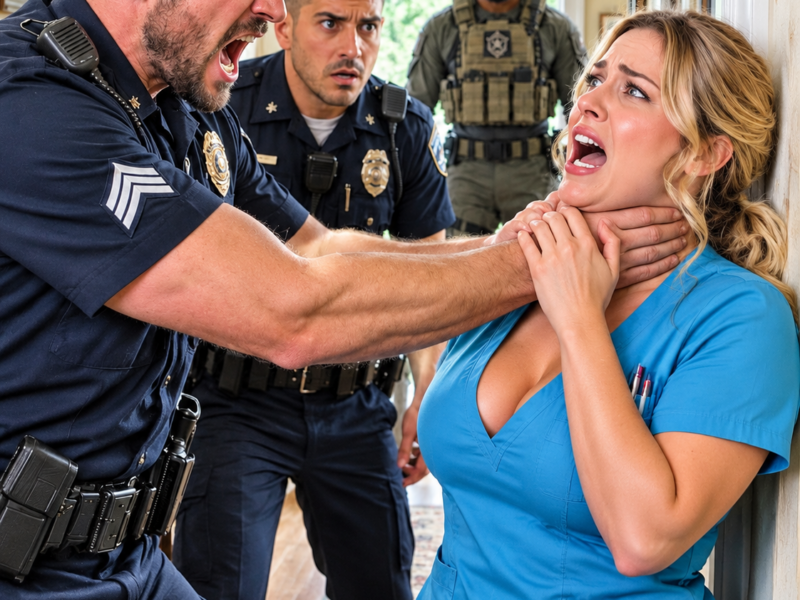
“I was kneeling beside a bleeding teenager in the emergency room when two police officers grabbed me by the arms, slammed me against the nurses’ station
I stared at the sealed envelope on the counter.
For six years, I had trained myself not to look backward. Not toward the desert, not toward the faces of the men I had lost, and certainly not toward the name printed across that envelope.
Captain Michael Torres.
My former team leader.
The man whose body had never been recovered.
Colonel Hayes stood on the other side of the counter, waiting. Sergeant First Class Daniel Cross remained a few feet behind him, his scarred face unreadable.
The two police officers who had attacked me were still in the room. Officer Sullivan kept rubbing his wrist, while Officer Reed stared at the floor.
I could hear the heart monitor behind me.
Noah was still fighting for every breath.
“Before I open that,” I said, “I want to know why you brought it here.”
Hayes glanced toward the officers.
“Not here.”
“Then you shouldn’t have come here.”
His jaw tightened.
“Rachel, this concerns national security.”
I almost laughed.
“That’s what people say when they don’t want to explain themselves.”
Cross stepped forward.
“She’s right, sir.”
Hayes gave him a warning look, but Cross didn’t back down.
“She deserves to know what we’re asking her to walk into.”
I looked at Cross.
He had been beside me during the Syria mission. He had carried our injured radio operator through a field of burning wreckage. He had once promised me that none of us would ever leave another behind.
Now he was standing here, six years later, looking like a man who had rehearsed an apology and never found the courage to say it.
“Daniel,” I said quietly. “What happened out there?”
He swallowed.
“Not everything you were told.”
The words hit harder than Sullivan’s shove.
I reached for the envelope.
The red classification stamp caught the fluorescent light. My hands were steady, but my chest felt as if someone had wrapped a cable around it.
I broke the seal.
Inside were three photographs, a printed intelligence report, and a small memory card inside a clear evidence sleeve.
The first photograph showed a desert compound at night.
The second showed a burned-out vehicle.
The third showed a man standing beside a helicopter.
I recognized his posture before I could see his face.
Michael Torres.
Older. Thinner. A deep scar ran from his temple toward his jaw.
But alive.
I lowered the photograph.
“Where was this taken?”
“An airfield near the Syrian border,” Hayes said. “Four days ago.”
“Why wasn’t he brought home?”
“Because he wasn’t alone.”
I looked at the second page.
A satellite image showed the compound surrounded by vehicles. Several buildings had been marked with red circles.
Then I saw a familiar symbol painted on a concrete wall.
A white crescent with a black line through its center.
My stomach tightened.
I had seen that symbol before.
Not on an enemy uniform.
On the equipment crate that had been inside our extraction vehicle six years ago.
I looked at Cross.
“You remember this?”
He nodded slowly.
“I remember.”
“That symbol wasn’t supposed to be there.”
“No,” he said. “It wasn’t.”
Hayes pulled a chair closer but didn’t sit.
“Six years ago, your unit was sent to recover an intelligence source. The mission was compromised before your team reached the extraction point. The official report said Torres died during the final engagement.”
“His body was never found.”
“Correct.”
“And now you’re telling me he survived.”
“We believe he did.”
I turned another page.
The report contained a transcript of the transmission.
The message was short, distorted, and partially encrypted.
But one sentence had been highlighted.
THE WRONG MAN CAME HOME.
I read it twice.
Then a third time.
“What does that mean?”
Hayes didn’t answer immediately.
Cross did.
“It means someone returned from that mission using Torres’s identity.”
The room seemed to shrink around me.
“Who?”
Cross looked directly at me.
“Me.”
For a moment, I couldn’t hear anything except the monitor behind me.
I stared at the man I had once trusted with my life.
“You came home wearing his identity?”
“Not by choice.”
“That’s not an answer.”
He looked down at his hands.
“After the extraction failed, we were separated. I was captured. When I escaped, I found Torres alive, but badly wounded. He told me to take his identification and get the mission data out.”
“Why?”
“Because someone inside our command structure had betrayed us. Torres believed the person responsible was monitoring every communication connected to the operation.”
I felt cold.
“So you let everyone believe he was dead.”
“I let them believe I was Torres.”
“And what happened to you?”
Cross lifted his eyes.
“I came home as Daniel Cross. But the report listed me as Michael Torres.”
I looked at Hayes.
“Did you know?”
Hayes didn’t deny it.
“I suspected the identity record had been manipulated. I didn’t know who had survived until the transmission arrived.”
“Then why did you wait six years?”
“Because the people who arranged the original betrayal were still in positions of authority. Every attempt to investigate ended with witnesses disappearing, records being altered, or operations being canceled.”
I looked back at Cross.
“And you knew I was alive. You knew where I worked.”
His silence answered me.
I stepped away from the counter.
“You watched me build a life while I thought my team was dead.”
“I was trying to keep you safe.”
“Don’t.”
My voice cracked.
“Don’t use that excuse.”
He flinched.
I had spent six years waking up from the same nightmare. Six years hearing the explosion again. Six years wondering whether I had made the wrong decision when I chose to treat an injured teammate instead of following Torres toward the extraction vehicle.
And now Cross was telling me that some of it had been a lie.
A sharp alarm interrupted us.
The monitor beside Noah’s bed began beeping faster.
I turned immediately.
His oxygen level was dropping again.
“Move!”
I rushed to his side.
Melissa was already adjusting the oxygen equipment, while Kevin checked the monitor.
“He’s struggling,” she said.
“Get respiratory therapy here. Now.”
I checked Noah’s airway and listened to his breathing. His chest was rising unevenly. The bruising around his ribs had become more pronounced.
“His breathing is getting worse,” Kevin said.
“I can see that.”
I reached for the emergency equipment.
Behind me, Hayes began speaking into his radio.
I didn’t care.
The room had one priority.
A seventeen-year-old boy was in danger, and I wasn’t going to let another person die while men in uniforms argued about secrets.
“Melissa, prepare for emergency imaging. Kevin, stay with his oxygen and tell me immediately if his saturation drops again.”
Noah’s eyes opened briefly.
“Am I going to die?”
I leaned closer.
“Not tonight. Stay with me.”
His fingers closed around mine.
I remembered another hand gripping mine in Syria. A young soldier whose name I still couldn’t say without feeling the weight of the last breath he took.
I pushed the memory away.
This was Noah.
He needed me here.
The respiratory therapist arrived, followed by the emergency physician. They took over the next steps while I gave them a clear account of his deterioration and injuries.
Within minutes, Noah was being prepared for further evaluation.
His oxygen level began to stabilize.
Only then did I turn around.
The police officers were still there.
Sullivan looked uncomfortable.
“That kid was resisting arrest,” he said.
I stared at him.
“He was struggling to breathe.”
“He was being difficult.”
“He was injured, terrified, and handcuffed. You thought that made him dangerous?”
Reed shifted his weight.
“We were following procedure.”
“No. You were using your authority to silence someone who was trying to help him.”
Sullivan’s face hardened.
“Watch how you speak to us.”
I stepped closer.
“You already had your chance to control this room. You used it to hurt a nurse instead of helping a patient.”
Hayes moved between us.
“Officers, you’re finished here.”
Sullivan looked at him.
“With respect, Colonel, this is a police matter.”
“Not anymore.”
Hayes removed a second document from his coat.
It wasn’t a threat. It was a formal request for the officers’ names, incident details, and any available body-camera footage. He instructed them to preserve all recordings and cooperate with the hospital’s investigation.
Then he turned to me.
“I won’t interfere with the hospital’s procedures. But those officers will answer for what happened.”
I didn’t thank him.
I had learned long ago that promises meant nothing until someone acted on them.
The officers finally left.
When the doors closed, I looked at Cross.
“Now tell me what you haven’t told me.”
He glanced at Hayes.
The colonel gave a small nod.
Cross took a breath.
“During the Syria operation, Torres discovered that our extraction route had been changed. The new coordinates were sent through an encrypted channel that only a handful of people could access.”
“Who had access?”
“Torres. Hayes. Me. And the operations director.”
“Name.”
“General Adrian Voss.”
The name meant nothing to most people outside the military.
To me, it meant something else.
Voss had personally approved our deployment. He had appeared in the official debriefing after the explosion. He had stood in front of a room full of grieving families and described Torres as a hero who had died protecting his team.
I remembered his polished shoes.
His carefully chosen words.
The way he had avoided looking at me.
“You’re saying a general ordered the wrong extraction coordinates?”
“We believe he did more than that,” Hayes said. “We believe he arranged for the intelligence source to be eliminated and used your team as cover.”
I looked at the photograph again.
“Why would Torres send a message now?”
“Because he has evidence,” Hayes answered. “Evidence that can connect Voss to the operation.”
“And he wants me?”
Cross nodded.
“Torres said you were the only person who knew what really happened at the extraction point.”
I felt my pulse quicken.
I had never told anyone what I saw that night.
Not Hayes.
Not Cross.
Not even the military investigators.
Six years earlier, after the explosion, I had crawled from the wreckage with blood running down my neck. The extraction vehicle was burning. My radio was dead. I found a man lying near the rear tire.
He was wearing Torres’s uniform.
His face was badly burned.
I had checked his pulse and found nothing.
But there was something I had never been able to explain.
The man’s left hand had been missing two fingers.
Torres had all ten.
I had assumed the body belonged to someone else. I had assumed the chaos had made identification impossible. But the official report had listed the remains as Michael Torres.
I had kept that detail out of my debriefing because I didn’t know what it meant.
Now I understood why it mattered.
“Who was the man in the vehicle?” I asked.
Hayes looked at me.
“We don’t know.”
“Did Torres?”
“He may have.”
Cross reached into his jacket and removed a folded piece of paper.
“Before we lost contact, he gave me this.”
I unfolded it.
There were only five words written in Torres’s handwriting.
THE MEDIC KNOWS ABOUT THE HAND.
My throat tightened.
He remembered.
He knew I had seen the missing fingers.
“Why didn’t you give me this before?”
“Because I didn’t know whether you were being watched,” Cross said. “And because I didn’t know whether I could trust Hayes.”
The colonel accepted the accusation without protest.
“He’s right,” Hayes said. “I should have found a way to tell you sooner.”
I folded the paper.
“Where is Torres?”
“That’s what we need you to help us discover.”
I shook my head.
“You came to an emergency room and attacked my life with a photograph. You expect me to walk into another operation because a man who might be dead left a message?”
“No,” Hayes said. “I expect you to decide whether you want the truth.”
I looked through the glass toward Noah’s room.
The boy was awake now. Melissa was checking his IV, and Kevin was speaking quietly with the physician.
I had spent six years trying to leave my old life behind.
But I had never forgotten what it meant to be responsible for someone else’s survival.
“Tell me everything,” I said. “No more classified half-truths. No more protecting me by keeping me ignorant.”
Hayes nodded.
“We have a secure location twenty minutes from here. The full intelligence file is there.”
“Then we’re going.”
Cross looked relieved.
I wasn’t.
I was angry, frightened, and exhausted.
But beneath all of it was a feeling I hadn’t experienced in six years.
Hope.
And hope was dangerous when it came from a man whose grave had never existed.
Before we left the emergency department, I checked on Noah one more time.
His breathing had improved. The physician believed he would recover, though he needed continued monitoring and further tests.
He looked at me when I entered.
“Are those men going to come back?”
“Not tonight,” I told him.
He hesitated.
“Are you in trouble?”
I pulled a chair beside his bed.
“Noah, listen to me. You didn’t do anything wrong by needing help.”
His eyes filled with tears.
“I thought nobody would believe me.”
I gently adjusted his blanket.
“Someone should have believed you the first time.”
He looked toward the door.
“Will you come back?”
“I’ll try.”
I wanted to promise him I would.
But I had learned what happened when people made promises they couldn’t keep.
I left Melissa with instructions and asked the hospital supervisor to document every detail of the officers’ conduct. Then I followed Hayes and Cross outside.
A black SUV waited near the ambulance entrance.
I climbed into the back seat.
Cross sat opposite me.
For several minutes, neither of us spoke.
Finally, I asked, “Did you ever think about calling me?”
“Every day.”
“Why didn’t you?”
“Because the last person who tried to contact you disappeared.”
I turned toward him.
“Who?”
“A former intelligence analyst. Her name was Elena Price. She had been reviewing the Syria mission records. She found a second set of extraction coordinates that didn’t match the official report.”
“What happened to her?”
“She was found dead two years ago.”
Hayes looked back from the front passenger seat.
“Her death was ruled an accident.”
“And you don’t believe that.”
“No.”
The SUV turned onto a quiet road.
I looked down at the envelope in my lap.
The memory card was still inside.
“What is on this?”
“A recording from Torres.”
Hayes handed me a secure tablet.
“Listen carefully.”
I inserted the memory card.
The screen flickered.
Then a familiar face appeared.
Older. Exhausted. A beard covering much of his jaw.
But the eyes were unmistakable.
Michael Torres.
For a few seconds, he simply stared into the camera.
Then he spoke.
“Rachel. If you’re watching this, Daniel found a way to reach you.”
I stopped breathing.
“I know what they told you. I know what they put in the report. And I know you saw the body near the extraction vehicle.”
I gripped the tablet.
“That man wasn’t me.”
Torres leaned closer to the camera.
“He was the intelligence source. The man Voss wanted erased. He had evidence of a weapons transfer that wasn’t supposed to exist.”
He paused.
“Voss ordered the extraction route changed because he needed the source dead and the operation buried. When the explosion happened, I was taken alive by the people who were supposed to be our allies.”
My eyes burned.
“I survived because someone inside the compound helped me. I’ve been moving from one safe location to another ever since.”
The recording crackled.
Then Torres said something that made my blood turn cold.
“Rachel, there is one more thing. The source wasn’t working alone. Someone from our own unit was helping him.”
Cross stiffened beside me.
I looked at him.
Torres continued.
“I don’t know who it was. But I know they were present when the extraction coordinates changed.”
The video froze.
Hayes tried to restart it.
Nothing.
“That’s all we have,” he said.
I stared at the blank screen.
“Why did you bring Daniel here if you don’t know whether he’s the traitor?”
“Because Torres trusted him enough to send the message,” Hayes replied.
“That’s not proof.”
“No,” Cross said. “It isn’t.”
He looked directly at me.
“You have every reason to doubt me.”
I watched his face.
Six years ago, Cross had been the one who pulled me from the burning vehicle. He had carried me until his arms shook. He had refused evacuation until the last wounded soldier was accounted for.
But six years was a long time.
And betrayal didn’t always come from strangers.
The SUV slowed.
Through the window, I saw a plain building surrounded by a high fence. No signs. No visible insignia. A single security light illuminated the entrance.
Hayes stepped out first.
“Welcome to the facility.”
I followed him inside.
The room beyond the security checkpoint contained several monitors, a conference table, and a large digital map of the Syrian border region.
A woman in her forties waited beside the table.
Short dark hair. Black jacket. Tired eyes.
“Rachel Morgan,” she said. “I’m Director Lena Ward. I oversee the investigation.”
I shook her hand.
“Then I want the complete file.”
She nodded and activated the main display.
The first screen showed the original extraction route.
The second showed the altered route.
The third displayed a list of personnel who had accessed the mission channel.
There were four names.
Torres.
Cross.
Hayes.
Voss.
I studied the timestamps.
The altered coordinates had been entered eleven minutes before our team reached the extraction point.
“Who made the change?”
Ward enlarged the access log.
A user identification appeared.
It wasn’t Voss.
It was Daniel Cross.
I turned slowly.
Cross stared at the screen.
“No.”
Ward’s voice was controlled.
“The system shows your credentials.”
“Someone used my code.”
“Can you prove that?”
Cross didn’t answer.
I looked at the time.
“Where were you eleven minutes before extraction?”
“I was with Torres.”
“Can anyone confirm that?”
He shook his head.
The room became very quiet.
I looked at the man who had once carried me out of a burning vehicle.
“Daniel, tell me the truth.”
He stepped toward the screen.
“I swear I didn’t change those coordinates.”
“Then why does your code appear there?”
“Because Torres gave me his access token earlier that night. He thought someone was monitoring his account.”
Ward folded her arms.
“Why wasn’t that included in the official report?”
“Because I never got the chance to explain it.”
I looked at Hayes.
“Did you know?”
Hayes shook his head.
“That detail was never included in the records I received.”
Ward changed the display.
A second log appeared.
This one showed an access attempt made three hours ago.
The same identification code had been used.
But the location wasn’t Syria.
It was Jacksonville.
My blood ran cold.
“Someone accessed the system from here?”
“From a terminal connected to the hospital’s internal network,” Ward said.
I thought of the emergency department.
The officers.
The sealed envelope.
The people who had arrived at exactly the right moment.
“Who used it?”
Ward brought up a security image.
The photograph showed a man wearing a maintenance uniform.
He was pushing a cleaning cart through a hospital corridor.
His face was turned away from the camera.
But I recognized the shape of his shoulders.
The slight limp in his left leg.
And the silver ring on his right hand.
Officer Sullivan.
I stepped closer to the screen.
“That’s one of the officers who attacked me.”
Ward nodded.
“According to the hospital’s initial report, Sullivan wasn’t assigned to that terminal. He had no reason to be in that corridor.”
“Then he wasn’t there by accident.”
“No.”
Cross stared at the photograph.
“Voss knew Rachel was at that hospital.”
I looked at Hayes.
“Did he send those officers?”
“We don’t know yet.”
“Then find out.”
Ward enlarged the image.
The man had stopped beside a service door.
On the cart was a small black case.
The same kind of case used to transport secure data equipment.
I remembered Sullivan gripping my wrist.
His eyes had not been angry.
They had been searching.
He hadn’t been trying to stop a nurse.
He had been trying to keep me away from something.
“That envelope,” I said.
Hayes looked at me.
“What about it?”
“Someone wanted me to open it. Someone wanted me to see Torres’s message.”
Ward frowned.
“Why would they do that?”
“Because they knew I would recognize the hand detail. They knew I’d question Cross. They knew I’d come here.”
I looked at the photograph again.
“And if they knew where I was going, they could follow us.”
A security alarm sounded.
The lights above the main entrance flashed red.
Ward turned toward the monitor.
“Perimeter breach.”
Hayes reached for his radio.
“How many?”
“Two vehicles. No authorization.”
Cross moved toward the door.
I caught his arm.
“Wait.”
He looked at me.
“That’s what they want. They want us moving before we know where they’re coming from.”
Ward switched to the exterior cameras.
Two black vehicles had stopped outside the fence.
Men were getting out.
One of them looked directly at the camera.
Then he raised a phone.
The monitor went dark.
A second later, every screen in the room shut down.
Someone had cut the feed.
Hayes ordered the security team to lock the building down.
I stepped away from the conference table and listened.
Footsteps.
A metallic crash.
Then the sound of someone trying the door.
Cross stood beside me.
“Rachel, stay behind me.”
I looked at him.
“Don’t make that mistake again.”
He nodded once.
The door shook.
Ward opened a cabinet and removed a small encrypted drive.
“This contains the original evidence,” she said. “If they get inside, they must not take it.”
I took the drive.
“Where is the backup?”
“Outside this facility.”
“Then we need to get it there.”
Hayes shook his head.
“The extraction route is compromised.”
“Then we don’t use it.”
I studied the building map on the emergency display.
There was a service corridor behind the storage room, leading to a loading bay on the opposite side.
“That door?”
Ward nodded.
“It connects to the maintenance tunnel.”
“Good.”
The main door buckled.
A voice shouted from the other side.
“Open up! Federal agents!”
Hayes looked toward Ward.
“Are they ours?”
She checked her phone.
“No authorization has been issued.”
The door shook again.
I looked at Cross.
“Do you trust me?”
He gave a grim smile.
“I always did.”
“Then follow my lead.”
We moved through the service corridor.
Ward carried the drive’s duplicate. Hayes stayed behind long enough to contact the legitimate security team.
Cross walked beside me.
For a moment, we were back in Syria.
The same narrow passage.
The same uncertainty.
The same question hanging between us.
Who would make it out?
We reached the loading bay.
The door opened onto a dimly lit alley.
A vehicle waited at the far end.
Then a voice came from the darkness.
“Rachel.”
I froze.
A man stepped into the light.
He wore a dark jacket and held his hands where we could see them.
His face was older than the photograph.
His hair was almost completely gray.
But I knew him.
I had known him before the explosion.
Before the lies.
Before the six years of silence.
“Captain Torres,” I whispered.
He smiled faintly.
“Still calling me that?”
I couldn’t move.
Cross took one step forward.
“Sir.”
Torres looked at him.
“Daniel.”
Then his expression changed.
“Put the drive down.”
I turned toward him.
“What?”
Torres pointed at the evidence in my hand.
“That file is compromised. They put a tracking device inside the case.”
Ward checked the drive.
Her face drained of color.
“He might be right.”
I stared at Torres.
“How did you know we were here?”
“Because I sent the message.”
“Then why did you bring us into this?”
“I didn’t bring you here. I tried to warn you.”
He looked past me toward the facility.
“Voss has people inside every agency. If he knows you have that evidence, he’ll never stop.”
Cross stepped between us.
“Then tell us where the real evidence is.”
Torres looked at him for a long moment.
“Under the place where we buried the wrong man.”
I felt the words settle in my chest.
The body.
The missing fingers.
The false identification.
“Where?”
“At the original extraction site.”
Ward shook her head.
“That area is controlled by hostile forces.”
“Not anymore,” Torres said. “Voss has been moving people through it for years. He built his operation on the belief that nobody would ever return to look.”
I looked at him.
“Why didn’t you come home?”
His eyes softened.
“Because I wasn’t the only one who survived.”
He pulled a photograph from his jacket.
It showed a young man in civilian clothes, standing beside a woman and a small child.
I recognized the face.
The intelligence source.
The man whose body had been identified as Torres.
“He’s alive?”
Torres nodded.
“I got him out. He’s been under protection ever since. He has the original records, the names, and the proof that Voss ordered the operation.”
I looked toward the facility.
“Then why is everyone still chasing us?”
“Because someone told them where we were going.”
A sharp sound came from the alley entrance.
A vehicle engine.
Torres turned.
“Move.”
We ran toward the waiting vehicle.
A gunshot cracked through the night.
The rear window shattered.
Cross pushed Ward down behind the wheel.
I pulled Torres behind the vehicle and checked him for injuries.
“I’m fine,” he said.
“Don’t argue with a medic.”
For the first time, he laughed.
It was a small, exhausted sound.
But it was him.
The driver accelerated.
Behind us, the facility’s security lights flickered as more vehicles arrived.
We reached a secure apartment several miles away.
Inside, Torres finally gave us the complete story.
The intelligence source had discovered an illegal weapons transfer involving private contractors and senior military officials. Voss had ordered our team to retrieve him, but the real purpose of the mission was to eliminate the source and destroy the evidence.
When Torres discovered the altered extraction coordinates, he tried to stop the operation.
The explosion was triggered before he could get everyone out.
The body I had found belonged to the source’s double, a man who had sacrificed himself to protect the original intelligence.
Torres survived with serious injuries.
Cross had helped him escape.
But when Cross returned to the United States with the evidence, Voss’s people intercepted the transfer and changed the identity records. Cross became Torres on paper, while the real Torres disappeared.
The official investigation closed.
The families mourned.
And the people responsible continued working.
“Why did you wait six years to contact me?” I asked.
Torres looked down.
“Because I knew you had seen the body. And I knew Voss would come after you if he believed you could identify it.”
“I could have helped.”
“You had already lost enough.”
I shook my head.
“You don’t get to decide how much truth I can handle.”
He accepted that without arguing.
Then he placed a second photograph on the table.
It showed the intelligence source with his family.
On the back was a location and a date.
“Tomorrow morning, he’s prepared to testify,” Torres said. “But he won’t do it unless the evidence is secured.”
Ward examined the photograph.
“We can arrange federal protection and transfer the records to an independent prosecutor.”
“Do it,” I said.
Hayes nodded.
Cross sat quietly near the window.
I turned toward him.
“Daniel.”
He looked up.
“Why did you let me believe you were dead?”
His eyes filled.
“Because I thought if you knew the truth, you’d come looking. And if you came looking, Voss would have another reason to kill you.”
“That was my choice to make.”
“I know.”
He looked away.
“I’ve replayed that decision every day.”
I wanted to forgive him.
Part of me already had.
But forgiveness was not the same as pretending nothing had happened.
“You don’t get six years back,” I said.
“No.”
“And neither do I.”
He nodded.
For the first time that night, I saw the weight he had been carrying.
Not as an excuse.
As a consequence.
The next morning, the intelligence source gave his statement under federal protection.
The evidence was transferred to investigators outside Voss’s chain of command. The original extraction logs, the altered coordinates, and the recordings were authenticated.
Within days, General Adrian Voss was suspended.
A formal investigation followed.
Officer Sullivan and Officer Reed were also placed under investigation after the hospital released its security footage and documented my injuries. Their claims that I had interfered with an arrest collapsed when the footage showed them assaulting a nurse while a patient was in medical distress.
I gave my statement.
I told the truth about every second.
I didn’t mention my military training to make myself look stronger.
I didn’t need to.
The footage spoke for itself.
Noah recovered.
His injuries were serious, but he was stable enough to leave the hospital after several days. Before he went home, he found me at the nurses’ station.
“Miss Morgan?”
I turned.
He held a folded piece of paper.
“I wanted to say thank you.”
I opened it.
It was a simple drawing of a nurse standing beside a hospital bed. Above the drawing, he had written:
THANK YOU FOR NOT GIVING UP ON ME.
I felt my eyes sting.
“You take care of yourself, Noah.”
He nodded.
Then he hesitated.
“Are you going to be okay?”
I looked at the drawing again.
For six years, I had believed that surviving meant never looking back.
Now I understood that surviving sometimes meant finally facing what had happened.
“I think I will be,” I said.
A week later, I met Torres and Cross outside the hospital.
The sun was setting over Jacksonville.
Torres looked healthier, though the scar on his face remained.
Cross stood beside him, hands in his pockets.
None of us knew exactly what came next.
There would be investigations, hearings, and questions that couldn’t be answered in a single conversation.
There would also be names to remember.
Three teammates who never came home.
A source who had spent years hiding from the people who wanted him silenced.
And a nurse who had thought she could bury her past by refusing to speak about it.
Torres held out his hand.
“Welcome back, Rachel.”
I looked at it.
Then I shook his hand.
“I’m not going back to the battlefield.”
“I know.”
“I’m staying at the hospital.”
He smiled.
“Then that’s where you belong.”
I looked through the glass doors at the emergency department.
The monitors were beeping.
The nurses were moving.
Someone was calling for help.
Life was happening, one patient at a time.
I had once believed my greatest strength was knowing how to fight.
I was wrong.
My greatest strength was knowing when not to.
I had been a soldier.
I had been a medic.
Now I was a nurse again.
And when the next frightened patient came through those doors, I would be there.
Not because I had forgotten the past.
Because I had finally stopped letting it decide who I was.
The end.









