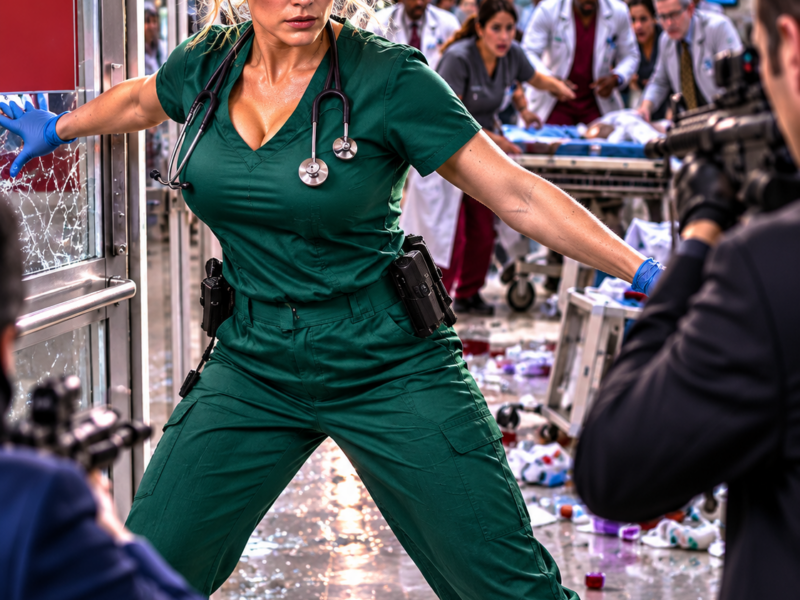
“I was kneeling beside a bleeding hospital technician when six armed men stormed Ridgecrest Army Medical Center
I stared at the tiny green light beneath the crash cart, listening to the gunfire echo from somewhere above me.
For three years, I had dreamed about the day I would never have to look at another explosive device.
Apparently, that day hadn’t arrived.
“Colonel Reyes, I need everyone off the emergency floor,” I said into the radio. “Immediately. Use the west corridor. Nobody comes through the ambulance entrance.”
“Whitfield, our security teams are already moving toward the second floor. What’s your assessment?”
“Your security teams aren’t my concern right now. The people hiding in this department are.”
There was a pause.
Then Reyes replied, “Understood. I’ll get them moving.”
I put the radio down and looked at the device.
It was small enough to fit beneath a medical supply tray.
The wiring was concealed with ordinary hospital tape, and the receiver was positioned where someone approaching the crash cart would never notice it.
I didn’t touch it.
I didn’t need to.
I recognized the design philosophy.
Costin’s people liked devices that created confusion. They wanted emergency personnel rushing toward the injured, security teams gathering in predictable places, and everyone making decisions before thinking.
This wasn’t meant to be a spectacular explosion.
It was meant to punish anyone who responded to the attack.
I looked toward Marcus.
He was conscious now, breathing more easily, but still pale.
“Marcus, listen carefully. I need you to stay exactly where you are.”
“Where are you going?”
“To make sure nobody else gets hurt.”
His fingers tightened around my sleeve.
“Sloan…”
It was the first time he’d used my first name.
“Please don’t do anything stupid.”
I almost laughed.
“That’s a little late for that.”
I moved away from him.
The emergency department was nearly empty now, except for patients sheltering behind overturned furniture and a few staff members who hadn’t managed to reach the west corridor.
Priya was helping an elderly woman remove her IV tubing so they could move her safely.
When she saw me approaching, she looked at the crash cart.
“Is that what I think it is?”
“Probably.”
Her face lost color.
“Can you stop it?”
I looked at her.
“I need you to get everyone out first.”
She nodded.
No arguments.
No questions.
Just trust.
That meant more to me than I could explain.
I contacted the base EOD team and relayed the device’s location and visible characteristics.
I followed their instructions and stayed clear while they coordinated the response.
The equipment and procedures had changed since my service days, and I wasn’t going to pretend otherwise.
My job was to keep people away and give the specialists the information they needed.
Within minutes, the last patient was moved into the west corridor.
Priya returned for Marcus with two military medics.
Before she left, she stopped beside me.
“You’re coming too, right?”
“In a minute.”
She looked at my hands.
They weren’t shaking.
That seemed to frighten her more than the explosion.
“Sloan, what did you do before you came here?”
I didn’t answer.
There wasn’t time.
The radio crackled.
“Whitfield, this is Colonel Reyes. Status?”
“Emergency department evacuated. Marcus is being transported. Device is still in place. Your EOD team has the location.”
“Copy. Stay behind cover.”
I moved toward the west corridor.
Then I heard footsteps behind me.
Not the heavy boots of the military police.
These were slower.
Careful.
I turned.
A man stepped through the damaged ambulance entrance.
He wore the same black tactical clothing as the others.
His rifle was raised.
For a moment, neither of us moved.
He looked at the empty emergency department.
Then at me.
“Where’s the doctor?”
I said nothing.
He glanced toward the stairwell.
“Where’s Vasco?”
“Upstairs.”
He tilted his head.
“You don’t seem very frightened.”
“I’ve had a long day.”
He took one step forward.
“You’re the nurse they were talking about.”
I recognized his voice.
He was the sixth man, the one who had stayed behind.
His eyes moved toward the crash cart.
Then he smiled.
“You found it.”
I kept my hands visible.
“Your friends aren’t going anywhere.”
He laughed quietly.
“You still think this is about getting one man out?”
The words settled between us.
Before I could respond, the radio crackled.
“Whitfield, the device has been secured. Repeat, the device has been secured.”
The man’s smile disappeared.
He raised his rifle.
I moved behind the nearest concrete support as the first shot struck the wall.
The sound was deafening in the empty department.
I wasn’t carrying a weapon.
I had no intention of pretending I could win a gunfight with an unarmed hospital employee’s equipment.
But I knew the layout.
I knew where the fire extinguishers were.
I knew which doors led to restricted corridors and which ones opened into the service area.
And I knew he couldn’t see everything from where he stood.
When he moved closer, I pulled the emergency fire extinguisher from its bracket and discharged it across the corridor.
The white cloud filled the space between us.
He fired once, hitting an empty supply cabinet.
I used the moment to move behind cover and create distance.
He stumbled through the powder, coughing.
His rifle struck the floor.
By the time he recovered, military police were entering through the west corridor.
“Drop your weapon!”
He looked toward the ambulance doors.
There was nowhere left to go.
Two officers brought him to the ground and secured his hands.
One of them looked at me.
“Ma’am, are you injured?”
I glanced at the cut on my forearm.
“Nothing serious.”
“Who are you?”
I almost gave him the same answer I’d given everyone else.
Just a nurse.
But before I could speak, Colonel Reyes appeared behind the officers.
He looked at the captured man.
Then at me.
“That’s Sergeant Whitfield,” he said.
The officer straightened.
Reyes continued.
“Former 761st Explosive Ordnance Disposal.”
The officer’s expression changed.
I hated that expression.
It was the look people got when they realized they had been standing beside someone with a history they hadn’t bothered to learn.
“Ma’am,” he said quietly.
I turned away.
“Check the patients. That’s what matters.”
The fighting upstairs continued for another several minutes.
I stayed near the corridor, listening to radio traffic.
The military police had reached the second-floor ward.
The armed men were trapped between the secured stairwell and the restricted treatment area.
One surrendered.
Two were wounded.
Another was taken into custody near the service elevator.
Costin was still missing.
Then Reyes came over the radio.
“Whitfield, we have Vasco secured. The detainee is alive.”
I closed my eyes.
For the first time since the ambulance doors exploded, I allowed myself to breathe.
But the next transmission made my stomach tighten.
“Costin is in custody.”
I looked toward the ceiling.
“Any casualties?”
A few seconds passed.
“Two officers injured. No fatalities.”
I sat down on the nearest overturned chair.
No fatalities.
Those two words felt almost impossible.
The radio continued crackling, but I stopped listening.
For a moment, I wasn’t in Ridgecrest.
I was back in Korengal Valley.
I could smell dust and hot metal.
I could hear Danny laughing beside me.
Then the sound disappeared.
I pressed my palms against my knees.
Not today, I whispered.
Not today.
A few minutes later, Priya came back.
She didn’t say anything at first.
She simply sat beside me.
Her uniform was dusty, and there was a small cut above her eyebrow.
“Marcus is in surgery,” she said.
“How is he?”
“They think he’ll recover.”
I nodded.
Priya looked toward the broken entrance.
Then she turned to me.
“You’re not going to tell me this was another kitchen accident, are you?”
I looked down at my hands.
“No.”
She waited.
I wasn’t sure how to begin.
“I was in the Army.”
Her expression softened.
“I figured.”
“I worked in explosive ordnance disposal.”
She looked at the scars on my knuckles.
“That’s why you knew what to look for.”
“Yes.”
“And that’s why that man called you Sergeant.”
I nodded.
Priya leaned back against the wall.
“How long were you doing that?”
“Seven years.”
She was quiet for a while.
Then she asked the question I had been avoiding for three weeks.
“What happened?”
I looked at the empty space where the crash cart had stood.
“I lost two people.”
Priya didn’t ask me to explain.
She simply reached for my hand.
For once, I didn’t pull away.
The following morning, Ridgecrest looked like a hospital that had survived a war.
The broken entrance had been boarded up.
Security officers stood at every corridor.
Patients were being transferred to nearby facilities while investigators examined the building.
The news had already spread across the base.
By lunchtime, everyone knew that six armed men had attacked the hospital.
By evening, the story had changed.
People were talking about the quiet nurse who had stayed behind.
Someone had obtained security footage showing me moving toward Marcus while everyone else ran.
Another clip showed me directing patients toward safety.
A third captured the moment Costin recognized me.
The footage spread quickly.
I didn’t watch it.
I didn’t want to see myself from the outside.
I knew what I had done.
I also knew what I hadn’t been able to do three years earlier.
And that was enough to keep me awake.
Two days later, Colonel Reyes summoned me to his office.
His desk was covered with reports.
My military service jacket lay folded beside a thick personnel file.
I hadn’t seen that jacket in years.
“Sit down, Sergeant.”
“Sir, I’m not a sergeant anymore.”
“You’re still entitled to the title.”
I sat.
He opened the file.
“Seven years of service. Three deployments. Explosive ordnance disposal. Multiple commendations.”
He turned a page.
“Medical discharge following the incident in Korengal Valley.”
I looked away.
He noticed.
“I’m not going to ask you to relive it.”
“Thank you, sir.”
“But I do need to understand why someone with your experience ended up working here without informing hospital command.”
I folded my hands.
“Because I wanted a normal job.”
“That’s understandable.”
“I didn’t want people looking at me and seeing a soldier. I wanted them to see a nurse.”
Reyes studied me.
“Did you know Vasco was being held upstairs?”
“I saw his name on the transfer manifest.”
“And you recognized it?”
“Yes.”
“Why didn’t you report that?”
“I didn’t have a reason to believe an attack was coming.”
He closed the file.
“Fair enough.”
For a moment, neither of us spoke.
Then he said something I hadn’t expected.
“Your former commanding officer contacted me this morning.”
My shoulders tightened.
“Why?”
“He wants to speak with you.”
“I don’t think that’s necessary.”
“He also mentioned Danny O’Shea.”
The room seemed to become smaller.
I stared at the folder.
Reyes continued carefully.
“He said you were the one who brought Danny’s body back to the evacuation point.”
I swallowed.
“I couldn’t leave him.”
“I know.”
“No, sir. You don’t.”
The words came out sharper than I intended.
Reyes didn’t take offense.
He simply nodded.
“You’re right. I don’t.”
I looked toward the window.
For three years, I had carried the memory of that day as if surviving it had been some kind of failure.
I had returned to the hospital because I wanted to help people.
But perhaps I had also been trying to find a place where I could finally stop thinking about the people I couldn’t save.
Reyes slid a document across the desk.
“The Army would like to recognize your actions during the attack. They’re recommending a commendation.”
I didn’t pick it up.
“Sir, I don’t need another medal.”
“I didn’t say you did.”
He paused.
“But you should know that your work saved lives.”
I nodded.
“That’s all I wanted.”
He closed the file.
“Then go back to your hospital.”
I almost smiled.
“Gladly.”
But the hardest conversation was waiting for me in the emergency department.
Dr. Holt Ambrose found me near the medication station on my first shift back.
He looked different.
Not physically.
He was still the same neatly dressed doctor with the expensive watch and the habit of speaking as if every room belonged to him.
But his usual confidence seemed to have disappeared.
“Whitfield.”
“Doctor.”
He glanced at the empty bed beside us.
Then back at me.
“I owe you an apology.”
I waited.
“I treated you badly. I made assumptions about your ability, and I embarrassed you in front of the staff.”
He struggled to find the next words.
“When the shooting started, I ran.”
I didn’t answer.
He looked down.
“I’ve been thinking about that.”
“Most people ran, Doctor.”
“Not you.”
I adjusted a stack of patient charts.
“I had patients to take care of.”
He nodded slowly.
“I suppose that’s the difference.”
I looked at him.
“No. The difference is that I had experience in situations like that. You didn’t.”
He seemed surprised by the answer.
Then he gave a small, tired laugh.
“That’s probably the kindest way anyone could have put it.”
I didn’t forgive him immediately.
An apology didn’t erase three weeks of humiliation.
But I accepted it.
And when a new resident made a careless remark about another nurse a few days later, Ambrose was the first person to tell him to stop.
That mattered more than his apology.
The person I worried about most, however, was Costin.
Military investigators interviewed me twice about him.
He had been identified as a member of Vasco’s network and was facing charges related to the hospital attack, the attempted extraction, and the explosives recovered from the building.
During one interview, an investigator showed me a photograph.
It was taken years earlier.
A younger Costin stood beside another man wearing civilian clothes.
The investigator pointed to him.
“Do you recognize this individual?”
I leaned closer.
The man looked familiar.
Not from the hospital.
From an old intelligence briefing.
“He’s connected to Vasco’s supply network,” I said.
“Correct. His name is Elias Mercer. He’s believed to have coordinated the acquisition and movement of components used in several attacks.”
I looked at the photograph again.
“Why are you showing me this?”
The investigator hesitated.
“Because Costin has been cooperating.”
I waited.
“He says Mercer was the person who selected the target in Korengal Valley.”
The room went quiet.
I felt my fingers tighten around the edge of the table.
“You’re saying the device that killed Danny and the others was deliberately placed for my team?”
“We’re still verifying the intelligence.”
I looked at the photograph.
For three years, I had blamed myself for missing something.
A wire.
A movement.
A detail.
Anything that might have changed the outcome.
Now someone was telling me the attack might have been planned specifically for the people I had been trying to protect.
I didn’t know whether that made the grief easier or harder.
“Does Costin know where Mercer is?”
The investigator nodded.
“That’s what we’re trying to establish.”
I stared at the photograph for another moment.
Then I pushed it back.
“I’ll answer any questions I can. But I don’t want to go back into the field.”
“We understand.”
And for the first time, I believed someone actually did.
A week later, I visited Marcus in physical therapy.
He was walking slowly between parallel bars, still favoring his injured side.
When he saw me, his face lit up.
“There’s the nurse who wouldn’t let me die.”
I laughed.
“You’re making it sound dramatic.”
“Lady, I got shot in a hospital. I think I’ve earned a little drama.”
He sat down carefully.
Then he looked at me.
“Can I ask you something?”
“Sure.”
“Why didn’t you run?”
I considered giving him the easy answer.
Because I was trained.
Because it was my job.
Because I knew what to do.
But none of those answers felt complete.
“I used to work with people who depended on me,” I said. “When things went bad, they needed me to stay calm.”
“Military?”
I nodded.
“Yeah.”
He looked down at his recovering hand.
“Must have been hard.”
“It was.”
“Then why come back to a hospital?”
I watched him struggle to straighten his injured leg.
“Because people still need help, Marcus. It doesn’t matter what uniform they’re wearing.”
He nodded.
“I guess I never thought about it that way.”
Before I left, he handed me a folded piece of paper.
I opened it.
It was a thank-you card.
His handwriting was uneven, but the words were clear.
You didn’t know me very well, but you treated my life like it mattered.
I folded the card carefully and put it in my pocket.
That evening, I went home and took my old military jacket out of the closet.
I hadn’t touched it since the day I left the Army.
The fabric smelled faintly of storage and dust.
I ran my fingers over the embroidered name.
WHITFIELD.
For a long time, I had thought putting the jacket away meant I could put the past away with it.
But the past wasn’t something I could fold neatly and store on a shelf.
Danny was still gone.
The people I had lost were still gone.
And no amount of quiet hospital shifts could change that.
What I could change was what I did with the life I still had.
The next morning, I arrived early.
Priya was already at the nurses’ station with two coffees.
She handed me one.
“You’re late,” she said.
I looked at the clock.
“I have twelve minutes.”
“Exactly. Terrible.”
I smiled.
Then I noticed a small envelope beside my computer.
There was no return address.
My name was written across the front in block letters.
I opened it carefully.
Inside was a photograph.
It showed Danny O’Shea standing beside me in Korengal Valley.
He was grinning, one arm thrown over my shoulder.
I hadn’t seen that photograph in years.
On the back, someone had written a short sentence.
He never blamed you.
I read it twice.
Then I turned the photograph over again.
There was another line beneath the first.
Neither should you.
I looked at Priya.
“Where did this come from?”
She shook her head.
“I found it here when I came in.”
I checked the envelope again.
No signature.
No explanation.
But I knew who could have sent it.
My former commanding officer.
He had probably found it among the old unit records.
I sat down.
For the first time in three years, I let myself look at Danny’s face without immediately remembering the explosion.
I remembered the coffee he stole.
The terrible jokes.
The way he always insisted that he was going to retire at thirty and open a fishing shop despite having no idea how to fish.
I remembered him as a person.
Not a casualty.
And that was something I hadn’t allowed myself to do for a very long time.
Later that week, Colonel Reyes called again.
He told me the hospital had approved a new position.
They wanted someone to help train medical staff in emergency threat recognition, evacuation planning, and responding to attacks in clinical environments.
They wanted me to lead the program.
I looked through the glass doors toward the emergency department.
Patients were arriving.
Nurses were moving between beds.
Doctors were arguing over lab results.
Life was continuing in the ordinary, messy way it always did.
“Do I have to leave the ER?” I asked.
“No,” Reyes replied. “You can continue working clinical shifts if you want.”
I thought about it.
For the first time, the idea of using my old experience didn’t feel like returning to the life I had escaped.
It felt like bringing something useful from that life into the one I had chosen.
“I’ll do it,” I said.
“Good.”
“But I have one condition.”
“What’s that?”
“I want the training to include the people who never get called heroes. Nurses, technicians, receptionists, security staff. Everyone.”
Reyes chuckled.
“I had a feeling you’d say that.”
I started the program two months later.
The first session was held in a small conference room beside the emergency department.
Priya sat in the front row.
Marcus attended as a guest after finishing his rehabilitation.
Even Ambrose showed up, although he spent most of the session looking unusually attentive.
I didn’t begin with a story about combat.
I began with a photograph of a hospital corridor.
“This is where emergencies happen,” I told them. “Not just in operating rooms or on battlefields. They happen in waiting rooms, hallways, parking lots, and places where people assume they’re safe.”
I explained how to recognize danger, communicate clearly, protect patients, and avoid turning panic into another emergency.
I didn’t tell them they needed to be fearless.
I didn’t believe that anymore.
At the end of the session, a young nurse raised her hand.
“How do you know if you’re brave enough?”
I looked around the room.
I saw people who had families waiting at home.
People who had never held a weapon.
People who had never been in combat.
People who had spent years caring for strangers without anyone knowing how difficult their work could be.
“You don’t always know,” I said. “Sometimes you’re frightened. Sometimes your hands shake. Sometimes you have to take a breath before you can move.”
I paused.
“But you learn to focus on the person who needs you. And you take the next right step.”
Afterward, Priya walked with me back toward the nurses’ station.
“You know,” she said, “I always thought you were quiet because you didn’t like people.”
I laughed.
“What do you think now?”
“I think you were carrying too much to waste words.”
I looked at her.
“That’s probably closer.”
She bumped my shoulder.
“Still not an excuse for refusing to come to lunch with us.”
“I came last Friday.”
“You sat at the table for eleven minutes.”
“I had a patient.”
“You had a sandwich.”
I laughed again.
It was a real laugh.
Not the polite kind I’d used to hide behind.
A few months after the attack, the ambulance entrance reopened.
The new glass doors were thicker, reinforced, and surrounded by additional security measures.
The hospital had changed.
So had I.
But I still wore the same blue scrubs.
I still checked every patient’s blood pressure twice when something didn’t look right.
I still brought extra blankets to the elderly patients who complained about the cold.
And I still made sure Marcus got teased whenever he visited for his follow-up appointments.
One afternoon, I was restocking supplies when a young doctor approached me.
“Whitfield, I heard you were in the Army.”
“That’s right.”
“Explosive ordnance disposal?”
I nodded.
He looked at my hands.
“Must have been terrifying.”
I considered the question.
Then I looked toward the trauma bay, where Priya was helping a little boy hold a stuffed dinosaur while his mother spoke to the doctor.
“Sometimes,” I said.
He waited for me to continue.
“But the hardest part wasn’t being afraid.”
“What was?”
I thought about Danny.
I thought about the three years I had spent believing that surviving meant I had somehow failed the people who hadn’t.
Then I thought about Marcus’s thank-you card.
“The hardest part was learning that surviving meant I still had somewhere to be.”
The doctor nodded, although I wasn’t sure he understood.
Maybe he would someday.
That evening, I stayed a little later than usual.
The emergency department was quiet.
A monitor beeped in one of the rooms.
For a moment, my shoulders tightened.
Then I heard Priya laughing at the nurses’ station.
A patient called for water.
Someone rolled a supply cart down the hallway.
Ordinary sounds.
Living sounds.
I reached into my pocket and touched the photograph of Danny.
I had started carrying it again.
Not because I wanted to remember the worst day of my life.
Because I wanted to remember the friend who had made the days before it worth living.
I placed the photograph back in my pocket and walked toward the trauma bay.
There was a new patient waiting.
A frightened young soldier with a badly injured leg, asking whether he would ever run again.
I pulled up a chair beside his bed.
“Let’s take this one step at a time,” I told him.
He looked at me, searching my face for reassurance.
I gave him the same thing I had spent years trying to find for myself.
A reason to believe that tomorrow was still possible.
And when the monitor beeped again, I didn’t flinch.
I simply reached for his chart.
The End









