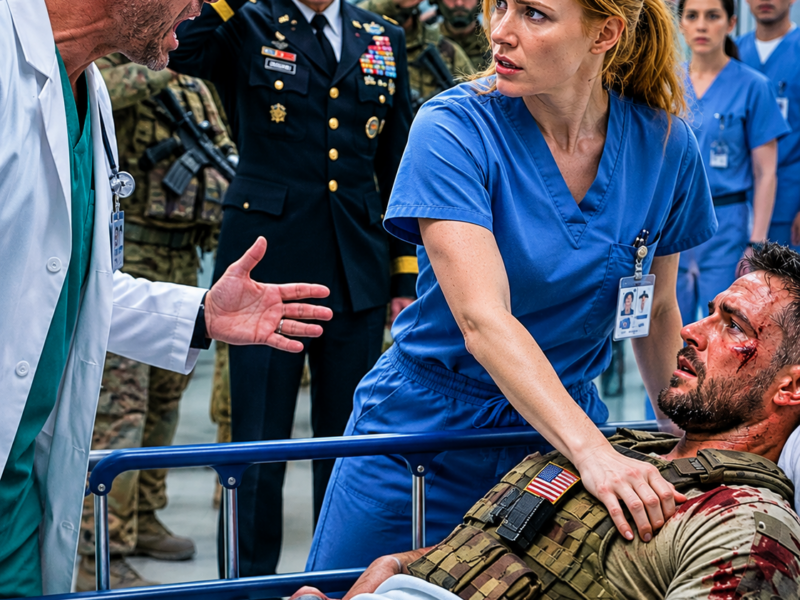
“I was just an ER nurse trying to stop a doctor from making an irreversible decision when hospital security grabbed my arm and ordered me to step away from the patient
The general turned the envelope around so I could see the signature again.
For several seconds, I couldn’t make myself look away.
It was unmistakable.
The handwriting belonged to Dr. Richard Lawson.
But the date on the envelope was from three days earlier, and the signature was followed by a sentence that made my stomach turn.
“Patient is not to be permitted to regain consciousness under any circumstances.”
I looked at the general.
“Sir, what does this mean?”
He didn’t answer immediately.
Instead, he turned toward the two security guards holding my arms.
“Release that nurse.”
They hesitated.
“General, we have orders from hospital administration—”
“I didn’t ask who gave you orders.”
His voice was quiet, but something in it made both men let go.
I rubbed my wrist and stepped toward the patient.
“He’s deteriorating,” I said. “His blood pressure is dropping.”
The general nodded to one of the officers.
“Get a medical team here. Now. And nobody leaves this room.”
Lawson recovered enough to step forward.
“General, with all due respect, you don’t understand the medical situation.”
The general looked at him.
“Then explain why your signature is on an instruction to keep this man unconscious.”
Lawson glanced at Reeves.
It was only a second.
But I saw it.
The general saw it too.
“Mr. Reeves, would you care to explain?”
The hospital administrator swallowed.
“I have no idea what you’re referring to.”
“Interesting. Because your name is on the authorization record.”
Reeves looked toward the exit.
One of the officers quietly moved in front of the door.
I turned back to the patient.
His heart rhythm had become increasingly unstable.
“General, I need to treat him. Whatever this investigation is, it can wait. His heart can’t.”
The general stepped aside.
“Do what you need to do, Nurse Carter.”
For the first time that evening, nobody questioned me.
I worked quickly, checking the monitor, reviewing the available results, and asking the respiratory therapist to prepare the equipment.
Lawson stood near the counter, watching.
I didn’t trust him anymore, but I still needed his medical knowledge if the patient’s condition worsened.
“Doctor,” I said without looking up, “I need you to review these results.”
He didn’t move.
The general turned toward him.
“She’s asking you to help save a life.”
Lawson approached reluctantly.
We examined the initial bloodwork and cardiac readings.
The results didn’t fit the explanation we’d been given.
The patient showed signs of a serious cardiac problem, but there were also indications of a possible drug exposure.
I pointed to the medication history.
“There’s no documented medication administration before arrival, but these results suggest we need to investigate that possibility.”
Lawson stared at the screen.
“That isn’t possible.”
“Why?”
He didn’t answer.
Then the patient moved.
His fingers loosened slightly, and the small metal object slipped against the bedsheet.
I picked it up.
It was a military identification tag, worn around the edges and scratched across the front.
The name was partially obscured.
I wiped away a trace of blood.
The letters became visible.
THOMAS WHITAKER.
The general closed his eyes briefly.
“Colonel Whitaker.”
I looked at him.
“You know him?”
The general pulled a chair closer to the bed.
“I’ve known him for thirty-one years.”
He paused.
“And I’ve spent the last six months trying to find him.”
Before I could ask why, Reeves interrupted.
“This is a hospital, General. You cannot conduct a military investigation in an active emergency department.”
The general turned slowly.
“You’re right. This is a hospital. Which makes it even more disturbing that someone appears to have tried to interfere with a patient’s treatment.”
“That’s an outrageous accusation.”
“Then you’ll have no trouble explaining the paperwork.”
Reeves said nothing.
I continued monitoring Colonel Whitaker.
His condition was still critical, but the immediate danger appeared to be stabilizing.
The general leaned closer to him.
“Tom, it’s Daniel. You’re safe.”
The patient’s eyelids fluttered.
For a moment, I thought he might respond.
Then his lips moved.
“Daniel…”
The general took his hand.
“I’m here.”
Whitaker tried to speak again.
“Not… the report.”
“What report?”
The colonel struggled to breathe.
“Original… records…”
His eyes shifted toward Reeves.
The administrator went pale.
The general noticed.
“Mr. Reeves, I think we’re going to have a long conversation.”
I looked at the general.
“Sir, I need to know what’s happening. If this patient has a medical directive or a history we don’t know about, it could affect his care.”
He nodded.
“You deserve to know enough to protect him.”
He introduced himself as General Daniel Mercer, a retired four-star Army general who had recently been recalled to assist with an independent investigation.
Colonel Thomas Whitaker had served under him for years.
According to Mercer, Whitaker had been a senior military logistics officer responsible for reviewing supply contracts and equipment procurement.
Six months earlier, he had discovered irregularities involving military medical equipment.
At first, the discrepancies seemed ordinary.
Invoices didn’t match shipments.
Equipment listed as delivered had never reached its destination.
Some records showed supplies being transferred between facilities that had never requested them.
Whitaker initially believed it was an accounting problem.
Then he found something much worse.
A series of emergency medical devices had been listed as delivered to military treatment facilities, but the serial numbers on the invoices belonged to equipment already declared missing.
Some of those devices were later connected to preventable deaths.
Whitaker began collecting evidence.
He submitted internal reports.
He requested audits.
And then the people he had reported started receiving warnings about his investigation.
“Why didn’t he go directly to law enforcement?” I asked.
“He tried,” Mercer replied. “But every time he submitted a report, someone seemed to know about it before investigators could review it.”
I glanced at Lawson.
He was still standing near the counter.
“And the hospital?”
Mercer looked toward Reeves.
“Three weeks ago, we received information suggesting that someone had arranged for Colonel Whitaker to be brought here under a false identity.”
“Why?”
“Because he was scheduled to testify tomorrow morning.”
The room seemed to grow smaller.
I looked at the patient.
“Then whoever brought him here knew exactly where he was going.”
Mercer nodded.
“And they knew we would be looking for him.”
A new thought occurred to me.
“How did you know he was here?”
The general reached into his jacket and showed me a photograph.
It was an old picture of Whitaker standing beside a younger version of Mercer.
On the back was a handwritten note.
“If I disappear, look where the records don’t match.”
Mercer tapped the paper.
“We traced a medical transport request that was entered into the system before the ambulance was dispatched.”
I remembered the wristband.
The incorrect arrival time.
The admissions clerk who had been told to remain silent.
Everything was connected.
But one question still bothered me.
“Why did the envelope have Lawson’s signature?”
The general looked at the doctor.
“That’s what we’re going to find out.”
Lawson finally spoke.
“That signature isn’t what you think it is.”
Mercer took one step toward him.
“Then tell us what it is.”
Lawson looked down at the floor.
“I signed a preliminary medical assessment three days ago.”
“For Colonel Whitaker?”
“I didn’t know his identity at the time.”
“Then how did you know he would be here?”
Lawson’s face tightened.
“I was told he was a high-risk patient who might require emergency intervention.”
“By whom?”
Lawson looked toward Reeves.
The administrator shook his head.
“Richard, don’t.”
That was when I understood that the two men were no longer protecting each other.
They were trying to decide which one would be blamed first.
Mercer signaled to his officers.
“Separate them. Preserve every electronic record associated with this admission. Nobody deletes anything.”
Reeves immediately protested.
“You cannot seize hospital property without proper authorization.”
One officer produced a document.
“We have the necessary legal authority.”
For the first time, Reeves had nothing to say.
But the most important discovery of the evening wasn’t in the paperwork.
It was in the patient’s hand.
I had placed the metal identification tag on a clean tray beside his bed.
When I reached for it, I noticed a tiny seam along the back.
The tag wasn’t solid.
It had been modified.
“General?”
Mercer came over.
“What is it?”
I showed him the seam.
He examined it carefully, then looked at the officers.
“Get a secure evidence bag.”
The tag was opened under supervision.
Inside was a folded piece of paper, so small it could barely fit beneath the metal cover.
There were six handwritten names.
Beside each name was a date and a series of numbers.
Mercer read the first name.
Then the second.
By the third, his expression had changed completely.
He folded the paper again.
“Where did you get this?”
“I found it in his hand,” I said.
The general looked at me.
“Emily, this is no longer just about missing equipment.”
He glanced toward the door.
“These are the names of people who approved the original transfers.”
I looked at the list.
One name was familiar.
Martin Reeves.
But there was another name at the bottom.
Dr. Richard Lawson.
Lawson saw it.
His face drained of color.
“That isn’t possible.”
Mercer looked directly at him.
“Then perhaps you should explain why your name appears beside a payment authorization.”
Lawson shook his head.
“I never received any money.”
“That’s not what the document says.”
“I signed a review. I never approved a shipment.”
Reeves suddenly raised his voice.
“Stop talking, Richard!”
The doctor turned toward him.
“You told me this was only about protecting the hospital.”
“And you were supposed to do what you were told!”
The room fell silent.
Even the officers stopped moving for a moment.
Reeves seemed to realize what he’d just admitted.
Mercer stepped closer.
“Thank you, Mr. Reeves. I believe you’ve just made this investigation considerably easier.”
But before anyone could question him further, the cardiac monitor sounded.
The colonel’s heart rhythm had changed again.
I rushed to his bedside.
“Doctor, I need you here!”
Lawson moved immediately.
For a few minutes, the investigation disappeared.
There was only the patient, the monitor, and the medical team trying to keep him alive.
I watched Lawson work.
He was frightened, exhausted, and clearly hiding something.
But in that moment, he was also a physician treating a man whose life depended on him.
I didn’t have the luxury of deciding whether I liked him.
I needed him to do his job.
Together, we stabilized Whitaker.
When the monitor finally settled, I stepped back and removed my gloves.
The general was waiting beside the bed.
“How is he?”
“Still critical. But he’s responding.”
Mercer nodded.
Then he leaned toward the colonel.
“Tom, we found the list.”
Whitaker opened his eyes.
He looked at the general, then at me.
His voice was barely audible.
“Emily…”
I moved closer.
“Yes, sir?”
He tried to lift his hand.
I gently supported it.
“Don’t trust…”
He stopped to catch his breath.
“Don’t trust… the first list.”
Mercer leaned forward.
“What do you mean?”
Whitaker looked at the general with an expression I couldn’t forget.
“Six names…”
He swallowed.
“Seven people.”
Then he lost consciousness again.
Mercer stood completely still.
I looked at the paper inside the evidence bag.
Six names.
Six signatures.
Six people connected to the missing equipment.
But the colonel had just told us there were seven.
The general turned toward his officers.
“Secure every person who had access to the original investigation.”
Then he looked at me.
“Emily, did anyone ask you to sign anything when this patient arrived?”
I shook my head.
“No.”
“Did anyone give you instructions about his identity?”
“Only the order to keep him unconscious.”
Mercer stared at the document in his hand.
“Then we may have a seventh person we haven’t identified.”
I looked at Lawson.
He was watching the evidence bag, but his expression wasn’t one of surprise.
It looked like recognition.
“Doctor?” I asked.
He looked at me.
“Who is the seventh person?”
He opened his mouth.
Before he could answer, his phone vibrated.
He glanced at the screen.
Then he slowly turned it toward General Mercer.
The message contained only eight words.
“Stop looking for the seventh name. It’s yours.”
Mercer stared at the screen.
For the first time since he’d entered the hospital, the general looked genuinely shaken.
He took the phone from Lawson and examined the sender information.
It came from an encrypted account that had been inactive for six months.
The same account that had sent the original warnings to Colonel Whitaker.
“How did this get to your phone?” Mercer asked.
Lawson shook his head.
“I don’t know.”
“Who has access to this device?”
“Nobody.”
The general handed the phone to an officer.
“Preserve it. Don’t respond.”
Then he looked at the colonel.
“Tom, what did you find?”
Whitaker didn’t answer.
His breathing remained shallow.
I adjusted his blanket and checked the monitor again.
Something about the general’s reaction bothered me.
He had been confident when confronting Reeves.
He had been decisive when ordering the officers to secure the records.
But that message had changed him.
I wondered whether Colonel Whitaker had discovered something about the general that the rest of us didn’t know.
A few minutes later, a woman in a navy suit arrived with two federal agents.
She introduced herself as Special Agent Laura Bennett.
She reviewed the evidence bag, the medical records, and the envelope.
Then she asked General Mercer to accompany her into the hallway.
I wasn’t trying to listen.
But the trauma bay doors were still open.
I heard enough.
“Daniel, you need to tell me whether your name appears in the original transfer documents.”
Mercer answered quietly.
“I signed the initial emergency procurement request.”
“Did you know where the equipment went?”
“No.”
“Did you investigate?”
“I ordered an audit.”
“And who controlled the audit?”
He hesitated.
“Colonel Whitaker.”
Agent Bennett lowered her voice.
“Then we need to establish whether you were negligent, compromised, or deliberately involved.”
The general didn’t argue.
He simply nodded.
That was the first time I understood why the colonel had warned him.
Mercer might not have been the person responsible for the missing equipment.
But his signature was part of the chain that had allowed it to happen.
And until the original records were found, nobody could know whether he had been a victim of the deception or part of it.
I returned to the workstation.
I opened the admission record and compared it with the original paramedic paperwork.
The false arrival time was still there.
But now I noticed another entry.
A medication order had been created at 6:11 p.m.
Thirty-one minutes before the ambulance supposedly found Whitaker.
The order was marked as canceled.
I clicked the details.
The medication had been prepared under a physician’s authorization.
Lawson’s name appeared again.
But this time there was a second approval.
A hospital administrator.
Martin Reeves.
I printed the audit trail and carried it to Agent Bennett.
“Look at this.”
She examined it.
“Where did you get it?”
“From the hospital system. The original entry hasn’t been deleted.”
Her eyes narrowed.
“Can you show me the access history?”
I nodded.
The system showed that the order had been created from a terminal in the administrative offices.
Not the emergency department.
And it had been accessed again just minutes before the general arrived.
Agent Bennett called one of the officers over.
“Secure the administrative terminal.”
Then she looked at me.
“Did you see anyone near that office tonight?”
I thought for a moment.
Then I remembered Jessica.
The admissions clerk had been carrying a stack of folders when she came into the trauma area.
One folder had been marked with the same code printed on Whitaker’s wristband.
“I saw Jessica from admissions.”
“Can you identify her?”
“Yes.”
Agent Bennett found her in the corridor.
The young woman looked terrified when she saw the agents.
“I didn’t do anything,” she said.
Nobody had accused her yet.
That was when I knew she was holding something back.
Agent Bennett spoke gently.
“We’re not here to blame you for doing your job. We need to know who gave you the instructions.”
Jessica looked at me.
I nodded.
“It’s okay. Tell them what happened.”
She began crying.
“Mr. Reeves told me to create the patient record before the ambulance arrived. He said the patient was expected and that the paperwork had already been approved.”
“Did he tell you why?”
“No.”
“Did he give you a name?”
Jessica shook her head.
“He told me not to use one.”
Agent Bennett waited.
Jessica wiped her face.
“But there was something else.”
“What?”
“He asked me to print two wristbands.”
I frowned.
“Two?”
“Yes. One for the patient. One for a second person.”
“Who was the second person?”
Jessica looked down.
“I don’t know. The name was already entered.”
Agent Bennett asked her to show the record.
We returned to the admissions workstation.
The second wristband had never been used.
It was still listed as pending.
The name field contained only initials.
D.M.
I looked toward the hallway.
General Daniel Mercer was standing beside the federal agent.
D.M.
His initials.
Agent Bennett saw the screen.
She didn’t immediately react.
Instead, she asked Jessica to print the access history.
The second wristband had been created three days earlier.
It had been modified twice.
The last modification came from a terminal assigned to the general’s military liaison office.
Mercer read the information.
His face tightened.
“That’s not my office.”
Agent Bennett looked at him.
“Who has access?”
“Three people. My assistant, my security liaison, and me.”
“Where are they now?”
He reached for his phone.
Before he could dial, a voice came from the end of the hallway.
“General?”
A young officer in uniform approached.
He was carrying a black folder.
“Sir, your vehicle is ready.”
Mercer looked at him.
“Who told you to come here?”
The officer hesitated.
“Your assistant.”
“Where is he?”
“Waiting outside.”
Agent Bennett stepped forward.
“What’s your name?”
“Lieutenant Andrew Collins.”
She looked at the folder.
“What’s inside?”
“Documents for the general.”
Mercer took one look at the handwriting on the cover.
Then he stopped.
It was the same handwriting I’d seen on the envelope.
The same handwriting I had recognized earlier.
But this time, the general knew it too.
He looked at the lieutenant.
“Who gave you this?”
Collins swallowed.
“Your assistant, sir.”
Mercer opened the folder.
Inside was a single sheet of paper.
It contained a list of names.
Six names.
The same six names from the metal identification tag.
But beneath them was a seventh.
General Daniel Mercer.
And beside his name was a handwritten note.
“Final authorization pending.”
Agent Bennett took the paper.
“General, I need you to come with me.”
Mercer didn’t resist.
He looked toward Whitaker’s room.
Then he looked at me.
“Emily, stay with him. Whatever happens outside this room, don’t let anyone remove him without proper authorization.”
“I won’t.”
He followed the agents.
As the doors closed, I returned to the colonel’s bedside.
For the first time that night, I wondered whether saving him had put us all in danger.
At 3:17 a.m., Whitaker woke.
His eyes moved slowly around the room until they found me.
“General?” he whispered.
“He’s with federal agents.”
Whitaker closed his eyes.
“Good.”
I adjusted his pillow.
“Colonel, I need you to tell me what happened before the ambulance brought you here.”
He stared at the ceiling.
“I found the original shipment records.”
“Where?”
“At the warehouse.”
“What warehouse?”
He turned his head toward me.
“The one they said didn’t exist.”
I waited.
He struggled to speak.
“The equipment wasn’t missing. It was being diverted.”
“By whom?”
He shook his head.
“Not just the six.”
I pulled a chair closer.
“Then who?”
He looked toward the door.
“Someone inside the hospital.”
I felt the skin along my arms tighten.
“Mr. Reeves?”
“No.”
“Dr. Lawson?”
He closed his eyes.
“No.”
He took a slow breath.
“Someone who knew how to make a patient disappear without moving him.”
I stared at him.
The false admission.
The premature medication order.
The second wristband.
The missing identity.
All of it had happened inside the hospital system.
“Who?” I whispered.
Whitaker looked directly at me.
“Your supervisor.”
I didn’t understand.
“My supervisor?”
“Head nurse…”
He swallowed.
“Margaret.”
I sat back.
Margaret Ellis had been my nursing supervisor for six years.
She had trained me when I first joined St. Matthew’s.
She had stood beside me after my father died.
She had brought coffee to the nurses’ station during double shifts and covered my breaks when the department was overwhelmed.
I had trusted her.
Whitaker watched my face.
“She knew… the schedule.”
I shook my head.
“No. Margaret wouldn’t do this.”
He didn’t argue.
He only whispered, “Check the room assignment.”
I looked at the monitor.
Then I turned toward the workstation.
The original trauma assignment showed that Whitaker had been placed in Bay 2.
But the audit history showed that the room had initially been changed to Bay 4.
The change had been made by Margaret Ellis.
At 6:08 p.m.
Three minutes before the medication order.
I opened the access record.
Her employee credentials had been used again at 6:37 p.m.
Just five minutes before the ambulance arrived.
I stared at the screen.
A new entry appeared.
A visitor access request.
The name was Margaret Ellis.
The destination was Trauma Bay 2.
The timestamp was 3:21 a.m.
I looked at the clock.
It was 3:21.
The door opened.
Margaret stood there holding two cups of coffee.
She smiled when she saw me.
“Emily, you’ve had a long night.”
I didn’t move.
She placed one cup on the counter.
“How’s our patient?”
I looked at the visitor access record.
Then I looked at the woman who had taught me never to ignore a nurse’s instincts.
“Margaret,” I said carefully, “why did you change his room assignment before the ambulance arrived?”
Her smile disappeared.
For a moment, neither of us spoke.
Then she looked at the colonel.
And the expression on her face told me that she knew he was awake.
“Emily,” she said softly, “you need to step away from that computer.”
I stayed where I was.
“Why?”
She put down her coffee.
“Because you don’t understand what you’re looking at.”
“Then explain it to me.”
Her eyes moved toward the hallway.
She was checking whether anyone had followed her.
“Not here.”
“Why not?”
She looked at me with something close to desperation.
“Because if they know I told you, neither of us will leave this hospital safely.”
The words landed harder than any threat Lawson had made.
I glanced at Whitaker.
His fingers moved against the blanket.
He was awake, listening.
Margaret stepped closer.
“Emily, please. I know you trust me.”
I swallowed.
“That’s exactly why I need you to tell me the truth.”
She looked down at her hands.
Then she reached into her pocket and pulled out a small flash drive.
“I didn’t create the false order,” she whispered. “I only changed the room assignment.”
“Why?”
“Because I was trying to keep him away from the administrative cameras.”
I stared at her.
“Why would you do that?”
She looked at Whitaker.
“Because I knew someone was coming to finish what they’d started.”
I couldn’t speak.
She placed the flash drive on the counter.
“Everything you need to understand is on here.”
I didn’t touch it.
“Who is the seventh person?”
Margaret closed her eyes.
“Someone who has been protecting this hospital for years.”
“Who?”
She looked straight at me.
“Me.”
Before I could respond, the emergency department lights flickered.
A loud crash came from the corridor.
Margaret grabbed my wrist.
“Emily, listen to me. I didn’t help them kill those people. I helped hide the records because I thought I could prove what happened without putting anyone else in danger.”
“Then why did you let them bring him here?”
“Because he asked me to.”
I stared at her.
“What?”
Margaret’s eyes filled with tears.
“Thomas Whitaker contacted me two weeks ago. He knew someone inside the hospital was involved. He needed a place where he could get treatment and deliver the original records to the federal investigators.”
“Why didn’t he tell me?”
“Because he didn’t know who he could trust.”
She glanced toward the flash drive.
“And neither did I.”
The crash came again.
This time, footsteps followed.
Margaret moved between me and the door.
“Whatever happens, don’t let them take that drive.”
I reached for it.
Then the door opened.
A man in a gray jacket stood in the entrance.
I recognized him.
He was the hospital’s chief security officer, Frank Delaney.
He looked at Margaret.
Then at the flash drive.
“Give me that,” he said.
Margaret stepped back.
“No.”
Delaney’s expression hardened.
“Margaret, don’t make this worse.”
I moved toward the emergency call button.
He noticed.
“Don’t.”
Whitaker began struggling to raise his hand.
I stepped between Delaney and the bed.
“You’re not coming any closer.”
He looked at me with a tired, almost disappointed expression.
“Emily, you’ve done enough tonight.”
“Not until I know why a patient was given a false identity and an unauthorized medical order.”
Delaney took another step.
Then Margaret did something I never expected.
She threw the coffee in his face.
He recoiled, shouting.
I pressed the emergency call button.
The security alarm sounded.
Within seconds, two federal agents rushed into the room.
Delaney tried to run, but one of them tackled him before he reached the hallway.
Margaret sank into a chair.
I stood beside Whitaker, breathing hard.
Agent Bennett entered moments later.
She looked at the flash drive.
“Is this what I think it is?”
Margaret nodded.
“Original transfer logs. Payment records. The names of everyone involved.”
“Why didn’t you bring this to us earlier?”
Margaret looked at me.
“Because one of the people on that list was my brother.”
Nobody spoke.
She wiped her face.
“He was a procurement officer. He approved the first transfer. He believed the equipment was going to military hospitals. When he realized it was being diverted, he tried to report it.”
“What happened to him?” I asked.
Margaret looked down.
“He died in a warehouse fire.”
Whitaker opened his eyes.
“That wasn’t an accident.”
Margaret nodded.
“I know.”
She explained that her brother had sent her copies of the records shortly before his death.
She had spent years trying to understand them.
When the investigation began, she recognized the same names.
She knew the people involved had access to hospital systems.
She had changed Whitaker’s room assignment to keep him away from the cameras controlled by Delaney.
But she had also made a terrible mistake.
She had waited too long to tell anyone.
Agent Bennett took the flash drive and placed it in an evidence bag.
“Margaret, you’ll need to come with us.”
Margaret nodded.
Then she looked at me.
“I’m sorry.”
I wanted to say something.
I wanted to ask how she could have let me believe everything was normal while people were being hurt.
But all I managed was, “I trusted you.”
She looked as if I’d struck her.
“I know.”
She left with the agents.
By sunrise, the hospital had become a crime scene.
Federal investigators secured the administrative offices, the security room, and the records department.
Martin Reeves was arrested.
Frank Delaney was taken into custody.
Dr. Lawson was placed on administrative leave while investigators examined his role in the unauthorized orders and the original procurement reviews.
He later admitted that he had signed documents without properly verifying their purpose.
He insisted he had never intended to harm Whitaker.
The investigation would determine how much of that was true.
General Mercer returned to the hospital shortly after seven.
He looked older than he had the night before.
He approached Whitaker’s bed.
“Tom.”
The colonel opened his eyes.
“Daniel.”
The general pulled a chair close.
“I need to tell you something.”
Whitaker waited.
“I signed the original procurement authorization. I trusted the people who presented the numbers. I should have questioned the discrepancies sooner.”
The colonel looked at him for a long moment.
“Did you know?”
“No.”
“Then prove it.”
Mercer nodded.
“I will.”
For the first time, the colonel smiled faintly.
“That’s all I wanted.”
Over the following weeks, the investigation revealed that the missing equipment had been diverted through a network of contractors and intermediaries.
Several shipments had been resold, while others had been stored in private warehouses.
Records had been manipulated to make the equipment appear delivered.
The original documents on Margaret’s flash drive helped investigators trace the transactions.
Colonel Whitaker eventually gave his testimony.
General Mercer also testified, acknowledging the failures in the original oversight process.
He was cleared of knowingly participating in the scheme, although the investigation concluded that his failure to detect the irregularities had contributed to the damage.
Margaret cooperated with investigators.
She admitted concealing records and altering hospital assignments.
She also provided evidence that helped establish the full chain of responsibility.
She lost her position and faced legal consequences for her actions.
She and I never returned to the friendship we once had.
A few months later, I received a letter from her.
It contained no excuses.
Just an apology and one sentence that I read several times.
“I thought protecting people meant carrying the truth alone, and I was wrong.”
I put the letter in my desk drawer.
I didn’t forgive her immediately.
Maybe I never completely will.
But I stopped needing to hate her in order to remember what she had done.
As for Colonel Whitaker, he recovered slowly.
The last time I saw him before he was transferred to a rehabilitation facility, he handed me the small metal identification tag.
“Keep it,” he said.
“I can’t take this, Colonel.”
“You already did more for me than you know.”
I looked at the worn metal in my palm.
“I was just doing my job.”
He smiled.
“That’s what everyone says when they do something brave.”
I shook my head.
“I was scared.”
“Being scared doesn’t mean you did nothing.”
General Mercer stood near the doorway.
He approached and extended his hand.
“Emily, the Army will remember what you did.”
I shook it.
“Sir, I don’t need recognition. I just want the next nurse who questions an order to be heard before someone grabs her arm.”
He looked at me for a moment.
Then he nodded.
“I’ll make sure that message reaches the people who need to hear it.”
I returned to work at St. Matthew’s several weeks later.
The emergency department was still noisy.
The monitors still beeped.
Patients still arrived frightened, injured, and uncertain whether they would make it home.
But something had changed in the way I looked at every chart, every signature, and every order that didn’t quite make sense.
I learned that doing the right thing doesn’t always mean knowing the whole truth.
Sometimes it means refusing to ignore the one detail everyone else wants you to overlook.
On the day I finally removed the colonel’s identification tag from my locker, I held it beneath the fluorescent lights and ran my thumb over the scratched letters.
THOMAS WHITAKER.
I remembered his hand gripping it, his voice struggling to form a warning, and the room full of people who had decided I should stay quiet.
Then I placed it back in the drawer.
Not because I wanted to remember the fear.
Because I never wanted to forget the moment I chose to speak.
THE End.









