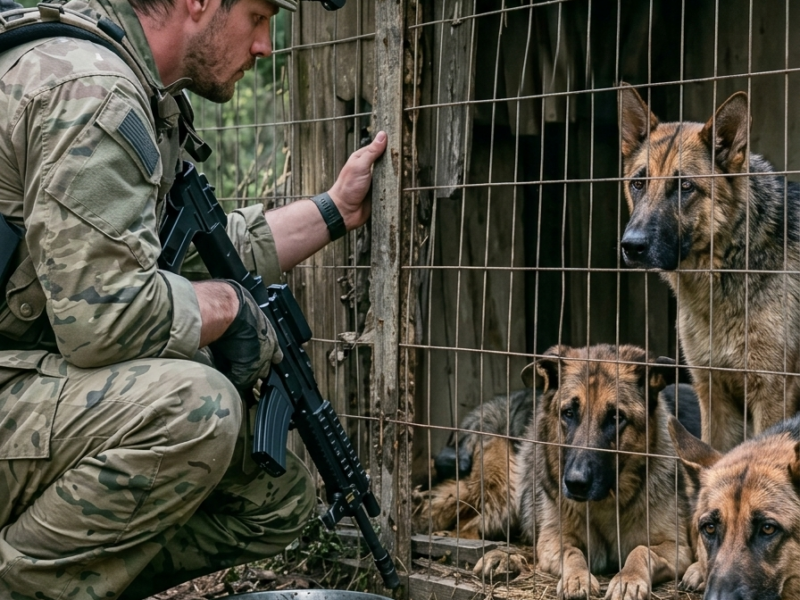
I was investigating an abandoned farm outside rural Montana when I heard desperate scratching behind a rusted barn door, and when I forced it open
The smell hit me first. Rotten hay, damp wood, and something painfully familiar beneath it all—the sharp, unmistakable metallic tang of dry blood and neglected iron.
I was investigating an abandoned farm outside rural Montana when I heard desperate scratching behind a rusted barn door, and when I forced it open, I found six starving German Shepherds chained in the darkness while a powerful local businessman watched from his truck, smiling coldly as he told me those dogs were worthless—until one of them dragged itself toward me and revealed a military tag bearing the name of my best friend, who had died three years earlier.
I was a Navy SEAL, recently returned from a brutal eight-month deployment in the Red Sea, but nothing in my military training had prepared me for the sickening sight inside that decaying structure. Shafts of pale gray sunlight filtered through the cracked roof boards, illuminating six heavy metal chains anchored to concrete posts.
At the end of each chain sat a German Shepherd. Their ribs showed starkly beneath matted, dirt-caked coats. Their paws were raw and bleeding from digging at the hard-packed earth, and six empty, dented water bowls sat scattered across the filthy floor.
One Shepherd tried to stand as the heavy wooden door creaked open, but his hind legs buckled under his own meager weight, and he collapsed back into the straw with a hollow whimper.
I dropped to my knees, my heart slamming against my ribs. “Easy, buddy,” I whispered, keeping my hands low and palms open. “Easy. You’re safe now.”
The largest dog lifted his heavy head. Cloudy brown eyes met mine, and I saw a deep, jagged scar running from beneath his left ear down to his neck. He didn’t bark. He didn’t growl. He just stared at me with an expression of profound, weary recognition.
Then he shifted his weight, and a small metal disk pinned to his heavy nylon collar caught the sunlight.
My hands began to shake as I leaned closer to inspect the tag. Stamped into the worn aluminum were a service number, a blood type, and a name: DANIEL CARTER.
Daniel Carter had been my closest friend, my teammate, and my brother in arms. Three years ago, while I was stationed in Okinawa, I received the official casualty report stating that Petty Officer First Class Daniel Carter had been killed in an explosion during a training operation off the coast of Alaska. I had attended his closed-casket funeral in Arlington. I had presented the folded American flag to his weeping sister. And for three long years, I had spent every silent night wondering why the final letter he promised to send me had never arrived.
Behind me, the sharp crunch of gravel shattered the heavy silence.
“You need to leave those animals alone, son,” a voice boomed from the open barn doorway.
I turned slowly, keeping my body between the dogs and the intruder. A silver-haired man stood beside a late-model black pickup truck parked in the overgrown driveway. He wore an expensive shearling coat, polished leather boots, and a cold, patronizing smile that never reached his pale blue eyes. This was Vance Thorne, a wealthy regional real estate tycoon and military logistics contractor whose name was plastered on half the commercial development signs in the county.
“I’m calling animal control,” I said, my voice dangerously low as I pulled my phone from my pocket. “And then I’m calling the county sheriff.”
Thorne chuckled—a dry, grating sound that held no humor. “Save your battery. Those dogs belong to me. They’re private property on private land.”
“They’re dying, Thorne,” I snarled, stepping out of the shadows of the barn. “They haven’t had water in days.”
“Then perhaps you should stop wasting your time trespassing on my lease,” Thorne replied smoothly, straightening his expensive cuffs. “They’re aggressive, broken-down strays. Culls. They’re being put down tomorrow anyway.”
I closed the distance between us until I was standing less than two feet from his chest. My jaw was clamped so tight my teeth ached. “My name is Jack Miller. I’m an active-duty Navy SEAL, and these animals are coming out of this barn today. Try to stop me, and we’ll see how well your security guards handle a combat veteran.”
Thorne’s arrogant smile vanished instantly, replaced by a dark, calculating glare. He looked at my posture, my calloused hands, and the lethal focus in my eyes, recognizing that I wasn’t making a bluff.
“You have no idea what you’ve walked into, Chief Miller,” Thorne whispered softly, stepping back toward his vehicle. “Some dead men ought to stay buried.”
He climbed into his black pickup, slammed the door, and accelerated down the dirt lane, leaving a thick cloud of tan dust hanging motionless in the cold afternoon air.
I turned back into the barn and immediately dialed a local emergency veterinary service, pleading for a mobile transport team. But before the first responders could arrive, a low scraping noise drew my attention back to the rear stall.
The scarred Shepherd was dragging his trembling body across the dirt, his front claws digging into the ground, pulling his heavy chain behind him. He reached a rusted wooden crate hidden beneath a mound of rotting straw and began scratching at the iron latch with frantic desperation.
“What is it, boy?” I asked, kneeling beside him and gently taking over.
I cleared away the damp straw and pried open the wooden lid. Sitting at the bottom of the crate was a heavy-duty, waterproof military document pouch. My chest tightened as I unzipped the seal. Inside was a faded photograph, a folded letter written on legal paper, and a tarnished military identification card.
The photograph showed Daniel Carter in desert battle dress, standing proudly beside three young German Shepherds—including the scarred dog currently resting his warm chin against my knee.
On the back of the photograph, in Daniel’s sharp, slanted handwriting, were four simple words: If anything happens, find them.
My fingers trembled as I unfolded the handwritten letter.
Jack,
If you’re reading this, I couldn’t get the physical evidence out in time. The contractor network is bigger than we thought, reaching all the way into local government. The dogs witnessed what happened at the staging facility, and Thorne knows they can lead you to the buried site. Don’t trust the official reports. The crash was staged.
I read the lines twice, my heart pounding in my ears like a war drum.
I looked at the six starving animals around me. They weren’t forgotten pets or abandoned strays. They were high-grade Military Working Dogs—K-9 units retired under classified status after a covert logistics mission that had supposedly concluded without a single casualty.
According to Daniel’s letter, he had uncovered a massive corruption scheme: millions of dollars in tactical gear, medical supplies, and weapons meant for deployed frontline units were being systematically stolen from military depots and resold on the black market through Thorne’s private logistics firm. Daniel had gathered the paper trail, but before he could deliver it to Federal authorities, he had been hunted down.
A faint, pathetic whimper pulled me back to the present.
The scarred Shepherd was staring at me, his cloudy brown eyes wide and pleading, his tail moving weakly against the filthy straw. I knelt beside him, wrapping my arms around his emaciated neck, pressing my forehead against his cool nose.
“Did Daniel leave you here to protect this?” I whispered.
The dog let out a deep, trembling sigh and pressed his head firmly against my chest, right over my heart. For the first time in three long, brutal years, I wept for my lost brother without a single shred of shame.
By sunset, two veterinary ambulances had arrived. The six Shepherds were carefully loaded onto stretchers, hydrated, and transported to an isolated veterinary surgical clinic ten miles outside town. I followed in my truck, having already contacted a trusted federal investigator I knew from my days on the West Coast teams.
For an hour, as the clinic staff wrapped intravenous lines and administered antibiotics to the malnourished animals, I sat in the quiet waiting room, believing the worst of the ordeal was finally behind us.
Then my cell phone vibrated in my palm. An unknown, unlisted number.
I pressed the receiver to my ear. “Miller.”
A man’s raspy, wind-strained voice spoke before I could even breath out a greeting. “Jack… if you’ve found Daniel’s dogs, you need to listen to me very carefully.”
I froze in the center of the brightly lit clinic hallway, my muscles instantly locking into position. “Who is this? How do you have this number?”
There was a long, excruciating pause on the line, heavy with the sound of ragged breathing.
Then the voice whispered, “Daniel is alive. And Thorne knows you’ve found him.”
The line went dead with a sharp click.
Behind the clinic’s glass doors, all six recovery kennels erupted simultaneously into a frenzy of wild, desperate barking. I whipped around, my hand flying to the concealed sidearm at my belt.
Through the reinforced glass of the clinic’s rear exit, I watched the scarred Shepherd rise to his feet for the first time without help. He was standing tall, his ears pinned back, staring intently through the darkness at a figure standing beneath the parking lot light outside.
The man outside was tall, broad-shouldered, and wearing a faded, salt-stained Navy flight jacket—the exact jacket Daniel Carter had worn the day he departed for his final deployment.
The silhouette beneath the yellow parking lot lamp stood motionless in the freezing Montana night, the collar of the faded flight jacket pulled high against the biting wind.
“Stay inside!” I barked to the frightened receptionist as I drew my sidearm, racked the slide, and kicked open the heavy glass exit door of the clinic.
Cold air slammed into my lungs like a physical wall. I rounded the corner of the building with my weapon raised in a low-ready position, scanning the snow-dusted asphalt.
The figure was gone.
The only movement was the violent swinging of an unlatched chain-link gate at the far edge of the property, rattling rhythmically against its iron post. I sprinted across the parking lot, my tactical boots crunching on the thin ice, but the dark treeline beyond the perimeter fence was empty. Whoever had been standing beneath that lamp had vanished into the dense lodgepole pines like a ghost.
Ranger—the name I had found etched on the scarred Shepherd’s secondary medical tag—was throwing his full, emaciated weight against the interior glass door behind me, his deep, resonant barks ringing out across the quiet facility.
I rushed back inside, holstering my weapon, and knelt in front of Ranger’s enclosure. The dog was hyperventilating, his nose pressed hard against the iron bars, his paws scratching frantically at the tile floor.
“You saw him too, didn’t you, buddy?” I murmured, reaching through the bars to stroke his neck until his shivering slowed. “You know that jacket.”
The veterinary surgeon, a sharp-eyed woman named Dr. Evelyn Reed, hurried down the corridor with a clipboard and an armful of medical charts.
“Mr. Miller, what on earth is going on out there?” she demanded, looking between my tense posture and the agitated animals. “These dogs are in critical condition. They’re suffering from acute renal distress, severe anemia, and physical trauma. If they are subjected to any more stress, their hearts will fail.”
“Dr. Reed, I need this building locked down immediately,” I said, my voice leaving no room for argument. “Deadbolts on every door, security shades drawn. The man who owned that barn knows they’re here, and he isn’t going to let them survive the night.”
She opened her mouth to protest, but the raw intensity in my expression made her stop. She nodded slowly, turned to her staff, and began barking orders to secure the perimeter.
I walked into the private office at the back of the clinic, pulled out my phone, and dialed a secure satellite line. It rang three times before being picked up by Master Chief Marcus Vance, my former team leader currently working out of Naval Special Warfare Command in Coronado.
“Vance,” the deep voice growled through the speaker.
“Marcus, it’s Jack,” I said, pacing the small room. “I need you to pull up the classified incident report on Daniel Carter’s death. Alaska, three years ago.”
A long silence stretched over the satellite link. “Jack, we buried Daniel three years ago. You were at the service. What is this about?”
“I’m standing in a veterinary clinic in rural Montana,” I replied, my voice shaking with restrained anger. “I just pulled six of Daniel’s tactical MWDs out of a locked barn owned by Vance Thorne. They were chained up and left to starve. And five minutes ago, I read a letter from Daniel stating that his death was staged to cover up a multi-million-dollar military supply theft ring.”
“Jesus Christ,” Marcus breathed. “Jack, listen to me very carefully. The official report filed by Naval Intelligence stated that Daniel’s patrol boat suffered an internal magazine explosion off the Aleutian Islands. No remains were recovered. The case was handled exclusively by a private intelligence subcontractor attached to the Department of Defense.”
“Let me guess,” I spat. “Thorne Logistics.”
“Thorne held the primary security and salvage contract for that entire sector,” Marcus confirmed grimly. “If Daniel discovered something on that vessel, Thorne was the one who controlled the crime scene. Jack, if Daniel is alive, he’s been off the grid as an illegal combatant for thirty-six months. If the authorities find him before we do, they won’t take him into custody. They’ll eliminate him.”
“He’s here, Marcus,” I said, staring through the office window toward the dark pines outside. “He just made contact. I need you to run a trace on the satellite tower near Highway 83. Find out where that call originated.”
“I’m on it,” Marcus said. “Keep those dogs alive, Jack. They’re the only physical link to whatever happened on that boat.”
I hung up the phone and walked back into the recovery ward. Ranger had finally settled down, lying on a thick pile of sterile blankets inside his run. As I approached, he lifted his head and let out a soft, low whine, pointing his snout toward the heavy canvas duffel bag where I had placed Daniel’s waterproof pouch.
I sat down on the clean tile floor beside his run, pulled out the hand-drawn topographical map Daniel had left in the crate, and spread it out under the fluorescent lights.
The map depicted a vast, roadless tract of state forest land thirty miles north of the abandoned farm. Marked in red ink near a feature called Deadman’s Canyon were three precise geographic coordinates, accompanied by a single word written in block letters: CACHE.
Ranger reached his head through the lower gap in the run gate, resting his chin on the edge of the map, his dark eyes fixed on the red coordinates.
Suddenly, the clinic’s overhead lights flickered once, twice, and died completely.
The facility was plunged into absolute, pitch-black darkness.
A second later, the sharp, deafening screech of a high-voltage power line short-circuiting echoed from the main transformer outside the building.
“Dr. Reed!” I yelled, drawing my SIG Sauer as the emergency backup generator coughed, sputtered, and failed to engage.
From the front lobby came the heavy, metallic sound of glass shattering under a sledgehammer, followed by the rapid, rhythmic thud of tactical boots entering the building.
The darkness inside the clinic was heavy and suffocating, broken only by the thin green glow of the exit signs and the frantic, panicked barking of the six weakened Shepherds.
“Stay down! Under the desks!” I roared toward the administrative hallway where Dr. Reed and her nurses were huddled.
I dropped into a low combat crouch behind the steel frame of the medical reception counter. My eyes adjusted rapidly to the dark, relying on the spatial awareness drilled into me through years of night-clearance operations.
Three men moved through the shattered front entrance. They were wearing dark tactical gear, suppressed carbines, and night-vision goggles—professional mercenaries, moving with disciplined, overlapping sectors of fire. These weren’t local farmhands; these were trained contractors hired to clean up a liability.
“Clear the rooms,” a harsh, accented voice ordered from the lobby. “Find the flash drives and destroy the animals. Leave no brass.”
The first operator stepped into the recovery hallway, his weapon raised, the infrared laser of his rifle sweeping across the floorboards.
I didn’t give him the chance to identify my position.
I lunged from behind the counter, grabbed the barrel of his carbine, and shoved it forcefully toward the acoustic tile ceiling just as he squeezed the trigger. The suppressed weapon let out a muted pfft-pfft-pfft, punching holes in the drywall above. In the same fluid movement, I drove my right elbow into his throat, crushing his windpipe, and followed with a devastating knee to his solar plexus.
He folded with a strangled gasp. I seized his tactical vest, slammed his head against the concrete doorframe, and disarmed him before he hit the deck.
“Contact in the hall!” the second contractor yelled, spinning his weapon toward my position.
I rolled behind a heavy stainless steel operating table just as a hail of submachine-gun fire shattered the glass windows behind me, sending sharp shards raining down like ice.
From inside his enclosure, Ranger erupted into a fury of wild, protective rage. Despite his severe weakness and the IV line taped to his foreleg, the scarred Shepherd slammed his body against the latch of the kennel gate. The rusted iron bolt snapped under the force, and Ranger burst into the hallway like a dark storm.
He didn’t hesitate. Ranger leaped through the air, his jaws locking around the wrist of the second gunman.
The contractor shrieked in pain, dropping his weapon as seventy pounds of tactical working dog dragged him to the floor.
“Ranger, hold!” I barked, popping up from behind the surgical table and delivering two precise shots into the chest plates of the third operator advancing through the front lobby. The heavy 9mm rounds knocked the man backward through the shattered glass front doors, sending him tumbling down the concrete entry steps.
I sprinted down the hall, grabbed the secondary contractor pinned by Ranger, and slammed him against the wall, jamming the barrel of my sidearm under his chin.
“Who sent you?” I growled, my finger tightening on the trigger. “Where is Thorne?”
The mercenary gasped for air, his eyes wide with shock as he stared at the bleeding, scarred Shepherd standing over him with bared teeth. “The… the airstrip,” he choked out. “Thorne is clearing the hangar at the county airfield… shipping the remaining crates out at midnight!”
“Where is Daniel Carter?” I demanded, shoving the steel barrel harder against his jaw.
“He’s… he’s at the canyon!” the man sobbed. “We couldn’t catch him! He’s been living in the mountain caves for three years… watching the farm!”
I knocked the contractor unconscious with the butt of my pistol, pulled Dr. Reed from her office, and handed her the mercenary’s zip-ties.
“Bind them,” I ordered, my chest heaving as the distant sound of approaching police sirens finally began to wail in the valley below. “The police will be here in three minutes. Tell them to hold these men for Federal authorities.”
“Jack,” Dr. Reed gasped, looking at the unconscious mercenaries and the bleeding dog standing beside me. “You can’t leave! You’re hurt!”
“I have to finish this,” I said.
I turned to Ranger. The dog was breathing heavily, his flank bloodied from where his IV line had pulled free, but his eyes were blazing with a fierce, unbreakable determination. He walked over to my side, bumped his head against my hand, and turned toward the rear exit.
“You’re coming with me, aren’t you, buddy?” I whispered.
He didn’t whine. He simply walked to the passenger side of my truck and waited by the door.
Ten minutes later, with Ranger sitting proudly in the bench seat beside me and Daniel’s topographical map taped to the dashboard, my heavy 4×4 truck tore through the snow-slicked curves of Highway 83, racing north toward the razor-sharp granite peaks of Deadman’s Canyon.
The storm hit full force as we reached the upper elevation of the timber pass.
Heavy, wet snow slammed against the windshield of my truck, turning the dirt logging road into a treacherous lane of churning mud and deep ruts. I shifted the vehicle into low four-wheel drive, the engine roaring as we climbed higher into the wilderness of Deadman’s Canyon.
Beside me, Ranger sat rigid, his ears pricked forward, his eyes scanning the dense wall of pine trees through the sweeping wiper blades.
Three miles past the pavement’s end, the logging trail terminated at the lip of a massive granite gorge. Below us, the black waters of a mountain river crashed over sharp boulders, the sound echoing off the sheer cliffs like distant thunder.
I turned off the engine and killed the headlights. The mountain enveloped us in heavy, silent darkness.
“Stay close, Ranger,” I whispered, reaching into the back seat to grab a tactical vest I had fitted onto the dog, along with my night-vision gear and a heavy-duty assault rifle retrieved from my cabin’s gun safe.
We stepped out into the knee-deep snow. The wind howled through the canyon, driving icy needles against my face.
Ranger immediately picked up a scent, lowering his snout into the snow and trotting purposefully toward a narrow, hidden game trail that wound upward along the edge of the cliff face. I followed three paces behind him, my rifle raised, my night-vision monocular painting the snow-covered forest in sharp, ghostly shades of emerald green.
We climbed for twenty grueling minutes, ascending toward a high ridge dominated by the ruins of an abandoned 19th-century silver mine.
Suddenly, Ranger stopped dead in his tracks. His tail dropped low, and a soft, vibration-like purr sounded in his chest.
Ten yards ahead, sitting beneath the shelter of a massive fallen Douglas fir, was a crude timber lean-to reinforced with pine boughs and camouflage tarp. Smoke drifted almost imperceptibly from a small, stone-shielded fire pit buried beneath the roots.
“Daniel!” I called out, keeping my voice low and steady as I lowered my rifle. “It’s Jack! I have Ranger with me!”
A figure stepped slowly out of the shadows of the tree roots.
My breath caught in my throat.
He looked like a man who had been carved out of the mountain itself. He was thin—dangerously so—with a long, unkempt beard streaked with gray, and deep, sunken hollows beneath his eyes. He wore a patchwork of worn military garments, animal hides, and the faded Navy flight jacket I had seen at the clinic.
In his hands, he held an old, bolt-action hunting rifle pointed directly at my chest.
For three long seconds, nobody moved. The only sound was the whistling wind and the crackle of the embers.
Then Ranger let out a sharp, joyful bark and broke formation, bounding through the deep snow and throwing his front paws directly onto the man’s chest.
The bolt-action rifle dropped into the snow.
Daniel Carter fell to his knees in the freezing drift, wrapping his arms around the massive Shepherd, burying his face in the dog’s thick fur as his shoulders shook with silent, overwhelming sobs.
“Ranger…” Daniel wept, his voice raspy and broken from years of isolation. “My boy… my good boy… you made it…”
I stepped forward, dropping my own weapon into the snow, and knelt beside my best friend. I placed a hand on his trembling shoulder.
Daniel looked up at me, his eyes wild, haunted, but filled with a fierce, unmistakable intelligence. “Jack…” he choked out. “You shouldn’t have come here. Thorne… Thorne has half the county in his pocket.”
“I don’t care if he has the whole state, Dan,” I said, my voice thick with emotion. “You’re coming home.”
Daniel wiped his face with a ragged sleeve, leaning against the tree trunk as Ranger licked the ice from his bearded cheek. “I couldn’t come back, Jack. When I uncovered the theft network on the coast, Thorne’s men intercepted my unit. They blew the boat to make it look like an accident. I was blown clear into the water, but three of our teammates died that night.”
His voice broke, turning into a harsh whisper. “I dragged myself ashore on the Aleutian coast. Thorne’s people declared me dead before the search even started. I realized the only way to keep my sister and my friends safe was to let the world believe I was in that grave.”
“Why the dogs, Dan?” I asked gently. “Why leave them at that farm?”
“Because Thorne used them to track the stolen crates,” Daniel explained, his eyes darkening with rage. “Those dogs were trained on the specific chemical markers of the military munitions Thorne was smuggling. When Thorne realized I was still alive and hiding in these mountains, he locked the dogs in that barn to starve them—so nobody could use them to find his main underground supply bunker.”
Daniel reached beneath his coat and pulled out an old, waterproof tactical hard drive.
“Everything is on here, Jack,” Daniel said, holding the drive out to me. “The manifests, the offshore accounts, the serial numbers of every crate of stolen ordnance sitting in Thorne’s hangar right now at the county airport. He’s loading the final cargo plane tonight. Once that plane takes off for South America, the evidence leaves with it.”
I took the hard drive, gripping Daniel’s hand tightly in mine. His skin was cold, but his pulse was steady and strong.
“That plane isn’t taking off,” I said, turning to look down the mountain valley toward the distant, glowing lights of the county airfield. “We’re going to shut Thorne down once and for all.”
The county airfield sat in a wide, flat basin five miles outside town, surrounded by high chain-link fencing topped with razor wire.
At 11:30 PM, a massive, double-engine Soviet-built cargo plane sat on the dark tarmac, its rear loading ramp lowered into the snow. Floodlights illuminated a busy staging area where three forklifts were transferring heavy, green wooden crates from a row of Thorne Logistics tractor-trailers into the belly of the aircraft.
Vance Thorne stood near the foot of the loading ramp, wearing his expensive coat, checking his watch impatiently as a team of six armed private security guards patrolled the perimeter.
“Move it!” Thorne shouted over the roar of the plane’s idling turboprop engines. “We wheels-up in twenty minutes! I want this tarmac clear!”
He didn’t see the heavy 4×4 truck approach the dark perimeter fence half a mile down the runway with its lights killed.
Inside the cab, I checked the action of my assault rifle, while Daniel adjusted a tactical chest rig I had provided from my gear stash. Beside us in the back seat, Ranger sat perfectly still, his eyes locked on the illuminated hangar ahead.
“Federal authorities are ten minutes away,” I said, glancing at the encrypted radio display on my dash. “Marcus managed to pull a joint task force of FBI and State Troopers together, but if that plane starts its takeoff roll, they won’t be here in time to stop it.”
“Then we hold the runway,” Daniel said, a fierce, familiar smile breaking through his weathered face. “Just like old times, Chief?”
“Just like old times,” I agreed.
I slammed my foot onto the accelerator.
The heavy steel front bumper of my truck smashed through the chain-link perimeter fence with a deafening screech of tearing metal, sending wire snapping through the air as we roared onto the wide concrete runway.
“Hostiles on the tarmac!” a security guard screamed over the radio.
I barreled straight down the center line of the runway, turning on my high-beam floodlights and blinding the guards standing near the aircraft.
“Ranger, GO!” I bellowed as I slammed on the brakes fifty yards from the cargo plane, bringing the truck into a sweeping sideways slide that created a temporary metal barrier between us and the loading ramp.
Daniel and I kicked our doors open simultaneously, taking up defensive firing positions over the truck’s hood and bed.
Ranger leaped out from the back seat like a missile, tearing across the snow-covered tarmac and tackling the lead security guard before the man could bring his shotgun to bear.
“Fire! Kill them!” Thorne screamed, retreating up the loading ramp of the cargo plane in pure, frantic panic.
Automatic gunfire erupted across the tarmac. Bullets slammed into the side panels of my truck, shattering the windows and sparking off the steel rims. I returned fire with calm, surgical precision, dropping two guards armed with automatic rifles, while Daniel covered the left flank, his fire pin-point accurate despite his three years in the wilderness.
The cargo plane’s engines suddenly roared to a deafening whine. The pilot was advancing the throttles, attempting to initiate an emergency taxi down the runway with the loading ramp still lowered.
“He’s trying to roll!” Daniel shouted over the engine roar.
“Not on my watch!” I yelled.
I grabbed a heavy-duty steel tow cable from the bed of my truck, sprinted through the crossfire toward the front landing gear of the nearest heavy forklift, and clamped the industrial hook onto its frame. I threw the forklift into gear, slammed the accelerator to the floor, and rammed the heavy vehicle directly into the lower hydraulic arm of the aircraft’s cargo ramp.
With a sickening crunch of tearing steel and popping hydraulic fluid, the ramp twisted sideways, jamming the aircraft’s rear structure and pinning the plane firmly to the tarmac.
The plane’s engines sputtered, stalled, and died as power was cut to the main drives.
Thorne stumbled out from the ruined cargo bay, his coat covered in hydraulic oil, a heavy nickel-plated revolver held in his shaking hand.
“You ruined everything!” Thorne shrieked, pointing the weapon directly at my chest. “I built an empire! You were supposed to be dead!”
Before he could pull the trigger, a dark shadow leaped through the air from the top of an elevated supply crate.
Ranger hit Thorne full in the chest, knocking the revolver from his hand and pinning the tycoon back against the icy concrete floor of the ramp. Thorne let out a terrified screech as the scarred Shepherd stood over him, his jaws inches from Thorne’s throat, a deep growl vibrating through the dog’s massive chest.
“Freeze! Don’t move!” Thorne sobbed, throwing his hands flat against the deck. “Keep that monster off me! Please!”
Daniel walked slowly up the ramp, his combat boots echoing against the steel floorboards. He stood over the man who had ordered his death, looking down at him with cold, absolute disdain.
“He’s not a monster, Thorne,” Daniel said softly. “He’s a decorated veteran. And unlike you, he remembers his oath.”
In the distance, the night sky lit up with the brilliant red and blue flashing lights of thirty federal and state law enforcement vehicles. Sirens echoed off the valley walls as a fleet of armored SUVs swarmed the airfield, encircling the tarmac and securing the remaining contractors.
Federal agents rushed up the ramp, weapons drawn, but stopped in their tracks when they saw the scene: Vance Thorne pinned on the deck, Daniel Carter standing tall in his flight jacket, and Ranger maintaining his silent, watchful guard.
The lead FBI agent stepped forward, looking between Daniel’s face and an old mugshot on his digital tablet.
“Petty Officer Daniel Carter?” the agent asked, his voice filled with genuine shock.
“Yes, sir,” Daniel replied, offering a crisp, disciplined salute. “Reporting back from duty.”
Six months later, the spring sun shone warmly over the green rolling hills of my farm outside Bozeman, Montana.
The news had been dominated for weeks by the trial of Vance Thorne and his network of corrupt officials. Over forty individuals had been indicted, millions in stolen military assets had been recovered, and the memory of the fallen sailors from Daniel’s unit had finally been honored with full military honors.
I stood on the porch of my farmhouse, holding a cup of hot black coffee, watching the wide open pasture below.
Running freely across the high grass were six healthy, thriving German Shepherds. Their coats were thick, glossy, and full of life, their ribs long hidden beneath healthy muscle and proper care.
Leading the pack was Ranger, his scars now a badge of honor, his tail wagging as he chased a ball across the field.
Walking beside the dogs was Daniel, his frame filled out, his beard neatly trimmed, his eyes clear and free of the dark ghosts that had haunted him for three long years. He threw a wooden dummy into the air, and all six Shepherds bounded after it in a wave of joy and boundless energy.
He looked up toward the porch, catching my eye, and offered a simple, warm nod of gratitude.
I lifted my coffee cup in return, feeling the cool mountain breeze blow through the valley. The war was over. The lost had been found. And beneath the vast Montana sky, my brother and his dogs had finally come home.
The end.









