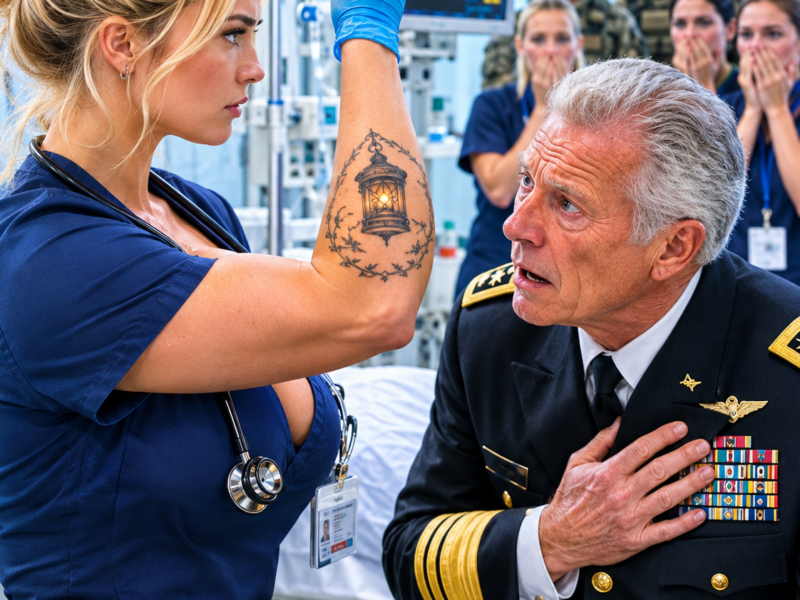
“I was holding an admiral’s artery shut with both hands when he looked at the tattoo on my forearm, stopped laughing, and whispered the name of a military unit that officially NEVER existed
I stared at the photograph for another five seconds.
Then I turned off my phone.
Whoever had taken that picture knew Dixon was vulnerable. They knew I had been exposed. And they knew exactly which part of my past would make me run.
Fourteen years earlier, I had run because five people I loved were dead, and I was the only one left to tell their story.
I wasn’t going to make the same mistake twice.
I pulled the pistol from my duffel, checked the magazine, and slid it into the holster beneath my jacket.
Then I removed the SIM card from my phone and snapped it in half.
I had almost reached the apartment door when another thought stopped me.
The photograph had been taken inside Dixon’s hospital room.
That meant whoever sent it had access to the hospital, its security system, or both.
Leaving without warning him would be handing them another opportunity.
I put the duffel back on the bed, took only the medical supplies and pistol, and headed for my car.
At 2:17 a.m., I parked two blocks from Naval Medical Center San Diego.
The emergency entrance was quiet, but I didn’t use it.
I went around the back, through the loading dock, and entered with a maintenance crew changing the overnight supply carts.
Eight months in that hospital had taught me its rhythms.
It had also taught me that the most dangerous people rarely looked dangerous.
When I reached the fourth floor, I noticed a security camera pointed toward the elevators.
Its red indicator light was off.
Someone had disabled it.
I continued down the corridor.
Dixon’s room was dark except for the green glow of his monitors.
He was awake.
He turned his head as I entered.
“You came back.”
“I didn’t come back for a social visit.”
His eyes moved to the pistol beneath my jacket.
“That doesn’t look like standard nursing equipment.”
“Your hospital has a serious security problem.”
He tried to sit up, then winced.
“Edwards told me you went home.”
“Someone photographed you in this room.”
The humor disappeared from his face.
I showed him the message on the phone I had borrowed from the supply desk.
He studied the photograph.
“Who sent it?”
“Someone who wants me to disappear.”
“Holmes?”
I didn’t answer immediately.
Dixon looked toward the closed door.
“Fourteen years ago, I watched five men die on a ridge. I spent the next fourteen years being told there was nothing more to investigate. Now I find the woman who saved me working as my nurse, and somebody tries to kill me again.”
“You’re missing a few details.”
“Then fill them in.”
I pulled a chair closer to his bed.
“Before Salt Harbor, my team received intelligence about a weapons shipment moving through a coastal compound in southern Somalia. We were told the shipment included equipment being used to arm a militia targeting American personnel.”
Dixon nodded slowly.
“I remember the operation.”
“We were supposed to capture the shipment, identify the people behind it, and extract before daylight.”
“Who commanded your unit?”
“Captain Nathan Cole.”
His eyes softened at the name.
“Good officer.”
“The best.”
I looked down at my hands.
“On the night of the operation, we discovered something nobody had mentioned in the briefing. The warehouse contained American-made shoulder-fired missiles. Their serial numbers had been altered, but the manufacturing marks were still visible.”
“Someone was selling American weapons.”
“Someone with access to military logistics, transportation schedules, and classified supply routes.”
“Brett Holmes.”
“His company handled the routing.”
I took a breath.
“We sent the information through the secure channel. Twenty minutes later, the enemy knew exactly where we were.”
Dixon’s jaw tightened.
“How did you survive?”
“I crawled.”
The answer came out quietly.
“I had a bullet wound in my neck. My radio was gone. I couldn’t hear properly, and I couldn’t stand for more than a few seconds. I spent five days moving through a dry cave system, drinking from whatever water I could find.”
He said nothing.
“By the time I reached a village, I weighed less than a hundred pounds. A local doctor treated me. When I eventually managed to contact someone I trusted, I learned the official report had already declared my entire team dead.”
“And you were listed as what?”
“A rogue operator who had abandoned her post.”
Dixon closed his eyes.
“Fourteen years.”
“Fourteen years of watching my back.”
“Why didn’t you come to me?”
I almost laughed.
“Admiral, I didn’t know your name until you were lying in that hospital bed.”
He looked genuinely confused.
“Your unit rescued my team. You were the officer in charge. You knew who we were.”
“I knew the people who pulled us out. I didn’t know their names. Everything was classified beyond my clearance.”
I watched him absorb that.
“Then why did you never come forward?”
“Because the first person who tried to help me after Salt Harbor was found dead three weeks later.”
Dixon’s expression changed.
“Who?”
“An intelligence officer named Daniel Mercer. He had been investigating the weapons shipments. He told me he could help clear my name.”
I swallowed.
“He was killed in a parking garage in Virginia. The report called it a robbery.”
“Was anything stolen?”
“His briefcase. Nothing else.”
Dixon reached for the bedside phone.
“Get me Captain Cooper.”
“Don’t.”
He stopped.
“You have to understand something,” I said. “Holmes has people watching military intelligence. If you make another call through the wrong channel, he’ll know.”
“Then we’ll use the right channel.”
He dialed a number from memory.
“Adam. It’s Dixon.”
A pause.
“I need you to come to Balboa. Alone. And don’t use your office phone.”
He listened.
“No, this isn’t a medical emergency.”
Another pause.
“It may become one.”
He hung up.
I studied him.
“You trust Cooper?”
“With my life.”
“That’s what people said about my old commander.”
He didn’t argue.
Instead, he looked at the monitor and then at me.
“Your hand is bleeding.”
I glanced down.
The skin on my palm had been torn during the emergency compression the previous night.
“It’s nothing.”
“That’s what I used to tell my corpsman.”
“Then you know how annoying it is when someone refuses treatment.”
For the first time, he smiled.
It was small, but real.
“You always this difficult?”
“Only with patients who deserve it.”
At 3:06 a.m., Captain Adam Cooper arrived.
He was in his early fifties, with a lean face, silver hair, and the cautious manner of someone who had spent most of his career asking questions people didn’t want answered.
He locked the door behind him.
“Admiral.”
“Adam, this is Morgan Bailey.”
Cooper looked at me.
Then his eyes dropped to my forearm.
He didn’t ask about the tattoo.
He simply nodded.
“Lantern Six.”
I felt the muscles in my back tighten.
“How much do you know?”
“Enough to understand that your personnel file is one of the strangest documents I’ve ever encountered.”
He placed a small laptop on the bedside table.
“Your nursing credentials are legitimate. Your education is legitimate. Your employment history is not.”
“That’s reassuring.”
“Your birth certificate exists. Your Social Security records exist. But your military history has been sealed under several layers of classification.”
“Can you access them?”
“Not without triggering another alert.”
Dixon leaned forward.
“Then don’t access the file. Follow the money.”
Cooper opened the laptop.
“That’s what I’ve been doing.”
He brought up a spreadsheet.
Several defense contractors appeared on the screen, along with shipping companies, offshore accounts, and payments made over fourteen years.
One company appeared repeatedly.
King Systems.
Cooper pointed to a series of transactions.
“These payments began six months before Salt Harbor. They continued for nearly a year afterward. Most went through shell companies registered in the Caribbean.”
“How much?” Dixon asked.
“Approximately forty-seven million dollars.”
I stared at the screen.
“That’s not the full amount.”
Cooper looked at me.
“How do you know?”
“Because the shipment we found was worth more than that. And Holmes wasn’t the only person involved.”
I remembered the warehouse.
The crates.
The men wearing civilian clothes who moved through the compound without carrying weapons.
There had been a symbol painted on one of the loading containers.
A white bird inside a black circle.
I had seen it again years later on a document Daniel Mercer showed me.
“There’s another account,” I said. “Look for a company called Meridian Coastal Logistics.”
Cooper typed.
A result appeared.
His face changed.
“That’s interesting.”
“What?”
“Meridian received payments from King Systems for twelve years. The company was dissolved last month.”
Dixon stared at him.
“Who owned it?”
Cooper opened another record.
“Brett Holmes.”
The room went quiet.
“There’s more,” Cooper continued.
“Three weeks before your Djibouti mission, Admiral, someone accessed the route-clearance system using credentials linked to a King Systems subcontractor.”
Dixon’s fingers tightened around the blanket.
“Who authorized the clearance?”
“That’s what I’m trying to establish.”
“Then establish it.”
Cooper looked at me.
“There’s a problem.”
I waited.
“The access record has been altered. But the original entry was copied into a backup archive.”
“Where?”
“An old logistics server scheduled for decommissioning at Naval Base Coronado.”
I looked at Dixon.
“That’s where the original Salt Harbor routing records might be.”
Cooper nodded.
“If the backup still exists.”
Dixon reached for his phone.
“Get a team.”
“No,” I said.
Both men looked at me.
“Holmes knows we’re investigating. If we send a team to Coronado, he’ll hear about it before they reach the gate.”
Cooper considered that.
“Then what do you suggest?”
“One person goes in quietly. One person watches the records. And nobody uses a network connected to King Systems.”
Dixon gave a faint smile.
“Sounds like an operator.”
“I’m a nurse.”
“Of course you are.”
Cooper closed the laptop.
“I can get you temporary access to the archive. But there’s something else you should know.”
He looked directly at me.
“Someone has been asking questions about your former commander.”
I felt the room narrow.
“Nathan?”
“His name appeared in a recent inquiry. The request came from a private law firm representing King Systems.”
“Why would Holmes care about Nathan now?”
Cooper didn’t answer.
I already knew.
Nathan Cole had been the only person on our team who understood the full weapons operation.
Before he died, he had copied part of the shipping manifest.
He had told me to protect it.
I had spent fourteen years believing the document had burned with him.
“Where is it?” Dixon asked.
“I don’t know.”
But I remembered something.
Nathan had a habit of hiding important things in ordinary places.
He once told me that if we ever lost everything, the safest place for a secret was somewhere nobody thought to look.
I had never understood what he meant.
Until then.
His old military identification bracelet.
I had kept it in a small box inside a storage locker in Spokane.
I had carried it from apartment to apartment, never opening the box because I couldn’t bear to look at his name.
“There’s something I need to retrieve,” I said.
Dixon studied me.
“Where?”
“Spokane.”
“You’re not going alone.”
“I don’t need an escort.”
“That wasn’t a request.”
I looked at his injured leg.
“Admiral, you can barely get to the bathroom.”
“Then I suppose I’ll have to remain here and be difficult.”
Cooper almost smiled.
I didn’t.
Because the name Nathan Cole had brought back a memory I had spent years avoiding.
The night before Salt Harbor, he had sat beside me on the transport aircraft.
He had taken off his bracelet and handed it to me.
“Keep this for me, Morgan.”
I had laughed.
“Planning on losing it?”
He shook his head.
“Planning on making sure somebody remembers us if things go bad.”
I had told him to stop talking like that.
He had smiled and returned to checking his equipment.
The next morning, he was dead.
At sunrise, I left the hospital with Cooper’s number written on a piece of paper.
Dixon remained under observation.
Before I left, he caught my wrist.
“Morgan.”
I turned.
“Don’t disappear again.”
I looked at him for a long moment.
“I’ll try.”
It was the most honest promise I could make.
The flight to Spokane was quiet.
I spent most of it staring through the window, remembering a different version of myself.
A younger woman who believed the people wearing the same uniform would always tell the truth.
When I reached the storage facility, I parked near the entrance and watched the surrounding road.
Nothing moved.
The locker was number 218.
I entered the code, lifted the metal door, and pulled out the small cardboard box.
Inside were a few letters, an old photograph, and Nathan’s identification bracelet.
I picked it up.
The metal was cold.
For a moment, I couldn’t breathe properly.
Then I noticed something.
The bracelet had a small scratch near the clasp.
Three short lines.
I remembered making them with a pocketknife during a long deployment.
Nathan had laughed when he saw them.
“Now I’ll know if you steal it.”
I turned the bracelet over.
There was a tiny metal plate beneath the clasp.
I pressed the edge.
It opened.
Inside was a narrow piece of folded plastic.
My hands began to shake.
It was a microfilm strip.
Nathan had hidden it in the bracelet.
I held it up to the light.
A series of numbers and shipping codes appeared.
And beneath them was a handwritten message.
MORGAN—IF YOU’RE READING THIS, DON’T TRUST THE OFFICIAL REPORT.
I sat down on the concrete floor.
For fourteen years, I had believed I was the only survivor who knew what happened at Salt Harbor.
Nathan had known more than I did.
He had expected someone to betray us.
And he had prepared for it.
My phone rang.
It was Cooper.
“Where are you?”
“Spokane. I found something.”
“Don’t move.”
His voice was different.
“What happened?”
“Someone accessed your storage facility records twenty minutes ago.”
I looked toward the entrance.
“How?”
“Your locker was flagged under an old security investigation.”
I stood.
“Adam, somebody knows I’m here.”
“Listen to me carefully. Leave the bracelet. Leave everything. Get outside and find a public place.”
I looked at the microfilm.
“No.”
“Morgan, this isn’t a suggestion.”
“I’ve spent fourteen years leaving things behind.”
I slipped the microfilm into the inside pocket of my jacket.
“I’m done.”
The call ended.
I heard a car door slam outside.
Then another.
I moved toward the rear exit.
A man stood beside the loading area.
He wore a gray jacket and held a phone in one hand.
When he saw me, he lowered it.
“Morgan Bailey?”
I kept walking.
“Wait. I only want to talk.”
I didn’t stop.
He moved toward me.
“About Nathan Cole.”
That made me turn.
He lifted his other hand.
An identification card.
Naval Criminal Investigative Service.
“My name is Special Agent Rachel Turner,” she said. “I’ve been trying to find you for six years.”
I studied her face.
“Why?”
“Because I think your team was murdered by someone inside the defense contracting system.”
I looked at her identification.
Then at the road behind her.
“Who sent you?”
“Nobody.”
“That’s not an answer.”
She lowered the card.
“I was working with Daniel Mercer before he died.”
The name hit me harder than I expected.
“Daniel is dead.”
“I know.”
She looked down.
“Before he died, he gave me something. A copy of the original Salt Harbor investigation.”
I took a step closer.
“What was in it?”
“Evidence that the airstrike was authorized before your team even requested extraction.”
The world seemed to tilt.
“That’s impossible.”
“I thought so too.”
She opened a folder and showed me a photograph.
It was a screenshot of an old command log.
The strike authorization carried a signature.
Brett Holmes.
But below it was another name.
A senior military officer who had been in charge of the operational command that night.
Admiral Thomas Rourke.
I recognized the name.
He had retired years ago.
He had later become chairman of a congressional defense advisory board.
“Holmes couldn’t have authorized an airstrike by himself,” Turner said. “Someone with military authority had to approve the mission.”
I looked at the photograph.
“Why didn’t Mercer release this?”
“Because the second signature wasn’t the only problem.”
She turned the page.
There was a photograph of Nathan Cole standing beside a man in civilian clothes.
I recognized the man immediately.
He was not a stranger.
He was the intelligence liaison who had briefed us before Salt Harbor.
The man who had personally assured Nathan that the weapons shipment was legitimate.
The man who had told us the compound was only lightly guarded.
His name was Colonel Richard Voss.
I had believed he was retired.
Turner watched my face.
“He is still alive.”
I folded the photograph.
“Where?”
“Washington.”
I looked at her.
“Then we need to get this to the right people.”
She nodded.
“That’s what Daniel wanted.”
We left the storage facility through the rear exit.
I took the microfilm with me.
Turner drove.
For the next hour, we discussed the evidence.
The shipping codes matched the King Systems payments Cooper had discovered.
The microfilm also contained the names of several officials who had approved suspicious transfers.
But one name appeared more frequently than the others.
Richard Voss.
He had signed the original logistics clearance for Salt Harbor.
He had also signed the clearance for the route in Djibouti.
I felt sick.
The roadside explosion hadn’t been an isolated attack.
It had been part of the same operation.
Holmes and Voss had spent fourteen years eliminating people who could connect the weapons shipments to the original ambush.
Dixon had reopened the investigation.
And they had tried to kill him.
Turner glanced at me.
“There’s one more thing.”
I waited.
“Voss knows about the microfilm.”
“How?”
“Because the original archive was accessed yesterday.”
I looked at her.
“Who accessed it?”
“An account belonging to Admiral Dixon.”
My stomach tightened.
“That wasn’t Dixon.”
“I know.”
She turned onto the highway.
“Someone has been using his credentials.”
I immediately called Cooper.
He answered on the first ring.
“Morgan?”
“Adam, listen carefully. Someone accessed the archive using Dixon’s credentials.”
Silence.
Then he said, “I know.”
“What?”
“Admiral Dixon received a visit this morning.”
“From whom?”
“Richard Voss.”
My hand tightened around the phone.
“Get Dixon out of that room.”
“He’s already gone.”
“Where?”
“Admiral Dixon insisted on speaking with Voss privately. They left the hospital together.”
I closed my eyes.
“Adam, that’s exactly what they wanted.”
“I know.”
“Where did they go?”
“Naval Base Coronado.”
I looked at Turner.
She understood immediately.
“That’s where the original logistics archive is,” she said.
I took the phone away from my ear for a moment.
Then I spoke again.
“Adam, don’t send anyone who hasn’t been cleared by you personally.”
“I’ve already contacted the inspector general.”
“How long?”
“Twenty minutes.”
I looked at the road ahead.
“Then we have twenty minutes.”
Turner pressed the accelerator.
The drive back to San Diego felt endless.
When we reached Coronado, the sun was setting.
The old logistics building stood behind a fenced compound near the base’s administrative area.
A security guard recognized Turner’s credentials and allowed us through.
Inside, the building smelled of dust, metal, and old electrical equipment.
The server room was at the end of a narrow hallway.
I heard voices before I reached the door.
One belonged to Dixon.
The other belonged to a man I hadn’t heard in fourteen years.
Richard Voss.
“You’ve made a serious mistake, Dale.”
Dixon sounded tired.
“That’s what people keep telling me.”
“You should have stayed in your hospital bed.”
“I tried. The food was terrible.”
There was a pause.
Then Voss spoke again.
“Do you have any idea how many people have worked to keep this country safe?”
“Apparently not the people who sold missiles to the highest bidder.”
“You don’t understand the scale of what you’re accusing me of.”
“I understand enough.”
I stepped into the room.
Dixon stood near an old terminal, leaning heavily on a cane.
Voss was beside a metal cabinet.
He was in his late sixties, with neatly combed white hair and a face that seemed permanently arranged into a polite smile.
He looked at me.
For several seconds, neither of us spoke.
Then he said my name.
“Morgan.”
I felt the old anger rise.
“Colonel.”
He looked at the tattoo on my arm.
“I thought you were dead.”
“You should have checked.”
His smile disappeared.
Dixon turned toward me.
“You found it?”
I nodded.
I held up Nathan’s bracelet.
Voss’s eyes moved to it.
And for the first time, I saw genuine fear on his face.
“Where did you get that?”
“From the man you killed.”
Voss shook his head.
“Nathan Cole was a traitor.”
I stepped closer.
“No.”
He looked at me.
“He discovered the shipment records. He intended to expose the entire operation. He compromised national security.”
“By refusing to let you sell American weapons?”
His expression hardened.
“You were young. You didn’t understand what was happening.”
“I understood enough to watch my friends die.”
Voss looked toward Dixon.
“Admiral, I suggest you consider your position carefully. You’re making accusations against a decorated officer.”
Dixon rested both hands on his cane.
“Richard, I’ve spent thirty-six years watching men hide behind their uniforms. I know what it looks like.”
Voss turned back to me.
“Give me the bracelet.”
I didn’t move.
“You have no idea what you’re holding.”
“I know exactly what I’m holding.”
He reached into his jacket.
Turner raised her weapon.
“Don’t.”
Voss stopped.
For a moment, nobody moved.
Then he smiled again.
“You think this ends with me?”
I looked at him.
“No. I think it starts with you.”
Turner stepped forward.
“Richard Voss, you’re being detained pending investigation into the Salt Harbor operation, weapons trafficking, conspiracy, and obstruction of justice.”
He laughed.
“On whose authority?”
A voice answered from the doorway.
“Mine.”
Captain Adam Cooper entered with two federal investigators and a naval security team.
Behind them stood a woman in a dark suit.
She introduced herself as a representative of the Naval Inspector General.
Voss looked around the room.
His eyes moved from Cooper to Turner, then to Dixon.
For the first time, he seemed to understand that his connections were no longer protecting him.
The investigators took the bracelet and the microfilm.
They secured the archive.
And Voss was placed in handcuffs.
But the moment that mattered most came afterward.
As they led him through the hallway, he stopped beside me.
“You think you have justice now?”
I looked at him.
“No.”
His eyebrows rose.
“I think I finally have the chance to tell the truth.”
He was taken away.
I watched until the door closed behind him.
Then my knees weakened.
Dixon reached for my arm.
“Easy.”
I leaned against the wall.
For fourteen years, I had imagined confronting the man responsible for Salt Harbor.
In those imagined moments, I always had something powerful to say.
Something sharp enough to make him understand what he had taken.
But when the moment came, all I could think about was Nathan.
And the other four men.
They deserved more than a confrontation.
They deserved to be remembered.
The investigation lasted eight months.
The microfilm provided the missing link between the original weapons shipments and the later attacks.
Cooper’s financial records connected King Systems to shell companies controlled by Voss.
The two men arrested at the hospital eventually agreed to testify.
Their communications revealed that Holmes had ordered Dixon’s assassination after learning of the reopened Salt Harbor inquiry.
The photograph sent to me had been taken by one of the hospital contractors.
He had been paid to monitor Dixon and report whenever I entered the room.
Holmes had believed the tattoo would lead him to me.
He had never expected me to stop running.
The case eventually reached federal court.
Brett Holmes was arrested eleven days after the first records were submitted.
He was taken into custody inside the Capitol building, where he had arrived to testify at a defense contracting hearing.
He wore a navy suit and carried a leather briefcase.
When agents approached, he looked genuinely offended.
“There’s been a misunderstanding,” he said.
One of the agents read him his rights.
Dixon attended the hearing in a wheelchair.
His left leg was still healing, and every movement caused him pain.
But he refused to miss it.
When Holmes passed him, he stopped.
“Admiral, you should be careful about believing everything you’ve been told.”
Dixon looked up.
“I spent fourteen years trying to find the woman who saved my life. I believe her.”
Holmes said nothing.
The agents led him away.
Eight months later, I stood in a federal courtroom in Washington.
Holmes was seated at the defense table.
Voss sat several rows behind him, awaiting a separate hearing.
I wore a plain gray suit.
My right sleeve covered the tattoo.
When the judge asked whether any family members of the victims wished to speak, I stood.
My hands were shaking.
I had imagined this moment for so long that I wasn’t sure what I would say.
I looked at Holmes.
“Five people died on that ridge,” I began.
“Captain Nathan Cole. Chief Petty Officer James Walker. Petty Officer Daniel Ruiz. Petty Officer Marcus Hill. And Petty Officer Thomas Reed.”
Holmes looked down at his papers.
“I remember every one of them. I remember how Nathan laughed when the helicopter door wouldn’t close. I remember James carrying extra medical supplies because he never trusted anyone else to pack enough.”
My voice caught.
“I remember Marcus singing badly during long missions. I remember Thomas asking me whether I thought we would ever have ordinary lives.”
I paused.
“They weren’t numbers on a classified report. They weren’t acceptable losses. They were people who trusted the men giving them orders.”
Holmes finally looked up.
“You don’t know what was happening behind the scenes,” he muttered.
I turned toward him.
“You’re right. I don’t know everything that happened behind the scenes. But I know what happened on that ridge.”
The courtroom was silent.
“I held my teammates while they died. I watched them wait for help that never came. And for fourteen years, I carried the blame because your paperwork said I had abandoned them.”
I took a breath.
“You didn’t just kill five people. You took fourteen years from the one person who survived them.”
Holmes’s mouth opened, but nothing came out.
I sat down.
Dixon’s hand rested briefly on mine.
The judge later found Holmes guilty on multiple federal counts, including conspiracy, weapons trafficking, and murder-related offenses.
He was sentenced to life in prison.
Voss was convicted separately for his role in the operation and the cover-up.
The money recovered from the shell companies was directed toward the victims’ families and other restitution.
But the most important announcement came from the Navy.
The official record of Operation Salt Harbor was reopened.
The five fallen operators were formally recognized.
And the name of the sixth member was restored.
Morgan Bailey.
Not as a rogue operator.
Not as a deserter.
As a member of Lantern Six.
I received the Navy Cross in a quiet ceremony at Fort Rosecrans.
The morning was bright.
The Pacific stretched beyond the cemetery, and the wind moved gently through the trees.
Five new headstones stood together.
I placed a small American flag beside each one.
Then I took Nathan’s old identification bracelet from my pocket.
I laid it against the base of his headstone.
“Found your message,” I whispered.
“I wish you’d been here to see it.”
I stood there for a long time.
For years, I had thought surviving meant carrying the dead alone.
That morning, for the first time, I allowed myself to believe that remembering them didn’t have to mean living inside the worst moment of my life.
I went back to work at Balboa.
Not because I had forgotten my past.
Because I had finally stopped believing it was the only thing I was allowed to be.
My first day back, Dr. Edwards found me changing an IV bag in the fourth-floor suite.
He looked at the tattoo visible beneath my sleeve.
Then he looked at me.
“Are you really going to pretend nothing happened?”
I smiled faintly.
“I’m a nurse, doctor. We prefer to keep the paperwork manageable.”
He laughed.
A few minutes later, I heard the familiar sound of a cane against the hallway floor.
I turned.
Admiral Dale Dixon stood in the doorway.
He wore his full dress blues.
The gold on his sleeves caught the sunlight, and his left leg was still slightly stiff.
Behind him stood six Navy operators in camouflage.
Several nurses had gathered in the corridor.
Dixon took one careful step into the room.
“Mrs. Bailey.”
“Admiral. You’re supposed to be resting.”
“I’ve been told that several times.”
He set his cane against the bed rail and straightened.
Then he raised his right hand in a formal salute.
The operators behind him followed.
I looked at the men standing in the doorway.
For a moment, I saw five other faces.
Five men who should have been there.
My eyes filled before I could stop them.
Dixon lowered his hand.
“I wanted to thank you properly.”
“You already did, sir.”
“No. I thanked you for saving my life.”
He paused.
“This is for saving the truth.”
I looked down at my forearm.
The broken chain was still there.
The lantern was still there.
But for the first time in fourteen years, I no longer felt the need to hide it.
I returned his salute.
“It was an honor to serve with you, Admiral.”
He smiled.
Then his eyes moved to the blood pressure monitor beside the bed.
“Speaking of service, I believe somebody should check your blood pressure.”
I laughed.
“Mine?”
“Yes, nurse. I hear you’ve been under considerable stress.”
I picked up the monitor cuff.
“Your blood pressure is still my responsibility, Admiral.”
“Then I suppose I’m in good hands.”
Outside the window, the Pacific glittered beneath the afternoon sun.
For the first time since the night of Salt Harbor, I didn’t look toward the exits.
I stayed where I was.
And when I looked at the tattoo on my arm, I no longer saw a reminder of the night five people died.
I saw a promise that had finally been kept.
The End.









