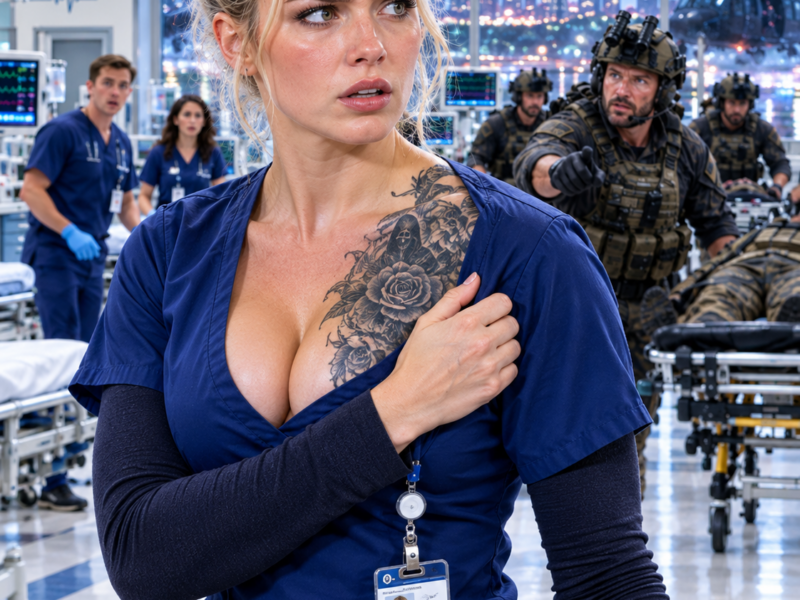
“I was holding a dying soldier’s artery together with my bare hands when the commander of an armed military unit walked into my emergency room
The message remained on the cracked screen.
VIPER HAS BEEN LOCATED.
For several seconds, nobody moved.
Then Tanner grabbed the device and shoved it into his vest.
“Kill every radio in this room. Now.”
I looked at him.
“Jack, what did you just bring into my hospital?”
“Something I should have told you about three years ago.”
Before I could respond, the lights flickered.
Jessica stepped away from the trauma table, still holding a blood-soaked towel.
“Abby? What’s happening?”
I looked at her.
“Jessica, take the civilian patients to the interior radiology corridor. Stay away from the windows.”
She glanced at Powell.
“Is she serious?”
Powell looked at the commander, then at the shattered entrance.
For once, he didn’t have an argument.
“Do what she says.”
Tanner turned toward his remaining operators.
“Rook, take the east corridor. Mason, secure the stairwell. Nobody uses an electronic device until we know who’s listening.”
The men moved immediately.
I watched them disappear into the darkened hallway.
Then I turned back to Tanner.
“You’re going to explain everything.”
He looked down at the wounded soldier.
“First, we keep Davis alive.”
I glanced at the monitor.
The young operator’s blood pressure was holding, but barely.
“He’s not going anywhere until a surgical team takes over. I’ve stopped the bleeding, but he needs an operating room.”
“Then we’ll get him one.”
“You don’t understand. This isn’t a military field hospital. There are civilians in this building.”
Tanner’s jaw tightened.
“I know.”
“Then start acting like it.”
For a moment, the commander I remembered disappeared, and I saw the exhausted man underneath.
“Fair enough, Viper.”
He looked toward the entrance.
“We have about twenty minutes before whoever sent that message realizes the beacon isn’t moving.”
“Who is looking for me?”
“Someone who knows your real name.”
My hands went still.
Nobody outside my old unit knew my real name.
Not even the people who had helped me disappear.
I leaned closer.
“Say it.”
Tanner lowered his voice.
“Major Evelyn Shaw.”
The name hit harder than the sound of the helicopter.
Evelyn had been our commanding officer.
She had recruited me when I was twenty-six, trained me, trusted me with her people, and once sat beside me for six hours while I held pressure on a wounded operator whose injuries were beyond anything I could repair.
Three years earlier, I had watched her disappear during a mission in Syria.
We had received confirmation of her death.
I had attended a memorial service.
There had even been a folded American flag.
“That’s impossible,” I whispered.
Tanner shook his head.
“I said the same thing.”
I looked at the identification beacon.
“That number belonged to Mason Cole.”
“Yes.”
Mason had been twenty-nine.
He had a crooked smile, an irritating habit of stealing my coffee, and a daughter who was learning to ride a bicycle when we deployed.
I had held his hand while he died.
Or at least, I thought I had.
“Jack, I watched Mason die.”
“I know.”
“Then why is his beacon transmitting?”
Tanner looked at me for a long moment.
“Because somebody has been using his identity.”
A crash echoed from the corridor.
We both turned.
Rook appeared at the doorway.
“Commander, we’ve got movement near the loading dock. Two vehicles without plates. They’re not police.”
Tanner checked his weapon.
“How many?”
“At least four.”
I looked toward the radiology corridor.
Jessica was back there with patients who had no idea their hospital had become the center of a military operation.
“Jack, we need local law enforcement.”
“We’ve tried.”
“What does that mean?”
He pulled a small satellite communicator from his vest.
“Every secure channel we used tonight was compromised. Someone inside the federal response network is feeding them information.”
I stared at him.
“You think someone in the government is helping the people who attacked you?”
“I don’t think. I know.”
He reached into his vest again and removed a folded photograph.
It was old, damaged at the edges, and stained with something dark.
I recognized the location immediately.
An abandoned medical compound outside Aleppo.
The place where our unit had been sent to recover a captured intelligence officer.
The place where everything had gone wrong.
I took the photograph.
There were six people standing outside the building.
Tanner.
Mason.
Evelyn.
Me.
And two operators whose names I hadn’t spoken aloud in three years.
I looked closer.
On the back was a handwritten date.
December 14.
Tomorrow.
My eyes narrowed.
“That’s not the date of the Syrian operation.”
“No.”
“Then what is it?”
Tanner leaned toward me.
“The date the operation was officially scheduled to be erased.”
I stared at him.
“What operation?”
He hesitated.
Then he said something that made the room feel smaller.
“Operation Black Lantern.”
I remembered the name.
Not because it had appeared in our deployment orders, but because I had overheard Evelyn arguing about it with someone over a secure phone line.
At the time, she had told me it was an administrative designation.
I had believed her.
Tanner watched my expression.
“You remember something.”
“I remember Evelyn telling me never to ask about it.”
“She lied to all of us.”
I looked at the photograph again.
“Why?”
“Because the mission wasn’t a rescue operation. It was an extraction.”
“Who were we extracting?”
“An intelligence analyst who had discovered that a private military contractor was selling classified American operations to foreign buyers.”
I felt the blood drain from my face.
“That’s why we were ambushed.”
“Yes.”
“And the casualties?”
Tanner looked away.
“Not all of them were casualties.”
I didn’t understand.
He took a breath.
“Three years ago, the people in charge needed everyone to believe that Black Lantern had ended in Syria. They needed the team gone, the records destroyed, and the analyst silenced.”
My throat tightened.
“You mean the people we buried…”
“Some were never found.”
I thought of the memorial service.
The empty spaces where coffins should have been.
The names engraved on the wall.
And the folded flag I had held against my chest until my fingers hurt.
“Who did we actually bury, Jack?”
He didn’t answer.
A faint metallic click came from the ceiling.
I looked up.
A small red light blinked above the trauma bay door.
Tanner followed my gaze.
“That’s not hospital equipment.”
He raised his rifle.
“Everyone down!”
The first shot shattered the glass panel beside the doorway.
Jessica screamed from the corridor.
I ducked behind the trauma bed as another round punched through the wall.
Tanner fired toward the entrance.
“Rook! Contact!”
I crawled toward the patient, checking the monitor.
Davis was still alive.
His chest rose weakly beneath the bandages.
I could hear shouting outside.
Then the lights went out.
The backup generators kicked in seconds later, bathing the room in red.
Tanner looked at me.
“Can you move him?”
“Not safely.”
“Then we hold here.”
I glanced at the oxygen cylinders beside the wall.
“Jack, get your men away from the gas supply.”
He understood immediately.
“Rook, move the team!”
A burst of gunfire echoed down the corridor.
Tanner positioned himself near the doorway while I checked the trauma cart.
I wasn’t a soldier anymore.
I was a nurse responsible for a patient who had survived a catastrophic injury.
And I wasn’t going to let armed strangers turn his hospital bed into a battlefield.
A figure appeared at the far end of the corridor.
He wore dark tactical clothing and a medical mask.
For one brief second, I thought he was another hospital employee.
Then I noticed the weapon in his hand.
He raised it.
Tanner fired first.
The figure dropped behind a supply cart.
“Viper!” Tanner shouted.
I grabbed the trauma cart and pushed it across the doorway, creating a barrier between the corridor and the patient.
Jessica appeared behind me, pale and trembling.
“Abby, what do we do?”
I looked at her.
“Get the patients behind the fire doors. Keep them low. Don’t open anything for anyone unless you know their name.”
She nodded.
Then she looked at my shoulder.
At the tattoo.
At the woman she had worked beside for three years.
“Who are you?”
I wanted to tell her everything.
Instead, I said, “Someone who should have told you the truth a long time ago.”
Her eyes filled.
“Are you going to be okay?”
I looked toward the corridor.
“I don’t know.”
She swallowed.
“Then come back and tell me when you do.”
She disappeared through the fire doors.
I turned toward Tanner.
“How many?”
“Four confirmed outside. Possibly more.”
“Are they here for the beacon?”
He shook his head.
“They’re here for you.”
I glanced at the black device.
“Then we need to know what it contains.”
Tanner pulled a small data cable from his vest.
“There’s a secure terminal in the ambulance communications room. We can access the beacon’s last transmission.”
“Why didn’t you tell me that earlier?”
“Because the last transmission contains a location.”
“Whose location?”
He looked directly at me.
“Yours.”
Before I could respond, a voice came over the hospital’s public-address system.
“Abigail Mitchell, please report to the main lobby.”
I stared at the speaker.
The voice was female.
Calm.
Professional.
Almost familiar.
Then it spoke again.
“Abigail, it’s been a long time.”
My fingers tightened around the surgical instrument in my hand.
I knew that voice.
I had heard it through satellite communications in Syria.
I had heard it during the worst night of my life.
And I had heard it in my nightmares.
“Major Shaw,” I whispered.
Tanner’s face hardened.
“Don’t answer.”
The speaker crackled.
“I know you’re there, Viper. I know Tanner is with you. And I know you’ve been told some things about Black Lantern.”
I looked at Tanner.
He raised one finger to his lips.
“There’s something you need to understand,” Evelyn continued. “The people who attacked your team three years ago weren’t the people you think they were.”
The announcement ended.
Then every phone in the trauma bay vibrated simultaneously.
A message appeared on the hospital’s internal emergency system.
PATIENT TRANSFER AUTHORIZATION: DAVIS, ELIAS. DESTINATION: FEDERAL SECURE FACILITY.
I looked at the screen.
“Who authorized this?”
Tanner stepped closer.
“Nobody on my team.”
The message displayed an electronic signature.
Major Evelyn Shaw.
I looked at the patient.
Davis.
The young man whose life I had just fought to save.
He was the only surviving operator carrying the original Black Lantern mission files.
Now someone was trying to remove him from the hospital.
“Jack, they’re not just looking for me.”
He shook his head.
“They need Davis.”
I checked his identification bracelet.
Elias Davis.
Twenty-four years old.
Emergency contact: Rachel Davis.
Relationship: Mother.
There was a small photograph tucked into the plastic sleeve.
A young woman holding a little boy on a beach.
On the back, someone had written:
Come home safe, Eli.
I looked at Tanner.
“We’re not handing him over.”
“No argument here.”
We moved toward the communications room.
The corridor smelled of burnt wiring and antiseptic.
Emergency lights cast long shadows across the walls.
Tanner walked ahead, checking each intersection.
I followed with the beacon tucked into my pocket.
When we reached the communications room, I found the terminal still powered by the emergency system.
Tanner connected the device.
A series of encrypted files appeared.
Most were corrupted.
One was labeled BLACK LANTERN / ARCHIVE 07.
He opened it.
The first document contained a list of names.
Six members of our old unit.
Beside three names were the words KILLED IN ACTION.
Beside two were the words STATUS UNCONFIRMED.
Beside mine was a single designation.
ASSET RECOVERED.
I read it twice.
“What does that mean?”
Tanner looked sick.
“It means they never considered you dead.”
A second file opened automatically.
It contained a recording.
The date was three years earlier.
The camera showed a dimly lit room.
Major Shaw sat at a metal table.
Across from her was a civilian man in a dark suit.
I recognized him.
Not by name.
By the silver ring on his right hand.
He had visited our field hospital in Syria two days before the ambush.
He had introduced himself as a Defense Department liaison.
The recording began.
“The team has been compromised,” Shaw said.
The civilian man folded his hands.
“Then eliminate the problem.”
“These are American operators.”
“They are also witnesses.”
“What about Mitchell?”
The man paused.
“She’s the only one who knows the complete medical extraction sequence.”
Shaw looked down.
“She’s a medic.”
“She’s more than that. She treated the analyst before the transfer. She knows what he told her.”
I felt my stomach tighten.
The civilian continued.
“If she survives, recover her. If she refuses, make sure she cannot testify.”
The recording ended.
I stared at the screen.
“What did the analyst tell me?”
Tanner shook his head.
“I don’t know.”
I closed my eyes.
Then something surfaced.
A memory I had spent three years trying to bury.
A medical tent.
A man with a bullet wound in his side.
A frightened intelligence analyst named Peter Lawson.
He had been brought to us during the Syrian operation.
He was barely conscious.
I remembered holding his hand while I treated his injuries.
I remembered him grabbing my wrist.
“Don’t let them take the children.”
At the time, I thought he was delirious.
Now I remembered something else.
He had slipped a small folded paper beneath my glove.
I had never seen it again.
I opened my eyes.
“Jack, we didn’t just extract an intelligence officer.”
Tanner looked at me.
“What?”
“We extracted evidence.”
I remembered the man’s words.
The children.
The medical evacuation.
And a young girl whose photograph he had kept inside his uniform.
“Peter gave me something.”
Tanner stared.
“Where?”
“I don’t know. I thought I lost it.”
I reached instinctively toward the pocket of my old field jacket.
I didn’t own that jacket anymore.
But I remembered the small emergency seam inside the left sleeve.
The place where I used to hide medication during deployments.
I had kept the jacket for years after leaving the military.
Then, shortly before moving to Seattle, I had donated it to a veterans’ clothing collection.
My mouth went dry.
“Jack, I think the evidence is still out there.”
He looked at me.
“Where?”
“I don’t know. But if they think I still have it, they’ll keep coming.”
A new sound came from the corridor.
Footsteps.
Several people.
Tanner disconnected the device.
“Time to move.”
We returned to the trauma bay.
Davis was still alive.
Jessica stood beside him, one hand resting on the bed rail.
Powell was checking the patient’s monitor.
He looked up when I entered.
“Mitchell.”
“Doctor.”
“I’ve contacted the regional surgical team. They’re setting up an operating room at a secure location.”
I frowned.
“Which location?”
He hesitated.
“Federal medical transport says they’ll take him.”
“Did you verify the authorization?”
“Yes.”
“With whom?”
Powell looked toward the door.
“An agent named Daniel Mercer.”
Tanner’s expression changed.
“Did he show identification?”
Powell nodded.
“He had credentials.”
I stepped closer.
“Richard, did you personally verify them?”
He looked offended.
“Of course I did.”
“Did you call the agency through an independent number?”
His expression faltered.
“Well, no.”
Tanner raised his weapon.
“Nobody moves Davis.”
Powell looked at him.
“You’re not going to point that thing in my hospital.”
“I’d rather not.”
I placed a hand on Tanner’s arm.
“Put it down.”
He looked at me.
“Viper—”
“He’s a doctor. And he’s scared.”
Tanner lowered his rifle slightly.
I turned to Powell.
“Someone has used your hospital’s internal system to authorize a transfer. That doesn’t make the authorization real.”
Powell looked at the monitor.
Then at Davis.
For the first time that night, I saw something other than pride in his expression.
Concern.
“What do you need?”
“Lock down the transfer system. Nobody gets near this patient without verification.”
He nodded.
Then he pulled out his phone.
I caught his wrist.
“Don’t use that.”
He looked at me.
I pointed toward the ceiling.
“They may be monitoring the network.”
He slowly put the phone away.
“Understood.”
It was the first time in three years that Richard Powell had followed an order from me without questioning it.
A few minutes later, two people appeared outside the trauma bay.
One wore a dark suit.
The other wore a federal tactical vest.
The man in the suit held up an identification badge.
“Daniel Mercer. Federal investigation. We’re here for Elias Davis.”
Tanner stepped between them and the patient.
“Show me your authorization.”
Mercer held out a folder.
“Already submitted through the hospital system.”
I walked closer.
“That’s the same system that was just compromised.”
He looked at me.
“You’re Abigail Mitchell?”
“Yes.”
His eyes moved to my exposed shoulder.
Something almost like recognition passed across his face.
Then he smiled.
“Major Shaw sends her regards.”
Tanner raised his weapon.
“Get on the floor!”
Mercer didn’t move.
Instead, he looked directly at me.
“She said you’d be difficult.”
I noticed something then.
His right hand.
A silver ring.
The same ring from the recording.
My mouth went dry.
“You’re the man from Syria.”
His smile disappeared.
For the first time, I saw genuine irritation in his eyes.
“That was a long time ago.”
“You were there when our team was ambushed.”
“I was there to supervise an operation.”
“You ordered them to eliminate us.”
He sighed.
“People die in complicated operations, Nurse Mitchell.”
Tanner stepped forward.
“Hands where I can see them.”
Mercer reached slowly inside his jacket.
The armed agent beside him moved at the same time.
A gunshot exploded.
Tanner shoved me behind the trauma bed.
The bullet struck the metal frame.
Powell ducked behind the medication cart.
Jessica pulled Davis’s bed away from the doorway.
The agent fired again.
Tanner returned fire, forcing both men into the corridor.
Mercer dropped the folder and ran.
I wanted to follow him.
But Davis’s monitor began alarming.
His blood pressure was falling.
I turned back to the patient.
“Jessica, get the blood ready!”
She was already moving.
Powell joined us.
“Tell me what you need.”
“Pressure on the wound. Don’t let up.”
He pressed both hands against the dressing.
His white coat quickly turned red.
For several minutes, there was no military history, no classified mission, and no hidden identity.
There was only a young man who needed us to keep him alive.
And we did.
When the bleeding finally stabilized, I looked toward the doorway.
Tanner was gone.
My stomach tightened.
Then Rook appeared.
“Commander is pursuing the suspect. He told me to keep you here.”
I shook my head.
“Tell him not to be reckless.”
Rook almost smiled.
“He’s never been good at following that advice.”
I looked at the black beacon.
It was still in my pocket.
I took it out and examined the casing.
Something was wrong.
The battery cover was slightly loose.
I pressed it.
A tiny compartment opened.
Inside was a microSD card.
I stared at it.
“Jack was right,” I whispered.
This wasn’t just a tracking device.
It was a storage unit.
I carried it to the terminal and inserted the card.
A folder appeared.
The files were labeled with dates and names.
The final document was a scanned medical report.
Peter Lawson.
The intelligence analyst.
I opened it.
There was a photograph of a little girl.
Seven years old.
Dark hair.
A small scar above her left eyebrow.
Under the photograph was a name.
EMMA LAWSON.
Below it was a list of locations.
Safe houses.
Medical facilities.
Schools.
And one final entry.
A residential address in Seattle.
My hands began to shake.
I knew that address.
It was the location of a small community clinic where Jessica volunteered twice a month.
The report listed a second name beside it.
Rachel Davis.
Elias’s mother.
I read the next paragraph.
Peter Lawson had discovered that a private military contractor called Aegis Meridian was secretly moving displaced children across borders under the cover of humanitarian medical evacuations.
Some children were being relocated to legitimate foster homes.
Others were disappearing into private facilities.
The contractor had been using stolen military transport records and falsified medical documents.
The evidence was substantial.
But there was something worse.
Peter had discovered that an American official was authorizing the transfers.
The man was Daniel Mercer.
I heard a noise behind me.
Jessica stood in the doorway.
“Abby?”
I turned.
She looked at the screen.
“Is that why they came here?”
I nodded.
“Someone has been using medical records to hide children.”
She looked horrified.
“Children?”
I closed the document.
“That’s what Peter was trying to tell us.”
Jessica stepped closer.
“Then we have to do something.”
I looked at her.
For three years, I had convinced myself that keeping my head down was the only way to stay alive.
But now I was looking at the same kind of frightened people I had once promised to protect.
I thought of the little girl in the photograph.
I thought of the children whose names had become entries in a database.
And I thought of Peter Lawson, bleeding in a tent, asking me not to let them take the children.
“Yes,” I said.
“We do.”
The next hour was a blur of emergency procedures, encrypted messages, and distant sirens.
Eventually, Tanner returned.
His sleeve was torn, and there was blood on his cheek.
But he was alive.
“Mercer?”
“Escaped,” he said. “But we recovered his phone.”
I showed him the microSD card.
He read the report in silence.
Then he looked at me.
“Peter trusted you.”
“He gave me something. I just didn’t understand what it was.”
Tanner nodded.
“There’s more.”
He handed me a photograph.
It showed a woman standing outside a small apartment building.
She was older, her hair streaked with gray, but I recognized her immediately.
Major Evelyn Shaw.
Behind her was a little girl.
The same girl from Peter’s photograph.
Emma Lawson.
The date on the photograph was three days earlier.
I looked at Tanner.
“She’s alive.”
“Yes.”
“Why is she with Emma?”
“Because Evelyn has been protecting her.”
I stared at the photograph.
“Then why did she send people after us?”
Tanner took a long breath.
“Because she knew the operation was compromised. She couldn’t trust anyone in the chain of command. She needed the evidence recovered, but she couldn’t expose the child’s location.”
“She could have told me.”
“She thought you were being watched.”
“She let me believe she was dead.”
“I know.”
I turned away.
I wanted to be angry.
I was angry.
But I also remembered the woman who had once carried an injured soldier across a minefield because she refused to leave him behind.
I couldn’t make the person in that memory fit neatly with the woman in the recording.
“Where is she now?”
Tanner checked the photograph.
“Somewhere in Seattle.”
Before I could respond, Powell approached us.
“Mitchell, we have a problem.”
He held up a printed hospital report.
“The emergency transfer authorization was issued from inside this building.”
I looked at him.
“Which terminal?”
He pointed to a line near the bottom.
“Administrative office, third floor.”
Tanner’s expression hardened.
“Who has access?”
Powell looked uncomfortable.
“Senior administrators. Security supervisors. A few attending physicians.”
He paused.
“And the hospital’s emergency systems director.”
I looked at him.
“Who is that?”
“Dr. Martin Ellis.”
I knew the name.
Ellis had been the administrator who approved my employment three years earlier.
He had never asked many questions about my previous experience.
He had also been the only person at Seattle Memorial who knew I had served in the military.
I had told him I was an ordinary Army nurse.
I had never told him about my unit.
“Where is he?”
Powell checked his watch.
“His office. He was supposed to be home tonight, but security says his access card was used about twenty minutes ago.”
Tanner looked at me.
“Someone inside the hospital is helping them.”
I glanced toward the third-floor elevators.
“Then let’s go meet him.”
Powell stepped forward.
“I’m coming.”
Tanner looked him up and down.
“You’re a civilian doctor.”
Powell straightened.
“And this is my hospital.”
I almost smiled.
Three years of arguments, and somehow this was the first time I understood why Richard Powell had become chief of emergency medicine.
He cared about the place.
He just wasn’t always good at showing it.
We took the stairwell.
Tanner went first.
Rook followed.
Powell and I stayed behind them.
The third floor was almost empty.
Most administrative offices were dark.
A strip of light shone beneath Ellis’s door.
Tanner signaled for us to stop.
He approached quietly.
The door was unlocked.
Inside, Ellis sat behind his desk.
A laptop was open in front of him.
He looked up when we entered.
“Abigail.”
His expression was not surprised.
That frightened me more than anything else.
“Dr. Ellis.”
He slowly closed the laptop.
“I was wondering when you’d come.”
Tanner raised his rifle.
“Hands on the desk.”
Ellis looked at him.
“Commander Tanner. I see you’ve brought the entire circus.”
“Hands.”
Ellis complied.
I stepped closer.
“Why did you authorize the transfer?”
He looked at me.
“Because you don’t understand what you’re involved in.”
“Then explain it.”
He sighed.
“I was told the hospital would be used as a temporary holding site. The soldiers were supposed to be transferred before the federal team arrived.”
“Which federal team?”
He didn’t answer.
“Daniel Mercer?”
His eyes flickered.
That was enough.
“You knew he was coming.”
Ellis looked down.
“I was told the children would be protected.”
I felt something cold settle in my chest.
“You knew about the children?”
“Not at first.”
“When did you find out?”
He rubbed his forehead.
“Six months ago. A representative from Aegis Meridian approached the hospital. They offered funding for a new pediatric trauma wing.”
Powell’s expression changed.
“That’s why you approved the donation?”
Ellis nodded.
“They promised equipment, staff, and funding for underinsured families. I thought it was legitimate.”
“And then?” I asked.
“They asked for access to certain medical records. I refused. Then they showed me documents proving that my signature had already been used to authorize transfers.”
He looked at me.
“They threatened my family.”
I stared at him.
“Who?”
“Mercer.”
His voice cracked.
“He told me he knew where my daughter went to school.”
For a moment, I couldn’t speak.
Ellis wasn’t a mastermind.
He was a frightened man who had made a terrible decision.
But that didn’t excuse what he had done.
“You gave them access to this hospital.”
“I thought I could control it.”
“You can’t control people like Mercer.”
He closed his eyes.
“I know.”
Tanner moved closer.
“Where is the transfer data?”
Ellis nodded toward the laptop.
“On the server.”
“Can you get it?”
“Yes.”
“Then do it.”
Ellis opened the laptop.
His fingers moved slowly across the keyboard.
A list of records appeared.
Names.
Dates.
Medical facilities.
And dozens of children.
I felt sick.
Then I saw one name.
Emma Lawson.
Status: Protected.
Location: Seattle.
The last update was timestamped two days earlier.
I leaned closer.
“Where is she?”
Ellis shook his head.
“I don’t know. The address is encrypted.”
“Can you unlock it?”
“Not without the second authorization.”
“Whose?”
He looked at me.
“Major Shaw’s.”
I stepped back.
Evelyn had the key.
And if she was protecting Emma, then she was also protecting the only evidence that could bring Mercer down.
I looked at Tanner.
“We need to find her.”
He nodded.
“Agreed.”
Then Ellis’s laptop chimed.
A new message appeared.
TRANSFER COMPLETE.
The screen went black.
Ellis stared at it.
“No.”
Powell stepped closer.
“What happened?”
Ellis’s face turned white.
“They just deleted the entire server.”
Tanner grabbed the laptop.
“Can you recover it?”
Ellis shook his head.
“Not from here.”
I looked at the empty screen.
All those names.
All those children.
All the evidence.
Gone.
Then I remembered something Peter had told me in the medical tent.
He had said there were two copies.
One was digital.
The other was physical.
I looked at Tanner.
“The paper records.”
He frowned.
“What paper records?”
“Peter said he made a backup. He hid it before the extraction.”
“Where?”
I closed my eyes.
I could almost see the tent again.
The smell of diesel.
The rain hitting the canvas.
Peter’s fingers gripping my wrist.
Then I remembered the folded paper he had pushed beneath my glove.
There had been a symbol on it.
A small drawing of a lighthouse.
I had thought it was a child’s doodle.
But it wasn’t.
It was the logo of a veterans’ outreach center near Seattle.
A place I had visited once after leaving the service.
The same place where I had donated my old field jacket.
I looked at Tanner.
“I know where the second copy might be.”
His eyes narrowed.
“Then we’re going.”
Powell stepped forward.
“What about the hospital?”
I looked at him.
“Keep the patients safe. Contact the authorities through a verified channel. Tell them everything.”
He nodded.
Then he looked at my shoulder.
“Mitchell.”
I turned.
“I owe you an apology.”
I didn’t answer immediately.
He continued.
“For three years, I treated your experience as a threat to my authority. Tonight, you saved a patient I couldn’t save. And you protected this hospital when I was too busy worrying about my title.”
He swallowed.
“I’m sorry.”
I looked at him.
“Save your apology for when the patients are out of danger.”
He nodded.
“Fair enough.”
Tanner and I left through the service stairwell.
The rain had slowed, but the streets were still slick.
Rook drove us in an unmarked hospital transport van.
The veterans’ outreach center was closed when we arrived.
It was a modest brick building tucked between a pharmacy and a small church.
A sign above the entrance read:
NORTHWEST VETERANS RESOURCE CENTER.
I hadn’t been there in almost three years.
The memories came back as soon as I stepped inside.
The smell of old coffee.
The faded photographs on the walls.
The bulletin board covered in job postings and handwritten notes.
I walked toward the reception desk.
A woman in her sixties looked up from a stack of paperwork.
“Can I help you?”
I hesitated.
“My name is Abigail Mitchell. I donated a military jacket here a few years ago.”
She studied my face.
Then she stood.
“You’re the nurse.”
I frowned.
“How do you know?”
“Because someone left a message for you.”
She opened a drawer and pulled out a small envelope.
My name was written across the front.
The handwriting belonged to Peter Lawson.
My fingers trembled as I opened it.
Inside was a folded piece of paper.
A photograph.
And a short note.
If you’re reading this, the operation failed. Trust Evelyn. She knows where the children are. Do not trust the man with the silver ring.
I read it twice.
Then I turned the photograph over.
On the back was a message.
THE LIGHTHOUSE IS NOT A PLACE. IT IS A PERSON.
I stared at the words.
Tanner leaned over my shoulder.
“What does that mean?”
I looked at the photograph.
It showed a young girl standing beside a woman in a blue coat.
The woman wasn’t Evelyn.
It was Jessica.
I felt the room tilt.
“Why is Jessica in this photograph?”
Tanner took it from me.
“How long have you known her?”
“Three years.”
“Does she know about your past?”
“No.”
He looked at the picture again.
“Then someone has been watching you longer than we thought.”
I remembered Jessica’s words.
Come back and tell me when you do.
I remembered how she had always volunteered at the community clinic.
How she never talked about her family.
How she had once told me she grew up in foster care.
I had never thought much about it.
Now I wondered whether she had been protecting someone all along.
I took out my phone.
It had no signal.
Tanner checked his communicator.
“Nothing.”
The woman behind the desk was watching us.
“Is everything all right?”
I looked at her.
“Do you know where Jessica Brondie is?”
She shook her head.
But her eyes moved toward the hallway.
A door opened behind her.
A little girl stepped into the reception area.
Dark hair.
A small scar above her left eyebrow.
The same child from Peter’s photograph.
Emma Lawson.
She looked at me.
Then she said something I had never expected to hear.
“Are you Doc Viper?”
I knelt in front of her.
“Yes.”
She looked down at the photograph in my hand.
“My dad said you would come.”
I felt my throat tighten.
“Your father?”
She nodded.
“He said you saved his life.”
I closed my eyes.
Peter had survived.
At least long enough to get his daughter somewhere safe.
“Where is he now, sweetheart?”
Emma’s eyes filled.
“He told me not to tell anyone.”
I looked at Tanner.
He lowered himself to one knee.
“Emma, we’re friends.”
She studied him carefully.
Then she pointed toward the back hallway.
“He’s waiting.”
I followed her through the building.
At the end of the corridor was a small room with a couch and a desk.
A man stood near the window.
He was thinner than I remembered.
His hair had grown longer.
A scar ran along his jaw.
But I recognized him immediately.
Peter Lawson.
He turned.
“Hello, Doc.”
I couldn’t speak.
For three years, I had believed that I had failed him.
Now he was standing in front of me.
Alive.
I took one step toward him.
Then another.
“You’re alive.”
He gave me a tired smile.
“Mostly.”
I reached out and touched his arm.
“Why didn’t you tell me?”
He looked at Emma.
“Because I couldn’t risk anyone finding her.”
Tanner stepped into the room.
“Peter, we need the original files.”
Peter nodded.
“I know.”
He opened a drawer and pulled out a small metal case.
Inside were handwritten records, photographs, printed transfer orders, and a list of names.
The complete evidence.
Everything that had disappeared from the hospital server.
I stared at it.
“How did you keep this hidden?”
Peter looked at me.
“Because I knew someone would come looking.”
He opened the final folder.
It contained a series of signed documents.
One was a transfer authorization.
The signature belonged to Major Evelyn Shaw.
I felt my chest tighten.
“She signed these?”
Peter nodded.
“She did.”
Tanner’s expression darkened.
“Then she was involved.”
Peter shook his head.
“Not the way you think.”
He placed another document beside it.
It showed a list of children who had been moved through the contractor’s facilities.
Every transfer was marked with a signature.
Some belonged to Mercer.
Others belonged to officers inside the federal chain of command.
But Evelyn’s signature appeared only beside one designation.
PROTECTIVE EXTRACTION.
Peter looked at me.
“Evelyn was using the same system to move children out of danger. She had to make it look like she was cooperating with Mercer.”
I stared at the documents.
“She let us believe she was dead.”
“Because Mercer had access to the casualty reports. If he believed she was dead, he would stop looking for her.”
Tanner looked away.
“She could have trusted us.”
Peter’s voice softened.
“She wanted to. But she didn’t know who was compromised.”
I thought of the recording.
The conversation with Mercer.
The words about recovering me.
It had sounded like betrayal.
Now I understood the missing piece.
The recording had been edited.
The original file had a second audio channel.
Peter opened it.
A faint voice came through.
Evelyn’s.
“If they come for Mitchell, make sure she gets out. She is not to be used as leverage.”
I covered my mouth.
She had been trying to protect me.
And I had spent three years believing she had abandoned us.
Peter closed the laptop.
“There’s one more thing.”
He handed me a final document.
It was a list of the original Black Lantern team.
Beside each name was a current status.
Tanner: Active.
Mason Cole: Active.
Evelyn Shaw: Active.
Abigail Mitchell: Active.
I stared at the page.
“Mason?”
Peter nodded.
“He survived.”
My hands went cold.
“Where is he?”
Peter looked toward the window.
“That’s why I brought Emma here. Mason is the one who has been watching her.”
A knock sounded at the front door.
Three slow taps.
Then a familiar voice called from the reception area.
“Peter?”
Tanner raised his rifle.
Peter closed the metal case.
Emma moved behind me.
The door opened.
A man stepped into the room.
He wore a dark jacket and carried no visible weapon.
His hair was shorter than I remembered.
His face was thinner.
But the crooked smile was unmistakable.
Mason Cole.
The man I had held while he died.
The man whose identification beacon had been transmitting.
He looked at me.
“Hey, Viper.”
I couldn’t move.
He gave me a sad smile.
“I owe you an explanation.”
I wanted to hit him.
I wanted to hug him.
I wanted to ask why he had let me spend three years grieving someone who was still alive.
Instead, I heard myself whisper:
“You let me bury you.”
Mason’s smile disappeared.
“I know.”
He looked at the floor.
“And I’m sorry.”
For a moment, nobody spoke.
Then Emma ran toward him.
“Dad!”
Mason dropped to his knees and caught her.
He held her tightly, pressing his face into her hair.
I looked at Peter.
Then at the photograph.
The girl in the picture.
The woman in the blue coat.
And suddenly I understood.
Mason was Emma’s uncle.
Peter had been protecting her father, not just his evidence.
The entire operation had been built around keeping one family alive.
Mason stood slowly.
“I didn’t know how to come back.”
I looked at him.
“You could have tried.”
He nodded.
“I should have.”
Tanner stepped forward.
“Enough. We have evidence, but Mercer is still free.”
Mason looked at him.
“Not for long.”
He opened his jacket and pulled out a small encrypted drive.
“Before the attack tonight, I sent a copy of the files to an independent federal investigator. Someone outside Mercer’s chain of command.”
“Who?” Tanner asked.
“Special Agent Laura Bennett. Internal Affairs.”
Peter nodded.
“She’s been working on this for months.”
I looked at the documents.
“Can she protect the children?”
“She already has a list of safe locations,” Mason said. “The original files will give her enough to expose the network.”
I looked at Emma.
She was holding Mason’s hand.
For the first time that night, she looked like an ordinary little girl.
Not a name in a classified report.
Not a protected asset.
Just a child who wanted her family together.
I turned to Tanner.
“Then we give her everything.”
He nodded.
The next morning, federal agents arrived at the veterans’ center.
Not the people Mercer had sent.
A separate team led by Special Agent Bennett.
She was a woman in her forties with tired eyes and a calm voice.
She listened while Peter explained the documents.
She examined the original files.
Then she looked at me.
“Ms. Mitchell, I need you to understand what happens next. There will be investigations. There will be testimony. There will be questions about your military service and your actions at the hospital.”
I nodded.
“I understand.”
“Your identity may become public.”
I looked at the people around me.
Tanner.
Peter.
Mason.
Emma.
And Jessica, who had arrived with Powell after the hospital was secured.
Jessica stood near the doorway.
Her eyes were red.
She looked at me.
“Are you really leaving?”
I hadn’t realized how much that question would hurt.
I looked at her.
“I don’t know.”
She nodded slowly.
“I should have told you about Emma.”
I stared at her.
“You knew?”
She wiped her cheek.
“Not everything. I volunteered at the clinic because I met Peter there. He asked me to help keep Emma safe. I didn’t know about the military operation or the contractor.”
“Why didn’t you tell me?”
“Because he said you were in danger. He told me that if I cared about you, I should let you have the life you were trying to build.”
I looked down.
For three years, I had believed that keeping secrets was the same as protecting people.
Now I knew how much damage that belief could cause.
“I wish you had trusted me.”
Jessica stepped closer.
“I know.”
We stood quietly for a moment.
Then she reached for my hand.
“I’m still your friend, Abby.”
I squeezed her fingers.
“I hope so.”
Powell approached us.
He looked tired.
His white coat was stained, and there was a small bandage above his eyebrow.
“The hospital is going to need a new trauma director,” he said.
I raised an eyebrow.
“Is that your way of asking me to come back?”
He smiled faintly.
“It’s my way of admitting that I could use someone who knows more than I do about keeping people alive.”
I almost laughed.
“Richard, I am a nurse.”
“You’re also the most capable person I’ve ever seen in a trauma bay.”
He paused.
“And I would like to learn how to listen before someone has to prove they’re worth listening to.”
I looked at him.
It wasn’t a perfect apology.
But it was honest.
And that was enough for that morning.
The investigation took months.
Mercer was arrested after Agent Bennett connected the original transfer records to a series of financial accounts and falsified federal contracts.
Several officials resigned.
Others were charged.
Aegis Meridian lost its government contracts and was placed under investigation.
The children were located through the recovered records.
Some were reunited with relatives.
Others entered legitimate protective care.
Emma went home with Peter and Mason.
Evelyn Shaw testified under a protected identity.
She never asked me to forgive her.
When we finally met again, it was in a small federal office overlooking the water.
She looked older.
Smaller, somehow.
But her eyes were the same.
“I should have told you,” she said.
“Yes.”
“I thought keeping you away would keep you alive.”
I looked at her.
“You made that decision for me.”
She nodded.
“I did.”
I wanted to tell her that I understood.
I wanted to tell her that I forgave her.
But forgiveness wasn’t something I could offer simply because I understood why someone had hurt me.
So I said the only honest thing I had.
“I’m glad you’re alive, Evelyn.”
Her eyes filled.
“That’s more than I expected.”
We sat together for a long time.
There were no grand speeches.
No promises that everything would return to the way it had been.
Some things couldn’t.
Mason and I spoke several times after that.
The first conversation was angry.
The second was awkward.
The third lasted nearly two hours.
He told me about his daughter, the years he had spent in hiding, and the guilt he carried for letting me believe he was dead.
I told him about Seattle.
About the hospital.
About the coffee machine that never worked.
And about Jessica.
Eventually, we found a way to speak without pretending the past hadn’t happened.
But we never became the people we had been before Syria.
Neither of us expected to.
Six months after the attack, I returned to Seattle Memorial.
The hospital entrance had been repaired.
The glass doors were new.
The trauma bays had been renovated.
And Dr. Powell had finally replaced the ancient coffee machine.
Jessica was waiting near the nurses’ station.
She held two cups.
“One black, one with too much cream.”
I took the black one.
“You’re learning.”
She smiled.
“Don’t get used to it.”
I looked around the emergency department.
The same monitors.
The same fluorescent lights.
The same hurried footsteps.
But something inside me had changed.
I no longer wore long sleeves to hide my shoulder.
The tattoo was still there.
I hadn’t removed it.
I didn’t need to.
It was part of my history, but it no longer had to be a secret.
Powell walked over carrying a stack of charts.
“Mitchell, trauma bay two needs you.”
I looked at him.
“Coming.”
As I passed the nurses’ station, I noticed a small photograph pinned to the board.
It showed Emma standing beside Peter and Mason.
She was holding a bicycle helmet and smiling at the camera.
Someone had written beneath it:
Home safe.
I touched the edge of the photograph.
Then I continued down the hallway.
That evening, I received a message from Tanner.
Team is checking in. Nobody missing. Nobody left behind.
I read it twice.
Then I looked at the tattoo on my shoulder.
For three years, I had believed that surviving meant disappearing.
I had hidden my name, my history, and the people I loved because I thought the safest life was the one nobody could find.
But the truth was that I hadn’t stopped being Viper.
I had simply forgotten that I could be Abigail, too.
I walked into the trauma bay.
A young nurse was standing beside a frightened patient, struggling to keep her hands steady.
I recognized that look.
I’d worn it once.
I placed a hand gently on her shoulder.
“Take a breath,” I said. “You’re not alone.”
Outside, Seattle rain began tapping against the windows again.
For the first time in a long while, I didn’t hear the sound of a battlefield.
I heard the sound of home.
The end.









