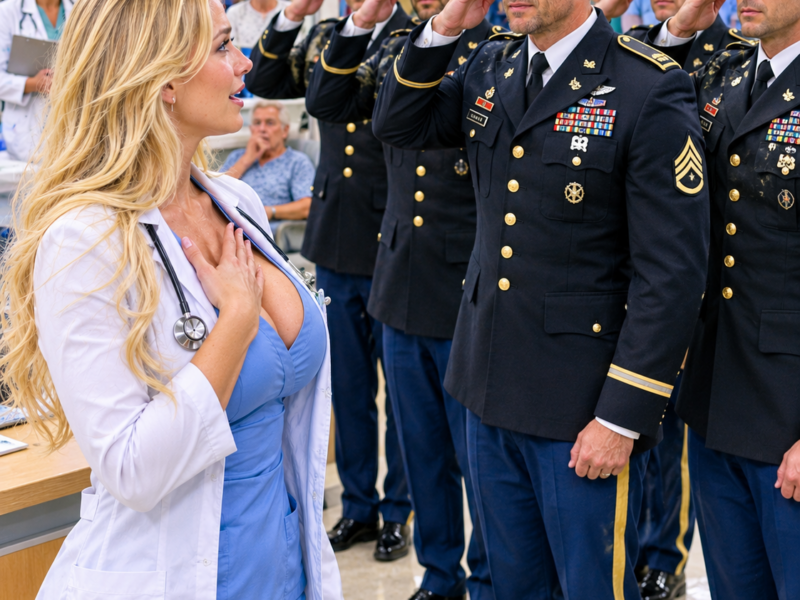
“I was halfway through treating a dying soldier in the emergency room when the hospital administrator grabbed my arm and ordered me to leave the trauma bay
I couldn’t stop looking at the handwriting.
For several seconds, the emergency department seemed to disappear around me.
The monitors continued beeping.
Someone called for a respiratory therapist.
A child was crying somewhere near the waiting room.
But all I could see was Daniel Brooks’s handwriting on that envelope.
“She was never supposed to be left behind.”
I reached for it.
The officer gently placed his hand over the envelope.
“Before you open that, we need to move somewhere private.”
I looked at him.
“Who are you?”
“Master Sergeant James Walker. I served under Captain Brooks.”
“Served?”
His jaw tightened.
“Yes, ma’am.”
“Then tell me how a dead man managed to take a photograph three weeks ago.”
Walker glanced at the five men behind him.
None of them smiled.
“That’s what we’ve come to explain.”
Richard Reynolds stepped forward, his face turning red.
“This conversation is over. You’re disrupting hospital operations, and I will have all six of you escorted out.”
Walker slowly turned toward him.
“Mr. Reynolds, I understand you’re responsible for this facility. But we’re here at the request of the Department of Defense, and we have authorization to speak with Ms. Carter.”
He produced a document from an inside pocket.
Reynolds examined it.
His expression changed.
“Emily, I strongly recommend you don’t get involved in something you don’t understand.”
I looked at him.
“Why are you so concerned about what I understand?”
He didn’t answer.
Walker noticed.
“Actually, that’s a good question.”
He turned to one of his men.
“Secure the hallway.”
Then he looked back at me.
“There’s a conference room on the second floor. We can talk there.”
I picked up the envelope.
“Not without seeing the patient first.”
Walker nodded.
“Of course.”
We walked toward the recovery area.
The wounded man was awake now, with an oxygen tube beneath his nose and an IV running into his arm.
When he saw Walker, he tried to sit up.
“Easy,” I told him.
His eyes moved to me.
“You’re the nurse.”
“That’s usually what the uniform means.”
He attempted a weak smile.
“Captain said you’d say something like that.”
I pulled the blanket back into place.
“What captain?”
He swallowed.
“Brooks.”
My hand paused.
“Do you know him?”
The man’s eyes filled with tears.
“He carried your picture for six years.”
I stepped away from the bed.
Walker leaned closer to him.
“Corporal, you’re not cleared to talk about the operation.”
The wounded man ignored him.
“He told us if we ever found you, we had to say thank you.”
I looked down at the challenge coin resting inside its evidence bag.
“What was your name?”
“Michael Hayes.”
He struggled to breathe.
I adjusted his oxygen.
“Don’t talk too much. You’ve lost a lot of blood.”
He caught my wrist.
“Ma’am, please. He didn’t abandon you.”
I gently freed my hand.
Then I walked out.
Because those words hurt more than I expected.
Six years earlier, I had spent eleven months waiting for Daniel to come home.
We had met at a military hospital in Maryland.
He was recovering from an injury, and I was a civilian trauma nurse assigned to the rehabilitation wing.
He had a habit of pretending his pain was worse than it was whenever he wanted extra coffee.
I had a habit of bringing him coffee even when he didn’t ask.
We became friends first.
Then something more.
Daniel was not the kind of man who made grand promises.
He remembered little things.
How I took my coffee.
Which songs I played when I was tired.
The fact that I hated thunderstorms because my father had once left me stranded during one.
When he proposed, he did it in the hospital parking lot.
No ring.
No flowers.
Just a question and a nervous smile.
“I don’t have a perfect life to offer you, Emily. But I can promise you’ll never have to wonder whether I mean what I say.”
I said yes.
Three months later, he left for an assignment.
He told me it was temporary.
He kissed my forehead before getting into the transport vehicle.
“Save me a place at the breakfast table.”
I laughed.
“Only if you promise to come back hungry.”
That was the last ordinary conversation we ever had.
The military notification arrived eleven months later.
It said Daniel Brooks had been killed during a classified operation overseas.
No body was recovered.
No details were provided.
I attended a memorial service with a folded flag in my hands.
I cried until I couldn’t breathe.
Then I went back to work.
I left the military hospital.
I changed cities.
I stopped answering questions.
And eventually, I learned how to live with the empty space where Daniel used to be.
Or at least, I learned how to make it look that way.
Now six men were telling me he had been alive.
I followed Walker upstairs.
The conference room was empty except for a long table and a stack of untouched paperwork.
One of the officers closed the door.
Walker placed a folder in front of me.
“Before we begin, I need you to understand something. We aren’t asking you to do anything dangerous. We’re here because you deserve the truth.”
I stared at the folder.
“Then start with the truth.”
He nodded.
“Six years ago, Captain Brooks led a small team assigned to a classified recovery mission. The operation was called Blue Lantern.”
I looked at him.
“Blue Lantern wasn’t a recovery mission.”
His eyebrows rose.
“You know something about it?”
“Daniel told me it was a surveillance assignment. He said they were monitoring a weapons shipment.”
Walker exchanged a glance with the man beside him.
“That’s what the official briefing said.”
“What was the real mission?”
He opened the folder.
Inside were photographs of a damaged compound, satellite images, and several pages of reports.
“An intelligence source had identified a detention site where American personnel and local informants were being held. Our mission was to locate them and bring them out.”
“How many?”
“Nine.”
I looked at the photographs.
“Did you find them?”
“Yes.”
“Then what happened?”
Walker’s fingers rested on the edge of the folder.
“We were compromised before extraction.”
He pointed to one of the photographs.
“Our communications were intercepted. The evacuation route was exposed. Someone knew where we were going before we got there.”
I looked at him.
“Someone inside your operation?”
“That’s what we eventually discovered.”
The room became quiet.
Walker continued.
“Daniel ordered the team to split into two groups. He took the wounded personnel toward the secondary extraction point while the rest of us drew attention away from them.”
“Why?”
“Because the original extraction route had become a kill zone.”
I felt my throat tighten.
“Was he injured?”
Walker nodded.
“Twice.”
“Was he captured?”
He didn’t answer immediately.
That hesitation told me enough.
“Yes,” he finally said. “He was taken.”
I pressed my palms against the table.
“How long?”
“Four months before we located evidence that he was still alive.”
Four months.
I had been sitting in a funeral chapel holding a folded flag while he was somewhere in the world being held prisoner.
I looked down at the photographs.
“Why didn’t anyone tell me?”
“Because we didn’t know.”
“You had a body?”
“No.”
“You had proof he was dead?”
“No.”
“Then why did I receive a death notification?”
Walker looked uncomfortable.
“The mission was classified. The notification was issued under a special casualty procedure after intelligence indicated there were no surviving members of the extraction group.”
“Indicated?”
He lowered his eyes.
“That was the official conclusion.”
I laughed once, without humor.
“An official conclusion. That’s a beautiful way to describe burying a man who wasn’t dead.”
Nobody responded.
I opened the next page.
There was a photograph of a man sitting against a concrete wall.
His beard was long.
His face was thinner.
But I recognized him.
Daniel.
The date was six months after the operation.
I touched the edge of the photograph.
“Where was this taken?”
“An intelligence facility outside the original conflict zone.”
“Was he rescued?”
“Not then.”
“Then when?”
Walker took a breath.
“That’s where things become complicated.”
I looked up.
“More complicated than six years of thinking my fiancé was dead?”
He accepted the rebuke.
“After four months, Daniel managed to get a message to our command. He provided information about the people responsible for the compromised operation.”
“Who?”
Walker slid another document across the table.
A list of names.
Most meant nothing to me.
One did.
Richard Reynolds.
I stared at it.
Then I looked at Walker.
“Why is the hospital administrator’s name on this list?”
Walker’s expression hardened.
“Because six years ago, Mr. Reynolds wasn’t a hospital administrator.”
I remembered his polished shoes.
His expensive watch.
The way he had looked at the challenge coin.
“Who was he?”
“Richard Reynolds worked as a civilian logistics contractor supporting the operation. He had access to movement schedules and medical evacuation records.”
“You’re saying he betrayed the team?”
“We’re saying Daniel identified him as someone who helped compromise the extraction.”
I leaned back.
The room felt too small.
“Then why is he here?”
“That’s a question we’ve been trying to answer.”
I thought about my reassignment.
His insistence that I leave the past outside the hospital.
The way he had reacted when the team arrived.
Suddenly, his behavior made sense in a way I didn’t like.
“Did he know I worked here?”
“We believe he did.”
“Why would he care about me?”
Walker closed the folder.
“Because Daniel’s final report mentioned you.”
I stared at him.
“What did it say?”
Walker hesitated.
Then he removed a second envelope from his jacket.
This one was older.
The edges were worn, and a faint brown stain crossed one corner.
It had my name written across the front.
I recognized the handwriting immediately.
“Where did you get that?”
“It was recovered during a recent operation.”
I reached for it.
This time, Walker let me take it.
The envelope was sealed.
I opened it carefully.
Inside was a single sheet of paper.
Emily,
If this reaches you, it means I haven’t found my way home yet.
I need you to understand something.
The night Blue Lantern went wrong, I made a choice that may have cost me everything.
I sent you away because I believed someone was using you to get to me.
I thought distance would keep you safe.
I was wrong about how much that decision would hurt you.
There are things I cannot explain in this letter.
But I want you to remember one thing.
You were never a weakness.
You were the reason I kept trying to survive.
I’m sorry I couldn’t come home when I promised.
Daniel.
I read it twice.
Then a third time.
The paper shook between my fingers.
“Why didn’t this reach me?”
Walker looked at the table.
“Because the people handling the investigation didn’t want it to.”
I folded the letter.
“Who handled the investigation?”
He turned to the last page in the folder.
There was a signature at the bottom.
Richard Reynolds.
For a moment, I couldn’t speak.
Then someone knocked on the conference room door.
One of the officers stepped outside.
He returned less than a minute later.
“Sir, we have a problem.”
Walker stood.
“What?”
“Reynolds is gone.”
I looked at the door.
“What do you mean, gone?”
“His office is empty. His car is still in the parking garage, but security can’t locate him.”
Walker immediately reached for his radio.
“Lock down the building. Notify local authorities. Nobody enters or leaves without verification.”
I stood too.
“He’s running.”
“Probably.”
“Then you need to find him.”
Walker looked at me.
“We will.”
I picked up Daniel’s letter.
“But I know something you don’t.”
He waited.
“Reynolds wasn’t afraid when you walked in. He was afraid when he saw the coin.”
Walker’s expression changed.
I continued.
“He knew exactly what it was. He also knew I recognized it.”
The officer beside him frowned.
“Are you certain?”
I nodded.
“Six years ago, Daniel gave me one before he left. He said if anything happened to him, I should never hand it to anyone unless they knew what Blue Lantern meant.”
Walker looked toward the hallway.
“Do you still have it?”
I stared at him.
“No.”
I swallowed.
“I gave it to the military investigator after Daniel was declared dead.”
Walker went completely still.
“Who was the investigator?”
I closed my eyes.
I remembered a small office.
A man with gray hair.
A quiet voice.
A signature on a receipt.
Then the name came back.
“Colonel Thomas Reed.”
Walker looked at his men.
“That’s impossible.”
“Why?”
“Because Colonel Reed died two years ago.”
I looked at him.
“Then someone else collected it.”
Nobody spoke.
My phone vibrated on the table.
An unknown number.
I almost ignored it.
Then I saw the message.
Emily, don’t trust the men in black. Reynolds isn’t the one who sent them. Ask Walker what happened to the ninth prisoner.
I read it again.
The ninth prisoner.
I looked up.
Walker was watching my face.
“What is it?”
I turned the phone toward him.
He read the message.
His expression changed so quickly that I knew the words had hit something important.
“Who sent this?”
“I don’t know.”
“Don’t reply.”
“Why?”
He took a step toward me.
“Because whoever sent that message knows things that should never have left the original investigation.”
I looked at the six men.
“Who was the ninth prisoner?”
Walker said nothing.
“James.”
He rubbed a hand across his face.
“Emily, the nine people we recovered were not all civilians.”
“Then who were they?”
“Eight were American personnel or local intelligence sources.”
“And the ninth?”
He looked at the door.
“The ninth was a civilian medical officer who had been working under an assumed identity.”
I stared at him.
“What was her name?”
He lowered his voice.
“Dr. Laura Bennett.”
The name meant nothing to me.
“Why does that matter?”
“Because Daniel believed she was the person who exposed our extraction route.”
I shook my head.
“Then why would someone send me a message about her?”
Walker didn’t answer.
Instead, he reached for his radio.
“Get me the records from the original casualty investigation. I want every surviving file.”
A voice crackled back.
“Sir, we’ve got another issue.”
“What now?”
“The wounded corporal is asking for you. He says he knows who sent the message.”
Walker looked at me.
I was already heading for the door.
When we reached the recovery room, Michael Hayes was sitting upright despite the pain.
His face had lost some of its color.
He looked at me.
Then at Walker.
“Did she get the message?”
Walker stopped beside the bed.
“Who sent it?”
Michael looked down.
“Dr. Bennett.”
Walker went silent.
I pulled a chair closer.
“Where is she?”
Michael shook his head.
“I don’t know where she is now.”
“Is she alive?”
He nodded.
“Yes.”
“Then why did you say she was responsible for the betrayal?”
Michael’s eyes filled with shame.
“Because that’s what we were told.”
He looked toward the window.
“After the operation, we were interrogated separately. We were given the same story. They said the medical officer had sold our location to the enemy.”
“Did Daniel believe it?”
Michael looked at Walker.
“Not at first.”
“What changed?”
“Nothing. That’s the point.”
He took a breath.
“Daniel never believed it. He said the medical officer had been trying to get us out. He said she had warned him the extraction route was compromised.”
I looked at Walker.
“Then why was she listed as the traitor?”
Walker spoke carefully.
“Because someone needed a person to blame.”
Michael nodded.
“Captain Brooks told us the betrayal came from inside the logistics chain. He said the person responsible had access to the evacuation schedules and medical transport records.”
I remembered Reynolds’s name.
“Richard.”
Michael nodded.
“Daniel suspected him. But he couldn’t prove it.”
“Where did the evidence go?”
Michael’s eyes shifted to the ceiling.
“Daniel hid it.”
“Where?”
He looked at me.
“He said if anything happened to him, the only person who could find it would be the woman who knew how he thought.”
I felt a familiar ache in my chest.
“Me?”
Michael nodded.
“He left you a clue.”
Walker leaned forward.
“What clue?”
Michael struggled to reach beneath his blanket.
A nurse hurried over to stop him.
“Sir, you need to stay still.”
“Please.”
He pulled a small folded piece of paper from his pocket.
It was creased and stained.
He handed it to me.
I unfolded it.
There was a series of numbers.
And beneath them, three words.
The quiet room.
I stared at the paper.
I knew exactly what he meant.
Six years earlier, Daniel and I had spent a weekend at a small cabin in the Shenandoah Mountains.
It had belonged to his grandfather.
There was a tiny room at the back, barely large enough for a chair and a window.
Daniel called it the quiet room.
When life became too loud, he would sit there and read.
He once told me that if he ever needed to hide something important, he would put it somewhere people would overlook.
I looked at Walker.
“I need to go there.”
He shook his head.
“Not until we know who sent that message.”
“Daniel left something for me.”
“And if Reynolds knows about it?”
“Then we need to get there before he does.”
Walker considered this.
Finally, he nodded.
“Two vehicles. My team will escort you.”
I looked at Michael.
“You’re going to be okay.”
He gave me a tired smile.
“Captain said you’d be stubborn.”
I managed a small smile of my own.
“Captain was usually right.”
For the first time that night, I felt something other than fear.
It wasn’t hope exactly.
It was the possibility that the story I had been living with for six years was not the whole story.
We left the hospital shortly after dawn.
Rain had stopped.
The sky was the pale gray color that comes before sunrise, and the roads were almost empty.
Walker sat in the passenger seat of the lead vehicle.
I rode behind him, holding Daniel’s letter in my lap.
I kept reading the same lines.
You were never a weakness.
You were the reason I kept trying to survive.
I wondered how many times he had repeated those words to himself.
And how many times I had mistaken his silence for abandonment.
The cabin was less than two hours away.
It sat at the end of a narrow gravel road surrounded by trees.
The wooden porch sagged slightly.
A rusted wind chime hung beside the front door.
I had not been there since the summer before Daniel left.
When I stepped out of the vehicle, the smell of wet leaves brought back memories so clearly that I had to pause.
Walker approached.
“Are you sure you want to do this?”
I looked at the cabin.
“Yes.”
He signaled his men to secure the perimeter.
Then we entered.
Dust covered the furniture.
A thin layer of leaves had gathered near the back door.
The place looked untouched.
I walked through the living room.
The old fireplace was still there.
So was the small bookshelf Daniel had built from leftover wood.
I touched the edge.
He had made it crooked.
He’d laughed when I pointed it out.
“Character,” he’d said.
I moved toward the hallway.
The quiet room was at the back.
The door stuck slightly before opening.
Inside, there was a chair beside the window and a small wooden desk.
I stood in the doorway.
For a moment, I could almost see him sitting there with a book in his hands.
I approached the desk.
The numbers on Michael’s paper were not coordinates.
They were a date and a time.
The day Daniel had proposed.
And the time printed on the hospital receipt from that evening.
I remembered the receipt.
He had kept it because the coffee machine had charged him twice.
I searched the desk drawers.
Nothing.
Then I noticed a small scratch beneath the desk.
Three lines.
The same three scratches as the challenge coin.
I knelt.
There was a narrow panel beneath the drawer.
I pressed it.
A wooden compartment opened.
Inside was a small black drive, a folded photograph, and a second envelope.
My name was written on the envelope.
This time, the words beneath it were different.
For when you’re ready to know why I stayed away.
My fingers trembled as I opened it.
Emily,
If you’ve found this, then someone finally told you enough of the truth to bring you here.
I don’t know whether I’m alive or dead when you read this.
But I need you to know what happened to Laura.
She didn’t betray us.
She saved us.
She discovered that our extraction schedule had been sold before the mission began. She tried to warn command, but the warning never reached the people who needed it.
When I realized the leak came from our own logistics office, I sent the evidence to her because she was the only person I trusted outside the team.
I also sent it to you.
I never told you because I knew someone was watching you.
If I came home, I would bring them to your door.
If I stayed away, I could keep them looking in the wrong direction.
I chose the second option.
I know you may never forgive me.
But I hope you understand that leaving you was the hardest order I ever gave myself.
Daniel.
I lowered the letter.
Walker stood near the doorway.
“Is it him?”
I nodded.
He stepped closer.
“May I?”
I handed him the letter.
He read it carefully.
Then he looked at the black drive.
“That’s probably the evidence.”
I turned it over.
There was a small label.
BLUE LANTERN — ORIGINAL RECORDS.
Walker called for a secure communications specialist.
One of his men checked the device without connecting it to any network.
“Sir, this could contain operational intelligence.”
Walker nodded.
“Then we handle it through proper channels.”
I looked at him.
“Can it prove Reynolds betrayed the team?”
“Maybe. But we need to verify the contents and preserve the evidence.”
I picked up the photograph.
It showed Daniel standing beside a woman in civilian clothes.
She was in her forties, with dark hair and a serious expression.
On the back, Daniel had written:
Laura. The person who tried to bring us home.
I stared at her face.
“She was real.”
Walker nodded.
“Yes.”
“Where is she now?”
He looked down.
“We don’t know.”
My phone vibrated again.
Another message.
You found it. Don’t give the drive to Walker.
I looked at the screen.
A second message arrived.
He doesn’t know who replaced Colonel Reed.
I turned slowly.
Walker was speaking quietly to his communications specialist.
For the first time, I wondered whether the man who had brought me here was telling me everything.
I approached him.
“James, who replaced Colonel Reed?”
He turned.
“What?”
“After Reed died, who took over the investigation?”
Walker’s face tightened.
“I don’t have that information.”
“Then why did you say the files were being retrieved?”
“Because we’re trying to locate them.”
I showed him the messages.
He read them.
His expression became unreadable.
“Emily, I need you to listen carefully. Do not assume every anonymous message is true.”
“That’s reasonable.”
“Someone is trying to turn us against each other.”
“Then help me understand why the person knows things you don’t.”
He stared at the phone.
Then he slowly lowered it.
“There’s one possibility.”
“What?”
“The original investigation may have been compromised after Reed’s death.”
“By whom?”
“I don’t know.”
I looked at the black drive.
“Then nobody touches this until we know who can be trusted.”
Walker nodded.
“Agreed.”
We heard a vehicle outside.
One of the officers moved toward the window.
“Sir.”
Walker raised his hand.
“Report.”
“Black SUV approaching. No markings.”
The vehicle stopped near the porch.
A man stepped out.
He was wearing a dark overcoat.
I recognized him immediately.
Richard Reynolds.
Walker drew his weapon.
“Stay behind me.”
Reynolds lifted both hands.
“I’m not armed.”
“Stop where you are.”
Reynolds stopped.
Then he looked past Walker.
His eyes found mine.
“Emily, I need to talk to you.”
I stepped forward just enough to be seen.
“You’ve had six years.”
His face tightened.
“I know.”
“Why did you lie?”
He looked at the floor.
“Because I was afraid.”
“Of what?”
“Of the people who paid me.”
Walker moved closer.
“You’re under investigation for your involvement in Blue Lantern. You need to keep your hands visible.”
Reynolds nodded.
“I expected that.”
He looked at me again.
“I didn’t know Daniel was alive.”
“You’re telling me you didn’t know?”
“I knew he might be.”
“That’s not an answer.”
He swallowed.
“I was told he died in captivity. I believed it for a long time.”
I took another step.
“You signed the report that declared him dead.”
“I was instructed to sign it.”
“By whom?”
He hesitated.
Then he said a name.
“Deputy Director Samuel Pierce.”
Walker looked sharply at him.
“Pierce was never assigned to the operation.”
“He didn’t need to be. He controlled the civilian intelligence contractors.”
I remembered the messages.
The person who replaced Colonel Reed.
“Did Pierce take over the investigation?”
Reynolds nodded.
“After Reed died, Pierce made sure every remaining file went through his office.”
Walker looked at me.
“That would explain the missing records.”
Reynolds continued.
“I wasn’t the only person involved. I handled the schedules, but I didn’t know the full operation. When I realized what had happened, it was too late.”
“Then why did you come here?”
He looked at the envelope in my hand.
“Because I received a message last night.”
“What message?”
He reached slowly into his coat.
Walker raised his weapon.
“Don’t.”
Reynolds stopped.
“It’s a photograph.”
“Take it out with two fingers.”
He did.
The picture showed Daniel standing in front of a building.
The image was recent.
Very recent.
On the back was a handwritten sentence.
If Emily finds the drive, she becomes the next casualty.
I looked at Reynolds.
“Who sent it?”
“I don’t know.”
“Then why bring it to me?”
“Because I finally understood that the people who used me were not finished.”
Walker took the photograph.
“Why should we believe you?”
Reynolds looked at him.
“You shouldn’t.”
Then he turned toward me.
“But I can tell you something that may help you understand why Daniel stayed away.”
I waited.
“After the mission, Daniel escaped from the facility where he was being held. He contacted me through an encrypted channel.”
My throat tightened.
“When?”
“Five years ago.”
Five years.
I had spent another entire year believing he was gone.
“What did he say?”
Reynolds closed his eyes briefly.
“He told me to keep you safe.”
I stared at him.
“And you did what?”
“I kept you under observation.”
A cold sensation moved through my chest.
“Observation?”
“I knew where you worked. I knew when you moved. I made sure nobody approached you.”
“You watched me?”
“I thought I was protecting you.”
“You had no right.”
“I know.”
I looked at the man who had once stood in my hospital office and ordered me to forget my past.
For the first time, he looked genuinely ashamed.
“Did Daniel know I thought he was dead?”
Reynolds nodded.
“Yes.”
“Did he know I held a funeral for him?”
His eyes dropped.
“Yes.”
I turned away.
The anger came slowly, not as an explosion but as something heavy settling into my bones.
He had known.
Someone had known.
And I had spent six years talking to an empty photograph.
Walker stepped forward.
“Mr. Reynolds, you’re coming with us.”
Reynolds nodded.
“I understand.”
Before the officers escorted him away, he turned back.
“Emily, there’s one more thing.”
I didn’t look at him.
“Daniel didn’t leave you because he stopped loving you.”
I finally faced him.
“He left because the people responsible for Blue Lantern threatened to use you to force him into silence. He believed staying away was the only way to keep you alive.”
“Then he should have trusted me enough to let me choose.”
Reynolds had no answer.
And neither did I.
The officers took him into custody.
Walker watched the SUV disappear down the road.
Then he turned to me.
“We need to get that drive to a secure facility.”
I held it tightly.
“Not until I know what happened to Daniel.”
He nodded.
“I’ll help you find out.”
For the first time, I believed him.
Not because he had earned my trust.
Because he had finally admitted what he didn’t know.
We returned to the hospital that afternoon.
Michael was recovering from surgery.
His condition was stable.
I visited him before going home.
He was awake, watching the television without really seeing it.
When I entered, he smiled.
“Found the quiet room?”
I nodded.
“And the evidence.”
He closed his eyes.
“Good.”
I pulled a chair beside his bed.
“Michael, why did Daniel keep that coin?”
He smiled faintly.
“He gave one to each of us before the mission.”
“Why?”
“He said it was a reminder that we weren’t just names on a roster.”
I looked at the challenge coin on the bedside table.
“Why did he give me one?”
Michael took a moment to answer.
“Because he wanted you to know that if the worst happened, someone would remember you were part of his life.”
My eyes burned.
“He could have told me that himself.”
“I know.”
Michael looked toward the window.
“Captain wasn’t good at asking people to share the weight he carried.”
I understood that more than I wanted to.
Before I left, Michael caught my hand.
“There’s something else.”
“What?”
“Daniel asked us to look after you if we ever got home.”
I swallowed.
“He asked you?”
“Every time we talked about escape. Every time one of us thought we wouldn’t make it.”
Michael gave a small, tired smile.
“He’d say, ‘If you see Emily, tell her I kept the breakfast table empty.'”
I looked down.
The old promise.
Save me a place at the breakfast table.
I squeezed his hand.
“Thank you for telling me.”
That evening, Walker called.
The drive had been examined by a specialist.
It contained original communications, logistics records, and a series of recorded conversations.
The evidence was extensive.
More importantly, one recording appeared to confirm that Reynolds had been pressured to alter the extraction schedule.
Another showed Deputy Director Pierce discussing the removal of records from the original investigation.
The evidence was enough to reopen the case.
But there was something else.
A final audio file.
It was labeled with a date from five years earlier.
Walker asked if I wanted to hear it.
I sat alone in my apartment with the phone pressed to my ear.
The recording began with static.
Then Daniel’s voice.
Older.
Rougher.
But unmistakably his.
“James, if you’re hearing this, it means the evidence made it out.”
I covered my mouth.
There was a pause.
Then he continued.
“I don’t know if I’ll ever get home. I’ve been told that if I return, the people who compromised Blue Lantern will come after Emily.”
He took a breath.
“I need you to tell her something.”
The recording crackled.
“Tell her I know she deserved the truth. I know I took that choice away from her. I told myself I was protecting her, but maybe I was just afraid of watching her suffer because of me.”
His voice broke slightly.
“I still remember that parking lot. I still remember the coffee. I still remember the way she laughed when I asked her to marry me without a ring.”
I closed my eyes.
“I don’t want her to spend her life waiting for a man who might never come home. If she finds someone who makes her happy, I hope she lets herself have that happiness.”
There was a long silence.
Then Daniel spoke again.
“But if I do make it home, and she’s willing to see me, I want one chance to explain it myself.”
The recording ended.
I sat in the dark for a long time.
I wasn’t angry anymore in the same way.
But I wasn’t ready to forgive him either.
Love could survive a lot.
It could survive distance.
It could survive fear.
But six years of silence had changed the shape of what I remembered.
I wanted to know the man who had made those choices.
Not just the man in the photograph.
Three days later, federal investigators arrived at St. Catherine’s.
Reynolds agreed to cooperate.
The evidence from the drive led to the arrest of several people connected to the original operation.
Deputy Director Pierce was taken into custody at his home.
Dr. Laura Bennett was located in another state.
She had been living under a protected identity for years.
Her testimony helped establish how the extraction schedule had been leaked and how the investigation had been manipulated afterward.
She also confirmed something Daniel had never been able to prove.
He had helped her escape after the operation.
He had given her the evidence.
And he had stayed behind long enough to draw attention away from the remaining prisoners.
When I finally spoke to her, she was quiet for a long time.
“Emily, your fiancé saved my life.”
I stared at the phone.
“Why didn’t you contact me?”
“I tried once. The message was intercepted. After that, I was told that any contact could put you in danger.”
I looked down at my hands.
“Did Daniel ever stop trying to come home?”
“No.”
Her answer came without hesitation.
“Not once.”
I thanked her.
Then I hung up.
The investigation took months.
I returned to my regular night shifts.
I treated patients.
I changed dressings.
I held the hands of frightened strangers.
Life did not suddenly become simple because the truth had finally been spoken.
Some nights I still woke from dreams about the memorial service.
Some mornings I found myself looking at the door whenever an ambulance arrived.
But I was no longer living inside a story someone else had written for me.
One Thursday evening, almost four months after the black-clad team walked into my hospital, I was finishing my shift when Karen approached the nurses’ station.
She held two cups of coffee.
“Someone’s asking for you.”
I looked at her.
“Another administrator?”
She shook her head.
“No.”
Her expression was different.
Softer.
“He’s waiting outside.”
I set down my chart.
For a moment, I couldn’t move.
Then I walked toward the main entrance.
The automatic doors opened.
A man stood beneath the covered driveway.
He wore a dark jacket and held a small paper coffee cup.
His hair was shorter than I remembered.
There were lines around his eyes.
A faint scar crossed his left cheek.
But I knew him.
Daniel.
He didn’t rush toward me.
He didn’t call my name.
He simply stood there, holding the coffee with both hands.
I stopped several feet away.
“Hi, Emily.”
His voice was lower than I remembered.
I looked at him.
Six years of grief stood between us.
Six years of questions.
Six years of birthdays, holidays, and ordinary mornings he had missed.
I wanted to run to him.
I wanted to slap him.
I wanted to ask why he had let me bury him while he was still breathing.
Instead, I said the first thing that came to mind.
“You brought coffee.”
He looked down at the cup.
“I remembered how you take it.”
I almost laughed.
Almost cried.
“Of course you did.”
He nodded toward the hospital entrance.
“Can we talk?”
I looked at the clock.
My shift was over.
For the first time in years, I had nowhere I needed to be.
“There’s a diner across the street.”
He nodded.
“I know.”
We walked there without touching.
The diner smelled of bacon, burnt toast, and fresh coffee.
It was almost empty.
We took a booth near the window.
Daniel sat across from me.
For several seconds, neither of us spoke.
Then he placed something on the table.
A small velvet box.
I stared at it.
“What’s that?”
“The ring I was supposed to give you.”
He opened it.
Inside was a simple gold ring.
Not extravagant.
Not perfect.
Just like Daniel.
“I carried it for six years,” he said. “I know that doesn’t make anything better.”
I looked at the ring.
“Why didn’t you come back when you escaped?”
He lowered his eyes.
“Because I didn’t know who was watching. I had evidence, but no way to know whether the people protecting you were the same people reporting your movements.”
“James found me.”
“I know.”
“He came to the hospital.”
Daniel nodded.
“I was the one who told him to find you.”
I looked up.
“Then why did he wait six years?”
“Because he couldn’t find me until the operation that recovered Michael. I had been moving between safe locations. When the investigation reopened, I finally had a way to come home.”
I took a slow breath.
“You could have sent a letter.”
“I tried.”
“One letter?”
He looked at me.
“Seven.”
I stared.
“What?”
“Seven letters. None reached you. I sent them through channels I believed were safe. Later, I learned they had been intercepted.”
I remembered the envelope from the quiet room.
The one that had survived.
“Did you ever think about calling me?”
“Every day.”
“That isn’t an answer.”
He nodded.
“No. I didn’t. I was afraid someone would trace it.”
I looked at him.
“Daniel, you don’t get to decide what kind of life I can survive.”
His eyes filled.
“I know.”
“You decided I was safer not knowing. You decided I was better off grieving you. You decided I didn’t need to choose whether I wanted to wait.”
He looked down at his hands.
“You’re right.”
That answer surprised me.
I had prepared myself for explanations.
For arguments.
For another version of the same justification I had heard from Reynolds.
But Daniel didn’t defend himself.
“I thought I was making the sacrifice for both of us,” he said. “I didn’t understand that I was making it for you without asking.”
I looked out the window.
Across the street, headlights moved through the wet evening.
“Do you still want to marry me?”
He took a long breath.
“I do.”
Then he added quietly, “But I know you may not.”
I looked at the ring again.
For six years, I had imagined what it would feel like to see him alive.
I had imagined tears.
An embrace.
An apology that would somehow make everything right.
I hadn’t imagined sitting across from him with a cup of coffee, realizing that love and hurt could occupy the same space.
I closed the velvet box.
“Put it away.”
Daniel nodded.
He didn’t argue.
We sat for another hour.
He told me about the men who hadn’t made it home.
About the months in captivity.
About Laura.
About the people who had helped him escape.
I told him about my first apartment after leaving the military hospital.
About the nights I worked double shifts because sleeping was harder than staying awake.
About Karen, who had become the closest thing I had to family.
And about the memorial service.
That was the part he struggled to hear.
“I held the flag,” I said.
Daniel’s face tightened.
“I know.”
“No. You don’t know.”
I looked directly at him.
“I held it while people told me how brave you were. I went home and put your photograph on the kitchen counter. I learned how to cook for one. I stopped buying your favorite coffee because seeing it in the cupboard hurt too much.”
He reached across the table, then stopped before touching my hand.
“I’m sorry.”
I nodded.
“I believe you.”
It wasn’t forgiveness.
Not yet.
But it was something honest.
When we finally stood to leave, Daniel held the door open.
Outside, the rain had started again.
He looked at me.
“Can I see you again?”
I studied his face.
The man I had loved was standing in front of me.
But I was no longer the woman who had waited for him.
I had built a life without him.
A quiet one.
A good one.
And if he wanted a place in it, he would have to meet the person I had become.
“Coffee,” I said.
He nodded.
“Coffee?”
“Tomorrow. No promises beyond that.”
His mouth curved into the smallest smile.
“Tomorrow.”
I walked back toward the hospital.
At the entrance, I turned once.
He was still standing beneath the awning, watching me go.
For the first time in six years, I didn’t feel the need to look back again to make sure he was still there.
Over the following months, Daniel kept his promise.
He called when he said he would.
He showed up when we made plans.
He answered questions even when the answers were difficult.
Sometimes we talked for hours.
Sometimes we sat in silence.
There were days when I wanted to forgive him completely.
There were others when the memory of that folded flag returned, and I needed distance.
He never asked me to hurry.
Eventually, I learned that he had started volunteering with a veterans’ support organization.
He helped families navigate the uncertainty that came with missing service members and classified casualty reports.
He couldn’t undo what had happened to us.
But he could make sure another family didn’t have to face the same silence without someone fighting for answers.
I continued working at St. Catherine’s.
Karen never again called me the hospital’s gentle ghost.
One night, she brought two cups of coffee to the nurses’ station and placed one beside me.
“Your friend called.”
I looked up.
“Which friend?”
She smiled.
“The one who remembers your order.”
I laughed.
That small sound surprised me.
It had been a long time since it came so easily.
On the anniversary of Daniel’s disappearance, we drove to the Shenandoah cabin.
The quiet room was still there.
The little desk.
The crooked bookshelf.
The chair beside the window.
I placed the original challenge coin on the desk.
Daniel stood behind me.
“I thought I lost that,” he said.
“You lost a lot of things.”
He nodded.
“I know.”
I turned toward him.
“Some things can be found again.”
He reached for my hand.
This time, I let him take it.
We didn’t get married that year.
We didn’t pretend the past had disappeared.
We simply began again, slowly, with the understanding that love could not survive on protection and promises alone.
It needed honesty.
It needed choice.
And it needed two people willing to stand in the same room, even when the truth was uncomfortable.
Before we left, I opened the small window in the quiet room.
Cool mountain air moved through the curtains.
On the desk, Daniel’s old letter rested beside the coin.
I thought about the six men who had walked into my emergency department that rainy night.
They had come to thank me for helping save their captain.
But the greatest thing they gave me wasn’t gratitude.
It was the chance to stop mourning a man who was still alive.
And when Daniel reached for my hand as we stepped out into the fading light, I understood something I hadn’t known six years earlier.
Being loved meant very little if I wasn’t allowed to choose what happened next.
The end.









