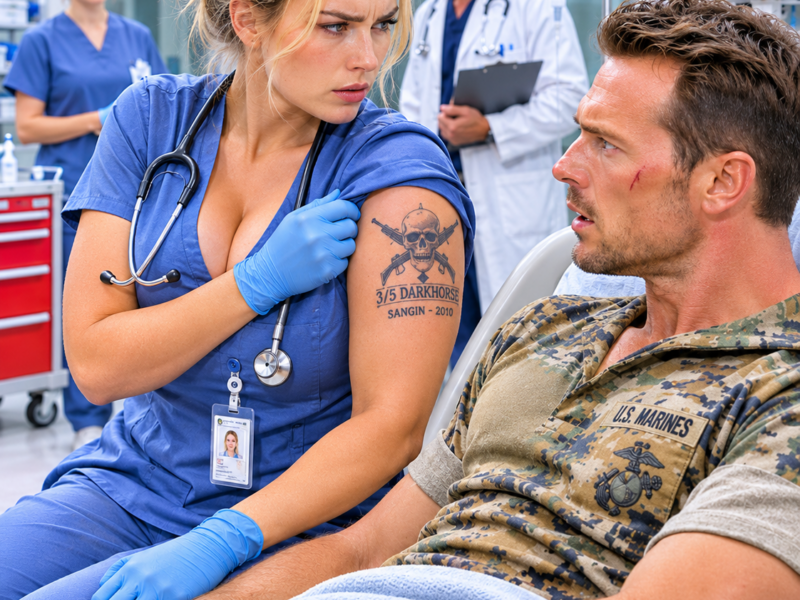
“I was halfway through treating a bleeding Marine colonel at Oceanside Memorial when he grabbed my wrist and called me a civilian babysitter
The young woman held the phone between us, her fingers trembling so badly that the screen nearly slipped from her grasp.
“Please,” she whispered. “Just listen.”
The recording crackled through the small speaker.
At first, I heard rain, the faint rumble of an engine, and the sound of someone breathing heavily.
Then Richard Hayes’s voice came through.
“James, listen to me. I need you to stay where you are. Do you understand?”
A younger man’s voice answered.
“I can’t do this anymore, sir.”
My stomach tightened.
I knew that voice.
It was James Miller.
“James, you’ve survived things most people couldn’t imagine. Don’t let tonight be the night you forget who you are.”
There was a long silence.
Then Miller spoke again.
“You weren’t there, sir.”
Hayes took a shaky breath.
“No. I wasn’t.”
“You told me you’d get me out.”
“I know.”
“You promised.”
The recording crackled.
Then came a sentence that made the young woman’s face collapse.
“There’s something I haven’t told you about Sangin, Colonel.”
I looked at her.
“Who gave you this recording?”
“My father called me before he left home. He said he needed to help someone, but he also said something was wrong. He told me to keep this phone if anything happened to him.”
The military police sergeant stepped closer.
“Miss Hayes, we need that device as evidence.”
“Not until she hears the rest,” Evelyn replied.
The officer frowned.
“Ma’am, this is a criminal investigation.”
“And he’s my father!”
Her voice broke.
I gently placed a hand on her shoulder.
“Evelyn, let them preserve the recording. But if there’s something important on it, we need to know what it is.”
She looked at me for several seconds before nodding.
The taller officer took the phone and connected it to his department’s evidence system.
We listened again.
This time, the recording continued beyond the first exchange.
Miller’s voice was barely audible.
“I didn’t tell you everything about that convoy.”
Hayes answered quietly.
“What do you mean?”
“Corporal Davis didn’t die because of the first blast.”
I felt the air leave my lungs.
Sergeant Davis.
I remembered him lying on a makeshift treatment table, his uniform soaked in blood, his hand wrapped around mine.
I remembered promising him that the medevac was coming.
I remembered the moment his fingers stopped moving.
On the recording, Hayes said something I couldn’t quite understand.
Then Miller continued.
“The second explosion happened because I went back for the equipment.”
“James, we discussed this.”
“No, sir. You told me the investigation was closed. You told me nobody was going to blame me.”
“Nobody is blaming you.”
“You don’t understand. I heard the radio traffic. I know what the report said.”
There was a pause.
Then Miller whispered:
“Someone changed the report.”
The recording ended.
Nobody spoke.
The military police sergeant looked at his partner.
“Did you know about this?”
The second officer shook his head.
“No.”
Evelyn looked at me.
“Do you know what he’s talking about?”
I couldn’t answer immediately.
Because I remembered something from that deployment that I had spent years trying to forget.
The night Davis died, there had been an argument outside the treatment tent.
A senior officer had demanded to know why the convoy had deviated from its assigned route.
I remembered a radio operator saying the coordinates had been changed.
I remembered Miller insisting that the new route had come through command.
And I remembered being told, very firmly, that medical personnel had no reason to concern themselves with operational decisions.
I had been too busy trying to keep Davis alive to ask questions.
Now, fourteen years later, those questions had followed us into a California hospital.
“Where is James now?” I asked.
Evelyn shook her head.
“My father said he was in Los Angeles. He didn’t tell me which apartment.”
The sergeant stepped forward.
“We’ll find him.”
I looked at him.
“Then find him before someone else does.”
He didn’t argue.
He took the phone and walked toward the hospital security office.
Evelyn remained beside me.
For the first time, she seemed to notice how tightly I was holding my own arm.
“Did you know my father before tonight?”
“Not personally. But I served with his battalion.”
She glanced at my sleeve.
“That’s why he recognized your tattoo.”
I nodded.
“My father never talks about Afghanistan,” she said. “Not really. When I was younger, I thought it was because he didn’t want to remember the bad things.”
She swallowed.
“Now I wonder if he was afraid of remembering something specific.”
I didn’t have an answer.
I only knew that the man upstairs had nearly died trying to reach a Marine who believed he had been abandoned.
And I had a feeling that whatever Miller had discovered was the reason he had never stopped suffering.
At 10:20 that morning, Dr. Gable came out of the surgical wing.
His surgical cap was in his hand, and exhaustion had settled into every line of his face.
Evelyn stood immediately.
“Doctor?”
He offered a tired smile.
“Your father is out of surgery.”
She covered her mouth.
“We managed to stabilize the fracture with a titanium rod. The vascular team repaired the femoral artery, and we relieved the pressure in his lower leg.”
“Will he lose it?”
“Not if his recovery continues as expected. But he’s going to need extensive rehabilitation.”
Evelyn began crying.
I closed my eyes for a moment.
We had saved him.
At least physically.
When we entered the ICU several hours later, Richard Hayes was still unconscious.
His right leg was elevated, wrapped in thick surgical dressings.
The ventilator breathed steadily for him.
Evelyn sat beside the bed and took his hand.
I stayed near the monitors.
She looked at her father for a long time before speaking.
“You idiot,” she whispered. “You absolute idiot.”
Then she kissed his forehead.
“I still need you, Dad.”
I turned away to give her privacy.
But before I reached the door, I heard her say something else.
“Whatever happened in Afghanistan, you don’t have to carry it alone anymore.”
I wondered if Richard could hear her.
I hoped he could.
Three days later, the colonel was awake.
The ventilator had been removed, and he was breathing through a nasal cannula.
His face was bruised, his lips were dry, and his right leg looked painfully swollen beneath the bandages.
I entered room 312 during my afternoon break.
He turned his head.
“Doc Jenkins.”
“Still causing trouble, Colonel?”
A faint smile appeared.
“Apparently.”
I checked his IV and examined the color of his toes.
“How’s the pain?”
“Manageable.”
“That’s Marine language for terrible.”
He gave a quiet laugh, then winced.
“Don’t make me laugh. It hurts.”
“Then stop being funny.”
For a few minutes, we talked about his surgery and the rehabilitation ahead.
Then his expression changed.
“Evelyn told me about the phone.”
I stopped adjusting the IV pump.
“She played the recording for me.”
“Did she tell you what Miller said?”
He stared at the ceiling.
“Yes.”
“Richard, what happened in Sangin?”
He didn’t answer immediately.
Instead, he turned toward the window.
The Pacific Ocean was visible in the distance, sunlight flashing across its surface.
“Fourteen years ago, we were operating outside Sangin. My convoy had six vehicles. Davis was in the second truck. Miller was in the lead vehicle.”
I pulled a chair closer.
“Go on.”
“We received new coordinates through command. The route was supposed to avoid a suspected explosive device. I approved the change.”
He closed his eyes.
“That was my responsibility.”
“What happened?”
“The first explosion hit the lead vehicle. The second hit Davis’s truck.”
I remembered the noise.
The smoke.
The screaming.
Hayes continued.
“Miller survived the first blast. Davis was trapped in the second vehicle. Miller went back for him.”
“That sounds like James.”
“He’s always been that way.”
A tear gathered at the corner of his eye.
“He got Davis out. But he left the radio equipment behind. Some of it contained the updated route information.”
I frowned.
“Why would that matter?”
“Because the route change had come through a communications relay that wasn’t supposed to be active.”
He looked at me.
“Someone had transmitted coordinates using a command channel without authorization.”
My fingers tightened around the chair.
“Are you saying the convoy was deliberately redirected?”
“I don’t know. That’s what I’ve been trying to establish.”
He took a shallow breath.
“After the explosion, the official report said the route change came from a verified source. Miller told investigators he had heard something different on the radio. He said the transmission had been altered.”
“Did you believe him?”
“At first, yes.”
“Then?”
Hayes looked away.
“Then I was shown a report with his authentication code on it.”
I stared at him.
“You thought Miller had authorized the change?”
“I thought he had made a mistake and couldn’t live with it.”
His voice became quieter.
“I was wrong.”
The room fell silent.
I remembered James apologizing for bleeding on my boots.
I remembered him asking whether Davis had suffered.
I remembered the look in his eyes when I told him there was nothing more I could do.
“Why didn’t you tell him you believed him?” I asked.
“I tried.”
He swallowed.
“But by then he’d stopped answering my calls.”
“Then why were you driving to Los Angeles?”
“Because he called me that night.”
Hayes looked at me with exhausted blue eyes.
“He told me he had found something.”
“What?”
“A copy of the original radio transmission.”
I sat back.
“Where did he get it?”
“He said someone had kept a backup recording from the communications center. Someone who was there when the report was changed.”
“Who?”
Hayes shook his head.
“He wouldn’t tell me over the phone.”
I thought about the recording.
The sentence Miller had spoken before the call ended.
Someone changed the report.
“Richard, do you think the crash was connected to this?”
“I don’t know.”
His jaw tightened.
“But whoever drove that truck didn’t hit me by accident.”
That afternoon, Evelyn arrived carrying a paper bag from a coffee shop.
She placed it on the table and sat beside her father.
“How are you feeling?”
“Like I got hit by a truck.”
She stared at him.
“Dad.”
He sighed.
“Sorry.”
She took his hand.
“There’s something you need to know.”
He looked at her.
“The police found the driver.”
“I know.”
“He wasn’t drunk.”
Richard’s expression hardened.
“What?”
“The toxicology report came back. No alcohol. No drugs.”
She reached into her bag and pulled out a folded document.
“The truck had been reported stolen two days earlier, but the owner says the keys were taken from his office.”
Hayes stared at the paper.
“Who owned it?”
“A construction company in Los Angeles.”
“Name?”
“Westbridge Logistics.”
The colonel went completely still.
I recognized the name.
Not because I had heard it before, but because it was printed on the back of the envelope Evelyn had placed beside the report.
Westbridge Logistics.
There was also a handwritten address.
And beneath it, a name.
Captain Michael Rourke.
Hayes closed his eyes.
“Of course.”
“Who is he?” Evelyn asked.
Hayes didn’t answer.
I looked at him.
“Someone from the battalion?”
“Former operations officer,” he said.
“Was he involved in the convoy investigation?”
Richard nodded slowly.
“Rourke was the officer who certified the route change.”
Evelyn’s face tightened.
“Then he knows what happened?”
“He should.”
“Did he lie?”
Richard looked at his daughter.
“I don’t know.”
She pushed the document toward him.
“Well, someone knows. And someone tried to kill you.”
He didn’t argue.
For the first time since I had met him, the colonel looked uncertain about what order to give next.
Two days later, the military police returned.
The taller sergeant, Donovan, entered room 312 carrying a folder.
He introduced himself to Hayes and closed the door.
“We’ve identified the driver,” he said.
“Who?”
“Former Marine. His name is Kyle Bennett. He served in communications support before being medically discharged.”
Richard’s eyes narrowed.
“Under whose command?”
“Captain Rourke.”
The room went quiet.
Donovan opened the folder.
“Bennett has refused to cooperate. But we recovered his phone from the truck. There are several messages between him and an unidentified contact.”
“Can you identify the contact?” I asked.
“Not yet. The account was encrypted.”
Evelyn leaned forward.
“What about the recording?”
Donovan nodded.
“We sent it to investigators. They’ve requested the original file and any other recordings related to the Sangin incident.”
Hayes looked at him.
“Have you located Miller?”
“Yes. He’s at a veterans’ treatment facility in West Los Angeles.”
“Is he safe?”
“At the moment, yes.”
Hayes tried to sit up.
His face tightened with pain.
“Then I want to see him.”
Donovan shook his head.
“Colonel, you’re not medically cleared to travel.”
“I didn’t ask for a medical opinion.”
“Richard,” I interrupted.
He turned toward me.
“You’re not going anywhere today.”
His eyes narrowed.
“Doc—”
“You have a repaired artery, a fractured femur, and a lung that was trying to collapse three days ago. If you try to walk out of here, I’ll personally call security.”
Evelyn covered a smile with her hand.
Donovan cleared his throat.
“Perhaps we can arrange a supervised video call.”
Hayes looked annoyed.
But after a moment, he nodded.
“Fine.”
It was the first sensible decision I had seen him make all week.
The video call happened that evening.
James Miller appeared on the screen wearing a gray sweatshirt.
He looked older than I remembered.
His hair was shorter, his face thinner, and the bright confidence I had once seen in him had been replaced by something guarded.
When Richard appeared on the screen, Miller stared without speaking.
“Hello, James,” the colonel said.
Miller looked down.
“Sir.”
“How are you?”
“Fine.”
Hayes gave a small, humorless smile.
“Still a terrible liar.”
Miller looked away.
For several seconds, the only sound was the faint hiss of the hospital equipment.
Then Hayes spoke.
“I should have believed you.”
Miller’s expression tightened.
“Sir, you didn’t know.”
“I should have.”
“You had the report.”
“I had a report someone wanted me to believe.”
Miller shook his head.
“It doesn’t matter now.”
“It matters to me.”
Miller rubbed his forehead.
“I went back for Davis. I heard the transmission telling us to take the alternate route. I thought it was legitimate.”
“I know.”
“But when the investigators questioned me, the recording said I had acknowledged the coordinates myself.”
Hayes closed his eyes.
“Did you?”
“No, sir.”
His voice cracked.
“I never gave that acknowledgment.”
I felt a familiar pressure in my chest.
James continued.
“I kept telling them the transmission was different. I told them to check the original recording. They said there wasn’t one.”
“Where did you find it?” Richard asked.
Miller looked toward someone outside the camera.
Then he leaned closer.
“A communications specialist named Aaron Bell kept a backup copy.”
Hayes sat very still.
“Bell?”
“Yes, sir. He was working at the relay station that night. He said the original recording had been deleted from the official archive, but he’d saved a copy before the system was wiped.”
“Why didn’t he come forward?”
“He tried. He sent a letter to the investigation office. Two weeks later, he was transferred. After that, nobody could reach him.”
Donovan, who was standing beside the hospital bed, made a note.
“Where is he now?”
Miller shook his head.
“I don’t know. But I have the recording.”
“Where?”
Miller hesitated.
“In a storage locker.”
“Which one?”
“Number 214. On Sepulveda.”
Donovan immediately stepped forward.
“Do not go near that locker. We’ll secure it.”
Miller nodded.
Then he looked at Richard again.
“Sir, there’s something else.”
“What?”
“I didn’t call you that night because I wanted to die.”
Hayes’s expression softened.
“I know.”
“I called because I couldn’t keep carrying what happened.”
Miller wiped his eyes.
“I thought if I could finally prove I hadn’t caused Davis’s death, maybe I could sleep again.”
Richard looked down at his bandaged leg.
“I wish I’d understood that sooner.”
Miller’s voice trembled.
“I needed you to believe me.”
“I know.”
The colonel’s eyes filled.
“I’m sorry, James.”
For the first time, Miller didn’t look away.
The storage locker was secured the following morning.
Investigators recovered a small digital recorder, several handwritten notes, and a sealed envelope.
The original audio file was intact.
The technical review took almost two weeks.
During that time, Richard began physical therapy.
His first attempt to sit on the edge of the bed ended with his face turning white and sweat running down his temples.
He refused to stop until his physical therapist reminded him that determination and stupidity were not the same thing.
I watched him grip the parallel bars during his first standing session.
His injured leg trembled.
His jaw tightened.
“Take your time, Colonel,” the therapist said.
“I’ve got time.”
He managed to stand for eleven seconds.
When he sat down, his breathing was ragged.
Evelyn clapped quietly.
Richard looked at her.
“Don’t tell anyone about that.”
She smiled.
“Too late. I filmed it.”
He groaned.
I laughed for the first time in days.
It felt good.
The investigation eventually uncovered what had happened.
The original radio recording revealed that the convoy’s route had been changed by an unauthorized transmission.
The voice giving the coordinates belonged to a communications relay using Captain Rourke’s command credentials.
More importantly, the recording showed that Miller had questioned the new route before the convoy moved.
He had never authorized it.
He had never acknowledged the coordinates.
Someone had inserted a false confirmation into the official report.
The investigation found that Rourke had been involved in a separate logistics scheme involving stolen military equipment and falsified transport records.
The route change had been used to move a shipment through an area where the convoy was expected to provide cover.
When the explosives were detonated, the entire operation was exposed.
Rourke had altered the report to hide his involvement.
Miller became the convenient scapegoat.
The truth was ugly.
But it was finally documented.
The military investigators arrested Rourke at his home.
Kyle Bennett, the driver who had rammed Hayes’s vehicle, eventually admitted that he had been paid to frighten the colonel into abandoning his investigation.
He claimed he had not intended to cause such catastrophic injuries.
That distinction meant very little to Richard.
The evidence was forwarded to federal prosecutors, and the case moved into the courts.
For the first time in fourteen years, James Miller’s name was officially cleared.
When I told Richard the news, he was sitting beside his hospital window with a walker resting against the chair.
I placed the printed report on his table.
“Read the last page.”
He picked it up.
His eyes moved slowly across the document.
Then he stopped.
“Finding confirmed,” he whispered.
I nodded.
“James was cleared.”
He read the sentence again.
Then he lowered the paper.
For a long time, he said nothing.
Finally, he pressed the document against his chest.
“I should have done this years ago.”
I sat beside him.
“You tried to find answers.”
“Not hard enough.”
“Richard, you were carrying your own guilt. You made mistakes. But you didn’t create the lies that were used against James.”
He stared at the ocean.
“I was his commanding officer. I was supposed to protect him.”
“You still can.”
He looked at me.
“How?”
“By making sure he knows that the truth doesn’t erase what happened, but it does mean he doesn’t have to carry the blame anymore.”
Richard nodded slowly.
James visited the hospital the following weekend.
He arrived with Evelyn, wearing a clean shirt and carrying a small paper bag.
He looked nervous standing outside room 312.
I was updating a chart when I noticed him.
“James?”
He turned.
For a moment, neither of us spoke.
Then he smiled.
“Doc Jenkins.”
I walked toward him.
“Look at you. Still getting into trouble?”
He laughed softly.
“Not as much as I used to.”
His eyes dropped to my scrub sleeve.
The edge of the old tattoo was visible.
“I remember that symbol,” he said.
“I’d be worried if you didn’t.”
He looked down.
“Thank you for what you did for me in Sangin.”
I shook my head.
“You don’t owe me anything.”
“I know.”
He swallowed.
“But I never got to say it.”
I placed a hand on his shoulder.
“I’m glad you’re here, James.”
He nodded.
Then he walked into room 312.
Richard looked up from his chair.
For several seconds, the two men simply stared at one another.
Finally, James spoke.
“Sir.”
“James.”
Miller took a few steps forward.
“I heard about the report.”
Richard nodded.
“It’s official.”
Miller looked down at his hands.
“They cleared my name.”
“They should have done it fourteen years ago.”
The young Marine shook his head.
“I spent so long thinking I killed Davis.”
Richard’s voice broke.
“You didn’t.”
“I know that now.”
Miller took a shaky breath.
“But knowing it and believing it are two different things.”
Richard reached toward him.
“Come here, son.”
James stepped forward.
The colonel pulled him into an embrace as best he could from his chair.
Neither man tried to hide his tears.
Evelyn stood near the doorway, crying quietly.
I looked away.
Some moments don’t need an audience.
Recovery took months.
Richard underwent several additional procedures to address the damage in his leg.
He learned to walk again with a cane, then a walker, and eventually with only a slight limp.
The Marine Corps medical board eventually confirmed what Dr. Gable had predicted.
He would not return to combat duty.
When the decision arrived, Richard read it twice before folding the letter.
He placed it on his bedside table.
Evelyn watched him carefully.
“Are you okay?”
He nodded.
“Yes.”
“Really?”
He looked at his daughter.
“I spent most of my life believing I had to be on the front line to be useful.”
He glanced toward the window.
“Maybe it’s time I learned something else.”
He began volunteering with a veterans’ rehabilitation program.
At first, he only visited.
Then he started helping organize peer-support meetings for injured Marines and veterans struggling with post-traumatic stress.
James joined him when he was ready.
They didn’t talk about being heroes.
They talked about sleepless nights, difficult mornings, guilt, anger, and the strange loneliness that could follow a person home from war.
Sometimes they sat in silence.
Sometimes they laughed.
Sometimes someone cried.
And nobody was told to toughen up.
Richard eventually became one of the program’s most dependable volunteers.
He never wore his old rank during meetings.
He wanted the younger veterans to speak to him as a person, not an officer.
One Friday afternoon, several months after the crash, I was finishing my shift when I heard familiar footsteps outside the nurses’ station.
I looked up.
Two dozen Marines stood in the corridor.
Some wore dress blues.
Others wore their everyday uniforms.
At the front was James Miller, leaning on a cane.
Evelyn stood beside him.
And behind them, moving slowly but steadily with a walking stick, was Richard Hayes.
I smiled.
“Colonel, you’re not supposed to be walking around my hospital without permission.”
He gave me the same faint smile I remembered from the ICU.
“Just visiting, Doc.”
The Marines formed two lines along the corridor.
James stepped forward.
He looked at me, then at the faded tattoo on my arm.
Without saying a word, he raised his hand in a crisp salute.
The Marines behind him followed.
One by one, their hands rose.
The hallway became completely still.
I felt my throat tighten.
For years, I had believed that leaving the military meant leaving that part of my life behind.
I had traded deployment boots for hospital shoes.
I had traded field dressings for sterile gloves.
I had stopped sleeping in tents and started sleeping in a quiet apartment near the coast.
But standing there, looking at those Marines, I understood something.
The uniform had changed.
The responsibility hadn’t.
I placed my hand over my heart.
Then I walked toward Richard.
He extended his hand.
I shook it.
“Thank you,” he said.
“For what?”
“For reminding me that accepting help doesn’t make a man weak.”
I glanced at James.
“And for giving him the truth he deserved.”
Richard nodded.
“I can’t change what happened in Sangin.”
“No,” I replied. “But you can decide what happens next.”
He looked down the corridor at the young Marines.
“That’s what I’m trying to do.”
Before they left, James handed me a small wooden box.
Inside was a photograph.
It showed a group of Marines standing outside a field hospital in Afghanistan.
I recognized myself immediately.
My hair was tucked beneath a helmet, my uniform covered in dust, and my arm was wrapped around a young Marine with a bandaged shoulder.
James stood on my other side.
Davis was in the background, smiling at something outside the frame.
I had forgotten the photograph existed.
On the back, someone had written a sentence in black ink.
“Some people bring you home, even when they can’t bring you back.”
I ran my thumb over the words.
For a moment, I could almost hear the desert wind.
I could almost smell the dust.
And I could almost hear Davis laughing.
I placed the photograph carefully inside my locker.
That evening, after the hospital had quieted and the last ambulance had pulled away, I rolled up my sleeve.
The tattoo was still there.
The skull.
The crossed rifles.
The knife.
The faded words beneath them.
I used to think that symbol belonged to the worst days of my life.
Now I understood that it also belonged to the people who had survived those days together.
Richard Hayes had lost his place on the battlefield, but he had found another way to serve.
James Miller had spent fourteen years believing he had failed his brothers, only to discover that the truth had been waiting for someone brave enough to uncover it.
And I had learned that sometimes the most important battles don’t happen overseas.
Sometimes they happen beneath fluorescent hospital lights, in a room where a frightened man refuses to trust anyone, or in the quiet heart of someone who has carried guilt for far too long.
I pulled my sleeve down and returned to my shift.
There would be another ambulance.
Another patient.
Another frightened family waiting for news.
And when the doors opened, I would be there.
Not because I wore a uniform.
Not because someone called me a hero.
But because once, a young Marine had held my hand while I tried to save his life.
And I had promised him I wouldn’t let go.
I intended to keep that promise.
THE END.









