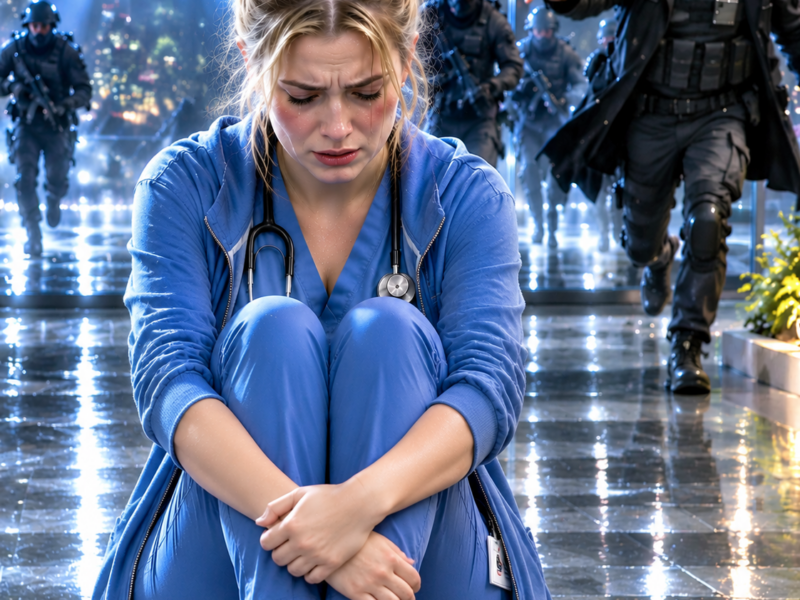
“I was halfway through restocking trauma supplies at a small military hospital in Virginia when my commanding officer laughed
Mercer waited for my answer.
The hospital seemed to have gone completely silent.
Even Captain Brooks had stopped pretending he was in charge.
I looked at the photograph of Nathan Hayes again.
His face was older than I remembered, but there was no mistaking him.
The scar above his right eyebrow.
The narrow eyes.
The expression that always made him look as though he knew something everyone else didn’t.
“Where did you get that photograph?” I asked.
Mercer didn’t look away.
“Three days ago. An intelligence team tracked him to a private airfield outside Norfolk.”
“Was he alone?”
“No.”
“Who was with him?”
“Two men using military identification. Neither man’s identity checked out.”
I rubbed my thumb against the side of my index finger.
It was an old habit.
I used to do it before entering a building I wasn’t certain I would leave.
“James, answer my question. Why are you here?”
He glanced at the other five men.
Then he said something that made the back of my neck tighten.
“Because someone has started killing the people who survived Silent Harbor.”
Melissa covered her mouth.
Captain Brooks looked between us.
“Colonel, this is a hospital. Whatever classified matter you’re discussing, you need to take it somewhere else.”
Mercer turned toward him.
“Captain, with respect, this facility is currently safer than the place we’re supposed to be taking her.”
Brooks frowned.
“Taking her?”
“Yes.”
“I don’t believe you have authority to remove one of my medical officers.”
Mercer opened his identification case again and showed him a document.
Brooks read the first page.
Then the second.
His face lost its color.
“Doctor Carter is under my supervision,” he said quietly.
Mercer closed the case.
“Not anymore.”
I stepped between them.
“Stop.”
Both men turned.
I looked at Mercer.
“I’m not getting on one of your helicopters until somebody tells me what happened to my team.”
For the first time that night, his expression softened.
“That’s fair.”
He reached into his jacket and handed me a folded photograph.
It showed six people standing in front of a military transport aircraft.
I was in the middle.
To my left was James Mercer.
To my right was Sergeant Cole Bennett, our communications specialist.
Behind us stood Marcus Reed, our sniper, and Daniel Price, our explosives expert.
The sixth person was Lieutenant Colonel Hayes.
Someone had drawn a red circle around my face.
On the back, someone had written a date.
November 18.
Tomorrow.
I looked up.
“What’s tomorrow?”
Mercer hesitated.
“An emergency intelligence hearing. Someone has requested that you appear as the sole surviving witness to Silent Harbor.”
I stared at him.
“That doesn’t make sense. There were survivors.”
He nodded.
“That’s what we’ve been trying to prove.”
I looked at the photograph again.
“How many?”
“Five.”
My mouth went dry.
Five people.
Five people who had supposedly died.
“Where are they?”
“Three are in protective custody. One disappeared six months ago.”
“And the fifth?”
Mercer looked at the floor.
“We found his body yesterday.”
I didn’t ask who.
I already knew.
Daniel Price had been the funniest man in our unit.
He could make an entire helicopter crew laugh while preparing to enter a building full of armed men.
He used to call me Doc even when I threatened to throw medical supplies at him.
I remembered the last thing he’d said to me before Silent Harbor.
“If we get out of this one, I’m buying you the worst cup of coffee in Virginia.”
He never got to buy it.
I turned away from the photograph.
“Show me the body.”
Mercer shook his head.
“Emily, you don’t want to see that.”
“That’s not your decision.”
He studied my face.
Then he nodded once.
“All right.”
Before we could move, Captain Brooks cleared his throat.
“Doctor Carter, I need you to understand that walking away from this department in the middle of a shift is unacceptable.”
I looked at him.
For three months, I’d allowed him to decide what kind of person I was.
I had accepted his criticism, his dismissive comments, and the endless supply-room assignments.
I had done it because I wanted a life where nobody knew my old rank.
But the man standing in front of me had no idea what it meant to carry the memory of an entire unit.
“Captain, I spent seven years making sure people came home alive.”
My voice remained quiet.
“Tonight, I’m going to find out why someone made sure they didn’t.”
I removed my hospital identification badge and placed it on the counter.
Melissa stepped forward.
“Emily.”
I turned toward her.
She looked as though she wanted to ask a hundred questions but didn’t know where to begin.
Instead, she reached out and squeezed my hand.
“Be careful.”
I managed a small smile.
“I’ll try.”
Then I followed Mercer through the hospital doors.
Outside, the night air smelled of aviation fuel and wet asphalt.
The six helicopters stood on the landing area, their rotors slowing.
Cole Bennett approached us.
He was taller than I remembered, with a dark beard and a slight limp.
When he saw me, he stopped.
For a second, neither of us spoke.
Then he opened his arms.
“Well, look at that. The ghost finally came home.”
I laughed once, although my throat felt tight.
“You’re getting old, Bennett.”
He grinned.
“You’re still rude.”
He hugged me carefully.
I noticed the stiffness in his shoulders.
“What’s wrong with your leg?”
“Long story.”
“Does it hurt?”
“Only when I walk.”
“That’s generally how legs work.”
He laughed.
It was the first familiar sound I’d heard in two years.
Then Marcus Reed approached.
He didn’t smile.
He simply looked at me and said, “I thought you were dead.”
“I thought you were.”
He nodded.
“Fair enough.”
We boarded the lead helicopter.
Mercer sat across from me while Cole secured himself beside the door.
As the aircraft lifted, Fort Belvoir disappeared beneath us.
For several minutes, nobody spoke.
Then I noticed something.
Mercer kept looking at the small black identification case he’d brought into the hospital.
“James.”
He looked up.
“What’s inside?”
“Your old mission file.”
“That’s not what I asked.”
He considered his answer.
Then he opened the case.
Inside was a single metal identification plate.
Mine.
I reached for it.
The plate was scratched along one edge.
I turned it over.
There was a small number engraved on the back.
0719.
My breath caught.
Mercer noticed.
“You remember?”
I nodded slowly.
“That was the security code for the storage compartment.”
“Which storage compartment?”
“The one inside our command vehicle.”
Cole leaned forward.
“Emily, what are you talking about?”
I stared at the number.
During Silent Harbor, our command vehicle had been destroyed by an explosion.
At least, that was what the official report said.
But I remembered something else.
Before the explosion, Hayes had ordered me to retrieve a black case from a locked compartment.
He’d told me it contained medical evacuation records.
I had opened the compartment using the code 0719.
The case was there.
But when I carried it outside, Hayes took it from me and ordered me to get the wounded soldiers to the extraction point.
I never saw it again.
“James, who gave you this?”
“An intelligence officer found it in an evidence locker.”
“Where?”
“At a military storage facility in Maryland.”
I looked at him.
“That facility was supposed to have been emptied two years ago.”
“Exactly.”
The helicopter changed direction.
Mercer leaned closer.
“Emily, there’s something else you need to know. The official mission report says the command vehicle was destroyed at 02:14.”
I frowned.
“And?”
“The explosion happened at 02:31.”
I stared at him.
“That’s seventeen minutes.”
He nodded.
“Seventeen minutes during which the vehicle was still transmitting.”
The number hit me harder than I expected.
Seventeen minutes.
The same seventeen minutes I had never been able to remember clearly.
I looked at Cole.
He had stopped smiling.
“You knew?” I asked.
He shook his head.
“Not until yesterday.”
Mercer closed the case.
“We’re going to show you everything.”
The helicopter landed at a secured facility outside Washington, D.C.
It wasn’t a regular military base.
There were no visible unit signs, no flags, and no soldiers standing around chatting near the hangars.
Just concrete buildings, security cameras, and a perimeter fence.
Inside, Mercer led us down a corridor to a small briefing room.
A woman in civilian clothes waited beside a projector.
She was in her late thirties, with short brown hair and a folder tucked under her arm.
“Commander Carter,” she said.
I looked at Mercer.
“Commander?”
He gave a faint smile.
“Some habits are difficult to break.”
The woman extended her hand.
“Special Agent Laura Mitchell, Defense Criminal Investigative Service.”
I shook it.
“What’s going on?”
She placed a thick folder on the table.
“Two years ago, the government received a report claiming that your team had been compromised during a classified operation in Syria.”
I sat down.
“Compromised how?”
“According to the report, someone inside Black Viper provided operational information to an enemy organization.”
I looked at Mercer.
He remained silent.
Laura continued.
“That information resulted in the capture of a group of American intelligence assets. The subsequent extraction failed, and your unit was listed as killed or missing.”
I leaned forward.
“That’s not what happened.”
“I know.”
She opened the folder.
Inside were photographs of a damaged command vehicle, several maps, and copies of the original mission logs.
“We found discrepancies in the timestamps. The vehicle’s communication system remained active for seventeen minutes after the explosion was supposedly reported.”
I stared at the photographs.
“Who submitted the original report?”
Laura turned a page.
“Lieutenant Colonel Nathan Hayes.”
I felt my jaw tighten.
“Of course.”
She placed another document in front of me.
“This is the transmission log from that night.”
The first few lines were routine.
Coordinates.
Weather conditions.
Extraction requests.
Then I saw my name.
EMILY CARTER — MEDICAL EVACUATION AUTHORIZED.
The next line was dated seventeen minutes later.
EMILY CARTER — COMPROMISED.
I read it twice.
“Who entered this?”
Laura pointed to the signature field.
“Nathan Hayes.”
I looked up.
“That’s impossible.”
“Why?”
“Because I was standing next to him when the command vehicle exploded. He ordered me to evacuate the wounded. He knew exactly where I was.”
Laura’s expression didn’t change.
“Then perhaps you should see the next page.”
She slid it across the table.
It was a transcript of an audio recording.
The first voice was Hayes.
“Package secured. Begin secondary extraction.”
A second voice answered.
“Confirmed. What about Carter?”
There was a pause.
Then Hayes said, “She doesn’t know what she carried. Keep it that way.”
I stopped breathing for a moment.
Cole swore under his breath.
Mercer leaned forward.
“Do you recognize the second voice?”
I listened again.
The audio was distorted, but the cadence was familiar.
I knew that voice.
I’d heard it during briefings, operations, and late-night calls.
It belonged to a senior intelligence officer who had once personally approved our deployments.
General Richard Vaughn.
For a moment, nobody spoke.
Laura closed the folder.
“General Vaughn retired eight months ago.”
I looked at her.
“Where is he now?”
“That’s what we’re trying to establish.”
I pushed the transcript away.
“Why would he be involved?”
Laura answered carefully.
“Because the evidence suggests Silent Harbor wasn’t simply an extraction operation. Your unit was sent to retrieve a source who possessed information about unauthorized military transfers.”
“What kind of transfers?”
“Equipment, intelligence, and personnel.”
“Personnel?”
She nodded.
“American assets were being moved between facilities without proper authorization. Some were listed as deceased. Others disappeared from official records.”
My stomach tightened.
The faces of the men we’d tried to rescue in Syria returned to me.
One of them had been a young intelligence analyst named Peter Wallace.
He had spent four days with us in an underground safe house.
He’d been terrified, exhausted, and barely able to stand.
Before extraction, he’d grabbed my sleeve.
“Doctor, if they tell you we were never here, don’t believe them.”
At the time, I’d thought he was delirious.
Now I wasn’t so sure.
“Was Peter Wallace one of those assets?” I asked.
Laura’s expression changed.
“Yes.”
“Is he alive?”
She looked at Mercer.
He gave a small nod.
Laura turned back to me.
“We believe he may be.”
I stood.
“Where?”
“We don’t know yet.”
I put both hands on the table.
“Then what exactly have you been doing for two years?”
Mercer spoke before Laura could answer.
“Trying to get someone high enough to listen.”
I looked at him.
“And now?”
“Now we have the evidence.”
Laura reached into the folder and removed a small memory card.
“This was recovered from the evidence locker with your identification plate.”
I stared at it.
“What’s on it?”
“An audio file. The recording was damaged, but our technicians recovered most of it.”
She connected it to the computer.
The room filled with static.
Then a voice spoke.
It was mine.
My own voice, younger and frightened.
“Hayes, the case is empty.”
A pause.
Then Hayes answered.
“No, Carter. It was never supposed to be full.”
I closed my eyes.
The recording continued.
“Then why did we come all this way?”
Hayes lowered his voice.
“Because somebody needed to believe we were looking for it.”
I opened my eyes.
Laura stopped the recording.
Nobody moved.
I looked at Mercer.
“What does that mean?”
He shook his head.
“We’re still trying to understand.”
I returned my attention to the screen.
“Play the rest.”
Laura hesitated.
“There’s another section.”
“Play it.”
She pressed the button.
Static crackled again.
Then I heard a third voice.
A voice I had never expected to hear.
“Emily, if you’re hearing this, it means they finally found you.”
My hands went cold.
The voice belonged to Daniel Price.
The teammate Mercer had just told me was dead.
He continued.
“I know you’re going to want to trust James. Don’t. Not until you know what happened at the extraction point.”
The recording ended with a loud burst of interference.
I looked at Mercer.
He was staring at the table.
“James?”
He didn’t answer.
“Did you know Daniel was alive?”
His jaw tightened.
“No.”
“Then why does he sound like he’s warning me about you?”
Mercer rubbed his forehead.
“Because I made a decision that night.”
“What decision?”
He looked at me.
“One that I have regretted every day since.”
Before he could continue, the room’s door opened.
A young security officer stepped inside.
“Colonel, we have a problem.”
Mercer stood.
“What?”
“One of the protected witnesses has disappeared.”
Laura grabbed her phone.
“Which one?”
The officer swallowed.
“Peter Wallace.”
I looked at Mercer.
“Where was he being held?”
“At a secure location in Arlington.”
“How long ago?”
“Forty minutes.”
I reached for my jacket.
Mercer stepped in front of me.
“You’re not going anywhere.”
I stared at him.
“Move.”
“Emily, this could be a setup.”
“Then we should probably stop wasting time.”
He studied me for a long moment.
Then he turned to the officer.
“Get the vehicle ready.”
We drove through the outskirts of Washington in two unmarked SUVs.
Laura sat in the front passenger seat of the lead vehicle, speaking with investigators over the radio.
Mercer drove.
I sat behind him, watching the streets pass.
For the first time since leaving the hospital, I felt the familiar rhythm of an operation settling into my bones.
But this wasn’t Syria.
This time, the people I was hunting wore the same uniforms as the people I had once served.
The safe house was a modest brick building on a quiet residential street.
Two investigators waited outside.
One was holding a broken security camera.
The other had a medical bag open on the sidewalk.
“Any injuries?” I asked.
“One guard was struck. He’s conscious.”
I knelt beside him.
His name was Thompson.
He had a cut above his eye and a swollen wrist.
“What happened?”
He winced.
“Two men came through the back entrance.”
“Did you see their faces?”
“One had a beard. The other wore a baseball cap.”
“Did they take Wallace?”
He nodded.
“Wallace went willingly.”
I looked up.
“What?”
Thompson swallowed.
“He knew them.”
Mercer stepped closer.
“Did you hear anything?”
The guard hesitated.
“Wallace said something before he left.”
“What?”
“He told them, ‘You promised she wouldn’t be involved.'”
I stood slowly.
“She?”
The guard nodded.
“He said her name, too.”
I felt the cold air against my face.
“Emily.”
Mercer looked at me.
“Who would make that promise?”
I thought about the recording.
Daniel’s warning.
Hayes’s transmission.
The empty case.
And the seventeen minutes that had vanished from the official report.
There was only one person who could connect all of it.
“General Vaughn,” I said.
Laura turned toward me.
“Why do you think that?”
“Because Hayes never made a move without someone above him approving it.”
Mercer looked at the building.
“We need to find Wallace before Vaughn does.”
I shook my head.
“No.”
He frowned.
“No?”
“We need to find out why Wallace came willingly.”
I stepped inside the safe house.
The living room was almost untouched.
A cup of coffee sat on the table.
Beside it was a folded piece of paper.
I picked it up.
My name was written across the front.
Not my rank.
Not my title.
Just Emily.
I unfolded it.
Inside was a single sentence.
“Ask James what happened to the helicopter at extraction.”
I read it again.
Then I turned toward Mercer.
He had entered the room behind me.
His expression told me he already knew what I had found.
“What helicopter?” I asked.
He closed the door.
For a moment, he looked older than the man who had walked into my hospital.
Then he took a breath.
“During the extraction, our aircraft was ordered to leave without you.”
I stared at him.
“That doesn’t make sense. You were on the ground with us.”
“I know.”
“Then why would you leave?”
His voice dropped.
“Because I was told you were already dead.”
I stepped closer.
“By whom?”
“Hayes.”
“And you believed him?”
Mercer didn’t answer.
I laughed once, bitterly.
“You were standing twenty feet away from me.”
“I couldn’t see you.”
“You could hear me.”
His eyes dropped.
I remembered the sound of the helicopter engines.
The smoke.
The wounded men.
My radio screaming with overlapping voices.
And then the moment I had reached the landing zone only to see the aircraft rising into the night.
I’d always believed the pilot had been forced to leave because of enemy fire.
But now I understood something.
The aircraft hadn’t been forced to leave.
It had been ordered to.
“Why didn’t you come back?” I asked.
Mercer swallowed.
“Because the next transmission said the entire extraction team had been compromised. We were ordered to withdraw and report to a secondary location.”
“Who gave that order?”
“Vaughn.”
I looked away.
The room felt too small.
For two years, I’d carried the guilt of being the only one who had made it out.
I’d believed my teammates had died because I hadn’t reached them in time.
And now I was learning that someone had made a deliberate choice to leave us behind.
“How many people were still at the extraction point?” I asked.
“Four.”
I closed my eyes.
Four men.
I remembered their faces.
Their voices.
The way one of them had kept asking whether his brother would be told where he’d died.
I opened my eyes.
“Did they survive?”
Mercer shook his head.
“We don’t know.”
I looked at him.
“That’s not an answer.”
“It’s the only one I have.”
For a long moment, I couldn’t speak.
Then I noticed something on the paper.
There was a small mark beneath the sentence.
Three numbers.
0719.
The same code.
I turned the paper over.
Nothing.
“James, this wasn’t written by Wallace.”
“How do you know?”
“Because he didn’t know the code.”
I examined the ink.
The letters were uneven.
Someone had written them in a hurry.
But the paper itself was old.
It had been folded and unfolded many times.
There was a faint stain along one edge.
I recognized it.
It was the same kind of red ink used on classified medical evacuation forms.
I looked at Laura.
“Do you have access to the original medical records from Silent Harbor?”
She nodded.
“Yes.”
“Then I want every page.”
She frowned.
“Why?”
“Because the missing seventeen minutes weren’t just in the communications log.”
I pointed to the paper.
“They were in the evacuation records, too.”
We returned to the facility shortly before dawn.
Laura brought in the original files.
Most of them were scanned copies, but a few had been preserved in sealed evidence bags.
I went through each page slowly.
Patient names.
Injury classifications.
Extraction times.
Medical signatures.
Then I found a form with a handwritten amendment.
The time had been changed from 02:14 to 02:31.
I held it up.
“Who changed this?”
Laura examined the signature.
“Hayes.”
“Look closer.”
She leaned toward the page.
The signature was too neat.
Hayes always wrote his last name with a sharp downward stroke.
This signature was rounded.
It looked almost like someone had copied it.
I turned the paper over.
There was a faint impression from the page beneath it.
I tilted it toward the light.
A second name appeared.
Not Hayes.
Richard Vaughn.
I looked at Mercer.
“He signed the amendment.”
Laura immediately reached for her phone.
“That changes everything.”
“Not everything,” I said.
I placed the form on the table.
“Vaughn could still claim he was correcting a clerical error. We need something that proves he knew what happened.”
Cole, who had been quiet for most of the morning, stepped forward.
“Maybe we already have it.”
He reached into his bag and pulled out a small digital recorder.
“I recovered this from Daniel’s equipment before they took his body.”
Mercer looked at him.
“You had this the entire time?”
“I didn’t know what was on it.”
Cole placed it on the table.
The device was damaged, but the memory chip was intact.
Laura connected it to a secure computer.
A series of files appeared.
One was dated November 18.
The day of Silent Harbor.
She opened it.
The recording began with the sound of wind and distant gunfire.
Then Daniel’s voice came through.
“Command, this is Price. We have the asset. Repeat, we have the asset.”
A second voice responded.
“Confirm identity.”
“Peter Wallace. Alive.”
There was a pause.
Then Daniel said something that made me grip the table.
“He’s telling us the transfers are still happening.”
The second voice became clearer.
“Then you know what to do.”
Daniel answered.
“No. We need to get him out.”
The voice replied.
“Negative. The asset is no longer required.”
Daniel sounded angry.
“He’s a witness.”
“He’s a liability.”
Then another voice entered.
I recognized Hayes.
“Price, stand down. Follow the extraction plan.”
Daniel responded immediately.
“Sir, the plan puts the entire team at risk.”
Hayes was silent for several seconds.
Then he said, “I know.”
The recording continued.
A burst of gunfire.
Someone shouting.
Then Daniel’s voice again.
“Emily, get Wallace to the secondary route. Don’t wait for us.”
I pressed my hand against my mouth.
That was the last instruction he’d ever given me.
The file ended.
Nobody spoke.
I looked at Mercer.
“Why didn’t you tell me?”
He lowered his eyes.
“Because I didn’t know the recording existed.”
I shook my head.
“No. I mean why didn’t you tell me the mission had been changed?”
He looked up.
“I was told to keep you focused on evacuation. I believed the change was temporary.”
“By whom?”
“Hayes.”
I stared at him.
“James, you were the commander of the team. You had authority to challenge the order.”
He nodded.
“I did.”
“And?”
“He relieved me of command.”
The words landed heavily.
Mercer had been removed from command during the operation.
I hadn’t known.
He continued.
“I was placed under arrest after extraction. They told me the team had been compromised and that your actions had caused the failure.”
I stared at him.
“That’s why you disappeared?”
“Yes.”
I looked toward Cole.
“And you?”
Cole leaned against the wall.
“I was picked up by a medical transport unit. They told me I’d been the only survivor from my section. By the time I recovered, the report had already been sealed.”
I looked back at the recorder.
For two years, we’d each been carrying a different version of the same lie.
But one question remained.
“Where is Peter Wallace?”
Laura closed the computer.
“We have a possible location.”
She turned the screen toward us.
A private medical facility outside Annapolis.
A place registered under a company with no visible connection to the military.
“Why would he be there?” I asked.
“Because he may have been injured during his removal from Arlington.”
I stood.
“Then we’re going.”
Mercer nodded.
But before we could leave, the facility’s security alarm sounded.
A red light flashed above the door.
A guard rushed into the room.
“Colonel, we have an incoming call from the Pentagon.”
Mercer frowned.
“Who?”
The guard looked at Laura.
“General Richard Vaughn.”
Laura answered the secure line.
A man’s voice filled the room.
Calm.
Polite.
Almost friendly.
“Agent Mitchell, I understand you’ve been asking questions about an operation that was closed two years ago.”
Laura didn’t answer.
Vaughn continued.
“I’d strongly recommend that you stop.”
Mercer stepped closer to the speaker.
“General, this is Colonel Mercer.”
A pause.
Then a faint sigh.
“James. I wondered how long it would take you to find your way back.”
Mercer’s jaw tightened.
“Where is Peter Wallace?”
Vaughn chuckled softly.
“Still asking the wrong questions.”
I stepped toward the phone.
“Then I’ll ask the right one.”
The line went quiet.
“This is Emily Carter.”
Vaughn took a breath.
“Commander Carter. It’s been a long time.”
“Not long enough.”
“You’re alive. I’m pleased.”
“Four men were left at the extraction point. Daniel is dead. Peter is missing. You altered the medical records. Why?”
Another pause.
Then Vaughn said something I hadn’t expected.
“Because the alternative was a much larger tragedy.”
I stared at the speaker.
“Explain.”
“Not over an unsecured line.”
“Then meet me.”
Mercer turned sharply toward me.
“Emily, no.”
Vaughn answered before I could.
“Tomorrow. Ten in the morning. The old naval communications station in Annapolis.”
Laura immediately wrote something down.
“Why should we trust you?” I asked.
“You shouldn’t.”
The line disconnected.
Nobody moved.
Then Mercer shook his head.
“Absolutely not.”
I looked at him.
“He’s offering us a chance to confront him.”
“He’s offering us a chance to walk into a trap.”
“Then we’ll know he’s afraid of what we have.”
Laura stepped between us.
“We’re not going anywhere without a proper plan.”
I nodded.
For once, I agreed with her.
But as we prepared to investigate the medical facility, I couldn’t stop thinking about Vaughn’s final words.
The alternative was a much larger tragedy.
It sounded like something a man said when he wanted to convince himself that betrayal was necessary.
The facility outside Annapolis was surrounded by a high fence and several security cameras.
There were no signs identifying the company.
A medical transport vehicle was parked near the rear entrance.
We arrived with a small investigative team and an official search authorization.
The first guard tried to block our entry.
Laura showed him the warrant.
He looked at the paper.
Then at me.
“You’re not supposed to be here.”
I stepped closer.
“Who told you that?”
He didn’t answer.
Inside, the building smelled of disinfectant and cold coffee.
A nurse led us down a corridor.
At the end was a private room.
Peter Wallace sat beside the window.
He looked thinner than I remembered.
His hair had turned almost completely gray.
But when he saw me, he recognized me immediately.
“Doctor Carter.”
I approached slowly.
“Peter.”
He looked at Mercer.
Then at Cole.
His eyes filled with tears.
“I thought you were all gone.”
I pulled a chair beside his bed.
“Some of us were.”
He looked down.
“I’m sorry.”
“For what?”
He swallowed.
“For leaving Arlington.”
“Why did you go willingly?”
He glanced at the nurse.
She nodded and stepped outside.
Peter lowered his voice.
“Because they told me they had your medical records.”
“My records?”
“Your old Black Viper files. They said if I didn’t cooperate, they’d release the details of what happened in Syria and make it look like you had betrayed the team.”
I felt a dull pressure behind my ribs.
“Who told you that?”
“Hayes.”
I looked at Mercer.
Peter continued.
“He said Vaughn had been trying to protect the operation. He told me the only way to keep you safe was to disappear.”
“Did you believe him?”
Peter shook his head.
“Not completely. But I was tired, Emily. I’d spent two years hiding from people who were supposed to be protecting me.”
He reached toward the bedside table and picked up a small envelope.
“I took something from the safe house before they moved me.”
He handed it to me.
Inside was a photograph.
It showed a group of men standing beside a transport aircraft.
I recognized Hayes.
Vaughn.
And three men from the extraction team.
But there was someone else.
A man standing slightly behind them, holding a black case.
I leaned closer.
The case had a small silver marking on its side.
0719.
My throat tightened.
“Who is that?”
Peter studied the photograph.
“An intelligence contractor named Robert Kessler.”
I searched my memory.
The name meant nothing.
“He was responsible for coordinating the transfer program,” Peter explained. “He moved personnel and equipment through facilities that didn’t officially exist.”
“Why?”
“Because he was selling information.”
Mercer stepped closer.
“To whom?”
Peter looked at him.
“Multiple buyers. Foreign intelligence services. Private military companies. Anyone willing to pay.”
Laura took the photograph.
“Do you have proof?”
Peter nodded.
“Some of it.”
He opened a drawer and removed a small notebook.
Inside were handwritten account numbers, dates, and facility codes.
“I kept records whenever I could.”
I examined the pages.
Then I saw something familiar.
A sequence of numbers.
The same number I’d seen on my identification plate.
0719.
“Peter, what is this?”
He leaned closer.
“The storage compartment code.”
I looked up.
“How do you know?”
“Because it wasn’t a storage compartment for medical equipment.”
He turned another page.
“It was a transfer archive.”
I stared at him.
“What does that mean?”
Peter took a slow breath.
“The black case wasn’t supposed to contain evidence. It was supposed to hold the key to an encrypted archive. The case itself was just a decoy.”
I remembered Hayes taking it from me.
The empty case.
The strange instructions.
The seventeen missing minutes.
I felt the pieces beginning to connect.
“Where is the archive?”
Peter shook his head.
“Nobody knows. But the access key was split into two parts.”
He pointed to the number 0719.
“One part was stored in the compartment.”
Then he looked at me.
“The other part was carried by the medic who retrieved the case.”
I stared at him.
“Me?”
He nodded.
“Your medical identification plate.”
I looked down at the metal plate in my hand.
The scratched edge.
The number engraved on the back.
It hadn’t been an identification mark.
It was a key.
And someone had been searching for me because I was the only person who could access the archive.
Mercer looked at the plate.
“Can it still be used?”
Peter nodded.
“If the archive hasn’t been moved.”
Laura stepped forward.
“Where is it?”
Peter looked at me.
“Inside the old command vehicle.”
The room went silent.
I remembered the official report.
The explosion.
The burned vehicle.
The seventeen minutes.
“They never destroyed it,” I whispered.
Peter shook his head.
“No.”
He looked at Mercer.
“They moved it.”
“Where?”
Peter closed his eyes.
“To the old communications station in Annapolis.”
The same location Vaughn had chosen for our meeting.
I looked at Laura.
“He wants the key.”
She nodded slowly.
“And he knows you have it.”
For the first time that morning, I understood why Vaughn had contacted us.
He wasn’t offering an explanation.
He was arranging a retrieval.
The next day, we arrived at the communications station before ten.
The building sat near the water, surrounded by old concrete barriers and rusting antennas.
Mercer wanted to bring a full tactical team.
Laura insisted on a controlled investigative operation.
In the end, we compromised.
Two investigators would remain outside.
Cole and Marcus would cover the northern entrance.
Mercer and I would enter through the main doors with Laura.
Before we went inside, Mercer stopped me.
“Emily.”
I turned.
“I should have told you what happened during extraction.”
I looked at him.
“Yes.”
“I thought I was protecting you.”
“By letting me believe everyone was dead?”
He looked down.
“I know how it sounds.”
“It sounds like what it was.”
He nodded.
“I can’t change that.”
“No. But you can stop deciding what I’m allowed to know.”
He met my eyes.
“I won’t do that again.”
I believed that he meant it.
I wasn’t sure yet whether that was enough.
We entered the building.
The main room was almost empty.
Dust covered the floor.
Old equipment stood beneath plastic sheets.
At the far end, a man in a gray suit waited beside a metal table.
General Richard Vaughn.
He looked older than his photographs.
His hair was white, and his shoulders had begun to stoop.
But his eyes were the same.
Sharp.
Patient.
Uncomfortable to meet.
“Emily Carter,” he said.
I stopped several feet away.
“General.”
He looked at the identification plate in my hand.
“So you found it.”
I didn’t answer.
He gestured toward the table.
“Please. We should talk.”
Laura remained standing.
“We’re recording this conversation.”
Vaughn gave a faint smile.
“Of course you are.”
He looked at me.
“Do you know why Silent Harbor happened?”
“Because you wanted to eliminate the witnesses.”
His expression barely changed.
“That’s one version.”
“What’s yours?”
He walked toward a large window overlooking the water.
“Robert Kessler had been moving classified personnel and intelligence assets through unauthorized channels. At first, it was a small operation. Then it grew.”
“Why didn’t you report him?”
“Because by the time I understood what he was doing, he had access to people above me.”
I stared at him.
“That still doesn’t explain why you left us behind.”
Vaughn turned.
“Because Kessler had threatened to expose a list of undercover assets. If that list became public, people would die.”
“So you sacrificed my team?”
“I made a decision to preserve hundreds of lives.”
I felt my hands tighten.
“You don’t get to decide that four people are expendable.”
He looked at me for a long moment.
“No. Perhaps I don’t.”
For the first time, his voice sounded tired.
He reached into his jacket and placed a small photograph on the table.
It showed Daniel Price.
Alive.
Standing beside a vehicle at a desert airfield.
I stared at it.
“When was this taken?”
“Six months ago.”
My mouth went dry.
“You told us he was dead.”
“I didn’t tell you anything. Your investigators did.”
“Where is he?”
Vaughn looked toward the window.
“Robert Kessler has him.”
I took a step forward.
“Where?”
“I don’t know.”
“You’re lying.”
He shook his head.
“Daniel was taken after he tried to contact me. He had discovered that Kessler was using the original transfer archive to identify surviving witnesses.”
I looked at Mercer.
He was watching Vaughn carefully.
“Why didn’t you tell us?” he asked.
“Because I didn’t know who I could trust.”
I almost laughed.
“That’s convenient.”
Vaughn accepted the accusation without argument.
Then he opened a small metal case.
Inside was an old laptop and a sealed drive.
“The archive contains every transfer record, payment, and communication connected to Kessler’s operation.”
He looked at the identification plate in my hand.
“Your key will unlock it.”
I didn’t move.
“Why should I help you?”
“Because once the archive is opened, the people responsible can be identified.”
“And what happens to the men you left behind?”
Vaughn looked down.
“I cannot undo what happened.”
“No. But you can tell the truth.”
He nodded.
“That’s why I called you.”
Laura stepped closer.
“General, I need you to place your hands where I can see them.”
Vaughn looked at her.
Then he looked at me.
“You don’t understand. Kessler is already here.”
A faint sound came from somewhere behind us.
A door closing.
Mercer reached for his weapon.
Laura turned.
Two men emerged from the corridor.
One carried a handgun.
The other held a small black device.
Vaughn stepped away from the table.
The armed man pointed at him.
“Move away from the case.”
Vaughn raised his hands.
The second man looked directly at me.
“Commander Carter. Put the plate on the table.”
I recognized his face from the photograph Peter had given us.
Robert Kessler.
He looked completely ordinary.
That was the most disturbing thing about him.
No dramatic expression.
No visible anger.
Just a man in a dark jacket who seemed irritated that we had arrived earlier than expected.
“Where’s Daniel?” I asked.
Kessler smiled faintly.
“Still asking about your friends.”
“Where is he?”
“Alive, last time I checked.”
I took a step toward him.
Mercer caught my arm.
“Don’t.”
Kessler raised the black device.
“One more step and the archive becomes useless.”
Laura’s eyes narrowed.
“What is that?”
“Remote encryption trigger.”
I looked at the laptop.
He wasn’t bluffing.
If the archive was destroyed, years of evidence would disappear.
Kessler turned to Vaughn.
“You should have stayed retired.”
Vaughn said nothing.
Then Kessler looked back at me.
“Put the key down.”
I slowly placed the identification plate on the table.
But I didn’t release it.
“Before I do, I want to know why you kept me alive.”
Kessler smiled.
“Because you were useful.”
“That’s all?”
“That’s enough.”
He glanced toward Mercer.
“Your former commander made things difficult. Hayes was easier to manage.”
I looked at Vaughn.
“Did you know?”
Vaughn’s eyes lowered.
Kessler laughed softly.
“Of course he knew. Hayes and Vaughn both understood the arrangement. They just disagreed about how many people needed to disappear.”
Vaughn finally spoke.
“Hayes was trying to stop you.”
Kessler turned toward him.
“Hayes was trying to save himself.”
I looked at the black device.
Then at the laptop.
Then at the small metal plate beneath my fingers.
There was something about the way Kessler held the device that bothered me.
His thumb was resting against the side button.
But the indicator light wasn’t on.
I had seen similar equipment during my old deployments.
A device like that needed a secure connection to the archive before it could trigger a wipe.
The laptop wasn’t connected.
It was powered down.
Kessler was bluffing.
I didn’t look at Mercer.
I didn’t want Kessler to notice that I had understood.
Instead, I loosened my grip on the plate.
“All right.”
Kessler stepped closer.
“Slowly.”
I slid the plate across the table.
As he reached for it, I pushed the laptop toward Laura.
Mercer moved at the same time.
A shot rang through the room.
The armed man dropped behind the table.
Laura pulled Vaughn down.
Kessler lunged for the plate.
I caught his wrist.
The device hit the floor.
He struck me across the face, and I stumbled against the metal table.
Mercer grabbed Kessler from behind.
They crashed into the equipment racks.
I reached for the device.
Kessler broke free and turned toward me.
Then a second gunshot echoed from the corridor.
Cole’s voice came through the radio.
“North entrance secure!”
Marcus answered.
“Second man detained!”
Mercer forced Kessler onto the floor.
I picked up the identification plate and stepped away.
For several seconds, all I could hear was my own breathing.
Laura stood up.
“Everyone all right?”
I touched my cheek.
“Define all right.”
She gave me a quick look.
Then she turned toward Vaughn.
“General, you’re under arrest pending investigation into the events surrounding Operation Silent Harbor and the unauthorized transfer program.”
Vaughn didn’t resist.
He simply looked at me.
“I know you may never forgive me.”
I stared at him.
“That’s not what I’m worried about.”
“What is?”
I looked toward the damaged laptop.
“Finding Daniel.”
The next several hours were spent securing the building, preserving the archive, and taking statements.
The evidence was worse than any of us had imagined.
Kessler had used unauthorized transfers to move intelligence assets, equipment, and personnel through private facilities.
Some were moved to protect their identities.
Others were moved because they had discovered too much.
Hayes had helped him falsify the Silent Harbor reports.
Vaughn had approved the operation and later attempted to contain the damage.
Neither man had been innocent.
But neither had controlled the entire network.
Kessler had.
The archive also contained a list of surviving witnesses.
At the top was Peter Wallace.
Below him were the names of three former intelligence officers.
And then I saw another name.
Daniel Price.
Status: Active.
Last known location: Unknown.
Cole stood beside me.
“He’s alive.”
I nodded.
“Apparently.”
He rubbed his eyes.
“That idiot owes me a terrible cup of coffee.”
For the first time that day, I smiled.
Then Laura entered the room carrying a telephone.
“We have a lead.”
I stood.
“What?”
“An encrypted message was sent from one of Kessler’s accounts six hours ago. It contains coordinates for a private airfield in West Virginia.”
“Could Daniel be there?”
“We think so.”
Mercer picked up his jacket.
“Then let’s go.”
This time, nobody told me to stay behind.
The airfield was surrounded by wooded hills and a narrow access road.
We arrived shortly before midnight.
A small transport hangar stood at the far end of the runway.
There were two vehicles outside.
No visible guards.
Mercer signaled for the team to spread out.
I followed him toward the hangar.
My hands were steady.
My thoughts weren’t.
If Daniel was inside, I would finally know what happened to him.
If he wasn’t, I’d have to live with another unanswered question.
The hangar door was partially open.
Mercer pushed it aside.
A man sat on a folding chair near the center of the room.
His hair was longer.
His face was thinner.
A pale scar crossed his chin.
But I recognized him.
“Daniel?”
He looked up.
For a moment, he didn’t move.
Then he stood.
“Doc?”
I walked toward him.
He stared at me as though he couldn’t decide whether I was real.
Then he laughed.
“Well, I’ll be damned.”
I stopped in front of him.
“You look terrible.”
He grinned.
“You always know how to make a reunion special.”
I reached out and hugged him.
He held on tightly.
For several seconds, neither of us said anything.
Then he pulled away.
“James?”
Mercer stepped forward.
“Good to see you, Price.”
Daniel looked at him.
“Didn’t think you’d come back.”
Mercer nodded.
“Neither did I.”
Cole approached and punched Daniel lightly in the shoulder.
“You’re buying the coffee.”
Daniel winced.
“Still cheap, Bennett?”
“Still alive, aren’t you?”
Daniel smiled.
Then his expression changed.
“Where’s Hayes?”
I looked at him.
“Under investigation.”
“And Vaughn?”
“Under arrest.”
Daniel nodded slowly.
“Good.”
I sat beside him.
“Tell me what happened.”
He rubbed his hands together.
After the extraction failed, Daniel had been captured by Kessler’s men.
He’d been moved between facilities and interrogated about the transfer archive.
He had refused to give them the location.
“They thought the archive was a physical drive,” he explained. “They never understood that the key was split between two pieces of evidence.”
“The identification plate and the original compartment?”
He nodded.
“Exactly.”
I looked down at the plate in my hand.
“So they needed me.”
“That’s why they kept searching.”
He leaned back.
“Hayes told them you were dead. Vaughn told them you had disappeared. Kessler never believed either of them.”
I looked at Mercer.
“And the warning on the recording?”
Daniel lowered his eyes.
“I didn’t trust anyone by then.”
“Not even James?”
He glanced at Mercer.
“Especially James.”
Mercer accepted that without protest.
Daniel continued.
“After the extraction, James was ordered to withdraw. He was told you were dead. I was captured before I could tell him otherwise.”
I looked at Mercer.
“Did you ever believe I survived?”
He hesitated.
“Some nights.”
That answer hurt more than I expected.
Daniel reached for my hand.
“Emily, none of us knew what happened to you. We were all being fed different stories.”
I nodded.
I understood.
But understanding didn’t erase the years.
It didn’t give me back the people who hadn’t survived.
It didn’t undo the nights I’d woken up remembering the sound of the helicopter leaving without me.
Daniel looked toward the hangar doors.
“Did you find out what happened to the four men?”
I looked at Laura.
She had joined us quietly.
She shook her head.
“Not all of them.”
She explained that the investigation had uncovered the identities of two men who had been moved to another facility before the final extraction.
Both were alive.
The other two had died during the operation.
One from injuries.
The other while protecting Peter Wallace.
Daniel closed his eyes.
He knew their names.
So did I.
We sat in silence.
No one tried to make the news sound better than it was.
Some things didn’t have a comforting explanation.
The investigation continued for months.
Kessler was charged with multiple federal offenses, including conspiracy, unlawful transfer of classified information, and obstruction.
Hayes was arrested after investigators located him at a property in North Carolina.
Vaughn cooperated with the investigation, but cooperation did not erase his role.
His testimony helped expose the full network.
Several officers resigned.
Others were removed from command.
The surviving witnesses were placed under protection until their identities could be secured.
Peter Wallace eventually recovered enough to testify.
He also returned to civilian life.
Daniel spent weeks in a rehabilitation facility.
Cole visited him almost every day, usually bringing terrible coffee and complaining that Daniel was taking too long to get better.
Mercer was formally cleared of the charges that had followed him since Silent Harbor.
But when the paperwork arrived, he didn’t celebrate.
He sat in my apartment with a cup of coffee cooling between his hands.
“Two years,” he said.
“Yes.”
“Two years of people thinking I abandoned my team.”
I watched him.
“You did leave.”
He nodded.
“I know.”
“But you didn’t know what they had told you.”
“No.”
He looked at me.
“That doesn’t make it all right.”
I respected him for saying that.
For a long time, I’d believed that forgiveness meant pretending something hadn’t hurt.
I no longer believed that.
“James, I don’t hate you.”
He looked up.
“But I can’t go back to trusting you the way I did before.”
He nodded slowly.
“I wouldn’t ask you to.”
We sat quietly.
Then he stood and walked toward the window.
“Do you ever think about going back?”
“To Black Viper?”
“To the work.”
I considered the question.
For seven years, that unit had been my home.
It had given me purpose, friendship, and a place where I knew exactly what was expected of me.
But it had also taken things I couldn’t recover.
“I think about the people,” I said.
“Not the missions.”
Mercer nodded.
“That’s probably healthier.”
A week later, I returned to Fort Belvoir.
I wasn’t sure what to expect.
I had been gone long enough for my absence to become a rumor.
When I walked through the emergency department, Melissa was standing near the nurses’ station.
She looked up.
Then she dropped the clipboard she was holding.
“Emily?”
I smiled.
“Hi.”
She came around the desk and hugged me.
I held on longer than I intended.
“I thought you weren’t coming back.”
“I wasn’t sure I would.”
She pulled away and studied the faint bruise that had almost disappeared from my cheek.
“Are you okay?”
I nodded.
“I’m getting there.”
Captain Brooks came out of his office.
He stopped when he saw me.
For a moment, neither of us spoke.
Then he cleared his throat.
“Doctor Carter.”
“Captain.”
He glanced at Melissa.
Then back at me.
“I owe you an apology.”
I waited.
He seemed uncomfortable with the silence.
“I judged you without knowing your background. I shouldn’t have treated you the way I did.”
I looked at him.
“You’re right.”
He nodded.
“I understand if you don’t want to return.”
I glanced toward the treatment rooms.
A nurse was helping an elderly man into a wheelchair.
Another doctor was explaining test results to a young mother.
The familiar sounds of the hospital filled the corridor.
I had spent two years trying to forget the people I’d lost.
Maybe I didn’t need to forget them.
Maybe I just needed to find a way to keep living.
“I’ll return to my medical duties,” I said.
“But I want my assignments to be based on my qualifications, not your assumptions.”
Brooks nodded.
“Fair.”
I walked toward the treatment area.
Melissa fell into step beside me.
“Supply room is still a mess,” she said.
I laughed.
“Some things never change.”
That night, I worked the emergency department again.
A young soldier came in with a badly injured hand.
He was frightened and embarrassed because he had been trying to repair a motorcycle when the accident happened.
I sat beside him and explained what we needed to do.
He watched me carefully.
“Are you sure?”
I nodded.
“Yes. And I’m going to tell you what’s happening before I do anything.”
His shoulders relaxed.
It was a small moment.
No helicopters.
No classified documents.
No men in tactical uniforms.
Just a frightened young man who needed someone to make him feel safe.
And for the first time in a long while, I understood why I’d become a medic in the first place.
I wasn’t there because I loved danger.
I wasn’t there because I wanted a title.
I was there because people deserved someone who wouldn’t leave them wondering whether they mattered.
Near the end of the shift, I found an envelope tucked beneath my locker door.
There was no return address.
Inside was a photograph.
It showed the six of us standing in front of the transport aircraft before Silent Harbor.
Me.
Mercer.
Cole.
Marcus.
Daniel.
Hayes.
On the back, Daniel had written a sentence in his familiar crooked handwriting.
“Coffee’s on me this time, Doc.”
I smiled.
Then I noticed something else.
A second line had been written beneath it.
“Some of us made it home because you refused to leave.”
I folded the photograph carefully and placed it in my locker.
The next morning, I met Daniel, Cole, Marcus, and Mercer at a small diner outside the base.
Daniel had insisted on choosing the place.
He ordered six coffees, complained about the prices, and then spent ten minutes arguing that the food was worse than military rations.
It felt almost normal.
When the waitress brought the check, Daniel reached for it.
I caught his wrist.
“Not this time.”
He grinned.
“You’re stealing my moment.”
“You owe me two years of coffee.”
He laughed.
For a while, we talked about ordinary things.
Cole’s new apartment.
Marcus’s plans to move closer to his sister.
Daniel’s physical therapy.
Mercer mentioned that he was considering a position training medical teams.
Nobody talked about Syria.
Nobody needed to.
Eventually, Daniel raised his cup.
“To the ones who made it.”
We lifted ours.
Then he added quietly, “And to the ones who didn’t.”
I looked around the table.
For two years, I had thought home was a place I had lost.
But sitting there with people who understood the parts of me I rarely spoke about, I realized home wasn’t the old unit, the missions, or the uniform.
It was the people who were willing to tell the truth, even when it hurt.
I still had questions.
I still had nights when the sound of distant aircraft made me stop what I was doing.
And I still carried the names of the men who never came back.
But I no longer carried the lie that their deaths had been my fault.
When we finally left the diner, the morning sun was spreading across the parking lot.
Daniel walked beside me, moving carefully but without his cane.
“Hey, Doc.”
I turned.
“What?”
He pointed toward the road.
“Think they’ll ever stop calling you a rookie?”
I looked at the diner window, where our reflections stood together.
Then I smiled.
“They can call me whatever they want.”
Because the people who knew what I’d done no longer needed me to prove it.
And the people who mattered had finally learned to see me.
The end.









