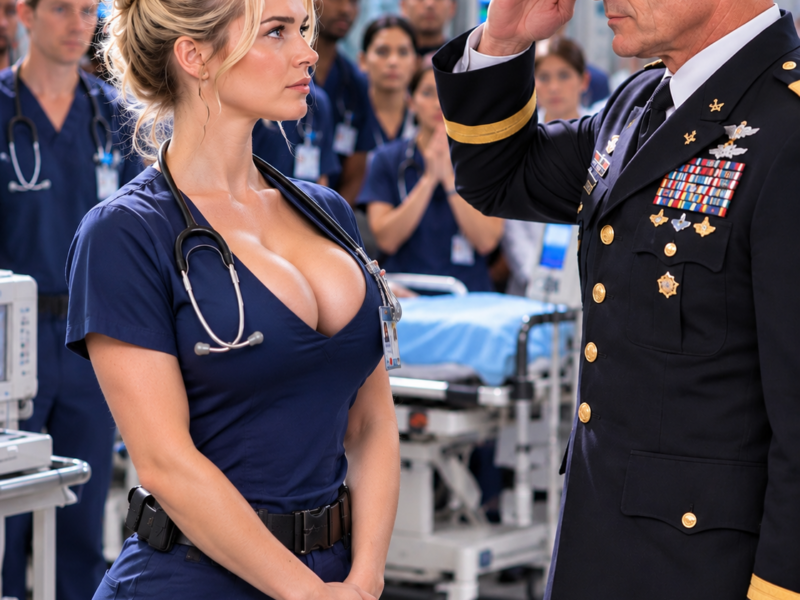
“I was halfway through mopping blood off the trauma bay floor at Sacred Heart Medical Center in Boston when a four-star general walked past the chief of surgery
For several seconds, I didn’t move.
General Clayton Briggs slowly lowered his hand, but his eyes never left my face.
“Vivien,” he whispered. “We buried you.”
“I heard.”
“We held a memorial service. Your entire team was there.”
“I know, Clayton.”
His expression tightened.
“Then you understand what this means. You can’t simply stand here and pretend none of this happened.”
I glanced at Captain James Miller, who was breathing through the emergency airway I had established.
“He’s still critical. Whatever you came here to discuss can wait until my patient is stable.”
The general looked toward the drainage reservoir.
Then he nodded.
It was a small gesture, but everyone in the room noticed it.
A four-star general had just accepted an order from a woman wearing faded civilian scrubs.
Dr. Gregory Harrison apparently couldn’t accept what he was witnessing.
“Excuse me!” he shouted. “I don’t know what kind of military theater this is, but this woman has just performed an unauthorized surgical procedure in my department.”
General Briggs slowly turned.
Harrison pointed at me.
“She assaulted an attending physician, ignored hospital protocol, and performed an emergency airway procedure without authorization. I want her removed immediately.”
Nobody answered.
Harrison looked around, expecting someone to support him.
Brenda suddenly became very interested in the medication cart.
Felix kept his eyes on the patient.
I reached for a clean pair of gloves.
“Captain Miller needs continuous monitoring. Felix, check his oxygenation and prepare for transfer to the operating room if his condition allows.”
“Yes, ma’am,” Felix replied.
Harrison’s face reddened.
“Did you just hear him? He’s taking orders from a float nurse!”
General Briggs stepped closer.
“Doctor, do you know who you’re speaking to?”
“I know exactly who she is. She’s an employee of this hospital.”
“No,” Briggs said quietly. “You know what her badge says.”
He paused.
“You have absolutely no idea who she is.”
The general turned toward the other military officers.
“Close the doors. Nobody discusses the identity of Colonel Galloway outside this room without clearance.”
Harrison gave a nervous laugh.
“Colonel?”
Briggs looked directly at him.
“Colonel Vivien Galloway was the commanding chief medical officer for a Joint Special Operations Command medical unit. She was a decorated trauma surgeon and one of the most experienced battlefield physicians our military ever had.”
The room remained silent.
“She spent twenty years treating wounded soldiers in active combat zones. She developed emergency vascular procedures that are still used by military medical teams today.”
Brenda slowly lowered the clipboard in her hands.
Felix stared at me.
Harrison shook his head.
“That’s impossible.”
I finally looked at him.
“Most things seem impossible when you don’t bother looking closely.”
He went quiet.
Briggs continued.
“She performed emergency surgery in helicopters, temporary field hospitals, and underground medical facilities while people were shooting at the walls around her. She saved hundreds of lives.”
Harrison looked at my arms.
For the first time, I saw him noticing the scars.
The jagged marks beneath my sleeves weren’t from an accident at home.
They were reminders of a place he had only ever seen in photographs.
“Why would someone like that work here?” he asked.
I turned back toward the patient.
“Because I needed a job.”
It was the simplest answer I could give.
And it was the only one I wanted to give.
But General Briggs wasn’t finished.
“Vivien, I need you to come with us.”
I shook my head.
“No.”
His eyebrows drew together.
“You’re refusing a direct request from your commanding officer?”
“You’re no longer my commanding officer.”
“Your country needs you.”
I gave him a tired look.
“My country needed me six years ago.”
He flinched.
For a moment, the general looked less like a powerful military commander and more like an old friend who had spent too many nights wondering whether he had failed someone.
“At least let me explain,” he said.
I looked at the armed men outside the glass doors.
“Not here.”
He nodded.
We moved into the small consultation room beside the trauma bay.
Briggs dismissed everyone except one intelligence officer, a woman named Major Rebecca Lawson.
She closed the door.
The general remained standing.
“Six years ago, you were leading a medical extraction team in Kandahar,” he began. “Your unit recovered an encrypted drive from a compound outside the city. The intelligence on that drive implicated several senior officers in the unauthorized sale of military equipment and the diversion of humanitarian supplies.”
I remembered the drive.
I remembered its weight in my medical pack.
And I remembered the last radio transmission before the bunker collapsed.
“Continue,” I said.
“The operation was compromised. Your location was exposed. An artillery strike hit the medical bunker.”
I looked at him.
“That wasn’t an accident.”
Briggs lowered his eyes.
“I know.”
I sat down.
For six years, I had waited to hear those words from someone who had the authority to investigate them.
But hearing them now didn’t bring relief.
It brought back the smell of burning concrete.
The dust in my lungs.
The sound of people calling for help beneath the rubble.
“I was in the lower surgical chamber when the first impact hit,” I said. “My assistant was operating on a young lieutenant. The second strike brought the ceiling down.”
My voice remained steady.
I had learned a long time ago that grief didn’t need an audience.
“I crawled out with two broken legs and a punctured lung. I tried to reach the radio, but the entire communications station was gone.”
Briggs closed his eyes.
“I thought you were dead.”
“You thought the report was accurate.”
He looked up sharply.
“Vivien, I didn’t authorize that strike.”
“I know.”
“Then why didn’t you contact me?”
I leaned forward.
“Because the people who ordered the strike were still listening.”
Major Lawson shifted uncomfortably.
I continued.
“If I had transmitted my location, they would have known I survived. They would have sent another team.”
Briggs didn’t argue.
He knew what happened to witnesses when powerful people became frightened.
“I made my way across the border into Pakistan,” I said. “I spent almost a year recovering in a small clinic. After that, I came home.”
“Why didn’t you return to the military?”
I looked at my hands.
“Because I didn’t want to spend the rest of my life looking over my shoulder.”
The general sat opposite me.
“And the people responsible?”
I met his eyes.
“General Robert Hayes.”
His expression hardened.
“Hayes is dead.”
“I know.”
I reached into the pocket of my scrub pants and pulled out a small folded photograph.
It was old, slightly damaged, and creased down the middle.
Three soldiers stood beside me in front of a field hospital.
One of them was smiling with his arm around my shoulder.
His name was Daniel Price.
He had been my closest friend.
He hadn’t survived the bunker.
I placed the photograph on the table.
“Hayes ordered the strike because he believed the encrypted drive contained evidence that could destroy his career and expose an international weapons network.”
Briggs stared at the photograph.
“I spent three years collecting evidence after I returned to the United States,” I continued. “I found financial transfers, falsified operational records, and messages linking Hayes to the people who arranged the shipment diversions.”
“How did you get it to investigators?”
“Quietly.”
I had learned that the safest way to expose powerful people was not to announce that you were coming.
It was to let them believe nobody was watching.
I had passed the evidence to investigative journalists and federal investigators through intermediaries.
Eventually, the military opened an investigation.
Hayes was convicted by a military tribunal.
He died in custody before sentencing was completed.
Briggs looked down.
“I remember the investigation. I remember the scandal.”
“Then you know the war ended a long time ago.”
He shook his head.
“Not completely.”
I studied him.
“What does that mean?”
He exchanged a glance with Major Lawson.
She opened a thin folder.
“Colonel, three days ago, we received information that someone had accessed an archive connected to the Kandahar investigation.”
I didn’t touch the folder.
“What archive?”
“Original operational records. Radio logs. Medical extraction records. The classified after-action report.”
My fingers tightened.
“Who accessed them?”
“We don’t know yet.”
“Then why are you here?”
Briggs leaned forward.
“Because Captain Miller was transporting a copy of the original records when his vehicle was attacked.”
I looked through the glass toward Trauma Bay One.
“Why would anyone attack a military transport over six-year-old records?”
“Because the copy contains something the original investigation never recovered.”
Major Lawson opened the folder.
She slid a photograph across the table.
It showed a small black electronic storage device.
My mouth went dry.
I recognized it immediately.
It was the encrypted drive from Kandahar.
The one I had believed was destroyed beneath six tons of concrete.
“Where did you get that?” I asked.
“Captain Miller recovered it during an operation last week,” Lawson replied. “It was hidden inside a storage facility belonging to a former military contractor.”
I stared at the photograph.
“That’s impossible.”
“Apparently not.”
Briggs folded his hands.
“The drive has been partially decrypted. It contains communications from the night of the bunker collapse.”
I felt the room becoming smaller.
“Who is named?”
The general hesitated.
That hesitation told me more than his answer would have.
“Vivien, there are people still serving who were involved.”
I stood.
“Names.”
“We’re working on it.”
“Names, Clayton.”
He looked at me.
“One of them is still in senior command.”
I felt an old anger rise, but I kept my voice low.
“Then you should be very careful about who knows Captain Miller survived.”
Briggs nodded.
“That’s why we brought him here under military protection.”
A knock sounded against the door.
Felix opened it slightly.
“Colonel?”
I turned.
He looked uncomfortable using the title.
“Captain Miller is awake. He’s asking for you.”
I glanced at Briggs.
“I’ll be right back.”
When I entered Trauma Bay One, Miller was conscious but struggling to speak.
His eyes followed me.
I leaned close.
“Don’t try to talk. You’re safe.”
He shook his head weakly.
His right hand moved toward the blanket.
I noticed a small piece of paper tucked beneath his fingers.
He pushed it toward me.
I unfolded it.
Three words were written in hurried handwriting.
THEY KNOW YOU’RE ALIVE.
I looked at him.
“Who gave you this?”
Miller tried to speak.
A faint sound escaped his throat.
I leaned closer.
“Take your time.”
He swallowed.
“Someone… inside command.”
Then his eyes moved toward the glass doors.
A man in a dark suit was standing in the corridor.
He wasn’t looking at the patient.
He was looking at me.
The moment our eyes met, he turned and walked away.
I stepped toward the door.
“Felix, stay with Captain Miller.”
I moved into the hallway.
The man had disappeared.
But I noticed something on the floor near the elevator.
A small plastic access card.
I picked it up.
The name printed on it was Major Rebecca Lawson.
I turned toward the consultation room.
Through the glass, I could see Briggs standing beside the table.
Lawson was no longer there.
I looked down at the card again.
Then I heard footsteps behind me.
“Colonel Galloway.”
I turned.
Major Lawson was standing at the end of the corridor.
Her expression was calm.
Too calm.
“That belongs to me,” she said.
I held up the card.
“Then explain why I found it beside the elevator.”
She looked at it.
For a fraction of a second, something changed in her face.
Then she smiled.
“Someone must have dropped it.”
I studied her.
“You were just in the consultation room.”
“Yes.”
“And now you’re here.”
“Is there a problem?”
I slipped the card into my pocket.
“Not yet.”
She stepped closer.
“General Briggs wants to speak with you.”
“I’ll speak with him when I’m finished with my patient.”
Her smile disappeared.
“Colonel, I wouldn’t recommend making this difficult.”
I looked at her hands.
Her right thumb was trembling.
I had seen that particular movement before.
It was the nervous habit of someone trying to conceal a weapon or keep a hand from shaking after an adrenaline surge.
I moved slightly to the side.
“Major, where were you when Captain Miller’s convoy was attacked?”
Her eyes narrowed.
“That’s classified.”
“Then you won’t mind if I ask the general.”
She didn’t answer.
I walked past her.
As I reached the consultation room, I heard her say something quietly into her phone.
“She’s suspicious.”
I didn’t turn around.
I entered the room and closed the door.
Briggs looked up.
“Where’s Lawson?”
“Probably somewhere she doesn’t want us to look.”
I placed the access card on the table.
His expression changed immediately.
“Where did you get that?”
“Outside the elevator.”
He picked it up.
“Rebecca’s card?”
“She claimed she dropped it.”
Briggs stared at the card for several seconds.
Then he reached for his secure phone.
“Lock down the building. Nobody leaves until we establish what happened.”
I stopped him.
“Wait.”
He looked at me.
“If Lawson is involved, she may already know we’re suspicious. A public lockdown could make her panic.”
He slowly lowered the phone.
“What do you suggest?”
“Let her think we’re still discussing the drive. Keep the guards visible. Quietly check every access log and every communication she made tonight.”
Briggs studied me.
Then he gave a small, almost reluctant smile.
“You’re still thinking three moves ahead.”
“Someone has to.”
Within twenty minutes, the first results came in.
Major Lawson had accessed the hospital’s security system shortly before the convoy arrived.
She had also requested the location of Trauma Bay One.
More disturbing, a temporary access credential linked to her account had been used to download the hospital’s patient transfer records.
Captain Miller’s medical information was among them.
Someone had been preparing for his arrival.
But that wasn’t the worst discovery.
At 1:17 a.m., a hospital maintenance worker reported seeing two men attempting to enter the electrical control room.
They were not hospital employees.
Military police found them before they could reach the equipment.
One carried a suppressed pistol.
The other had a small device designed to interfere with communications.
I looked at Briggs.
“They weren’t here to arrest anyone.”
“No,” he replied. “They were here to make sure nobody could call for help.”
He ordered the two men detained.
Then he turned to me.
“We need to move Miller.”
“Not until he’s stable enough.”
“Vivien, if these people know he’s alive, this hospital is no longer safe.”
I looked through the glass.
Felix was adjusting Miller’s blanket.
The young resident looked exhausted, but he hadn’t left the patient’s side.
“Give me fifteen minutes.”
Briggs nodded.
I returned to the trauma bay.
Felix looked up.
“Everything okay?”
“No.”
He swallowed.
“Are we in danger?”
I checked Miller’s pulse.
“Possibly.”
Felix looked toward the hallway.
“Should I call hospital security?”
“Not yet. Stay with the patient and follow my instructions.”
He nodded.
Then, quietly, he asked, “Colonel, were you really in Afghanistan?”
I glanced at him.
“Yes.”
“My father served there.”
“What’s his name?”
“Thomas Adler. He was a combat medic.”
I stopped moving.
“Thomas Adler?”
Felix nodded.
“Do you know him?”
I looked at the young man for a moment.
Then I smiled faintly.
“I knew a medic named Tom Adler. He once argued with me for twenty minutes because I refused to let him operate on a broken finger.”
Felix stared.
“That’s my dad.”
I looked down at the patient.
“Your father was a good man.”
His expression softened.
“He doesn’t talk much about the war.”
“Sometimes that’s because the memories are heavier than the words.”
Felix nodded slowly.
Then he looked at my hands.
“Did you know him well?”
I glanced at the old scars on my wrist.
“He helped carry me out of the bunker.”
Felix’s mouth opened slightly.
“He never told me.”
“Perhaps he was waiting for the right time.”
For a few seconds, the noise of the emergency department seemed distant.
Then Miller’s monitor began to change.
I turned immediately.
His blood pressure was falling.
“Felix, call for blood. Now.”
We stabilized him, but the episode made the decision unavoidable.
He needed a secure military medical facility.
Briggs arranged an armored medical transport.
The transfer team arrived shortly before three in the morning.
As they prepared the stretcher, Miller caught my wrist.
His grip was weak, but deliberate.
He pulled me closer.
“Colonel…”
“I’m here.”
He swallowed.
“The drive.”
I leaned toward him.
“What about it?”
He looked directly into my eyes.
“There’s another file.”
“What file?”
“Your name.”
My stomach tightened.
“What do you mean?”
He struggled for breath.
“The original command… knew you survived.”
Before I could ask another question, his eyes closed.
The medical team moved quickly.
I stepped aside and watched them wheel him toward the ambulance.
Briggs approached me.
“We need to leave.”
I shook my head.
“Not yet.”
He followed my gaze toward the elevator.
“Vivien, we have to protect you.”
“I’ve spent six years protecting myself. That’s not the same thing.”
He looked at me.
“What do you want?”
I thought about the photograph in my pocket.
Daniel Price smiling beside me.
The men who had died beneath that concrete.
The young soldiers who had never been given the chance to come home.
“I want the original records.”
Briggs nodded.
“Then we’re going to Washington.”
I looked back at Sacred Heart.
For five years, it had been my hiding place.
It had given me quiet nights, ordinary problems, and a reason to get out of bed without remembering the sound of collapsing concrete.
I wasn’t ready to leave it.
But I knew the truth wasn’t going to stay buried forever.
Before we could reach the ambulance, Felix appeared beside me.
“Colonel.”
I turned.
He was holding a folded piece of paper.
“I found this in Captain Miller’s blanket after they moved him.”
I opened it.
It was a photograph of a handwritten military record.
At the bottom was a signature.
Robert Hayes.
Above it was a line identifying the officer who had approved the coordinates for the strike.
I read the name twice.
Then I looked at Briggs.
He recognized it immediately.
His face went pale.
“That’s not possible.”
The signature belonged to Clayton Briggs.
For several seconds, neither of us spoke.
The general slowly reached for the photograph.
“I never approved this.”
I studied his face.
I wanted to believe him.
But six years in hiding had taught me that trust was not something I could afford to give simply because someone wore the right uniform.
“Then someone used your authorization.”
He looked devastated.
“Vivien, I swear to you…”
I raised a hand.
“Don’t swear. Prove it.”
He nodded.
For the first time that night, he looked frightened.
Not of me.
Of what the evidence might reveal.
We left Boston just before sunrise.
The rain had stopped, leaving the streets washed clean beneath a pale gray sky.
I sat inside the armored transport beside General Briggs.
My old photograph of Daniel rested in my coat pocket.
I kept touching its folded edge.
Briggs watched me for a while.
“Do you ever think about going back?” he asked.
“Back where?”
“To the people you served with. To the life you had.”
I looked out the window.
“Every day.”
“Then why not return?”
“Because the woman who left that bunker isn’t the same woman who crawled out of it.”
He said nothing.
“And because I finally learned that saving lives doesn’t require wearing a uniform.”
He lowered his eyes.
“I should have found you sooner.”
“Yes.”
It was the first honest answer I had given him all night.
At the military facility in Washington, the drive was transferred to a secure laboratory.
The original records were examined by an independent investigative team.
The first discovery came within hours.
The authorization bearing Briggs’s signature had been generated after the artillery strike.
It was a forgery.
The second discovery was worse.
The encrypted files contained a recording from the command center on the night of the collapse.
We listened in a secure briefing room.
The audio was distorted, but the voices were clear enough.
One officer asked whether the medical bunker had been evacuated.
Another replied that the surgical team was still inside.
Then a third voice gave the order to proceed.
“Destroy the site. No survivors.”
I closed my eyes.
I recognized the voice.
It was Robert Hayes.
But another voice answered him.
A voice I knew.
Clayton Briggs.
“Negative. There are wounded personnel inside. We need to delay.”
The recording crackled.
Hayes responded.
“General, the authorization is already signed.”
Then came another voice.
“Do it.”
The room went silent.
I looked at Briggs.
He was staring at the table.
“Who was that?” I asked.
He didn’t answer immediately.
Then he whispered, “General Arthur Whitmore.”
Whitmore had been the senior commander overseeing the entire regional operation.
He had attended Daniel’s memorial.
He had shaken my hand and told me my team would never be forgotten.
He had stood beside an empty casket and spoken about honor.
And he had ordered the bunker destroyed.
Briggs looked at me.
“I challenged the order. Hayes claimed the building had been evacuated. By the time I understood what was happening, the strike had already been authorized.”
“Why didn’t you investigate?”
“I tried. Whitmore controlled the investigation. He made sure every report was classified and every witness was transferred.”
I stood.
“Then we finish it.”
The independent team moved quickly.
They recovered financial records linking Whitmore to the weapons network.
They found payments routed through private contractors and falsified supply reports.
The encrypted drive also contained communications proving that Hayes had used Briggs’s signature without permission.
For the first time, the evidence was complete.
But Whitmore was not going to surrender quietly.
Two days later, he requested a private meeting with me.
I agreed, but only with investigators present.
He entered the room wearing his decorated uniform.
His hair was silver, his posture rigid, and his expression almost paternal.
“Vivien,” he said softly. “I wondered when we’d meet again.”
I remained seated.
“General.”
He looked at my scarred hands.
“You survived.”
“Apparently.”
He sighed.
“You have no idea what was at stake that night.”
I stared at him.
“I know exactly what was at stake. My team.”
“Your team was part of a classified operation. Difficult decisions had to be made.”
“You ordered artillery fire on a medical bunker.”
“I prevented a larger international conflict.”
“You murdered people who were treating the wounded.”
His expression hardened.
“History is rarely as simple as you want it to be.”
I leaned forward.
“Neither is a military tribunal.”
He looked toward the investigators.
“You think these people can protect you?”
I didn’t answer.
He turned back to me.
“You could have remained dead. You could have lived your little civilian life in Boston. Nobody needed to know.”
I studied him.
“That’s what you wanted, isn’t it?”
He said nothing.
“You wanted the world to believe everyone in that bunker was dead. You wanted the evidence destroyed. And you wanted me to disappear because you knew I had seen your orders.”
His jaw tightened.
“Be careful, Colonel.”
I looked directly into his eyes.
“I’ve spent six years being careful.”
The investigators ended the meeting.
Whitmore was arrested before leaving the facility.
The evidence was released to federal prosecutors and the military’s independent oversight committee.
The investigation lasted several months.
Several officers were removed from command.
The contractor network was dismantled.
And the families of the soldiers killed in Kandahar finally received the truth.
For me, the hardest part wasn’t testifying.
It was returning to the memorial wall.
Daniel’s name was engraved beside the others.
I stood there for a long time.
I remembered his terrible jokes, his habit of stealing coffee, and the way he always complained that I worked too much.
I placed the old photograph beneath his name.
“I got it, Danny,” I whispered.
“The truth finally came out.”
I didn’t cry.
Not then.
But when I walked away, I felt as though I had finally put down something heavy that I had carried for six years.
A month later, I returned to Boston.
Sacred Heart Medical Center looked exactly the same.
The ambulance bay doors still opened every few minutes.
The nurses still argued over assignments.
And someone had left an empty coffee cup on the counter beside the medication cart.
Brenda saw me first.
She stood at the nurses’ station, holding a clipboard.
For a moment, she looked as though she wasn’t sure whether to approach me.
Then she walked over.
“Vivien?”
I nodded.
She looked at my civilian jacket.
“I heard what happened.”
“News travels.”
She swallowed.
“I owe you an apology.”
I waited.
“For the way I treated you. For the things I said. I thought because you didn’t fight back, you didn’t have anything to offer.”
I looked at her.
“Brenda, you don’t have to like everyone you work with.”
“I know.”
“But you do have to respect them.”
She nodded.
“I know that now.”
Across the room, Felix was speaking with a patient.
When he noticed me, his face lit up.
“Colonel!”
Several people turned.
I smiled.
“Just Vivien.”
He approached, holding a chart.
“My dad wanted me to tell you something.”
“What is it?”
“He said he still owes you a coffee.”
I laughed softly.
“Your father has owed me coffee since 2009.”
Felix grinned.
“He also said he’s proud of me for becoming a doctor.”
I looked at him.
“Then make sure you become the kind of doctor your patients deserve.”
He nodded.
“I’ll try.”
I glanced toward Trauma Bay Four.
A new patient was being wheeled in.
A young woman with a broken arm and a frightened expression.
The nurse beside her was struggling to get the equipment ready.
I took off my jacket.
“Need a hand?”
She looked relieved.
“Actually, yes.”
I stepped forward.
No general.
No military police.
No classified files.
Just another patient who needed someone to help.
And that was enough.
I never returned to active military service.
The government offered me a senior advisory position, but I declined.
Instead, I accepted a position training emergency department staff in advanced trauma response.
I helped develop a program for nurses who wanted to specialize in emergency medicine.
I also insisted that every trainee learn something that had been missing from too many hospitals.
The quietest person in the room might be the one who knows exactly what needs to be done.
Dr. Harrison resigned three months after the incident.
An internal review uncovered years of complaints about his conduct, including several cases in which nurses had raised legitimate concerns that he had dismissed.
He eventually found work elsewhere, though his reputation never recovered.
I didn’t celebrate his downfall.
I had no interest in spending another minute of my life thinking about him.
One cold evening in December, I was walking past the ambulance entrance when I saw a new employee struggling with a mop bucket.
She was young, nervous, and clearly overwhelmed.
A surgeon had just shouted at her for leaving supplies in the wrong place.
She stood silently, staring at the floor.
I recognized that expression.
I walked over.
“What’s your name?”
“Emily.”
“First week?”
She nodded.
“Second day.”
I smiled.
“Then you’re doing fine.”
She looked surprised.
“That doctor doesn’t seem to think so.”
“Doctors aren’t always right.”
She gave a small laugh.
I picked up the mop.
“Come on. I’ll show you where the extra supplies are kept.”
We walked down the corridor together.
As we passed the trauma bay, I heard the familiar sound of a monitor alarm.
A nurse called for assistance.
I handed Emily the mop handle.
“Stay here for a minute.”
Then I stepped into the room.
The patient needed help.
And I knew exactly what to do.
For years, I had believed that disappearing was the only way to survive.
But I had been wrong about one thing.
I hadn’t needed to erase the woman I used to be.
I had only needed to decide what kind of woman I wanted to become.
The next morning, I arrived early.
I pinned my silver-streaked hair into its familiar bun, put on my navy-blue scrubs, and walked into the emergency department.
For the first time in six years, I wore my real name on my badge.
VIVIEN GALLOWAY, RN — TRAUMA EDUCATION DIRECTOR.
I stopped in front of the trauma bay doors.
Beyond them, the hospital was already awake.
People were rushing.
Phones were ringing.
Someone was asking for blood.
And somewhere in the distance, a patient was calling for help.
I took a breath and walked toward the sound.
I had once been buried beneath six tons of concrete, declared dead by the people I trusted, and forgotten by the world.
But I had never stopped being a doctor.
And I had never stopped being the person who ran toward the wounded.
The End.









