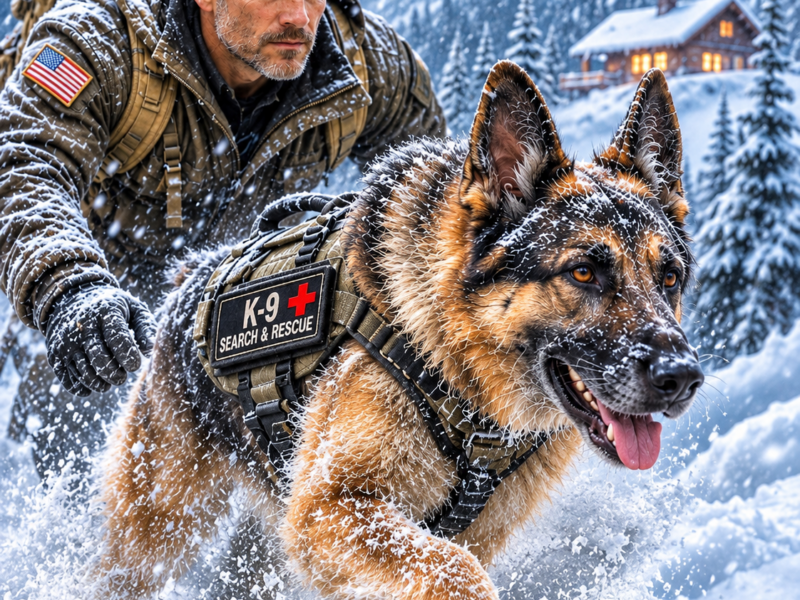
“I was halfway down a snow-covered mountain road when a strange German shepherd suddenly blocked my path, growling and refusing to move
The radio crackled again.
“Knox, do you copy?”
I pressed the transmit button.
“Go ahead. I have you.”
Static swallowed the first few words.
Then the dispatcher came through clearly enough.
“North access is compromised. A second slide has been reported near the Cedar Mile crossing. Do not use the old bridge. Repeat, do not use the old bridge.”
I looked toward Sable.
She was already watching the trail ahead.
“What’s the alternative?”
“Return to the main road and wait for the rescue team to clear the route.”
I checked my watch.
7:42 p.m.
“How long?”
“Unable to estimate. The weather is worsening.”
I looked down at the oxygen case.
Emmett’s backup supply might last until ten.
Waiting for the road to reopen could take hours.
“Dispatcher, we have a patient with a limited oxygen supply. I’m carrying a replacement cylinder toward Cedar Mile.”
“Senior Chief, I strongly advise you to return.”
I almost laughed at the title.
Twenty-five years in uniform had taught me that people sometimes used rank when they couldn’t offer a better answer.
“Understood. I’ll assess the route.”
“Knox, that’s not an authorization to proceed.”
“I heard you.”
I released the button.
Sable began walking.
I followed her.
The trail descended through a dense stand of spruce trees.
Snow covered the branches, and every few minutes a heavy clump fell with a muffled thud.
I kept the case upright and watched my footing.
My right shoulder was burning.
My knee was stiffening.
After another ten minutes, Sable stopped.
She sat in the middle of the trail and stared toward the left side of the woods.
I remembered Mae’s instructions.
“That’s the signal, isn’t it?”
The dog didn’t move.
I looked where she was looking.
At first, I saw nothing.
Then I noticed a narrow line running between two trees.
A maintenance track.
It was almost completely buried.
I checked the GPS.
The track wasn’t on the route.
It was marked on an older topographic map I had saved in my emergency kit.
The path appeared to reconnect with Cedar Mile farther south, avoiding the old bridge entirely.
I looked at Sable.
“You’re not just finding the trail. You’re finding the safest one.”
She stood.
“All right. Show me.”
The new route was slower.
It climbed through a rocky section where the snow was thinner but the ground was uneven.
My knee complained with every step.
At one point, the pack shifted and pulled my shoulder backward.
I stumbled against a tree.
Sable immediately came back.
She pressed her body against my leg while I adjusted the straps.
“Easy. I’m still here.”
I rested for thirty seconds.
Then I continued.
For years, I’d believed that leadership meant being the person who carried the greatest weight.
You carried the equipment.
You made the decisions.
You accepted the consequences.
You didn’t ask anyone else to take responsibility for your survival.
But Sable kept making decisions I couldn’t make.
She could smell the creek beneath the snow.
She could recognize a safe passage through the trees.
She could hear things that never reached my ears.
And every time I followed her, we moved forward.
At the next ridge, the wind became stronger.
I checked the case.
The cylinder was still upright.
The pressure gauge looked normal.
I tightened the outer straps.
“How much farther, girl?”
Sable looked toward the valley.
Then she started down.
A few minutes later, I heard a faint sound.
Not wind.
Not branches.
A mechanical hum.
I stopped.
It was coming from somewhere below us.
Then I saw a light between the trees.
A cabin.
I checked the coordinates.
We were close to Cedar Mile Lane.
I pressed the radio button.
“Dispatch, this is Knox. I’m approaching the lower end of Cedar Mile. I have the oxygen cylinder.”
A burst of static followed.
Then a familiar voice answered.
“Knox, this is Mae. I’m at the rescue station. They got me out.”
I smiled despite the cold.
“Good to hear your voice.”
“Did you reach Emmett?”
“Not yet. We’re close.”
“There’s one thing I forgot to tell you.”
I stopped walking.
“What?”
“Emmett’s house is the third house on Cedar Mile. The third door from the road. Not the first lit one. He lives farther up the lane.”
I looked toward the lights.
Four houses were visible through the falling snow.
Only one had a light in the window.
“Understood.”
“Garrett?”
“Yes?”
“Thank you for going.”
I released the button.
Sable continued down the slope.
We reached the lane at 8:34 p.m.
The snow was waist-deep along the roadside.
I could barely feel my fingers.
The case was heavy, and my knee was close to giving out.
But we had made it.
Four houses stood along the narrow road.
The first was dark.
The second had a porch light but no movement.
The third sat farther down, partly hidden behind a large pine tree.
A warm amber glow shone through its front window.
Sable moved ahead.
“Slow down, girl. We’ve got to make sure.”
She stopped beside the third house.
I checked the address.
Cedar Mile, number 708.
The label on the oxygen case matched the name Mae had given me.
EMMETT VALE.
I knocked.
No answer.
I knocked harder.
A faint voice came from inside.
“Who’s there?”
“Garrett Knox. Mae Donnelly sent me. I have your oxygen.”
There was a long pause.
Then I heard the sound of a chair moving.
The door opened a few inches.
An elderly woman looked out.
Her hair was white, and her hands trembled as she held the door.
“Mae sent you?”
“Yes, ma’am. Is Emmett here?”
She looked at the case.
Then her face changed.
“He’s in the living room. Please, come in.”
I stepped inside.
The house smelled of wood smoke and peppermint tea.
An elderly man was sitting in a recliner near the fireplace.
A thin oxygen tube ran beneath his nose.
His breathing was shallow.
His wife moved toward him.
“Emmett, they brought it.”
He looked at me.
“That girl finally got somebody to listen.”
I set the case on the floor.
“Let’s get this connected.”
I checked the label and the instructions Mae had packed.
I didn’t touch the prescribed flow setting.
I made sure the cylinder was secure and upright, then helped Emmett’s wife connect the tubing according to the instructions.
Within moments, the oxygen was flowing.
Emmett closed his eyes.
His shoulders slowly relaxed.
“That’s better,” he whispered.
His wife held his hand.
I stepped back.
“How long were you running on the backup?”
“Since seven,” she answered. “We were trying to conserve it.”
I looked at the clock.
8:41.
We had made it.
I sat down heavily in the nearest chair.
My knee was throbbing.
My shoulder felt as if someone had driven a nail through it.
Sable approached and rested her head against my leg.
I put a hand on her neck.
“Good girl.”
Emmett opened his eyes.
“What’s your name, son?”
“Garrett.”
“Well, Garrett, I don’t know what you did to get here, but I’m grateful.”
I nodded.
“Mae did the hard part. She knew what you needed.”
“Mae’s a stubborn woman.”
His wife laughed softly.
“She gets that from her mother.”
For the first time that evening, I felt the tension leave my shoulders.
Then the radio came alive.
“Knox, dispatch. We have confirmation that you’re at Emmett Vale’s residence?”
I picked it up.
“Affirmative. Oxygen delivered. Patient connected and stable.”
“Copy. Rescue team has reached Mae. She’s being evaluated at Frostmir Community Hall. We’ll send a team for you once the road becomes safe.”
I looked at the window.
The snow was still falling.
“Understood.”
I put the radio down.
Emmett’s wife brought me a blanket.
“You’re freezing.”
“I’m all right.”
“That’s what people say when they’re not.”
She draped it over my shoulders anyway.
I looked at Sable.
She was sitting near the fireplace, watching the room.
“Is she yours?” Emmett asked.
“No. I met her on the mountain.”
The old man raised his eyebrows.
“You met her?”
“She stopped me on the road. Then she led me to Mae.”
Emmett smiled.
“That sounds like Sable.”
I looked at him.
“You know her?”
“Mae brings her around every winter. She’s been helping the rescue crew for years.”
His wife sat down beside him.
“Mae trained her after a search operation went wrong several years ago. She knows these mountains better than most people who have lived here their whole lives.”
I looked at the dog again.
There was something I still didn’t understand.
“Why did she come looking for me?”
Emmett smiled.
“Maybe because you were the first person she found who looked stubborn enough to follow her.”
I laughed.
It was the first genuine laugh I’d had in weeks.
Around nine, the wind began rattling the windows.
Emmett’s wife checked the oxygen line and the fireplace.
I noticed a small pile of wood beside the stove.
“Do you have enough fuel?”
“Until morning,” she said.
I stood carefully.
“Then let’s bring some inside.”
She looked at my knee.
“You should sit down.”
“I can carry a few pieces.”
Emmett shook his head.
“Let the young man do something. He’s clearly not going to rest until somebody gives him a job.”
His wife smiled.
“That’s what my husband used to say about himself.”
I carried three armfuls of wood inside.
Then I checked the emergency generator.
The house had power from a small backup unit, but its fuel line was partially clogged.
I found the problem and cleaned it enough to get the generator running smoothly.
By the time I returned to the living room, Emmett was sleeping.
His wife sat beside him, one hand resting on his shoulder.
Sable was still awake.
She watched me enter.
“You’re not planning on sleeping, are you?”
Her ears moved.
“Neither am I, apparently.”
I sat near the fireplace.
For the first time in fourteen years, I wasn’t thinking about the men I’d lost.
I was thinking about the people who were still here.
At 10:15, the radio crackled.
“Knox, this is Frostmir Rescue. Mae has been transported to the community hall. She’s stable. The extraction team is preparing to reach your location.”
I leaned toward the radio.
“How is she?”
“Minor leg injury, possible ligament damage, no immediate complications. She’s asking about Sable.”
I looked at the dog.
“Tell her Sable is fine.”
The dispatcher laughed.
“She said she’d like to hear that from you.”
I transmitted a short message.
“Mae, Sable is safe. Emmett has his oxygen. We made it.”
A moment later, her voice came through.
“Good. I knew she would.”
I sat back.
Emmett’s wife brought me coffee.
“You’ve done enough for tonight.”
I looked at the sleeping man.
“Maybe.”
She studied me for a moment.
“You military?”
“Former Navy SEAL.”
“That explains the way you keep checking the windows.”
I glanced toward the glass.
She smiled.
“My husband was a firefighter for thirty years. He never stopped listening for alarms, even after he retired.”
I looked at her.
“How long have you been married?”
“Forty-six years.”
“That’s a long time.”
“It is.”
She sat across from me.
“After he got sick, I thought I’d have to become strong enough for both of us.”
She looked toward Emmett.
“Then I realized he didn’t need me to be strong every minute. Sometimes he just needed me to sit beside him.”
I watched the fire.
“That’s harder than it sounds.”
“I know.”
She looked at my knee.
“You’ve been carrying something longer than that injury.”
I didn’t answer.
She didn’t push.
Her name was Norah Whitcomb.
Her husband, Emmett, had spent most of his adult life as a volunteer firefighter.
He’d helped build the rescue station and trained young men to operate in difficult weather.
Now he depended on oxygen to get through the night.
“Mae comes by every time there’s a storm,” Norah told me.
“She checks the generator, makes sure we have food, and tests the emergency equipment.”
“That’s why Sable knew the route.”
“Partly. That dog has been on this mountain more times than I can count.”
I glanced toward Sable.
“She saved my life before she even knew me.”
Norah smiled.
“Maybe she recognized someone who needed saving.”
I looked at her.
She seemed to realize she’d said more than she intended.
Then she stood.
“Get some sleep, Garrett. The dog will wake you if something happens.”
I almost argued.
Then I remembered how much energy I’d spent insisting I could manage everything myself.
“All right.”
I leaned back in the chair.
Sable settled beside my boots.
The storm continued through the night.
At some point, I fell asleep.
I woke to a soft sound near the front door.
Sable was standing.
Her ears were raised.
She moved toward the window and stared into the darkness.
I reached for the radio.
“What’s there, girl?”
She didn’t bark.
She simply looked toward the road.
A few seconds later, headlights appeared through the snow.
The rescue team had arrived.
I stood carefully, using the chair for support.
Norah came into the hallway.
“That’s them.”
The door opened, and two rescuers entered wearing heavy winter gear.
One of them was a woman with a splint around her leg.
Mae.
She smiled when she saw Sable.
“There’s my girl.”
Sable rushed forward and pressed her head against Mae’s chest.
Mae wrapped both arms around her.
“Good girl. You found someone.”
I looked at Mae.
“You all right?”
“I can walk. Apparently, that’s not enough to convince anybody.”
One of the rescuers shook his head.
“You can argue from the rescue sled.”
Mae rolled her eyes.
“I hate being carried.”
“Nobody enjoys it,” I said.
She looked at my knee.
“You don’t look much better.”
“That’s because I wasn’t expecting to spend the night hiking through a mountain.”
She laughed.
Then she looked at the oxygen case.
“Emmett?”
“Stable. His wife has everything under control.”
Mae nodded.
“Good.”
The rescuers checked the house and confirmed that the road was safe enough for a careful evacuation.
Before leaving, Emmett woke.
He reached toward Mae.
“You stubborn woman.”
She leaned down.
“You’re welcome, Emmett.”
He smiled.
“Tell your dog she did good.”
Mae looked at Sable.
“She knows.”
We left together shortly after dawn.
The snow had stopped.
The mountain looked almost peaceful, as if it hadn’t tried to bury the road only hours earlier.
The rescue team took Mae on a sled.
I walked slowly behind them with Sable.
At the bottom of the trail, an ambulance waited.
Mae was helped inside.
Before the doors closed, she looked at me.
“Garrett?”
“Yes?”
“You should come by the rescue station when your knee is better.”
“Why?”
“Because we could use someone who knows winter logistics, communications, and route assessment.”
I shook my head.
“I’m retired.”
“So am I from most things, but here I am.”
I looked at the ambulance.
She smiled.
“Think about it.”
Then the doors closed.
I watched the vehicle pull away.
Sable sat beside me.
I looked down at her.
“Well, girl, what now?”
She looked toward the rescue station.
I laughed.
“Of course.”
Three days later, I visited the station.
It was a modest building with a garage for rescue vehicles, a small equipment room, and a kitchen that smelled permanently of burnt coffee.
Mae was sitting at a table with her leg elevated.
She looked up when I entered.
“You’re late.”
“I didn’t know we had an appointment.”
“We do now.”
She introduced me to the team.
There were six regular volunteers, two part-time dispatchers, and several people who helped with equipment maintenance.
A man named Eli Parker was organizing radio batteries.
He looked about thirty.
“You’re Garrett Knox?”
“Yes.”
“Mae told us about the mountain.”
I nodded.
“She told you the version where the dog did all the work?”
“Pretty much.”
I smiled.
“Sounds accurate.”
Mae pushed a folder across the table.
“We need someone to help with winter logistics.”
I opened it.
There were route maps, equipment inventories, emergency contact lists, and maintenance schedules.
“Who’s responsible for all this?”
“Whoever remembers to do it,” Mae said.
I looked at the papers.
Some routes hadn’t been checked in months.
The emergency generator had an outdated maintenance record.
Two handheld radios were missing.
“You need a system.”
“We know.”
“You need someone to review the routes before every major storm.”
“We know that, too.”
I looked at her.
“Then why hasn’t it happened?”
Mae smiled.
“Because we’re volunteers, Garrett. Everyone has another job.”
I closed the folder.
“What are you asking me to do?”
“Help us make sure we’re prepared before someone gets hurt.”
I thought about my cabin.
The quiet.
The empty evenings.
The way I had stopped answering calls from old teammates because I didn’t know what to say.
I had believed retirement meant stepping away from responsibility.
Maybe I’d confused responsibility with command.
“I can help with logistics,” I said.
Mae smiled.
“Good.”
“But no medical work.”
“Agreed.”
“No command position.”
“Wasn’t offering one.”
“And I need time for physical therapy.”
She nodded.
“Then we’ll work around it.”
I signed the volunteer application.
Sable rested her head against my knee.
Mae watched her.
“She trusts you.”
“She trusts anybody who carries oxygen, apparently.”
Mae laughed.
“Not quite.”
She opened another folder and pulled out a training schedule.
“There’s something else.”
I looked at her.
“What’s that?”
“Search-and-rescue orientation.”
I shook my head.
“I’m not her handler.”
“Nobody said you were.”
She looked toward Sable.
“She has a handler. Me. But she can work with other people.”
I glanced at the dog.
“She already seems to have made her decision.”
Mae smiled.
“She usually does.”
Over the next month, I became part of the station.
At first, I worked from a chair.
I reorganized equipment, updated maps, and built a system for checking emergency supplies.
I also started physical therapy.
My orthopedic specialist made it clear that my knee needed months of rehabilitation.
I hated every session.
But I went.
One afternoon, my therapist watched me struggle through a set of exercises.
“You know, Garrett, the only part of rehabilitation you seem to enjoy is when it hurts less.”
“That’s the part that matters.”
She laughed.
“Then keep showing up.”
I thought about Aaron.
For fourteen years, I’d replayed the night in Nuristan.
The building collapsing.
The radio traffic.
The decision.
The silence afterward.
I’d spent so long believing that I had failed because I hadn’t been able to save everyone.
But that storm had forced me to confront something I’d avoided.
I had not been alone on the mountain.
Sable had made decisions.
Mae had given me information.
Norah had kept Emmett alive.
The rescue team had come for us.
Nobody had carried the entire mission alone.
And somehow, everyone had made it home.
One afternoon, Mae found me in the equipment room replacing a damaged hinge.
She leaned against the doorway.
“You’re fixing that again?”
“It was loose.”
“You fixed it last week.”
“It was still loose.”
She smiled.
“You know, I’ve been keeping track.”
I looked up.
“Of what?”
“Your volunteer hours. The generator repair. The radio inventory. The route assessments. The emergency supply shelves.”
I put down the screwdriver.
“You’re keeping records?”
“No.”
She pulled a folded paper from behind her back.
“Volunteer application renewal.”
I stared at it.
“You’re serious?”
“Very.”
I shook my head.
“I already signed one.”
“That was the initial application. This is the winter logistics commitment.”
I glanced at the form.
It asked for availability, responsibilities, and emergency contact information.
At the bottom was a section for a one-year commitment.
“Why a year?”
“Because we need someone who will still be here next winter.”
I looked toward the garage.
Sable was lying near the door.
Mae followed my gaze.
“She’ll stay my dog. She’ll stay my partner. But partners can work with more than one person.”
I read the form again.
Then I signed it.
Mae smiled.
“Welcome to Frostmir Volunteer Rescue.”
I handed the paper back.
“Orientation Thursday?”
“Thursday.”
“Bring coffee.”
“Of course.”
By January, I was helping coordinate welfare checks during severe weather.
The first call came on a Tuesday evening.
An eighty-one-year-old man named Peter Collins lived alone near the eastern ridge.
He had missed two radio checks after a night of freezing rain.
His daughter lived three states away.
The road was technically passable, but the eastern shoulder had begun to collapse from runoff.
Mae studied the map.
“Garrett, I want your assessment.”
I leaned over the table.
“Don’t use the east shoulder after mile six. The runoff is undercutting it. Take the lower road and approach from the west.”
Eli looked at the route.
“That adds fifteen minutes.”
“It also keeps you on solid ground.”
He nodded.
“Understood.”
I checked the emergency kit.
Sable stood beside the door.
Mae looked at me.
“She’s going with you.”
I raised an eyebrow.
“Am I officially her second handler now?”
“No. You’re her partner for today’s route.”
I glanced down.
Sable was watching me.
“All right, girl. Let’s go.”
The drive was slow.
Snow had covered the road, and the trees were bent beneath the weight of ice.
I kept to the lower route.
At mile six, I could see where the eastern shoulder had broken away.
Eli looked at the damage.
“Good call.”
I nodded.
We reached Peter’s house twenty minutes later.
He was inside, cold but conscious.
His backup generator had failed, and he hadn’t been able to reach the rescue station.
We helped him move to a warmer room and contacted his daughter.
When she answered, her voice was shaking.
“Is my father all right?”
I looked at Peter.
“He’s safe. We’re with him.”
She began crying.
I waited until she could speak again.
“Thank you,” she whispered.
I looked at Sable.
She was sitting beside Peter’s chair.
“You’re welcome.”
When we returned to the station, Mae was waiting.
“How did it go?”
“Peter’s safe. Generator needs repair. His daughter knows.”
She smiled.
“Good work.”
I took off my coat.
For the first time in years, the familiar exhaustion didn’t feel like punishment.
It felt like I’d spent the day where I was supposed to be.
That evening, I returned to my cabin.
The fire was burning.
My boots were drying near the door.
And Sable was asleep on the rug.
She had started visiting me during training sessions and sometimes stayed while Mae completed paperwork.
She still belonged to Mae.
But somewhere along the way, my cabin had become one of her favorite places.
I sat beside the fireplace.
On the shelf above it was a photograph of Aaron Decker.
We had been twenty-nine in that picture.
He was laughing, one arm around my shoulder.
I’d avoided looking at it for years.
That night, I picked it up.
“I didn’t forget you,” I whispered.
Sable lifted her head.
I looked at the photograph again.
“For a long time, I thought the only way to honor you was to keep carrying what happened.”
The dog stood and approached me.
She rested her head against my knee.
I put the photograph back on the shelf.
“Maybe there’s another way.”
The following spring, Mae organized a small memorial at the rescue station.
It was for volunteers who had died while serving their communities.
She asked whether I’d like to say something about Aaron.
I almost refused.
Then I agreed.
The gathering took place outside, beneath a clear blue sky.
A dozen volunteers stood near the flagpole.
Sable sat beside Mae.
I held a small photograph of Aaron.
“I knew him as a teammate,” I began.
“He was the kind of man who noticed when somebody was struggling, even when they were trying to hide it.”
I paused.
“Fourteen years ago, I made a decision during a mission. Two men needed help outside a collapsing building. Aaron was still inside.”
I looked at the photograph.
“I made the call to evacuate the wounded first. They survived. Aaron didn’t.”
Nobody moved.
“I spent a long time believing that if I had been better, faster, or stronger, I could have saved everyone.”
I looked toward Mae.
Then at Sable.
“Last winter, I met a dog who refused to let me walk past a dangerous slope. She led me to a woman trapped beside a wrecked vehicle, and then helped me carry oxygen to an old man who needed it to survive the night.”
I took a breath.
“I thought I was going to save them. But they helped save something in me, too.”
My voice softened.
“I can’t change what happened to Aaron. I won’t pretend that one successful rescue makes that loss disappear. But I can stop treating the rest of my life like a sentence I have to serve.”
I placed the photograph on the memorial table.
“Aaron deserved to come home. And I wish every day that he had.”
I stepped back.
Mae touched my shoulder.
She didn’t say anything.
She didn’t need to.
After the gathering, I walked toward the edge of the property.
Sable followed.
The mountains stretched across the horizon, green now instead of white.
I looked down at the dog.
“You know, I thought you needed me that night.”
She tilted her head.
“Turns out, I needed you.”
She wagged her tail.
I laughed.
A radio call came from the station.
A vehicle had broken down on the northern road, and a family with two young children needed assistance.
Mae was already moving toward the garage.
I followed.
Sable ran ahead, then stopped at the door and looked back.
I remembered the first night we’d met.
The forecast had said six.
Of course, it hadn’t mattered.
The mountain had its own plans.
And a dog I’d never seen before had stood in my path, refusing to let me continue toward the safety of my cabin.
I had thought she was asking me to rescue someone.
I hadn’t understood that she was also giving me a reason to come back to the world.
I picked up my radio.
“Frostmir Rescue, this is Knox. I’m on my way.”
Sable barked once.
Mae smiled.
“Ready, Senior Chief?”
I looked toward the mountains.
“Ready.”
For fourteen years, I had believed the worst decision of my life was the last thing Aaron would ever know about me.
Now I understood that I couldn’t rewrite that night, but I could decide what kind of man I would be in every morning that followed.
And as Sable ran beside me toward the waiting rescue truck, I finally stopped looking over my shoulder for the life I’d lost.
I was ready to live the one I still had.
The End.









