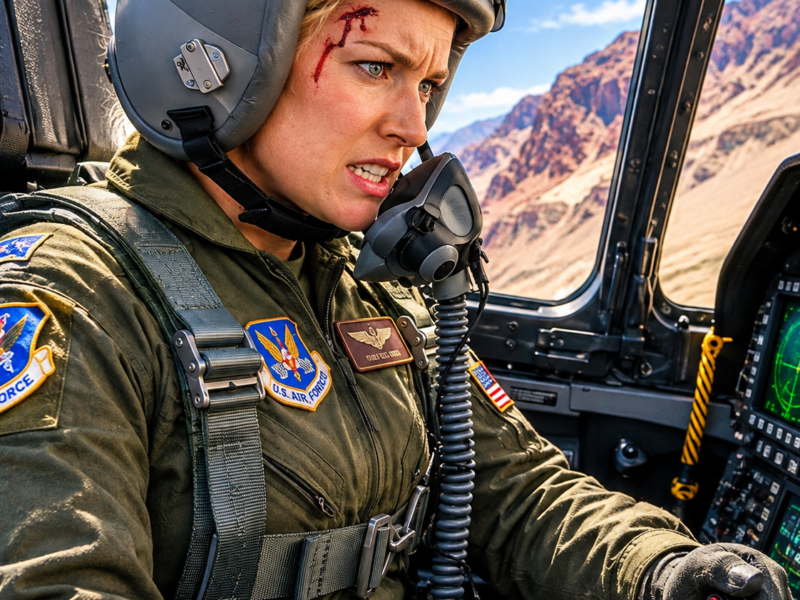
“I was flying an $80 million F-35 over the Nevada desert when every screen in my cockpit suddenly went black, my engine died, and my aircraft began falling out of the sky
I pressed my back against the rocks and forced myself to breathe quietly.
Above me, the helicopters continued circling the wreckage.
Colonel Kessler’s voice was still coming through the soldier’s radio.
“Search the eastern ridge first. She can’t have gone far. And remember, the hardware is the priority.”
Pruitt answered, “Understood, sir.”
I reached into my flight suit and touched the black module.
The little red light was still blinking.
Whatever information it contained, Kessler was willing to send armed men into the Nevada desert to retrieve it.
That meant I had something more valuable than a piece of classified equipment.
I had evidence.
But evidence wouldn’t help me if I died before I could deliver it.
I checked my pistol.
One magazine in the weapon, two spare magazines in my pocket.
Not enough to fight six men in open desert.
I needed water, communication, and a way to get off the range.
Most importantly, I needed to make sure the people hunting me couldn’t erase what I had found.
A man’s voice suddenly echoed from above the ravine.
“Check the wash. She may have gone down there.”
I lowered myself behind a sandstone ledge.
Boots crunched across the gravel less than twenty feet away.
I could see the shadow of a rifle moving over the rocks.
Then the footsteps stopped.
“Nothing here.”
“Keep moving. Pruitt wants this finished before dark.”
The men continued east.
I waited until their voices disappeared before moving again.
The ravine twisted through the desert, creating narrow passages between high red walls.
It was difficult terrain, but it offered something the open ground didn’t.
Cover.
I followed the dry creek bed for almost twenty minutes before spotting a soldier standing alone near a large boulder.
He was drinking from a hydration tube connected to a pack on his back.
Water.
My throat felt as if I’d swallowed a handful of sand.
I watched him for several seconds.
He was scanning the opposite side of the canyon, completely unaware that I was behind him.
I moved quietly.
When he finally heard something and started turning, I was already close enough to reach him.
I knocked his rifle aside, drove my shoulder into his chest, and brought him down onto the gravel.
He struggled.
I pressed my survival knife against his vest.
“Don’t move.”
He stopped.
I removed his radio and hydration pack.
“Who sent you?”
He stared at me through his dark goggles.
“You’re making a mistake, Captain.”
“That isn’t an answer.”
“We’re Iron Veil Tactical. Private security.”
“Who hired you?”
He hesitated.
I tightened my grip on his collar.
“Your employer sent you into restricted military airspace to kill an American pilot. I don’t think your contract covers what happens next.”
His expression changed.
“Colonel Kessler.”
I already knew the answer.
Hearing it from someone outside the Air Force made it real.
“Did he tell you why I was being hunted?”
“He said you stole classified hardware. Said you were planning to sell it.”
I almost laughed.
Kessler had created the crime before I even knew what the evidence meant.
“Where is your team heading?”
“Cutler Flats. Old mining station. There’s a communications relay there.”
“How many men?”
“Five with Pruitt. Two helicopters.”
I studied him.
“Why would a private security company take a job like this?”
He looked away.
“Because they told us it was a national security recovery operation.”
“Did you believe them?”
He didn’t answer.
I secured his wrists with plastic restraints and left him beneath the shade of the boulder with enough water to survive until someone found him.
Then I checked the radio.
A voice crackled in my ear.
“Granite Two, report.”
I stayed silent.
“Granite Two, acknowledge.”
The voice became sharper.
“All units, the pilot is armed and resisting. Weapons free. Do not allow her to reach the recovery point.”
I looked north.
Three miles away, the old mining station stood near a rusted communications tower.
It was my best chance.
If the black module contained the access logs I suspected, I needed to get its contents beyond Kessler’s control.
And I knew exactly where to send them.
The Department of Defense Inspector General had a secure reporting channel for classified misconduct.
Years earlier, during a test pilot safety briefing, we had been given instructions for reporting serious interference with flight operations.
I had never imagined needing it.
Now it might be the only thing keeping me alive.
I started walking.
The desert seemed endless.
The sun climbed higher, turning every rock into a source of heat.
My flight suit trapped sweat against my skin, and my injured ribs made every breath uncomfortable.
I drank carefully from the captured hydration pack.
I couldn’t afford to waste water.
For nearly two hours, I moved between dry washes and rocky slopes.
Twice, I heard the helicopters pass overhead.
Once, I saw a black uniform moving along a ridge less than a hundred yards away.
I dropped behind a bank of dirt and remained motionless until he disappeared.
By the time I reached Cutler Flats, the sun had begun descending toward the western mountains.
The old mining station looked like something abandoned by an entire generation.
Rusting machinery stood between corrugated steel buildings.
A broken truck sat beside a collapsed shed.
At the center of the compound was the communications tower.
Its metal framework rose above the buildings, leaning slightly to one side.
I ran toward the control shed.
A burst of gunfire tore through the dirt behind me.
“She’s there!”
I dropped behind an old flatbed truck.
Another burst struck the metal frame above my head.
I crawled toward the shed, keeping low.
The door was rusted shut.
I fired once into the lock and kicked it open.
Inside, dust covered everything.
An old relay terminal stood against the far wall.
Its equipment was decades old, but the main trunk line still connected to the microwave dish outside.
I pulled the black module from my pocket.
The red light blinked steadily.
“Please work,” I whispered.
I removed the access panel and examined the wiring.
The module had two distinct connections.
One received instructions from the aircraft.
The other transmitted data back to whoever controlled the system.
There was also a small memory chip embedded inside the casing.
I didn’t know how much information it held.
But if the system had recorded the attack, it might contain the one thing Kessler couldn’t explain away.
The original command.
I found an adapter inside the relay cabinet and connected the module to the terminal.
The screen flickered.
A line of text appeared.
DEVICE DETECTED.
REMOTE ACCESS LOGS AVAILABLE.
My hands tightened around the keyboard.
I opened the directory.
There were dozens of encrypted files.
I couldn’t read all of them, but one folder had a date matching the morning of my flight.
OCTOBER 14.
I opened it.
A list of timestamps appeared.
At 05:03, the system had been connected to my aircraft.
At 08:47, a remote access request had been approved.
At 09:22, the flight-control override had been activated.
Then I saw a name.
VICTOR KESSLER.
The authorization field displayed his personal command credentials.
Below it was another entry.
LOUIS FERRARO — HARDWARE INSTALLATION VERIFIED.
I stared at the screen.
Ferraro.
The same man who had avoided my eyes that morning.
The same man who had told me it was only a firmware patch.
I heard footsteps outside.
“Check the building.”
I turned toward the door.
I had less than a minute.
The terminal offered an export option.
I selected the complete log package and directed it to the Inspector General’s secure reporting channel.
A warning appeared.
ENCRYPTION HANDSHAKE REQUIRED.
I entered the authentication sequence I had memorized during training.
The connection began.
UPLOAD: 8%.
I pulled the module’s secondary data file into the transfer queue.
UPLOAD: 17%.
Then the window shattered.
A stun grenade bounced across the concrete floor.
I threw myself behind the heavy generator housing.
The explosion shook the building.
My ears rang.
Dust fell from the ceiling.
The door crashed open.
A large man entered with a rifle raised.
He wore black tactical clothing and a dark plate carrier.
His face was partly hidden behind a mask.
“Captain Whitlock.”
I recognized the voice from the radio.
Pruitt.
“Step away from the terminal.”
I slowly raised my hands.
“You’re a long way from home.”
He moved closer.
“That’s not your concern.”
“You know Kessler didn’t tell you the truth.”
Pruitt glanced at the screen.
“He’s paying us to recover classified property.”
“He’s paying you to murder an American officer.”
“That’s above my pay grade.”
I looked at the terminal.
UPLOAD: 61%.
Pruitt followed my eyes.
“Turn it off.”
“No.”
He raised his rifle.
“Don’t make this difficult.”
“You have any idea what’s inside that module?”
“I don’t care.”
“Then you’re being paid to die for a man who won’t even remember your name.”
His jaw tightened.
“Turn it off, Captain.”
UPLOAD: 74%.
I kept my hands raised.
“Ask Kessler why he used his own credentials. Ask him why he needed a contractor to install a backdoor in an American fighter.”
Pruitt stepped closer.
“Last chance.”
UPLOAD: 86%.
He lowered the rifle slightly and reached toward the console.
I moved.
A heavy wrench lay beside the generator.
I grabbed it and swung.
The wrench struck his rifle, knocking the barrel sideways.
A shot exploded into the ceiling.
Pruitt stumbled.
I hit his weapon again, sending it crashing against the wall.
He grabbed my flight suit and drove me into the console.
Pain shot through my ribs.
For a moment, I couldn’t breathe.
Then the terminal sounded a sharp electronic tone.
UPLOAD COMPLETE.
I looked at the screen.
DATA PACKET SECURE.
The evidence was out.
Pruitt saw it too.
His expression changed.
“You stupid—”
He reached for his pistol.
I shoved the generator housing between us.
He fired.
The bullet struck the metal casing.
Before he could fire again, a tremendous roar shook the building.
The sound came from above.
An aircraft engine.
Pruitt looked toward the broken window.
A gray F-35 swept across the mining station at extremely low altitude.
The shockwave sent dust and loose metal flying through the shed.
Then a familiar voice came through Pruitt’s radio.
“Halo, this is Sparrow. I have visual on your position.”
Owen.
I grabbed the radio.
“Sparrow, this is Halo. I’m at the relay station. Armed personnel on the ground.”
“Copy, Halo. Stay under cover. Help is inbound.”
Another voice followed, deeper and unmistakably authoritative.
“This is United States Air Force control. All armed personnel at Cutler Flats, drop your weapons immediately. You are surrounded.”
Through the broken window, I saw three rescue helicopters approaching from the north.
Their markings were unmistakable.
United States Air Force.
Pruitt looked at the radio, then at me.
His pistol remained in his hand.
“Don’t,” I said.
For several seconds, he seemed to consider his options.
Then he placed the weapon on the floor.
Outside, the remaining members of Iron Veil were ordered to their knees.
I slid down against the console.
My hands were shaking.
The fight was over.
But the truth was only beginning to come out.
An Air Force security team entered the shed and secured Pruitt.
A flight medic knelt beside me.
“Captain, can you hear me?”
“Yes.”
“You’re bleeding. We need to get you checked out.”
I looked at the terminal one more time.
“Did the upload finish?”
He glanced at the screen.
“Yes, ma’am.”
I closed my eyes.
For the first time since my engine died, I allowed myself to breathe.
The medical transport took me back to Nellis shortly after sunset.
Owen was waiting inside the hangar when they brought me in.
His flight suit was dusty, and there was a scratch across his cheek.
He looked younger than he had that morning.
“Hey, Halo.”
I managed a tired smile.
“Nice of you to show up.”
He laughed, but his eyes were wet.
“I thought I’d lost you.”
I reached for his shoulder.
“What happened after I disappeared?”
He sat beside the stretcher.
“When your aircraft vanished from radar, I requested permission to descend and search.”
“And?”
“Kessler ordered me back to base. Said your aircraft had experienced a classified system failure and that the area was restricted.”
“Did you believe him?”
“No.”
He looked down at his hands.
“Then he told me to stop asking questions. He said if I disobeyed another order, I’d lose my flying status.”
I studied him.
“So you came anyway.”
“I tried to follow you down. Then my data link was cut.”
He took a breath.
“I went back to Nellis, but I didn’t go to Kessler. I went straight to the Office of Special Investigations.”
That explained the helicopters.
It also explained why Pruitt’s team hadn’t been expecting an Air Force response.
“Owen, you could have lost everything.”
He shook his head.
“You were my flight lead. I wasn’t leaving you out there.”
I gripped his shoulder.
“Good flying, Sparrow.”
He smiled.
“Good landing, Halo.”
For the first time that day, I laughed.
It hurt my ribs, but I didn’t care.
The investigation began that same night.
The evidence I’d uploaded had already been received by the Inspector General’s office.
Lieutenant General Ruth Abernathy personally authorized an emergency investigation.
The black module was recovered from the relay station.
Its memory contained more than the access logs.
Investigators found the complete remote command history, encrypted communications, installation records, and payment authorizations connecting Iron Veil Tactical to a defense subcontractor.
Most importantly, they found the original authorization for Tether.
It carried Colonel Victor Kessler’s credentials.
But Kessler wasn’t the only person involved.
The following morning, investigators brought Master Sergeant Louis Ferraro in for questioning.
I was still in the medical ward when I heard his name.
I had mixed feelings.
Part of me wanted to believe he had been forced into helping.
Another part remembered his trembling hands as he closed the avionics panel.
Two days later, an investigator named Major Rebecca Hayes came to see me.
She carried a folder and sat beside my bed.
“Captain, Ferraro has agreed to cooperate.”
I looked at her.
“What did he say?”
“He installed the hardware module. Kessler told him it was part of a classified pilot safety system.”
I shook my head.
“Safety system?”
“That’s what he claims he believed.”
“Did he know what Tether actually did?”
Major Hayes opened the folder.
“He says he discovered the truth two days before your flight.”
I looked at the photographs inside.
One showed the same black module I’d found in my aircraft.
Another showed Ferraro standing beside the avionics bay.
“Why didn’t he tell me?”
“He’s going to explain that himself.”
I stared at the photograph.
“Where is he?”
“Under protective supervision.”
I was silent for a moment.
Then I asked the question that had been bothering me since the crash.
“Why did they choose my aircraft?”
Major Hayes closed the folder.
“That’s the part you’re going to want to hear.”
She explained that Tether had originally been developed as a remote aircraft-denial system.
Its stated purpose was to prevent stolen or compromised military aircraft from being used against American forces.
In theory, a secure remote command could disable an aircraft during an emergency.
But the system had no reliable safeguards against unauthorized activation.
It could bypass the pilot’s controls.
It could interrupt engine management.
And because it operated through a concealed hardware connection, investigators believed the resulting crash could be mistaken for a catastrophic electrical failure.
“Why test it on me?” I asked.
Major Hayes hesitated.
“Your aircraft had been selected because you were scheduled to perform high-stress maneuvers using the new software build.”
I understood immediately.
They wanted to know whether the override would work under real flight conditions.
I wasn’t just a test pilot that morning.
I was the test.
“And if I survived?”
“They had a recovery team ready.”
I looked away toward the hospital window.
Outside, the late afternoon sun illuminated the flight line.
Somewhere out there, the aircraft I’d spent years learning to fly was sitting in pieces.
“Who authorized the test?”
Major Hayes opened the folder again.
“Kessler. But we’re investigating two civilian officials who approved the funding.”
I looked at her.
“So this goes higher.”
“Possibly.”
She stood.
“Captain, your testimony matters. But I want you to understand something. This investigation won’t be finished in a day.”
I nodded.
“I didn’t survive that crash to make this easy for them.”
Three days later, I finally met Ferraro.
He sat across from me in a small interview room.
He looked older than I remembered.
His hair was uncombed, and his hands were folded tightly on the table.
For a long time, neither of us spoke.
Then he looked at me.
“Captain, I’m sorry.”
I stared at him.
“You put that thing in my aircraft.”
He nodded.
“I did.”
“You told me it was a firmware patch.”
“I know.”
“Did you know what it would do?”
He rubbed his face.
“Not at first.”
I waited.
“Six months ago, Kessler brought me into a restricted meeting. He said the Air Force was testing a new security system that could disable an aircraft if it was hijacked or stolen.”
“And you believed him?”
“I wanted to.”
His voice cracked slightly.
“He showed me authorization documents. There were signatures from people I respected. I didn’t question it.”
He explained that the original system was supposed to require multiple approvals before activation.
But the contractors had developed a separate override that could bypass those safeguards.
Ferraro discovered the backdoor when he examined the installation diagrams.
He had confronted Kessler.
Kessler told him the program had already been approved and that refusing to cooperate would end his career.
“I should have gone to investigators,” Ferraro said.
“Yes.”
“I was scared.”
I looked at his hands.
“You weren’t the one strapped inside that aircraft.”
He lowered his head.
“I know.”
For a moment, I wanted to shout at him.
I wanted to tell him that his fear had nearly killed me.
But I also knew that anger wouldn’t change what had happened.
“Why didn’t you warn me?” I asked.
He looked up.
“I tried.”
I frowned.
“What?”
“That morning. I wanted to tell you something was wrong, but Kessler had someone watching the maintenance crew. I thought if I spoke to you, he’d know I had turned against him.”
“You could have left a note.”
“I know.”
His eyes filled.
“I made the wrong choice, Captain.”
I stood slowly.
“Yes, you did.”
I reached the door, then stopped.
“Tell the investigators everything. Don’t protect anyone.”
“I will.”
I looked back at him.
“And don’t ever tell yourself that being afraid made it impossible to do the right thing.”
I left without offering forgiveness.
Not because I wanted him to suffer.
Because forgiveness wasn’t something he could ask for three days after nearly getting me killed.
He would have to earn whatever came next.
Colonel Victor Kessler was arrested the following week.
The military police escorted him from his office in front of several members of the squadron.
He wore the same perfectly pressed uniform he’d worn on the morning of my flight.
His expression was controlled.
Until he saw me.
I was standing near the entrance to the administration building, my forehead still marked by the healing cut.
For a moment, we simply looked at each other.
Then he approached.
“Captain Whitlock.”
“Colonel.”
His eyes moved briefly toward the investigators behind me.
“You’ve created quite a situation.”
I almost smiled.
“You ordered a live override on an American fighter.”
“I authorized a classified test.”
“You sent men to kill me.”
His expression hardened.
“You don’t understand the strategic implications of what we were developing.”
I stepped closer.
“Then explain them to the people who will be questioning you.”
He glanced toward the investigators.
“Do you think this changes anything? Programs like this don’t disappear because one pilot gets lucky.”
I held his gaze.
“Maybe not. But yours is finished.”
He said nothing.
The officers escorted him away.
I watched until the doors closed behind him.
There was no satisfaction in it.
I had imagined that moment many times during the days in the desert.
I thought I would feel victorious.
Instead, I felt tired.
A man I’d trusted had looked at my life as an acceptable expense in a project he wanted to protect.
That was harder to forget than the crash itself.
The investigation continued for months.
Iron Veil Tactical lost its federal contracts.
Several employees were arrested, and the company’s records revealed payments routed through shell corporations.
The civilian contractor who had designed the Tether module was charged alongside Kessler.
The program was suspended, its hardware seized, and every aircraft that had received related modifications underwent a full inspection.
The Inspector General’s report eventually confirmed that the system had been activated without lawful operational authorization.
It also confirmed that my aircraft had not suffered an ordinary mechanical failure.
The crash was deliberate.
Ferraro testified against Kessler and the contractor.
He received a reduced sentence in exchange for his cooperation, but he was permanently removed from flight-line maintenance duties.
I never saw him again.
I didn’t know whether I would have forgiven him if I had.
Some decisions leave damage that doesn’t disappear just because the truth comes out.
My own recovery took longer than I expected.
The bruised ribs healed.
The cut on my forehead faded into a thin scar.
The nightmares lasted longer.
Sometimes I woke in the middle of the night with my hands gripping the sheets, convinced I could still feel the aircraft falling.
I would sit on the edge of the bed and listen to the quiet.
Then I’d remind myself that I was on the ground.
I was alive.
And nobody was controlling my aircraft anymore.
Owen visited whenever his schedule allowed.
He never asked about the crash unless I brought it up.
Instead, he’d tell me about the squadron, complain about paperwork, or ask when I planned to return to flying.
One afternoon, he arrived carrying two coffees.
“Black, no sugar,” he said, handing me one.
I looked at him.
“You remembered.”
“Hard to forget. You complain about coffee more than you complain about my landings.”
“My complaints about your landings are completely justified.”
He laughed.
Then he became serious.
“They’re asking whether you’ll return to test flying.”
I looked through the hospital window.
Beyond the parking lot, the mountains rose against a clear Nevada sky.
“I don’t know.”
“That’s fair.”
He took a sip.
“But I hope you do.”
I looked at him.
“Why?”
“Because you’re good at it. And because people like Kessler shouldn’t get to decide who belongs in that cockpit.”
I thought about that for a long time.
He was right.
If I left because of what Kessler had done, then his decision would continue affecting my life long after his arrest.
But returning wasn’t about proving I wasn’t afraid.
I was afraid.
I knew exactly what could happen when a machine failed, when a person betrayed you, when the systems designed to protect you were turned against you.
I also knew that courage wasn’t the absence of fear.
It was deciding what mattered more.
“I’ll think about it,” I said.
Owen nodded.
“That’s all I wanted.”
Six weeks later, I walked back onto the Nellis flight line.
The October heat had passed.
A cool morning breeze moved across the runway, carrying the familiar smell of aviation fuel and dry desert air.
The squadron had changed.
Kessler’s office was empty.
A new commander had taken over, and every aircraft in the test program had undergone additional security inspections.
The men and women working there looked at me differently now.
Some offered quiet congratulations.
Others simply nodded.
I appreciated both.
My first flight back wasn’t a combat maneuver or an advanced software test.
It was a short, controlled evaluation with a second aircraft nearby and an independent safety team monitoring every system.
I stood beside the F-35 and ran my hand along the fuselage.
The surface was cool beneath my fingers.
For a moment, I remembered the black screen.
The dead engine.
The green letters.
Then I climbed the ladder.
Owen was already in his aircraft.
“Halo, Sparrow. Radio check.”
His voice came through clearly.
“Five by five, Halo.”
I smiled.
“Try to keep up today.”
“Wouldn’t dream of anything else.”
I lowered the canopy.
The cockpit came alive.
Every screen illuminated.
Every system responded.
I ran the checklist slowly, touching each control in its proper sequence.
For the first time since the crash, I felt the old familiarity returning.
Not the careless confidence I’d had before.
Something quieter.
Something earned.
“Nellis Tower, Halo 1-1 ready for departure.”
“Halo 1-1, cleared for takeoff.”
I advanced the throttle.
The engine roared.
The aircraft surged forward, and the runway began disappearing beneath me.
A few seconds later, the desert opened below.
I climbed through the morning light.
At 10,000 feet, Owen joined my right wing.
“Good to have you back, Halo.”
I looked at the mountains stretching toward the horizon.
“Good to be back, Sparrow.”
I had lost an aircraft that day.
I had lost a commander I once respected.
I had learned that the people wearing the same uniform weren’t always fighting for the same things.
But I had also learned something about myself.
Kessler had believed he could take control of my aircraft, erase my voice, and bury the evidence beneath the Nevada desert.
He had mistaken my willingness to follow orders for an inability to question them.
He had mistaken my trust for weakness.
And he had forgotten that even when the screens go dark, a pilot still has choices.
As the sun rose over the desert, I looked down at the endless stretch of mountains and felt the aircraft respond beneath my hands.
This time, every control was mine.
THE END.









