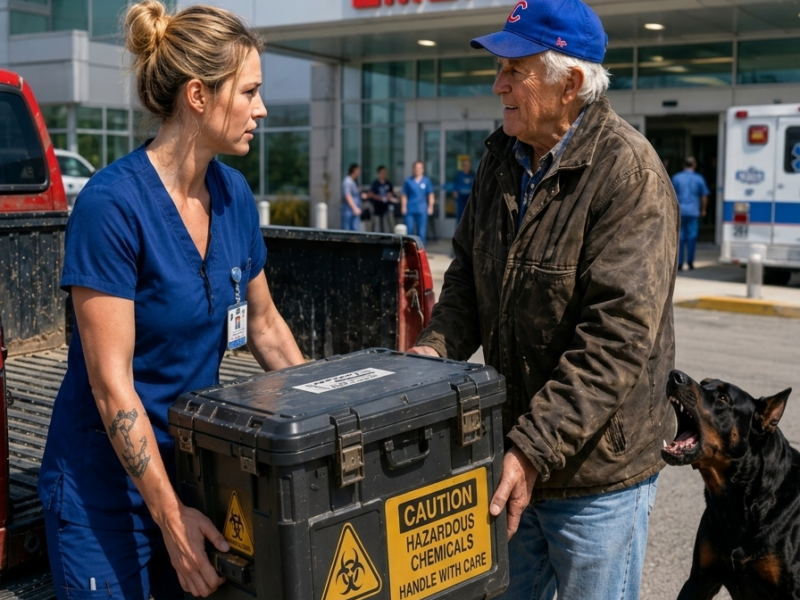
I was fired in front of a crowded hospital lobby for helping a bleeding elderly man nobody wanted to touch, but when his German Shepherd suddenly dropped to the floor
The scent of cheap floor floor wax and pine disinfectant did nothing to mask the metallic iron smell of fresh blood staining my blue scrub top. At 3:15 a.m., the main lobby of St. Jude’s General Hospital was usually an empty, cavernous vault of marble and fluorescent lights. Tonight, it was an arena.
Thirty patients, staff members, and visitors stood frozen in a wide circle around the intake desk. At the center of that circle stood Hospital Administrator Richard Collins, his manicured hands trembling with suppressed rage as he pointed a finger directly at my face.
“You’re finished here, Hayes,” Collins barked, his voice echoing off the double-height glass entryway. “Packed your locker by four a.m. You ignored basic triage protocols. You brought an unregistered, unidentified vagrant directly onto the polished floor of this facility and provided unauthorized medical treatment without checking his insurance status or entering a single chart entry!”
I didn’t step back. I stood beside the stainless-steel transport wheelchair, my hands still covered in thin latex gloves smeared with bright red blood.
“He was hemorrhaging from his temporal artery, Mr. Collins,” I said softly, my voice level despite the adrenaline pounding against my ribs. “He collapsed right outside the sliding doors. If I had spent eight minutes filling out digital intake forms in the portal, he would have bled out on your welcome mat.”
“You are a staff nurse, not an emergency trauma surgeon!” Collins spat, stepping closer. He was a man who lived by spreadsheets and corporate compliance metrics; to him, a human life was merely an unscheduled liability. “You put this hospital at immense legal risk. I want you off the property immediately.”
I looked down at the old man sitting in the wheelchair. He was frail, wearing a threadbare army-green coat that was caked with mud and wet snow. A thick layer of sterile gauze was taped tightly across his left eyebrow, where I had spent the last ten minutes holding direct pressure to close a severe laceration. His hands were weathered, trembling, and spotted with age.
Beside the wheelchair, a massive German Shepherd lay stretched out across the marble tiles. The dog was broad-chested, its coat a mixture of dark sable and silver gray around a muzzle that bore a thick, jagged white scar across the bridge of its snout. For the last twenty minutes, the animal had growled at anyone who stepped within six feet of its master, forcing two armed hospital security guards to keep their hands hovering near their tasers.
But as Collins stepped toward me again, his voice raised in another sharp reprimand, the dog’s ears twitched.
The massive Shepherd slowly rose to its feet. It didn’t bark. It didn’t snap.
It walked past the administrator, stepped directly into my personal space, and lowered its head against my knee. It let out a soft, low whimper, letting its heavy snout rest against my hand.
I froze. I slowly lowered my blood-stained hand and let my fingers stroke the soft fur behind the dog’s left ear.
Then, right in front of thirty stunned onlookers, the dog shifted its weight, squared its broad shoulders, and sat rigidly at attention at my left side—its posture stiff, precise, and unwavering.
The two security guards exchanged nervous, bewildered glances.
I felt a cold shiver run straight down my spinal cord. I hadn’t seen a canine execute a formal military working dog salute like that in almost six years. Not since my final deployment at Bagram Airfield before the explosion that shattered my pelvis and ended my active service as a Navy Lieutenant Commander.
“Easy, Ranger,” I whispered under my breath, testing a hunch that made my throat constrict.
The dog’s ears instantly shifted forward. It let out a tiny, soft huff of air, locking its dark brown eyes onto mine.
In the wheelchair, the elderly man slowly raised his head. His eyes, previously cloudy with shock and pain, cleared slightly as he stared up at my face.
“You… you remember him,” the man murmured, his voice a raspy whisper that barely carried over the hum of the air conditioning units overhead.
I swallowed hard, my chest tightening. “I remember dogs like him. K-9 handlers in the Special Operations Warfare Group.”
The old man studied my features—the scar along my hairline, the posture I held despite my worn hospital scrubs, the way my eyes scanned the perimeter out of pure muscle memory.
“No,” the man whispered, his jaw trembling. “You remember Admiral Walker.”
My heart stopped beating. The air in the lobby suddenly felt impossibly thin.
Admiral Thomas Walker.
He was the man who had pulled me out of the darkness six years ago. When a mortar shell ripped through our field hospital in Helmand Province, killing four members of my surgical team and shattering my body, it was Admiral Walker who signed the medical waiver keeping me in the service. When the Navy finally medically retired me, he sat in my hospital room in Bethesda, handed me my honorable discharge papers, and told me that my life wasn’t over. He personally arranged my civilian nursing credentials and made me swear a solemn oath never to let the memory of the soldiers I couldn’t save destroy the woman I was meant to become.
Three months after I took this job at St. Jude’s, the news reported that Admiral Walker had died peacefully in his sleep at his private residence in Virginia. Heart failure, they said. Natural causes.
I had wept for three days. But deep in my bones, where the instincts of a combat medic still lived, I had never believed that report. Thomas Walker was a man made of iron and granite; he didn’t just stop breathing in the middle of the night.
And yet, I had never spoken his name inside this hospital. I had buried my military service deep beneath a quiet, unremarkable civilian life.
“Who are you?” I asked, leaning down until my eyes were level with the elderly man’s.
With shaking fingers, the old man reached deep inside the torn lining of his heavy winter coat. He pulled out a small, yellowed Manila envelope tied with a faded red string.
“Someone who owes you an apology, Commander Hayes,” he rasped. “Someone who ran out of time.”
Before his fingers could release the envelope, Richard Collins stepped forward, reached over my shoulder, and snatched the paper out of the old man’s hands.
“That is enough of this theater!” Collins barked, stuffing the envelope into his tailored suit jacket. “Security! Escort this vagrant out into the street immediately and get Miss Hayes off my floor before I call the local precinct!”
GRRRRRR…
Ranger didn’t hesitate. The German Shepherd lunged forward three inches, placing his massive body between Collins and the wheelchair. He didn’t bite, but his upper lip curled back, exposing inches of gleaming white teeth while a guttural, terrifying rumble vibrated from his chest.
Collins jumped back two full steps, his face turning bright red. “Control that animal!”
The elderly man reached out with a trembling hand, grabbing my right wrist with a grip that was surprisingly desperate.
“Don’t… don’t let him take that envelope, Clara,” he whispered urgently, his fingers digging into my scrub sleeve. “Please.”
I looked up at Collins. The administrator wasn’t just acting like an angry boss anymore. His eyes were darting toward the front glass doors every three seconds. Sweat was glistening on his forehead despite the cold air in the lobby.
He was terrified.
That was the exact second I realized this confrontation had nothing to do with hospital protocol, unauthorized patients, or union rules.
Someone in this facility had recognized me. And someone else was desperate to make sure whatever was inside that Manila envelope never saw the light of day.
I slowly stood up to my full height. I pulled my shoulders back, the slouch of an exhausted night-shift nurse vanishing instantly, replaced by the commanding presence of a naval officer.
“Give the envelope back to him, Richard,” I said, my voice dropping an octave into a cold, lethal quiet.
Collins tried to laugh, though the sound came out high-pitched and strained. “You are a fired staff nurse with zero authority in this hospital, Clara. Stand down or I will have you arrested for criminal trespass.”
The elderly man reached into his breast pocket once more. He didn’t pull out a wallet. He pulled out an old, metal-rimmed military identification card attached to a steel chain. He tossed it onto the reception desk between us.
Collins glanced down at the card. The laughing expression on his face died instantly.
The card bore the official golden seal of the Department of the Navy. In the photo was a younger Admiral Thomas Walker in his dress whites. But it was the handwritten message scrawled across the white back of the card in faded black ink that made my blood run cold.
I recognized that handwriting instantly. I had seen it on fifty different duty rosters in Afghanistan.
If anything happens to me, find the nurse who saved my life in Field Hospital 4. Find Clara Hayes.
My eyes burned with sudden, stinging tears. “I… I didn’t save his life,” I whispered, my voice breaking. “The mortar blast killed his security detail. I just held his chest tube in place until the MEDEVAC arrived.”
The elderly man looked up at me, his eyes filled with a grief so profound it seemed to fill the entire lobby.
“Your admiral didn’t die of natural causes, Clara,” he whispered.
The breath caught in my throat. “What?”
“He was murdered,” the old man said, his words slicing through the silence of the room like a scalpel. “Digital neuro-toxin delivered via his medical regulator. And twenty minutes before his heart stopped, the last outgoing call logged from his private secure terminal was placed to your personal cell phone.”
I shook my head violently. “That’s impossible! I never got a call! My phone never rang!”
The old man pointed a shaky finger straight at Richard Collins, whose hand was currently inside his pocket, frantically tapping at the screen of his personal phone.
“Because someone intercepted the line,” the old man said. “Someone wiped the carrier logs from the local tower right here in this district.”
WOOF! WOOF! WOOF!
Ranger suddenly whirled around toward the heavy glass entrance doors, his bark echoing like gunshot blasts through the lobby.
Outside in the circular driveway, a matte-black Chevy Suburban swung hard around the flagpole, its tires screaming against the wet asphalt. The vehicle slammed to a stop right in front of the emergency doors.
The dark tinted windows hid the interior, but two seconds later, the driver and passenger doors clicked open. Two men stepped out onto the concrete. Both wore charcoal-grey suits, tactical earpieces, and carried themselves with the silent, dangerous precision of professional contractors.
The elderly man grabbed my hand, pulling me down until his face was inches from mine.
“They tracked my signal,” he whispered, panic bleeding into his ragged breathing. “They know I found you. If they get what the admiral left in your name, neither of us will live to see the sunrise.”
Before I could ask another question, the old man opened his trembling palm.
Resting in the center of his weathered skin was a heavy, old-fashioned brass key. Engraved across its cold surface were four words etched into the metal:
YOUR SON IS ALIVE
I stared at the key, unable to draw air into my lungs. The entire world seemed to dissolve into absolute white noise.
My son. Lucas.
Seven years ago, while I was deployed in the Middle East, my ex-husband had taken our five-year-old boy on a boat trip off the coast of North Carolina. The vessel had caught fire and capsized in a storm. The Coast Guard recovered the charred wreckage and my ex-husband’s body three days later. Lucas was never found. After six months of search operations, the military legal attache handed me a death certificate bearing my boy’s name.
I had spent seven years mourning a ghost.
“What did you say?” I gasped, my voice barely audible as my tears spilled over my cheeks.
“The admiral knew,” the old man whispered, pressing the heavy brass key into my palm and folding my fingers tightly over it. “He found out what really happened to the boat. Now run, Clara! RUN!”
The thick glass doors of the main entrance slid open with a soft pneumatic hiss, letting in a blast of freezing rain and the low, throaty hum of the black Suburban’s idling engine.
The two men in charcoal suits stepped into the lobby. They didn’t look at Richard Collins. They didn’t look at the screaming patients or the confused security guards. Their eyes swept the room with automated, lethal efficiency, settling instantly on the elderly man in the wheelchair—and then on me.
“Commander Hayes,” the lead contractor said, his voice flat, devoid of any accent or emotion. He reached inside his jacket, revealing the leather holster of a suppressed 9mm handgun. “Step away from the subject. Hand over the items in your possession, and you will not be harmed.”
Richard Collins backed away toward the security desk, clutching the Manila envelope to his chest. “Gentlemen! She has the key! Secure the perimeter before—”
“Shut up, Richard,” the contractor said without turning his head.
I didn’t wait to see what would happen next. Seven years of civilian life stripped away in a microsecond, replaced by the instinct that had kept me alive through two combat tours in Helmand.
“Ranger! BARRIER!” I roared.
The German Shepherd launched his two-hundred-pound frame forward, slamming his front paws onto the slick marble floor directly in front of the two suits. He let out a deafening, terrifying bark that echoed off the vaulted ceiling, forcing the two contractors to take a defensive step back and draw their weapons.
I grabbed the handles of the old man’s wheelchair, pulled a sharp 180-degree turn, and kicked the silver crash-bar of the double doors leading into the restricted Emergency Department corridor.
“Halt!” one of the suits shouted behind us.
THUMP! THUMP!
Two suppressed gunshots shattered the glass panes of the lobby doors above our heads, showering glittering shards over the waiting area. Patients began screaming, diving beneath plastic chairs.
“Collins cut the primary security feed!” I yelled over the chaos as I wheeled the old man down the narrow, green-tiled hallway. “He knew they were coming!”
“The lower ambulance bay!” the old man gasped, clutching his chest as the rapid movement jolted his injuries. “My name is Sergeant Major Arthur Vance… retired 7th Special Forces. The admiral… he gave me strict instructions… if I was compromised… bring you to the basement vault!”
“Vance, stay with me!” I ordered, noticing how gray his skin was becoming. His blood pressure was plummeting; the stress was triggering acute cardiac shock.
Behind us, the heavy impact of tactical boots echoed down the corridor. Ranger was staying three feet behind my heels, turning his head every five seconds to let out a low, warning growl as he covered our retreat.
I jammed my elbow into the wall sensor for Trauma Bay 3, threw open the double doors, and wheeled Vance inside. I reached into the emergency supply cabinet, snatched three pre-filled syringes of concentrated atropine, a roll of heavy medical tape, and a pair of surgical shears, stuffing them into my scrub pockets.
“There’s an old service elevator at the end of the north corridor,” I said, checking Vance’s pulse. It was thready, hitting 140 beats per minute. “It leads directly down to the old mechanical sub-basement. But I need to stop this bleeding first!”
“No time!” Vance choked out, grabbing my collar. “The key, Clara… the key opens a safe deposit box inside the Old First National Bank vault on 4th Street… but the clearance code… the code is in that envelope Collins took!”
I froze. “The envelope Collins has in his suit pocket?”
“Yes!” Vance rasped. “The admiral stored the telemetry data from your son’s abduction inside that file! If Collins hands that envelope to those men, the server trail will be wiped forever!”
I looked down at the brass key in my hand. YOUR SON IS ALIVE.
For seven years, I had gone to sleep every night praying to see my little boy’s face one more time. I had stared at his empty bedroom, his untouched toys, his small shoes sitting by the front door. If there was even a one-percent chance that Lucas was drawing breath somewhere on this earth, I would tear this hospital down brick by brick to find him.
“Ranger,” I said, kneeling in front of the scarred German Shepherd. I grabbed the dog’s broad face, looking deep into his intelligent brown eyes. “Stay with Vance. Guard him with your life. Do you understand me? GUARD.”
The dog let out a soft, single whimper, then immediately sat beside Vance’s wheelchair, resting his heavy head on the old man’s lap.
I stood up, pulled my surgical shears from my pocket, and turned toward the Trauma Bay door.
“Clara!” Vance called out weakly. “What are you going to do?”
“I’m going to go get my mail from Mr. Collins,” I said.
I stepped back out into the dimly lit hallway. The main overhead lights had been turned off—Collins had clearly initiated a localized power isolation to keep civilian staff from seeing what his hired guns were doing. Only the red emergency exit signs cast a bloody glow over the linoleum floor.
Through the red gloom, I saw two silhouettes moving toward Trauma Bay 3, their handguns raised, tactical lights sweeping the walls.
They thought they were hunting a civilian nurse. They thought thirty years of medical service meant I was soft.
They forgot that before I was a nurse, I was a Navy Lieutenant who spent eighteen months attached to a Marine Raider Task Force.
I slipped into the dark recess of the linen alcove, pulling a heavy steel oxygen tank from its wall bracket. I held the fifty-pound cylinder against my chest, breathing through my nose, counting the seconds by the rhythmic thud of their footsteps.
One… two… three…
The first contractor stepped past the alcove.
I swung the heavy steel oxygen tank with all the momentum in my body, slamming the flat brass base directly into the side of his tactical helmet.
CRACK!
The force of the blow shattered his visor and knocked him off his feet. He crashed hard onto the floor, his handgun sliding down the hall.
Before the second contractor could raise his weapon, I stepped out of the shadow, drove the pointed tip of my heavy surgical shears straight through the soft fabric of his tactical sleeve, pinning his radial artery against his forearm bone, and slammed my forehead directly into the bridge of his nose.
His head snapped back with a loud crunch. He stumbled backward, dropping his weapon as blood gushed from his shattered face. I swept his left leg with my heel, sending him crashing onto his back, caught his falling suppressed pistol mid-air, racked the slide, and leveled the barrel at his forehead.
“Where is Collins?” I growled, my voice dropping into a register that made the bleeding contractor freeze in terror.
“He… he went to the administrative suite…” the man gasped, clutching his broken nose. “Fourth floor… taking the private elevator…”
“Who hired you?” I demanded, pressing the cold steel barrel against his temple. “WHO HIRED YOU TO KILL ADMIRAL WALKER?”
The contractor spat blood onto my shoe, grinning through his broken teeth. “You’re too late, Commander. The boy was sold seven years ago. The Admiral tried to buy him back… and look where it got him.”
A cold, terrifying rage exploded behind my eyes. I didn’t pull the trigger. I brought the heavy steel butt of the pistol down onto his jaw, knocking him instantly unconscious.
I stripped the contractor’s tactical belt, taking two spare ammunition magazines, a small encrypted radio, and his keycard badge.
I stepped over their unconscious bodies and ran toward the central stairwell, heading straight for the fourth-floor administrative suite.
As I took the stairs three at a time, the radio on my hip crackled to life with static.
“Alpha Team, this is Control. Is the nurse neutralized? We have air transport landing on the south helipad in four minutes. Ensure the Walker file is secured.”
I unclipped the radio, pressed the push-to-talk button, and held it to my lips as I reached the fourth-floor landing.
“This is Commander Clara Hayes,” I said into the microphone, my tone deadly and clear. “Tell your flight crew to stay on the pad. Because I’m coming up, and I’m taking everything you stole from me.”
The administrative floor of St. Jude’s Hospital was a world away from the crowded, blood-stained realities of the Emergency Room below. Here, mahogany paneling lined the walls, thick plush carpeting muffled every footstep, and the air smelled of expensive espresso and leather furniture.
Tonight, however, the glass doors to the Executive Suite were shattered.
I stepped through the broken doorway, holding the suppressed 9mm pistol in a low-ready stance, my eyes darting across the dark office cubicles.
At the end of the main hallway, light spilled out from beneath the double oak doors of Richard Collins’s corner office.
I moved silent as a shadow, my rubber-soled nursing shoes absorbing any sound against the carpet. As I reached the door, I heard voices arguing inside.
“I was promised immunity!” Collins’s high-pitched, hysterical voice echoed through the wood. “You said if I held the file here until your team arrived, my name would be wiped from the federal indictment! I’ve spent seven years laundering your offshore medical accounts through this hospital!”
A second voice—cold, cultured, and heavily accented—replied with terrifying calm. “You were paid five million dollars to ensure Admiral Walker’s medical telemetry was erased from this facility’s mainframe seven years ago, Richard. You failed to realize he kept a duplicate hard copy in a personal blind trust.”
“I didn’t know about the trust!” Collins shrieked. “The old soldier brought it into my lobby tonight! Just take the envelope and let me get to my car!”
I didn’t knock. I raised my right foot and slammed my heel directly beside the heavy brass lock.
BOOM!
The double oak doors burst open, slamming against the interior drywall.
Inside the sprawling office, Richard Collins was cowering beside a glass conference table. Standing near the floor-to-ceiling windows overlooking the city skyline was a third man—older, impeccably dressed in a tailored navy suit, holding a silver briefcase in one hand and a high-caliber revolver in the other.
On the glass table between them lay the yellowed Manila envelope.
Collins screamed, scrambling backward over a leather armchair as he saw me standing in the doorway with a gun. “Clara! Shoot him! He’s going to kill us both!”
The man in the navy suit didn’t flinch. He turned slowly to face me, his grey eyes assessing me with cold, surgical detachment.
“Commander Hayes,” he said smoothly. “I must admit, your military service record did not fully capture your… persistent nature. I was told you were merely a broken trauma nurse living on disability.”
“Who are you?” I demanded, keeping the gun locked onto his chest. “And what does Admiral Walker have to do with my son?”
The man smiled—a thin, cruel line that didn’t reach his eyes. “My name is Victor Vance. And unlike my soft-hearted brother Arthur downstairs, I do not believe in military honor. I believe in market value.”
My eyes widened. “Arthur Vance’s brother…?”
“Arthur was always the idealistic fool,” Victor said smoothly, taking a slow step toward the glass table. “He believed Admiral Walker was a god. He served as the Admiral’s chief of staff for twenty years. But seven years ago, when our research syndicate required high-grade genetic profiles for private pediatric trial networks overseas, I needed a delivery system. And Richard Collins provided the medical records right here at St. Jude’s.”
The truth slammed into my chest like an iron fist.
“You didn’t just crash my ex-husband’s boat,” I whispered, my voice trembling with a mixture of horror and realization. “You staged the accident. You took Lucas off that boat before it burned!”
“Your son had a rare zero-negative blood factor, Clara,” Victor said, as if discussing the price of commercial real estate. “He was priceless to our international clients. Admiral Walker spent seven years hunting for him. He finally located the facility in Geneva last month. He was three days away from exposing us to the Senate Intelligence Committee when I had his medical regulator adjusted.”
“You murdered him,” I said, my finger tightening on the trigger.
“I protected an investment,” Victor corrected softly. “And now, you hold the brass key to the safe deposit box containing the Geneva coordinates. Hand it to me, Clara. Hand it over, or Mr. Collins here suffers a fatal stroke, and you go to prison for his murder.”
Collins gasped from behind the sofa. “Victor! No! We had a deal!”
“Deals are for men with leverage, Richard,” Victor sneered.
In that fraction of a second, while Victor’s eyes flicked toward Collins, I made my move.
I didn’t fire at Victor’s body—I knew a man of his stature was likely wearing soft body armor beneath that tailored suit. I lowered my aim two inches and fired straight into the glass conference table between us.
BANG!
The tempered glass exploded into millions of flying sharp crystals.
Victor dropped his arm to protect his face from the shower of glass. I lunged across the ruined table, driving my shoulder into his chest, knocking him hard against the panoramic window behind him.
The silver briefcase tumbled from his grip, bouncing across the floor.
I reached out with my left hand, snatching the Manila envelope off the ruined table, but Victor recovered with frightening speed. He grabbed my right wrist, twisting the gun out of my fingers, and slammed me face-first onto the carpet.
Pain flared through my old pelvic surgical scars, blinding and intense. I gasped for air, struggling beneath his weight.
“You should have stayed retired, Nurse Hayes!” Victor snarled, leaning down, pressing his revolver against the back of my neck.
From across the room, Richard Collins suddenly scrambled out from behind the sofa, grabbed the silver briefcase, and sprinted toward the open office door.
“I’m taking the payout!” Collins screamed frantically. “Find your own way off the roof!”
Victor swore loudly, his attention momentarily split between killing me and securing his five-million-dollar briefcase.
It was all the time I needed.
I reached up into my scrub pocket, pulled out the pre-filled syringe of concentrated atropine I had taken from Trauma Bay 3, uncapped the needle with my teeth, and jammed it backward into Victor’s thigh.
Victor gasped, his eyes going wide as three milligrams of pure cardiac stimulant hit his bloodstream. His heart rate exploded instantly, his hands trembling violently as the drug flooded his nervous system. He dropped the revolver, stumbling backward, clutching his chest as his blood pressure spiked to dangerous levels.
I scrambled to my feet, grabbed the Manila envelope, snatched Victor’s dropped revolver from the floor, and turned toward the doorway.
Victor was leaning against the shattered window, his face turning bright red, his breathing ragged as the atropine surged through his veins.
“You… you crazy… bitch…” he gasped.
“I’m a nurse, Victor,” I said, tucking the envelope into my scrub top and leveling the revolver at his face. “I know exactly how much medicine it takes to make a monster’s heart stop.”
I didn’t waste time finishing him. I turned around and sprinted out of the office, following the trail of dropped papers and open doors leading toward the emergency roof exit where Richard Collins had fled.
Above me, through the concrete ceiling, the deep, rhythmic thrum of helicopter blades began to beat against the night sky.
The rain had turned into a freezing sleet by the time I threw open the heavy steel access door leading onto the hospital roof.
The icy wind slammed into my face, whipping my wet hair across my eyes. Fifty yards away, sitting in the center of the concrete helipad, a twin-engine executive helicopter hummed loudly, its main rotors whipping the freezing rain into a blinding white mist.
Standing at the edge of the helipad, clutching the silver briefcase to his chest, was Richard Collins. He was screaming at the pilot through the open side door, but the pilot was shaking his head, pointing at the storm clouds rolling over the city.
“Get me out of here!” Collins shrieked, his voice barely audible over the roaring engines. “I’ll double your pay! Just pull up!”
“He isn’t taking you anywhere, Richard!” I shouted, stepping onto the rain-slicked concrete.
Collins spun around. When he saw me standing thirty feet away, holding the heavy revolver in both hands, his face turned paper-white. He backed up until his heels were resting against the low safety netting at the edge of the roof—an eighty-foot drop to the concrete parking lot below.
“Clara! Stay back!” Collins screamed, his voice cracking with pure terror. “If you shoot me, the briefcase falls over the edge! Five million dollars in untraceable bonds!”
“I don’t care about your money, Richard!” I yelled back, stepping slowly forward, my boots slipping slightly on the wet concrete. “I want the access codes for the safe deposit box!”
“I don’t have them!” Collins cried out, tears mixing with the freezing rain on his cheeks. “The codes aren’t numbers! They’re stored on the digital micro-chip inside the seal of that envelope you’re holding!”
I paused, reaching into my scrub top with one hand, feeling the hard, rectangular outline buried beneath the thick paper of the Manila envelope.
He was telling the truth. The Admiral hadn’t written a code. He had embedded a secure military micro-transponder directly into the physical paper.
“You sold my son,” I said, the words coming out cold, steady, and sharp as broken glass. “You sat in your climate-controlled office, signed corporate transfer forms, and sold a five-year-old child to human traffickers.”
“I had debts!” Collins sobbed, his hands shaking so violently he almost dropped the heavy briefcase. “You don’t understand how this city works! Victor Vance owned my mortgage! He owned this hospital! If I said no, he would have destroyed me!”
“You destroyed yourself,” I said.
Suddenly, the heavy steel door behind me burst open once again.
“CLARA! LOOK OUT!”
It was Sergeant Major Arthur Vance. He was leaning heavily against the doorframe, his hospital gown soaked in blood, but in his hands, he held a heavy tactical flashlight.
Standing right behind him, his gray muzzle dripping with rain, was Ranger.
The German Shepherd saw Collins, recognized the threat, and let out a terrifying roar that cut straight through the thunder of the helicopter blades.
WOOF! WOOF!
Ranger didn’t wait for a command. He launched himself across the slick wet helipad like a missile, his powerful legs driving him across the concrete.
“NO! GET IT AWAY FROM ME!” Collins screamed in blind panic.
He didn’t try to fight. He backed up two fast steps, forgetting where he was standing. His wet leather dress shoes slipped over the slick metal edge of the safety perimeter.
Collins lost his balance. He shrieked, his arms flailing wildly as his body tipped backward over the eighty-foot drop.
“CLARA!” Vance yelled.
Instinct—the ancient, unstoppable nurse’s instinct to save a falling human life—overrode everything else in my brain.
I dropped the gun, lunged across the wet concrete, and dove over the safety netting, reaching out with both arms into the open air.
My hands caught Collins’s right wrist a fraction of a second before he fell into the abyss.
The sudden, brutal weight slammed my chest hard against the cold steel railing. My old pelvic injuries screamed in agony as the bone frame groaned under the strain, but I gritted my teeth, locking my fingers around his wrist with every ounce of strength remaining in my body.
Below me, eighty feet in the dark, Collins dangled over the concrete parking lot, screaming hysterically as his shoes dangled in the freezing air. The heavy silver briefcase slipped from his left hand, plunging into the darkness below and shattering into pieces on the asphalt.
“HOLD ON!” I roared, my muscles tearing under the strain. “DONT LET GO!”
Collins looked up at me, his eyes wide with absolute, pathetic shock. “You… you’re saving me…? After what I did to your boy…?”
“I’m a nurse, you bastard!” I growled, blood dripping from my lip where I had bitten through my skin from the effort. “I don’t let people die on my shift! NOW GIVE ME YOUR OTHER HAND!”
Above us, Ranger reached the edge of the helipad. The massive German Shepherd grabbed the back of my scrub top with his jaws, bracing his heavy back legs against the concrete base, pulling backward with all his weight to anchor me against the railing.
With a final, agonizing heave, I pulled Collins up three inches—just enough for Sergeant Major Vance to reach over the railing, grab Collins’s collar, and drag the weeping, hyperventilating administrator back onto the safe concrete of the roof.
We all collapsed onto the wet roof in a heap of exhausted, panting bodies, the freezing rain washing the dirt and blood from our faces.
Collins lay on his back, sobbing uncontrollably into his hands, his spirit entirely broken.
Sergeant Major Vance dropped to his knees beside me, laying a warm, trembling hand on my shoulder.
“You pulled him up,” Vance murmured, his voice filled with awe. “After everything… you pulled him up.”
I sat up slowly, breathing heavily, resting my head against Ranger’s wet, warm fur as the German Shepherd leaned against my side, licking the rain from my cheek.
I reached inside my soaked scrub top and pulled out the yellowed Manila envelope.
The paper was damp, but the thick wax seal remained intact.
I looked up at the twin-engine helicopter hovering above us. The pilot, seeing that the operation had completely collapsed, pulled back on his flight stick, angled the aircraft into the gray morning sky, and vanished into the clouds over the city.
Silence settled over the roof, broken only by the soft wail of approaching police sirens in the streets below.
I turned my eyes to Sergeant Major Vance.
“It’s over, Arthur,” I whispered.
Vance looked down at the envelope in my hands, a faint, tearful smile touching his old eyes.
“No, Commander Hayes,” he said softly, pointing toward the rising sun breaking through the eastern horizon.
“It’s just beginning. Now go find your son.”
Three days later.
The morning sun over the Swiss Alps was blindingly bright, reflecting off the pristine white snowdrifts that covered the mountainside overlooking Lake Geneva.
A cold, crisp breeze rustled the pine trees surrounding a secluded, high-walled private medical villa nestled deep in the valley. Outside the heavy iron gates, four unmarked black vans belonging to the Swiss Federal Police and the United States Department of Justice stood parked with their doors open.
Over fifty federal agents, accompanied by international medical personnel, were quietly moving through the compound, escorting staff members in handcuffs into waiting transport vehicles. The global syndicate known as Project Cerberus had collapsed in seventy-two hours, unraveling like a ball of thread after the micro-transponder inside Admiral Walker’s envelope was decrypted by federal authorities in Washington.
I stood on the cobblestone driveway inside the courtyard.
I was no longer wearing stained hospital scrubs. I wore a clean black wool coat, dark jeans, and sturdy winter boots. Beside me, sitting proudly on the snow with a custom tactical vest strapped across his broad chest, was Ranger.
Sergeant Major Vance stepped out of the villa’s main glass doors, wrapping a thick scarf around his neck. He walked slowly over to my side, stopping to pat Ranger on the head.
“The Swiss authorities have cleared the upper floor,” Vance said softly, his voice trembling slightly with emotion. “The international pediatric medical team confirmed his identity twenty minutes ago. DNA match is 99.9 percent.”
My knees went weak. I had to reach out and rest my hand on Ranger’s broad back to keep from falling onto the snow.
For seven years, I had lived in a cold, silent tomb of grief. I had buried my feelings, buried my past, and buried my heart, believing that the sweetest part of my life had been erased in a dark ocean storm off the coast of North Carolina.
“Is he… is he okay?” I whispered, tears already blurring the mountain view before me.
“He’s healthy, Clara,” Vance said gently, a warm smile spreading across his weathered face. “They treated him like gold here—he was their prize asset. He speaks fluent French, he plays the piano, and he asks the staff every single night if his mother is ever coming to pick him up.”
A sob broke from my throat—a sound so deep, so full of seven years of unexpressed pain, that it seemed to shake my entire body.
Ranger let out a soft whine, leaning his heavy shoulder against my hip, nudging my hand with his cold nose.
“Go on up, Commander,” Vance said softly, stepping back and saluting me with crisp, unwavering respect. “Your shift is officially over.”
I returned the salute, my hand shaking, then turned and walked up the stone steps into the warm, sunlit interior of the villa.
The hallway was quiet, carpeted in deep blue wool, lined with framed oil paintings. At the very end of the corridor, a pair of white wooden doors stood half-open. Soft piano music—a simple, familiar nursery rhyme I used to sing to him when he was a baby—was drifting out into the hall.
I stopped at the threshold.
Sitting on a piano bench beside a grand window overlooking the snow-covered mountains was a twelve-year-old boy. He had thick brown curls, fair skin, and my mother’s soft hazel eyes.
He was holding a small, carved wooden sailboat in his lap, pressing one key on the piano with his thumb, over and over again.
Ranger stepped past my legs, his claws clicking softly against the hardwood floor.
The boy turned his head at the sound. His eyes locked onto the massive German Shepherd, widening with wonder.
“Ranger…?” the boy whispered, his voice soft, hesitant, but carrying a faint memory buried deep within his soul.
The dog didn’t bark. He walked slowly over to the piano bench, rested his broad, scarred snout on the boy’s knee, and let out a long, happy sigh.
The boy let out a tiny laugh, reaching down with his small hands to stroke the dog’s ears.
Then, slowly, the boy looked up past the dog’s head.
His hazel eyes met mine.
I stood in the doorway, tears streaming down my face, unable to speak, unable to move, holding my breath as if afraid that moving would shatter this beautiful, impossible dream.
The boy slowly let go of the wooden sailboat. He stood up from the piano bench, his hands trembling at his sides, stepping past the dog.
He took three slow, hesitant steps toward me, studying my face, my eyes, the small scar along my hairline.
A tiny, breathless gasp escaped his lips.
“Mom…?” he whispered.
I dropped to my knees on the hardwood floor, throwing my arms wide open.
“Oh, Lucas,” I sobbed.
My son didn’t hesitate. He ran straight into my arms, throwing his small hands around my neck, burying his face into my shoulder as the tears finally spilled over his cheeks.
I pulled him against my chest with all the strength in my body, breathing in the scent of his hair, holding him so tightly that nothing on this earth could ever separate us again.
Outside the window, the sun rose high over the Swiss Alps, bathing the world in a warm, brilliant light that chased away seven years of darkness.
My name is Clara Hayes. I used to be a Navy nurse. I used to be a ghost.
But today, as I held my son in my arms with Ranger sitting faithfully at our side, I knew the truth.
The storm was finally over. And we were home.
The end









