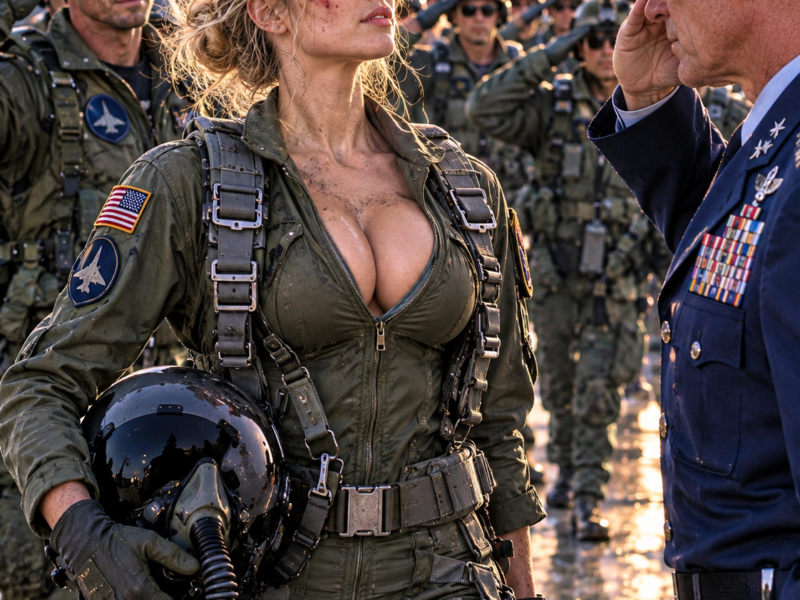
“I was climbing into my fighter at dawn when General Hale ordered me off the mission in front of the entire squadron
“Do not leave the runway, Danny!” I shouted into the radio.
For two seconds, there was nothing but static.
Then his voice came back.
“Elena, the tower just cleared us for departure.”
I looked at Colonel Sloan.
She was already reaching for her radio.
“Control tower, this is Colonel Sloan. Hold all aircraft immediately. Repeat, hold all aircraft.”
A different voice answered.
“Unable, ma’am. General Hale has issued direct departure authorization.”
Sloan’s face tightened.
“Then tell General Hale that I’m suspending the launch pending an intelligence discrepancy.”
There was another pause.
“Ma’am, the order came directly from the general.”
I looked at the runway.
Danny’s aircraft had begun rolling.
His afterburners illuminated the morning haze.
“Danny, abort!”
He answered almost immediately.
“Trying.”
The aircraft continued accelerating.
I watched it pass the halfway point of the runway.
Then, just before reaching takeoff speed, it slowed.
Its nose dipped slightly.
The aircraft rolled toward the far end and finally stopped.
I released a breath I hadn’t realized I was holding.
“Ortiz, confirm status.”
“Still on the ground.”
“Stay there.”
“Wasn’t planning on leaving.”
His attempt at humor sounded strained.
Colonel Sloan turned toward me.
“Show me everything.”
We moved into the operations building.
Inside, personnel were gathered around the main display, watching the emergency intelligence feed.
A red marker blinked near the allied forward position.
The hostile movement I’d identified in the original reconnaissance photographs had become visible.
Several vehicles were moving through a narrow valley.
Their direction matched the tracks I had been monitoring.
An intelligence officer leaned toward the screen.
“These are not the vehicles listed in the previous assessment.”
I stepped closer.
“Because the previous assessment used the wrong coordinates.”
He looked at me.
“What?”
I placed my tablet beside the main display.
“The communications relay is here. The revised target is almost six miles east.”
The officer examined the map.
“That doesn’t make sense.”
“It does if someone wanted the strike package looking in the wrong direction.”
Colonel Sloan turned toward him.
“Can you verify the original imagery?”
He nodded.
“Give me a few minutes.”
I looked at the display again.
The hostile vehicles were moving faster than they had the previous night.
“How long until they reach the forward position?”
The officer studied the terrain.
“If they maintain this speed, less than forty minutes.”
Sloan looked at me.
“How confident are you?”
I didn’t hesitate.
“High confidence that the vehicles are moving toward the allied position. I cannot confirm their exact equipment or intentions from this imagery alone.”
She nodded.
“That’s the answer I need.”
Then the doors opened.
General Hale entered.
Two staff officers followed him.
“What is going on?”
Sloan stood.
“General, I have suspended the strike launch because the approved target coordinates do not match the verified reconnaissance location.”
Hale looked at the main display.
“That decision was not yours to make.”
“Aircraft safety and mission integrity are my responsibility.”
“I issued the departure authorization.”
“And I issued the hold.”
The room went silent.
Hale looked at me.
“Captain Reyes, I thought we had already discussed your assignment.”
I met his eyes.
“Sir, this is no longer about my assignment.”
“Then explain why you’re interfering with an approved mission.”
I pointed toward the map.
“Because the strike package is heading toward a location that doesn’t contain the communications relay identified in the intelligence report.”
Hale’s expression remained controlled.
“The target coordinates were updated based on additional intelligence.”
“May I see that intelligence?”
“You are not authorized to review every operational source.”
“Then who verified it?”
He didn’t answer.
Colonel Sloan stepped forward.
“General, I need the source document before I can approve the mission.”
Hale turned toward her.
“Colonel, I expect you to follow command direction.”
“I am following operational safety procedures.”
His eyes narrowed.
For a moment, I thought he would order her to stand down.
Instead, he looked toward the intelligence officer.
“Show them the updated source.”
The officer hesitated.
“Sir, the updated package was uploaded under your authorization.”
Hale’s expression changed.
“That’s correct.”
“But the original source imagery is missing from the attachment.”
A few people looked at one another.
Hale walked toward the display.
“Then retrieve it.”
The officer began typing.
I watched the screen.
A progress bar appeared.
Then a warning.
ACCESS RESTRICTED.
The officer frowned.
“General, the source file has been locked.”
“By whom?”
He looked at the authorization field.
“Your office, sir.”
Nobody spoke.
I felt the room change around us.
The original reconnaissance image had not simply been overlooked.
Someone had deliberately restricted access to it.
Hale looked toward the officer.
“Restore the file.”
“Yes, sir.”
The officer entered a new command.
The screen flickered.
A second warning appeared.
Then a message.
FILE MODIFIED AFTER ORIGINAL SUBMISSION.
I stepped closer.
“Open the modification history.”
The officer did.
A list of changes appeared.
The original target coordinates had been replaced at 23:47 the previous night.
The image had been cropped.
The vehicle tracks had been removed from the visible frame.
And the original assessment had been reclassified.
I looked at Hale.
“Why?”
He didn’t answer.
Colonel Sloan’s voice was low.
“General, we need to know who changed this file.”
Hale glanced toward the room.
“Everyone except the colonel and the intelligence officer, step outside.”
Nobody moved immediately.
Then Sloan spoke.
“Remain at your stations.”
Hale turned toward her.
“Colonel.”
“Sir, the information concerns an active threat. We need a complete operational record.”
For the first time, I saw anger break through his calm expression.
“You’re exceeding your authority.”
Sloan didn’t move.
“And you’re asking us to launch aircraft using an unverified target.”
Before Hale could respond, an alarm sounded again.
This time, it came from the forward-position monitoring system.
The intelligence officer looked at the screen.
“New report. The hostile convoy has split into two groups.”
He enlarged the image.
One group continued toward the original communications relay.
The other was moving through a secondary road toward the allied position.
I recognized the terrain.
There was a narrow ridge between the road and the forward base.
A perfect location for a coordinated attack.
“They’re trying to approach from two directions,” I said.
The officer nodded.
“That’s what it looks like.”
Sloan turned toward Hale.
“We need to update the defensive units.”
Hale hesitated.
Then he gave a short nod.
“Proceed.”
The room erupted into activity.
Personnel began contacting the forward position.
The air defense team received updated coordinates.
The strike package remained grounded while the command staff reassessed the threat.
I moved toward the main display.
“There’s another problem.”
Sloan looked at me.
“What?”
I pointed to the original reconnaissance image.
“The screening around the communications relay.”
She examined the photograph.
“Yes?”
“Look at the shadows.”
She leaned closer.
I enlarged the area.
The screened structure had been casting a shadow that changed slightly between images.
At first, I had assumed it was a maintenance installation.
But now I noticed the shadow extended farther than the structure itself should have allowed.
I compared it with an older image.
The structure had been built recently.
Its position covered a service road that connected the relay to the valley.
“That’s not a maintenance shed,” I said.
The intelligence officer leaned over my shoulder.
“What do you think it is?”
“I don’t know. But something beneath that screening is large enough to block the road.”
Sloan looked at the display.
“Could it be equipment?”
“Possibly.”
“Could it be a communications installation?”
“Possibly.”
I paused.
“Or something intended to hide movement from aerial observation.”
The officer began comparing the images.
His fingers moved quickly across the keyboard.
Then he stopped.
“Colonel, there’s a heat signature beneath the screening.”
Sloan turned.
“From when?”
“Last night’s infrared collection.”
“Why wasn’t it included in the updated package?”
The officer didn’t answer.
Hale stepped toward the screen.
“That information is inconclusive.”
I looked at him.
“Then why was the image removed?”
He turned toward me.
“Captain, you are speculating.”
“I’m identifying a discrepancy.”
“Your interpretation is not an intelligence assessment.”
I felt the familiar urge to defend every word.
But this time, I didn’t need to.
The officer spoke first.
“General, the heat signature is confirmed.”
Hale looked at him.
“Can you identify the source?”
“Not yet.”
Sloan turned toward the forward command channel.
“Notify the allied commander. They may be dealing with a coordinated attack.”
Within minutes, the first reports arrived.
The forward position had detected movement near the eastern ridge.
Then another report confirmed that the southern access road was no longer clear.
The base was under pressure.
And the aircraft we had nearly launched toward the wrong target were still sitting on the runway.
I looked at the mission map.
The communications relay was now more important than ever.
If the hostile force controlled it, they could interfere with allied coordination.
But if we struck the wrong location, we might lose the opportunity to stop the attack.
Sloan approached me.
“Elena, I need your recommendation.”
Hale turned sharply.
“Colonel, the captain is not assigned to strike planning.”
Sloan ignored him.
“Captain?”
I took a breath.
“We need a fresh reconnaissance pass over the original target area, with the forward commander coordinating the defensive response. No strike until we can positively identify the structure beneath the screening.”
“Can we get that information in time?”
“Possibly. But we need the aircraft already on the runway and the correct sensor package.”
Sloan nodded.
“Prepare a reconnaissance aircraft.”
Hale stepped forward.
“Absolutely not.”
I turned.
“Sir, I am the pilot who identified the pattern. I know exactly which changes we’re looking for.”
“You’re not on the combat rotation.”
“Reconnaissance support is my assigned role.”
“That does not authorize you to conduct an independent mission.”
“I’m not requesting an independent mission. I’m requesting a properly authorized reconnaissance flight.”
Hale stared at me.
The silence stretched.
Then Sloan spoke.
“I’ll take responsibility for the mission authorization.”
Hale turned toward her.
“Colonel, you are making a serious mistake.”
“Then I’ll answer for it.”
She looked at me.
“Captain Reyes, can you fly?”
I thought about my qualifications.
My training.
The hours I’d spent preparing for this moment.
“Yes, ma’am.”
Sloan nodded.
“Then get ready.”
I didn’t smile.
I simply picked up my helmet.
As I walked out, Danny was waiting beside the aircraft.
He looked at me.
“You’re going?”
I nodded.
He held out my helmet.
“Thought you might need this.”
I took it.
“You’re not flying with me.”
He raised an eyebrow.
“I know.”
“Then why are you standing here?”
“Because somebody should be around to remind you to come back.”
I almost laughed.
“That’s not in the flight checklist.”
“It should be.”
We stood there for a second.
Then he stepped aside.
I climbed the ladder.
The cockpit smelled of leather, fuel, and the faint metallic scent of warmed electronics.
I settled into the seat.
The ground crew connected the final systems.
I began my checks.
Fuel.
Hydraulics.
Navigation.
Communications.
Sensors.
Everything was where it should be.
For the first time in weeks, I felt the familiar rhythm of work returning to my hands.
I wasn’t thinking about Hale.
I wasn’t thinking about the people who had questioned me.
I was thinking about the aircraft.
The mission.
The people waiting beyond the mountains.
The radio came alive.
“Captain Reyes, this is Colonel Sloan. You are cleared for the reconnaissance route. Maintain contact with the forward command channel.”
“Understood.”
“One more thing, Captain.”
“Yes, ma’am?”
“Bring back the truth.”
I looked through the canopy.
“That’s the plan.”
The engine came alive.
I taxied toward the runway.
As I accelerated, the aircraft lifted smoothly into the morning sky.
The base fell away beneath me.
The mountains approached.
I checked the navigation display.
The original communications relay was still several miles ahead.
I adjusted my sensors.
At first, the terrain looked ordinary.
Dry ridges.
Narrow roads.
Scattered buildings.
Then I found the vehicle tracks.
Three parallel lines.
Exactly where I’d seen them in the previous imagery.
I followed their direction.
The first convoy was moving toward the relay.
The second had already disappeared behind the eastern ridge.
I transmitted the coordinates.
“Forward command, this is Reyes. I have visual confirmation of two separate vehicle groups.”
A voice answered.
“Copy, Reyes. Continue observation.”
I adjusted the sensor angle.
Then the screened structure appeared.
It was larger than I’d expected.
The roofline was irregular.
Several support vehicles were parked nearby.
And the heat signature was much stronger than the previous night.
I zoomed in.
Something moved beneath the screening.
I couldn’t identify it clearly.
But I could see enough to know that the location was not an ordinary maintenance installation.
“Forward command, I have a possible concealed equipment site beneath the screened structure. Requesting additional imagery collection.”
The response came quickly.
“Copy. Can you identify the equipment?”
“Negative. Need another angle.”
I banked gently.
As the aircraft moved, the structure became visible from the opposite side.
There were several large containers.
A temporary antenna.
And a vehicle positioned near the entrance.
I took another image.
Then my warning system sounded.
A signal appeared on the threat display.
I looked at it.
Then I checked the surrounding terrain.
“Forward command, I have a possible hostile tracking signal.”
The voice came back.
“Confirm source.”
“Unable at this time.”
I changed altitude slightly and began moving away from the area.
The signal followed.
Not aggressively.
Not yet.
But it was there.
I transmitted my location and requested confirmation of the threat picture.
The response was immediate.
“Captain Reyes, break off observation and return to base.”
I checked the display.
The hostile signal had strengthened.
“Copy. Returning.”
I turned away from the ridge.
Then another signal appeared.
This one was coming from the south.
My stomach tightened.
There were two.
I checked the route.
The southern road was now behind me.
I had been watching the relay for less than ten minutes.
But someone had noticed.
“Forward command, multiple tracking signals detected. I am departing the area.”
A new voice entered the channel.
It was General Hale.
“Captain Reyes, maintain your current route.”
I glanced at the display.
“Sir, I have two hostile tracking signals.”
“Continue observation.”
“Negative, sir. I am disengaging under the threat warning.”
“Captain, maintain your assigned heading.”
My hands tightened around the controls.
The words were almost identical to the command that had appeared in the revised mission package.
I looked at the screen.
Then at the terrain.
Hale was ordering me to maintain a heading that would take me directly toward the southern ridge.
The same ridge where the second hostile convoy had disappeared.
I felt the hair rise along my arms.
“General, that route is no longer safe.”
“Your mission is to maintain observation.”
“Not at the expense of aircraft survival.”
“That is a direct order.”
For one second, I saw the operations room.
The altered coordinates.
The locked file.
The removed imagery.
Then I remembered my father’s voice.
You learn.
I had learned to follow procedures.
I had learned to recognize threats.
And I had learned that a command did not become safe simply because it came from someone wearing more stars.
“General, I am breaking off.”
I changed course.
A warning tone sounded.
The tracking signal intensified.
I accelerated away from the ridge.
For several seconds, I expected something to happen.
Then the signal disappeared.
I released a slow breath.
“Forward command, Reyes. Threat signal lost. Returning to base.”
Colonel Sloan answered.
“Copy, Captain. We have your position.”
Hale’s voice came back.
“Captain Reyes, you are relieved of mission authority pending review.”
I looked at the instruments.
“Understood, sir.”
I said nothing else.
I returned to base.
The landing was uneventful.
The ground crew met me beside the aircraft.
Danny was waiting near the hangar entrance.
He looked at my face.
“What happened?”
I removed my helmet.
“I found the site.”
“And?”
“Someone didn’t want me looking at it.”
His expression changed.
We walked toward the operations building.
Colonel Sloan was waiting.
She took the tablet containing my latest images.
“How much did you capture?”
“Enough to confirm the structure is active. I also detected two hostile tracking signals.”
Sloan studied the images.
“Can you identify the equipment?”
“Not conclusively.”
She nodded.
“That’s fine. We have other sources confirming movement in the area.”
I looked toward the main display.
The hostile convoy was now approaching the allied position.
“How long?”
“Twenty minutes, perhaps less.”
“Then we need to warn them.”
“They’ve already received the updated threat assessment.”
I felt a small measure of relief.
Then I noticed General Hale standing near the conference table.
He was speaking with two senior officers.
His expression was unreadable.
When he saw me, he ended the conversation.
“Captain Reyes. My office.”
Sloan stepped forward.
“General, she needs to remain available for the operational review.”
“I am not asking for your opinion, Colonel.”
Sloan held his gaze.
“Neither am I.”
Hale looked at her.
Then at me.
“Captain, come with me.”
I followed him.
His office was quiet.
The blinds were half closed.
A framed photograph of a fighter formation hung behind his desk.
He pointed toward the chair.
I remained standing.
“Do you understand the position you’ve put yourself in?”
“I understand that I disobeyed your direct instruction.”
“That is not a small matter.”
“No, sir.”
“You could face disciplinary action.”
“I know.”
He walked around the desk.
“You have been assigned to reconnaissance support. You were not authorized to make operational decisions in the air.”
“I made a threat response decision.”
“You disregarded command.”
“I followed the threat warning.”
He stared at me.
Then his voice lowered.
“You have no idea what was at stake.”
I looked at him.
“Then tell me.”
He turned away.
For a moment, I thought he might finally explain.
Instead, he opened a drawer and removed a folder.
He placed it on the desk.
“Do you know what this is?”
I looked at the cover.
PROJECT ECHO.
I had never seen the designation before.
Hale watched my expression.
“Your reconnaissance reports were being evaluated as part of a larger intelligence operation.”
“Without my knowledge?”
“Not every operational detail is shared with every pilot.”
“Then why were my coordinates changed?”
He opened the folder.
Inside were several maps.
One showed the communications relay.
Another showed the concealed structure.
A third showed the route of the hostile convoy.
I looked at the documents.
Then I saw a line of text near the bottom.
TARGET SITE: PROJECT ECHO ASSET.
My mouth went dry.
“That’s not a communications relay.”
“No.”
“What is it?”
Hale closed the folder.
“An intelligence installation.”
I stared at him.
“An allied installation?”
He didn’t answer immediately.
“Yes.”
The room seemed to tilt.
The hostile vehicles weren’t moving toward an ordinary communications site.
They were moving toward an allied intelligence facility.
And the strike package had been sent toward coordinates that would have exposed it.
“Why wasn’t this disclosed in the mission briefing?”
“Because the installation’s existence is classified.”
“Then why was the strike package directed toward its location?”
Hale’s jaw tightened.
“It wasn’t supposed to be.”
I looked at the folder.
“Someone changed the coordinates.”
He remained silent.
“Who?”
Hale walked to the window.
“Captain, you need to understand something. The intelligence operation was compromised weeks ago. We had reason to believe hostile forces were tracking our surveillance assets.”
“That’s why I was removed from combat rotation?”
“Your reconnaissance reports were too detailed.”
I stared at him.
He continued.
“You identified movement patterns that other analysts had overlooked. Your reports were being circulated beyond the approved intelligence group.”
“That sounds like a reason to investigate the leak, not remove me.”
“Your presence in the strike element created complications.”
I felt anger rising.
“You removed me because I was finding things.”
“I removed you because I was trying to protect an operation.”
“By making me look incompetent?”
His face hardened.
“I never said you were incompetent.”
“You let everyone believe it.”
He didn’t answer.
For a moment, I thought I might finally hear an apology.
Instead, he said, “You should have followed the order in the air.”
I looked at him.
“And if I had?”
“Your aircraft would have remained in the observation corridor.”
“With two hostile tracking systems following me.”
“Possibly.”
“And the forward position?”
He looked away.
I understood then that he had no answer.
I placed the folder back on his desk.
“Sir, the hostile force is moving toward the installation.”
“Yes.”
“Then we need to evacuate the personnel.”
“We are already working on it.”
“How many people?”
“Fourteen.”
Fourteen people.
I thought of the schoolteacher who had raised me.
The mechanic who had taught me to check every bolt twice.
The pilots who trusted their intelligence briefings because they believed someone had done the work properly.
Fourteen people were waiting inside a building that the enemy might already have located.
I turned toward the door.
“Captain.”
I stopped.
Hale’s voice sounded different.
Less certain.
“If this goes wrong, there will be consequences.”
I looked back.
“Then I hope we get it right.”
I left.
The next two hours passed in a blur.
Colonel Sloan coordinated with allied command.
The intelligence team confirmed that the installation had been compromised.
The forward position received emergency evacuation instructions.
The hostile convoy continued moving.
The strike package remained grounded.
There was no clean solution.
The facility was too close to the advancing forces for a conventional evacuation route.
And the weather was deteriorating.
I stood beside the main display, watching the map update.
Danny came to stand beside me.
“How bad?”
“Bad enough.”
He looked at the coordinates.
“Can they get the people out?”
“Not if the convoy reaches the road first.”
He studied the map.
Then he pointed to a narrow service route running along the western ridge.
“What about this?”
I looked at it.
The road was barely visible in the imagery.
It passed through a shallow valley and connected to an older supply route.
“That road hasn’t been used in years.”
“Could it still be open?”
I zoomed in.
There were faint vehicle tracks.
Recent ones.
I looked again.
The tracks were moving away from the facility.
“Someone has used it.”
Sloan joined us.
“What are you seeing?”
I explained.
She listened carefully.
Then she turned to the allied liaison officer.
“Can you confirm whether the western route is accessible?”
The officer made a call.
A few minutes later, he returned.
“The road is open. The local team has a vehicle near the entrance.”
I looked at the display.
“Then they can evacuate.”
“Possibly,” Sloan said. “But the convoy may reach the eastern approach first.”
I studied the terrain.
There was a narrow ridge between the two roads.
If the hostile vehicles continued south, they would reach the facility entrance before the evacuation vehicles could leave.
But if they turned east, they would lose sight of the western road.
I pointed to the screen.
“We need to give the evacuation team a reason to move now.”
Sloan nodded.
“How?”
I considered the reconnaissance images.
The concealed structure.
The heat signature.
The vehicle tracks.
Then I saw something I had missed.
The hostile vehicles were not traveling in a straight line.
They were slowing near the relay and accelerating again after passing the ridge.
They were responding to something.
A signal.
I opened the earlier images.
The temporary antenna near the screened structure was pointed toward the southern valley.
“Colonel, I think they’re using the facility to coordinate movement.”
Sloan looked at the image.
“Can you confirm?”
“No. But the antenna’s orientation changed between collections.”
The intelligence officer approached.
“We’ve received confirmation from another source. The hostile force is attempting to locate the intelligence installation.”
I pointed toward the antenna.
“Then we may be able to disrupt their coordination.”
The officer frowned.
“How?”
I looked at the map.
“The relay is connected to the facility’s external network. If the allied team can isolate the installation’s communications equipment, the hostile force may lose its ability to coordinate through that site.”
Sloan considered it.
“Can the team do that while evacuating?”
“They’ll need someone who understands the system.”
The allied liaison officer made another call.
Then he nodded.
“They have a technical specialist on site.”
Sloan turned toward the map.
“Get them on the line.”
The next few minutes felt longer than the entire flight.
The specialist came through the secure channel.
He confirmed that the facility could isolate its external communications link, but doing so would temporarily disable the remote monitoring system.
“Can the team complete the shutdown and evacuate?” Sloan asked.
“Yes, but they’ll need approximately twelve minutes.”
I looked at the convoy position.
“They may not have twelve.”
The specialist hesitated.
“Then we need a distraction.”
Everyone looked at me.
I studied the aerial images again.
The hostile force had been tracking the relay.
They believed the installation was still operating.
If the facility suddenly went silent, they might investigate.
But if the relay transmitted one final signal from a different location, it could draw them away from the western route.
I explained the idea.
The intelligence officer shook his head.
“That’s risky.”
“I know.”
Sloan looked at me.
“Can it be done?”
“I don’t know. We need the technical specialist to confirm.”
The specialist returned to the line.
After a short discussion, he said it was possible to redirect the signal to an older transmitter several miles east.
It would not last long.
But it might be enough.
Sloan made the decision.
“Proceed with the evacuation plan.”
I watched the map.
The allied team began moving.
The first vehicle left the installation.
Then the second.
The hostile convoy continued toward the eastern approach.
For several minutes, everything went according to plan.
Then the communications channel crackled.
“Command, this is Echo team. We have a problem.”
Sloan leaned forward.
“Go ahead.”
“The external isolation system is not responding.”
I felt my stomach tighten.
“What’s the fault?”
“The primary control unit is locked.”
I looked at the map.
“Can they isolate it manually?”
The specialist answered.
“Yes, but the control room is inside the main structure.”
Sloan turned toward him.
“How long?”
“Eight minutes, if they can access the panel.”
The allied team was already moving.
I watched the convoy.
It had reached the eastern ridge.
At its current speed, it would reach the installation in less than ten minutes.
“Tell them to keep moving,” I said.
The radio came alive.
“Echo team, proceed with manual isolation.”
A few seconds passed.
Then a voice answered.
“Copy.”
I watched the vehicle markers.
One.
Two.
Three.
The first vehicle reached the western road.
The second followed.
Then the signal from the installation disappeared.
The main display flickered.
The hostile convoy slowed.
For a moment, I thought the plan had worked.
Then another message arrived.
“Command, we have movement at the southern entrance.”
Sloan leaned toward the radio.
“How many?”
“Unable to confirm. Multiple vehicles.”
The room became tense.
The convoy had split again.
A second group was approaching from the south.
The evacuation team was caught between the two routes.
I looked at the map.
The western road was open.
The eastern approach was blocked.
The southern entrance was exposed.
There was only one way to get the remaining personnel out.
The old service route.
But the vehicle marker was still inside the facility.
I reached for the radio.
“Echo team, do you have access to the western service road?”
The response came after several seconds.
“Affirmative, but the gate is closed.”
“Can you open it?”
“Not remotely.”
I looked at Sloan.
“We need someone at the gate.”
The allied liaison officer was already making a call.
The answer came back.
“The team can reach it, but they need time.”
I watched the convoy.
It was closing.
“How much?”
“Five minutes.”
I looked at the map.
Five minutes was too long.
Then I noticed something on the earlier reconnaissance image.
The western gate was not a standard vehicle barrier.
It was a sliding maintenance gate connected to an external manual release.
I enlarged the photograph.
“Wait.”
I pointed to the image.
“The gate has a manual release on the outside. The team doesn’t need to enter the control room.”
The specialist examined it.
“You’re right.”
The liaison officer transmitted the instruction.
The response came almost immediately.
“Gate is open.”
The first evacuation vehicle moved through.
Then the second.
The convoy reached the southern entrance.
I watched the two groups converge.
The last vehicle was still inside.
“Echo team, confirm personnel count.”
“Thirteen accounted for.”
Sloan leaned toward the radio.
“Who is missing?”
A pause.
Then the answer.
“The site commander. He’s still inside.”
I stared at the screen.
“Why?”
“He went back for the classified equipment.”
Sloan closed her eyes briefly.
“Tell him to leave it.”
The radio crackled.
“He’s refusing.”
I looked at the map.
The convoy was approaching.
The site commander was inside a building that might soon be surrounded.
I took the radio.
“Echo team, this is Captain Reyes. Tell the commander the equipment is replaceable. His people are not.”
There was silence.
Then a different voice came through.
“Captain, this is Commander Lewis.”
“Sir, you need to leave now.”
“The equipment contains intelligence we cannot afford to lose.”
“Then it shouldn’t have been left in a building that was about to be compromised.”
A short pause.
I continued.
“Sir, thirteen people are already outside. Don’t make them watch another person disappear because of a piece of equipment.”
The radio remained silent.
Then I heard footsteps.
A door.
A hurried voice.
“Commander is moving.”
I watched the final vehicle marker leave the installation.
The entire evacuation team was now on the western road.
The hostile vehicles reached the southern entrance less than two minutes later.
They found an empty facility.
No personnel.
No active network.
No equipment worth recovering.
I lowered the radio.
Nobody in the operations room spoke for several seconds.
Then the allied liaison officer confirmed the final count.
Fourteen personnel evacuated.
No casualties.
I sat down.
My hands were shaking.
Not from fear alone.
From the realization that the morning could have ended very differently.
Colonel Sloan placed a hand on my shoulder.
“Good work, Captain.”
I looked at the screen.
The map still showed the hostile convoy.
The mission was not over.
But the people we had been trying to protect were safe.
That was enough for the moment.
The next morning, General Hale requested a formal review.
I expected another reprimand.
Instead, I found him sitting at the end of the conference table with two senior officers and an independent investigator.
Colonel Sloan sat beside me.
The investigator introduced himself as Brigadier General Thomas Whitaker.
He explained that the review concerned the altered target coordinates, the restricted reconnaissance imagery, and the unauthorized changes to the mission package.
Hale looked tired.
For the first time, his uniform seemed less important than the person wearing it.
Whitaker opened a folder.
“General Hale, did you authorize the removal of the original reconnaissance image?”
Hale paused.
“I authorized a revision to the intelligence package.”
“Did you know the revision removed evidence of hostile movement toward the allied installation?”
“I believed the information was inconclusive.”
“Then why restrict access to the original image?”
Hale looked toward me.
“Because the installation was part of a sensitive intelligence operation.”
Whitaker nodded.
“That explains why the location was classified. It does not explain why the mission coordinates were changed.”
Hale folded his hands.
“I was attempting to prevent the installation from being exposed.”
“By directing a strike package toward the wrong target?”
“I was trying to create a diversion.”
The room became silent.
I looked at him.
“A diversion?”
He nodded slowly.
“The hostile force had already detected activity near the installation. I believed that redirecting the strike package would draw their attention away from the actual site.”
I felt my stomach tighten.
“You were going to use our aircraft as a distraction?”
Hale didn’t answer immediately.
“That was one possibility.”
Colonel Sloan leaned forward.
“Without informing the pilots?”
“The information was compartmentalized.”
“Those pilots were being sent into a potentially hostile engagement without knowing the actual mission objective.”
Hale’s jaw tightened.
“The operation required secrecy.”
Whitaker closed the folder.
“Secrecy does not remove the responsibility to provide accurate operational information to the personnel being placed at risk.”
Hale looked down.
The investigation continued for several hours.
It uncovered a chain of decisions that had begun weeks earlier.
Hale had known the intelligence installation was being monitored.
He had received reports of suspicious vehicle movements.
He had also received my reconnaissance assessments.
Rather than share the full information with the strike planners, he had restricted the reports and altered the mission package.
He believed he could control the situation by managing what each person knew.
The result had been a mission plan built on incomplete information.
My reassignment had been part of that effort.
Hale wanted me away from the strike element because my reports were revealing patterns that contradicted the official assessment.
He hadn’t removed me because I was unqualified.
He had removed me because I was difficult to silence without making the attempt obvious.
That realization hurt more than I expected.
Not because I needed his approval.
Because I had spent weeks wondering whether something about me had changed.
Whether I had become less capable.
Whether the work I’d dedicated my life to had stopped being enough.
Now I understood that the problem had never been my performance.
It had been the information I was uncovering.
At the end of the review, Whitaker asked whether I had anything to add.
I looked at Hale.
Then at the folder.
“Yes, sir.”
He nodded.
I spoke carefully.
“I understand that classified operations require limited information. I understand that commanders sometimes make difficult decisions under pressure. But pilots cannot be expected to make safe decisions using information that has been deliberately altered.”
Whitaker nodded.
I continued.
“If you want us to trust the mission, you have to trust us with the information necessary to carry it out. We don’t need every secret. We need the truth about the risks we’re being asked to accept.”
Nobody interrupted.
I looked at Hale.
“And if a pilot raises a concern, the answer cannot be to remove that pilot from the mission until the concern disappears.”
Hale looked away.
The review ended without a dramatic announcement.
There were no raised voices.
No public confrontation.
Just a decision that General Hale would be relieved of operational command pending a full inquiry into his handling of the intelligence operation.
The altered mission package was formally withdrawn.
The original reconnaissance record was restored.
And the incident was referred for further review.
A week later, I received a message from Colonel Sloan.
She wanted to see me in her office.
When I arrived, she had a new assignment folder on her desk.
“Sit down, Elena.”
I took the chair.
She pushed the folder toward me.
“Command has approved a new reconnaissance and threat-assessment position.”
I opened it.
The position involved coordinating aerial intelligence with strike planning and forward operations.
My name appeared on the assignment.
I looked up.
“Is this permanent?”
“Unless you decide otherwise.”
I studied the document.
“Why me?”
Sloan smiled slightly.
“Because you found a threat nobody else was looking for. Because you were honest about what you could and couldn’t confirm. And because when the situation became dangerous, you made a decision based on the information available rather than the person shouting the loudest.”
I closed the folder.
“Thank you, ma’am.”
She leaned back.
“There’s one more thing.”
I waited.
“Danny has requested to remain your wingman.”
I laughed.
“Of course he has.”
“Apparently, he believes you need someone around to remind you to come back.”
I shook my head.
“He’s said that before.”
Sloan smiled.
“Then perhaps he’s learned something too.”
That afternoon, I walked out to the flight line.
Danny was standing beside his aircraft, talking with a crew chief.
When he saw me, he raised his coffee cup.
“Captain.”
“Lieutenant.”
He glanced at the folder in my hand.
“Good news?”
“New assignment.”
“Flying?”
“Some of it.”
He smiled.
“That’s a start.”
I looked toward the runway.
Several aircraft were preparing for an afternoon training mission.
The sky was clear.
The mountains stood in the distance, their ridges catching the last light.
For weeks, I had imagined that being returned to combat rotation would feel like winning something.
But it didn’t.
It felt quieter than that.
I wasn’t interested in proving General Hale wrong anymore.
I wasn’t interested in convincing every pilot who had watched me climb down from that aircraft that I belonged in the sky.
I simply wanted to do the work.
And I wanted the people depending on me to receive the truth, even when it was uncomfortable.
Danny fell into step beside me.
“You know,” he said, “when Hale removed you, I thought you were going to fight him every day.”
“I considered it.”
“Why didn’t you?”
I thought about the reconnaissance photographs.
The altered coordinates.
The fourteen people who had made it out of the installation.
“Because there were more important things to pay attention to.”
Danny nodded.
Then he looked toward the horizon.
“Think you’ll ever trust command again?”
I considered the question.
“I’ll trust people who earn it.”
He smiled.
“Fair answer.”
A few minutes later, I received a message from my mother.
It was a photograph of the old family house in Albuquerque.
My father was standing in the driveway beside his battered pickup, holding a small toolbox.
He had grown older.
His shoulders were narrower.
But he still wore the same faded cap he had worn when he first took me to the air show.
The message beneath the photograph read:
“Your father says he knew you’d find your way.”
I stared at it for a long time.
Then I called her.
“Tell Dad I still remember what he said.”
“What did he say?”
I looked toward the runway.
“You learn.”
My mother laughed softly.
“Well, he was right.”
I smiled.
“Yes, he was.”
That evening, I stood beside my aircraft as the crew finished the final inspection.
The ground crew chief gave me the clearance signal.
I placed one hand on the fuselage.
For years, I had believed that flying was about proving you belonged in the sky.
Now I understood that the responsibility was much larger.
It was about knowing what you were looking at.
Questioning what didn’t make sense.
And having the courage to speak when silence would be easier.
I climbed into the cockpit.
The canopy closed above me.
The radio crackled.
“Captain Reyes, you’re cleared to taxi.”
I looked at the runway stretching into the evening light.
“Copy. Taxiing.”
The aircraft began to move.
I didn’t look back toward the operations building.
I didn’t need to.
The people who had once decided I didn’t belong had finally learned that my place in the mission was never something they could give me or take away.
It was something I had earned through every hour of preparation, every difficult decision, and every person I refused to leave behind.
As the aircraft lifted into the sky, I thought of my father, my mother, Danny, and the fourteen people who had made it home.
Then I focused on the horizon.
For the first time in a long while, I wasn’t flying to prove anyone wrong.
I was flying because there were still people who needed me to get it right.
The end.









