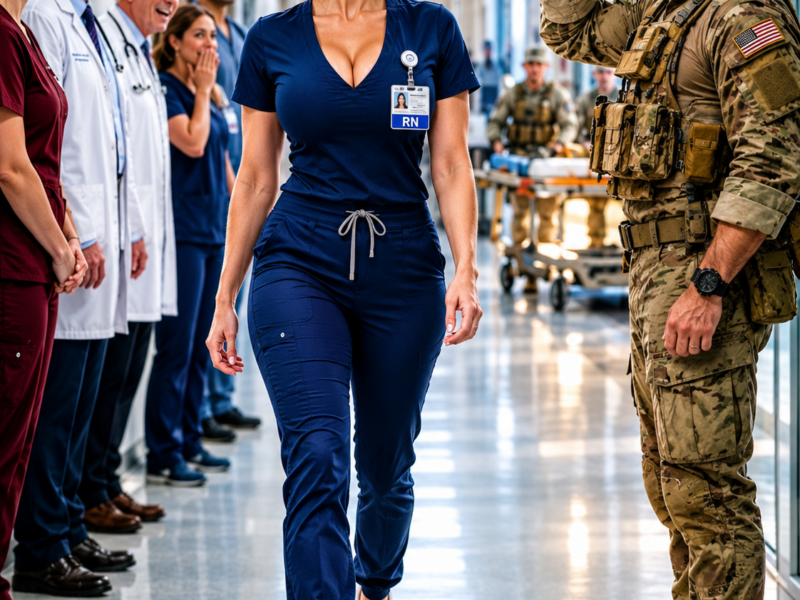
“I was being reprimanded in front of an entire hospital staff for refusing to leave a critically injured soldier alone when the emergency room doors suddenly burst open
The officer’s question hung in the hallway.
Dr. Lawson was the first to answer.
“Of course. He’s a patient in my department. Several members of my staff have accessed his records.”
The officer didn’t look satisfied.
“Which members?”
Lawson folded his arms.
“You’re going to need to explain your authority before interrogating my employees.”
The officer reached into his jacket and produced a military identification card.
“My name is Major Thomas Reed. The man in your trauma bay is Staff Sergeant Michael Hayes. He’s a member of a Special Operations unit, and his presence in this hospital is part of an active federal investigation.”
He paused.
“And I asked a very simple question.”
Nobody moved.
I looked at the envelope in his hand.
My brother’s handwriting was unmistakable.
Daniel had always written his letters with a slight upward slant, as though even his words were trying to climb out of the page.
I had kept birthday cards from him for years.
I knew every curve of his handwriting.
“Can I see the photograph?” I asked.
Major Reed handed it to me.
There was Daniel, younger than I remembered him in my last photograph, smiling with one arm around a soldier I’d never met.
His hair was shorter, and there was a small scar above his left eyebrow.
I touched the picture.
“Where was this taken?”
“Fort Bragg,” Reed replied. “About five years ago.”
“That’s impossible. Daniel died four years ago.”
Reed looked down.
“I know what his death certificate says.”
“Then why are you standing here telling me he didn’t die?”
He glanced toward Lawson.
“Because I don’t believe we should discuss this in front of everyone.”
Lawson immediately stepped between us.
“This is my hospital. You don’t get to remove employees or patients without proper authorization.”
Reed studied him for a moment.
“Doctor, I’m going to ask you to step away from the nurse.”
Lawson laughed without humor.
“You’re making a serious mistake.”
A second operator moved toward the trauma bay.
The others remained near the elevators.
They weren’t behaving like men who had arrived to make a scene.
They were behaving like men who expected someone to try to stop them.
I looked at Reed.
“Please tell me what’s happening.”
He lowered his voice.
“Four years ago, Daniel Carter was assigned to a classified recovery operation overseas. His team discovered evidence that someone was using military medical evacuations to conceal the movement of injured personnel and sensitive intelligence.”
I stared at him.
“What does that have to do with his accident?”
“Daniel found something he wasn’t supposed to find. Before he could bring it to his commanding officer, the operation was compromised.”
My fingers tightened around the photograph.
“Was he killed?”
Reed didn’t answer immediately.
“I can’t give you a complete account yet. But the accident report you received was not the whole story.”
I felt anger rise beneath the confusion.
“You’re telling me my brother might have been alive, and nobody bothered to tell his family?”
Reed looked genuinely uncomfortable.
“I wish I had a better answer.”
“That’s not an answer.”
“No, ma’am. It isn’t.”
Behind us, Lawson raised his voice.
“This conversation is over. Emily, you’re off duty. Hand over your badge and leave the department.”
I turned toward him.
“Why are you so eager to get me out of here?”
He stared at me.
“Because you’ve allowed a personal connection to interfere with your professional judgment.”
“Then why did that patient recognize my brother’s name?”
Lawson said nothing.
That silence was the first answer I trusted.
Reed looked toward one of his men.
“Get the patient stabilized. Nobody transfers him without verification from the receiving command.”
The operator nodded and disappeared into the trauma bay.
I followed.
Lawson grabbed my wrist.
“I said you’re finished here.”
I looked at his hand.
Then at his face.
“Let go.”
He released me.
Reed had noticed everything.
“Doctor, I strongly recommend you remain available.”
Lawson gave him a tight smile.
“I have patients to care for.”
For the first time that night, I wondered whether that was true.
Inside the trauma bay, Michael Hayes was breathing with assistance.
His face had gone pale, and the monitor showed a heart rate that remained dangerously high.
A younger doctor was reviewing his blood work.
I approached the bed.
“Has he regained consciousness?”
The doctor shook his head.
“Briefly. His blood pressure dropped again.”
I checked the IV line.
Something caught my eye.
The medication label didn’t match the medication listed in the chart.
I leaned closer.
“Who prepared this?”
The doctor looked over.
“I did not.”
I read the label again.
The dosage was unusually high for his condition.
I checked the electronic administration record.
It showed the medication had been ordered by Dr. Lawson.
My stomach tightened.
“Don’t administer another dose until this is verified.”
The doctor frowned.
“Is something wrong?”
“I need pharmacy to confirm this order.”
I took the medication bag and compared it against the original treatment plan.
The discrepancy was real.
A few seconds later, Reed entered.
“What’s happening?”
I showed him the records.
“Someone entered a medication order that doesn’t match the patient’s current plan.”
He studied the screen.
“Could it be a mistake?”
“It could. But I’m not willing to assume that.”
The doctor called pharmacy.
While we waited, I checked Michael’s other lines and reviewed the latest laboratory results.
His condition was serious, but there was still a chance.
A nurse hurried into the room.
“Pharmacy confirmed the order was changed after Dr. Lawson approved the transfer.”
Reed’s expression hardened.
“Who changed it?”
She looked uncomfortable.
“The user account belongs to Dr. Lawson.”
I felt a chill travel down my arms.
“Was the medication administered?”
“No. It was caught before it reached the patient.”
Reed nodded.
“Preserve the records. Don’t delete or modify anything.”
He turned to his team.
“Call the appropriate federal investigators.”
I looked at Michael.
The man had been trying to tell us something from the moment he arrived.
And I had nearly watched him disappear from the hospital because someone with a title told me not to ask questions.
I pulled a chair beside his bed.
“I’m here,” I whispered. “You’re not going anywhere until someone explains what happened.”
For several minutes, nothing changed.
Then his fingers moved.
I leaned forward.
“Michael?”
His eyelids fluttered.
He opened them slightly.
“Emily?”
“Yes. I’m here.”
He swallowed painfully.
“Daniel…”
“I know. They told me you knew my brother.”
Michael tried to lift his hand.
I gently placed my palm against his.
“Don’t strain yourself.”
His eyes moved toward Reed.
“Did you bring it?”
Reed nodded.
“She’s got the photograph.”
Michael closed his eyes.
For a moment, I thought he had lost consciousness again.
Then he whispered, “The blue house.”
I frowned.
“What blue house?”
He tried to speak, but his breathing became uneven.
Reed stepped closer.
“Michael, you need to rest.”
Michael shook his head weakly.
“She has to know.”
His gaze returned to me.
“Daniel left something… before they took him.”
“Who took him?”
His lips trembled.
“People we trusted.”
A monitor alarm interrupted him.
The medical team rushed forward, and I stepped aside while they stabilized his breathing.
Reed gently guided me into the hallway.
“That’s enough for now.”
I looked at him.
“What blue house?”
He rubbed his forehead.
“Daniel had a property listed in his old records. A small rental house outside Fayetteville. Blue exterior. He used it during a training period.”
“Did he own it?”
“Not officially.”
I remembered something.
A year before Daniel’s reported death, he had called me late one evening.
He’d sounded tired.
Not physically exhausted, but like someone who had spent too long choosing every word.
He asked me whether I still kept the spare key to our mother’s old storage unit.
I told him I did.
He said, “If anything ever happens to me, don’t throw away the old boxes.”
I had laughed and asked whether he was planning to become a spy.
He hadn’t laughed.
Now that memory returned with uncomfortable clarity.
“Where is that house?”
Reed gave me an address.
I recognized the road.
It was less than two hours from San Antonio.
Before I could say anything, my phone vibrated.
An unknown number.
I answered.
“Hello?”
A man’s voice spoke quietly.
“Emily Carter?”
“Who’s this?”
“You need to stop talking to the military.”
My skin prickled.
“Who are you?”
“Your brother made a mistake. Don’t make the same one.”
The call ended.
I stared at the screen.
Reed immediately noticed my expression.
“What happened?”
I handed him the phone.
He checked the number.
“Did you recognize the voice?”
“No.”
“Did he say anything else?”
I repeated the words.
Reed looked toward the elevators.
“You’re not leaving this hospital alone.”
“Major, I need to know what happened to my brother.”
“And I need you alive long enough to find out.”
I hated how calmly he said it.
But I understood that he wasn’t exaggerating.
Within twenty minutes, two investigators arrived.
They introduced themselves, secured the medication records, and began interviewing hospital staff.
Dr. Lawson was nowhere to be found.
A hospital administrator claimed he had left through the physician parking garage.
The security cameras showed him exiting at 2:41 a.m.
He hadn’t returned.
By 4:00 a.m., Michael’s condition had stabilized enough for him to be moved to a secure room under medical supervision.
Reed arranged for an official escort.
I stayed with Michael until sunrise.
He woke briefly around 6:20.
This time, he was able to speak in complete sentences.
“Emily?”
I moved closer.
“How are you feeling?”
“Like I got hit by a truck.”
Despite everything, I almost smiled.
“That’s one way to describe it.”
He studied my face.
“You look like him.”
“Daniel?”
He nodded.
“Same eyes.”
I sat down.
“Tell me what happened.”
Michael stared at the ceiling.
“Daniel saved my life once. I never got to repay him.”
“You don’t owe him anything.”
“That’s not how he saw it.”
He took a slow breath.
“Four years ago, we were sent to recover a group of injured personnel after an operation went bad. The official mission report said the evacuation had been completed. It hadn’t.”
“What happened?”
“Three men were left behind. Their names disappeared from the paperwork. Their medical records were changed. One of them was still alive, but the system said he had already been evacuated.”
I felt a knot form in my stomach.
“Why would anyone do that?”
“Because someone was using those records to cover up illegal transfers. They were moving people under false identities. Sometimes they were injured soldiers. Sometimes they were witnesses.”
I thought about the unexplained transfer order.
“And Daniel discovered it?”
“He found a pattern. The same names appeared on different evacuation forms. The same medical facilities were listed, even when the patients had never been there.”
“Was St. Mary’s involved?”
Michael looked at me.
“I don’t know.”
The answer unsettled me more than a yes would have.
“Daniel believed someone inside the hospital network was helping them. He didn’t have enough evidence to prove it.”
“That’s why he called me about the storage unit?”
Michael nodded.
“He left copies of documents. Not the originals. He was afraid someone would search his apartment.”
I leaned forward.
“Did you see him after the accident?”
Michael’s expression changed.
“Yes.”
The room seemed suddenly smaller.
“When?”
“About six weeks after the accident.”
I pressed my hand against my mouth.
“Where?”
“At a safe location. He was injured, but alive.”
I stared at him.
“Why didn’t he call me?”
Michael looked away.
“He wanted to. More than once.”
“That doesn’t answer my question.”
“He believed your phone was being monitored. He thought anyone close to him could become a target.”
I shook my head.
“That’s what everyone says when they decide someone else doesn’t deserve the truth.”
Michael didn’t argue.
Instead, he reached beneath his hospital blanket and pulled out a small plastic pouch.
Inside was a folded piece of paper.
“I kept this for him.”
I opened it.
It was a photograph of Daniel and me standing outside our mother’s house.
I was holding a birthday cake.
Daniel had his arm around my shoulders.
On the back was a short message.
“To Emily. The only person who ever knew when I was lying.”
My vision blurred.
I remembered that birthday.
Daniel had arrived two hours late and claimed his car had broken down.
I’d known immediately that he was hiding something.
But I hadn’t pushed.
He’d spent the evening helping me clean the kitchen, washing every dish while I complained about my terrible day at work.
I hadn’t known it might be the last normal evening we would ever have together.
“Where is he now?” I asked.
Michael looked at Reed.
The major had been standing quietly near the door.
“We don’t know,” he said.
I turned toward him.
“What do you mean?”
“Daniel disappeared after the safe location was compromised. We spent years trying to find him.”
“And now?”
“Michael believes Daniel left something at the blue house.”
Michael nodded.
“That’s where he told me to go if we ever lost contact.”
I looked down at the photograph.
My brother had been alive six weeks after the funeral.
I had stood beside his grave.
I’d listened to people tell stories about him.
I’d returned his clothes to his closet because I couldn’t bring myself to donate them.
And somewhere, he had been breathing.
I wanted to be angry with him.
I was angry with him.
But beneath it was something I couldn’t admit without breaking down.
Hope.
At 8:30 that morning, Reed arranged transportation to the blue house.
I was reluctant to leave Michael, but his condition was stable, and another nurse agreed to remain with him.
Before I left, he caught my hand.
“Emily.”
I turned.
“Yeah?”
“If you find Daniel, tell him I kept my promise.”
“What promise?”
Michael gave a tired smile.
“That I’d bring you home.”
I didn’t understand.
Not yet.
The blue house sat at the end of a quiet road lined with oak trees.
Its paint had faded in the Texas sun.
The front porch sagged slightly, and weeds had grown around the mailbox.
It looked ordinary.
Almost disappointingly ordinary.
Reed checked the property before allowing me inside.
Two operators searched the rooms while I waited in the doorway.
There was dust on the furniture.
A coffee mug sat on the kitchen counter.
A calendar from four years earlier still hung beside the refrigerator.
One date had been circled.
October 18.
The same date engraved on Michael’s military tag.
I approached it.
Under the date, someone had written two words.
“Don’t forget.”
Reed noticed.
“Does that mean anything to you?”
I shook my head.
“Not yet.”
The house contained very little.
A sofa.
A kitchen table.
Two bedrooms.
A small office with a locked filing cabinet.
One operator checked the cabinet and reported that it was empty.
I walked into the second bedroom.
There was a narrow closet with a wooden shelf.
On the shelf sat an old shoebox.
My name was written across the lid.
I sat on the edge of the bed.
For several seconds, I couldn’t make myself touch it.
Then I lifted the lid.
Inside were letters.
Dozens of them.
All addressed to me.
Some were dated before Daniel’s reported death.
Others were dated months afterward.
I picked up the first one.
“Emily,
I don’t know whether you’ll ever read this. I hope you won’t need to.”
My hands began to shake.
“I know you’ll be angry. You have every right to be. But there are things happening that I can’t explain without putting you in danger.”
I stopped reading.
The words blurred.
Reed stood near the doorway.
“Take your time.”
I opened another letter.
This one was dated eight months after the funeral.
Daniel wrote about the weather.
About a restaurant he remembered from childhood.
About how he still hated the taste of hospital coffee.
Then he wrote:
“I saw a woman wearing your blue scarf at a grocery store yesterday. For a second, I thought it was you. I almost followed her.”
I pressed the paper against my chest.
He had been close enough to see people who reminded him of me.
And I had been living as though he were gone.
I opened the last envelope.
There was no letter inside.
Only a small key and a folded piece of paper.
“Mom’s storage unit. Box 214. Don’t trust anyone who says they already searched it.”
I looked up.
“Major Reed, I need to go somewhere.”
He examined the note.
“Where?”
“Our mother’s storage unit.”
The facility was on the other side of town.
My mother had died when I was twenty-six, and I had kept her belongings in storage because neither Daniel nor I had been ready to let them go.
I hadn’t visited in almost three years.
When we arrived, Reed had the facility manager verify my identity.
Box 214 was near the back of the building.
The lock turned easily.
Inside were old photo albums, kitchen utensils, a winter coat, and a wooden jewelry box.
At the bottom sat a metal document case.
The key from Daniel’s letter fit.
I opened it.
There were printed emails, medical transfer records, photographs, and handwritten notes.
One document listed the names of seven injured personnel.
Three had been marked as deceased.
Two had been recorded as transferred.
One had no destination listed.
The final name was Michael Hayes.
His status read: “Transferred — destination verified.”
But Michael had just told us he had never reached that destination.
I looked at Reed.
“These records were altered.”
He nodded.
“Yes.”
I continued reading.
A series of hospital invoices showed repeated payments to a medical logistics company.
The company had no visible connection to the military.
But its registered address belonged to a private office complex in San Antonio.
A second set of papers listed several hospital employees who had approved unusual transfers.
I scanned the names.
Then I found one that made my breath catch.
Richard Lawson.
He had been working at St. Mary’s for years.
I had trusted his medical judgment.
I’d watched him comfort grieving families.
I’d accepted his criticism because I believed he was simply a difficult supervisor.
But his signature appeared on three transfer authorizations.
I handed the documents to Reed.
“Was he involved in what happened to Daniel?”
Reed studied the pages.
“We need to establish exactly what these records prove. But his name is significant.”
I turned another page.
There was a photograph of a hospital corridor.
It was St. Mary’s.
The image had been taken from a security camera.
A man stood near the elevator, holding a folder.
I recognized the coat.
It belonged to Lawson.
The photograph was dated three days after Daniel’s supposed accident.
I looked at Reed.
“Why was my brother’s case connected to my hospital?”
He didn’t answer.
Instead, he pointed to a handwritten note in the margin.
“Look at the initials.”
I leaned closer.
D.C.
Daniel Carter.
Beneath them was a sentence.
“Emily is not part of this. Keep it that way.”
I felt my stomach turn.
My brother had known someone at St. Mary’s.
And he’d been afraid that person would reach me.
Reed’s phone rang.
He stepped away to answer it.
I continued searching the case.
At the very bottom was a small memory card inside a plastic sleeve.
A label had been attached.
“FOR EMILY — ONLY.”
I held it up.
Reed ended his call and returned.
“What is it?”
“Something Daniel left for me.”
He looked at the label.
“We’ll need to examine it securely.”
I shook my head.
“He wrote my name on it.”
“Emily, I understand. But we don’t know what’s on there.”
“Neither do I.”
He considered that for a moment.
Then he nodded.
“We’ll use a secure device. No network connection.”
One of the investigators brought a laptop from the vehicle.
The memory card contained a single video file.
Its date was four years old.
I sat at the storage unit’s folding table.
Reed stood behind me.
I pressed play.
The screen flickered.
Then Daniel appeared.
He looked tired.
His hair was longer, and there was a small bandage near his temple.
But it was him.
My brother.
Alive.
I covered my mouth.
“Hey, Em.”
His voice was exactly the same.
A little rough around the edges.
A little amused, even when he was serious.
“If you’re watching this, something went wrong.”
He paused and looked away from the camera.
“I wanted to come home. I need you to know that first.”
Tears slid down my face.
“I thought about calling you every day. I thought about driving to the house and knocking on your door. But the people who were following me knew your name.”
He took a breath.
“There’s something else. The records we found weren’t just being used to hide missing soldiers. Someone was using medical transfers to make certain people disappear.”
He leaned closer.
“Lawson wasn’t the person who started it. But he knew what was happening.”
I looked at Reed.
He was watching the screen carefully.
Daniel continued.
“Emily, there’s a man named Victor Shaw. He runs the company behind the transfers. He has friends in places where people don’t ask questions.”
He glanced down at something outside the frame.
“Michael knows where the original records are. If he survived, he’ll be able to help you find them.”
Then Daniel’s expression softened.
“I know you’re going to hate me for this. I know you deserved better. But I wasn’t trying to leave you.”
He gave a small, sad smile.
“I was trying to make sure you got to live your life.”
The video ended.
I sat staring at the black screen.
For four years, I had imagined Daniel’s final moments.
I’d wondered whether he had been afraid.
Whether he’d thought of me.
Whether he’d known I would be alone.
Now I knew he had thought of me.
But that knowledge didn’t erase the years.
It didn’t give back the birthdays, the holidays, or the ordinary phone calls.
It only made the absence more complicated.
Reed gently placed a hand on the back of my chair.
“Emily, we have enough here to reopen the investigation.”
I wiped my face.
“Then do it.”
He nodded.
“And we’ll find your brother.”
I looked at him.
“Don’t promise me that unless you can mean it.”
“I can’t promise we’ll find him. I can promise we won’t stop looking.”
For the first time, I believed him.
The investigation moved quickly over the next several days.
The medical records from St. Mary’s were secured.
Lawson was located at a private residence and taken in for questioning.
The investigators discovered that he had been accepting payments from Victor Shaw’s logistics company for years.
He had altered transfer records and helped create false medical histories.
But he had not been the mastermind.
He had been a frightened, compromised employee who had convinced himself that cooperating was safer than refusing.
During questioning, Lawson initially denied knowing Daniel.
Then investigators showed him the photograph from the hospital corridor.
He stopped talking.
Eventually, he admitted that Daniel had confronted him after discovering the altered records.
Lawson claimed he had only agreed to one meeting.
He said Daniel had asked him to delay a transfer long enough for Michael Hayes to escape.
Instead, Lawson had informed Victor Shaw’s people.
The meeting had been compromised.
Daniel disappeared that night.
Lawson insisted he didn’t know whether Daniel had survived.
When investigators asked why he had ordered Michael’s transfer at St. Mary’s, he said he had recognized the initials on the identification tag.
He had realized Michael might expose the old operation.
He wanted him moved before anyone could question him.
The medication order had been another attempt to make the transfer easier.
He denied intending to kill Michael.
But that distinction didn’t make his choices any less dangerous.
When I heard the explanation, I sat quietly in the investigators’ office.
I thought about the nights Lawson had walked past me without saying hello.
The times he’d dismissed my concerns.
The way he’d looked at me when I asked why the patient couldn’t stay.
I had spent years believing that being quiet made me invisible.
Now I understood that someone had been counting on it.
The next morning, I received a call from Reed.
“We have a possible location.”
I gripped the phone.
“Daniel?”
“We found a financial trail connected to one of Shaw’s properties. A rural medical facility in Tennessee. It was shut down last year.”
“Is he there?”
“We don’t know. But one of the staff members remembered a man who used the name David Carter.”
I closed my eyes.
“That’s him.”
“Emily, I need you to understand something. If he’s there, he may not be ready to come home.”
I swallowed.
“I’ve waited four years. I’m not going to demand that he explain everything before I see him.”
Reed was quiet.
“We’ll contact you when we have confirmation.”
The next three days were the longest of my life.
I went to work, but I couldn’t concentrate.
Every time the elevator opened, I looked up.
Every time my phone rang, my hands went cold.
Michael called from the hospital.
His recovery was slow, but he was improving.
He told me the investigators had found additional evidence linking Victor Shaw to several disappearances.
He also told me something I hadn’t known.
Daniel had insisted that if the investigation ever reached me, Michael should make sure I was protected.
“He trusted you,” Michael said.
“He shouldn’t have had to.”
“Maybe. But he did.”
On the fourth evening, Reed called again.
“We found him.”
I sat down on the edge of my bed.
“Is he alive?”
“Yes.”
For several seconds, I couldn’t breathe properly.
“Where?”
“He’s receiving medical care at a secure facility. He’s been injured, but he’s stable.”
“When can I see him?”
“Tomorrow, if you’re willing.”
I let out a sound that was somewhere between a laugh and a sob.
“I’ve been willing for four years.”
The facility was a quiet medical center outside Nashville.
There were no dramatic entrances.
No uniforms lining the hallway.
Just a receptionist, a security officer, and the smell of fresh coffee.
Reed met me near the entrance.
“He knows you’re coming.”
I nodded.
My hands were shaking so badly that I tucked them into my coat pockets.
We walked down a long corridor.
At the end was a room with the door slightly open.
Reed stopped.
“I’ll wait here.”
I pushed the door.
Daniel was sitting beside the window.
His hair was mostly gray at the temples.
There was a scar along his jaw and another near his neck.
He looked older.
Not like the man in the photograph.
Not like the brother who used to steal fries from my plate.
But when he turned and saw me, his expression changed in a way I recognized immediately.
“Em?”
I couldn’t move.
He stood slowly.
For a moment, neither of us said anything.
Then I crossed the room.
I hit his chest with both hands.
Not hard enough to hurt him.
Hard enough to let him know I was angry.
“You let me bury you.”
His eyes filled.
“I know.”
“You let me stand beside Mom’s grave and tell her I was the only one left.”
“I know.”
“You let me spend four years wondering what I could have done differently.”
He lowered his head.
“I am sorry.”
I wanted to say something cruel.
I wanted to tell him that no apology could repair what he’d taken.
Instead, I started crying.
Daniel reached for me, then stopped.
He wasn’t sure whether I would let him.
That hesitation broke something in me.
I stepped forward and wrapped my arms around him.
He held me carefully, as though I were something fragile he had spent years trying to protect.
For a long time, neither of us spoke.
Then I pulled away.
“Why didn’t you come home when it was over?”
Daniel looked toward the window.
“Because it wasn’t over.”
“Is it over now?”
He nodded slowly.
“Victor Shaw has been arrested. The records are in federal custody. The people who helped him are being investigated.”
“That’s not what I asked.”
He looked at me.
“I don’t know if everything is over. But I’m done hiding from you.”
I sat beside him.
For the next hour, he told me pieces of what had happened.
After the compromised meeting, Daniel had been injured and forced to disappear.
He spent months moving between temporary locations.
He couldn’t contact me because the people searching for him knew about our relationship.
Eventually, he had managed to send evidence through Michael.
But before the investigation could reach the authorities, the operation was compromised again.
Daniel had spent years trying to protect the remaining witnesses and locate the original records.
He had not known whether he could trust anyone outside his team.
When I asked why he hadn’t at least found a way to tell me he was alive, he didn’t make excuses.
“I was afraid,” he said.
“Of what?”
“That I’d come home and someone would follow me to your door.”
I looked at him.
“You could have told me that. You could have given me a choice.”
He nodded.
“You’re right.”
That was the first answer he gave me that didn’t try to soften what he’d done.
I reached for his hand.
“I don’t know how to get four years back.”
“You don’t have to.”
“I don’t know how to trust you immediately.”
“I understand.”
“But I don’t want to lose any more time.”
His fingers tightened around mine.
“Neither do I.”
We sat by the window until the light outside began to fade.
I told him about the hospital.
About the patients who asked for me by name.
About the old house we’d sold after Mom died.
About the birthday cards I’d kept.
He listened to everything.
Then he laughed softly when I told him I’d once threatened to throw away his old baseball glove.
“You wouldn’t.”
“I absolutely would.”
“You never had the heart.”
I smiled through my tears.
For the first time in four years, the sound of his laughter didn’t belong to a memory.
The investigation continued for months.
Victor Shaw was eventually charged with conspiracy, fraud, obstruction of justice, and multiple crimes connected to the disappearance of military personnel and witnesses.
Lawson lost his medical license and faced criminal charges for his role in falsifying records and interfering with patient care.
Several other employees were investigated.
Some had knowingly participated.
Others had signed paperwork without understanding what it meant.
Michael recovered enough to return home.
Before leaving the hospital, he visited me.
He was still thin, and he walked with a slight limp.
He handed me a small wooden box.
“Daniel asked me to give you this when everything was safe.”
Inside was a silver bracelet.
It belonged to our mother.
I’d thought it had been lost when we emptied her house.
Beneath it was a folded note.
“Em,
I know I can’t ask you to forgive four years in one afternoon.
I don’t expect you to.
But I want you to know that every time I had the chance to come home, I thought about the person who would be waiting for me.
You were never forgotten.
Not once.”
I closed the box.
Michael watched me.
“He talked about you all the time.”
I looked up.
“Did he?”
“More than he probably should have.”
I laughed quietly.
“That sounds like him.”
Michael nodded.
“He’s a stubborn man.”
“So I’ve been told.”
Before he left, he hugged me.
Then he said something I would remember for the rest of my life.
“That night at St. Mary’s, you didn’t know who he was. You didn’t know what was happening. You just saw a patient who needed someone to stay.”
I looked toward the trauma bay.
“That’s what nurses do.”
Michael shook his head.
“Not everyone does it when it’s inconvenient.”
I didn’t know what to say.
A few weeks later, I returned to work.
The hospital had appointed a new medical director.
The investigation had changed the department.
New procedures were in place for emergency transfers.
Staff members were being retrained.
And for the first time in years, someone asked the night nurses what they thought before making major decisions.
I didn’t receive a medal.
I didn’t want one.
I only wanted the people in those beds to be treated as people, not paperwork.
One evening, as I was finishing a shift, I found a small envelope in my locker.
My name was written across the front.
Inside was a photograph.
It showed Daniel, Michael, and the rest of their team standing together outside a military hospital.
On the back, someone had written:
“To the nurse who never walked away.”
I smiled.
Then I placed the photograph beside the picture of my mother and brother that I had kept for years.
Daniel was still learning how to live without looking over his shoulder.
Some days were easy.
Others weren’t.
He occasionally woke from nightmares and sat in the kitchen until sunrise.
I learned not to ask him to explain every silence.
He learned that he didn’t have to disappear whenever life became difficult.
We weren’t able to recover the years we’d lost.
But we began making new memories.
Sunday breakfasts.
Long drives.
Arguments about baseball.
Phone calls that didn’t need a reason.
One afternoon, nearly a year after that night at St. Mary’s, Daniel came to visit me during my break.
He stood outside the nurses’ station holding two coffees.
I looked up and laughed.
“You brought the wrong one.”
He glanced at the cup.
“Black coffee. No sugar.”
“That’s yours.”
He smiled.
“Right. Yours is the one with too much cream.”
I took the cup.
For a moment, I just looked at him.
There had been a time when I thought I’d never see that face again.
Now he was standing in front of me, complaining about the hospital parking garage.
Before he left, he reached into his jacket and handed me a folded piece of paper.
It was a copy of the original death report.
Across the top, someone had stamped a correction.
“CASE REOPENED — DEATH RECORD VOIDED.”
I read it twice.
Then I folded it and put it in my pocket.
Daniel watched me.
“Does it help?”
I thought about the funeral.
The unanswered questions.
The years of believing I had lost the last member of my family.
Then I looked at my brother, standing there with coffee in his hand.
“It doesn’t give me those years back,” I said.
He nodded.
“But it means I don’t have to keep living as though you’re gone.”
He reached for my hand.
And this time, when he promised he wasn’t going anywhere, I didn’t need a photograph or a document to believe he meant it.
Outside the hospital windows, another shift was beginning.
A new patient was arriving.
Somewhere down the hall, a nurse was quietly preparing a bed, checking a chart, and making sure no one was left alone.
I watched Daniel walk toward the elevator.
He turned once and raised his coffee cup.
I raised mine in return.
Then I went back to work, knowing that the quietest person in the room might sometimes be the one who refuses to let the truth disappear.
The end.









