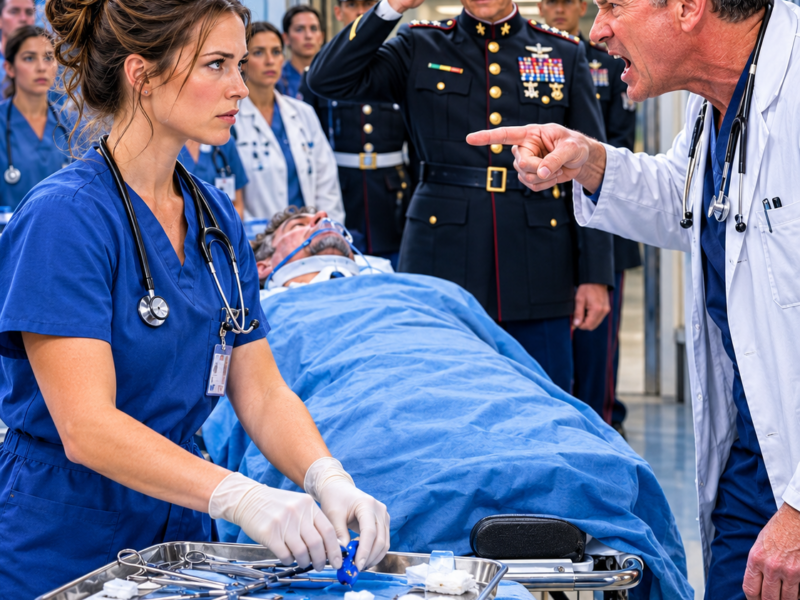
“I was being laughed at by three senior doctors in the middle of the emergency room when a four-star Marine general walked through the ambulance doors
The general held the photograph between two fingers, but he didn’t hand it to Dr. Hayes.
He kept looking at me.
“Emily, may I?”
I stared at the picture.
Three years had passed, but I could still remember the day it was taken as clearly as if someone had placed me back inside that helicopter.
“Yes, sir,” I whispered.
He turned the photograph toward the doctors.
It showed four people standing beside a military helicopter in Afghanistan.
I was on the left, wearing dusty combat fatigues and a medical vest.
My hair was pulled into a tight bun, my face streaked with dirt.
Beside me stood a young Marine with a wide smile and one arm around my shoulder.
His name was Sergeant First Class Matthew Reed.
At the time, he was twenty-nine years old.
He was also the man everyone had believed was dead.
Dr. Bennett leaned closer.
“Is that you?”
I nodded.
Dr. Hayes studied the picture.
“What’s the significance of this?”
The general’s expression hardened.
“That photograph was taken six hours before Emily Carter entered a burning military transport vehicle to rescue eleven Marines.”
Nobody moved.
“She was not ordered to go inside,” he continued. “The vehicle had taken an explosive hit. The fuel system was compromised, ammunition was cooking off, and the evacuation team had been told to stay back.”
Dr. Simmons looked at me.
“Eleven?”
“Eleven,” the general repeated.
He finally placed the photograph on the nurses’ station counter.
“She went in anyway.”
I looked down at my hands.
I didn’t want to remember the heat.
I didn’t want to remember the screaming.
And I especially didn’t want to remember the last voice I’d heard over the radio.
“General,” I said softly, “that’s enough.”
He studied my face.
For a moment, I thought he might ignore me.
Then he nodded.
“Of course.”
Dr. Hayes cleared his throat.
“General, with respect, I’m sure Nurse Carter’s military background is impressive. But we’re discussing a clinical disagreement that happened tonight.”
The general slowly turned toward him.
“Then let’s discuss it.”
He gestured toward the trauma bay.
“Who identified the tension pneumothorax in Corporal Brooks?”
Dr. Hayes hesitated.
“Our team did.”
“That wasn’t my question.”
The resident, Dr. Kevin Morris, looked uncomfortable.
“Emily noticed the respiratory changes first, sir.”
The general nodded.
“And who raised the concern?”
“Emily.”
“Who insisted that the patient’s condition needed immediate attention?”
Kevin glanced at Hayes.
“She did.”
The general looked back at the attending physician.
“Then perhaps you should be thanking her instead of reprimanding her.”
Hayes’s jaw tightened.
“I was supervising the case. She challenged my authority in front of the entire team.”
“An emergency department is not a stage for protecting someone’s pride, Doctor.”
The general’s voice wasn’t loud.
It didn’t need to be.
I could feel the tension spreading through the room.
But I wasn’t enjoying it.
I had spent years trying to become someone who didn’t need recognition for doing the right thing.
I didn’t want the general to destroy another person’s career just because he knew my history.
“Sir,” I said, “please don’t make this about me.”
He looked at me.
“Emily, it has never been just about you.”
I didn’t understand what he meant.
Not yet.
Before I could ask, a surgical resident hurried through the double doors.
“Dr. Hayes?”
Hayes turned.
“What?”
“Corporal Brooks is stable. The surgical team found the bleeding source and controlled it. His oxygenation has improved significantly.”
I released a breath I hadn’t realized I was holding.
The general closed his eyes briefly.
“Thank God.”
Then he looked at me again.
“May I ask you something?”
“Yes, sir.”
“Have you spoken to Matthew Reed since you left the service?”
The name hit harder than the general’s salute.
I shook my head.
“No.”
“Do you know where he is?”
“I was told he was recovering at Walter Reed. After that, I stopped receiving updates.”
The general’s expression changed.
“Emily, Matthew has been looking for you.”
My throat tightened.
“Why?”
The general didn’t answer immediately.
Instead, he reached into his uniform again and pulled out a second envelope.
It was worn around the edges.
My name was written across the front in handwriting I recognized instantly.
Matthew’s.
I couldn’t bring myself to touch it.
Dr. Simmons looked between us.
“Is this some kind of personal matter?”
The general glanced at her.
“It’s a matter that should have been resolved a long time ago.”
He held the envelope out.
I took it.
My hands were trembling now.
“How long have you had this?”
“Three years.”
I stared at him.
“Three years?”
“Matthew asked me to deliver it personally if I ever found you.”
“Why didn’t you?”
The general lowered his eyes.
“Because I didn’t know where you were. Your discharge records listed a forwarding address that no longer existed. When I finally located you, I was preparing to travel overseas.”
I looked at the envelope.
There was something strange about the way it had been sealed.
The flap had been opened and closed again.
“Has anyone read this?”
The general didn’t answer quickly enough.
My eyes moved to his.
“Sir?”
He exhaled.
“I have.”
“Why?”
“Because the contents involved an investigation that was still classified.”
Dr. Hayes gave a small, impatient sigh.
“Perhaps this conversation would be better suited to a private office.”
The general looked at him.
“You’re absolutely right.”
He turned toward me.
“Emily, would you come with me?”
I nodded.
We walked into a small consultation room near the back of the emergency department.
The general closed the door.
For the first time that night, the noise of the hospital became distant.
I placed the envelope on the table.
“Tell me what happened.”
He remained standing.
“Three years ago, the operation in Afghanistan was not as straightforward as the official report suggested.”
I felt my stomach tighten.
“What do you mean?”
“The vehicle carrying your team was not supposed to be on that road.”
I looked at him.
“We were rerouted because the original extraction point was compromised.”
“Yes. But the information about that compromised extraction point came from a source that had already been identified as unreliable.”
I slowly sat down.
“Who approved the route?”
The general paused.
“That is what the investigation was supposed to establish.”
I looked at the envelope again.
“Was Matthew involved?”
“No. Matthew was a casualty, just like the others.”
“Then why did you say he was looking for me?”
The general pulled out a chair.
“Because he remembers what happened after the explosion.”
I swallowed.
“I remember what happened.”
“Do you?”
His question was quiet.
But it made me look away.
Three years earlier, I had been serving as a Navy hospital corpsman attached to a Marine unit.
Our convoy had been moving through a narrow stretch of road when the first explosion hit.
I remembered the sound.
The violent shudder of the vehicle.
The dust.
The sudden pressure in my ears.
Then came the second blast.
When I regained consciousness, the transport vehicle was burning.
I had a cut across my forehead and blood running into my left eye.
Someone was shouting.
Someone else was praying.
And then I heard Matthew.
“Emily!”
He was trapped beneath a section of the vehicle.
His leg was pinned.
There was blood everywhere.
I crawled toward him.
“Don’t move!”
He looked at me through the smoke.
“Wasn’t planning on it.”
Even then, he tried to smile.
I found a way to lift part of the twisted metal using a damaged jack from the vehicle.
It took several minutes.
The fire was spreading.
One of the Marines had stopped breathing.
I started compressions while shouting for help.
There was no response from the radio.
No helicopter.
No rescue team.
Just smoke, fire, and eleven injured men.
I worked until my arms felt like they were coming apart.
When the first evacuation aircraft finally arrived, I had treated every Marine I could reach.
Matthew was still breathing.
Barely.
Before they loaded him, he grabbed my wrist.
“Promise me something.”
“Save your strength.”
“Emily. Look at me.”
I leaned closer.
“Don’t let them bury the truth.”
At the time, I thought he was delirious.
He had suffered a serious head injury.
I promised him anyway.
The next morning, I learned that two Marines had died.
Matthew was listed among the missing.
Then, several days later, I was informed that he had been recovered and transferred to another medical facility.
I tried to contact him.
My requests were denied.
My commanding officer told me to stop asking questions.
Weeks later, I was summoned to give a statement about the operation.
I reported what I remembered.
I mentioned that the radio had failed before the second explosion.
I also mentioned that our route had changed without a clear explanation.
The officer conducting the interview told me my recollection was inconsistent.
I disagreed.
He told me to be careful.
Two weeks later, I received an administrative notice accusing me of mishandling sensitive operational information.
I had never understood what information I supposedly mishandled.
My career ended quietly.
No dramatic courtroom.
No public accusation.
Just a discharge process, a stack of documents, and a final instruction not to discuss the operation.
I had spent the next three years trying to build a life that didn’t revolve around that day.
Now the general was telling me the story wasn’t over.
“Matthew survived,” he said.
“I know.”
“He regained consciousness after several surgeries. But he suffered complications from his injuries. His memory was incomplete for months.”
I nodded slowly.
“Why couldn’t he contact me?”
“Because his medical recovery overlapped with the investigation. And because someone had decided that keeping the two of you apart was convenient.”
I looked up.
“Someone?”
The general leaned forward.
“Emily, I need you to understand something. The investigation uncovered evidence that a senior logistics officer had altered the convoy’s route after receiving a warning about an imminent attack.”
My hands went cold.
“Who?”
“Colonel Thomas Whitaker.”
I knew the name.
He had been responsible for coordinating several operations in the region.
He had also been the officer who signed the paperwork that ended my military career.
The general continued.
“Whitaker was eventually removed from operational command. But the investigation never established whether he acted alone.”
I stared at him.
“And Matthew knows?”
“He remembers seeing something shortly before the attack. Something that may connect Whitaker to the decision.”
“What?”
The general looked at the envelope.
“That’s what Matthew wrote to you.”
I reached for it.
My fingers slipped under the flap.
Inside was a handwritten letter and a small folded piece of paper.
The letter was only two pages.
I recognized Matthew’s handwriting, though it had become less steady.
Emily,
If you’re reading this, I hope you’re somewhere peaceful.
I don’t know if you still remember what I said in the vehicle. I don’t blame you if you don’t.
I remember more now.
I remember the day before the convoy left.
I remember seeing Whitaker speaking to a civilian contractor near the operations tent.
I remember the contractor handing him a small envelope.
Most importantly, I remember Whitaker saying, “The new route will take care of the problem.”
I didn’t understand what he meant at the time.
But after I recovered, I learned that the route had been changed only forty minutes before departure.
The original route had been cleared.
The new route had not.
I also remember something else.
You weren’t supposed to be on that convoy.
You were assigned to a different medical team.
Someone changed your assignment at the last minute.
Emily, I think someone wanted you there.
I think they wanted you to be blamed if anything went wrong.
I stopped reading.
The room seemed to shrink around me.
I read the last paragraph.
I don’t know who to trust.
But I know you saved my life.
And I know you were punished for telling the truth.
I’m sorry it took me so long to find a way to reach you.
Matthew.
I lowered the letter.
For several seconds, I couldn’t speak.
The general sat quietly across from me.
Finally, I asked, “Why would someone deliberately put me on that convoy?”
He folded his hands.
“That’s the question we still haven’t answered.”
I looked at the small folded paper.
“What is this?”
“Something Matthew recovered from his personal equipment after he regained consciousness.”
I opened it.
It was a photograph of a handwritten assignment sheet.
The edges were torn.
The names were partially obscured by dirt.
But there, near the bottom, was my name.
Emily Carter.
And beside it, written in a different ink, were two words.
LAST MINUTE.
My stomach tightened.
“Where did this come from?”
“Matthew kept it because he thought it might matter.”
I studied the handwriting.
It looked familiar.
Too familiar.
The general noticed my expression.
“What is it?”
I turned the paper toward him.
“I’ve seen this handwriting before.”
“Where?”
I looked at the signature line.
It belonged to the administrative officer who had processed my discharge.
A man named Captain Robert Ellis.
The same man who had told me my testimony was inconsistent.
The same man who had warned me not to ask further questions.
The general slowly leaned back.
“Are you certain?”
“I spent three weeks looking at his signature on documents. I would recognize it anywhere.”
He nodded.
“Then we have a new direction.”
I looked at him.
“You’re investigating this again?”
“We never stopped.”
I wanted to believe him.
But trust had become difficult for me.
“Why bring this to me now?”
“Because Matthew asked me to. And because I believe the people responsible for what happened deserve to be held accountable.”
I glanced toward the consultation room door.
Outside, the hospital continued functioning.
Patients were arriving.
Phones were ringing.
Somewhere, a child was crying.
Life hadn’t stopped just because my past had walked back into the room.
“Does Dr. Hayes know any of this?”
“No.”
“Does anyone here?”
“Not unless you’ve told them.”
I nodded.
“Then I’d like to keep it that way.”
The general studied me.
“You’re entitled to privacy, Emily.”
I looked at him.
“Then why did you salute me in front of everyone?”
He didn’t answer immediately.
Finally, he said, “Because when I walked into that department, I saw three people laughing at a nurse who had just helped save a Marine’s life. I knew exactly who she was. And I wasn’t going to pretend her service didn’t matter.”
I looked down.
For the first time that night, tears gathered in my eyes.
I blinked them away.
“Thank you, sir.”
He stood.
“Get some rest. We’ll speak tomorrow.”
But the following morning, rest was the last thing I had on my mind.
I was in the hospital cafeteria when my phone rang.
Unknown number.
I almost ignored it.
Then it rang again.
“Hello?”
A man’s voice answered.
“Emily Carter?”
“Yes.”
“This is Robert Ellis.”
I stopped moving.
The cafeteria was full of people, but suddenly every sound seemed far away.
“Captain Ellis?”
There was a pause.
“I heard General Mitchell visited your hospital last night.”
I didn’t answer.
He continued.
“You shouldn’t have accepted that envelope.”
My fingers tightened around the phone.
“Why?”
“Because some things were left buried for a reason.”
I stood up.
“Did you change my assignment three years ago?”
Another pause.
Then a short breath.
“You’re asking questions you don’t understand.”
“Did you?”
“Listen carefully, Emily. You’re a nurse now. You have a career. You have a future. Don’t throw it away because a wounded Marine remembers something from a burning vehicle.”
My voice dropped.
“Did you know I was going to be on that convoy?”
He hung up.
I stood in the middle of the cafeteria, staring at the phone.
Then I noticed a man sitting near the window.
He wore a gray jacket.
He wasn’t eating.
He was watching me.
When our eyes met, he quickly stood and walked toward the exit.
I didn’t chase him.
Instead, I called the general.
“Sir, Ellis just contacted me.”
His voice sharpened.
“What did he say?”
I told him.
“Don’t leave the hospital,” he said. “I’m sending someone.”
“Someone from where?”
“Military police. And Emily?”
“Yes?”
“Do not contact Ellis again.”
The line went quiet.
I looked toward the cafeteria doors.
The man in the gray jacket was gone.
For the first time, I wondered whether leaving the military had really put enough distance between me and what happened in Afghanistan.
That afternoon, General Mitchell arrived with two investigators.
One was a civilian woman named Sarah Collins, who introduced herself as a special investigator assigned to the military’s criminal investigation division.
The other was a military police officer.
They met me in the same consultation room.
Sarah was in her forties, with short brown hair and a calm expression.
She placed a recorder on the table.
“We’d like to ask you about the convoy incident and your subsequent discharge.”
I nodded.
“I’ll tell you everything I remember.”
“Before we begin, I want you to know that you’re not under investigation.”
I almost laughed.
“That’s what they told me three years ago.”
Sarah didn’t smile.
“I understand.”
We spent nearly two hours going through my old statements.
I explained the route change.
The radio failure.
The assignment sheet.
The strange conversation I’d heard between two officers the evening before the convoy departed.
I hadn’t remembered it clearly until that moment.
One of them had said, “The medical team is being adjusted.”
The other had replied, “Make sure Carter is on the new list.”
At the time, I assumed it was routine.
Now I understood why Matthew’s letter had unsettled me.
Sarah wrote something down.
“Did you recognize either voice?”
“No.”
“Did you report the conversation?”
“No. I didn’t think it mattered.”
She nodded.
“That’s understandable.”
When the interview ended, she asked me to sign a statement.
I hesitated.
“Will this be used against me?”
“No,” she said. “It will be evidence in the investigation. And you will have access to legal representation.”
I signed.
For the first time in three years, I felt like someone was actually listening.
But the most difficult part was still ahead.
Two days later, Matthew arrived at St. Matthew’s.
I was changing a patient’s dressing when the charge nurse approached me.
“Emily, there’s someone asking for you.”
“Who?”
She hesitated.
“He says his name is Matthew Reed.”
I nearly dropped the gauze.
I finished securing the dressing, checked the patient’s comfort, and washed my hands.
Then I walked toward the main entrance.
He was sitting in a wheelchair near the reception desk.
His hair was shorter than I remembered.
There was a noticeable scar along his jaw.
His left leg was supported by a brace, and he held a walking cane across his lap.
But his eyes were the same.
The same tired humor.
The same stubborn warmth.
When he saw me, he tried to stand.
I rushed forward.
“Don’t. You’re going to hurt yourself.”
He smiled.
“Still giving orders, Carter?”
I couldn’t help it.
I laughed.
Then I cried.
He reached for my hand.
“I’m sorry.”
I shook my head.
“Don’t.”
“I should have found you sooner.”
“You were recovering.”
“I should have tried harder.”
I knelt beside his wheelchair.
For a moment, neither of us spoke.
Then he said something I hadn’t expected.
“Do you remember what you promised me?”
I looked at him.
“That I wouldn’t let them bury the truth?”
He nodded.
“I didn’t keep that promise.”
He squeezed my hand.
“You couldn’t. They took the choice away from you.”
I looked at his leg.
“How bad is it?”
“Bad enough that I won’t be running marathons.”
He gave me a small smile.
“Good thing I never liked running.”
I laughed through my tears.
Then his expression became serious.
“Emily, there’s something else you need to know.”
I sat back.
“What?”
“The night before the convoy left, I took a picture of Whitaker talking to that contractor.”
My breath caught.
“You have a picture?”
“I did.”
“What happened to it?”
He looked toward General Mitchell, who had entered quietly behind us.
“I gave it to someone I trusted.”
The general’s face became serious.
“Who?”
Matthew looked at me.
“Captain Ellis.”
Nobody spoke.
“Ellis told me he’d make sure the photograph reached the investigation team,” Matthew continued. “But after the explosion, when I woke up in the hospital, he told me the picture had been destroyed.”
I felt a cold pressure in my chest.
“Why would you give it to him?”
“I thought he was helping.”
Matthew lowered his eyes.
“Later, when I recovered enough to understand what had happened, I realized he had been the one handling the assignment changes.”
Sarah Collins stepped forward.
“Matthew, are you certain?”
He nodded.
“I saw him speaking to Whitaker. I saw him take the photograph from my equipment bag. And I remember the words he used.”
“What words?”
Matthew looked at me.
“He said, ‘This will be easier if everyone believes Carter made a mistake.'”
My hands began to tremble.
For three years, I had carried the shame of a failure that hadn’t been mine.
Now the person responsible might have been standing in front of me all along.
Sarah immediately requested the old investigation records.
But there was another problem.
Captain Ellis had retired from active duty.
And his personnel file showed that he had moved to Virginia.
We needed evidence.
Not memories.
Not suspicions.
Evidence.
The next week, investigators located a storage facility connected to Ellis’s former office.
A sealed box contained archived administrative documents.
Inside were copies of convoy assignments, communications logs, and several handwritten notes.
One document caught Sarah’s attention.
It was a message sent forty minutes before the convoy departed.
The original route had been marked safe.
The revised route had been approved by Colonel Whitaker.
But the authorization had been entered using Captain Ellis’s credentials.
Sarah studied the record.
“Someone used Ellis’s account to submit this.”
The general looked at her.
“Can we prove who?”
She nodded.
“Possibly. The system logs were preserved.”
For the first time, the investigation had something solid.
Then came another discovery.
A payment record showed that a civilian contractor had received money from a company connected to the logistics operation.
The payment had been authorized two days after the attack.
Its description was vague.
Consulting services.
The amount was $85,000.
The contractor’s name matched the one in Matthew’s old photograph.
Sarah placed the document on the table.
“This is enough to justify a formal interview.”
I looked at the general.
“Does this mean Whitaker planned the attack?”
“Not necessarily,” he replied. “But it suggests someone manipulated the route and attempted to conceal it.”
I thought about the eleven Marines.
The two who never came home.
Matthew’s damaged leg.
My discharge.
And the years I had spent believing I wasn’t good enough to serve.
“Then find out who did it,” I said.
Sarah nodded.
“We intend to.”
The formal interview with Ellis took place two weeks later.
I wasn’t required to attend.
But I asked to be present.
The general advised against it.
Sarah explained that hearing his account could be difficult.
I understood both concerns.
I went anyway.
Ellis entered the interview room wearing a navy suit.
His hair had turned gray.
He looked older than I remembered.
But the expression was familiar.
He glanced at me.
Then at the general.
“I suppose this is about the old convoy incident.”
Sarah opened a folder.
“It’s about the route change, the assignment modification, and the subsequent handling of evidence.”
Ellis sat down.
“I’ve already answered questions about that.”
“Not these questions.”
She placed the assignment sheet in front of him.
“Did you change Emily Carter’s assignment?”
He examined it.
“I processed hundreds of personnel changes.”
“That’s not an answer.”
He looked toward me.
“Emily, you should leave this alone.”
I didn’t respond.
Sarah placed another document on the table.
“This record shows that your credentials were used to submit the revised route authorization.”
Ellis shook his head.
“Someone else had access to the system.”
“Who?”
“I don’t know.”
She placed the payment record beside it.
“Do you know this contractor?”
He stared at the name.
For the first time, his confidence faltered.
“I’ve met a lot of contractors.”
“Did you receive money from this company?”
“No.”
“Did Colonel Whitaker?”
Ellis said nothing.
Sarah leaned forward.
“Mr. Ellis, we have testimony placing you with Whitaker before the convoy departed. We have evidence that you altered Carter’s assignment. We have a witness who says you took a photograph connected to the route change.”
Ellis looked at Matthew.
“You were barely conscious when I spoke to you.”
Matthew didn’t look away.
“I remember enough.”
Ellis shook his head.
“You don’t understand what was happening.”
I finally spoke.
“Then explain it.”
He looked at me.
For several seconds, I thought he might refuse.
Then he rubbed his forehead.
“Whitaker was under pressure. The contractor had been supplying information about local threats. Some of it was valuable. Some of it wasn’t.”
Sarah asked, “Did Whitaker knowingly send the convoy through an unsafe route?”
Ellis swallowed.
“He believed the intelligence was reliable.”
“Then why was the original route changed?”
“Because he received a message saying the original route had been compromised.”
“Who sent it?”
Ellis looked down.
“I don’t know.”
Sarah placed another document in front of him.
“This message was sent from your terminal.”
His face changed.
“I didn’t write that.”
“Then who did?”
He remained silent.
Finally, he said, “Whitaker told me to enter it.”
The room went still.
Sarah’s voice remained steady.
“Did he know the revised route had not been cleared?”
Ellis nodded once.
“Yes.”
I felt the words settle over me.
“Why?” I asked.
Ellis looked at me.
“Because the convoy was carrying a witness.”
I stared at him.
“What witness?”
He closed his eyes briefly.
“The civilian contractor had been selling information to multiple groups. Whitaker discovered it. He wanted the contractor removed before the investigation became public.”
Sarah’s expression hardened.
“Are you saying the convoy was deliberately sent into an ambush?”
Ellis shook his head.
“I don’t know whether Whitaker intended for anyone to die. He wanted the contractor intercepted. He thought the convoy would be able to handle it.”
“And the Marines?”
“He believed they would survive.”
I stared at him.
“Two of them didn’t.”
He didn’t answer.
“Matthew lost the use of his leg.”
Still nothing.
“And I lost my career.”
Ellis finally looked at me.
“I’m sorry.”
I waited for more.
For an explanation.
For some sign that he understood what those words meant.
But he offered nothing.
Sarah continued the interview.
Ellis eventually admitted that he had changed my assignment because Whitaker wanted a medic who could be blamed if the convoy’s medical response was questioned.
He had also withheld the photograph Matthew had given him.
He claimed he never received the $85,000 personally.
The money had gone through a company associated with the contractor.
His testimony was not enough to establish every part of the conspiracy.
But it gave investigators a clear path.
The investigation lasted another six months.
Colonel Whitaker was eventually charged with falsifying operational records, obstruction, and misconduct related to the convoy operation.
The civilian contractor was arrested in a separate investigation involving the sale of military information.
Ellis entered a cooperation agreement after additional electronic records contradicted his original statements.
He admitted his role in the assignment change and the concealment of Matthew’s photograph.
Not every question received an answer.
We never learned exactly how much Whitaker knew about the planned attack.
We never recovered every communication sent that night.
But the official report was corrected.
My original testimony was found credible.
My discharge record was amended to remove the allegations that had followed me for three years.
When the letter arrived, I read it twice.
Then I placed it on my kitchen table and sat down.
There was no cheering.
No dramatic music.
Just the refrigerator humming in the background and the afternoon sun falling across a document I had once thought I would never receive.
For three years, I had wondered whether I had failed those Marines.
Now I finally had an official answer.
I hadn’t.
A month later, the hospital held a small recognition ceremony.
I had tried to decline.
I wasn’t interested in standing on a stage while people applauded something I had never considered heroic.
But General Mitchell called me personally.
“Emily, this isn’t about making you uncomfortable. It’s about correcting something that should never have happened.”
So I agreed.
The emergency department conference room was filled with nurses, physicians, hospital administrators, and several military representatives.
Dr. Hayes stood near the back.
He looked different.
Less certain of himself.
When he approached me before the ceremony, he held a folded piece of paper.
“Emily, could I speak with you?”
I nodded.
He looked down at his hands.
“I owe you an apology.”
I waited.
“I was wrong about you. Not just that night. I made assumptions about your background, and I allowed my pride to interfere with patient care.”
He paused.
“I also allowed the other physicians to treat you disrespectfully.”
His voice was quieter now.
“I am sorry.”
I studied him.
Part of me wanted to tell him exactly how humiliating those first eleven days had been.
How many times I had questioned whether I belonged.
How often I had gone home and replayed conversations in my head.
But I didn’t want to spend the rest of my life carrying his behavior.
“Thank you for saying that,” I replied.
He nodded.
“I hope you’ll let me earn your trust.”
“That will take time.”
“I understand.”
It wasn’t a perfect reconciliation.
It didn’t need to be.
The ceremony began a few minutes later.
General Mitchell spoke about the Marines who had served in Afghanistan and the people who continued to care for them after returning home.
He mentioned the two men who had died.
He mentioned Matthew.
And then he mentioned me.
He didn’t describe me as a hero.
He described me as a medical professional who had made a difficult decision under pressure and continued serving people even after her own service had been taken from her.
When he finished, the room applauded.
I looked toward the back.
Matthew was sitting in the first row, his cane resting against his chair.
He gave me a small nod.
I smiled.
Then the general asked me to come forward.
He handed me a framed certificate recognizing my military service and my actions during the Afghanistan operation.
I accepted it.
But before I stepped away, I turned toward the audience.
“Thank you,” I said. “But I want to make sure we remember the people who didn’t make it home.”
The room grew quiet.
“Two Marines died that day. Their families lived with questions for three years. Matthew has spent three years learning how to walk again. And there are people whose names will never appear in a photograph like this.”
I looked down at the certificate.
“I don’t need anyone to call me brave. I just want the truth to stay where everyone can see it.”
When I stepped away from the microphone, Matthew was waiting.
He stood slowly, leaning on his cane.
“You always did know how to make a room uncomfortable.”
I laughed.
“You should try it sometime.”
He looked at the certificate.
“Looks good on you.”
“Thank you.”
He hesitated.
“Can I ask you something?”
“Of course.”
“Have you ever regretted leaving the service?”
I looked toward the hospital corridor.
A nurse was pushing a medication cart.
A young doctor was explaining something to a patient’s family.
Somewhere, a monitor began beeping.
“No,” I said after a moment. “I regret that I was forced to leave the way I did. But I don’t regret being here.”
Matthew nodded.
“Good.”
Then he looked at me with an expression I hadn’t seen since Afghanistan.
“You know, I still remember what you said when you pulled me out of that vehicle.”
“What?”
“You told me I was going to make it.”
I smiled.
“I was trying to keep you conscious.”
“You sounded pretty certain.”
“I was.”
He looked down at his cane.
“I wasn’t.”
I reached for his hand.
“Neither was I.”
For a moment, we stood quietly.
Then he said, “I think I owe you dinner.”
I raised an eyebrow.
“Is that your idea of a thank-you?”
“No. It’s my idea of asking you out.”
I laughed.
“You’re terrible at this.”
“I’ve had three years of physical therapy. Nobody prepared me for this part.”
I looked at him.
The scar on his jaw was still there.
His leg would probably never be the same.
Neither of us would ever be the people we had been before that convoy.
But we were still here.
And that counted for something.
“Friday,” I said.
His face brightened.
“Friday?”
“Don’t make me repeat myself.”
He smiled.
“Yes, ma’am.”
That evening, after my shift, I returned to the emergency department.
The same fluorescent lights were glowing above the trauma bays.
The same supply cabinets stood along the walls.
The same nurses moved quickly between patients.
I stopped outside the room where Corporal Daniel Brooks had been treated.
His bed was empty.
A small handwritten card sat on the counter.
It read:
Thank you for staying with me when I thought I wasn’t going to make it.
I picked it up and read it twice.
Then I placed it carefully back where I found it.
I thought about the general’s salute.
About the photograph.
About the years I had spent believing that the truth might never come out.
And I realized something.
The salute hadn’t restored my career.
The certificate hadn’t erased what happened.
And an apology couldn’t return the years I’d lost.
But none of those things had to carry the entire weight of my healing.
I had found my place again.
Not because someone important finally recognized my name.
But because a frightened young Marine had needed someone to hold his hand, and I had been there.
The next morning, I arrived early for my shift.
Dr. Hayes was already in the trauma bay, reviewing patient charts.
He looked up when I entered.
“Morning, Emily.”
“Morning, Doctor.”
He glanced toward the empty bed beside him.
“We’ve got a new admission coming in. Possible internal bleeding.”
I washed my hands and pulled on a fresh pair of gloves.
“What’s the estimated arrival?”
“Three minutes.”
I nodded and moved into position.
No one laughed.
No one questioned whether I belonged.
And when the ambulance doors opened, I didn’t think about the photograph, the investigation, or the general standing in the entrance.
I thought about the patient.
Because that was the work.
That had always been the work.
And somewhere in the hospital, behind a framed certificate I had finally learned to accept, was a photograph of eleven Marines who had survived a terrible day because people refused to give up on them.
I kept that photograph beside my nursing license.
Not as proof that I was somebody important.
But as a reminder that the people we save don’t always get to know how hard we fought to bring them home.
THE END.









