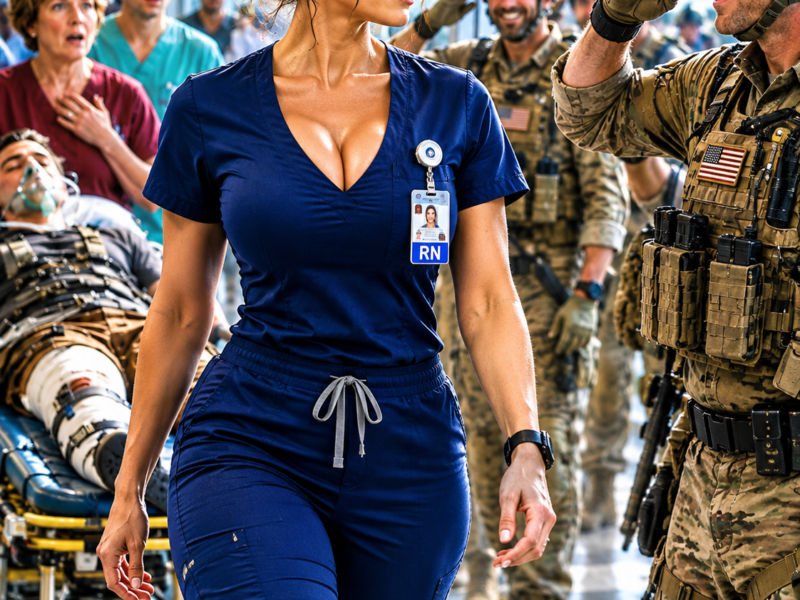
“I was being laughed at by three senior doctors for being ‘just a float nurse’ when six Special Forces operators stormed into the emergency department
I stared at the photograph in Captain Holloway’s hand.
For a moment, the emergency department disappeared.
The monitors, the fluorescent lights, Dr. Walsh’s irritated voice—all of it seemed to fade behind the faces staring back at me.
There were six of us in the picture.
Seven, if you counted the medic standing behind my shoulder.
I recognized every face.
Sergeant Marcus Cole, who could make a joke during an artillery strike.
Lieutenant Daniel Brooks, who never trusted a plan that looked too perfect.
Corporal Ethan Price, the youngest member of our team.
Captain Holloway, standing at the far right.
And me.
I looked younger, thinner, and considerably less tired.
My hair was pulled beneath a helmet, and my uniform was stained with dust.
On the back of the photograph, someone had written our old team designation.
TASK FORCE MERIDIAN.
I hadn’t seen those words in seven years.
“Where did you get this?” I asked.
Holloway lowered the photograph.
“From the man in Trauma Two.”
“Who is he?”
“Marcus Cole.”
My knees nearly gave way.
“Marcus?”
Holloway nodded.
“He’s been trying to reach you for three days.”
I looked toward the trauma bay.
“Why didn’t he just call?”
“Because someone has been monitoring the channels he used. He didn’t know who he could trust.”
I glanced at the metal identification tag.
“Where did you find this?”
“He gave it to us before we lost contact with him.”
“Lost contact?”
Holloway’s expression tightened.
“He was supposed to meet us at a secure location yesterday morning. Instead, someone attacked the vehicle transporting him.”
I swallowed.
“Was he alone?”
“No. Two men were with him. One is missing. The other is dead.”
Behind us, Dr. Walsh cleared his throat.
“This is becoming ridiculous. I have an injured patient in my department, and I have no idea why military personnel are questioning my staff.”
Holloway finally turned toward him.
“Doctor, we have reason to believe your hospital has been used to compromise a protected military witness.”
Walsh’s face changed.
Only slightly.
But I saw it.
“That’s an extraordinary accusation.”
“Then you’ll have no trouble cooperating.”
Walsh glanced toward the security desk.
“Someone needs to contact hospital administration.”
“Already done.”
Holloway looked at me again.
“Rebecca, I need you to answer something.”
I waited.
“Do you remember the last extraction in Afghanistan?”
My throat tightened.
“Every day.”
“Then you remember what happened to Ethan.”
I looked down.
Ethan Price had been twenty-four.
He had a habit of carrying a small notebook in his chest pocket and writing down things he wanted to remember.
His mother’s birthday.
The name of a girl he planned to marry.
The number of steps between the medical tent and the helicopter landing zone.
He was the youngest person on our team.
And I had been the last person to hold his hand.
“I remember,” I said.
Holloway nodded.
“Marcus believes Ethan’s death was covered up.”
I looked at him sharply.
“That’s impossible. We recovered his body.”
“Did we?”
The question landed harder than I expected.
I remembered the mission.
The dust.
The explosions.
The screaming over the radio.
I remembered carrying a wounded soldier toward the extraction point.
I remembered being told Ethan had been killed.
But I also remembered something else.
A medical transport arriving before the official extraction window.
A man with a clipboard telling me the casualty count had already been updated.
And a transfer order I had been instructed not to question.
I’d spent years convincing myself that those details were simply the chaos of war.
“What exactly does Marcus know?” I asked.
Holloway looked toward the trauma bay.
“Enough to put several people in danger.”
Before I could respond, a nurse came rushing through the doors.
“Captain, you need to come inside. The patient’s awake.”
I moved immediately.
Holloway followed.
Marcus was lying beneath a white hospital blanket.
His face was bruised, his right shoulder was immobilized, and a bandage covered the side of his head.
But when he saw me, he smiled.
It was the same crooked smile he’d worn seven years earlier when he’d stolen my last protein bar.
“Well,” he whispered, “look what the hospital dragged in.”
I stopped beside the bed.
“You’re an idiot.”
He gave a weak laugh.
“Good to see you too, Anchor.”
I reached for his hand.
For several seconds, neither of us said anything.
Then I noticed the bruising around his wrists.
Someone had restrained him.
“Who did this?”
Marcus’s smile disappeared.
“Not here.”
I leaned closer.
“Marcus, what happened?”
He looked toward Holloway.
“Did you bring the file?”
Holloway nodded.
“It’s secure.”
Marcus closed his eyes.
“Then we need to get it out of this building.”
I looked between them.
“Why?”
Marcus opened his eyes again.
“Because Mercy isn’t the name of a person, Rebecca.”
He took a shallow breath.
“It’s the name of the operation.”
I felt the skin along my arms tighten.
“Explain.”
“Seven years ago, after Ethan was reported dead, our team discovered that the evacuation records had been altered. The casualty report didn’t match the medical transport logs.”
I remembered the night we’d lost Ethan.
“That could have been a clerical error.”
“That’s what they told us.”
Marcus looked toward the ceiling.
“Then Daniel Brooks disappeared while trying to get the original records.”
I turned toward Holloway.
“Daniel was listed as missing in action.”
“Yes,” he replied.
“And you never found him?”
Holloway shook his head.
“Not until recently.”
My attention snapped back to Marcus.
“Is he alive?”
Marcus hesitated.
“I don’t know.”
That answer hurt more than I expected.
I pulled a chair closer.
“Start from the beginning.”
Marcus took a moment to gather his strength.
“After the mission, someone began moving injured personnel through a network of private medical facilities. Their identities were changed. Their medical histories were altered. Some were listed as dead before they were even transported.”
“Why?”
“Because some of those people had witnessed something they weren’t supposed to see.”
“What did they witness?”
Marcus looked at Holloway.
The captain nodded.
“Tell her.”
Marcus turned back toward me.
“An unauthorized detention program. Injured soldiers and local witnesses were being moved under false identities. Some were being held without proper records. Others were transferred to private contractors.”
I stared at him.
“Who authorized it?”
“We’re still tracing the chain of command. But the medical records were the key. If a person officially died, nobody kept looking for them.”
My mouth went dry.
“And Mercy General?”
Marcus’s eyes moved toward the door.
“That’s where some of the records ended up.”
I thought about the name he’d whispered.
Mercy.
The hospital.
The operation.
The same word.
“How long has this been happening?”
“Long enough that the people involved became comfortable.”
Holloway stepped closer.
“We have been investigating the operation through official channels. But someone keeps getting ahead of us.”
“Someone here?”
“We don’t know yet.”
I looked toward the hallway.
Dr. Walsh was standing outside the trauma bay.
He was watching us.
When our eyes met, he quickly turned away.
Marcus followed my gaze.
“That’s him?”
“Dr. Gregory Walsh. He’s been treating patients here for years.”
Marcus swallowed.
“Has he accessed my records?”
I nodded.
“Several times.”
His fingers tightened around mine.
“Then we need to move.”
A monitor alarm interrupted us.
Marcus’s blood pressure had begun dropping.
The younger physician hurried in.
I immediately checked the IV line and medication history.
Something was wrong.
The medication administered twenty minutes earlier wasn’t listed in the original treatment plan.
I looked at the chart.
“Who authorized this?”
The physician checked the record.
“Dr. Walsh.”
I turned toward the medication bag.
The dosage was inconsistent with Marcus’s documented condition.
“Stop the infusion. Now.”
The physician hesitated.
“Rebecca, that’s a physician’s order.”
“And this is a patient whose blood pressure is falling after receiving an unverified medication.”
Holloway stepped forward.
“Do what she says.”
The physician stopped the infusion and called pharmacy.
I began the necessary assessments while another nurse prepared emergency equipment.
For several tense minutes, the room was filled with movement and clipped instructions.
Then Marcus’s blood pressure began to recover.
I exhaled slowly.
The physician looked at the medication record.
“This order was entered under Dr. Walsh’s credentials.”
Holloway’s expression hardened.
“Secure that record.”
I looked toward the doorway.
Walsh was gone.
A hospital security officer hurried past the room.
Then another.
Holloway stepped outside.
“Nobody leaves without being identified.”
I stayed with Marcus.
He looked at me through half-open eyes.
“Still keeping everyone alive, huh?”
I shook my head.
“Save your breath.”
He gave me a faint smile.
“Some things never change.”
I adjusted his blanket.
“Some things should.”
For the next hour, the investigators secured the medication records and reviewed the security footage.
The hospital administrator arrived and tried to take control of the situation.
Holloway refused to let anyone alter the patient files.
By midnight, Dr. Walsh had been located in the physician parking garage.
He claimed he was leaving to attend to a family emergency.
The investigators asked him to accompany them for questioning.
He refused.
That was when they found a second phone in his coat pocket.
The phone contained messages from a contact saved under the name MERIDIAN.
One message had been sent less than ten minutes before Marcus’s medication order was entered.
“Patient recognized Anchor. Move him before she makes the connection.”
I read the message twice.
Then I looked at Holloway.
“How did they know I was here?”
He didn’t answer immediately.
Instead, he asked one of the investigators to review the hospital’s access logs.
Within minutes, they discovered that someone had searched my employee file three times in the previous week.
The first search had occurred before Marcus arrived.
The second had happened the morning of his transfer.
The third had occurred twelve minutes after I opened his hand and found the green fabric.
Someone had been watching me.
Not because I was a float nurse.
Because I was Anchor.
Holloway approached quietly.
“Rebecca, we need to discuss the old mission.”
I looked at Marcus.
He was asleep again.
“I’ve already told you I remember.”
“There’s something you don’t know.”
I followed him into a private consultation room.
He placed a folder on the table.
Inside was a copy of the original evacuation manifest.
I recognized the date immediately.
Seven years earlier.
The night Ethan Price had died.
Holloway pointed to a line near the bottom.
“Read this.”
I leaned closer.
The document listed six casualties.
But there were seven names.
Ethan’s name appeared twice.
One entry showed him as deceased.
The other showed him as medically evacuated under a different identification number.
I stared at the page.
“That can’t be right.”
Holloway nodded.
“We believe the second entry is authentic.”
“Then where did he go?”
“We don’t know yet.”
I looked up.
“Why did you tell us he was dead?”
Holloway’s face tightened.
“I didn’t. I was told the body recovered at the extraction point had been identified as Ethan.”
“By whom?”
“An officer named Colonel Adrian Voss.”
I remembered him.
He had arrived at the forward medical station shortly before extraction.
He had been carrying a clipboard and speaking to the transport coordinator.
He had told me to sign a casualty confirmation form.
I remembered refusing because I hadn’t personally verified the identity.
He had become irritated.
Then someone else had signed.
I felt my hands begin to shake.
“Why didn’t you investigate?”
“We did. The records were sealed, and every request for the original medical files was denied.”
“Seven years?”
“Seven years.”
I looked down at the manifest.
“Where is Voss now?”
Holloway’s expression changed.
“He’s a senior consultant with a private medical logistics company.”
I almost laughed.
It was the kind of coincidence that stopped being a coincidence.
“What’s the company called?”
“Northstar Medical Solutions.”
The name meant nothing to me.
But when I opened the folder, I found a photograph attached to the last page.
A man in a dark suit stood outside a private facility.
I recognized his face.
Not from the hospital.
From the night Ethan disappeared.
Colonel Adrian Voss had been standing beside the helicopter when I last saw my team together.
“He’s alive?” I whispered.
Holloway nodded.
“And he’s been trying to locate the original evacuation records.”
I looked at the manifest again.
“Where are they?”
“Marcus knows.”
I returned to the trauma bay.
Marcus was awake.
I showed him the photograph.
He stared at it for several seconds.
Then his expression hardened.
“Voss.”
“You know where the original records are?”
Marcus nodded.
“Daniel hid them before he disappeared.”
“Where?”
He looked at me.
“At the old field clinic.”
I recognized the name immediately.
Camp Redstone.
It had been abandoned years ago.
The medical station where our team had treated casualties during the final months of our deployment.
“Why would he leave them there?”
“Because nobody would look for them. Everyone believed the clinic had been destroyed.”
Holloway checked his watch.
“We need to verify the location before moving.”
Marcus shook his head.
“There’s no time.”
“You’re not medically cleared to travel.”
“Then you go without me.”
Holloway looked at me.
“Rebecca, the original records may be the evidence we need to establish the full chain of responsibility.”
I studied the manifest.
I thought about Ethan.
I thought about the official report that had followed him home.
I thought about the families who had been told their loved ones were dead when the paperwork might have been deliberately altered.
And I thought about how many people had been asked to accept a document instead of being given the truth.
“I’ll go,” I said.
Holloway frowned.
“You’re not required to.”
“I know.”
“You’re a civilian employee now.”
“I know that too.”
He looked at me for a long moment.
Then he nodded.
“All right. But you’ll follow the team’s instructions.”
I almost smiled.
“Captain, I was following your instructions before you learned how to shave.”
He laughed quietly.
“Some things never change.”
We left the hospital before dawn.
The team traveled in two vehicles, with an investigator coordinating the operation.
I sat beside Holloway.
For most of the drive, neither of us spoke.
Eventually, he looked over.
“Why did you leave the service?”
I watched the mountains pass outside the window.
“I didn’t leave because I stopped caring.”
“I didn’t think you did.”
“I left because I couldn’t keep doing it.”
He waited.
I continued.
“After Ethan, I started hearing every monitor alarm like it was his last heartbeat. Every time someone stopped breathing, I was back at that field clinic.”
Holloway nodded.
“I should have checked on you.”
“You were busy trying to find Daniel.”
“That’s not an excuse.”
I looked at him.
“None of us knew how to live with what happened.”
He said nothing.
But I could see the regret in his face.
When we reached Camp Redstone, the sun was beginning to rise.
The old facility stood behind a rusted fence.
Part of the roof had collapsed.
Weeds grew through the cracked concrete.
It looked exactly as I remembered it, except for the silence.
We entered cautiously.
The medical rooms were empty.
The supply shelves had been stripped.
A faded evacuation chart still hung on the wall.
I stood in the doorway of the room where Ethan had once slept.
His name was still written on the side of an old locker.
I touched it with my fingertips.
For seven years, I had believed this was the last place he had been alive.
Now I wondered whether he had left it through a different door.
Holloway called from the main corridor.
“Rebecca, come look at this.”
He was standing near a damaged storage cabinet.
Inside was a false panel.
Behind it sat a metal case.
I recognized the military markings.
It was the same type of case used for original medical transport records.
The lock had been broken.
But the contents were still there.
Holloway opened it carefully.
Inside were paper manifests, handwritten notes, medical photographs, and a small digital recorder.
At the top of the stack was a document bearing Ethan’s name.
I reached for it.
It was a medical assessment dated the morning after the mission.
The patient had been identified as Ethan Price.
His condition was critical.
But the final line was what made my breath catch.
“Patient responsive. Transfer authorized. Identity protection requested.”
He had been alive.
I sat down on the nearest chair.
For seven years, I had carried the image of a young soldier dying beneath my hands.
I remembered telling him to stay awake.
I remembered promising that we’d get him home.
I remembered the moment his eyes stopped responding.
But this document said someone had treated him afterward.
Someone had moved him.
Someone had hidden him.
Holloway crouched beside me.
“Rebecca.”
I couldn’t look at him.
“He’s alive?”
“I don’t know.”
I pressed my fingers against the paper.
“Then don’t tell me he’s dead again.”
Holloway didn’t.
He placed the document inside an evidence sleeve.
A noise came from the rear hallway.
Everyone turned.
One of the operators raised his hand.
“Movement.”
The team spread out.
I remained beside the case.
Then a voice came from the doorway.
“Still carrying everybody else’s weight, Anchor?”
I knew that voice.
I turned slowly.
A man stood at the far end of the corridor.
He was older, thinner, and leaning slightly to one side.
But his eyes were unmistakable.
Ethan Price.
For a moment, I couldn’t move.
He looked at me.
I looked at him.
Then he smiled.
“Hey, Rebecca.”
My mouth opened, but no words came.
Holloway lowered his weapon.
“Jesus Christ.”
Ethan took one careful step forward.
“I’d say it’s good to see you, but I think I owe you a much bigger apology.”
I crossed the room.
I wanted to hug him.
I wanted to hit him.
I wanted to demand seven years of explanations.
Instead, I stood in front of him and whispered, “You’re supposed to be dead.”
He nodded.
“I know.”
“Why?”
His smile disappeared.
“Because they needed me to be.”
He looked toward the metal case.
“Did you find the original records?”
Holloway nodded.
“All of them.”
Ethan closed his eyes briefly.
“Then it’s finally over.”
But I wasn’t ready to accept that.
“Not until you tell me what happened.”
He looked at me.
“I will.”
Then he glanced toward the entrance.
“But not here.”
Before anyone could respond, a vehicle engine started outside.
One of the operators rushed to the doorway.
“Captain, we’ve got a vehicle approaching the north fence.”
Holloway immediately ordered the team into position.
Ethan’s face went pale.
“They found us.”
“Who?”
He looked directly at me.
“Voss.”
The next few minutes passed in a blur.
The team moved the evidence case into a secure vehicle.
Holloway coordinated with the investigators.
The approaching vehicle stopped beyond the fence.
Two men stepped out.
One held a phone.
The other carried a document folder.
Then the man with the folder called toward us.
“Captain Holloway! We’re here to arrange a peaceful handover.”
Holloway didn’t answer.
Ethan moved closer to me.
“That’s how they did it before. They never came looking like criminals.”
I watched the man.
He was wearing a clean suit and polished shoes.
He looked like someone who would complain about the temperature in a conference room.
Not someone who had spent seven years hiding a living soldier.
The man raised the folder.
“We have authorization for the transfer of classified medical material.”
Holloway looked at the documents through binoculars.
“That’s a federal order.”
Ethan shook his head.
“It’s forged.”
“How do you know?”
“Because I saw the original.”
He reached into his jacket and removed a folded sheet of paper.
It was a signed directive.
The signature belonged to Colonel Voss.
But the date was six months after Voss had officially retired.
Holloway looked at it.
“That’s enough to bring him in.”
The man outside seemed to realize we weren’t going to cooperate.
He reached for his phone.
Holloway raised his radio.
“Federal team, move in.”
Two vehicles appeared from the opposite road.
Agents approached the men outside and ordered them to surrender.
There was shouting.
One man attempted to run.
He was stopped before reaching his vehicle.
The other dropped the folder.
It opened on the ground.
Inside were several copies of the same transfer authorization.
Each contained a different patient name.
Ethan’s was among them.
I looked at the paper.
The destination listed was a private medical facility in another state.
The same facility that had supposedly treated him after the mission.
The one he had never been allowed to leave.
I turned toward him.
“Where have you been all this time?”
Ethan looked down.
“Moving between facilities. At first, I was unconscious for weeks. When I recovered, they told me the military had abandoned me.”
“Who told you?”
“People working for Voss.”
“Why didn’t you contact us?”
He swallowed.
“I tried.”
I stared at him.
“They said if I contacted anyone from the old team, they’d make sure my family disappeared. They showed me photographs of my parents’ house. They knew where my sister lived.”
I felt sick.
“So you stayed hidden.”
“I thought I was protecting them.”
I shook my head.
“That’s what everybody keeps saying.”
He looked at me.
“I know.”
I stepped closer.
“Do you know what it was like to stand beside your photograph at a memorial?”
His eyes filled.
“No.”
“Do you know what it was like to explain to your mother that you weren’t coming home?”
He lowered his head.
“I know I can’t fix that.”
“No. You can’t.”
For several seconds, we stood in silence.
Then he said something I hadn’t expected.
“I heard your voice once.”
I frowned.
“When?”
“About three years ago. I was in a medical facility in Virginia. Someone had left a television on. There was a news report about a hospital nurse who had helped evacuate patients during a fire.”
I stared at him.
“You recognized me?”
“Your name appeared at the end of the report.”
He gave a faint smile.
“I wanted to call.”
“But you didn’t.”
“No.”
“Why?”
“Because I was still afraid.”
I looked at him.
“And now?”
He glanced at the evidence case.
“Now I’m more afraid of spending another year pretending I don’t exist.”
I felt the anger in my chest begin to loosen.
Not disappear.
Just loosen.
I reached for his hand.
“Then don’t.”
The federal investigation that followed was larger than any of us had expected.
The documents recovered at Camp Redstone connected several private medical companies to falsified evacuation records.
They also established that Voss had coordinated the movement of injured personnel under false identities.
Some had been hidden to prevent them from testifying.
Others had been used as leverage in financial and political arrangements.
Ethan’s case was one of several.
Marcus’s was another.
The medical order at Mercy General had been intended to move Marcus before he could provide testimony.
The investigation also revealed that someone inside the hospital had been passing information about patients to outside contacts.
It wasn’t a large conspiracy inside Mercy General.
It was a small group of people who had learned that medical records could be manipulated if everyone assumed someone else had checked them.
Dr. Walsh was charged with falsifying records, interfering with a protected witness, and conspiracy.
He eventually agreed to cooperate with investigators.
His testimony helped identify two other people who had participated in the transfer network.
When I saw him for the last time, he was sitting in a conference room with his lawyer.
He looked smaller without his white coat.
“Rebecca,” he said.
I stopped.
“I want to explain.”
I waited.
“I never intended for anyone to get hurt.”
I thought about Marcus’s medication order.
The green fabric.
The warning.
The way Walsh had dismissed every concern because he believed I was too insignificant to challenge him.
“You didn’t have to intend it,” I said quietly. “You only had to stop caring whether it happened.”
He looked down.
I walked away.
I didn’t feel victorious.
I only felt tired.
Ethan’s recovery took months.
He had physical injuries that still bothered him, and years of confinement had left him uncomfortable in crowded places.
Some mornings, he couldn’t sleep.
Some nights, he sat outside until sunrise because being indoors felt too much like the facilities where he’d been held.
I visited whenever I could.
At first, our conversations were awkward.
We spoke about the weather.
About baseball.
About the terrible coffee at the rehabilitation center.
We avoided the years that separated us.
Then, one afternoon, he asked about our old team.
I told him Marcus was recovering.
I told him Holloway had returned to active duty.
I told him Daniel Brooks was still missing, but investigators had reopened his case.
Ethan listened carefully.
“Do you think they’ll find him?”
“I don’t know.”
He nodded.
“I hope they do.”
I looked at him.
“Me too.”
A few weeks later, Marcus visited.
He walked with a cane and complained about the hospital food.
When he saw Ethan, he stopped in the doorway.
Neither man spoke.
Then Marcus shook his head.
“You always did have a talent for making people wait.”
Ethan laughed.
“You’re one to talk.”
They hugged.
It was a careful embrace.
Neither wanted to hurt the other.
But they held on longer than either probably intended.
I watched them from the window.
For years, I had thought our team had ended in Afghanistan.
Now I understood that it had simply been scattered.
Some of us had come home.
Some had disappeared.
Some had spent years trying to understand what had happened.
And some had been waiting for the chance to tell the truth.
Six months after the discovery at Camp Redstone, I received an invitation to a small military ceremony.
I almost declined.
I had never liked being in front of a crowd.
But Holloway called personally.
“You’re expected, Anchor.”
I looked down at the invitation.
“What for?”
“Recognition.”
“I don’t need a medal.”
“I know.”
“Then why should I come?”
He paused.
“Because Ethan wants you there.”
I looked across the room.
Ethan was sitting at the kitchen table, reading an old newspaper.
He glanced up.
I nodded.
“All right.”
The ceremony took place at a military medical center.
There were officers, families, and several members of the old team.
Marcus stood near the front.
Holloway was beside him.
Ethan sat in the first row.
When my name was announced, I walked forward.
A senior officer handed me a small medal and read a statement recognizing my service during the original deployment and my role in protecting a witness during the investigation.
I listened politely.
But I wasn’t thinking about the medal.
I was thinking about the night at Mercy General.
The night I had been told I was just a float nurse.
The night I had been ordered to step away from a patient because someone with a better title believed he knew more.
When the ceremony ended, Ethan approached me.
“Congratulations, Anchor.”
I laughed.
“Don’t start.”
He smiled.
“Too late.”
I looked at the medal in my hand.
“Do you think they finally understand?”
“Who?”
“The people who thought I was just filling a gap.”
Ethan followed my gaze toward the hospital staff who had attended.
Then he looked back at me.
“Maybe some of them do.”
“And the rest?”
He shrugged.
“They’ll learn when they need someone who doesn’t walk away.”
That evening, I returned to Mercy General.
I was still a float nurse.
I still moved between departments.
I still took the shifts nobody else wanted.
But things were different.
The new emergency director introduced me to the incoming staff as one of the hospital’s most experienced trauma nurses.
A few doctors who had once dismissed me now asked for my opinion.
I accepted their questions without reminding them of the past.
I didn’t need to.
One night, a young nurse approached me near the medication room.
“Rebecca?”
“Yes?”
“Can I ask you something?”
“Of course.”
She looked toward the emergency department.
“How do you handle it when doctors don’t listen?”
I thought about my answer.
I could have told her to be louder.
I could have told her to fight harder.
Instead, I said, “Know your patient. Know your facts. Speak clearly. And if something is wrong, don’t let someone’s title convince you that you didn’t see it.”
She nodded.
Then she hesitated.
“Can I ask you one more thing?”
“Sure.”
“Is it true that Special Forces came here looking for you?”
I smiled slightly.
“Yes.”
“Why?”
I looked through the glass toward the trauma bay.
A patient was being wheeled in.
His wife was walking beside him, holding his hand.
“Because someone needed help,” I said.
The young nurse glanced at the patient.
“That happens every night.”
“I know.”
I picked up my chart and headed toward the bed.
The monitors were already beeping.
A doctor was asking for vital signs.
The patient’s wife looked frightened.
I pulled a chair beside her.
“Hi. I’m Rebecca. I’m going to stay with you while we figure out what’s happening.”
She looked at me.
“Thank you.”
I squeezed her hand.
Across the room, a nurse called my name.
I turned and answered.
For years, I’d believed that leaving the military meant leaving Anchor behind.
But that night, I finally understood something.
Anchor had never been a uniform, a rank, or a callsign.
It was the person I had chosen to be when everything around me began to fall apart.
And whether I was standing in a field clinic in Afghanistan or an ordinary emergency room in Colorado, I had never stopped being that person.
The end.









