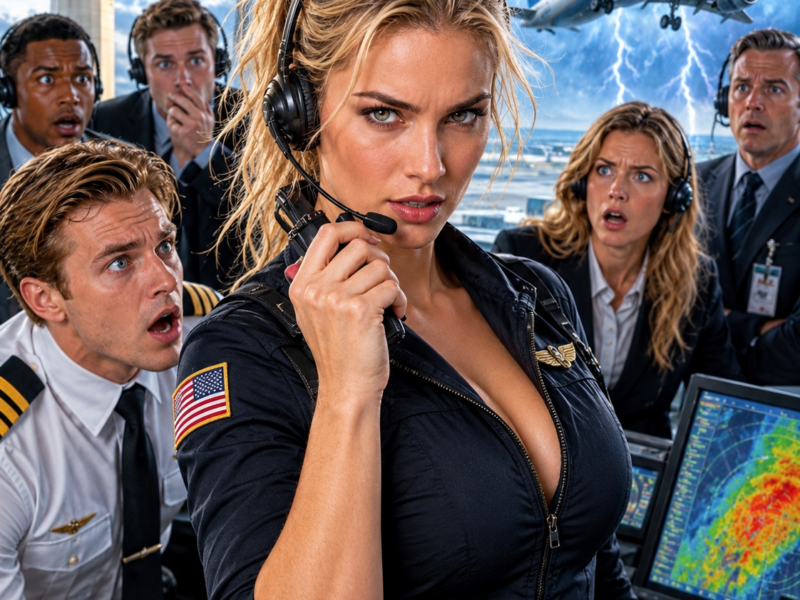
“I was being escorted out of the airport in front of three hundred passengers when the captain of Flight 618 suddenly came running down the terminal
The security supervisor reached for my arm, but I pulled my phone away from him.
“Wait. I need to see that aircraft’s maintenance records.”
“Sir, this is an active emergency. You need to come with us.”
“Then stop wasting time.”
Something in my voice made him hesitate.
I had spent decades in cockpits where hesitation could cost hundreds of lives. I wasn’t about to start explaining basic urgency to a man standing beside a coffee shop.
I showed him Emily’s photograph.
“That signature is mine, but I never approved this report. Someone has forged my name.”
He looked at the document, then at me.
“You’re saying this report is connected to the aircraft?”
“I’m saying somebody used a maintenance record from eleven years ago to cover something up. And now the same person may have put three hundred people in danger.”
He called his supervisor.
Within minutes, two airport operations officers arrived and escorted me into a restricted control room overlooking the gates.
Captain Ryan Mitchell was still inside Flight 618.
The aircraft had been pushed back from the gate, but its engines were shut down. Ground crews were moving around it, and emergency vehicles were beginning to gather nearby.
A voice came through the operations radio.
“Flight 618, confirm the nature of your emergency.”
Ryan’s response was clipped.
“We’re experiencing an abnormal hydraulic indication. Requesting maintenance assistance.”
I leaned toward the radio.
“Ask him whether the pressure warning appeared before or after engine start.”
The operations officer looked at me.
“Why?”
“Because the sequence matters. If the pressure dropped during engine start, it could point to a different failure than a leak discovered during taxi.”
He relayed the question.
There was a pause.
Then Ryan answered.
“The indication appeared during the preflight sequence.”
I shook my head.
“He’s not telling you everything.”
The operations officer frowned.
“How do you know?”
“Because I saw the maintenance crew working on that panel before he ever boarded.”
He turned back to his console.
“Get the maintenance supervisor on the line.”
A few seconds later, a tired-sounding man answered.
“This is Mark Ellis, maintenance control.”
The officer explained the situation and asked whether the aircraft had been cleared.
Mark said yes.
I leaned closer.
“Who authorized the final release?”
Mark hesitated.
“That information is in the electronic record.”
“Then read the name.”
Another pause.
“Ryan Mitchell.”
I looked at the officer.
The captain had apparently authorized the aircraft’s release himself.
That was not automatically proof of wrongdoing, but it was enough to make everyone in the room uncomfortable.
The operations officer asked Mark to explain.
“The aircraft had a recurring hydraulic pressure fault,” Mark said. “We replaced a component and performed a ground check. The readings were within limits.”
“Was the second inspection completed?” I asked.
Silence.
Then Mark said, “No.”
The room became very quiet.
“Why not?” the officer asked.
Mark swallowed audibly.
“We were instructed to expedite the release.”
“By whom?”
“I don’t know.”
I watched the runway cameras.
A fuel truck was moving away from the aircraft.
“Keep that plane on the ground,” I said.
The officer nodded to another employee.
“Notify airport operations. Flight 618 is not cleared for departure.”
For the first time that morning, I felt that somebody was actually listening.
Then my phone rang again.
Emily.
I stepped into the hallway.
“Where are you?” I asked.
“At the airline’s maintenance office. Security is outside my door.”
“Are you safe?”
“I think so.”
“What was in that report?”
She took a breath.
“An aircraft involved in an emergency landing eleven years ago. The report says the hydraulic system had been inspected and cleared before the flight.”
“That’s impossible.”
“I know.”
“Emily, I never signed that report.”
“I believe you.”
Her answer came so quickly that I had to close my eyes.
For years, I had wondered whether my daughter believed the stories people told about me.
After my retirement, some executives had quietly suggested that I had become difficult, paranoid, and unable to accept criticism.
Emily had never accused me of anything, but she had stopped asking about my career.
Now she said she believed me.
“Listen,” she continued. “I found something else in the archived files.”
“What?”
“The original report.”
My grip tightened around the phone.
“Where?”
“On an old backup server. It was never supposed to be accessible from the current maintenance system.”
“What does it say?”
“It says the hydraulic warning was reported before the aircraft left the hangar. It also says the replacement component came from a different aircraft.”
I stared at the wall.
“That doesn’t make sense.”
“That’s what I thought. The replacement part had been flagged for further testing.”
I remembered that night eleven years earlier.
The flight had been traveling from Chicago to Denver when the crew received a hydraulic system warning.
We had lost part of the normal braking system during the approach.
I had managed to land safely using the remaining emergency systems.
One hundred and eighty-six people had walked away.
The airline called it a successful emergency response.
But I remembered something else.
The maintenance crew had told investigators that the aircraft had passed inspection before departure.
I had never believed them.
Now I knew why.
“Emily, who had access to that backup server?”
“Only senior engineering management and a few maintenance supervisors.”
“Names?”
“One of them was your old supervisor, Thomas Reed.”
I stopped breathing for a moment.
Thomas Reed.
He had been the maintenance director during the incident.
He had also been the man who testified that my aircraft had no known hydraulic defects before departure.
After the investigation, he received a promotion.
I received an early retirement package.
We hadn’t spoken in eleven years.
“Is he still with the airline?” I asked.
“Yes.”
“Where?”
“He’s here. In the building.”
Before I could answer, a door slammed somewhere behind her.
“Emily?”
“I have to go.”
“Don’t leave that office.”
“Dad, someone just tried to access the backup files while I was looking at them.”
The call ended.
I immediately called her back.
No answer.
I returned to the control room.
“Get me the airline’s security department.”
The operations officer looked concerned.
“What’s happened?”
“My daughter has evidence that somebody is altering aircraft maintenance records. She’s in the airline’s maintenance office, and someone may be trying to reach her.”
He picked up another phone.
“What’s her name?”
“Emily Mercer.”
He paused.
“Mercer?”
“Yes.”
He looked at me differently.
“You’re Daniel Mercer?”
“I’ve been trying to tell everyone that for the last hour.”
He reached into a drawer and pulled out an old printed photograph.
It showed me standing beside an aircraft after the emergency landing eleven years earlier.
The headline beneath it read: PILOT PRAISED FOR SAVING 186 PASSENGERS.
“I remember that incident,” he said quietly.
“Then you remember why I stopped flying.”
He didn’t answer.
A radio transmission interrupted us.
“Flight 618 requesting permission to return to the gate.”
The operations officer responded immediately.
“Flight 618, remain stationary. Emergency personnel are approaching.”
Ryan’s voice came back.
“Understood.”
I listened carefully.
There was something strange about his breathing.
Not panic exactly.
More like someone trying very hard to sound calm.
I asked for the captain on the direct line.
A few seconds later, Ryan’s voice came through.
“Who is this?”
“Daniel Mercer.”
Silence.
Then he said, “You need to stay out of this.”
I almost laughed.
“Three hundred people are sitting inside an aircraft with an unresolved hydraulic fault. I think I’m already in it.”
“You don’t understand what’s happening.”
“Then explain it.”
He lowered his voice.
“Your daughter shouldn’t have sent you that report.”
“Why?”
“Because she doesn’t know what she’s looking at.”
“Then tell me what I’m missing.”
He hesitated.
For a moment, I heard the faint sound of someone speaking behind him.
Then Ryan said something I wasn’t expecting.
“Your name was used because you were already blamed for what happened eleven years ago. Nobody would question another report with your signature on it.”
I stared at the radio.
“So you admit the signature is forged?”
“I didn’t say that.”
“You just explained why somebody would forge it.”
“Listen, Daniel. I didn’t want any of this.”
“Then why did you clear the aircraft?”
His voice became sharper.
“Because I was told the problem had been fixed.”
“By whom?”
He didn’t answer.
“Ryan, who told you?”
The transmission went silent.
A moment later, the operations officer received a message.
Flight 618 was requesting permission to disembark passengers.
The aircraft was finally returning to the gate.
But the danger wasn’t over.
As the cabin door opened, Ryan was the first person to step onto the stairs.
He looked directly toward the terminal windows.
He knew I was watching.
Then he raised one hand and held up something small.
A flash drive.
My phone vibrated.
A new message from an unknown number appeared.
“Your daughter has the original file. Ryan has the copy. Thomas Reed has the only key that connects them.”
I read it twice.
Then another message arrived.
“Ask Thomas what happened to the mechanic who reported the fault eleven years ago.”
I felt the coldness of the airport floor through the soles of my shoes.
I knew that mechanic.
His name was Peter Walsh.
He had been a quiet, careful man who always carried a small notebook in his shirt pocket.
After the emergency landing, I remembered seeing him in the hangar.
He had approached me and whispered, “Captain, you were right. That aircraft should never have left the ground.”
Two days later, he disappeared from the maintenance department.
I had been told he resigned.
Nobody ever gave me an explanation.
“Sir?” the operations officer said.
I looked up.
“Get me Thomas Reed.”
He made the call.
Thomas answered after three rings.
“This is Reed.”
The officer introduced himself and explained that I wanted to speak with him.
Thomas was silent for several seconds.
Then he said, “Tell Daniel I have nothing to say.”
I took the phone.
“Thomas, it’s been a long time.”
“Daniel.”
His voice sounded older than I remembered.
“Did you forge my signature?”
“No.”
“Did you approve the maintenance report from eleven years ago?”
“I approved the report that was submitted to me.”
“Was it accurate?”
Silence.
“Thomas, I need you to answer.”
He exhaled.
“You’re asking questions that should have been asked years ago.”
“Then answer one now.”
Another pause.
“Peter Walsh is alive.”
My knees weakened slightly.
“Where is he?”
“I don’t know.”
“You just said he’s alive.”
“I know he was alive six months ago. That’s all.”
“Why did you tell everyone he resigned?”
Thomas’s voice cracked.
“Because I was told to.”
“By whom?”
He didn’t answer.
I looked at the operations officer.
He was watching me carefully.
“Thomas, three hundred people nearly boarded an aircraft with an unresolved hydraulic fault this morning. If you know anything, now is the time.”
Thomas whispered, “It wasn’t supposed to happen again.”
Those seven words told me more than any confession could have.
“What wasn’t supposed to happen again?”
“The pressure issue. The same component problem. The same people.”
I leaned against the desk.
“Who are you protecting?”
He said nothing.
Then the call ended.
I stood there holding the phone.
For a moment, I was eleven years younger, standing in a hangar with the smell of hydraulic fluid and hot metal in the air.
I remembered Peter Walsh handing me his notebook.
I remembered the little black spiral binding.
I remembered the way his hands trembled.
And I remembered telling him that the truth would eventually come out.
I had been wrong about how long it would take.
My phone rang again.
This time it was Emily.
“Dad, I’m outside the building.”
“Where are you?”
“Near the employee parking garage. I have the original maintenance file.”
“Stay where you are. I’m coming.”
“No. Listen first.”
Her breathing was uneven.
“I found the person who changed the report this morning.”
“Who?”
“Ryan.”
I closed my eyes.
“Are you sure?”
“I checked the access logs. He used his credentials to reopen the maintenance authorization after the second inspection was postponed.”
“Why would he do that?”
“I don’t know. But there’s something else.”
“What?”
“The original report from eleven years ago wasn’t signed by you. It was signed by Thomas Reed.”
I looked toward the windows.
Ryan was still standing near the aircraft stairs.
“Then why does the copy have my name?”
“Because someone replaced the final page.”
I said nothing.
Emily continued.
“Dad, I think Ryan knew about the old investigation before we got married.”
The words landed harder than I expected.
“Did he tell you?”
“No. I found a private folder on his work computer. It contains the old reports, your retirement agreement, and a document about Peter Walsh.”
“What document?”
“A payment record.”
I felt my jaw tighten.
“How much?”
“Twenty-five thousand dollars.”
“To Peter?”
“No. To a company registered under his name.”
“Was it a settlement?”
“I don’t know. But the payment was made three weeks after he disappeared.”
I rubbed my forehead.
“Emily, where is Ryan now?”
“He left the aircraft. He’s coming toward the parking garage.”
I looked through the glass.
The captain was walking quickly toward the terminal exit.
“Get somewhere safe.”
“Dad, I need you to understand something. Ryan told me he loved me. I believed him. But I don’t know how much of our marriage was built around what he knew about you.”
I couldn’t find an answer.
“Your marriage wasn’t my fault,” I finally said.
“I know.”
“Whatever he did, you didn’t cause it.”
“I know that too.”
She paused.
“But I need to ask you something. If the evidence proves he knowingly put those passengers at risk, will you help me report him?”
I looked at the aircraft.
Three hundred people were beginning to leave through the terminal.
Some were crying.
Some were angry.
A little boy was holding his mother’s hand while looking at the flashing emergency vehicles outside.
“Yes,” I said. “Even if it costs us everything.”
When I reached the parking garage, Emily was standing beside her car.
She looked exhausted.
Her hair was tied back loosely, and there was a small cut on her right hand.
I pulled her into my arms.
For several seconds, neither of us spoke.
Then she handed me a thick envelope.
Inside were printed maintenance records, photographs, payment documents, and an old handwritten statement.
The handwriting belonged to Peter Walsh.
It was dated eleven years earlier.
The first line read:
“I am making this statement because the aircraft assigned to Flight 214 was not safe to fly, and I was ordered to sign a report saying otherwise.”
I read the page twice.
Peter described a recurring hydraulic pressure problem and a replacement component that had failed a preliminary test.
He also wrote that Thomas Reed had been pressured by senior management to keep the aircraft in service.
But the final paragraph was the one that made my hands shake.
“I told Captain Mercer about the fault before departure. He refused to accept the aircraft until the issue was checked. The company then removed him from the maintenance discussion and used a falsified document to make it appear he had approved the flight.”
I looked at Emily.
“Why didn’t I ever see this?”
She turned the page over.
There was a handwritten note.
“Because I was told Captain Mercer would lose his pension and be prosecuted if I released it.”
I felt something inside me loosen.
For eleven years, I had carried the belief that I had somehow failed to protect those passengers.
I had questioned my own memory.
I had wondered whether the pressure from the investigation had made me unreliable.
Now I was reading proof that someone had deliberately used my name to conceal the truth.
But there was still one question.
Why had Ryan reopened the same kind of maintenance issue today?
Emily pointed to a line near the bottom of the report.
The replacement component used on Flight 618 had come from the same supplier involved in the earlier incident.
The supplier had been acquired by a larger aviation parts company five years earlier.
Its executive director was Thomas Reed.
I stared at the page.
“He’s still making money from this.”
Emily nodded.
“That’s what I think.”
A car pulled into the parking space beside us.
Ryan stepped out.
He wasn’t wearing his captain’s jacket anymore.
He had removed his tie, and his shirt collar was open.
“Emily.”
She moved behind me.
“Don’t.”
He looked at her, then at me.
“Daniel, I need to explain.”
“Then start with the maintenance release.”
Ryan rubbed his face.
“I didn’t know the component was defective.”
“Your credentials reopened the authorization.”
“I was told the second inspection was no longer necessary.”
“By Thomas?”
He didn’t answer.
Emily stepped forward.
“Why did you hide the old report from me?”
Ryan looked at her.
“I was trying to protect you.”
“From what?”
“From all of this.”
She shook her head.
“You knew I was investigating the records. You knew I was going to find your name.”
He lowered his eyes.
“I didn’t want you involved.”
“Then why did you marry me?”
The question hung between them.
Ryan opened his mouth, but nothing came out.
I watched my daughter wait for an answer.
Not an excuse.
Not another promise.
An answer.
Finally, Ryan said, “At first, I was assigned to monitor the investigation into your father’s old flight.”
Emily looked as though someone had struck her.
“Assigned by whom?”
“Thomas.”
“And after that?”
Ryan swallowed.
“After that, I fell in love with you.”
She stared at him.
“You expect me to separate those two things?”
“No.”
“Did you ever intend to tell me?”
He looked at the concrete floor.
“I kept thinking I would find a way.”
Emily let out a small, bitter laugh.
“You had three years.”
He didn’t defend himself.
I stepped closer.
“Ryan, why did you let Flight 618 get pushed back?”
His face changed.
“Thomas told me the component had been tested. He said the report was complete.”
“Did you see the test results?”
“No.”
“Then you had no business signing the release.”
“I know.”
“Did you know about the warning before the aircraft moved?”
He looked at me.
“Yes.”
Emily closed her eyes.
Ryan continued.
“I thought it was a sensor fault. I had seen similar indications before. I believed we could return to the gate if anything changed.”
“That’s not a decision you make with three hundred passengers behind you.”
“I know.”
“Then why did you do it?”
His voice dropped.
“Because Thomas said if I delayed the flight, he would make sure the airline blamed the entire maintenance failure on me. He showed me the old report with your signature. He said the company had already buried one captain and could bury another.”
I looked at him for a long time.
“You were afraid of losing your career.”
He nodded.
“And you risked three hundred lives to protect it.”
Ryan’s eyes filled with tears.
“I know.”
For a moment, I wanted to hate him.
It would have been easier.
But the man standing in front of me was not a monster from a newspaper headline.
He was a talented pilot who had made a series of cowardly decisions, each one easier to justify than the last.
That did not make him innocent.
It made the consequences worse.
A security vehicle entered the garage.
Two investigators stepped out.
Emily had already contacted the airline’s internal safety office and federal authorities.
Ryan looked at her.
“Are you reporting me?”
She nodded.
“Yes.”
He didn’t argue.
Instead, he reached into his pocket and took out the flash drive I had seen through the terminal window.
“I brought this because I knew you would find the old records eventually.”
He handed it to the investigators.
“Everything is on there. The messages between Thomas and me, the maintenance releases, and the original report.”
I watched the investigators take the drive.
One of them asked Ryan to accompany them.
Before he left, he turned toward me.
“Captain Mercer.”
I waited.
“I am sorry.”
I looked at him.
“Being sorry doesn’t make that aircraft safe.”
He nodded.
Then he walked away.
Emily stood beside me, watching the security vehicle disappear around the corner.
She didn’t cry.
She simply took off her wedding ring and placed it in the envelope containing the evidence.
“I need some time,” she said.
I put my hand on her shoulder.
“You have as much as you need.”
The investigation lasted seven months.
The airline initially described the incident as a procedural misunderstanding.
That changed when federal investigators recovered the maintenance system’s access logs and compared them with the original records.
The hydraulic fault on Flight 618 had been documented twice.
The second inspection had been deliberately postponed.
The aircraft was cleared using an authorization that Ryan had reopened without the required verification.
The aircraft had never taken off.
That fact saved three hundred people from a potentially catastrophic situation.
Thomas Reed was eventually charged with falsifying maintenance records, obstructing an aviation safety investigation, and directing improper aircraft releases.
The investigation also uncovered a pattern of concealed component defects involving several aircraft.
The supplier’s records had been altered, and employees who raised concerns had been pressured into silence.
Peter Walsh was found living in a small town outside Albuquerque.
He had left the aviation industry after being threatened with legal action and the loss of his professional credentials.
When investigators contacted him, he initially refused to speak.
Then they showed him my photograph.
He agreed to testify.
I met him in a quiet federal office building two months later.
He was thinner than I remembered, with silver hair and the same careful eyes.
For a moment, neither of us spoke.
Then he stood up.
“Captain Mercer.”
I shook his hand.
“Peter.”
He looked down.
“I should have come forward years ago.”
I pulled out a chair for him.
“So should I have.”
He shook his head.
“You tried.”
“I should have pushed harder.”
He sat down and opened the notebook he had carried all those years.
Its pages were yellowed, but his handwriting remained clear.
“I kept everything,” he said.
“Every inspection. Every warning. Every conversation.”
I looked at the notebook.
“Why?”
He gave a tired smile.
“Because I knew one day somebody would need to prove I wasn’t imagining it.”
I thought about all the years he had spent believing nobody would listen.
Then I thought about the passengers on Flight 618.
Three hundred people who would never know how close they had come to a different kind of morning.
“Thank you,” I said.
Peter looked at me.
“For what?”
“For keeping the truth.”
He lowered his eyes.
“I wish keeping it had been enough.”
The federal investigation eventually cleared my name completely.
The forged report from eleven years earlier was removed from my personnel file.
The airline issued a public correction and offered to restore my former position in its aviation safety advisory program.
I declined the title they suggested.
I wasn’t interested in being a symbol.
I wanted the maintenance records to be honest, the inspection procedures to be enforced, and the people who raised safety concerns to be protected.
Emily joined an independent aviation safety review team.
She moved out of the house she had shared with Ryan and rented a small apartment near Boulder.
Our relationship took time to repair.
There were Sunday dinners when she barely spoke.
There were phone calls that ended awkwardly.
And there were evenings when she asked me about my old flying days, something she hadn’t done in years.
One night, she brought over a box of photographs.
We sat on the living room floor, looking through pictures of aircraft, old colleagues, and places I had forgotten.
She stopped at one photograph.
It showed me standing beside a military aircraft, younger and thinner, with my hand resting on the fuselage.
“Is that the plane you flew in the Gulf War?”
“One of them.”
“You look so serious.”
“I was trying not to smile.”
She laughed.
It was the first time I had heard that sound from her in months.
Then she picked up another photograph.
It showed me beside Flight 214, the aircraft involved in the emergency landing eleven years earlier.
“Do you still think about that day?”
“More than I should.”
“Do you blame yourself?”
I looked at the picture.
For years, I had believed that if I had argued harder, demanded more documents, or refused to leave the investigation, I might have prevented everything that followed.
But I finally understood something.
I had been responsible for flying the aircraft safely.
I had not been responsible for the people who falsified the records and threatened those who told the truth.
“No,” I said. “Not anymore.”
Emily rested her head against my shoulder.
“I wish I’d understood that sooner.”
I put my arm around her.
“We both had a lot to learn.”
A year after the Flight 618 incident, the airline invited me to speak at an aviation safety conference in Chicago.
I almost refused.
Then I saw the list of attendees.
There were pilots, mechanics, engineers, dispatchers, and young employees who had only recently entered the industry.
I decided to go.
I stood at the front of the room with a microphone in my hand.
Behind me was a photograph of Flight 618 sitting safely at the Denver gate.
I didn’t talk about being a hero.
I didn’t talk about the humiliation at the airport or the captain who had once mocked my retirement.
Instead, I spoke about the technician who had looked frightened beside the landing gear.
I spoke about Peter’s notebook.
I spoke about Emily finding a document that everyone else had forgotten.
And I spoke about the danger of believing that a polished uniform, a senior title, or a long list of flying hours could replace the responsibility to ask difficult questions.
After the conference, a young maintenance technician approached me.
He looked nervous.
“Captain Mercer, can I ask you something?”
“Of course.”
“What if I report a problem and nobody listens?”
I looked at his hands.
They were trembling slightly.
I recognized that feeling.
“Document everything,” I told him. “Keep copies of what you’re allowed to keep. Follow the safety reporting process. And don’t let anyone convince you that asking a question makes you the problem.”
He nodded.
Then he shook my hand.
As he walked away, I noticed Emily standing near the entrance.
She had come to hear the speech.
“That was good,” she said.
“You’re being generous.”
“No. You finally told the story without apologizing for it.”
I looked at her.
For a moment, I couldn’t think of anything to say.
Then she reached into her purse and handed me a small envelope.
Inside was a photograph.
It showed the two of us standing outside Denver International Airport on the morning Flight 618 had been grounded.
We looked exhausted.
I was holding my old leather flight bag, and Emily was standing beside me with the envelope of evidence.
On the back, she had written:
“Three hundred people made it home that day. So did we.”
I folded the photograph carefully and placed it inside my wallet.
I still kept my old flight bag.
The leather had become softer over the years, and one of the brass buckles no longer closed properly.
Sometimes, when I passed an airport, I still looked up at the aircraft climbing into the sky.
I no longer wondered whether I should be sitting in the cockpit.
I had spent enough years trying to prove that I belonged there.
Now I understood that my greatest responsibility had never been to defend my reputation.
It was to speak when something wasn’t right, even when nobody wanted to hear it.
And I had learned that sometimes the person everyone dismisses is the one who notices what everyone else has learned to ignore.
THE END.









