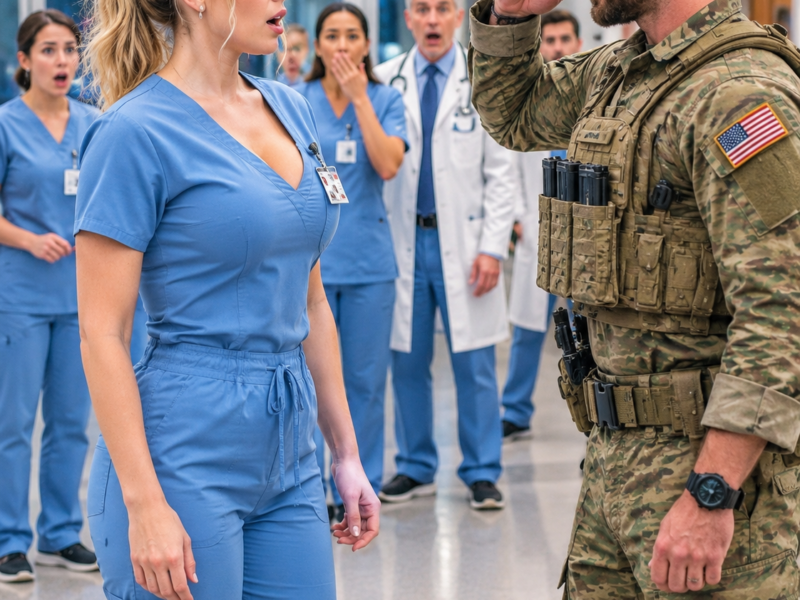
“I was being escorted out of St. Mary’s Medical Center with my nursing badge still in my hand when the hospital director announced
The tallest man held the photograph between two fingers, waiting for me to take it.
I didn’t move.
“My father?” I whispered.
He nodded.
“My name is Lieutenant Commander Jack Reynolds. These men are my team. And the man you saved last night is Chief Petty Officer Daniel Brooks.”
He paused, glancing toward the operating room.
“He’s one of ours.”
I looked at the photograph.
It showed a younger version of my father standing beside three Navy servicemen in front of a helicopter. He couldn’t have been more than thirty-five. His right arm was in a sling, and there was a familiar crooked smile on his face.
I recognized the man standing beside him.
It was the patient.
Even younger, with dark hair and a grin that seemed almost too big for his face.
I turned the photograph over.
There was handwriting on the back.
To Michael Carter. You brought me home. I’ll spend the rest of my life making sure your family is never alone.
My father had been dead for four years.
I had never seen that photograph.
“Where did you get this?” I asked.
“Daniel kept it in his personal effects,” Jack replied. “He carried it through three deployments.”
I looked at the six men.
“Why?”
Jack took a slow breath.
“Because your father saved his life.”
For a moment, the sounds of the emergency department seemed to fade.
I knew my father had been injured during his military service. He had told me pieces of the story over the years, usually when he was having a difficult night and couldn’t sleep.
He had never mentioned Daniel Brooks.
He had never mentioned a promise.
“My father was a Navy corpsman,” I said.
“He was more than that to us,” another SEAL replied.
The man was younger than Jack, with a small scar across his chin.
“Mike Carter was the reason three men made it out of Afghanistan alive. Daniel was one of them.”
I looked down at the photograph again.
“Then why didn’t he ever tell me?”
Jack’s expression softened.
“That’s something Daniel wanted to explain himself.”
Before I could respond, the elevator doors opened.
Dr. Harris stepped out, followed by Mr. Whitmore and the head of nursing.
“What is this gathering?” Whitmore demanded.
Jack turned toward him.
“We’re here to check on our teammate.”
“Visiting hours are restricted. You’ll need to speak with administration.”
“We already have authorization.”
Jack produced a document from a folder.
Whitmore glanced at it, then at the men behind him.
His tone changed slightly.
“Well, I understand your concern, but the patient is receiving excellent care.”
Jack looked at him without blinking.
“Then perhaps you can explain why the nurse who recognized his deteriorating condition was escorted out of this building.”
Nobody answered.
Dr. Harris stepped forward.
“This is an internal personnel matter. It has nothing to do with you.”
Jack’s jaw tightened.
“It became our business when you dismissed the person who kept our brother alive.”
Mr. Whitmore raised a hand.
“She violated hospital procedure.”
“Did she?” Jack asked.
“Yes.”
“Then I assume you’ve reviewed the trauma surgeon’s report.”
Whitmore hesitated.
Jack continued.
“Because we have a copy.”
He handed the document to the hospital director.
I recognized the format immediately.
It was the preliminary medical assessment from the night before.
At the bottom was a note from the trauma attending.
Immediate escalation by nursing staff contributed to timely recognition of suspected internal bleeding and prevented a potentially fatal delay in treatment.
Whitmore read it twice.
His face changed.
Dr. Harris leaned over his shoulder.
“That’s an incomplete assessment,” he said.
“Then why was it excluded from the incident report?” Jack asked.
The question hung in the hallway.
I looked at Rachel, who was standing near the nurses’ station.
She had gone pale.
She knew something.
I could tell by the way she kept looking toward the floor.
“Emily,” she said quietly.
Everyone turned.
She swallowed.
“I need to tell you something.”
Mr. Whitmore immediately interrupted.
“Rachel, this isn’t the appropriate time.”
“I don’t care.”
Her voice trembled, but she didn’t stop.
“I was there when Dr. Harris changed the report.”
Dr. Harris turned sharply.
“That’s enough.”
Rachel took a step forward.
“He removed the part about Emily’s warning and the request for a trauma consultation. He wrote that she initiated an unauthorized intervention without sufficient clinical justification.”
I stared at her.
“Why didn’t you say something this morning?”
Her eyes filled.
“Because I was scared. I have two kids, Emily. I can’t afford to lose this job.”
I understood that fear more than I wanted to.
But understanding didn’t make the betrayal hurt less.
Rachel wiped her cheek.
“I’m sorry.”
Dr. Harris pointed toward the security officer.
“Get these people out of here. This is becoming disruptive.”
Jack didn’t raise his voice.
He simply opened another folder.
“Before anyone leaves, I’d like to introduce the hospital’s legal department to a few people.”
Two men in business suits stepped out of the elevator behind the SEALs.
One introduced himself as a representative from the Navy’s medical liaison office.
The other was an attorney representing Daniel Brooks.
Jack looked at Whitmore.
“Chief Brooks is a decorated service member. His medical records, treatment decisions, and the circumstances surrounding his admission are being reviewed. We have reason to believe that someone removed information from his personal effects before the hospital documented them.”
Whitmore frowned.
“That’s a serious allegation.”
“Yes,” Jack replied. “It is.”
I looked at the photograph again.
The black medical bracelet.
The man’s warning.
Don’t let them…
I remembered his fingers gripping my wrist.
“Wait,” I said.
Jack turned.
“What is it?”
“Before he lost consciousness, he tried to tell me something. He said, ‘Don’t let them.’ He never finished the sentence.”
The six men exchanged glances.
For the first time since they had entered the hospital, their confidence seemed to crack.
Jack lowered his voice.
“Did he say anything else?”
“No. But he was terrified.”
Jack looked toward the operating room.
“Then we need to find out what happened before he got here.”
He turned to the attorney.
“Call the investigator.”
I wanted to ask what they meant, but the hospital’s trauma surgeon appeared before anyone could speak.
Dr. Melissa Grant was in her forties, with tired eyes and a surgical cap still tucked into the pocket of her scrubs.
“Chief Brooks is awake,” she announced.
Jack immediately stepped forward.
“Can we see him?”
“One at a time, and only briefly. He’s stable, but he needs rest.”
Then she looked at me.
“Emily, he asked for you.”
I blinked.
“Me?”
“Specifically.”
I glanced at Mr. Whitmore.
He looked as though he had swallowed something unpleasant.
Dr. Grant didn’t wait for his permission.
“Come with me.”
I followed her down the hallway.
The moment I entered the room, I saw Daniel Brooks lying beneath a white blanket.
He was pale, with an oxygen line beneath his nose and an IV in his arm.
But his eyes were open.
When he saw me, the tension in his face eased.
“You came back,” he whispered.
“I didn’t exactly have a choice. I was escorted out.”
He tried to smile, but the movement hurt.
“Sorry about that.”
I pulled a chair beside his bed.
“You’re the one who should be apologizing. You scared half the emergency department.”
He gave a weak laugh.
Then his expression became serious.
“Your dad would’ve been proud.”
I stared at him.
“You knew my father?”
Daniel closed his eyes for a moment.
“Better than I knew my own brother.”
I leaned forward.
“Why didn’t he ever tell me about you?”
“Because he didn’t want you carrying his war around like it belonged to you.”
I didn’t understand.
Daniel looked toward the window.
“Your father and I served together in Afghanistan. We were part of a team that was caught in an ambush during an evacuation operation.”
He paused to catch his breath.
“An explosion damaged our vehicle. I was trapped underneath part of the wreckage. Your dad came back for me when he had already been ordered to withdraw.”
I felt my throat tighten.
“He told me he had been injured in an accident.”
“He was. But he didn’t tell you the whole story.”
Daniel shifted slightly.
“He pulled me out. Took shrapnel in his shoulder, and stayed with me until the evacuation helicopter arrived.”
I looked down at my hands.
“Why would he risk that?”
Daniel looked directly at me.
“Because he knew I had a little girl waiting at home. He told me no child should have to grow up wondering why her father never came back.”
My eyes burned.
I remembered my father sitting on the edge of my bed when I was little, checking the lock on the front door twice before turning off the light.
I remembered the scars along his shoulder.
I remembered asking him if he was scared during the accident.
He had smiled and said, “Everybody gets scared, sweetheart. What matters is what you do when somebody needs you.”
I had repeated that sentence to myself during nursing school.
Now I understood where it had come from.
“Why were you at the waterfront?” I asked.
Daniel’s expression changed.
The warmth disappeared from his eyes.
“I wasn’t supposed to be there.”
He looked toward the door to make sure we were alone.
“Two days ago, I was meeting someone who claimed to have information about a former Navy contractor. A man named Richard Voss.”
“Who is he?”
“Someone who made a fortune supplying equipment to military units. Some of that equipment was defective. Men were injured because corners were cut, and records were altered to hide it.”
I listened without interrupting.
“Daniel,” I said carefully, “what does that have to do with the hospital?”
He took a breath.
“The man I was supposed to meet was going to give me evidence. Instead, I was attacked.”
My stomach tightened.
“Do you know who attacked you?”
“I saw one of them. He had a hospital identification badge.”
I stared at him.
“Here?”
Daniel nodded.
“I don’t know his name. But he knew I was being brought here.”
The room suddenly felt smaller.
I remembered the missing identification.
The medical bracelet.
His unfinished warning.
And the way he had clutched my wrist.
“Why didn’t you tell the police?”
Daniel looked at the doorway again.
“Because I don’t know who I can trust.”
Before I could answer, Jack entered the room.
He had been listening outside.
“Daniel, the investigator is here. We found something.”
Daniel’s fingers tightened around the blanket.
“What?”
Jack placed a clear evidence bag on the bedside table.
Inside was a small silver flash drive.
I recognized it immediately.
It was the same shape as the object I had seen tucked beneath the edge of Daniel’s blanket during the first assessment.
I’d assumed it was part of his medical equipment.
Jack noticed my expression.
“You’ve seen this before?”
I nodded slowly.
“It was near his waist when we first brought him in. I thought it was a piece of debris.”
Daniel closed his eyes.
“I hid it before they got to me.”
Jack looked at the drive.
“We recovered it from his clothing. The hospital had listed it as missing.”
I looked from one man to the other.
“What’s on it?”
“Records,” Daniel said. “Emails, equipment inspections, financial transfers. Enough to expose what Voss did.”
Jack placed a hand on the bed rail.
“We’ve also identified the person who arranged the meeting.”
Daniel’s eyes sharpened.
“Who?”
Jack hesitated.
Then he said a name I hadn’t expected.
“Dr. Harris.”
I stood up so quickly the chair scraped against the floor.
“No.”
Jack looked at me.
“We haven’t established exactly how much he knew. But his name appears in a communication recovered from the meeting location.”
I tried to remember the night before.
Dr. Harris’s impatience.
His refusal to call the trauma team.
His insistence that Daniel be moved.
The altered incident report.
The strange way he had reacted when the SEALs arrived.
I pressed my fingers against my forehead.
“Are you saying he knew Daniel was coming here?”
“We’re saying there’s evidence he may have been involved in arranging his arrival.”
Daniel spoke through clenched teeth.
“He’s the one who told me the meeting was safe.”
The room fell silent.
I looked at Daniel.
“Why would a hospital doctor be involved with a military contractor?”
Jack answered.
“Because Voss has been using private medical facilities to obtain restricted patient information and conceal injuries connected to his contracts.”
I thought of the patient with no identification.
The bracelet.
The missing personal belongings.
Suddenly, the details began fitting together.
Daniel wasn’t just a wounded man who had been found near the waterfront.
Someone had tried to make sure he never spoke.
And someone inside this hospital might have been helping them.
The door opened again.
Dr. Grant stepped inside.
“Emily, the hospital director wants to speak with you.”
I almost laughed.
“Does he want to fire me again?”
She shook her head.
“He’s asking you to come to the conference room. There are federal investigators waiting.”
Jack looked at Daniel.
“We’ll stay here.”
Daniel caught my wrist gently.
“Emily.”
I turned.
“Yes?”
“Whatever happens, don’t let them make you believe you did something wrong by listening.”
I nodded.
Then I walked out.
The conference room was full.
Mr. Whitmore sat at the head of the table, flanked by two hospital attorneys.
Dr. Harris stood near the window, his arms crossed.
Two federal investigators had placed several folders on the table.
One of them, Agent Laura Bennett, introduced herself and asked me to sit.
“Ms. Carter, we’d like to understand the events surrounding Chief Brooks’s admission.”
I explained everything.
I described his declining blood pressure, his changing breathing, the moment he grabbed my wrist, and the disagreement with Dr. Harris.
I didn’t exaggerate.
I didn’t leave anything out.
When I finished, Agent Bennett opened a folder.
“We’ve reviewed the original emergency department records and the amended incident report.”
She placed two pages side by side.
The first contained my original nursing notes.
The second contained the version submitted to administration.
Several entries were missing.
One had been changed by almost forty minutes.
I leaned closer.
“I didn’t write that.”
“We know,” Agent Bennett said.
Dr. Harris shifted his weight.
“This is being taken out of context.”
The second investigator spoke.
“Then perhaps you can explain why your hospital credentials were used to access Chief Brooks’s records before his ambulance arrived.”
Dr. Harris went pale.
“I don’t know anything about that.”
Agent Bennett slid another document across the table.
“And why your personal email account exchanged messages with Richard Voss the night before the attack.”
Whitmore looked at him.
“Doctor?”
Harris rubbed his forehead.
“This is ridiculous. I was consulting on a private medical matter.”
“Was that why you instructed the emergency department to move the patient before a trauma assessment?” Bennett asked.
He didn’t answer.
I watched his face.
For the first time, he looked less like an arrogant physician and more like a man realizing that the room was no longer under his control.
Agent Bennett continued.
“We have reason to believe Chief Brooks was attacked to prevent the disclosure of fraudulent equipment records. We also have evidence that someone attempted to remove those records from his belongings after he was admitted.”
Whitmore swallowed.
“Are you suggesting my hospital was involved in a federal crime?”
“We’re investigating that possibility.”
Then Agent Bennett turned to me.
“Ms. Carter, your actions are an important part of this timeline. Your escalation brought in the trauma team before the patient could be moved.”
I looked at Dr. Harris.
He wouldn’t look at me.
I didn’t feel victorious.
I felt tired.
Tired of having to prove that I had seen what I had seen.
Tired of knowing that the same people who had questioned my judgment had been willing to alter the record of a man’s medical emergency.
Agent Bennett closed her folder.
“We’ll need a formal statement from you. For now, please don’t discuss the investigation with anyone outside your legal representative.”
I nodded.
As the meeting ended, Whitmore approached me.
“Emily, I think we need to discuss your employment status.”
I looked at him.
“Do we?”
He cleared his throat.
“The hospital may have acted too quickly this morning.”
“May have?”
He glanced toward the attorneys.
“We’re prepared to reinstate you immediately, with full back pay.”
I stared at him.
A few hours earlier, he had told me to surrender my badge and leave.
Now he was offering to give it back as though it were a misplaced office key.
“Mr. Whitmore, I don’t want my job back because six Navy SEALs walked into your emergency department.”
His face reddened.
“That’s not what this is about.”
“Then why didn’t you ask the trauma surgeon what happened before firing me?”
He had no answer.
“I became a nurse because I wanted to help people. I didn’t become one so I could spend my career worrying about whether someone important would be embarrassed when I did my job.”
I took my termination letter from my bag and placed it on the table.
“You can keep your offer.”
Then I walked out.
Outside the conference room, Rachel was waiting.
Her eyes were red.
“Emily?”
I stopped.
“I heard what happened.”
I nodded.
She looked down at her hands.
“I should have spoken up this morning.”
“Yes,” I said.
She winced.
“I know.”
I wasn’t ready to forgive her.
But I also knew what fear could do to a person. I had watched people stay silent in rooms where speaking up might cost them everything.
“I hope next time you don’t wait until someone else does it for you,” I said.
Rachel nodded.
“I hope so too.”
Three days later, Daniel was moved to a secure rehabilitation facility.
His condition had improved enough for him to sit up without assistance, although he still had a long recovery ahead.
Before he left, he asked me to visit.
I arrived on a Saturday afternoon carrying a paper bag from a small bakery near my apartment.
Jack was sitting beside his bed, reading something on his phone.
Daniel looked at the bag.
“Please tell me that’s real food.”
“Depends. How do you feel about blueberry muffins?”
“I’ve survived worse.”
Jack laughed.
I placed the bag on the table.
For a while, we talked about ordinary things.
Daniel asked about nursing school.
Jack told me that one of the younger men on the team had managed to burn instant oatmeal in a microwave.
It felt strange to laugh with people who had entered my life through such an awful night.
Eventually, Daniel reached beneath his pillow and pulled out an envelope.
“I’ve been meaning to give you this.”
My name was written across the front in my father’s handwriting.
I recognized it immediately.
The letters were slightly uneven, with the same small upward slant he used on birthday cards.
My hands began to shake.
“Where did you get this?”
“Your father gave it to me years ago. He asked me to keep it until you were old enough to understand why he never talked much about his service.”
I opened the envelope carefully.
Inside was a letter, folded into thirds.
Emily,
If you’re reading this, Daniel has finally stopped carrying around a promise I never asked him to make.
I smiled through the tears gathering in my eyes.
I know you sometimes wonder why I don’t tell you much about the things that happened overseas. It’s not because I don’t trust you. It’s because I never wanted my worst days to become the story you told yourself about your father.
There were good men with me. Men who were brave, frightened, stubborn, funny, and sometimes completely impossible. Daniel was one of them.
I went back for him because I couldn’t leave him there. That’s all. I don’t need a medal for it.
But I hope you remember something.
Being brave doesn’t always mean doing something extraordinary. Sometimes it means noticing that someone is hurting when everybody else has stopped looking. Sometimes it means speaking up when it’s easier to stay quiet.
I hope you never lose that part of yourself.
Love, Dad.
I read the letter twice.
Then I folded it carefully and held it against my chest.
Daniel watched me.
“Your father talked about you all the time,” he said.
I wiped my cheeks.
“He did?”
“Every chance he got. He said you were stubborn.”
I laughed softly.
“That sounds like him.”
“He also said you were going to make a difference.”
I looked at the letter.
For four years, I had thought of my father’s service as something that belonged to a distant part of his life, something he had survived and then left behind.
But somehow, the people he had cared for were still finding their way into mine.
A week later, the federal investigation expanded.
Richard Voss was arrested after investigators recovered financial records and communications connecting him to the fraudulent equipment contracts.
Dr. Harris was placed under investigation for his role in the attempted cover-up and the unauthorized access to Daniel’s medical information.
The hospital released a statement acknowledging serious failures in its internal reporting process.
Mr. Whitmore resigned several weeks later.
The investigation did not end overnight.
There were interviews, legal proceedings, and months of paperwork.
But the truth was no longer buried in a file that could be quietly rewritten.
The hospital also issued a formal correction to my employment record.
They offered me reinstatement, back pay, and a public apology.
I accepted the correction and the back pay.
I declined the job.
Not because I hated the hospital.
I simply knew I couldn’t return to a place where I had learned how easily the truth could be made inconvenient.
A month later, I started working at a smaller trauma center outside Norfolk.
The nurses there weren’t perfect.
The doctors weren’t perfect.
We still had difficult shifts, disagreements, and patients whose conditions changed faster than anyone could predict.
But there was something I noticed during my first week.
When a nurse raised a concern, people listened.
And when someone made a mistake, the first question was what needed to be done for the patient, not who needed to be blamed.
On my first night, I found a new nursing student standing beside a patient’s bed, staring nervously at a monitor.
She looked about the age I had been when I started.
“Something doesn’t look right,” she said.
I stepped beside her.
“Show me what you’re seeing.”
She pointed to the screen and explained her concern.
We checked the patient together and called the attending physician.
It turned out she had noticed an early sign of a complication.
The doctor thanked her.
Afterward, she looked at me as if she couldn’t quite believe it.
“That’s it?” she asked.
“That’s it,” I said.
“Nobody’s mad?”
I smiled.
“Not when you speak up because you’re paying attention.”
That evening, when I got home, I placed my father’s letter in a small wooden frame on my kitchen shelf.
Beside it, I put the photograph Daniel had given me.
My father stood in the center, one arm in a sling, surrounded by men who had become his family.
I no longer looked at that picture as evidence of a secret life.
I saw it as proof that kindness could travel farther than any of us expected.
Six months after the night at St. Mary’s, I received an invitation to a small ceremony at a Navy facility in Virginia.
Daniel had recovered enough to attend.
Jack and the rest of the team were there, along with several military families and hospital staff who had been involved in the case.
I almost didn’t go.
I wasn’t a soldier.
I hadn’t served overseas.
I had simply done what I believed a nurse was supposed to do.
But Daniel called me the night before.
“Your father would have wanted you there,” he said.
So I went.
When I entered the room, the six men stood together near the front.
Daniel was wearing his dress uniform.
He looked stronger than he had in the hospital, though a slight stiffness remained in his movements.
Jack approached me.
“Emily Carter?”
“That’s me.”
He smiled.
“We’ve been waiting for you.”
The ceremony was brief.
Daniel spoke about his team, about the attack, and about the people who had helped him survive.
He mentioned the trauma surgeon.
He mentioned the emergency department staff who had worked through the night.
And then he mentioned me.
“That night, a young nurse noticed what others had overlooked. She didn’t have the most authority in the room. She didn’t have years of experience. But she had the courage to keep asking questions when the easy thing would have been to stay quiet.”
I looked down, uncomfortable with the attention.
Daniel continued.
“She reminded me of a man who once refused to leave me behind.”
He turned toward me.
“Your father saved my life, Emily. But that night, you gave me the chance to go home and keep living it.”
I felt tears slip down my face.
Daniel stepped closer.
“Your father made me promise I’d look after his family if he couldn’t. I spent years wondering whether I’d ever get the chance to repay him.”
He paused.
“I don’t think a promise like that is ever really repaid. But I hope you’ll let us keep being part of your life.”
I nodded.
“There’s nothing to repay.”
Jack smiled.
“That’s exactly what Mike used to say.”
The six men stood together.
Then, as they had done in the hospital hallway, they straightened their backs.
One by one, they raised their right hands in a salute.
This time, I understood.
It wasn’t a salute to a nurse who had broken the rules.
It wasn’t even a salute to the daughter of a man they admired.
It was a salute to the values my father had taught me without ever needing to explain them.
I stood quietly and returned the gesture as best I could.
After the ceremony, Daniel walked me outside.
The late afternoon sun was settling over the Virginia coastline.
For a while, neither of us spoke.
Then he said, “Do you ever regret what happened that night?”
I thought about the termination letter.
The conference room.
The fear in Rachel’s eyes.
The way Dr. Harris had looked at me when the truth came out.
Then I thought about the man lying in that hospital bed, the photograph, and my father’s letter.
“No,” I said. “I regret that it took something like that for people to listen.”
Daniel nodded.
“Your dad would’ve said the same thing.”
We stood there for another minute, watching the flags move gently in the breeze.
I had spent so much time thinking that becoming a nurse meant learning how to follow every instruction, remember every procedure, and never make a mistake.
I still believed in protocols.
I still believed in teamwork.
But I had learned that professional courage sometimes begins with a simple sentence.
“Something isn’t right.”
And sometimes, the person who needs you most is the one nobody else has stopped long enough to see.
Before I left, Daniel handed me a small card.
On it was a photograph of my father, standing beside the same helicopter, smiling at the camera.
On the back, in Daniel’s handwriting, were five words:
He would have come back.
I slipped the card into my pocket.
For the first time in four years, when I thought about my father, I didn’t remember the hospital room where he had taken his last breath.
I remembered the young man in that photograph, choosing to turn around when everyone else was moving forward.
And I understood that I hadn’t been trying to become my father all along.
I had simply been carrying forward the best thing he ever taught me.
The end.









