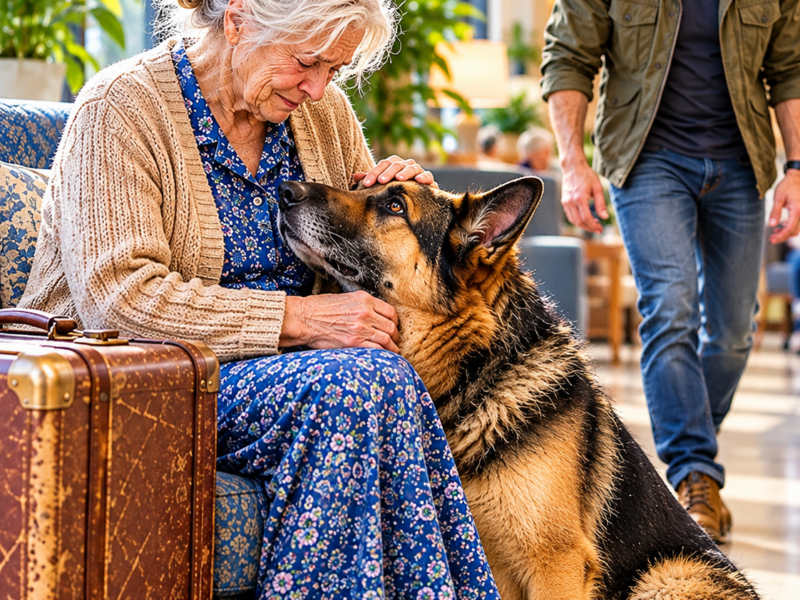
“I was already halfway out of the care facility when my German Shepherd refused to move, crossed the lobby, and laid his head on an elderly woman’s knee
Three days later, I returned to Willow Creek.
The rain had stopped, but the sky over Rowan Oak remained gray. Harker walked beside me through the entrance, his leash loose in my hand.
I had spent most of the drive thinking about Evelyn’s words.
“Nobody wants me home.”
I had heard similar things from Marines who believed their injuries had made them useless, from veterans who had lost their families, and from people who had spent too long convincing themselves they were a burden.
But Evelyn’s situation was different.
She wasn’t asking someone to rescue her from a life she couldn’t manage. She was asking why other people had decided she wasn’t allowed to manage it herself.
I found her in a small reading room near the lobby.
She was sitting beside the same battered suitcase.
This time, a woman sat across from her with a legal pad on her knee.
“Gunnery Sergeant Maddox?” the woman asked.
“Cole is fine.”
“Rachel Boon. Adult Protective Services.”
She was in her mid-forties, with dark curly hair threaded with gray and thin rectangular glasses. Her expression was warm, but her questions were precise.
“I understand you’ve spoken with Mrs. Mercer.”
“I have.”
“Then you understand I can’t discuss her medical or legal information without her permission.”
“Of course.”
Evelyn tapped her cane against the floor.
“I want him here.”
Rachel looked at her.
“Are you comfortable with that?”
“Yes. He’s brought me a dog who listens better than most people.”
Harker settled beside her chair.
Rachel smiled faintly.
“Then he can stay.”
She opened the folder on her lap.
“I’ve reviewed some of the records available to me. What concerns me is that the documentation doesn’t tell one consistent story.”
She explained that Evelyn’s hospital records described her as alert, oriented, and able to participate in her treatment decisions.
Later assessments at Willow Creek used different language.
Intermittent confusion.
Poor judgment.
Resistance to care.
One document recommended long-term supervised placement.
“Does that mean they’re saying I’m incapable?” Evelyn asked.
“It means some people have documented concerns about your ability to make certain decisions,” Rachel replied. “But those concerns need to be supported by an appropriate assessment.”
Evelyn looked down at her hands.
“I know what I want.”
“I believe you. But we need independent evidence, not assumptions.”
Rachel explained something I had never considered carefully enough.
A person could need help bathing, walking, preparing meals, or remembering to take medication without losing the right to decide where to live.
Physical limitations did not automatically erase decision-making authority.
Neither did old age.
The question was whether Evelyn understood the choices before her, including the risks of returning home, and whether practical support could reduce those risks.
I liked Rachel immediately.
Not because she promised to solve everything, but because she refused to pretend the answer was simple.
She had already requested Evelyn’s hospital records, the facility’s assessment history, the temporary guardianship documents, and financial records connected to the arrangement.
She also wanted an independent cognitive and functional assessment.
“Someone who isn’t employed by Willow Creek,” she said. “Someone who doesn’t report to Darren, and someone who has no personal interest in the outcome.”
Evelyn nodded.
“That’s what I want.”
Before Rachel could continue, footsteps sounded in the hallway.
“Aunt Evelyn?”
The woman sitting beside Harker stiffened.
A man entered the room.
He was about fifty-one, with thinning sandy-brown hair, a neatly trimmed beard, and a navy quilted jacket. He carried himself like someone accustomed to making difficult conversations sound reasonable.
“Darren,” Evelyn said.
He kissed her forehead.
“I didn’t know you had company.”
“You didn’t ask.”
His smile tightened for half a second.
Then he turned toward me.
“I’m Darren Pike. You’re the Marine who’s been visiting.”
“Cole Maddox.”
He shook my hand firmly.
“Thank you for checking on her. This has been a difficult few months.”
His voice sounded sincere.
And perhaps it was.
He told us he had been the one who answered the hospital’s call at two in the morning. He had paid initial bills, collected Evelyn’s mail, arranged repairs at the farmhouse, and helped her through the first weeks of rehabilitation.
He had not invented those responsibilities.
He had carried them.
But when Evelyn asked when she could return home, his expression changed.
“Aunt Evelyn, we’ve discussed this.”
“I know. I’m asking again.”
“The farmhouse isn’t suitable for you anymore.”
“I’ve lived there for thirty-four years.”
“And you fell there.”
“I fell in the barn. Not in the kitchen. Not on the porch. Not in my bedroom.”
Darren sighed.
“I’m trying to keep you safe.”
Evelyn’s voice grew quieter.
“Then help me be safe at home.”
He looked toward Rachel.
“Is this what you’ve been discussing?”
Rachel explained that an independent evaluation had been requested.
Darren’s jaw tightened.
“Another assessment?”
“A neutral one,” Rachel replied.
“You already have the facility’s assessment.”
“That’s precisely why we need an independent review.”
Darren stood.
“I don’t want her hurt. That’s all.”
For a moment, I believed him.
He looked less like a villain than a frightened nephew who had convinced himself that preventing every possible accident was the same as caring for someone.
But fear could become control.
And control could become a habit that nobody wanted to question.
After Darren left, Evelyn sat silently.
Harker pressed his head against her knee.
Rachel waited until Evelyn was ready to speak.
Then the older woman told us something she hadn’t mentioned before.
A few years earlier, she had leased a gravel section near the back of her property to a local equipment company. The rent helped cover taxes, insurance, and repairs.
Since the guardianship began, Darren had managed the account receiving those payments.
“Do you know whether the money is still there?” Rachel asked.
“I used to check it every month. I haven’t seen a statement since I came here.”
“Have you asked Darren?”
“Yes.”
“What did he say?”
“That I didn’t need to worry about money while he was handling everything.”
Rachel wrote something down.
She didn’t accuse him of stealing.
Neither did I.
But I could see that the situation had become more complicated than a disagreement about stairs and handrails.
That evening, as I collected my jacket from the lobby, I passed an administrative office.
The door was partly open.
A woman’s voice came from inside.
“If Mercer transitions home, the long-term care payment ends with the discharge date.”
A second voice replied.
“I understand. I’m asking you to revise the projection.”
I stopped for half a second.
Then the woman stepped into the hallway.
She was tall and narrow-shouldered, with steel-gray hair cut neatly at her chin. Her dark suit was immaculate.
Lydia Crane, the facility administrator.
She acknowledged me with a professional nod.
“Good evening, Sergeant.”
“Ma’am.”
She continued down the hallway.
I found Rachel near the elevators and told her what I had heard.
She listened without interrupting.
“It’s worth documenting,” she said. “But facilities receive payment for residents. That alone doesn’t establish misconduct.”
“What if they’re benefiting from keeping her here?”
“Then we need evidence that someone improperly interfered with her discharge or assessments. We can’t build a case from a sentence overheard in a hallway.”
I disliked the answer.
But I knew she was right.
For the first time in a long while, I had to accept that wanting something to be true didn’t make it true.
Rachel would gather the documents.
The independent evaluation would determine what Evelyn understood.
And the home assessment would establish what support she actually needed.
It would take longer than I wanted.
But Evelyn deserved a case that could withstand scrutiny.
Four days later, we drove to her farmhouse.
The independent evaluation had taken nearly two hours the previous afternoon. Evelyn had identified the date, explained her medications, described the risks of living alone, and answered questions about money and everyday decisions.
She even corrected the evaluator when he misstated the dosage of one prescription.
The conclusion was careful but encouraging.
There was no evidence of major cognitive impairment.
Her main limitations were physical: reduced balance, slower movement, and weakness following hip surgery.
It didn’t automatically mean she could return home without help.
But it meant the question could no longer be avoided.
Could her farmhouse be made safe enough for her to live there?
Rachel had arranged a supervised home assessment with Nina Patel, an occupational therapist who had spent twenty-six years helping injured and elderly patients return to their homes.
Nina was practical, observant, and refreshingly direct.
She did not describe every inconvenience as a danger.
When the farmhouse appeared beyond the bare oak trees, Evelyn stopped talking.
It was a white clapboard house with a deep front porch and weathered paint. The barn stood beyond the yard.
The vehicle stopped.
Evelyn did not move.
“You ready?” I asked.
She tightened her fingers around her cane.
“I thought I was.”
Nobody rushed her.
Harker climbed out first, crossed the yard, and walked up the porch steps. He stopped at the front door and looked back.
Evelyn laughed softly.
“Well, apparently somebody thinks I’m taking too long.”
Her first step onto the porch trembled.
The second was steadier.
Inside, the house smelled faintly of cedar and old coffee.
A ceramic mug sat upside down beside the kitchen sink. Gardening shoes rested beneath a bench. A faded green sweater that had belonged to her husband hung behind the back door.
Evelyn touched its sleeve.
“Thomas always forgot this thing when he went outside.”
I looked away.
Some memories deserved privacy.
She lowered herself into an old kitchen chair while Harker settled near her feet.
“I started thinking I’d die at Willow Creek,” she said.
Rachel remained quiet.
Evelyn looked around the room.
“In a place where people know my room number better than they know my name.”
Nina began her assessment when Evelyn was ready.
She measured the porch steps, bathroom clearance, and distance between the bedroom and the kitchen.
There were problems.
But they were not impossible.
A second handrail would make the porch safer. Motion-sensor lights could illuminate the hallway. Loose rugs needed non-slip backing. The shower needed a chair and grab bars.
Nina recommended a few hours of daily home assistance, a medical alert pendant, a weekly pill organizer reviewed by the visiting aide, and an emergency plan posted near the kitchen phone.
Grocery delivery could help during bad weather.
Outpatient therapy could continue without requiring Evelyn to remain in a residential facility.
“Does that mean I can go home?” Evelyn asked.
Nina looked at her.
“It means there is a realistic way to support you here. We still need the appropriate approvals and follow-up arrangements.”
Evelyn nodded.
“I can accept help.”
She looked around the kitchen.
“I just don’t want help to mean I stop being the person who lives here.”
Nina smiled.
“That’s a reasonable distinction.”
Over the next few days, the farmhouse slowly changed.
Contractors installed the handrails and bathroom supports. Motion lights appeared along the hallway.
I helped with smaller jobs, although my shoulder still limited what I could lift.
One afternoon, I began moving a narrow table away from the hallway.
“Put that back,” Evelyn said.
I looked at her.
“It’s narrowing the walkway.”
“I know.”
“You could catch your cane on it.”
“I haven’t in thirty-four years.”
“Mrs. Mercer—”
“Cole.”
Something in her voice stopped me.
“This is my house.”
I looked at the table.
Then I set it back exactly where it had been.
She pointed toward the bathroom.
“And I want the grab bar there, not where you marked it.”
“That position gives you better leverage.”
“That position means drilling through the tile Thomas installed himself.”
I almost argued.
Instead, I took out my notebook and erased the mark.
“Where would you like it?”
She showed me.
At the top of the page, I wrote a new rule.
ASK BEFORE FIXING.
Evelyn read it over my shoulder.
“That should be tattooed on you.”
“I’m already carrying enough permanent mistakes.”
She laughed.
It was the first time I had heard her laugh without immediately looking around to see whether she was disturbing someone.
That evening, Rachel received another batch of records.
She spread several documents across the farmhouse kitchen table.
One withdrawal from Evelyn’s account did not clearly match any listed care expense.
Another appeared connected to repairs on a vehicle registered to Darren.
A third was labeled simply as a property expense, with no invoice attached.
Rachel did not call the transactions criminal.
She marked them for review.
“Depending on the court’s order, some expenses may be legitimate,” she explained. “But the person managing someone else’s money must be able to account for it.”
Then she placed two medical documents side by side.
The first came from Evelyn’s rehabilitation physician.
Alert and oriented. Demonstrates understanding of treatment options and discharge planning.
The second had been entered at Willow Creek several days later.
Significant disorientation. Poor insight. Long-term supervised placement recommended.
I looked at the dates.
“Who wrote this one?”
“The facility assessment team.”
“Could they have made a mistake?”
“Certainly. That’s why we’re asking them to explain the difference.”
Rachel pointed to another detail.
The unfavorable assessments had increased shortly after Evelyn began asking about returning home.
It was not proof of deliberate falsification.
But it was a pattern that deserved an answer.
Evelyn listened quietly.
Finally, she asked, “If they made mistakes, will anyone admit it?”
Rachel met her eyes.
“I can’t promise what they’ll say. I can promise the records will be examined.”
That night, I found Evelyn sitting beneath the old apple tree.
The branches were bare, and the winter air had begun to sharpen.
Harker lay across her shoes.
I sat several feet away.
“Thomas planted it the year we bought the farmhouse,” she said. “He said we’d sit underneath it when we were old.”
“You made it.”
She smiled.
“He didn’t make it easy. He planted it too close to the fence.”
We sat quietly.
Then my phone rang.
My limited-duty assignment was ending on schedule. I was expected to report back to my unit the following week.
When I returned to the porch, Evelyn noticed my expression.
“Your orders?”
“Yes, ma’am.”
“You have to go back.”
“I do.”
She nodded as though she had expected it.
The following morning, I found her old suitcase open on the bed.
Her clothes were folded inside.
“What are you doing?”
“Making this easier.”
“For who?”
“For you.”
I stared at the suitcase.
“You think I’m staying because I’m assigned to this?”
“What else would it be?”
I knelt beside the bed, careful not to touch her belongings.
“Duty is what I do because I have to. I’m here because I choose to be.”
Her eyes filled.
“I don’t want to become the old woman who keeps people from getting where they’re supposed to go.”
“You aren’t keeping me from anything.”
“You have a unit. Rachel has other cases. Nina has other patients.”
“And you have a home.”
She looked down.
“I can go back to Willow Creek if this doesn’t work.”
I shook my head.
“You don’t have to decide that today. You have the right to understand the plan, ask questions, and make your choice.”
She looked at me for a long time.
Then she unbuckled the suitcase.
“I want to go home, Cole.”
I nodded.
“Then we’ll keep working toward that.”
Two days later, the short home trial began.
It was not unrestricted freedom. It was a formally approved trial with scheduled home assistance, medication checks, therapy, and follow-up visits.
Evelyn understood the conditions and agreed to them.
For the first time in nearly three months, she would sleep beneath her own roof.
Nina walked her through the emergency plan again.
The medical alert pendant worked from the porch to the bedroom. The visiting aide’s number was taped beside the phone. A neighbor had agreed to be a backup contact.
Evelyn could explain what she would do if she fell, missed a dose, or felt unwell.
The plan did not pretend she would never need help.
It made sure needing help would not automatically mean surrendering her home.
Darren objected.
His written challenge arrived that afternoon.
He argued that the independent evaluation did not prove Evelyn could manage emergencies alone. He questioned whether the farmhouse modifications were sufficient.
Then he made an accusation against me.
According to his filing, a wounded Marine with no family relationship to Evelyn had inserted himself into a vulnerable woman’s affairs, encouraged distrust of her family, and developed inappropriate influence over decisions involving valuable property.
I read it twice.
The first time, I was angry.
The second time, I understood how easily my anger could hurt Evelyn.
Darren’s accusation was not entirely unreasonable on its face. I had visited repeatedly. I had helped with repairs. Harker had become attached to her.
If I began acting like my uniform gave me authority over a civilian dispute, I could damage everything Rachel had built.
I called my commanding officer, Captain Aaron Beckett.
He listened without interrupting.
“Have you threatened the nephew?”
“No, sir.”
“Touched financial records?”
“No.”
“Represented yourself as acting on behalf of the Marine Corps?”
“Absolutely not.”
“Good. Keep it that way.”
I looked through the farmhouse window.
Evelyn was learning to use the new shower chair with her home care aide.
“Sir, she’s being pushed somewhere she doesn’t want to live.”
“Then let Boon and her attorney prove it. You can be her friend. You can be a witness if asked. You cannot become her investigator, lawyer, or personal enforcement detail.”
I exhaled.
“Understood.”
“And Maddox?”
“Yes, sir?”
“Standing beside someone still counts as standing.”
I ended the call.
That evening, Evelyn ate tomato soup at her own kitchen table.
She complained that the aide had put the spoons in the wrong drawer. She checked the back door twice before bed.
Harker checked it after her.
Nothing remarkable happened.
That was precisely why it mattered.
The following afternoon, two vehicles turned into the driveway.
One carried the county seal.
The other belonged to the sheriff’s office.
Evelyn saw them first.
The spoon in her hand struck the saucer.
“No.”
I looked up.
“No, no. They’re taking me back.”
She stood too quickly, gripping the table.
“Evelyn, wait.”
She moved toward the porch.
I followed but did not touch her.
A woman stepped from the county vehicle. She introduced herself as Denise Holloway, an adult protective services investigator assigned to conduct a welfare check after a report alleged that Evelyn was living in unsafe conditions.
A deputy named Mark Ellison emerged from the second vehicle.
Denise explained that the report also raised concerns about possible outside influence over Evelyn’s decisions.
Evelyn gripped the new porch rail.
“This is my home,” she said.
Her voice broke.
“Please don’t take me back there.”
I felt Harker move beside her.
He stood close to her leg, watching the visitors.
I stayed one step behind.
“Do you have a court order requiring Mrs. Mercer to be removed?” I asked.
Deputy Ellison looked at me.
“No, sir.”
“Then I’d like her caseworker contacted before anyone makes changes.”
There was no threat in my voice.
No rank.
Just a request.
Rachel arrived twenty minutes later with a copy of the approved home trial plan.
Denise inspected the modifications, reviewed the medication schedule, and spoke privately with Evelyn.
She also asked her to explain the conditions of the home trial in her own words.
Evelyn answered every question.
She knew what assistance was scheduled. She knew whom to call in an emergency. She understood the risks of living alone and the precautions she had agreed to take.
Denise found no evidence requiring emergency removal.
The deputy documented no immediate safety hazard.
The vehicles eventually left.
Only after they disappeared down the driveway did Evelyn’s knees begin to shake.
I reached toward her, then stopped.
She noticed.
And this time, she offered me her hand.
I took it.
“I thought I was going back,” she whispered.
“You’re home.”
She nodded, but her eyes remained on the driveway.
The welfare check had left her shaken.
It had also created an independent record that supported the home trial.
That evening, Rachel called.
The financial review had uncovered additional discrepancies.
Several payments from Evelyn’s account had funded expenses without clear connections to her care. One appeared to cover a personal credit card balance belonging to Darren.
The rental income from the gravel section of the property had continued arriving, but Darren’s accounting was incomplete.
There was no proof yet that he had deliberately stolen anything.
But he would have to explain the transactions.
Rachel had also received a response from Willow Creek concerning the conflicting assessments.
The facility claimed that Evelyn’s behavior had become increasingly difficult and that she had repeatedly refused recommended care.
But the notes did not consistently describe what she had refused or why.
Some entries appeared to treat her requests to return home as evidence of poor judgment.
One assessment described her as confused shortly after a physician had documented her as alert and oriented.
The facility would have to explain the discrepancies.
Rachel found no evidence that Darren and Lydia Crane had secretly coordinated a plan to keep Evelyn there.
The truth appeared less dramatic, but no less serious.
Darren had begun with legitimate responsibility and gradually discovered that control was convenient.
Willow Creek had financial reasons to prefer a longer placement.
One person had started calling control protection.
An institution had grown comfortable with asking fewer questions.
And Evelyn had been left trying to convince everyone that her own voice still mattered.
The court hearing was scheduled for the following week.
On the morning of the hearing, Evelyn walked into the courthouse with her cane in one hand.
She carried no suitcase.
I noticed that before anything else.
Rachel had prepared her carefully. Nina was there to explain the home modifications and support schedule. The rehabilitation physician had agreed to testify about Evelyn’s cognitive evaluation.
Darren sat across the room.
He looked older than he had at Willow Creek.
When the judge asked him about the financial transactions, he insisted he had believed the expenses were justified because he had been managing Evelyn’s affairs and maintaining responsibilities connected to the property.
He said he had been frightened she would fall again.
He said he had only wanted to protect her.
I watched Evelyn.
She did not interrupt.
She did not look toward me for reassurance.
She listened.
The physician confirmed that Evelyn understood her medical condition, the risks of returning home, and the support she would need.
Nina explained that the farmhouse had been modified appropriately and that daily assistance could address the tasks Evelyn could not safely perform alone.
Rachel presented the documentary record in the same measured manner she had approached everything.
Hospital findings.
Facility assessments.
Dates that did not align.
Financial transactions requiring explanation.
She did not accuse anyone of things she could not prove.
Then the judge turned to Evelyn.
“Mrs. Mercer, do you understand that returning home carries certain risks?”
“Yes, Your Honor.”
“Do you understand that you may need additional assistance as your condition changes?”
“Yes.”
“Why do you still wish to return?”
Evelyn placed both hands on the handle of her cane.
“Because it is my home.”
The judge waited.
She continued.
“I know I am slower than I used to be. I know I need help with certain things. I’m not asking anyone to pretend I am thirty years younger.”
Her voice grew stronger.
“But I know where I live. I know what medicine I take. I know what could happen if I fall. I am willing to accept help. I am not willing to give up every decision because I need it.”
The courtroom was silent.
Then the judge asked Rachel about less restrictive alternatives to guardianship.
Rachel explained the home care plan, the independent assessment, and the financial review.
She also explained that questions about money could be handled separately from Evelyn’s right to make decisions about her residence.
The judge studied the documents for several minutes.
Then came the ruling.
Darren’s temporary guardianship would not be extended.
Evelyn’s authority over her medical care, residence, and personal decisions would be restored because the evidence no longer supported continued guardianship.
An independent fiduciary service would temporarily review her accounts while the disputed transactions were reconciled.
The judge made clear that the financial review did not justify keeping Evelyn under a guardianship that was no longer necessary.
Evelyn listened without moving.
Then the judge asked her one final question.
“Mrs. Mercer, where do you intend to live?”
For weeks, she had needed paragraphs to explain herself.
Now she needed only four words.
“I’m going back home.”
Her eyes filled.
This time, she did not look away.
Three days later, the home care plan was finalized.
I drove to the farmhouse with Harker.
Evelyn was already on the porch, wrapped in her brown cardigan despite the cold.
Her old suitcase stood inside the doorway.
It was empty except for a few folded blankets she had decided to store in it.
I unclipped Harker’s leash in the yard.
“Go on.”
He looked at me, then at Evelyn.
He crossed the yard, climbed the porch steps, and circled once beside her chair.
Then he lay down.
His chin settled across his paws.
Evelyn looked at me.
I looked at Harker.
Neither of us said anything.
The first time Harker had chosen her, she had been sitting beside a suitcase in a place she believed she might never leave.
Now he had chosen her again.
Only this time, she was home.
My limited-duty assignment ended exactly when it was supposed to.
I reported back to my unit.
There was no dramatic resignation and no decision to abandon the Marine Corps. Evelyn didn’t need me to do that.
She had her own care team, her own decisions, and a plan that belonged to her.
I called when I could.
Harker and I visited on available weekends.
Sometimes Evelyn made too much food and complained when I refused a third helping.
Sometimes she asked about my shoulder.
Sometimes we sat beneath the apple tree without saying much at all.
By early spring, my assignment brought me regularly to the Rowan Oak area.
There was a small cottage near the far edge of Evelyn’s property. She offered to rent it to me.
I told her I didn’t need special treatment.
She handed me a written lease.
“Market rent,” she said.
I looked at the amount.
“That seems aggressive.”
“You can sleep in your truck.”
I signed.
Beneath our signatures, she insisted on adding one handwritten sentence.
Tenant will not move hallway furniture without permission.
I read it twice.
“This feels targeted.”
“Good. Then the language is clear.”
Harker sneezed beneath the table.
Evelyn declared that he was an official witness.
Within weeks, a narrow path appeared through the grass between the cottage and farmhouse.
Harker used it more often than I did.
Evelyn began keeping a water bowl on the porch, and I stopped pretending he belonged entirely to me.
One afternoon in April, Rachel arrived with a visitor.
His name was Walter Keen.
He was seventy-four, a retired machinist who had recently lost his small rental house in a fire. He was tall but stooped, with thinning white hair and rough hands marked by decades of working with metal.
His wife had died two years earlier.
Since then, he had lived quietly, keeping mostly to himself.
Now the fire had taken the few routines he still trusted.
Temporary housing was ending, and the possibility of entering a residential care facility frightened him more than he wanted to admit.
Rachel had not brought him for Evelyn to rescue.
She had brought him because sometimes a person can hear something different from someone who has sat in the same chair.
Walter stopped at the porch steps.
“I shouldn’t have come.”
Evelyn looked up.
“Why not?”
“I don’t want to be anybody’s burden.”
The words crossed the yard like something returning home.
I was repairing a loose fence board about fifty yards away.
My hammer stopped.
For an instant, Evelyn was back at Willow Creek, beside her battered suitcase, warning Harker not to get attached to her.
Then she reached for the second porch chair and pulled it closer.
Harker rose from the shade, walked between them, and lay down.
Evelyn patted the empty chair.
“Then today, don’t be anybody’s burden.”
Walter looked at her.
“Sit down and be a neighbor first.”
Slowly, he sat.
Harker rested his head across Walter’s shoe.
The old man laughed.
It was a small sound, but Evelyn smiled as though she understood exactly how much it had cost him.
I watched for another moment.
Months earlier, I would have crossed the yard immediately. I would have tried to find the problem, offer a solution, and carry whatever weight I thought someone else couldn’t manage.
But Evelyn was speaking.
Walter was listening.
And Harker was lying between them beneath the spring sunlight.
So I picked up my hammer and returned to the fence.
This time, Evelyn didn’t need me to come closer.
And that was how I knew we had finally understood what home meant.
It wasn’t a place where nobody ever fell, where nobody needed help, or where every day went according to plan.
It was a place where your voice still mattered.
Where you could accept a helping hand without surrendering your right to choose.
Where people didn’t decide your life for you simply because they were afraid of what might happen if you lived it yourself.
Evelyn had once believed nobody wanted her home.
Now her porch had two chairs, a German Shepherd who visited whenever he pleased, and a neighbor who was beginning to believe he still had a place in the world.
And sometimes, when I came home from duty, I could hear Evelyn laughing before I even reached the cottage.
I used to think protection meant standing between someone and every possible danger.
Evelyn taught me that sometimes it means standing beside someone while they decide what risks they are willing to take.
Harker taught me something simpler.
Never walk past someone who needs to know they haven’t been forgotten.
The old suitcase stayed in the farmhouse.
Not packed.
Not waiting.
Just sitting quietly in the corner, a reminder of how close Evelyn had come to believing she had nowhere left to go.
The end.









