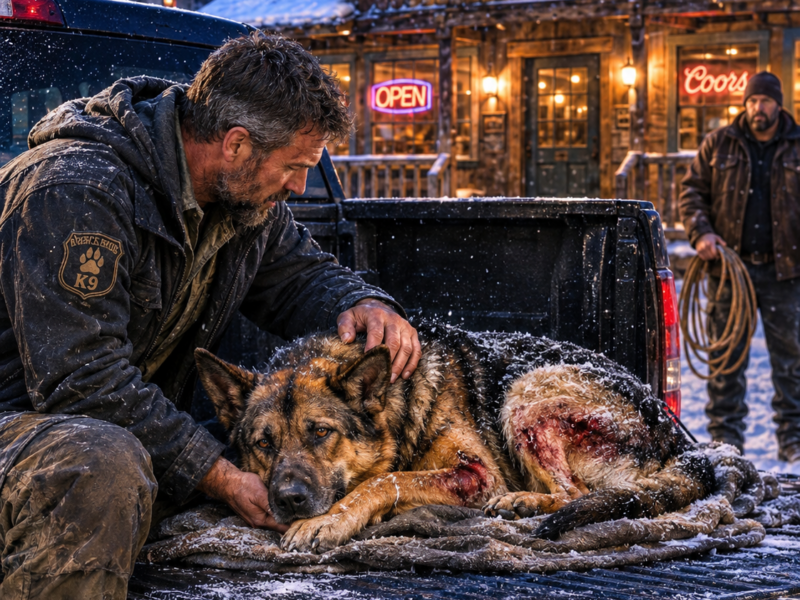
“I thought I was rescuing a wounded dog from a winter storm, but when she refused to leave one forgotten house on Frostline Row
The engine outside did not move.
It simply kept running.
I stood at the bottom of the basement stairs, listening to the low vibration travel through the floorboards.
The old woman clutched my sleeve.
“Please,” she whispered. “You have to get her out of here.”
I looked at Sable.
She was no longer trembling. Her body had shifted between the woman and the narrow passage, her ears pointed toward the stairs. Whatever had happened to her before she climbed into my pickup, she remembered the sound of that engine.
“What’s your name?” I asked.
“Margaret.”
“Margaret, I’m Owen. I’m going to get you somewhere safe.”
She shook her head.
“You don’t understand. He’ll hurt you.”
“That’s a possibility.”
I tried to keep my voice calm. “But we’re going to worry about that after we get you upstairs.”
A door slammed above us.
Then footsteps crossed the living room.
Slow.
Unhurried.
Someone who believed he had every right to be there.
Sable moved forward, placing herself between the stairs and Margaret.
I recognized the posture. It wasn’t the nervous reaction of an injured stray. It was a trained response, controlled and deliberate.
I had seen it in working dogs overseas.
“Stay with her,” I whispered.
Sable didn’t look at me.
I climbed the stairs quietly and stopped just before the pantry doorway.
A man’s voice came from the living room.
“Margaret? I know you’re here.”
I knew that voice.
Lyall Brick.
He sounded different without the tavern crowd around him. Less drunk. More confident.
“You can come out,” he called. “Nobody needs to make this difficult.”
I drew my phone and checked the screen.
One bar.
I sent a message to Norah Witcom, the volunteer rescue commander.
At the blue-shuttered house on Frostline Row. Possible trespasser. Elderly woman injured or in hiding. Call sheriff. Don’t come alone.
Then I put the phone away.
Lyall stepped into the hallway.
He was carrying a flashlight.
His eyes settled on me.
For a moment, neither of us spoke.
Then he smiled.
“Well, look at that. The town’s favorite mechanic.”
“Evening, Lyall.”
“What are you doing in my house?”
I glanced around the empty living room.
“Didn’t realize you lived here.”
“I don’t. I’m checking on something.”
“Funny. So am I.”
His gaze moved toward the pantry.
The smile disappeared.
“Where is she?”
“Who?”
“Don’t play games with me.”
He took a step forward.
I didn’t move.
“There’s an old woman downstairs,” I said. “She needs medical attention.”
Lyall’s jaw tightened.
“She’s confused. Been that way for years.”
“Then you won’t mind if I call the sheriff.”
He looked at my phone.
Then he looked at my hands.
“Put it away.”
“No.”
For a second, the room became very quiet.
Then he lunged.
I moved aside, caught his arm, and turned him away from me. He struck the wall hard enough to knock a framed picture crooked.
He swore and stumbled backward.
I didn’t hit him.
I didn’t need to.
“Stay where you are.”
Lyall stared at me with something between hatred and surprise.
“You have no idea what you’re interfering with.”
“That’s becoming a popular opinion tonight.”
He reached inside his coat.
I saw the movement and stepped back.
A small knife appeared in his hand.
Before he could come closer, Sable emerged from the hallway.
She didn’t attack.
She stood beside me, her head lowered, eyes fixed on the knife.
A low warning rolled through her chest.
Lyall froze.
His expression changed.
Not because he was afraid of me.
Because he recognized her.
“You,” he whispered.
Sable’s ears flattened.
“You should’ve stayed gone.”
I looked from him to the dog.
“What did you do to her?”
Lyall’s eyes flickered toward the stairs.
“She’s not your dog.”
“That’s not what I asked.”
He took a step backward.
Then another.
The knife lowered slightly.
“You don’t know what she was trained to do,” he said.
“No. But I know what you did to her.”
A siren sounded faintly in the distance.
Lyall heard it.
His face hardened.
“This isn’t over.”
He turned and ran through the front door.
I followed him to the porch but stopped at the top step. His truck was parked beside the road. He jumped in, reversed hard, and disappeared into the falling snow.
I watched until the red taillights vanished.
Then I returned to the basement.
Margaret was crying.
Sable was pressed against her knee.
“Is he gone?” she asked.
“For now.”
I crouched beside her.
“Margaret, we need to get you to a hospital.”
She shook her head, but the fight had gone out of her.
“Not until you know about the girl.”
“Ella?”
Margaret looked down at the photograph.
“Yes. My granddaughter.”
She took a shaky breath.
“Her mother, Anna, worked with military dogs. She was stationed overseas. She brought Mercy home after the dog was retired. They were inseparable.”
I glanced at Sable.
“Mercy was her name?”
Margaret nodded.
“She was a good dog. Brave, gentle with children. Anna used to say that Mercy could tell when someone was hurting before they said a word.”
Margaret’s fingers moved through the fur around Sable’s torn ear.
“Anna died six years ago.”
I waited.
“Officially, it was an accident. A vehicle crash on a mountain road. Ella was only nine. Afterward, I took her in. I was all she had.”
Her voice broke.
“What happened to Ella?”
Margaret closed her eyes.
“She disappeared.”
The words seemed to drain the warmth from the room.
“When?”
“Two years ago. She was sixteen. One night, someone came to the house. I heard shouting. By the time I reached her room, she was gone.”
“Did you report it?”
“Of course. The sheriff searched. They questioned people. They found no sign of her.”
Margaret swallowed.
“But I knew she hadn’t run away.”
“Why?”
“Because she left her coat, her medicine, her school bag. And because Mercy was gone, too.”
Sable lowered her head.
Margaret touched her cheek.
“I spent months looking. Then I found out someone had been using the old Rusk property to store stolen equipment. I started asking questions. Lyall caught me near the old shed.”
“What did he want?”
“The photograph. A notebook Anna left behind. He thought I knew where she had hidden it.”
Margaret looked at me.
“I didn’t know. Not until Mercy came back.”
I frowned.
“Came back from where?”
“Three nights ago. She appeared outside this house. Thin, injured, barely able to stand. She had something tied beneath her collar.”
My eyes moved to the dog’s neck.
There was no collar now.
“Where is it?”
Margaret pointed toward a small wooden box beside the sleeping bag.
I opened it.
Inside lay a faded red collar, a cracked metal tag, and a small waterproof pouch.
The tag had two words engraved on it.
MERCY — K9.
I turned the pouch over.
It was sealed with old tape.
“Did you open this?”
“No. I was afraid someone was watching.”
I carefully peeled back the tape.
Inside was a tiny memory card and a folded piece of paper.
The paper contained a handwritten message.
Grandma, if Mercy found you, then I got out. Don’t trust Lyall. Don’t trust anyone who says I ran away. The evidence is on the card. Find someone who will listen.
At the bottom was a name.
Ella.
For a moment, I couldn’t speak.
Margaret covered her mouth.
“She was alive.”
“Maybe,” I said gently. “But we need to find out where she is.”
A voice called from upstairs.
“Owen?”
Norah.
I hurried up the steps.
Norah stood in the doorway with two volunteer rescuers and Deputy Caleb Morris from the county sheriff’s office. Snow clung to their jackets.
“Are you all right?” she asked.
“I’m fine. We need an ambulance for Margaret. And we need to preserve something that may be evidence.”
Caleb looked at the open basement door.
“What happened?”
“Lyall Brick was here. He left when he heard the siren.”
Caleb’s expression tightened.
“Brick again?”
“You know him?”
“I know the name. He’s had complaints filed against him for trespassing and harassment. Nothing that stuck.”
I showed him the red collar and the waterproof pouch.
“There’s a missing teenager involved. Ella. Margaret’s granddaughter.”
Caleb’s face changed.
“Ella Dean?”
Margaret appeared at the bottom of the stairs, supported by Norah.
“Yes,” she whispered.
Caleb removed his gloves.
“Mrs. Dean, we never stopped looking.”
“You stopped asking,” Margaret replied.
He accepted the words without defending himself.
The ambulance arrived ten minutes later.
As the paramedics helped Margaret upstairs, Sable followed closely. She didn’t want to leave her side.
At the door, Margaret turned to me.
“Please don’t let them take Mercy away.”
I looked down at the dog.
“I won’t.”
But I had no idea what would happen next.
The memory card was handed to Deputy Morris, who arranged for it to be examined by the county’s digital evidence unit. He also called the regional missing-persons investigator.
By midnight, Margaret was at the hospital.
Sable was back in my truck.
And I was sitting in my garage with a cup of coffee I had forgotten to drink.
The brass gear on my key ring rested beside the memory card’s evidence receipt.
I kept looking at the words written on the paper.
If Mercy found you, then I got out.
A dog had crossed an unknown distance through winter to bring a message home.
I knew what that meant.
Someone had taught her where home was.
Someone had trusted her to return.
And someone had been waiting.
The phone rang at 1:17 a.m.
It was Caleb.
“We’ve got something.”
I stood up.
“What?”
“The memory card contains video files, photographs, and scanned documents. Some are damaged, but enough survived.”
“What’s on them?”
“Records from the Rusk property. Payments to Lyall Brick. Storage invoices. Names of people who received stolen equipment.”
I rubbed my forehead.
“What’s that got to do with Ella?”
Caleb hesitated.
“One of the videos shows her.”
My stomach tightened.
“Is she alive?”
“We don’t know when the video was recorded. But she’s alive in it.”
“Where?”
“An old service building near the north ridge. The video shows her speaking to someone off camera. She says she’s being held because she saw a shipment being moved.”
I looked at Sable.
She had risen from her blanket.
Her ears were pointed toward the phone.
“Is there an address?”
“Not yet. The building has been abandoned for years. We’re checking the location now.”
“I’m coming.”
“No, you’re not.”
“Caleb—”
“You’re not a deputy, Owen. You’re a witness. Let us do our job.”
I looked at the dog again.
“I understand.”
I didn’t.
But I said it anyway.
The next morning, the snow stopped.
The mountains emerged beneath a pale blue sky, and Hartfall Ridge looked almost peaceful.
I drove to the hospital with Sable in the passenger footwell. Margaret was sitting upright in bed when we arrived. She looked exhausted, but the color had returned to her face.
The moment she saw Sable, she began to cry.
“Mercy.”
The dog approached slowly.
She placed her head against Margaret’s hand.
Margaret closed her eyes.
“I thought I’d never see you again.”
I pulled a chair beside the bed.
“Caleb found video of Ella.”
Margaret opened her eyes.
“She’s alive?”
“We believe so.”
Her hand tightened around Sable’s fur.
“Then we have to find her.”
“We will.”
I wasn’t sure whether I was making a promise or simply refusing to accept another possibility.
Margaret told me more about Anna.
She had been a military working-dog handler before returning to Montana. She had spent her last years training rescue dogs and helping veterans adjust to civilian life.
Mercy had been her partner.
After Anna’s death, the dog had stayed with Ella.
But two years ago, someone had taken them both.
Margaret believed the old Rusk property was being used as a staging point for illegal shipments. Anna had discovered the operation before her death, and the notebook she left behind contained information that could expose it.
Lyall had been trying to recover that notebook.
The memory card showed that Ella had found it first.
And now the people behind the operation knew she had escaped.
At noon, Caleb called again.
“The service building is empty.”
My heart sank.
“Then where is she?”
“We found a blanket, food wrappers, and fresh tire tracks. Someone was there recently.”
“Could she have left?”
“Maybe. But we also found blood.”
I looked at Sable.
She was already standing.
Caleb continued.
“We’re bringing in a regional search team. I need you to stay away from the property.”
“Understood.”
This time, I meant it.
But Sable had other ideas.
She began pacing beside the hospital bed, moving from the window to the door and back again.
Margaret noticed.
“She’s telling you something.”
“She’s worried.”
“No,” Margaret said softly. “Mercy always did that when she knew someone needed her.”
I looked at the dog.
Her gaze was fixed on the northern hills.
I had spent years learning to recognize the difference between a trained response and a frightened one.
Sable wasn’t panicking.
She was waiting for a direction.
And I finally understood why she had come back to Frostline Row.
She hadn’t just found Margaret.
She had brought us the evidence.
Now she wanted us to find Ella.
That evening, I went to Norah’s rescue station.
The building was a converted firehouse, with a large garage, a radio room, and a kitchen that always smelled like soup.
Norah stood over a map of the north ridge.
Caleb was beside her, along with a regional investigator named Dana Pierce.
Dana was in her forties, with tired eyes and a voice that suggested she had spent too many years explaining difficult things to people who didn’t want to hear them.
She studied the video stills from the memory card.
“We believe Ella was moved from the service building sometime in the last twelve hours,” she said. “The people involved know the evidence has surfaced.”
“Do we know who they are?”
“Not all of them. But the records connect Lyall Brick to a transportation company operating out of the county. The same company has been investigated for stolen machinery and falsified shipping documents.”
“Who’s running it?”
Dana pointed to a name on the map.
“Warren Pike. He owns the company and several properties near the old quarry.”
Norah frowned.
“Pike’s donated money to half the town.”
“Which is why this has taken so long,” Dana replied.
I looked at the map.
The old quarry was north of the ridge, beyond a narrow service road that wasn’t maintained in winter.
“Could Ella be there?”
“We’re checking,” Dana said. “But we won’t move until we have enough information.”
I nodded.
Then Sable entered the room.
She had been resting in my truck, but Norah had brought her inside after noticing that she refused to settle.
The dog walked directly to the map.
Her nose hovered over the northern ridge.
Then she touched one point with her muzzle.
The old quarry.
Everyone looked at her.
Norah crouched.
“What is it, girl?”
Sable looked at her, then at me.
I stepped closer.
“That’s where you want us to go?”
She touched the map again.
Dana stared at the dog.
“Is she trained?”
“Former military working dog,” I said. “That’s what the records suggest.”
“Then she may recognize the location.”
I looked at the old quarry.
A memory surfaced.
Years ago, during an overseas deployment, I had worked alongside a German Shepherd trained to track people through damaged buildings. The dog had been injured during a search. Afterward, the handler had spent months teaching her that her work was over.
Some dogs never stopped listening for the people they had been trained to find.
I looked down at Sable.
“Did you find her there?”
The dog lowered her head.
Then she gave a quiet whine.
Dana picked up her radio.
“Let’s check the quarry.”
We did not go alone.
The sheriff’s office coordinated with the regional search team. Norah organized the volunteer rescue unit to prepare for the possibility of a winter evacuation.
I stayed behind with Sable.
It was the hardest decision I’d made in years.
But I had promised Caleb I wouldn’t interfere.
At 8:40 p.m., the radio crackled.
“Search team approaching the quarry entrance.”
Sable stood.
I knelt beside her.
“Easy.”
A second transmission came.
“Tracks found near the storage building.”
Then silence.
Five minutes passed.
Ten.
My hands tightened around the edge of the table.
Finally, Dana’s voice came through.
“We have a person.”
I leaned toward the radio.
“Ella?”
“Female. Approximately eighteen. Conscious, but weak.”
Margaret had been right.
Ella was alive.
Sable began to tremble.
Then Dana spoke again.
“She’s asking for a dog.”
I looked down.
“Tell her Mercy is here.”
The radio went quiet.
A moment later, Dana returned.
“She says to tell Mercy she kept her promise.”
I closed my eyes.
For the first time in weeks, Sable made a sound that seemed to come from somewhere deeper than her chest.
It was not a bark.
It was not a whine.
It was a long, trembling breath.
As if a burden she had carried across miles of snow had finally begun to lift.
Ella was brought to the hospital just before midnight.
She was eighteen now, thin and exhausted, with dark hair falling around a face that looked too young for the things she had endured.
Margaret was waiting in a wheelchair.
When the nurses brought Ella into the room, Margaret tried to stand.
“Grandma.”
That one word broke whatever strength Margaret had been holding together.
They embraced.
Neither spoke for a long time.
I stood near the doorway with Sable beside me.
Ella saw her.
“Mercy.”
The dog moved slowly.
Her tail gave one uncertain sweep.
Then another.
Ella lowered herself carefully to the floor and opened her arms.
Sable walked into them.
The girl buried her face in the dog’s neck.
“You came back,” she whispered.
Sable pressed closer.
“I knew you would.”
I turned away.
Not because I was ashamed of crying.
Because some moments belonged to the people who had survived them.
The investigation continued for months.
Warren Pike was arrested after investigators recovered stolen equipment, falsified shipping records, and documents connecting his company to the operation at the quarry.
Lyall Brick was charged with unlawful confinement, assault, and his role in transporting stolen property. He tried to claim he had only been following orders.
The evidence told a different story.
The notebook Anna had hidden contained dates, vehicle descriptions, and names. It also revealed that she had reported the operation before her death.
Her report had been buried.
The accident that killed her was reopened.
No one could prove that Pike had caused it, but investigators found evidence that someone had tampered with the vehicle before the crash.
The case became bigger than anyone in Hartfall Ridge had expected.
And for the first time, the town had to look at what it had chosen not to see.
Margaret recovered slowly.
Ella began working with a counselor and returned to school when she felt ready. She moved into Margaret’s home, where the windows were repaired, the furnace replaced, and the basement door left open.
Sable stayed with them for several weeks.
I visited every day.
I told myself I was checking on the dog.
Norah didn’t believe me.
Neither did Tessa.
One afternoon, Tessa found me standing in Margaret’s kitchen, watching Sable sleep beside Ella’s chair.
“You know,” she said, “you could just admit you miss her.”
“I see her every day.”
“That’s not an answer.”
“It’s a fact.”
Tessa smiled.
“Some people rescue animals because they need to save something. Others rescue them because they finally understand they don’t have to live alone.”
I looked at her.
She shrugged.
“Just something to consider.”
I returned to the garage that evening.
The place felt quieter than it had before.
There was no second bowl by the sink. No folded blanket near the stove. No soft footsteps following me between the workbench and the office.
I had spent years believing an empty room was easier to manage.
Now it felt like something was missing.
Two days later, Margaret called.
“Mercy keeps going to the door,” she said.
I looked up from an engine I was repairing.
“Is she uncomfortable?”
“No. She just sits there. Waits.”
“For Ella?”
“For you.”
I didn’t answer.
Margaret’s voice softened.
“She knows where she belongs, Owen. I think she’s waiting for you to understand that.”
I drove to the house that evening.
Ella was in the kitchen, helping Margaret prepare dinner.
Sable was lying near the front door.
When she heard my truck, she stood.
By the time I opened the door, she was waiting on the other side.
“Hello, girl.”
She pressed her nose against my hand.
Then she looked toward the garage, toward the road, and back at me.
I crouched.
“You want to come home?”
Her tail moved.
Once.
Twice.
Ella smiled.
“She likes you.”
“I’ve noticed.”
“She told me something.”
I looked at her.
“What?”
Ella glanced at Sable.
“When I was locked up, she used to sleep beside the door. Every night. I thought she was waiting for someone to come rescue us.”
She paused.
“Now I think she was remembering how to get home.”
I looked down at the dog.
Her torn ear stood a little straighter than it had when I first found her.
The scars remained.
The limp was almost gone.
But her eyes were different.
They no longer searched every corner as if danger might emerge from it.
They watched me.
I rested a hand against her neck.
“You know, I’m not very good at this.”
Ella laughed softly.
“Neither was she, at first.”
I looked at Margaret.
She nodded.
“Take her, Owen. You gave her somewhere safe when she had nowhere else to go. I think she gave you the same thing.”
I swallowed.
“All right.”
Sable rose immediately.
No hesitation.
No looking back.
She followed me to the truck.
This time, she climbed into the passenger seat by herself.
I didn’t put her in the footwell.
I folded a blanket across the seat and waited while she settled.
Then I reached for the brass gear on my key ring.
Her eyes followed it.
“Still remember this?”
Her ears lifted.
I smiled.
“Yeah. Me too.”
Winter slowly loosened its grip on Hartfall Ridge.
The snowbanks shrank. The creek began moving beneath its ice. The brass elk outside the tavern lost the white cap on its antlers.
At the garage, Sable developed a routine.
She slept near the stove while I worked.
She followed me to the office when the radio crackled.
She greeted Norah with a solemn look that suggested she disapproved of the volunteer rescue team’s paperwork.
And every morning, she walked with me to the bay door to watch the sun rise over the ridge.
I started leaving the door open a little longer.
People began stopping by.
Not just for repairs.
Sometimes they brought coffee. Sometimes they brought stories. Sometimes they asked whether Sable could visit an elderly neighbor who had lost her own dog.
I used to tell people I wasn’t running a rescue center.
Now I kept a box of dog treats beside the register.
Tessa noticed.
“Careful, Owen. You might become a decent person.”
“Let’s not get carried away.”
She laughed.
In early spring, Ella came to the garage with Margaret.
She carried a small wooden box.
“I found this in Grandma’s attic,” she said.
Inside was an old photograph of Anna and Mercy.
The dog looked younger, stronger, and proud. Anna stood beside her in a military uniform, one hand resting on the dog’s shoulder.
On the back, in faded handwriting, were the words:
My partner. My protector. My family.
Ella placed the photograph on my workbench.
“I thought you should have a copy.”
I looked at it for a long moment.
“Thank you.”
“She would have liked you,” Ella said.
I shook my head.
“She didn’t know me.”
Ella smiled.
“She knew Mercy.”
That was enough.
A week later, Ella brought a worn red ball.
She placed it on the garage floor in front of Sable.
“Do you want to try?”
Sable stared at it.
Then she looked at me.
I crouched beside her.
“It’s all right.”
Ella rolled the ball gently across the floor.
It stopped near the far wall.
Sable watched it.
Her ears lifted.
She took one step.
Then another.
For a moment, I thought she might turn away.
Instead, she walked to the ball, lowered her head, and picked it up.
She stood there, holding it carefully between her teeth.
Ella covered her mouth.
“Oh, Mercy.”
The dog looked at her.
Then she turned and walked back toward us.
She dropped the ball at my boots.
I stared down at it.
For a second, I couldn’t find anything to say.
Then I picked it up and rolled it a short distance.
Sable followed.
She brought it back.
Not perfectly.
Not quickly.
But she brought it back.
We played until she grew tired.
And when she finally lay down beside the stove, her head resting on her paws, I sat on the floor next to her.
I thought about the night she climbed into my pickup.
I had believed she was asking for help.
I hadn’t understood that she was carrying someone else’s hope.
She had survived hunger, cold, pain, and the cruelty of people who thought a frightened animal could be silenced.
Still, she had remembered the way home.
I had spent years believing that courage meant walking into danger without looking back.
Sable taught me something different.
Sometimes courage was staying beside someone who couldn’t stand.
Sometimes it was trusting a stranger with the last of your strength.
And sometimes it was finding the one person who would finally listen.
Outside, spring sunlight spilled across the snow.
The garage door stood open.
Sable slept peacefully.
For the first time in years, I didn’t feel the need to leave before the quiet became uncomfortable.
I had a dog beside me.
A family waiting down the road.
And a home that no longer felt like a place I was simply passing through.
The End









