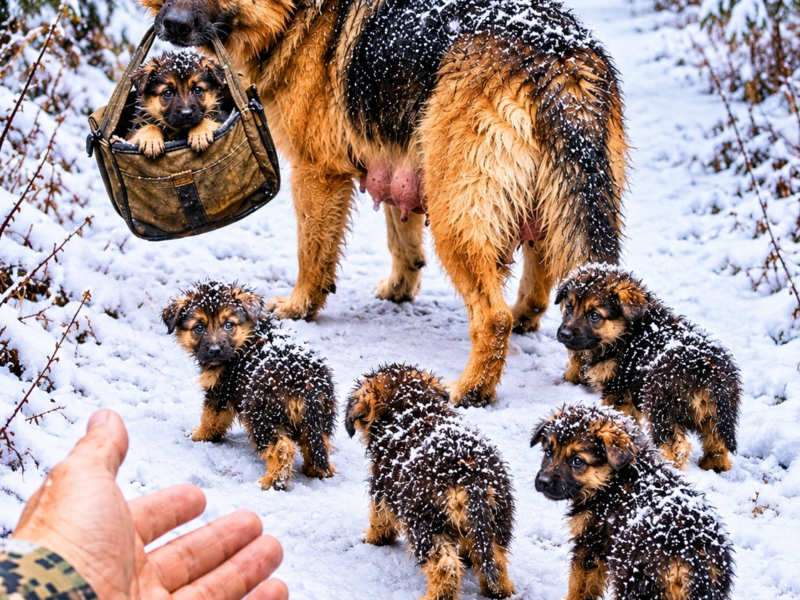
“I thought I was helping a mother dog get her puppies somewhere safe,” I told my sister over the phone. “Then I watched her carry one tiny puppy in an old cloth bag
“There’s something in that house you haven’t found yet. And before you make another decision about my family, I need you to know what happened six weeks ago.”
Margaret’s words stayed with me long after the video call ended.
I stood in the cabin’s kitchen, looking at the five puppies gathered around the old brown garden bag. Sadi lay beside them, her head resting on her front paws. She looked exhausted, but her amber eyes followed every movement I made.
I had questions.
A damaged roof. An empty cabin. A mother dog who had carried her puppies through falling snow. An elderly woman recovering from a fall.
And now Margaret was telling me there was something I hadn’t found.
I called her back.
“Margaret, what happened six weeks ago?”
She looked toward Rachel, who was sitting beside her.
“My husband, Henry, died eight years ago,” she began. “After that, I kept the cabin because it was the one place where I still felt close to him.”
She explained that Henry had spent most of his life gardening, repairing furniture, and building things for people who couldn’t afford to hire someone.
He wasn’t wealthy.
He wasn’t famous.
But he had a habit of leaving something useful behind wherever he went.
A repaired fence.
A shelf.
A new set of steps for an elderly neighbor.
Sometimes, he would disappear for an entire Saturday and return with muddy boots and a story about someone whose porch needed fixing.
Margaret had loved that about him.
When Henry died, she kept the cabin much as it had been.
The old tools stayed in the shed. His garden bag remained near the door. His photographs stayed on the shelf.
Then, several months before her fall, Sadi appeared.
At first, Margaret thought she was a stray passing through.
She left food and water outside.
The next evening, Sadi returned.
After several weeks, the dog began sleeping beneath the porch.
Margaret took her to a veterinarian for an examination, but Sadi had no collar, no identification, and no obvious owner.
“She wasn’t interested in being owned,” Margaret said. “She was interested in being welcome.”
I glanced at the dog.
That sounded familiar.
Margaret continued.
She had started preparing a warm place for Sadi before the puppies arrived. She even planned to have the old shed repaired.
Then came the fall.
She had been carrying a basket of laundry when her foot caught on the edge of a rug. She fell hard and couldn’t get up.
For nearly an hour, she lay on the floor before reaching her phone.
Rachel had rushed to the cabin and taken her to the hospital.
The doctors recommended rehabilitation.
What Margaret expected to be a two-week stay became six weeks.
“I thought I would be back quickly,” she said. “I didn’t know Sadi was going to have puppies. I didn’t know the roof would get worse. And I didn’t know how difficult it would be to convince my daughter that I still had a say in my own life.”
Rachel looked down.
“Mom, I wasn’t trying to take your life away.”
“I know.”
Margaret’s voice softened.
“You were trying to keep me safe.”
“Because you fell and couldn’t get up.”
“I remember.”
The silence that followed told me there was more to their story than either woman wanted to explain in front of a stranger.
Then Margaret returned to my question.
“What did you find inside the cabin?”
“Nothing unusual. Some photographs, a blanket, dog bowls, and the old stove.”
“Did you look in the wooden cabinet beside the fireplace?”
“No.”
“There’s a small drawer at the bottom. Henry kept his papers there.”
“What kind of papers?”
Margaret took a breath.
“Something he asked me to keep. Something I haven’t been able to bring myself to open since he died.”
Rachel shifted in her chair.
“Mom, you never told me about that.”
“I wasn’t ready.”
I looked toward the cabinet.
“Do you want me to open it?”
Margaret nodded.
“Only if you don’t move anything else.”
“I won’t.”
I ended the call and walked into the living room.
The cabinet was old oak, with a scratched surface and two brass handles. I pulled the bottom drawer open.
Inside were envelopes, folded documents, a small leather notebook, and a bundle of photographs tied together with string.
There was also a white envelope with Margaret’s name written across it.
The handwriting was unmistakably different from the other documents.
It was careful and deliberate.
I didn’t open it.
Instead, I photographed the envelope and called Margaret.
“Is this what you meant?”
She looked at the screen.
Her eyes filled.
“Yes.”
“Would you like me to read it to you?”
“No,” she whispered. “I want to read it myself.”
I understood.
Some things belonged to the people who had waited for them.
I placed the envelope back in the drawer and closed it.
Then I looked at Sadi.
She had moved closer to the cabinet.
Her nose touched the lower edge of the wood.
I wondered whether she remembered Henry’s scent there, or whether she was simply curious about the place where I’d been standing.
Either way, I left the drawer alone.
The following morning, Walter arrived with a utility truck.
He brought a portable heater, fresh blankets, dog food, and a few supplies from a local animal shelter.
He was a broad, weathered man with thinning gray hair and a white mustache. His heavy coat smelled faintly of coffee and wood smoke.
“Looks like you’ve had yourself a busy day,” he said.
“I’ve had more questions than answers.”
Walter laughed.
“That’s usually how things work around here.”
I showed him the damaged roof.
He examined the fallen branch and the sagging boards.
“We can make this place safe enough temporarily, but I wouldn’t keep puppies under that section.”
He also checked the cabin’s heating system.
The furnace worked, though it needed maintenance.
Walter arranged for a local contractor to inspect the roof and promised to return with additional materials.
Before leaving, he watched Sadi settle beside the old garden bag.
“You know,” he said, “Margaret used to leave that door cracked whenever she was here.”
“Why?”
“So Sadi could come and go.”
I looked at the dog.
“She never belonged to Margaret?”
Walter shook his head.
“Not the way people usually mean it. Margaret fed her. Sadi trusted her. Sometimes she’d sleep inside for three nights. Sometimes she’d disappear into the woods for two days.”
“So Margaret never tried to keep her?”
“Not after the first time Sadi walked out.”
Walter smiled faintly.
“Henry used to say a good home was a place you could return to without being trapped there.”
I looked at the cabin.
It was a simple sentence.
But it explained more about the relationship between Margaret and Sadi than any adoption paper could have.
That afternoon, Dr. Hannah Price arrived.
Hannah was 57, with short silver-blonde hair, warm brown eyes, and small rectangular glasses. She had worked as a veterinarian for decades and had a calm manner that made nervous animals less nervous and nervous people slightly more nervous.
She examined Sadi first.
The scrape on her paw was superficial, but it needed cleaning and monitoring.
She also checked the puppies.
“They’re around six weeks old,” she told me. “They’re small, but they’re doing well. The mother has been working hard to keep them fed and protected.”
“Can they stay here?”
“Temporarily, with proper warmth and supervision. But the damaged roof needs to be repaired, and we need to make sure the mother has enough food and water.”
She looked toward Sadi.
“She’s a very determined dog.”
“I noticed.”
Hannah smiled.
“Determined doesn’t mean invulnerable. She needs rest, too.”
I nodded.
She examined each puppy separately.
The bold male tried to chew her sleeve.
A quiet female watched from behind Sadi.
Another puppy repeatedly attempted to climb over the edge of the old bag.
The fifth, the smallest, remained close to its mother.
Hannah explained that each puppy would need an individual assessment as they grew.
“Don’t assume they’ll all need the same kind of home,” she said.
I glanced at the five little faces.
“They’re siblings.”
“That doesn’t mean they’re identical.”
She gave me a look.
“People forget that sometimes.”
I thought about Emily.
I thought about Margaret and Rachel.
Then I thought about the old Reed family house.
Apparently, I was beginning to recognize a pattern.
Over the next several days, the cabin became a small center of activity.
Walter arranged for the roof to be secured.
A contractor replaced the damaged section and checked the beams.
Hannah returned to monitor Sadi’s paw.
I brought food and water each morning.
The puppies grew stronger.
And Margaret called every evening.
Sometimes she asked about the dogs.
Sometimes she asked whether the cabin was still warm.
Sometimes she simply wanted to hear what the weather was doing outside her home.
She didn’t ask me to make decisions.
She asked me to tell her what I saw.
I began to understand the difference.
One evening, while the puppies slept, I received a call from Emily.
“Have you spoken to Rachel?”
“Yes.”
“About the cabin?”
“Some.”
Emily sighed.
“Thomas, I need you to promise me something.”
“What?”
“Don’t become the person who decides what happens to that place just because you’re the one standing there.”
I leaned against the kitchen counter.
“I haven’t.”
“You were already talking about repairing the roof, moving the dogs, and arranging everything before you knew who Margaret was.”
I looked toward the living room.
“That’s fair.”
She was quiet.
Then she said, “I know you want to help.”
“I do.”
“But sometimes you act as though being helpful means being in charge.”
I rubbed my forehead.
“Are you talking about the cabin or our house?”
“Both.”
I didn’t answer immediately.
Our parents’ house had become an uncomfortable subject between us.
I wanted to sell it.
The roof needed work, the property taxes had increased, and neither of us lived there.
Emily wanted to preserve it.
Not because she believed the house was perfect, but because it was the last place where our family had lived together.
I had treated her attachment as an obstacle to a sensible decision.
Now I wasn’t so sure.
“I’ll call the realtor,” I said.
Emily went quiet.
“To cancel?”
“To postpone.”
She exhaled.
“Thank you.”
“Don’t thank me yet. We still need to discuss what happens.”
“I know.”
For once, the conversation ended without either of us trying to win.
A week later, Rachel brought Margaret to the cabin.
Margaret had made progress in rehabilitation.
She could walk short distances with a cane, although the uneven ground outside the cabin still made her nervous.
When she stepped through the back door, Sadi rose from her bedding.
The dog stood completely still.
Margaret lowered one hand.
“Hello, sweetheart.”
Sadi approached slowly.
She pressed her head against Margaret’s knee.
Margaret closed her eyes.
For several seconds, nobody spoke.
Then the smallest puppy began chewing the end of Margaret’s shoelace.
Rachel laughed.
“Mom, I think you’re being welcomed back.”
Margaret looked down.
“Apparently, I’m also being robbed.”
The room filled with laughter.
It was the first time I’d heard Rachel laugh freely since meeting her.
But the warmth of the reunion didn’t make the difficult conversation disappear.
That afternoon, Hannah returned.
She explained that the puppies would soon need more space and continued socialization.
Sadi would need time away from them as they became more independent.
And Margaret, despite her progress, could not safely manage six dogs alone.
Rachel looked relieved to hear someone else say it.
Margaret looked disappointed.
I understood both reactions.
“Could we find a place where all six can stay together?” I asked.
Hannah shook her head.
“Why do you want that?”
I frowned.
“Because they’re a family.”
“They are a family right now,” she replied. “But each puppy is becoming an individual. Keeping them together simply because separating them feels sad doesn’t necessarily serve them best.”
She explained that the puppies would need different kinds of homes depending on their personalities.
One might thrive in an active household.
Another might do better with a quieter family.
One could be comfortable around children.
Another might need a patient adult adopter.
Sadi would also need to be evaluated separately.
“Her future shouldn’t be decided only by what we want her to mean to us,” Hannah said.
Margaret looked toward the old garden bag.
“I don’t want her to disappear.”
Hannah’s expression softened.
“Then we should find out what she needs and what she chooses, as much as we safely can.”
Rachel looked at her mother.
“Mom, I want you to be safe. That’s all.”
Margaret gripped her cane.
“I know.”
“But the cabin is isolated. You can’t pretend nothing happened.”
“I don’t.”
“Then why won’t you discuss staying with me?”
Margaret looked away.
The conversation had finally reached the part neither woman could avoid.
Rachel explained that she had been frightened when she found her mother on the floor.
She had imagined what might have happened if Margaret hadn’t been able to reach her phone.
She had also started looking into selling the cabin.
Margaret’s expression changed.
“You called a realtor?”
Rachel didn’t deny it.
“I wanted to understand the options.”
“Without asking me?”
Rachel’s voice sharpened.
“Mom, you were lying on the floor for almost an hour.”
The room became quiet.
I hadn’t known that.
Margaret stared at her hands.
“I didn’t want you to worry.”
“I was already worried.”
Rachel’s eyes filled.
“You keep telling me you’re fine, and then something happens that proves I don’t know what is going on with you.”
Margaret looked toward her daughter.
For a moment, the stubbornness in her face softened.
“I was frightened, too,” she said.
Rachel swallowed.
“Then why do you fight me every time I try to help?”
“Because being frightened doesn’t mean I want someone else deciding what my life will look like.”
Rachel sat down.
“I don’t want to take your life away.”
“I know.”
“I just don’t want to lose you.”
Margaret reached across the table.
“I don’t want to lose myself.”
Neither woman spoke for a while.
Then Margaret asked Rachel to sit beside her.
They began discussing options.
Perhaps Margaret could stay with Rachel during the coldest months.
Perhaps the cabin could be repaired and made safer.
Perhaps someone could check on her regularly.
Perhaps she could keep her independence without pretending she didn’t need support.
It wasn’t a perfect solution.
But it was a conversation.
And sometimes that was the first thing a family needed.
Later, Margaret asked me to bring the old envelope from the cabinet.
She wanted to read it herself.
We sat at the kitchen table while Rachel made tea.
Margaret opened the envelope carefully.
Inside was a letter written by Henry.
His handwriting was slightly uneven, but every word was clear.
He had written it shortly before he became seriously ill.
The letter wasn’t about money or property.
It was about the cabin.
Henry explained that he had always hoped Margaret would keep it as long as it brought her happiness.
But he didn’t want her to feel obligated to remain there simply because it had once belonged to them.
He wanted her to have a choice.
He also mentioned the old nursery property beyond the trees.
Years earlier, he had helped a local community group restore part of the land as a small garden and animal refuge.
The project had never been formally completed.
Henry had kept copies of the plans and a list of people who had offered to help.
At the end of the letter, he had written:
If the cabin ever becomes too much to manage, don’t mistake leaving it for leaving me. Everything we loved was never contained in these walls.
Margaret read the sentence twice.
Then she lowered the letter.
Rachel reached for her mother’s hand.
I looked toward the window.
The cabin had always seemed like a place Margaret was fighting to keep.
Now I understood that she was trying to preserve something much larger than the building.
She wanted to preserve the freedom to decide what came next.
The following morning, Margaret asked Walter to bring the old leather notebook from the shed.
Inside were Henry’s notes about the nursery project.
There were sketches of raised garden beds, a small storage building, and a fenced area intended for temporary animal care.
He had also written down the names of several neighbors who had helped him.
Walter recognized some of them.
“Henry wanted a place where people could grow things and help animals,” he explained. “He never had enough money to finish it.”
Margaret ran her fingers over the pages.
“He talked about it for years.”
“Maybe we could finish it,” I said.
She looked at me.
“Maybe.”
Then she added, “But not because you think it’s the perfect solution.”
I smiled.
“I wouldn’t dream of it.”
She gave me a knowing look.
“Thomas, you would absolutely dream of it.”
I laughed.
She was right.
The idea appealed to me immediately.
A community garden.
A small animal refuge.
A place where volunteers could work together.
A project with a clear purpose.
I could already imagine the schedules, materials, safety plans, and responsibilities.
Then I remembered what Emily had told me.
Don’t become the person who decides.
So I asked the only question that mattered.
“Would you like to explore the idea?”
Margaret considered it.
“Yes,” she said. “But I want to talk to the people who would use it before anyone starts building.”
I nodded.
“Then that’s where we’ll begin.”
Over the next few weeks, Walter contacted former volunteers.
Rachel spoke with a local community organization.
Margaret made phone calls from her rehabilitation center.
I helped inspect the land and estimate the repairs.
But no one made promises.
We learned that the old nursery could become useful again, though it would require substantial work.
The roof on the shed needed replacement.
The fencing was incomplete.
The water system needed inspection.
And the animal refuge would require proper approval, veterinary oversight, and trained volunteers.
It wasn’t going to happen overnight.
That was all right.
For once, I wasn’t in a hurry to turn an idea into a finished project.
Meanwhile, the puppies continued growing.
Hannah began evaluating them individually.
The bold male was curious and energetic.
The quiet female was observant and cautious.
The tail thief was playful and clever.
Another puppy seemed especially comfortable around people.
The smallest remained closely attached to Sadi.
Hannah recommended that each puppy be placed through a reputable rescue organization once it was ready.
Sadi would need her own assessment.
Margaret agreed.
It was difficult for her.
I could see that.
But she understood that love wasn’t a reason to ignore what the dogs needed.
One afternoon, I found her sitting beside Sadi while the puppies played nearby.
She had the old garden bag resting across her lap.
“I used to think keeping something was the same as caring for it,” she said.
I sat down beside her.
“And now?”
“Now I think caring for something means being honest about what it needs.”
She looked at the puppies.
“I can’t give all five the life they deserve. But I can help them find people who can.”
Sadi rested her head against Margaret’s knee.
Margaret stroked her ears.
“And perhaps she’ll still come back here sometimes.”
I looked at the dog.
“Perhaps.”
The first puppy left three weeks later.
It was the bold male.
A family from Flagstaff had completed the rescue organization’s screening process. They had an older German Shepherd, a fenced yard, and experience raising young dogs.
The family arrived with their two children.
Hannah supervised the introduction.
Sadi watched from a few feet away.
When the puppy approached the children, she stood and observed.
She did not panic.
She did not try to block them.
After a while, she lay down.
I noticed Margaret watching her carefully.
“Are you all right?” I asked.
Margaret nodded.
“It’s harder than I expected.”
“I know.”
“But look at him.”
The puppy was chasing a leaf across the yard.
His new family was laughing.
Margaret smiled through her tears.
“He’s going to be happy.”
One by one, the other puppies found suitable homes.
The quiet female went to a retired couple who had experience with nervous dogs.
The playful tail thief went to a family with an older child who loved training animals.
Another went to a young veterinary assistant.
The smallest stayed with Sadi the longest.
Hannah wanted to ensure the puppy was ready before making any decision.
Eventually, he too found a carefully selected home.
The day the last puppy left, Sadi walked through the cabin and sniffed the empty bedding.
She stood beside the old garden bag.
Then she looked at Margaret.
Margaret knelt slowly.
“I know, sweetheart.”
Sadi pressed her head against Margaret’s shoulder.
There was no way to know exactly what the dog understood.
But I knew what Margaret was feeling.
Sometimes the hardest part of loving something was allowing its life to become bigger than your own.
A few days later, Sadi was evaluated by Hannah and the rescue organization.
She was healthy, though still recovering from the strain of caring for five puppies.
She remained cautious with unfamiliar people.
She was comfortable at the cabin.
And she showed no signs of wanting to leave the property permanently.
The rescue coordinator explained that Sadi could remain under a supported foster arrangement while the organization continued to monitor her health and welfare.
Margaret agreed.
She didn’t claim ownership.
She didn’t insist Sadi become a permanent house dog.
She simply made sure the dog had food, shelter, veterinary care, and the freedom to choose where she felt comfortable.
It was the arrangement Henry would have understood.
By early spring, Margaret had completed rehabilitation.
She could walk with her cane and had regained much of her strength.
She decided to spend part of the year at Rachel’s home and part at the cabin, depending on the weather and her health.
Rachel agreed to help arrange regular check-ins.
They also established a simple emergency plan.
Margaret kept a phone beside her chair.
A neighbor had a spare key.
And she agreed to use a medical alert device when she was alone.
She didn’t love the idea.
But she accepted it.
Rachel, in return, promised not to make decisions about the cabin without discussing them first.
Their relationship wasn’t suddenly perfect.
They still disagreed.
But they had begun to understand that independence and safety did not have to be enemies.
As for the nursery project, it moved forward slowly.
The community group reviewed Henry’s old plans.
Walter helped organize volunteers.
Hannah advised on the animal-care requirements.
Margaret participated in the decisions without taking on more work than she could manage.
I volunteered to coordinate the building repairs.
This time, I made a point of asking before assigning anyone a task.
It was astonishing how much better people responded when they were treated like people rather than pieces of a plan.
Emily visited one weekend.
She walked through the nursery with Margaret and examined Henry’s old sketches.
“You know,” she said, “Dad would have loved this.”
Margaret smiled.
“He would have complained about the price of lumber.”
Walter laughed.
“He complained about the price of everything.”
We all laughed.
Then Emily turned toward me.
“What about our house?”
I looked at her.
“I’ve been thinking.”
She raised an eyebrow.
“Dangerous.”
I smiled.
“I don’t want to sell it without talking through the options with you.”
She looked surprised.
I continued.
“We could repair the roof. We could rent it. We could keep it for another year and see how we feel. But I don’t want to decide alone.”
Emily was quiet.
Then she said, “I’d like to keep it for now.”
“Then let’s figure out whether we can afford that together.”
She smiled.
“That’s all I wanted.”
For the first time, the house didn’t feel like an argument waiting to happen.
It felt like something we still shared.
By late spring, the old nursery had changed.
The damaged shed had been repaired.
The garden beds had been rebuilt.
A new fence surrounded the temporary animal-care area.
The community group had not turned it into a large rescue center, and that was intentional.
It was a modest place where approved volunteers could provide temporary support, help with animal care, and connect people with established rescue organizations.
The first garden beds were planted with vegetables and flowers.
Margaret chose the flowers.
Walter handled the tools.
Rachel helped organize the volunteer schedule.
Emily photographed the project for her school.
And I built a set of wooden benches near the entrance.
One afternoon, as we worked, I saw Sadi walking across the clearing.
She moved carefully, her black-and-tan coat shining in the sunlight.
She paused near the garden beds and sniffed a patch of fresh earth.
Margaret sat on one of the benches.
Sadi approached her.
Margaret lowered her hand.
The dog leaned into it.
No leash.
No command.
No attempt to hold her in place.
Just a familiar touch freely accepted.
I sat beside Emily.
“Do you think Sadi remembers that first morning?”
Emily looked toward the dog.
“I think she remembers what matters to her.”
I watched Margaret stroke Sadi’s neck.
“What matters to her?”
Emily smiled.
“Maybe that’s something we should stop assuming we know.”
I laughed quietly.
She had inherited our mother’s ability to make one sentence feel like an entire lecture.
Later that afternoon, Walter brought out a small wooden sign.
He had made it from a piece of cedar Henry had stored in the shed.
The lettering was simple.
It read:
HENRY’S GARDEN
Beneath it, in smaller letters:
A place to grow, care, and come home.
Margaret stood in front of the sign for a long time.
Then she touched the edge of the wood.
“He would have liked that.”
Rachel stood beside her.
“I think he would have loved it.”
Margaret looked at her daughter.
“Thank you for helping me keep this place.”
Rachel shook her head.
“You helped me understand why it mattered.”
They hugged.
I looked away for a moment, giving them the privacy the moment deserved.
When I turned back, Sadi was lying beside the bench.
The old brown garden bag rested near Margaret’s feet.
Its blue floral patch was faded.
Its handle was worn.
But it was still there.
I had once thought of it as an old piece of fabric that needed replacing.
Now I understood why Margaret had refused to throw it away.
It had carried Henry’s tools.
It had held towels for a frightened dog.
It had traveled through snow with five tiny puppies.
And it had reminded all of us that something didn’t have to be new to remain valuable.
That evening, I drove home with Emily following behind me.
She was staying for dinner.
We had planned to discuss the repairs to our parents’ house, but neither of us seemed eager to turn the evening into another negotiation.
When we arrived, Teddy wasn’t waiting for us.
There was no Teddy.
There was only the quiet house I had lived in since leaving the military.
But for the first time, I didn’t feel as though quiet meant empty.
I made coffee.
Emily looked through our mother’s old photographs.
We talked about childhood summers at the cabin, our father’s endless repair projects, and the way our mother used to sew patches into anything we tried to throw away.
At one point, Emily held up a photograph of the two of us standing beside our father in the garden.
“You look miserable,” she said.
“I was probably being told to pull weeds.”
“You always hated gardening.”
“I preferred jobs with measurable results.”
Emily laughed.
“Of course you did.”
I looked at the photograph again.
Our father had one hand on my shoulder.
His other hand rested on Emily’s.
He was smiling.
For years, I had looked at that photograph and seen a memory of something that could never return.
Now I saw something else.
A reminder that what people leave behind doesn’t have to remain frozen in the past.
It can become something useful.
Something shared.
Something that grows.
A week later, I visited Henry’s Garden alone.
Sadi was lying near the cabin steps.
She raised her head when she heard my truck.
I got out and stood beside the fence.
She watched me for a moment, then stood and approached.
I didn’t reach for her.
I waited.
She came close enough to sniff my hand.
Then she turned toward the cabin.
I followed at a distance.
The old brown bag sat beside the door.
A clean blanket lay inside it.
Sadi lowered herself beside the bag and rested her head on her paws.
I sat on the porch step.
For a while, neither of us moved.
Then I thought about that morning on the snowy road.
I had seen a tired mother carrying one puppy in a cloth bag while four others struggled behind her.
I had believed she needed someone to take control.
But she had already made a plan.
She knew where she was going.
She knew which puppy needed carrying.
She knew when to stop, when to return, and when to continue.
She had not been waiting for a hero.
She had been asking the world to give her enough space to finish what she had started.
I had been fortunate enough to learn that before I made things worse.
My phone vibrated.
A message from Emily appeared.
I found another box of Mom’s old photographs. Some of them are from the cabin. Don’t throw anything away before I get there.
I smiled.
Then I typed back.
I won’t. We’ll go through them together.
I put the phone away.
Sadi lifted her head.
Somewhere beyond the trees, a bird called.
The evening sunlight stretched across the clearing.
I thought about how many years I’d spent believing that strength meant having the answer before anyone else.
I had been trained to move quickly.
To assess.
To act.
To protect.
Those skills had their place.
But they had never taught me everything about caring for another living thing.
Sadi had taught me that protection could include patience.
Margaret had taught me that independence could include accepting help.
Rachel had taught me that fear could sound like control.
Emily had taught me that love did not give me the right to make decisions for someone else.
And five tiny puppies had reminded me that every life deserved to be understood as its own.
I stood and brushed the snowless dust from my jeans.
Sadi watched me walk toward the truck.
Before I opened the door, I looked back.
She was still beside the old garden bag.
Not trapped.
Not abandoned.
Home, in the way she had chosen to define it.
I started the engine.
And as I drove away, I realized that the most important thing I had carried out of those woods wasn’t a puppy, a photograph, or a story worth telling.
It was a lesson I should have learned years earlier.
You can offer someone shelter.
You can offer them your time.
You can offer them your strength.
But you cannot call it love if you refuse to let them choose.
The end.









