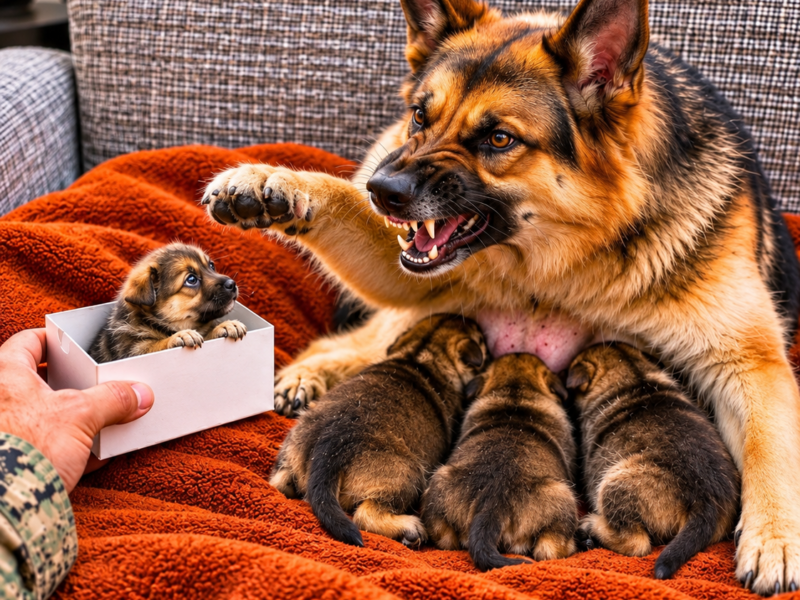
“I thought bringing a frightened three-week-old German Shepherd puppy to a nursing mother would be the kindest thing I could do
The silence on the phone seemed to stretch longer than it should have.
“Dr. Carter?” I asked. “What is it?”
Emily finally answered. “Willow is improving, Nathan. Her temperature is normal, she’s eating again, and she’s responding well to treatment. That’s the good news.”
I glanced at Lucy, who was curled against Daisy in the corner of the puppy pen. Hazel lay beside them, her head resting on her paws.
“And the part you need to discuss?” I asked.
“Willow is still recovering. She recognizes familiar scents and responds when Martha visits, but she’s not ready to resume caring for a puppy. I don’t want anyone rushing a reunion just because everyone wants it to happen.”
Helen, standing across the room, caught my expression.
“Can she meet Lucy?” I asked.
“Yes. Eventually, under supervision. But there’s something else. Lucy has formed a bond with Hazel and the litter. That bond matters, too. We shouldn’t disrupt it.”
I looked down at the little black-and-tan puppy who had once cried whenever I stepped away from her box.
“So what are you recommending?”
“Let Lucy continue growing with Hazel. When Willow is strong enough, we’ll arrange a calm introduction. No pressure, no expectations. We’ll let both mothers decide how comfortable they are.”
After I hung up, Helen folded her arms.
“Willow’s getting better?”
“Yes.”
“But?”
“She may not be able to take Lucy back the way Martha imagined.”
Helen looked toward Hazel.
“Maybe Lucy doesn’t need to be taken back.”
I understood what she meant, but I also knew Martha deserved to hear the truth from someone who wouldn’t make it sound easier than it was.
I called her.
She arrived twenty minutes later, still wearing the green apron from her flower shop. A few petals clung to one sleeve, and her gray-blonde hair had begun escaping its loose bun.
“Is Willow worse?” she asked before she had even closed the door.
“No. She’s improving.”
Her shoulders dropped.
“Then why did you sound so serious?”
I told her what Emily had said.
Martha listened without interrupting. When I finished, she looked through the open doorway at Lucy, who was trying unsuccessfully to climb over Teddy.
“So she might not come home to Willow,” Martha whispered.
“Not right now.”
“And if Willow never wants to nurse her again?”
“Then Lucy will still have everything she needs. Hazel has accepted her, and Emily will make sure we do what’s best for both dogs.”
Martha pressed her lips together.
“I know I should be grateful,” she said. “I am grateful. I just keep thinking about Willow waking up after all those days at the clinic and wondering where her little girl went.”
I had spent years learning how to respond when people were frightened. In the military, I could give an order, make a plan, and move everyone toward a clear objective.
But there was no order that could make this hurt less.
So I didn’t pretend there was one.
“I think Willow knows Martha is still there,” I said quietly. “And Lucy knows she’s loved.”
Martha blinked away tears.
“That’s not quite the same as having her mother.”
“No,” I admitted. “It isn’t.”
For a moment, neither of us spoke.
Then Lucy made a small, indignant squeak as Teddy rolled against her.
Martha laughed through her tears.
“She’s still fighting for her place, isn’t she?”
“Every day.”
She crouched beside the pen. Lucy noticed her and toddled over, placing both tiny front paws against the edge.
Martha held out one finger.
“Hello, little girl.”
Lucy sniffed it, then leaned forward and licked her fingertip.
Martha smiled.
“I don’t want her to forget Willow.”
“She won’t have to.”
“And I don’t want her to lose Hazel, either.”
“Then we won’t make her choose.”
That was the first time Martha looked genuinely relieved.
Over the next two weeks, Lucy changed almost faster than I could keep up with.
Her ears began to stand, first one and then the other, giving her a permanently puzzled expression. Her legs lengthened, and the tiny puppy who had once seemed too fragile to lift began charging across the blanket with the confidence of a much larger dog.
Teddy remained the biggest and most determined of the litter. He had a habit of pushing his way toward the warmest spot and acting surprised when anyone objected.
Daisy was gentle, often curling against Lucy even when there was plenty of room elsewhere.
Cooper continued to sleep through almost everything. Once, Helen dropped a metal bowl beside the pen, and Cooper merely stretched one paw before returning to his nap.
Lucy, meanwhile, had developed a stubborn streak.
She wanted to reach every toy, investigate every corner, and follow Hazel whenever the older dog stood up.
Sometimes Hazel allowed it.
Other times, she gently nudged Lucy back toward the blanket and settled down again.
It was never harsh. Hazel seemed to understand exactly how much encouragement the little puppy needed.
Dr. Emily checked Lucy regularly and adjusted her feeding plan as she grew. She also monitored Hazel to make sure caring for four puppies wasn’t placing too much strain on her.
There were still supplemental feedings, careful weighing, and plenty of cleaning.
But Lucy was gaining weight.
Her breathing was strong. Her eyes were bright. Her little body no longer trembled whenever the room grew quiet.
One afternoon, I found her asleep with her head resting across Hazel’s front paw.
I stood there longer than I intended.
Helen came up beside me.
“You know what I think?” she said.
“What?”
“I think Hazel stopped seeing Lucy as a guest a long time ago.”
I looked at the four puppies pressed against her.
“How can you tell?”
Helen smiled.
“Because she doesn’t count them anymore.”
I frowned.
“What does that mean?”
“When she gets up, she checks all four. When one cries, she looks for all four. She doesn’t seem to be deciding whether Lucy belongs. She already knows.”
I watched Hazel lower her muzzle and gently lick Lucy’s ear.
There were things I could understand through training, discipline, and experience.
This wasn’t one of them.
And maybe it didn’t need to be.
The following Friday, Emily called again.
“Willow is ready for a short visit,” she said. “She’s stronger, and she’s been responding well to Martha. I want to arrange the meeting here at the clinic first.”
Martha was standing in my kitchen when I took the call. She had brought a small bag of groceries and was helping me prepare a bottle for Lucy.
When she saw my face, she stopped.
“Willow?”
I nodded.
“She’s ready to see Lucy.”
Martha put the bottle down.
For several seconds, she didn’t move.
Then she covered her mouth with both hands.
“Oh, thank God.”
I drove her to the clinic the next morning. Helen stayed with Hazel and the puppies.
Martha carried a small blanket that smelled of her home. I carried nothing but a leash and a feeling that I couldn’t quite name.
Willow was waiting in a quiet examination room.
She looked thinner than she had in the photographs Martha had shown me, but her eyes were clear. Her black-and-tan coat had lost some of its shine, and she stood carefully, as though her strength hadn’t completely returned.
The moment Martha entered, Willow lifted her head.
“Hello, sweetheart,” Martha whispered.
Willow walked toward her slowly, then pressed her muzzle into Martha’s hands.
Martha knelt and wrapped her arms around the dog’s neck.
“I missed you,” she whispered. “I’m so sorry you had to go through all that.”
Willow leaned against her.
I looked away for a moment, giving them privacy.
Emily waited until Willow had settled before opening the door to the adjoining room.
“Let’s keep this calm,” she reminded us. “Let Willow approach Lucy. Don’t push them together.”
I nodded.
Martha took a slow breath.
Then Lucy came in.
She was carried in a small padded basket, her ears standing unevenly and her nose moving as she investigated the unfamiliar room.
At first, Willow didn’t move.
She simply watched.
Lucy turned toward her, then made a tiny sound.
Willow’s ears lifted.
She stepped forward and sniffed the basket.
Once.
Twice.
Then her nose stopped near Lucy’s neck.
The room went quiet.
Willow inhaled again, and something in her expression seemed to soften.
She gave Lucy a slow, careful lick across the forehead.
Martha began to cry.
“Oh, Willow,” she whispered.
Lucy blinked, then pushed her nose toward Willow’s muzzle.
Willow licked her once more.
There was no dramatic rush, no frantic attempt to reclaim the puppy. Just a quiet recognition, expressed in the only way Willow knew.
Emily smiled.
“That’s a lovely response.”
Martha crouched beside them.
“She knows her,” she whispered.
“I think she recognizes her scent,” Emily said. “And she’s comfortable enough to approach her. That’s exactly what we wanted.”
Lucy gave a small squeak and wobbled forward.
Willow lowered herself onto the floor.
For a few minutes, they stayed that way, nose to nose, with Martha’s hand resting gently on Willow’s back.
Then Lucy became distracted by a loose thread on the blanket.
I almost laughed.
“She’s not exactly sentimental,” I said.
Martha smiled through her tears.
“She gets that from me.”
Emily let them spend a little longer together before ending the visit. Willow was tired, and we weren’t going to ask more of her than she could comfortably give.
As Martha helped her stand, she looked at Lucy.
“Will she be able to see her again?”
“Yes,” Emily answered. “With gradual visits. But Lucy should continue growing with Hazel and the litter for now. Willow needs time to regain her strength.”
Martha nodded.
“I understand.”
And this time, she truly did.
We arranged another visit the following week.
Then another.
Willow became stronger with each one. She started walking with more energy, her coat grew glossy again, and the familiar alertness returned to her eyes.
Lucy grew stronger, too.
The meetings became easier. Willow would approach, sniff Lucy, and give her a few affectionate licks. Sometimes Lucy would settle beside her. Other times, she would wander off to investigate Martha’s shoes.
Hazel remained the center of Lucy’s everyday world.
That mattered.
We never forced Hazel and Willow into a shared space before Emily believed they were ready. When the time came for a carefully supervised meeting, both dogs were given room, separate resting places, and time to become comfortable with one another.
Hazel was cautious at first.
She stood close to her puppies, watching Willow’s movements.
Willow didn’t approach the litter. She stayed beside Martha, sniffing the air and occasionally looking toward Lucy.
Then Hazel took a step forward.
Willow remained still.
They sniffed each other briefly.
Hazel’s ears stayed upright, but her body relaxed.
Willow looked toward the puppies again.
There was no growling, no challenge, and no attempt to push Hazel aside.
Emily watched carefully.
“Good,” she said. “Let’s leave it there for today.”
It wasn’t a grand friendship.
It was something better for that moment: two mothers being allowed to feel safe.
As the weeks passed, Willow returned home with Martha.
Her recovery continued under Emily’s guidance, and her visits with Lucy became part of their routine.
Lucy never stopped belonging with Hazel and the litter.
And Willow never stopped being the dog who had brought her into the world.
Martha eventually found a rhythm that worked for everyone. She visited Helen’s house regularly, bringing treats for Hazel, supplies for the puppies, and flowers from her shop.
She never tried to make Lucy choose where she belonged.
One afternoon, I found Martha sitting on the floor beside the pen.
Lucy had grown into a sturdy little puppy with bright eyes and ears that now stood straight. She was wrestling with Teddy while Daisy watched from a comfortable spot against Hazel’s side.
Cooper was asleep.
Of course.
Martha looked up at me.
“I used to think that if Willow couldn’t raise Lucy herself, something important would be missing from her life.”
I sat down beside her.
“And now?”
“Now I think Lucy has something I couldn’t have planned for her.”
She watched Hazel gently separate Lucy and Teddy when their wrestling became too rough.
“She has Hazel,” Martha continued. “She has Willow. And she has people who were willing to help when things didn’t go the way they were supposed to.”
I nodded.
“That’s a pretty good beginning.”
Martha smiled.
“It’s more than a beginning.”
A few minutes later, Helen opened the back door.
Willow had arrived with her.
She walked in beside Martha, looking healthy and confident again. Hazel lifted her head from the blanket.
For a moment, the two dogs watched each other.
Then Hazel shifted slightly, making room beside the pen.
Willow approached and lowered her muzzle toward Lucy.
Lucy abandoned Teddy immediately and trotted over.
She sniffed Willow’s nose, then turned and pressed her shoulder against Hazel’s front leg.
Martha laughed softly.
“Look at her.”
I did.
Lucy stood between the two dogs, one nose resting near her head and the other close to her back. She seemed perfectly content with the arrangement.
It was a small moment.
No one announced what it meant.
No one needed to.
By the time the puppies were old enough to explore the garden, Lucy had become impossible to overlook.
She was no longer the smallest, and she certainly wasn’t the quietest.
Teddy still tried to lead every adventure. Daisy followed with gentle curiosity. Cooper preferred to inspect the world from wherever he happened to fall asleep.
Lucy did both.
She charged after Teddy, paused to sniff every flower Daisy discovered, and occasionally returned to Hazel just to make sure the familiar warmth was still there.
Willow watched from the grass beside Martha.
Her recovery was complete enough that she could enjoy the sunshine and move comfortably, though we continued to follow Emily’s advice about introductions and interactions.
One afternoon, Lucy wandered away from the others and stopped in front of Willow.
Willow lowered her head.
Lucy placed one paw on her muzzle.
Then she licked Willow’s nose.
Martha smiled.
“Hello, little one.”
Lucy turned and ran back toward Hazel.
Martha watched her go.
“I used to feel guilty whenever I saw her with Hazel,” she admitted. “As if being happy there meant she had forgotten Willow.”
I looked at Willow, who was calmly watching her daughter play.
“Maybe love doesn’t work that way.”
Martha considered that.
“Maybe it doesn’t.”
I thought about the first night, when Lucy had cried in that white box and Hazel had warned me away.
I had been ready to solve the problem by making something happen.
I had assumed that if I brought the puppy close enough, Hazel would understand.
But Hazel had needed time.
Willow had needed time.
Martha had needed time.
And Lucy, somehow, had been the one teaching all of us how to wait.
Helen stepped onto the porch with a mug of tea.
“She’s quite the little survivor,” she said.
I watched Lucy stumble over her own paws, recover, and immediately try again.
“Yeah,” I replied. “She is.”
Helen glanced at me.
“You know, Nathan, when you first brought her here, I thought you were going to try to manage the whole thing like a military operation.”
“I may have had a plan.”
“You had about twelve plans.”
“Fourteen,” I corrected.
She laughed.
“And how many worked?”
I watched Hazel settle in the shade while Lucy curled against her side. Across the garden, Willow rested near Martha, peaceful and content.
“Not as many as I thought.”
Helen sat beside me.
“Sometimes the best thing we can do is make a safe place and let love find its own shape.”
I looked at the dogs.
For most of my adult life, I had believed strength meant taking control. Finding the problem, making a decision, and refusing to let anything stand in the way.
But Lucy had shown me another kind of strength.
The patience to stay.
The courage to trust.
The humility to accept that care didn’t always look like the plan you started with.
That evening, as the sun slipped behind the trees, Martha gathered Willow’s leash.
Helen carried the puppies inside.
Hazel followed, pausing at the doorway to make sure all four little bodies were moving with her.
Lucy was the last one in.
She turned once, looked back at Willow, then trotted after Hazel.
Willow watched her go without distress.
Martha rested a hand on her neck.
“She’ll be all right,” she whispered.
I believed her.
Not because everything had gone perfectly.
Not because anyone had been able to promise that nothing would ever hurt again.
But because Lucy had never been alone.
She had a mother who gave her life.
A mother who helped her survive.
And a family that grew larger when the world gave them a reason to open their hearts.
As I switched off the garden light, I heard one last tiny bark from inside the house.
Helen laughed.
“That’s Lucy. She’s decided bedtime is optional.”
I smiled.
For the first time in a long while, I didn’t feel the need to rush toward the next problem or prepare for the next emergency.
I simply stood there, listening to the sounds of a safe home.
And I understood something I wished I’d learned years earlier.
Sometimes, the bravest thing you can do isn’t to save someone by yourself.
It’s to give them a place where they can be loved by more than one heart.
The End.









