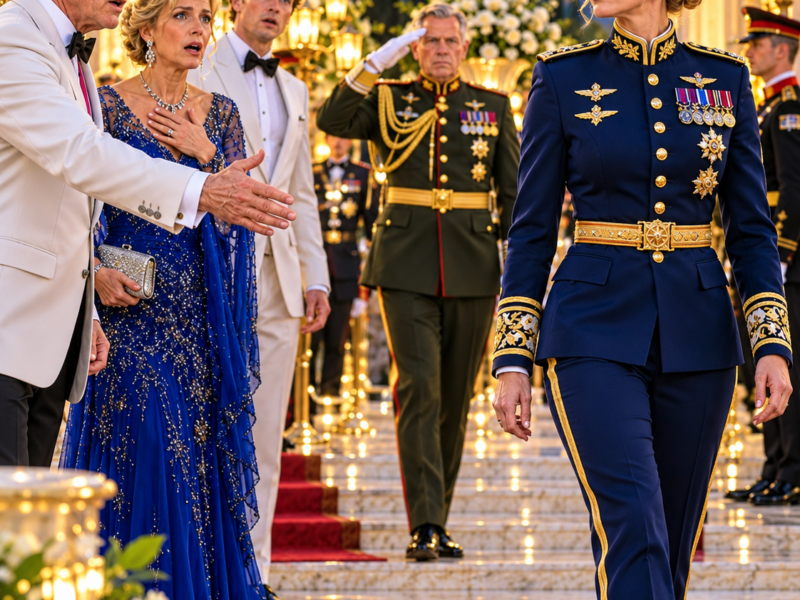
“I stood motionless as my billionaire father called me a worthless mall cop at the White House, never imagining that the four-star general approaching us
The aide’s words hung in the conference room.
“He says he has information about you that could affect your appointment.”
I looked at General Vance.
“What information?”
The aide glanced down at his tablet. “He didn’t specify. He insisted it was urgent and personal. He also requested that the meeting happen before the procurement review.”
I almost laughed.
Of course he did.
Arthur Mercer had spent twenty-six years pretending I didn’t exist. Now, after discovering I wore a general’s stars, he suddenly had something important to tell the people responsible for my career.
“Tell the liaison I’ll speak with them after the briefing,” I said.
Vance studied me. “You don’t have to meet him.”
“I know, sir.”
“And if he raises anything that falls outside the appropriate process, we end the conversation.”
“Agreed.”
I gathered my documents and stood.
I wasn’t afraid of what my father might say. I was concerned about what he might attempt to manufacture.
There was a difference.
The meeting with the White House liaison took place in a smaller conference room. General Vance attended, along with a military legal adviser and a senior ethics official. The arrangement was deliberate. Nobody wanted a private conversation that could later be misrepresented.
Arthur arrived three minutes late.
He entered wearing the same confident expression he’d worn at the East Gate, but it didn’t quite fit anymore. His tie was slightly crooked. His smile looked rehearsed.
Evelyn followed him, her pearls perfectly arranged.
Trevor came last, carrying a leather portfolio.
My father stopped when he saw me seated at the table.
“Kate.”
“Mr. Mercer.”
His face tightened.
“Really? That’s how we’re doing this?”
“That’s how you asked me to behave twenty-six years ago.”
The ethics official introduced herself and explained the purpose of the meeting.
“Mr. Mercer, you requested an urgent discussion concerning General Katherine Mercer. You indicated that you possessed information relevant to her appointment. Please explain.”
Arthur pulled out a chair but didn’t sit immediately.
“I believe there has been a serious omission in the background information provided to this administration.”
“Please be specific,” the official said.
Arthur looked directly at me.
“General Mercer is my daughter.”
Nobody spoke.
He seemed disappointed by the lack of reaction.
“I understand that may not appear relevant,” he continued, “but there are family and financial circumstances that deserve consideration.”
The legal adviser opened a notebook.
“What circumstances?”
Arthur sat down.
“She was raised in a wealthy family. She had access to considerable resources. Her decision to enter the military was not based on financial necessity or a lifelong commitment to service. It was an act of rebellion.”
I stared at him.
He was trying to turn my life into a character reference.
“Is there a specific financial interest you believe should be disclosed?” the ethics official asked.
Arthur hesitated.
“She was excluded from our family inheritance.”
“By whom?”
“By me.”
“Are you alleging that General Mercer concealed an inheritance or financial interest?”
“No, but—”
“Then what is the relevance?”
His jaw tightened.
“I am simply explaining that she has a history of making impulsive decisions.”
General Vance leaned back.
“Mr. Mercer, are you questioning her professional qualifications?”
“I’m questioning her judgment.”
“On what professional basis?”
Arthur looked uncomfortable.
“She rejected a guaranteed executive position at my company to enlist.”
“She was nineteen,” I said.
He turned sharply toward me.
“Don’t interrupt.”
The ethics official raised a hand.
“General Mercer may respond.”
I met his eyes.
“I declined a private-sector career because I wanted to serve. I completed my education, commissioned through ROTC, and spent twenty-six years meeting the requirements of increasingly responsible Army assignments. My evaluations, command records, and security reviews are available through the appropriate channels. My father’s disappointment is not a professional qualification.”
The room went quiet.
Trevor shifted in his chair.
Arthur gave a bitter laugh.
“You always were good at making yourself sound important.”
I didn’t answer.
The ethics official turned to him.
“Mr. Mercer, is there anything else?”
He looked at Evelyn, then at Trevor.
Trevor opened the portfolio.
“We have documentation,” he said. “Financial records showing that Kate received money from our family trust after she left.”
I looked at the portfolio.
That was new.
The ethics official extended her hand.
“May I see those documents?”
Trevor passed over a printed bank statement.
She examined it, then handed it to the legal adviser.
The adviser studied the page.
“Mr. Mercer, this account appears to be a corporate vendor payment. It doesn’t identify General Mercer as the recipient.”
Arthur leaned forward.
“It was transferred to an account connected to her.”
“Which account?”
He glanced at Trevor.
Trevor looked down.
The adviser turned the paper around.
“The beneficiary listed here is Mercer Strategic Holdings.”
I knew the name.
It was one of my father’s subsidiary companies.
Not mine.
The ethics official’s expression became more serious.
“Why did you present this as evidence that General Mercer received family trust money?”
Arthur’s face reddened.
“I was told it was connected to her.”
“By whom?”
He looked at Trevor again.
Trevor’s fingers tightened around the edge of the portfolio.
“I handled the paperwork,” he admitted. “But Dad said the company had the information.”
The ethics official closed the folder.
“Then this is not evidence of a financial interest held by General Mercer. It is a company record. We’ll retain it for review.”
Arthur sat back, furious.
“This is ridiculous. I’m trying to protect the integrity of this process.”
“Then you should provide accurate information,” she replied.
For the first time, I saw something close to fear in my father’s expression.
He had expected to walk into that room and remind everyone that I was a disobedient daughter.
He hadn’t expected anyone to ask him to prove what he was saying.
The ethics official continued.
“General Mercer, do you have any financial relationship with Mercer Defense Tech or any affiliated entity?”
“No.”
“Any ownership, board membership, consulting agreement, or outstanding compensation?”
“No.”
“Any current or expected inheritance interest?”
“No.”
“Have you participated in any procurement decision involving this company?”
“Not before this assignment. And I have disclosed the relationship as soon as I recognized the company’s involvement.”
The legal adviser nodded.
“That disclosure is documented. We’ll determine whether any further recusal is required.”
Arthur looked from one official to another.
“So she’s just going to get away with this?”
The ethics official’s voice remained calm.
“General Mercer has not been accused of wrongdoing. You have not presented evidence of wrongdoing.”
He stood abruptly.
“This is a waste of my time.”
“Mr. Mercer,” Vance said, “you requested this meeting.”
Arthur glared at him.
Then he turned to me.
“You think those stars make you better than me?”
“No.”
“Then why are you acting like you don’t know your own father?”
I held his gaze.
“Because you told me not to.”
His mouth opened.
For a moment, he seemed to search for an answer that would make the past disappear.
He found none.
The meeting ended shortly afterward.
The ethics official retained the documents, and the legal adviser asked Trevor to provide the source of the bank statement. Arthur refused to sign the acknowledgment confirming what he had submitted.
That decision would matter later.
But I didn’t know that yet.
As I left the room, General Vance walked beside me.
“You handled that well.”
“Thank you, sir.”
“Don’t let this become a personal contest.”
“I won’t.”
He paused.
“Your father may be difficult, but the procurement review is a separate matter. We’ll keep it separate.”
“That’s exactly what I want.”
He nodded.
Then he returned to the conference room.
I walked toward the briefing area, where the procurement team was preparing the next set of materials.
My father’s company was still under review.
And I had no intention of letting him turn that review into a family dispute.
The next two days were demanding.
The technical team examined the delivery records. Independent engineers compared test results with the manufacturer’s certifications. Contracting officers reviewed invoices and change orders.
I read everything.
The concerns were more serious than the initial briefing had suggested.
Several components had been certified as meeting military specifications, but the test documentation contained unexplained gaps. A shipment had been recorded as complete even though the receiving unit reported missing equipment. A subcontractor had billed for inspections that its own employees said had never taken place.
None of those discrepancies automatically proved fraud.
But together, they raised questions that couldn’t be dismissed.
I asked for the original records.
Not summaries.
Not slides prepared for executives.
The source documents.
One of the contracting specialists, a woman named Colonel Dana Brooks, brought me a thick binder on the third afternoon.
“We found a pattern,” she said.
I opened it.
“Show me.”
She pointed to a series of invoices.
“These inspection charges were submitted through a subcontractor called Northbridge Technical Services. The company appears on several Mercer Defense invoices.”
“Who owns Northbridge?”
“We’re still verifying that. The corporate registration lists a holding company.”
“Who signed the inspection certificates?”
“That’s the problem. The signatures are nearly identical, but the names belong to three different inspectors.”
I studied the pages.
“Have we contacted them?”
“Two have responded. Both deny signing the documents.”
I looked up.
“And the third?”
“Unable to locate. His employment records are incomplete.”
I closed the binder.
“Preserve the originals. Get the contracting officer to issue a formal request for clarification. No accusations until the evidence supports them.”
Brooks nodded.
“Understood.”
Later that evening, my phone rang.
The number was unfamiliar.
I answered.
“General Mercer.”
A man’s voice came through.
“Kate, it’s Trevor.”
I stood beside the window.
“How did you get this number?”
“Dad gave it to me.”
“Why are you calling?”
There was a long pause.
“I need to tell you something.”
I said nothing.
Trevor exhaled.
“Those bank records we showed them? They weren’t supposed to be used that way.”
“Then why did you bring them?”
“Because Dad told me they proved you were connected to the company.”
“They didn’t.”
“I know that now.”
I watched the lights of Washington move below the window.
“What do you want, Trevor?”
He hesitated.
“I think Dad’s involved in something.”
That got my attention.
“Be specific.”
“I don’t know everything. But I’ve seen payments going through Northbridge. He told me it was a consulting arrangement.”
I felt my grip tighten around the phone.
“Northbridge Technical Services?”
“Yes.”
“Why are you telling me this?”
“Because I think he’s going to blame me.”
I closed my eyes for a moment.
There it was.
The first crack in the story.
“Trevor, listen carefully. If you have information, you need to provide it through the appropriate investigators. Don’t alter anything. Don’t delete anything. Don’t take documents you’re not authorized to access.”
“I know.”
“And don’t tell me what you think I want to hear. Tell the truth.”
He went quiet.
Then he said something I hadn’t expected.
“I didn’t know he was going to cut you off.”
I stared at the window.
“You were twelve, Trevor.”
“I know. But I remember the day you left. He said you were choosing strangers over your family. Evelyn said you would come crawling back when the money ran out.”
I said nothing.
“I thought you would,” he continued. “I thought everyone did.”
“Well, I didn’t.”
“I can see that.”
For the first time in twenty-six years, my stepbrother sounded less like the heir to a fortune and more like a frightened young man who had spent his life trying to please the wrong person.
“Trevor, if you have evidence, give it to the investigators. Don’t make this about me.”
“Okay.”
He hung up.
I stood there for a long time.
I didn’t know whether Trevor was telling the truth.
But I knew I couldn’t ignore what he’d said.
The next morning, I informed the ethics official that a potential witness had contacted me and described a possible connection between Northbridge and Mercer Defense Tech.
I provided no details beyond what was necessary.
The official arranged for the appropriate investigative office to contact Trevor directly.
I recused myself from any further discussion of Northbridge’s ownership or financial relationships.
That decision wasn’t easy.
I wanted to know what my father had done.
I wanted to understand why he had presented false records in a room full of officials.
But wanting something didn’t give me the right to compromise the process.
So I stepped back.
For the next week, I focused on the portions of the assignment that remained within my authority.
The independent team continued its work.
And the evidence kept growing.
Northbridge had received millions of dollars through several layers of subcontracting. Some of the payments were legitimate. Others appeared to lack supporting documentation.
The investigators found that the company shared a business address with an entity connected to Arthur Mercer.
They also found that two inspection certificates had been submitted after the listed inspectors had already left the subcontractor.
Trevor eventually provided emails and accounting records to the investigators.
He did so through counsel, not through me.
The documents suggested that he had been instructed to approve several payments without the usual supporting materials.
He had signed them.
He also admitted that he had helped prepare the bank statement presented at the White House, although he claimed he hadn’t understood its purpose.
The investigators would determine what that meant.
I wouldn’t.
My father, however, understood that the review was no longer going away.
He requested another meeting.
This time, he didn’t ask to discuss my appointment.
He asked to speak with me privately.
I declined.
Then he sent an email through an address I hadn’t used in years.
The subject line read: WE NEED TO TALK.
I opened it once.
Kate,
I don’t know what you’ve been told, but there are people trying to damage this family. You have an opportunity to stop this before it becomes irreversible.
You may think you’ve proven something by wearing a uniform and impressing a few generals. But you are still my daughter.
Call me.
Dad.
I read it twice.
Then I forwarded it to the ethics official.
Not because it frightened me.
Because I wanted the record to be complete.
A few days later, I received a message from the liaison.
The procurement review had reached a preliminary conclusion. The contract award would be suspended pending further investigation. The agency would seek independent testing and require the company to account for the disputed charges.
The message contained no personal commentary.
It didn’t need any.
I knew what it meant for Mercer Defense Tech.
The company would not receive the contract on the strength of Arthur’s promises.
And my father would have to answer questions he couldn’t settle with a donor ticket or a confident handshake.
When I returned to my office, General Vance was waiting.
“How are you holding up?”
“Fine, sir.”
He gave me a look.
“That’s an officer’s answer.”
“It’s also the truth.”
He nodded toward the chair across from him.
“Sit down.”
I did.
“There’s something you should know. Your father has been contacting people outside the review process.”
“I assumed he would.”
“He has suggested that your involvement is the reason the contract is being delayed.”
I kept my expression neutral.
“Has he made a formal complaint?”
“Not yet.”
“Then I’ll wait for one.”
Vance leaned forward.
“You’re not responsible for his decisions, Kate. But you are responsible for protecting the integrity of your own.”
“I understand.”
He studied me.
“You’ve done that so far.”
I nodded.
For a moment, I thought that was all he wanted to say.
Then he added, “The President has been briefed on the review. He also asked me to pass along his appreciation for your service.”
I lowered my eyes briefly.
“Thank you, sir.”
Vance smiled.
“Don’t look so surprised. You’ve earned it.”
I didn’t know what to say.
Praise from a commanding officer had always meant more to me than anything my father could have given me.
Still, hearing it reminded me of a small ceremony years earlier.
I’d been a young captain then, standing in a crowded auditorium after a difficult deployment. My soldiers had been recognized for their work. I remembered looking toward the back of the room, half expecting my father to appear.
He hadn’t.
I had stopped looking for him after that.
The following Friday, the investigative team requested a formal interview with Arthur Mercer.
He agreed.
Evelyn accompanied him to the building but did not enter the interview room.
Trevor arrived separately with his attorney.
I wasn’t present.
I didn’t ask to be.
The process took several hours.
Later, I learned that Arthur had denied directing the questionable payments. He said Northbridge had been selected by his finance department and that he had relied on internal reports.
When investigators showed him emails bearing his approval, he claimed he had authorized only routine administrative actions.
When they asked about the inspection certificates, he said he had never reviewed them.
Then they presented the original documents.
The signatures.
The dates.
The payment approvals.
The messages instructing staff to “keep the delivery numbers clean before the review.”
Arthur reportedly asked for a break.
He never returned to the same room that afternoon.
The investigation continued for months.
I remained separated from it, as required.
I didn’t receive privileged updates, and I didn’t ask for them.
What I did know was that the contract stayed suspended.
The independent testing confirmed that some of the equipment met specifications, while other components did not. The agency required replacements, additional inspections, and repayment of unsupported charges.
Mercer Defense Tech lost the award.
The company also lost two major private-sector clients after the public disclosure of the investigation’s findings.
Arthur resigned as chief executive before the board could remove him.
The legal consequences took longer.
The company entered a settlement requiring repayment of disputed funds and changes to its compliance program. Several executives faced separate proceedings. Arthur was named in civil claims concerning his approval of payments and representations made to government officials.
I didn’t celebrate.
People had worked in that company who had nothing to do with my father’s decisions. Employees had families, mortgages, and futures that didn’t deserve to be collateral damage in a corporate scandal.
But accountability wasn’t cruelty.
It was necessary.
And for once, my father couldn’t simply make a phone call and expect the problem to disappear.
Six months after the White House event, I received a letter.
It arrived at my official office in a plain envelope with no company logo.
The handwriting was unmistakable.
Arthur Mercer.
I considered returning it unopened.
Instead, I sat down and read it.
Kate,
I have spent a long time thinking about what happened at the White House.
I was angry when I saw you. I was embarrassed. I had no idea you had become a general, and I reacted badly.
That was not an excuse.
I also understand that I made the situation worse by bringing up your appointment and presenting documents that were not what I claimed they were.
I cannot undo what happened.
I want you to know that I am proud of your service.
I should have said that a long time ago.
I read the final line several times.
Then I placed the letter on my desk.
It wasn’t the apology I’d imagined when I was nineteen.
It didn’t mention the years of silence.
It didn’t mention the birthdays, the holidays, or the times I had been wounded and wondered whether he would ever call.
It didn’t mention the day he told me I was no longer his daughter.
But it was the first time he had acknowledged that he was responsible for something.
A week later, he called.
I let it ring twice before answering.
“Kate.”
“Arthur.”
He exhaled.
“I wasn’t sure you’d pick up.”
“I almost didn’t.”
“I understand.”
Silence stretched between us.
Then he said, “I would like to see you.”
I looked at the photograph on my desk.
It showed me with a group of soldiers after a long deployment. I was younger, thinner, and smiling in a way I rarely did anymore.
“Why?”
“Because you’re my daughter.”
I closed my eyes.
“That wasn’t important to you for twenty-six years.”
“I know.”
“Do you?”
He didn’t answer immediately.
“I think I do now.”
I wanted to believe him.
But wanting an apology to be real didn’t make it complete.
“Arthur, I can’t go back to being nineteen and waiting for you to change your mind.”
“I’m not asking you to.”
“And I won’t pretend the years didn’t happen.”
“I’m not asking that either.”
I looked out the window.
The late-afternoon sky was gray, and a line of rain had begun moving across the city.
“Then what are you asking?”
“One conversation. Not about the company. Not about money. Just us.”
I considered it.
I thought about my mother.
I thought about the girl who had packed two suitcases and left the only home she’d ever known.
And I thought about the woman I had become.
“One conversation,” I said. “Somewhere public. No business. No promises.”
“Thank you.”
“Don’t thank me yet.”
He gave a quiet, almost broken laugh.
“Fair enough.”
We met three weeks later at a small restaurant outside Washington.
Arthur arrived early.
For the first time I could remember, he wasn’t wearing an expensive suit. He had on a plain navy jacket and a white shirt. His hair had turned almost entirely gray.
He stood when I entered.
“Kate.”
I sat across from him.
“Arthur.”
He looked at me for a long moment.
Then his eyes moved to the insignia on my uniform jacket.
“I never thought I’d see you wearing those stars.”
“I know.”
“I thought you’d change your mind.”
“I didn’t.”
He nodded.
The waiter brought water.
Arthur waited until we were alone again.
“I was wrong about the Army.”
I didn’t respond.
“I was wrong to think that choosing something different meant rejecting me.”
I looked at him.
“That’s not the only thing you were wrong about.”
“I know.”
He rubbed his hands together.
“I wanted you to take over the company. I thought I was giving you everything. The education, the position, the future.”
“You were giving me the future you wanted.”
He nodded slowly.
“I suppose I was.”
“And when I chose my own, you punished me.”
His eyes lowered.
“Yes.”
It was the first time he had said it without qualification.
I felt no sudden relief.
No dramatic release.
Just the quiet recognition that the truth had finally been spoken.
“Why?” I asked.
He looked up.
“Because I thought you would come back. I thought if I made it difficult enough, you’d realize how much you needed the family.”
I stared at him.
“You thought cutting me off would make me love you?”
He swallowed.
“I didn’t think it through.”
“No. You didn’t.”
He looked toward the window.
“Evelyn said you would come back when you needed money. Trevor believed it, too.”
“And you?”
“I believed what I wanted to believe.”
I took a breath.
“Arthur, I didn’t need the money. I needed my father.”
His face changed.
For a moment, he looked like the man in the old family photographs, standing beside my mother with his arm around her shoulders.
Then the moment passed.
“I know,” he said.
I didn’t forgive him that afternoon.
He didn’t ask me to.
We talked for an hour.
He asked about my career, and I told him about the parts I could share. He asked whether I was happy, and I said I was proud of the life I’d built.
He asked whether I ever regretted leaving.
“No,” I said. “I regret that you made it feel like I had to choose between serving my country and being loved by my father.”
He looked down at his hands.
“I understand.”
When the conversation ended, he offered to pay for dinner.
I declined.
Not because I wanted to make a point.
Because I could afford my own meal.
Outside, he stood beside me on the sidewalk.
“Can I call you again?”
“Yes.”
His face brightened slightly.
“But don’t assume that means everything is fixed.”
“I won’t.”
I nodded.
Then I walked toward my car.
He didn’t follow.
Trevor contacted me a month later.
He had resigned from Mercer Defense Tech and was cooperating with the company’s compliance review. He said he was considering returning to school to study accounting and corporate governance.
I told him that sounded sensible.
He asked if we could meet.
I agreed, cautiously.
We met for coffee.
He apologized for the shove at the White House.
He apologized for the way he’d treated me when we were younger.
He also admitted that he had enjoyed being the favored child, even when he knew what it cost me.
“I thought being chosen meant I was better,” he said.
“It meant Dad chose you,” I replied. “It didn’t mean you were better.”
He nodded.
We didn’t become close overnight.
There were too many years between us.
But we began speaking occasionally, and that was more than we’d had before.
Evelyn never contacted me.
I didn’t expect her to.
The White House event became a story that traveled through military circles, though not for the reason my father had intended.
Some people remembered the moment General Vance addressed me by rank.
Others remembered Arthur’s expression when he realized the woman he’d called a mall cop was a major general.
I remembered something else.
I remembered that I hadn’t raised my voice.
I hadn’t threatened him.
I hadn’t used my position to humiliate him.
I had simply stood where I belonged.
A year later, I was invited to speak at a commissioning ceremony for new Army officers.
The auditorium was filled with families, proud parents, nervous graduates, and young people trying to imagine the lives waiting beyond that stage.
I stood at the podium and looked out at the rows of faces.
I told them about the day I had chosen ROTC.
I told them that not everyone would understand their decisions.
Some people would call their ambitions foolish.
Some would insist that love came with conditions.
Some would mistake obedience for loyalty.
“But your life is not a debt you owe to someone else’s expectations,” I said. “You can respect the people who raised you without surrendering the person you are becoming.”
I paused.
“Service is not a way to prove your worth to people who refuse to see it. It is a commitment you make because you believe the work matters.”
The applause was warm and sustained.
After the ceremony, a young lieutenant approached me.
“Ma’am, may I ask you something?”
“Of course.”
“My father thinks I’m throwing my life away by staying in the Army. He says I’ll regret it.”
I looked at him.
“Do you regret it?”
He shook his head.
“Then don’t borrow his regret.”
He smiled.
“Thank you, ma’am.”
I watched him return to his family.
For a moment, I saw myself at nineteen, standing in my father’s study with a scholarship letter in my hand.
I wished I could tell that girl one thing.
You won’t be alone.
Not forever.
The Army will give you people who trust you, challenge you, and stand beside you when things get difficult. You’ll find purpose in places you never expected. You’ll lose people. You’ll carry memories you can’t explain. You’ll become someone your younger self could barely imagine.
And one day, the man who told you that you were nothing without his name will have to look at you and see what you built without it.
My father and I still speak occasionally.
We are not the family we might have been.
We may never be.
Trust doesn’t return because someone finally discovers your rank, and forgiveness doesn’t arrive simply because an apology is overdue.
But I no longer need him to understand my choices.
I no longer need his company, his money, or his approval.
I have my soldiers.
I have my career.
I have the life I chose.
And every time I put on my uniform, I remember the nineteen-year-old girl who walked out of that mansion with nothing but a suitcase and a promise to herself.
She had no idea how far she would go.
She only knew she couldn’t stay somewhere she had to surrender her future to be loved.
At the White House, my father had told me to pretend I didn’t know him.
For twenty-six years, he had made that choice for both of us.
But when General Vance walked toward me and called me by my rank, I finally understood something.
I didn’t need the world to know who my father was.
I needed to know who I was.
And I did.
The end.









